Newsletter Subscribe
Enter your email address below and subscribe to our newsletter

HVAC made simple

Choosing a gas tankless water heater sounds straightforward until you begin comparing the specifications. One model advertises 11 GPM, another emphasizes a 0.98 UEF, another includes a recirculation pump, and another promises easier installation. Then you have to choose between natural gas and propane, indoor and outdoor installation, condensing and non-condensing technology, and different maximum BTU inputs.
I’m Savvy Mavi, and when I compare water-heating equipment, I look beyond the biggest number on the specification sheet. My goal is to find the combination of efficiency, usable hot-water capacity, installation practicality, fuel consumption, durability and long-term value that makes sense for the home.
For most homes that already have natural gas or propane available, a modern gas tankless water heater can be an excellent replacement for a conventional storage tank. Instead of maintaining 40 or 50 gallons of hot water around the clock, a tankless system fires when hot water is requested and modulates its output according to demand. That can reduce standby energy losses while providing a practically continuous supply of hot water, provided the unit has been sized correctly.
The important qualification is “sized correctly.” A tankless heater does not provide unlimited hot water at an unlimited flow rate. Its actual capacity depends heavily on incoming water temperature, desired outlet temperature and the amount of heat the burner can deliver. That distinction influences almost every recommendation in this guide.
For 2026, I would begin my shortlist with established manufacturers that publish detailed performance information and have meaningful installer and service networks. Among the models I reviewed, the Rinnai SENSEI RX199iN stands out as my best overall choice because it combines a maximum 199,000 BTU input, up to 11.1 GPM under favorable conditions, a 0.98 UEF, natural-gas or propane capability, recirculation compatibility and indoor/outdoor installation flexibility.
For households where built-in recirculation is particularly important, the Navien NPE-240A2 remains a compelling premium option. Its published performance data are particularly useful because Navien provides flow rates at different temperature rises rather than relying only on the maximum headline GPM number. The Rheem IKONIC RTGH-SR11i is another strong recirculation-oriented alternative, combining a built-in pump, Wi-Fi capability, 11.2-GPM published maximum capacity and 0.96 UEF.
For homeowners converting from a conventional storage tank, I also like the installation philosophy behind the Noritz EZ Series, particularly the EZ98 and EZ111. Noritz designed this family with tank replacement in mind, which can be valuable because installation complexity is one of the biggest variables in the real cost of converting to tankless.
The right choice among these systems depends much more on your house than a simple ranking suggests, so I would treat these recommendations as starting points rather than automatically buying whichever model receives the highest overall rating.
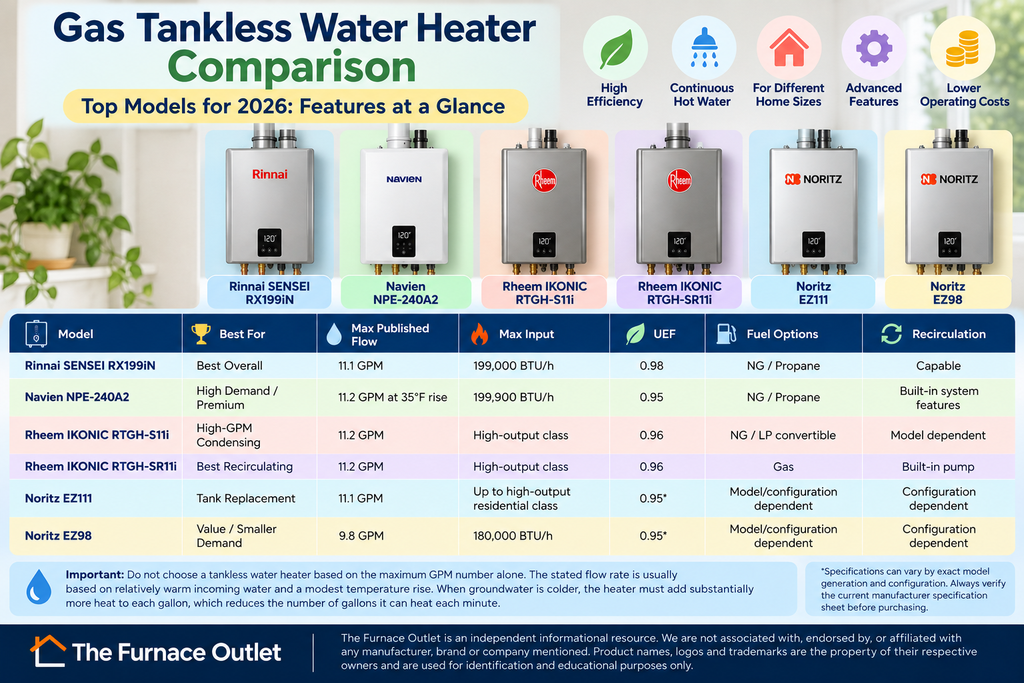
| Model | Best For | Max Published Flow | Max Input | UEF | Fuel Options | Recirculation |
|---|---|---|---|---|---|---|
| Rinnai SENSEI RX199iN | Best Overall | 11.1 GPM | 199,000 BTU/h | 0.98 | NG / Propane | Capable |
| Navien NPE-240A2 | High Demand / Premium | 11.2 GPM at 35°F rise | 199,900 BTU/h | 0.95 | NG / Propane | Built-in system features |
| Rheem IKONIC RTGH-S11i | High-GPM Condensing | 11.2 GPM | High-output class | 0.96 | NG / LP convertible | Model dependent |
| Rheem IKONIC RTGH-SR11i | Best Recirculating | 11.2 GPM | High-output class | 0.96 | Gas | Built-in pump |
| Noritz EZ111 | Tank Replacement | 11.1 GPM | Up to high-output residential class | 0.95* | Model/configuration dependent | Configuration dependent |
| Noritz EZ98 | Value / Smaller Demand | 9.8 GPM | 180,000 BTU/h | 0.95* | Model/configuration dependent | Configuration dependent |
*Specifications can vary by exact model generation and configuration. Always verify the current manufacturer specification sheet before purchasing.
The comparison also demonstrates why I do not recommend buying on GPM alone. The maximum flow rate shown in marketing materials may represent relatively warm incoming water and a modest temperature rise. When groundwater becomes colder, the same heater must add substantially more heat to every gallon, reducing the number of gallons it can heat each minute.
The Rinnai SENSEI RX199iN is the model I would put at the top of my 2026 shortlist for a homeowner who wants a high-efficiency, high-capacity gas tankless heater without locking the installation into an unnecessarily narrow configuration.
Rinnai lists the RX199iN at 199,000 BTU/h maximum input, 11.1 GPM maximum domestic hot-water flow and 0.98 UEF. It can operate on natural gas or propane, can be configured for indoor or outdoor installation, is recirculation capable and carries ENERGY STAR certification. Those characteristics make it unusually flexible for both replacement projects and new installations.
The 0.98 UEF is particularly attractive from my perspective because it indicates that the unit is designed to capture a very high proportion of the fuel’s useful energy. However, I would still compare the complete installed system rather than efficiency in isolation. A high-efficiency heater that requires extensive gas-line, plumbing or venting modifications may have a very different economic case from the same heater installed in a house already suited to it.
Another advantage is fuel flexibility. The RX199iN supports both natural gas and propane, which broadens the situations in which the platform can be used. That does not mean homeowners should casually switch fuels themselves; gas conversion and commissioning must follow the manufacturer’s requirements and applicable codes.
For a larger home with meaningful simultaneous hot-water demand, the RX199iN gives me the combination I want to see: strong burner capacity, excellent efficiency, installation flexibility and support for recirculation rather than one spectacular specification surrounded by compromises.
The Navien NPE-240A2 is particularly useful for demonstrating how tankless specifications should actually be interpreted. Navien publishes a maximum 11.2 GPM at a 35°F temperature rise, but the same heater is rated at 8.7 GPM at a 45°F rise, 6.5 GPM at a 60°F rise and 5.6 GPM at approximately a 70°F rise.
That is exactly why I encourage homeowners to stop treating “11 GPM” as if the heater will deliver 11 gallons of 120°F water every minute under every condition. It will not.
If incoming water is 75°F and you want 120°F water, you need a 45°F rise. If incoming water is only 45°F, producing 120°F water requires a 75°F rise. The second house therefore gets substantially less hot-water flow from the same appliance.
The NPE-240A2 has up to 199,900 BTU/h input and a 0.95 UEF, and Navien states that NPE-2 models are field convertible between natural gas and LP. The model can be installed indoors or outdoors and is ENERGY STAR certified.
I consider it particularly attractive for larger households, homes with long plumbing runs, and applications where recirculation functionality is valuable. However, the final sizing decision should be based on the household’s simultaneous fixture demand and winter groundwater temperature rather than the 11.2-GPM headline.
Condensing technology is where gas tankless water heating becomes particularly interesting from an efficiency standpoint. Instead of allowing a larger portion of combustion heat to disappear through the exhaust, a condensing heater extracts additional heat from the combustion gases before they leave the appliance.
The Rheem IKONIC RTGH-S11i is a strong example. Rheem lists the model at 11.2 GPM and 0.96 UEF, with ENERGY STAR certification and field conversion capability from natural gas to LP using the appropriate conversion arrangement.
That combination makes it an attractive choice for homeowners who want high capacity without dropping into the lower efficiency range associated with some older non-condensing designs.
Condensing equipment does introduce another installation requirement: condensate. Cooling the combustion gases sufficiently to recover additional heat creates acidic condensate that must be drained correctly. Depending on the installation and local requirements, condensate treatment or neutralization may also be appropriate.
I would therefore never evaluate a condensing tankless heater by purchase price alone. The correct comparison is heater + venting + gas supply + condensate management + plumbing + electrical work + labor.
If natural gas is already available at your home and the gas supply can support the required input, I generally prefer natural gas over propane from an operating-cost perspective in markets where pipeline gas remains competitively priced.
My overall natural-gas recommendation remains the Rinnai RX199iN, although the Navien NPE-240A2 and Rheem IKONIC models deserve serious consideration. The decision may ultimately come down to which brand has stronger qualified service support in your area.
That last point is easy to underestimate. A technically excellent water heater is much less attractive if qualified technicians, replacement components or warranty support are difficult to obtain locally. I would happily choose my second-ranked heater over my first-ranked heater if the second has substantially stronger professional support in my area.
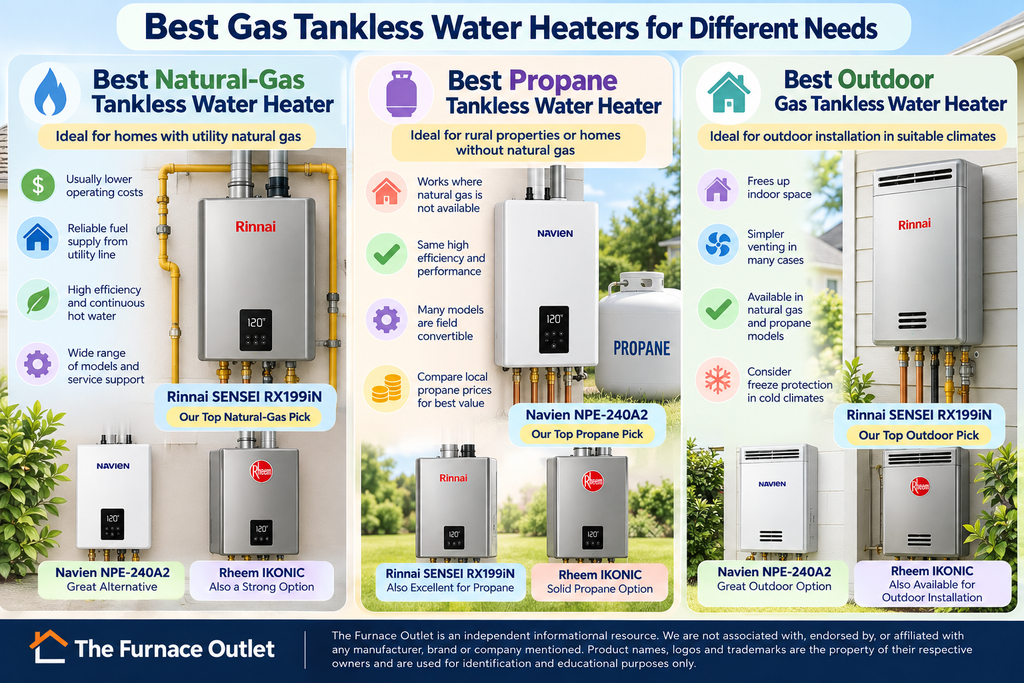
For rural properties and homes without utility natural gas, propane can make whole-home gas tankless water heating possible without requiring a large electric tankless installation.
I again like the Rinnai RX platform because of its natural-gas/propane flexibility, while Navien’s NPE-2 platform is also field convertible between the two fuels according to the manufacturer.
Propane economics need closer examination, however. Fuel prices vary considerably by location and season. Navien’s own published standardized operating-cost information illustrates how different fuel costs can materially change annual operating expenses even when the appliance itself is efficient.
I would therefore obtain the local propane price, estimate annual fuel consumption and compare that with realistic alternatives before assuming that propane tankless automatically produces the lowest lifetime cost.
Outdoor installation can simplify certain projects because the appliance does not require the same indoor combustion vent route. It can also free interior space and reduce some vent-routing complications.
Both the Rinnai RX199iN and Navien NPE-240A2 support outdoor installation in appropriate configurations according to their manufacturers.
Climate matters enormously here. Outdoor installation in a mild climate is a very different proposition from installing the appliance where severe freezes are routine. Tankless heaters can incorporate freeze-protection features, but those systems have operating limits and generally depend on electrical power. Exposed water piping also requires appropriate protection.
I would choose outdoor installation because it suits the house and climate, not simply because outdoor mounting appears easier.
One complaint homeowners sometimes have after switching to tankless is that “instantaneous heating” does not mean instant hot water at the faucet. The heater can begin producing hot water quickly, but the cold water sitting inside a long plumbing run still has to leave the pipe before the hot water reaches you.
Recirculation addresses that problem.
The Rheem IKONIC RTGH-SR11i combines 11.2-GPM published capacity, 0.96 UEF, ENERGY STAR certification, built-in Wi-Fi and a built-in recirculation pump.
For a larger home where the primary bathroom or kitchen is a long distance from the heater, I consider recirculation more than a luxury feature. Properly controlled recirculation can reduce the amount of water wasted while occupants wait for hot water.
However, I prefer demand-based or intelligently scheduled recirculation rather than continuously circulating hot water through the house. Continuous circulation can increase heat loss through the piping and partially undermine the energy-saving logic of tankless water heating.
Value is not synonymous with the lowest equipment price. My definition of value includes the cost and complexity of getting the heater correctly installed.
That is why the Noritz EZ98 deserves attention, particularly for replacement applications. Noritz lists the EZ98 at up to 9.8 GPM with a 0.95 UEF, while the larger EZ111 reaches up to 11.1 GPM. The EZ family was designed to provide flexible options for tank-replacement projects.
For a household that does not require the capacity of a 199,000-BTU flagship unit, the EZ98 can represent a sensible middle ground. I would rather install a correctly sized 9.8-GPM-class heater than pay for additional capacity that the household will rarely use.
For homeowners prioritizing premium features and recirculation capability, I would also look closely at the Rinnai RXP199iN. Rinnai lists it with 0.98 UEF, up to 11.1 GPM, 199,000 BTU/h maximum input, natural-gas and propane capability, indoor/outdoor installation, Wi-Fi capability and recirculation support.
This is the kind of product I would consider when comfort and convenience matter almost as much as minimizing initial cost. Large homes, long plumbing layouts and households that use hot water frequently can benefit more from sophisticated recirculation than small homes with short fixture runs.
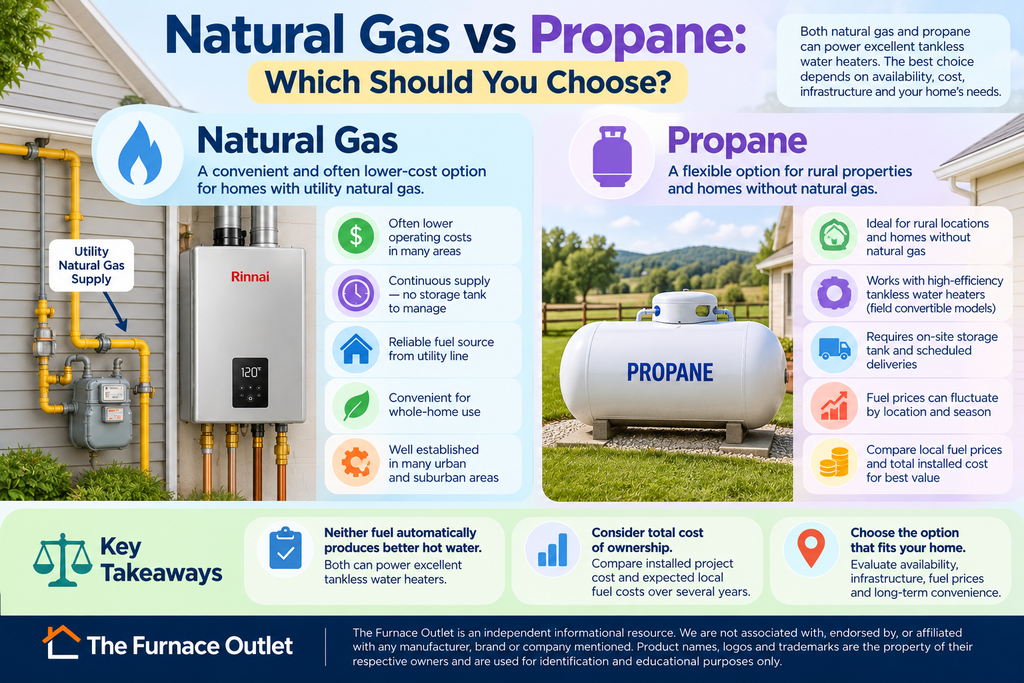
Natural gas and propane can both power excellent tankless water heaters, and neither fuel automatically produces better hot water. The more meaningful differences involve fuel availability, delivered energy cost, gas infrastructure and storage.
Natural gas usually arrives continuously through a utility line. There is no storage tank to monitor, and in many markets the cost per unit of useful heat can be attractive. If the house already has adequately sized natural-gas service near the water heater, the installation economics can be compelling.
Propane gives homeowners independence from a natural-gas utility and is particularly useful in rural locations. The tradeoff is that propane must be stored and delivered, and its price can fluctuate significantly.
I would not convert from one fuel to another based purely on a theoretical efficiency difference. Instead, compare the installed project cost and expected local fuel cost over several years.
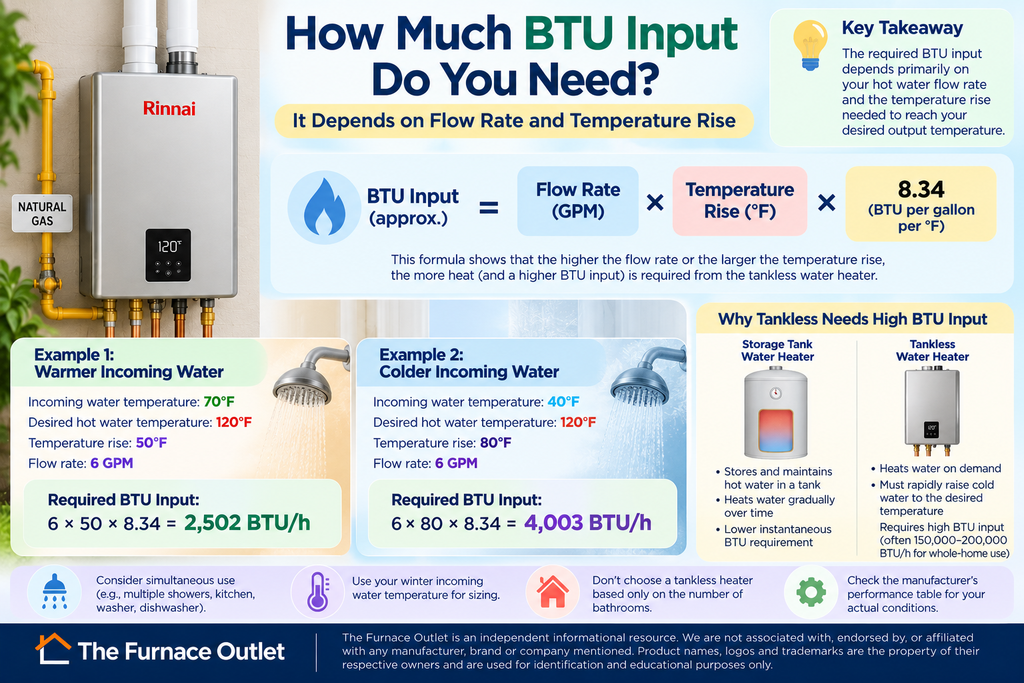
High-capacity residential gas tankless heaters commonly approach 199,000 or 200,000 BTU/h of maximum input. That sounds enormous compared with many storage water heaters, but the difference reflects how the systems operate.
A tank stores already-heated water. A tankless heater may have only seconds to raise cold incoming water to the desired outlet temperature while several gallons pass through it every minute.
The amount of heating required depends primarily on flow rate × temperature rise.
A home requiring 6 GPM with incoming water at 70°F has a very different load from a home requiring 6 GPM with incoming water at 40°F. If both households want approximately 120°F water, the first requires a 50°F rise while the second requires an 80°F rise.
This is why I would never select a gas tankless heater from the number of bathrooms alone. Count the fixtures that could realistically operate simultaneously, estimate their combined flow, determine the design temperature rise and then check the manufacturer’s performance table.
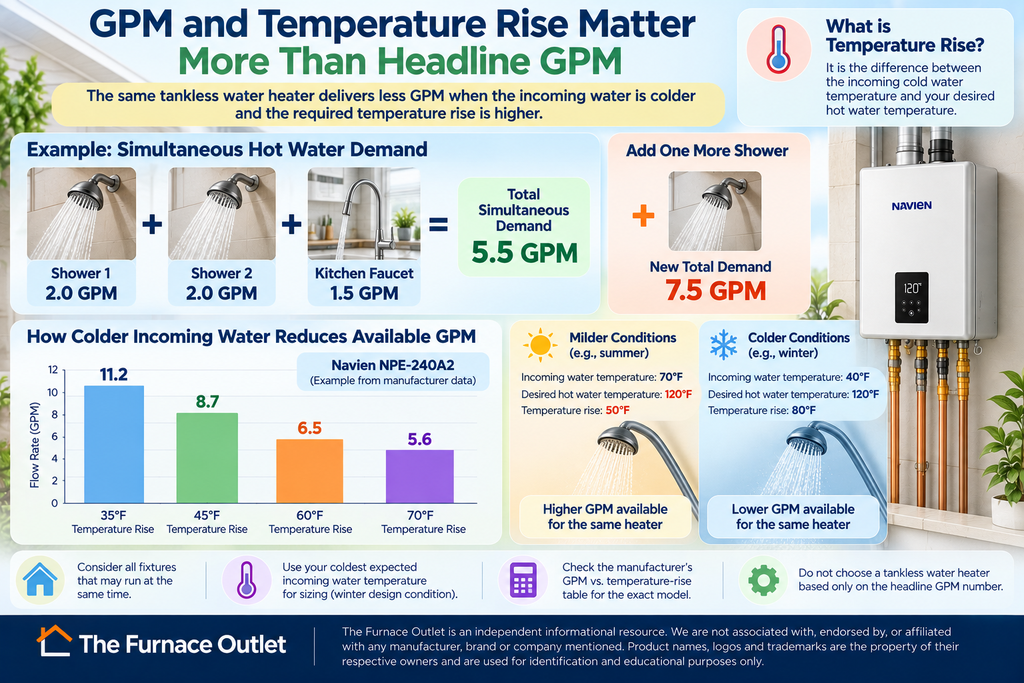
Imagine two showers each consuming approximately 2 GPM while a kitchen faucet uses another 1.5 GPM. The simultaneous demand is approximately 5.5 GPM.
A heater capable of supplying 5.5 GPM at the required temperature rise could theoretically handle that demand. Add another shower, however, and the requirement may rise to 7.5 GPM.
Now add winter.
If incoming groundwater falls significantly, the heater has to put more energy into each gallon. Maximum available flow falls accordingly. Navien’s published NPE-240A2 data demonstrate this relationship clearly: the heater’s flow decreases as temperature rise increases.
For me, the winter design condition is therefore one of the most important numbers in tankless sizing.
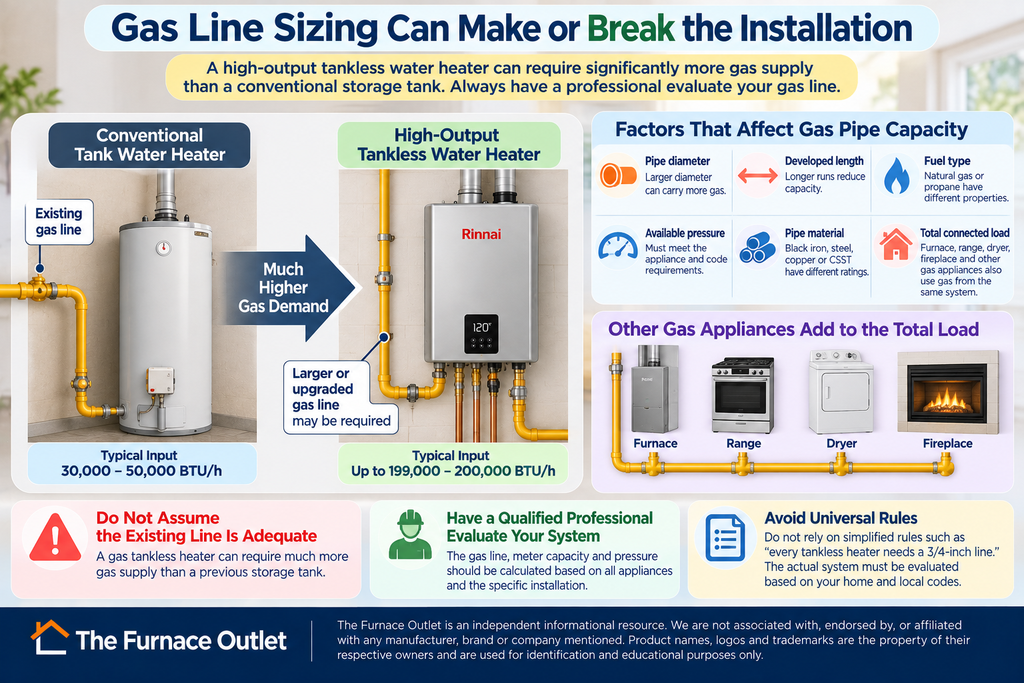
Replacing a conventional gas tank with a high-output tankless heater can expose a problem homeowners never knew they had: the existing gas piping may not be suitable for the new appliance.
Gas-pipe capacity depends on several factors, including pipe diameter, developed length, fuel type, available pressure, material and the combined demand of other gas appliances.
A 199,000-BTU tankless heater can represent a substantial addition to the home’s gas load. The furnace, range, dryer, fireplace and other gas equipment may also be drawing from the same system.
I would have a qualified professional calculate the gas piping and meter capacity rather than assuming that the existing line is adequate because a gas tank water heater previously worked there. Never reduce gas-line sizing to a universal rule such as “every tankless heater needs a 3/4-inch line.” The actual system must be evaluated.
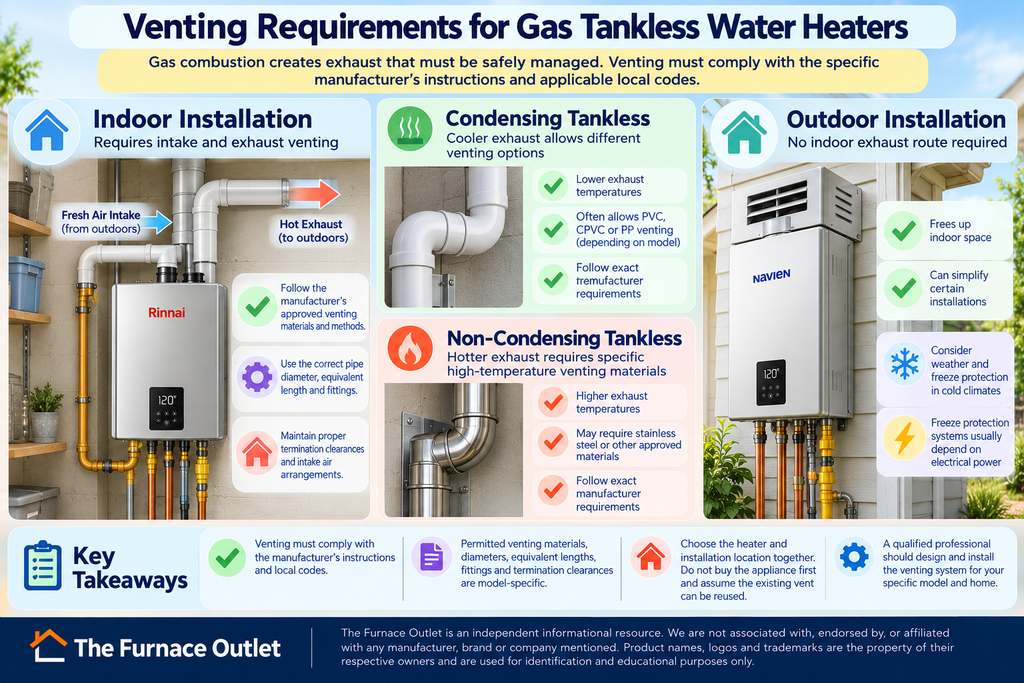
Gas combustion creates exhaust that must be safely managed. Indoor tankless systems therefore require venting that complies with the specific manufacturer’s instructions and applicable codes.
Condensing tankless heaters have an advantage because their cooler exhaust can permit venting materials and configurations that differ from hotter non-condensing appliances. However, permitted materials, diameters, equivalent lengths, fittings, termination clearances and intake arrangements remain model-specific.
Outdoor units can eliminate an indoor exhaust route, but they introduce weather and freeze considerations.
My recommendation is simple: select the heater and installation location together. Do not buy the appliance first and assume the existing vent can be reused later.
High-efficiency condensing heaters recover heat by cooling combustion gases enough for water vapor to condense. That efficiency improvement creates liquid condensate that has to go somewhere.
The condensate drain should be included in installation planning from the beginning. Depending on the installation, gravity drainage may be possible; other situations can require a condensate pump. Local requirements and the manufacturer’s instructions determine whether additional neutralization or drainage provisions are appropriate.
The Rinnai RX199iN, for example, incorporates a condensate connection as part of its condensing design.
A beautiful installation that ignores condensate management is not a complete installation.
Cold climates create two separate challenges for tankless water heating. First, incoming groundwater can be much colder, which increases the required temperature rise and reduces available GPM. Second, outdoor equipment and piping may face freezing conditions.
This means a heater advertised at 10 or 11 GPM might provide substantially less usable hot water during winter in a northern climate.
For cold-climate buyers, I would size from the manufacturer’s temperature-rise chart rather than the maximum GPM number. If several showers may operate simultaneously, calculate the combined demand under winter conditions.
I would also approach outdoor installation cautiously in severe climates. Freeze protection does not eliminate every freeze risk, particularly during power failures or unusual weather events.
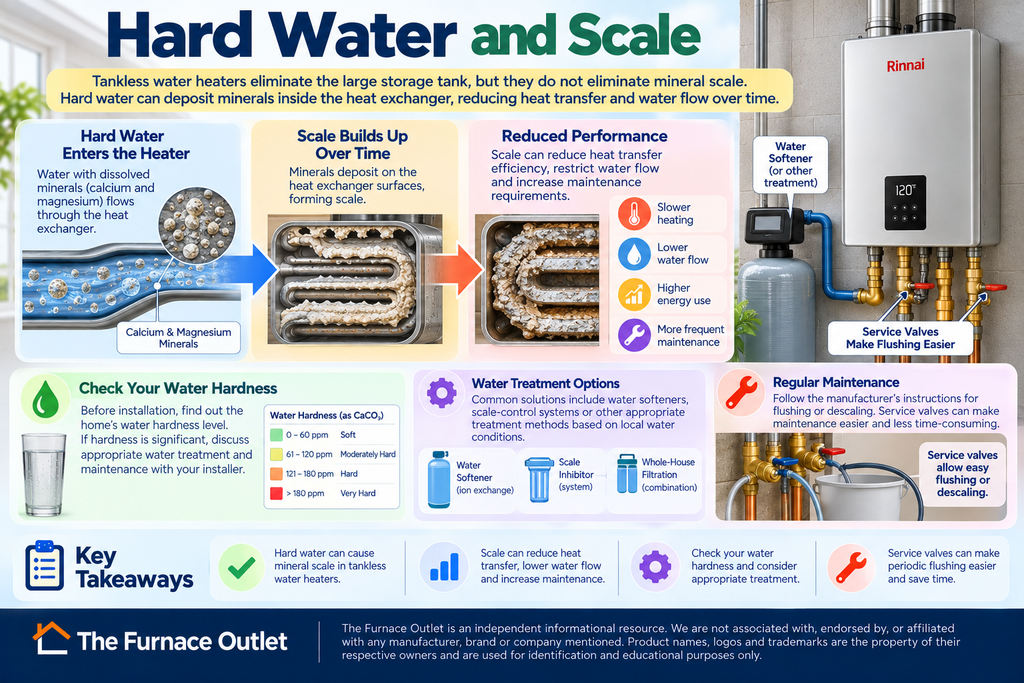
Tankless water heaters eliminate the large storage tank, but they do not eliminate mineral scale.
Hard water can deposit minerals inside the heat exchanger. As deposits accumulate, heat transfer and water flow can deteriorate. Extremely hard water can therefore change the maintenance requirements and long-term economics of a tankless system.
Before installation, I would find out the home’s water hardness. If hardness is significant, discuss appropriate water treatment and maintenance with the installer and follow the manufacturer’s instructions.
Service valves are also worth considering because they can make periodic flushing or descaling easier. Spending a little more during installation can make future maintenance considerably less frustrating.
Gas tankless installation costs vary too much for a single national number to be meaningful for every house. A straightforward replacement with suitable gas service, accessible plumbing and convenient venting is fundamentally different from a conversion requiring a larger gas line, meter upgrade, new vent route, electrical receptacle, condensate drain and relocated plumbing.
When comparing estimates, I would ask contractors to separate the major components of the project: heater, gas work, venting, water piping, isolation valves, condensate work, electrical requirements, permits and labor.
That approach also makes competing estimates easier to compare.
The cheapest quote is not necessarily the best value. Combustion equipment is one area where correct installation, commissioning and future service support matter more to me than saving a few hundred dollars upfront.
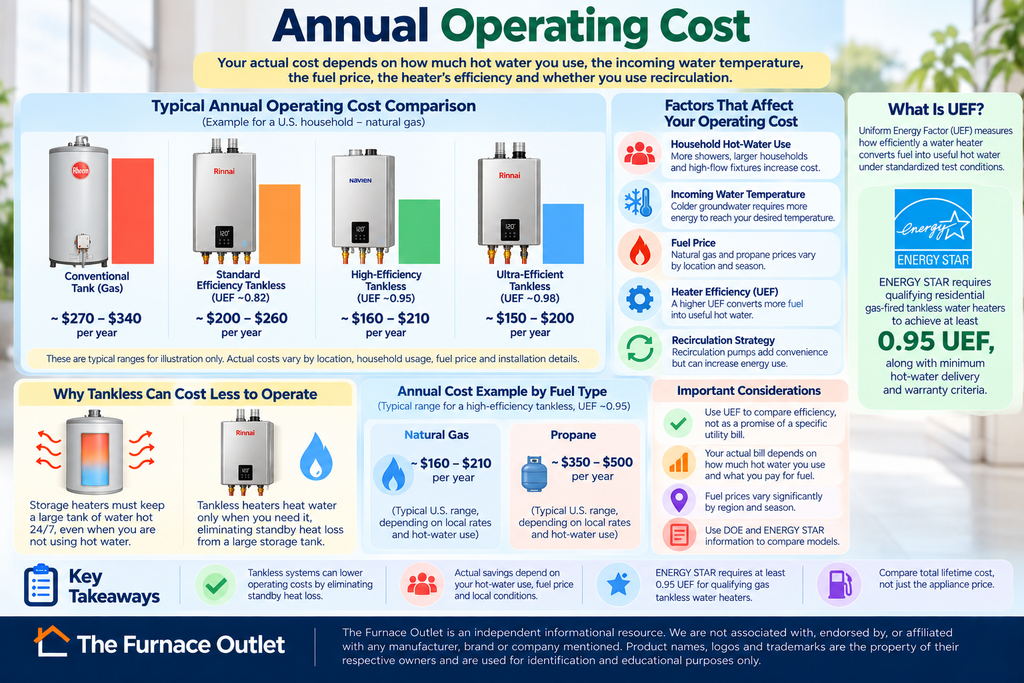
Operating cost depends on household hot-water use, incoming water temperature, fuel price, heater efficiency and recirculation strategy.
Tankless systems have an inherent advantage over conventional storage heaters because they do not need to maintain a large tank of water at temperature around the clock. However, the actual savings depend on the household.
The U.S. Department of Energy and ENERGY STAR provide standardized efficiency information that helps consumers compare water heaters. ENERGY STAR currently requires qualifying residential gas-fired instantaneous water heaters to achieve at least 0.95 UEF, along with minimum hot-water delivery and warranty criteria.
I would use UEF as a comparison tool rather than interpreting it as a direct promise of a particular annual utility bill. A 0.98-UEF heater is extremely efficient at converting fuel into useful water heating, but your actual bill still depends on how much hot water your household consumes and what you pay for fuel.
Tankless does not mean maintenance-free.
A gas tankless heater contains a heat exchanger, burner, sensors, valves, combustion components and controls. Condensing systems add condensate-management components, while recirculation systems introduce pumps and additional controls.
The maintenance schedule should follow the manufacturer’s instructions and should reflect local water quality and operating conditions. In hard-water areas, scale management becomes particularly important.
I would keep a simple record containing the installation date, model and serial number, maintenance dates, descaling history, error codes and repairs. That record becomes surprisingly valuable years later when deciding whether an aging appliance should be repaired or replaced.
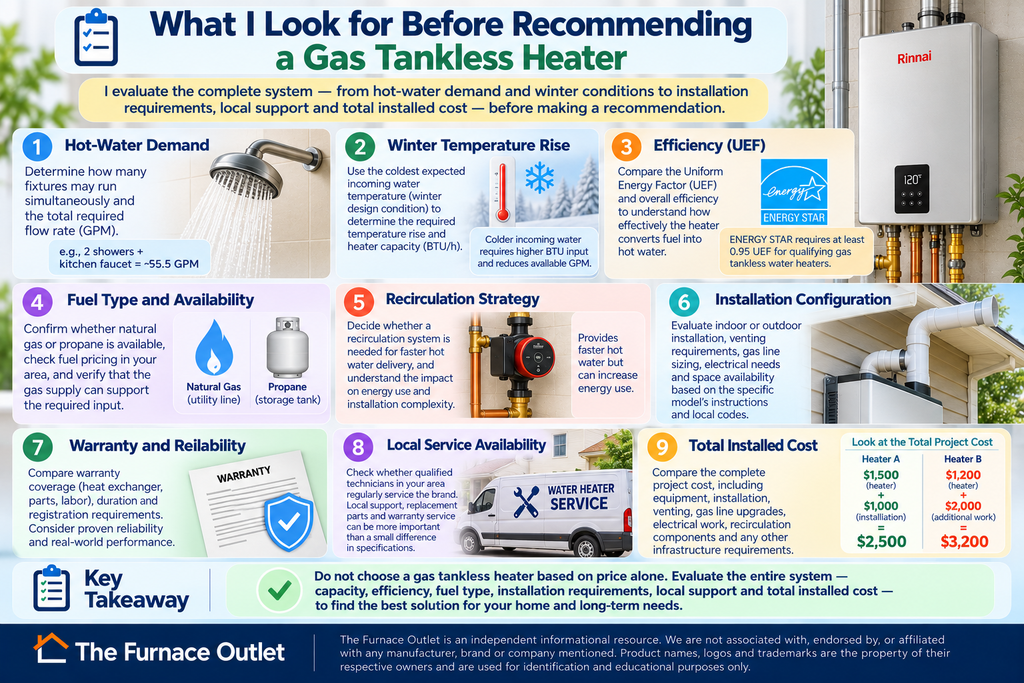
I start with actual hot-water demand and winter temperature rise. Only after determining the required capacity do I compare efficiency, fuel type, recirculation, installation configuration, warranty and price.
I also investigate local service availability. Tankless water heaters contain sophisticated controls and combustion systems, and not every plumber services every manufacturer equally well.
Finally, I compare the complete installed cost, not the equipment price displayed by an online retailer. A $1,500 heater installed for $2,500 can be a better value than a $1,200 heater that requires $2,000 of additional infrastructure work.
That is the difference between shopping for a product and designing a water-heating system.
For a combination of efficiency, capacity and installation flexibility, my overall pick is the Rinnai SENSEI RX199iN. Its published specifications include 0.98 UEF, up to 11.1 GPM, 199,000 BTU/h maximum input, natural-gas or propane operation, and indoor/outdoor installation capability. However, the best heater for a particular house depends on required temperature rise, simultaneous hot-water demand and installation conditions.
Not necessarily. High burner input allows the heater to maintain greater flow when a substantial temperature rise is required. The correct size should be determined from required GPM and temperature rise rather than simply selecting the highest BTU rating available.
A smaller household with limited simultaneous use may require considerably less capacity than a large household where two showers, a faucet and an appliance can operate together. Add the realistic simultaneous fixture flows and then check whether the heater can deliver that flow at your required temperature rise.
Not under every condition. Maximum GPM is achieved under specified test conditions. As the required temperature rise increases, available flow decreases. Always consult the manufacturer’s flow-versus-temperature-rise data.
Natural gas is often less expensive per unit of useful heat where utility gas is available, but regional fuel prices vary. Propane can still be an excellent solution for homes without natural-gas service. Compare current local fuel prices before deciding.
For many installations, I prefer condensing technology because it can achieve very high efficiency by recovering additional heat from combustion gases. The tradeoff is that condensate must be properly drained and the installation must follow the manufacturer’s venting and condensate requirements.
Not necessarily. It heats water on demand, but hot water still has to travel through the piping to the faucet. A properly designed recirculation system can reduce the wait at distant fixtures.
I would not recommend DIY installation of a whole-home gas tankless heater unless the work is legally permitted and the installer has the necessary professional qualifications and expertise. Gas supply, combustion, venting, condensate drainage, electrical connections and code compliance all affect safety and performance.
There is no single interval appropriate for every installation. Water hardness, usage and manufacturer requirements matter. Homes with hard water may require more frequent scale management than homes with softer water. Follow the manufacturer’s maintenance instructions and discuss local water conditions with a qualified service professional.
Most modern gas tankless heaters require electricity for electronic ignition, controls, sensors and fans, even though natural gas or propane supplies the heating energy. They therefore generally will not operate normally during an electrical outage unless an appropriate backup-power solution is provided.
Neither is universally better. Outdoor installation can simplify venting and save indoor space, particularly in mild climates. Indoor installation provides greater environmental protection and may make more sense in cold climates. The home’s layout, climate and manufacturer’s installation requirements should determine the choice.
Service life depends on water quality, installation quality, usage, maintenance and component availability. A well-maintained tankless heater can provide a long service life, but I would avoid treating any generic lifespan estimate as a guarantee. Maintenance history often matters more than the calendar alone.
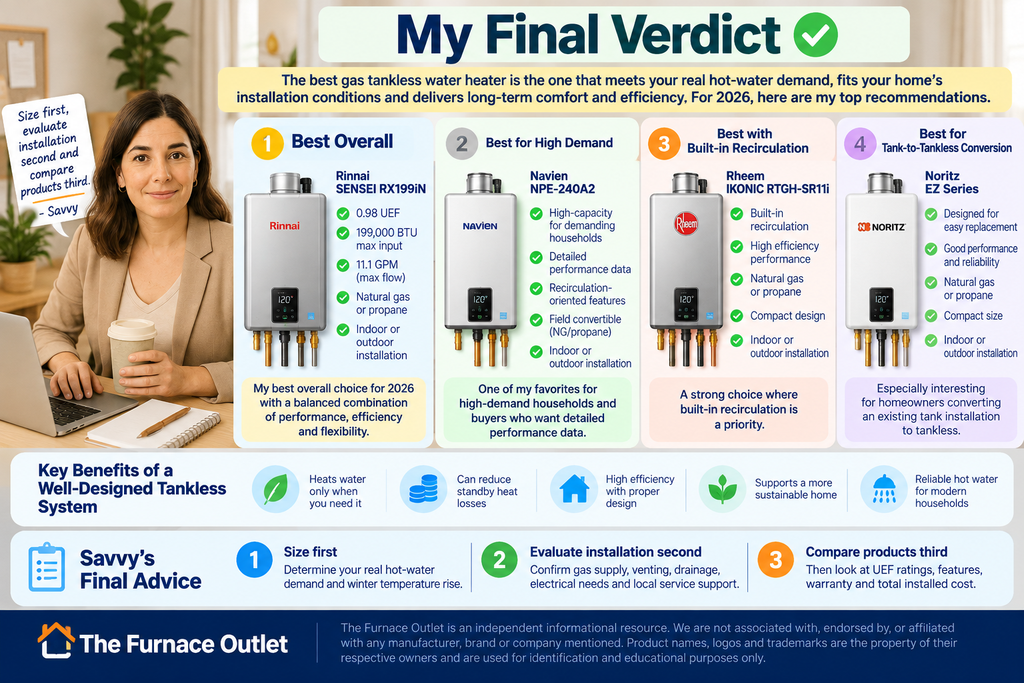
The best gas tankless water heater is not automatically the model with the highest GPM, largest burner or highest price. The best system is the one capable of meeting your household’s real simultaneous hot-water demand at your real winter temperature rise, while fitting the home’s gas supply, venting, drainage and installation conditions.
For 2026, the Rinnai SENSEI RX199iN is my best overall choice because its 0.98 UEF, 199,000-BTU maximum input, natural-gas/propane capability, 11.1-GPM published maximum flow and flexible indoor/outdoor installation create an unusually balanced package. The Navien NPE-240A2 is one of my favorites for high-demand households and buyers who want detailed performance data and strong recirculation-oriented features, while the Rheem IKONIC RTGH-SR11i deserves particular attention where built-in recirculation is a priority. The Noritz EZ Series is especially interesting for homeowners converting an existing tank installation to tankless.
From a sustainability perspective, I like the basic logic of tankless water heating: heat water when you need it rather than continuously maintaining a large reservoir of hot water. But efficiency begins with correct design. Oversizing unnecessarily, ignoring hard water, running an inefficient recirculation schedule or creating an unnecessarily complicated installation can erode some of the benefits you were trying to achieve.
My approach is therefore to size first, evaluate installation second and compare products third. Once those pieces are in the right order, the impressive UEF ratings, sophisticated controls and high-output burners of today’s premium gas tankless heaters can actually deliver the comfort and efficiency they promise.
For readers who want to verify specifications or go deeper into efficiency, sizing and product performance, I recommend starting with authoritative government resources and manufacturer technical documentation rather than relying only on retailer descriptions.
1. U.S. ENERGY STAR — Residential Water Heater Key Product Criteria. This is particularly useful for understanding UEF and the current efficiency requirements applied to ENERGY STAR-certified gas-fired instantaneous water heaters. ENERGY STAR Water Heater Key Product Criteria
2. ENERGY STAR — Whole-Home Tankless Gas Water Heaters. This consumer resource covers tankless capacity, purchasing considerations and efficiency considerations for whole-home gas systems. ENERGY STAR Whole-Home Tankless Gas Water Heaters
3. Rinnai — SENSEI RX199iN Technical Specifications. Rinnai’s official product page provides current information on UEF, maximum flow, BTU input, fuel compatibility, installation options and connections. Rinnai SENSEI RX199iN Specifications
4. Navien — NPE-240A2 Technical Specifications. This is one of the most useful manufacturer references because it publishes flow rates across multiple temperature rises, illustrating why maximum GPM should never be considered in isolation. Navien NPE-240A2 Specifications
5. Rheem — IKONIC Super High Efficiency Condensing Tankless Water Heater. Rheem provides specifications covering UEF, GPM, fuel conversion and warranty information for the IKONIC platform. Rheem IKONIC RTGH-S11i Specifications
6. Noritz — EZ Series. Noritz provides technical information on its EZ98 and EZ111 models and explains the platform’s tank-replacement-oriented design. Noritz EZ Series Tankless Water Heaters
The Furnace Outlet provides this article for general educational and product-research purposes. Product specifications, efficiency ratings, certifications, warranties, prices and availability can change, and specifications may differ between natural-gas, propane, indoor, outdoor and regional versions of similar products. Always verify the exact model number and current manufacturer documentation before purchasing.
Gas tankless water heaters involve fuel-gas piping, combustion, venting, electrical connections, water piping and, for condensing equipment, condensate management. Installation requirements are governed by manufacturer instructions and applicable local codes. Gas-system sizing, installation, conversion, venting and commissioning should be performed by appropriately qualified professionals where required. The Furnace Outlet is an independent informational resource and is not a substitute for the appliance manufacturer’s instructions, local code requirements or professional installation advice.