Newsletter Subscribe
Enter your email address below and subscribe to our newsletter

HVAC made simple
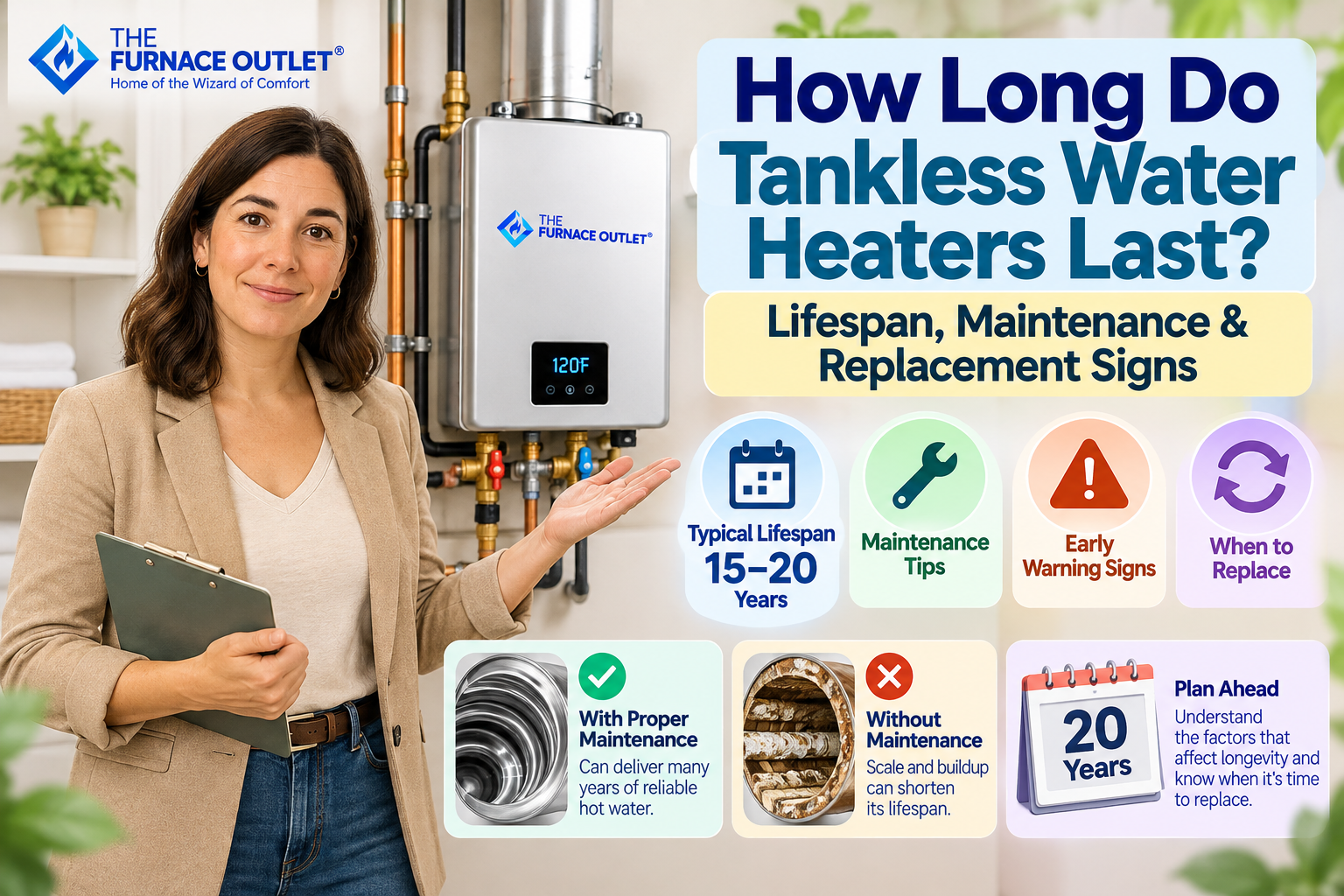
One of the strongest arguments for buying a tankless water heater is longevity. A conventional storage water heater contains a large volume of heated water around the clock, while a tankless system heats water as it passes through the appliance. That difference does not make a tankless heater immune to wear, mineral scale, corrosion or component failure, but a properly installed and maintained system can remain useful for a surprisingly long time.
For homeowners planning a new installation, I would use about 20 years as a reasonable planning expectation for a quality residential tankless water heater, rather than treating 20 years as a guaranteed replacement date. ENERGY STAR currently describes tankless water heaters as having a life expectancy of approximately 20 years, while Rinnai states that the useful life of its tankless water heaters can be up to 20 years and specifically notes that actual longevity depends on water quality, usage and maintenance.
From my sustainability perspective, the more useful question is therefore not simply, “How many years does a tankless water heater last?” I would ask what determines whether a particular heater reaches the upper end of its potential life. Water hardness, scale accumulation, installation quality, maintenance frequency, operating intensity, combustion conditions, environmental exposure and the availability of replacement parts can all influence whether the heater becomes a long-lived appliance or an expensive early replacement.
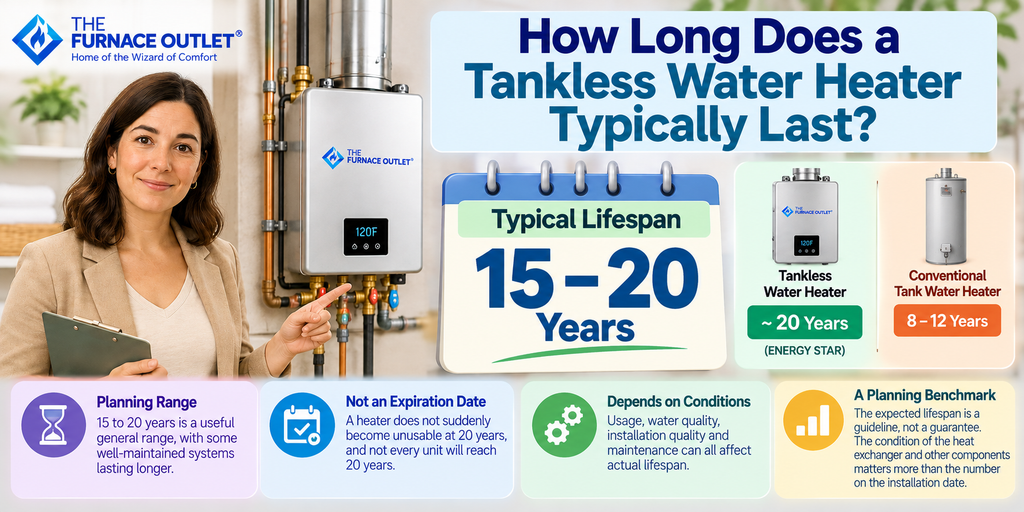
For household planning, 15 to 20 years is a useful general range, with some properly maintained systems potentially operating beyond that period. ENERGY STAR cites a 20-year life expectancy for tankless water heaters, and U.S. Department of Energy building guidance has similarly described tankless equipment as generally lasting up to approximately 20 years compared with shorter expected service lives for conventional tank-type equipment.
That number should not be interpreted as an expiration date. A heater does not suddenly become unusable when it reaches its twentieth birthday, nor should homeowners assume that every tankless unit will reach 20 years. A lightly used, correctly sized heater supplied with good-quality water and maintained regularly may have a very different service history from an identical model operating under heavy demand with extremely hard water and little maintenance.
I would therefore treat the advertised or expected lifespan as a planning benchmark rather than a promise. The condition of the heat exchanger and other major components ultimately matters more than the number printed on the installation date.
A conventional storage water heater continually stores many gallons of heated water inside a tank. Over time, the tank is exposed to corrosion, sediment accumulation and repeated heating cycles. Once the storage vessel itself begins leaking, replacement is usually the practical solution because the tank is the fundamental structure of the appliance.
A tankless heater has no large storage vessel that eventually rusts through in the same way. Instead, its most important water-side component is generally the heat exchanger, accompanied by flow sensors, valves, controls and, in gas equipment, combustion components. Many of these supporting components can potentially be serviced or replaced individually, which can make repairing an aging tankless system more practical than repairing a leaking storage tank.
That serviceability is one reason tankless equipment can achieve a long useful life, but it should not be confused with indestructibility. Heat exchangers can still experience mineral accumulation, corrosion, thermal stress or other deterioration, while electronic controls, fans, pumps, sensors and valves can eventually fail.
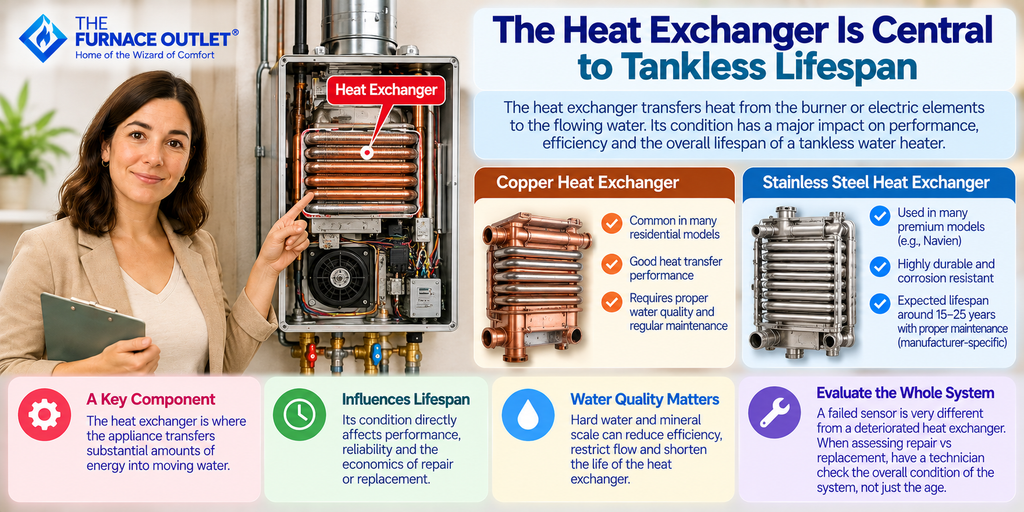
If I were evaluating the health of an older tankless water heater, I would pay particular attention to the heat exchanger because this is where the appliance transfers substantial amounts of energy into moving water. Its condition can strongly influence both performance and the economics of repairing an aging heater.
Heat exchangers can use materials such as copper or stainless steel depending on the design. Navien, for example, states that its stainless-steel heat exchangers can have an expected lifespan in the range of approximately 15 to 25 years with proper maintenance, while emphasizing that water quality and usage frequency influence actual life. That range is manufacturer-specific and should not automatically be applied to every tankless heater, but it illustrates why water quality and maintenance matter when discussing longevity.
A failed inexpensive sensor on an otherwise healthy 12-year-old heater presents a very different replacement decision from a severely deteriorated heat exchanger on an older appliance. When evaluating repair versus replacement, I would therefore ask the technician to identify the failed component and assess the overall condition of the system rather than making the decision based solely on age.
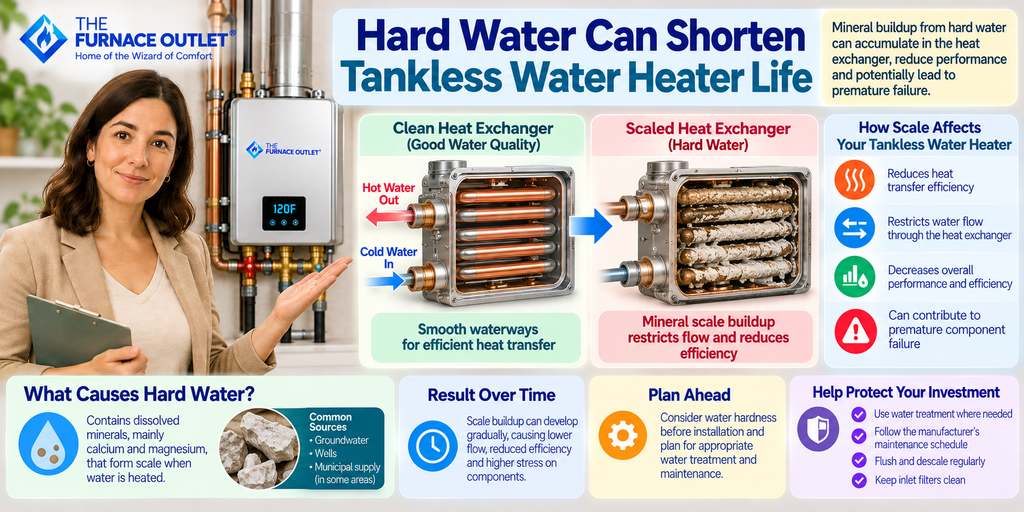
Water quality is one of the biggest variables affecting tankless longevity. Hard water contains dissolved minerals, particularly calcium and magnesium, that can form scale as water is heated. Those deposits can accumulate within heat-exchanger waterways and interfere with the transfer of heat from the appliance into the water.
Scale does not necessarily cause an immediate dramatic failure. The problem can develop gradually as deposits restrict waterways and reduce heat-transfer effectiveness. Navien warns that excessive mineral deposits can clog or erode heat-exchanger waterways, reduce flow and efficiency, decrease overall performance and potentially contribute to premature failure.
This is why I would consider water hardness part of the equipment-selection and maintenance discussion before the heater is installed. If the home has severe hard-water conditions, addressing water quality and planning more frequent maintenance can be considerably more sensible than allowing scale to accumulate for years and then blaming the heater when performance deteriorates.
Tankless does not mean maintenance-free. Periodic descaling removes mineral accumulation from the heat exchanger by circulating an appropriate cleaning solution through the water passages and then thoroughly flushing the system according to the manufacturer’s procedure.
Navien currently recommends annual maintenance for its tankless equipment and explains that homes with hard water may require more frequent service. Its guidance specifically identifies heat-exchanger flushing/descaling, inlet-water filter cleaning and inspection among the maintenance measures intended to keep equipment functioning correctly for many years.
Rinnai likewise recommends periodically checking the inlet screen filter and flushing the unit to control scale and lime, while noting that the required maintenance frequency depends on household water quality.
I would therefore use annual maintenance as a reasonable starting framework while allowing the manufacturer’s instructions and actual water conditions to determine the final schedule. In hard-water areas, waiting a full year between descaling procedures may not always be appropriate, while a properly treated water supply may create different requirements.
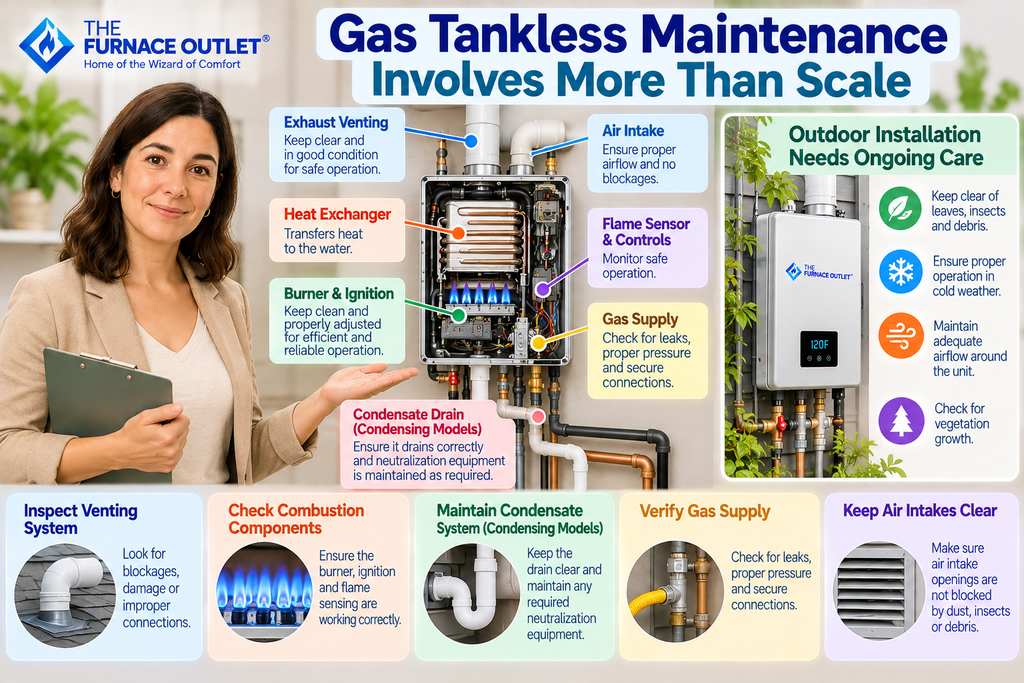
A gas tankless heater is both a water-heating appliance and a combustion system, so maintaining the water side alone does not provide a complete picture. Air intake, exhaust pathways, burner operation, ignition components, flame sensing and gas supply all contribute to reliable performance.
A professional inspection can identify blocked intake or exhaust openings, unusual combustion conditions, deteriorated connections and other problems that a homeowner performing only a basic flush may never see. Condensing models also introduce a condensate system that needs to drain correctly, and applicable neutralization equipment may require attention according to the manufacturer’s instructions.
For an outdoor tankless heater, I would also consider environmental exposure. Leaves, insects, vegetation, snow, freezing conditions and other debris can affect airflow or equipment operation. Outdoor installation eliminates a conventional indoor vent route, but it does not eliminate the need to protect and inspect the appliance.
Two identical tankless water heaters can accumulate very different amounts of operating time over 15 years. A small household with modest hot-water consumption may place considerably less demand on its heater than a large family using multiple showers, laundry appliances and kitchen fixtures throughout the day.
Heavy use does not mean a correctly sized tankless heater will necessarily fail early, but greater operating intensity creates more cycles and operating hours for components. Water quality can compound the difference because processing a larger volume of hard water means exposing the heat exchanger to more scale-forming minerals over time.
This is another reason I would avoid predicting an exact replacement year based solely on equipment age. Age, operating history, water quality and maintenance history should be considered together when assessing remaining useful life.
Even excellent equipment can struggle when the surrounding installation is incorrect. Gas pressure and supply capacity, venting, combustion air, electrical supply, condensate drainage, water pressure, pipe sizing, freeze protection and clearances all need to comply with the requirements for the specific model.
An improperly sized gas line, poorly designed vent system or unsuitable condensate arrangement can create operational problems that have little to do with the inherent quality of the heater. Likewise, a heater installed where future service access is extremely difficult may be less likely to receive the preventive maintenance it needs.
For this reason, I consider serviceability part of installation quality. Isolation valves, accessible service ports and adequate working space may not make the installation look more impressive on day one, but they can make proper maintenance considerably easier throughout the heater’s life.
One of the first signs that a tankless heater needs attention can be a noticeable change in performance. Hot water may take longer to reach the desired temperature, available flow may seem lower than before, or the heater may struggle with demands that it previously handled without difficulty.
These symptoms do not automatically mean the heater needs replacement. A dirty inlet filter, mineral scale, plumbing restriction, flow problem or maintenance issue may be responsible. Rinnai, for example, notes that debris in an inlet-water filter can reduce flow and interfere with operation.
I would therefore investigate declining performance before assuming that the appliance has reached the end of its life. Correcting a maintenance problem can be far less expensive and environmentally preferable to replacing an otherwise serviceable heater.
Water that repeatedly becomes unexpectedly hot, cold or inconsistent can indicate that something in the system is no longer functioning as intended. Possible causes range from scale and restricted flow to sensors, controls, plumbing conditions or other equipment problems.
Occasional temperature changes do not by themselves prove that the heater is failing, particularly if household demand has changed. If two showers and another fixture are suddenly being operated simultaneously, for example, the system may simply be reaching its available capacity at the required temperature rise.
Persistent temperature instability under operating conditions that previously worked normally deserves investigation. On an older appliance, recurring performance problems combined with repeated component failures can eventually make replacement more sensible than continuing to repair symptoms individually.
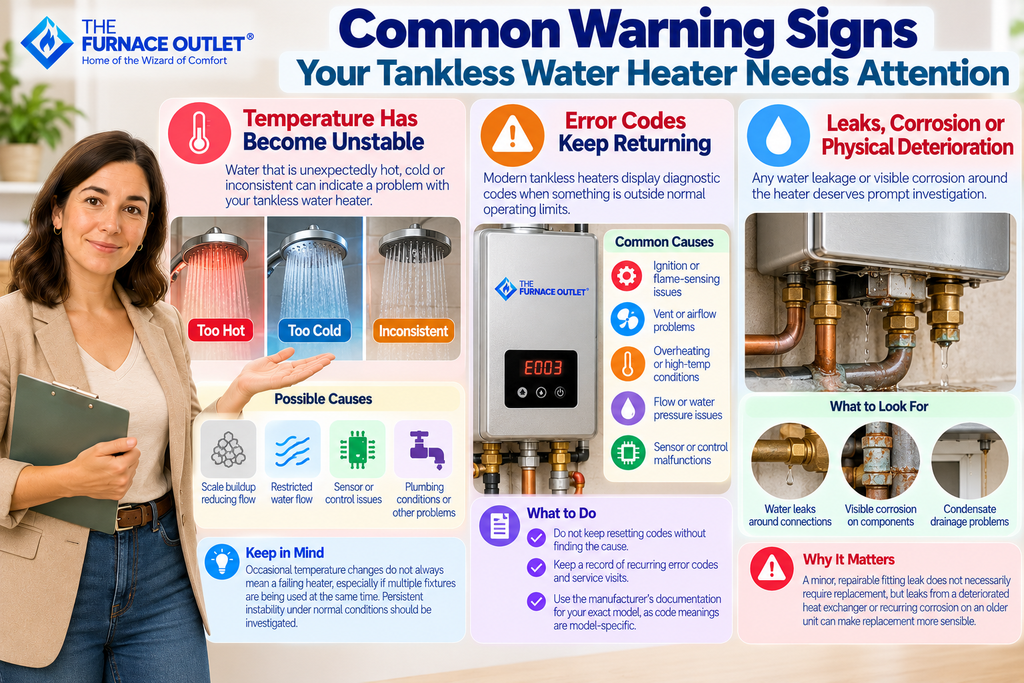
Modern tankless heaters monitor numerous operating conditions and can display diagnostic or error codes when something falls outside acceptable limits. A single code may identify a straightforward maintenance or operating problem, but repeated faults should not simply be reset indefinitely without determining the underlying cause.
I would keep a record of recurring error codes and service visits, particularly as the heater ages. A 16-year-old appliance that has required several repairs over a short period deserves a different economic evaluation from a similarly aged heater that has needed little more than routine maintenance.
The manufacturer’s diagnostic documentation should always be used because error-code meanings are model-specific. I would not diagnose a tankless heater from a generic list found online when the manufacturer provides instructions for the exact equipment.
Any water leakage around the heater deserves prompt investigation. The absence of a large storage tank reduces the risk of the classic catastrophic tank rupture, but a tankless appliance still contains heat exchangers, water connections, valves, seals and internal waterways that can leak.
Visible corrosion also deserves attention, particularly if it appears around important internal or plumbing components. Condensate drainage problems, water leaks or environmental exposure can contribute to deterioration, and simply wiping away evidence of moisture does not address the underlying cause.
A minor repairable fitting leak does not necessarily justify replacing the heater. Leakage from a seriously deteriorated heat exchanger, however, can change the economics dramatically, particularly when the appliance is already approaching the later portion of its expected service life.
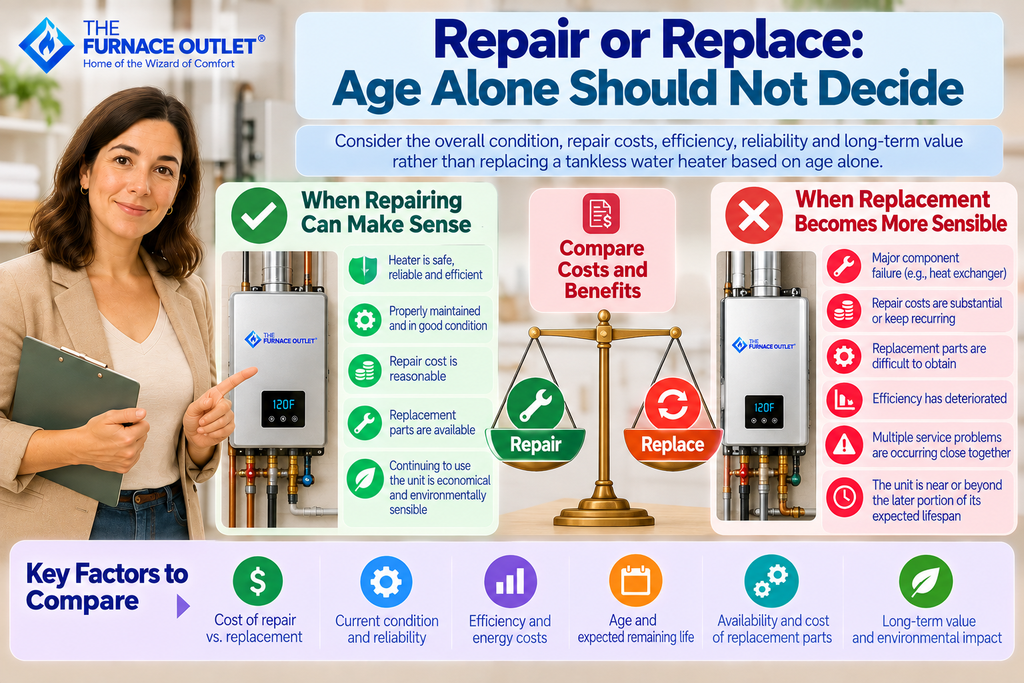
I would not replace a functioning 15-year-old tankless heater simply because an online article says that it is “old.” If it remains safe, efficient, reliable, properly maintained and supported with replacement parts, continuing to use it can be economically and environmentally sensible.
Conversely, I would not continue pouring money into a troublesome 18- or 20-year-old appliance solely because tankless heaters can sometimes last longer. Replacement becomes increasingly reasonable when a major component fails, repair costs become substantial, parts are difficult to obtain, efficiency has deteriorated or multiple service problems begin occurring close together.
The correct comparison is therefore cost of repair versus cost and benefits of replacement, adjusted for the condition and likely remaining life of the existing system. A relatively inexpensive replaceable component may justify repairing an older heater, while a major heat-exchanger problem combined with other age-related deterioration may make a new system the better investment.
Homeowners sometimes assume that a heater should be replaced when its warranty expires, but warranty coverage and expected service life are different concepts. A manufacturer might provide different coverage periods for the heat exchanger, other parts and labor, and those periods can vary according to product, application and installation conditions.
A tankless heater can operate successfully for many years after some warranty coverage has expired. Likewise, the existence of a long heat-exchanger warranty does not guarantee that every other component will remain covered for the same period.
Before purchasing a new system, I would therefore read the warranty rather than simply looking at the largest number printed in the marketing material. Registration requirements, maintenance obligations, residential versus commercial use and installation requirements can all affect coverage.
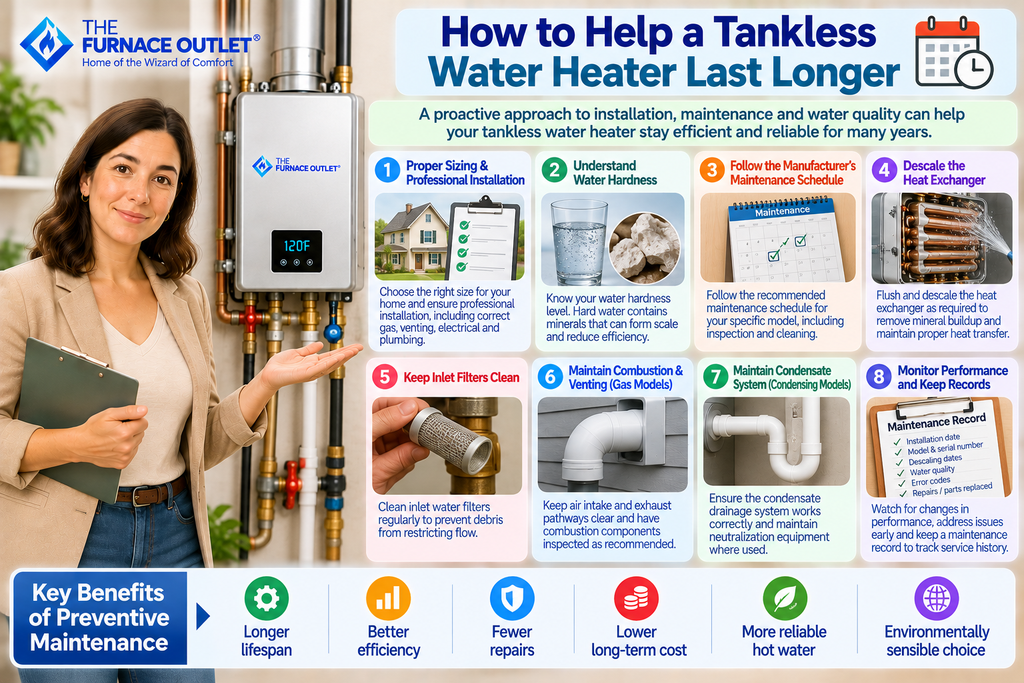
The most useful longevity strategy is preventive rather than reactive. Start with correct sizing and professional-quality installation, understand the home’s water hardness, follow the manufacturer’s maintenance schedule, descale the heat exchanger as required, keep inlet filters clean and investigate performance changes before they become larger problems.
For gas equipment, maintain unobstructed intake and exhaust pathways and have combustion-related components inspected according to the manufacturer’s requirements. For condensing equipment, include the condensate system in routine maintenance. Where hard water is severe, evaluate an appropriate water-treatment strategy rather than relying indefinitely on increasingly frequent descaling.
I would also keep a simple maintenance record containing the installation date, model and serial information, descaling dates, water-quality information, error codes, repairs and components replaced. That history becomes increasingly valuable as the heater ages because it helps determine whether the appliance has been consistently reliable or is beginning to develop a pattern of deterioration.
For planning purposes, I would consider roughly 15 to 20 years a realistic general lifespan range for residential tankless water heating, with around 20 years commonly cited by ENERGY STAR and major manufacturers as an expected or potential service life. Some equipment may last longer, while harsh water conditions, neglected maintenance, demanding operation or installation problems can shorten that period considerably.
From my sustainability perspective, I would not define longevity merely as keeping an appliance running for the greatest possible number of years. The better objective is to keep it safe, efficient, reliable and serviceable for as much of its potential life as reasonably possible. Preventive maintenance can help preserve heat-transfer efficiency, water flow and component condition, while timely replacement can make sense once major failures and repeated repairs begin outweighing the value of keeping an aging system.
A tankless water heater therefore should not have a predetermined replacement birthday. Maintain it properly, monitor its performance and replace it when its condition and repair economics—not simply its age—show that continued operation no longer makes sense.
Can a tankless water heater last 20 years? Yes. ENERGY STAR currently cites approximately 20 years as the life expectancy for tankless water heaters, and Rinnai states that its tankless units can have a useful lifespan of up to 20 years. Actual results depend on factors including water quality, usage, environmental conditions and maintenance.
Can a tankless water heater last longer than 20 years? Some systems can remain serviceable beyond 20 years, but this should not be assumed. Condition, maintenance history, water chemistry, component availability and repair economics become increasingly important as equipment ages.
Does hard water shorten tankless water-heater life? It can. Mineral scale can accumulate in heat-exchanger waterways, reducing heat transfer and water flow and potentially contributing to premature component problems. Appropriate descaling and, where justified, water treatment can help control this risk.
How often should a tankless water heater be maintained? The exact schedule should come from the manufacturer and account for water quality and usage. Navien currently recommends annual maintenance and notes that hard-water conditions can require more frequent attention, while Rinnai likewise states that maintenance intervals depend on water quality.
Should I replace a 15-year-old tankless water heater? Not simply because it is 15 years old. If the heater remains safe, reliable, efficient and economical to maintain, continued operation can make sense. Replacement becomes more attractive when major components fail, repairs become frequent or expensive, parts become difficult to obtain or overall performance deteriorates.
What are the main signs that replacement may be approaching? Recurring error codes, persistent temperature instability, declining performance, serious leaks or corrosion, repeated repairs and failure of an expensive major component can all justify evaluating replacement. Each symptom should first be professionally diagnosed because some problems may have relatively simple maintenance-related causes.
For additional research, ENERGY STAR’s tankless water-heater benefits and lifespan guidance provides useful federal efficiency and longevity context. U.S. Department of Energy guidance on transitioning to a tankless water heater provides technical background on tankless service life and system considerations.
For manufacturer maintenance information, Navien’s tankless water-heater maintenance guidance and Navien’s descaling guidance explain how mineral accumulation can affect performance and why routine maintenance matters. Rinnai’s tankless water-heater FAQ provides additional manufacturer guidance on expected lifespan, water quality, filters and flushing.
This article is provided by The Furnace Outlet for general educational purposes and is not a substitute for the installation, operation, maintenance or diagnostic instructions supplied by the manufacturer of a specific water heater. Tankless lifespan, maintenance intervals, warranty requirements and replacement decisions vary by model, installation, water quality, usage and operating conditions. Gas, electrical, venting and internal appliance repairs should be performed by appropriately qualified professionals where required, and the current manufacturer’s documentation should always take precedence over general guidance.