Newsletter Subscribe
Enter your email address below and subscribe to our newsletter

HVAC made simple
Choosing the correct size gas tankless water heater is one of the most important decisions you will make when designing an on-demand hot-water system. A unit can have excellent efficiency, sophisticated controls and a strong warranty, but none of those advantages will matter much if it cannot produce enough hot water when your household needs it most.
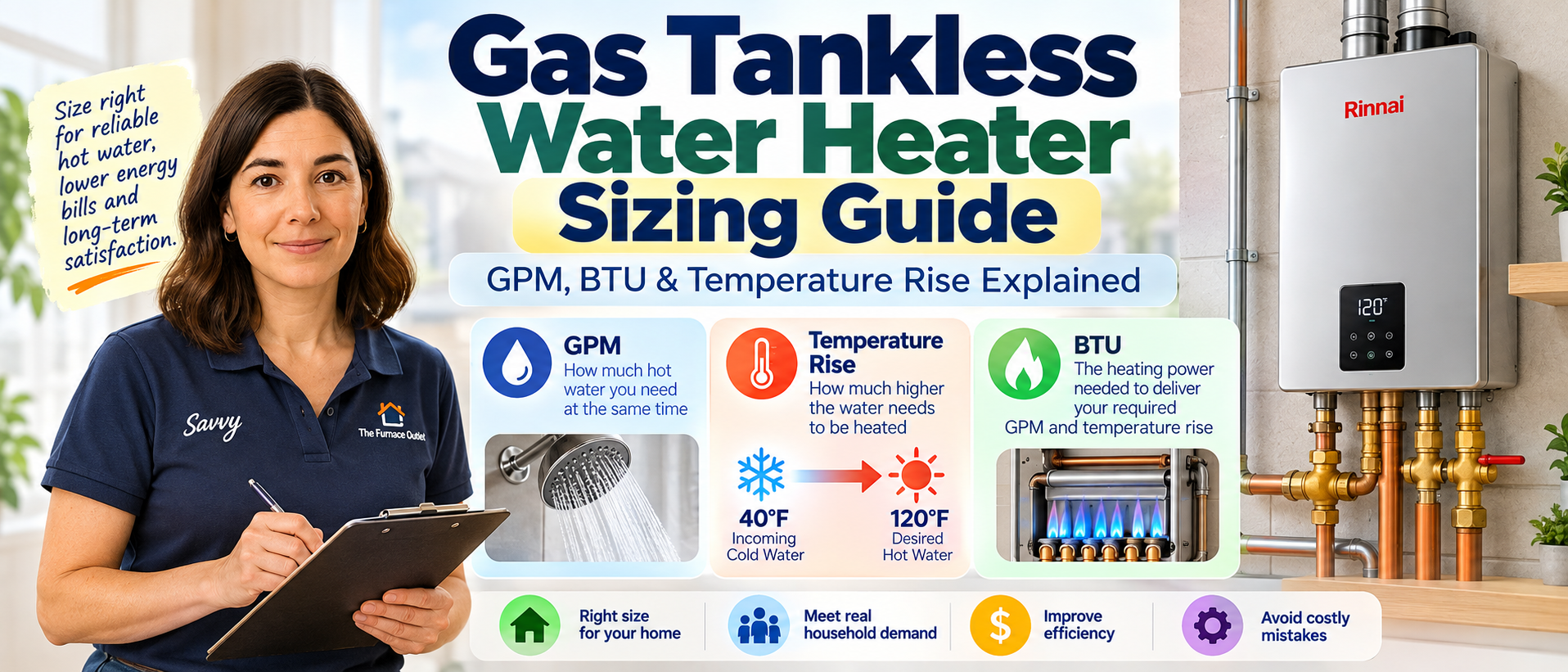
I’m Savvy Mavi, and when I size a tankless water heater, I do not begin with the number of bathrooms or the manufacturer’s headline GPM rating. I start with three connected questions: How much hot water could the household realistically use at the same time? How cold is the incoming water during the most demanding part of the year? How much heat must the heater add to deliver the desired outlet temperature?
Those questions give us the three numbers that matter most: GPM, temperature rise and BTU input. DOE building-science guidance similarly says tankless sizing should consider the practical maximum simultaneous flow rate and the required temperature rise, which depends partly on winter incoming-water temperature. Building Science Education
Once you understand how those numbers work together, tankless sizing becomes much easier—and you are far less likely to buy a heater that looks impressive on paper but disappoints during a cold winter morning.
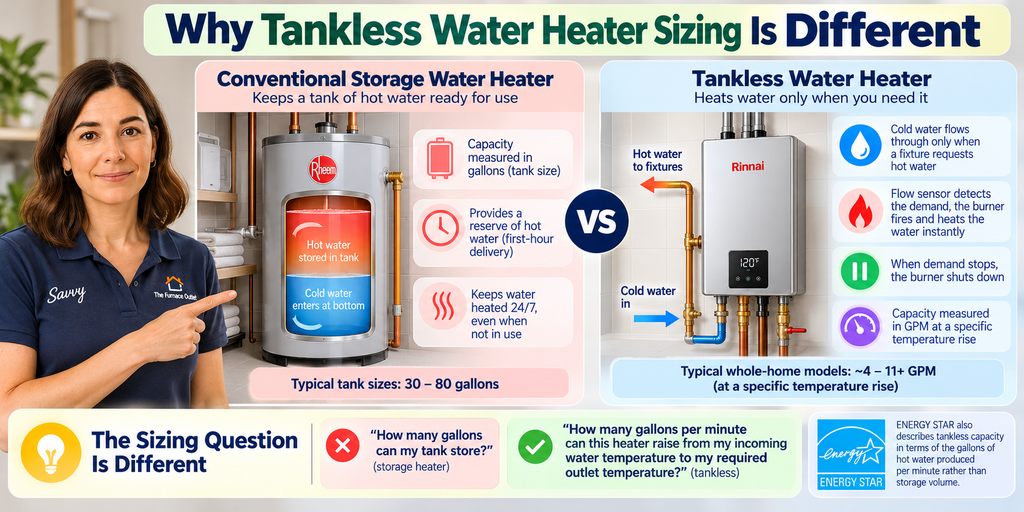
A conventional storage water heater keeps a reservoir of heated water ready for use. Its capacity is therefore commonly discussed in terms of tank volume and first-hour delivery. A tankless heater works differently. Cold water flows through the appliance only when a fixture requests hot water. A flow sensor detects the demand, the burner fires, and the heat exchanger transfers energy into the moving water. When demand stops, the burner shuts down.
That creates a completely different sizing problem. Instead of asking, “How many gallons can my tank store?” you need to ask, “How many gallons per minute can this heater raise from my incoming-water temperature to my required outlet temperature?”
ENERGY STAR also describes tankless capacity in terms of the gallons of hot water produced per minute rather than storage volume. This is why a heater advertised as “11 GPM” should never automatically be considered an 11-GPM heater for every house.
I like to think of tankless sizing as a three-part relationship. GPM tells us how much water must be heated, temperature rise tells us how much warmer that water needs to become, and BTU/h tells us how much heating power is available to accomplish the job.
If you increase the required GPM while everything else remains constant, you need more heating capacity. If you increase the required temperature rise while maintaining the same GPM, you also need more heating capacity. This relationship explains why the same tankless heater can perform very differently in Florida and Minnesota, or even in the same house between summer and winter. The appliance has not changed. The load has.
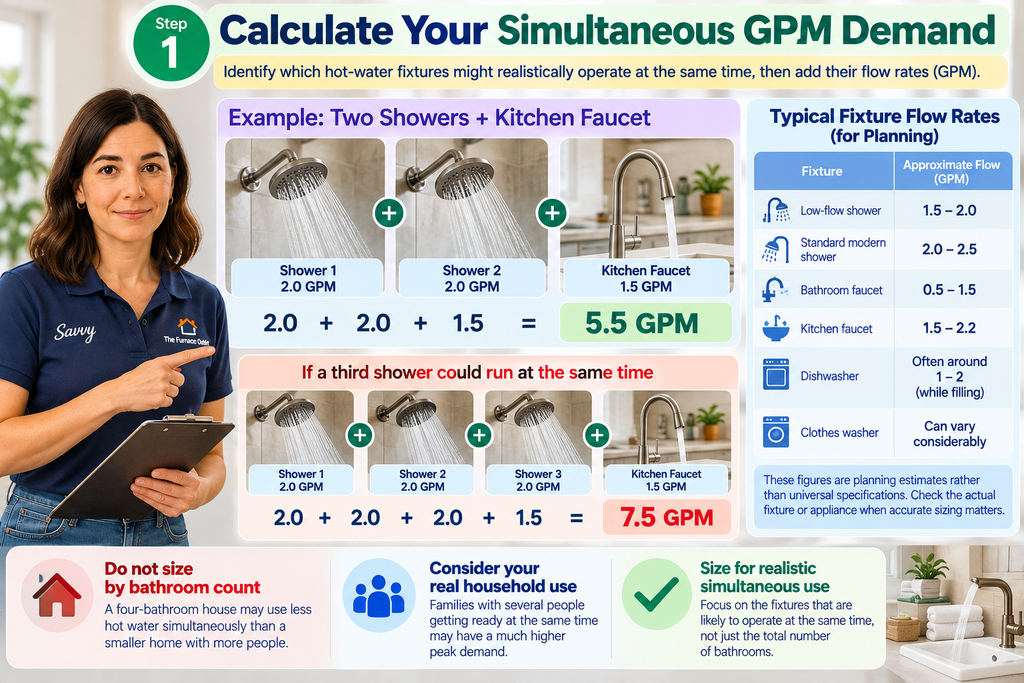
The first step is not to count bathrooms. Instead, identify which hot-water fixtures might realistically operate at the same time. Suppose your household could have two showers running while somebody uses the kitchen faucet. If each shower flows at approximately 2.0 GPM and the kitchen faucet contributes approximately 1.5 GPM, your theoretical simultaneous demand would be: 2.0 + 2.0 + 1.5 = 5.5 GPM
If a third 2.0-GPM shower could realistically operate at the same time, demand increases to approximately: 5.5 + 2.0 = 7.5 GPM
That difference is substantial.
A household with four bathrooms does not automatically require four showers’ worth of simultaneous capacity. Two people living in a four-bathroom house may rarely use more than one shower and one faucet at once. Conversely, a family with several people getting ready at the same time every morning may have a much higher peak demand. That is why I size around realistic simultaneous use rather than fixture count alone.
Typical fixture flow rates can help you make an initial estimate, but I prefer checking the actual fixtures whenever possible because low-flow showerheads and faucets can substantially change the calculation.
| Fixture | Approximate Flow for Planning |
|---|---|
| Low-flow shower | 1.5–2.0 GPM |
| Standard modern shower | 2.0–2.5 GPM |
| Bathroom faucet | 0.5–1.5 GPM |
| Kitchen faucet | 1.5–2.2 GPM |
| Dishwasher | Often around 1–2 GPM while filling |
| Clothes washer | Can vary considerably |
These figures are planning estimates rather than universal specifications. Check the actual fixture or appliance when accurate sizing matters.
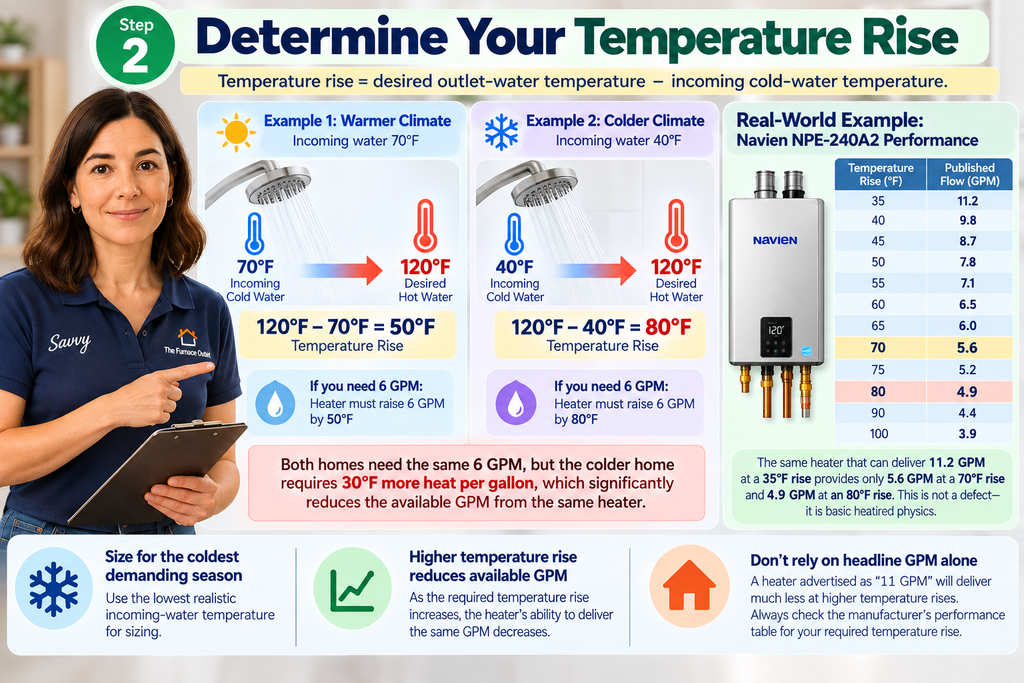
Now we come to the number many buyers overlook. Temperature rise = desired outlet-water temperature − incoming cold-water temperature.
Suppose you want approximately 120°F hot water and your incoming water is 70°F. The required temperature rise is: 120°F − 70°F = 50°F
Now imagine the same house—or another house using the same tankless heater—has 40°F incoming water during winter: 120°F − 40°F = 80°F
Both homes may require exactly 6 GPM, but the second heater has to add 30°F more heat to every gallon passing through it.
That dramatically changes available capacity. ENERGY STAR technical material emphasizes the same relationship: as demanded flow increases, a tankless heater’s ability to raise the water temperature decreases, which is why both flow rate and corresponding temperature rise are necessary when evaluating capacity.
For sizing purposes, I care much more about the coldest realistic incoming-water temperature than the comfortable conditions you may experience for much of the year. Imagine buying a heater because it provides 8 GPM during a 45°F temperature rise. If your winter conditions require a 70°F rise, that 8-GPM specification is no longer the relevant number.
DOE building-science guidance specifically points to winter cold-water temperature when determining required heat rise for tankless sizing. This is one reason I recommend sizing for the demanding season rather than an annual average. If the heater can meet your realistic peak demand during winter, warmer seasons generally become easier operating conditions.
A real manufacturer’s performance table makes this concept much easier to understand. Navien publishes the following domestic-hot-water performance for its NPE-240A2:
| Temperature Rise | Published Flow |
|---|---|
| 35°F | 11.2 GPM |
| 40°F | 9.8 GPM |
| 45°F | 8.7 GPM |
| 50°F | 7.8 GPM |
| 55°F | 7.1 GPM |
| 60°F | 6.5 GPM |
| 65°F | 6.0 GPM |
| 70°F | 5.6 GPM |
| 75°F | 5.2 GPM |
| 80°F | 4.9 GPM |
| 90°F | 4.4 GPM |
| 100°F | 3.9 GPM |
The same appliance that can deliver 11.2 GPM at a 35°F rise provides only 5.6 GPM at a 70°F rise and 4.9 GPM at an 80°F rise. That is not a defect. It is basic heating physics.
This is also why I would never write “11.2 GPM = enough for X bathrooms” without knowing the incoming-water temperature and simultaneous demand.
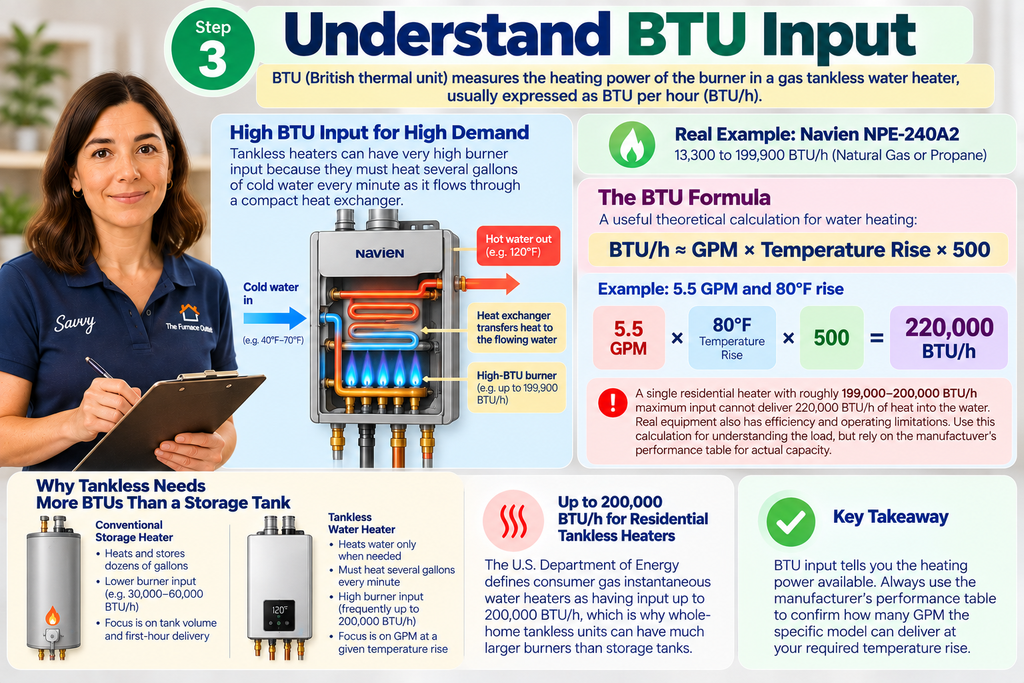
BTU stands for British thermal unit, and gas tankless water-heater burner capacity is normally expressed in BTU per hour (BTU/h). Large residential gas tankless heaters frequently approach 200,000 BTU/h. For example, Navien lists the NPE-240A2 at 13,300 to 199,900 BTU/h for both natural gas and propane. Navien
The high maximum input makes sense when you consider what a tankless appliance is being asked to accomplish. Instead of slowly heating and storing dozens of gallons, it may need to take several gallons of cold water every minute and raise their temperature dramatically while the water passes through a relatively compact heat exchanger. DOE’s current definition of a consumer gas instantaneous water heater includes units with input up to 200,000 BTU/h. The Department of Energy’s Energy.gov
That explains why a whole-home tankless heater can have a burner much larger than the burner found in a conventional storage water heater.
For water, a useful theoretical heating calculation is: BTU/h ≈ GPM × Temperature Rise × 500
The factor of approximately 500 comes from the weight of water and converting gallons per minute into gallons per hour.
Suppose we need 5.5 GPM and an 80°F temperature rise: 5.5 × 80 × 500 = approximately 220,000 BTU/h of heat delivered to the water
That immediately tells us something important. A single residential heater with roughly 199,000–200,000 BTU/h maximum fuel input cannot deliver 220,000 BTU/h of heat into the water. Real equipment also has efficiency and operating limitations. This theoretical calculation is therefore useful for understanding the load, but I would not use it as a substitute for the manufacturer’s certified performance table.
The performance table is what ultimately tells you what the specific heater can deliver under a specified temperature rise.
Suppose a couple typically uses one 2.0-GPM shower while another person may use a 1.5-GPM kitchen faucet.
That does not mean I would automatically buy a 100,000-BTU heater. I would take the 3.5-GPM demand at a 55°F rise and check the manufacturer’s published performance data for the models under consideration. The calculation gives us context. The manufacturer data makes the equipment selection.
Now imagine a family where two 2.0-GPM showers regularly operate simultaneously, occasionally accompanied by a 1.5-GPM kitchen faucet.
We are now approaching the output capability of large residential gas tankless equipment. This is exactly the type of situation where looking at an “11 GPM” advertisement could be misleading. Navien’s 199,900-BTU/h NPE-240A2, for example, is published at 5.6 GPM at a 70°F rise. That is much closer to the information we actually need.
That is beyond what a typical single 199,000–200,000-BTU/h residential unit can deliver under those conditions. You now have several possible solutions. You could reduce simultaneous demand, use lower-flow fixtures, investigate a system designed for greater capacity, or—in unusually demanding applications—consider multiple tankless units designed for cascading.
Navien, for example, publishes cascading configurations for applications requiring substantially greater flow than a single unit can provide. For an ordinary residence, however, I would first ask whether three simultaneous showers represent a genuine daily requirement or merely a theoretical worst case.
You will often see simplified recommendations such as “7 GPM for two bathrooms” or “10 GPM for three bathrooms.” Those shortcuts can be useful for very preliminary shopping, but they are not how I would make the final selection.
Bathrooms do not consume hot water. Fixtures operating simultaneously consume hot water. A five-bathroom house occupied by two people could have lower peak demand than a three-bathroom house occupied by six people every weekday morning. The climate can also reverse an apparently obvious comparison. A smaller home in a cold northern climate may place a greater instantaneous heating load on the heater than a larger home in a warm southern climate.
Count realistic fixtures, calculate simultaneous GPM and determine temperature rise. That gives you much better information than bathroom count.
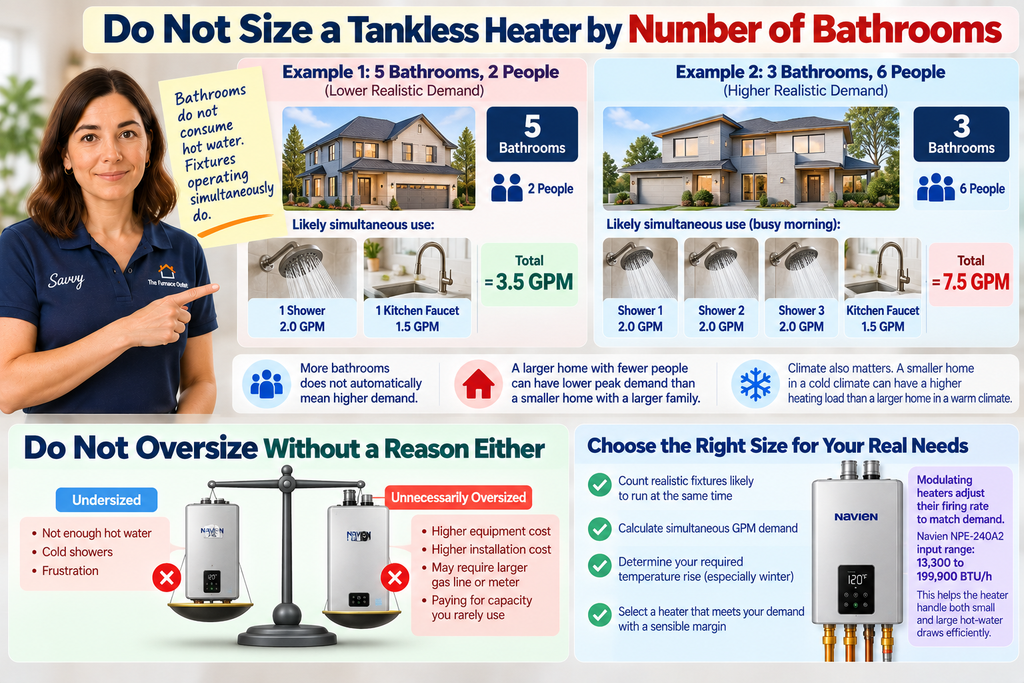
Undersizing gets most of the attention because nobody wants a cold shower, but unnecessarily oversizing equipment is not my preferred approach either. I want enough capacity to meet realistic peak demand with a sensible margin. I do not want homeowners paying for capacity they are extremely unlikely to use simply because the biggest model appears safer.
Modulating gas tankless heaters can reduce their firing rate when demand is low, which helps them handle varying loads. Navien’s NPE-240A2, for example, publishes an input range from 13,300 to 199,900 BTU/h rather than operating at maximum fire continuously. Minimum flow and minimum firing characteristics can therefore matter in addition to maximum capacity, particularly in homes with small hot-water draws.
A high UEF is desirable, but efficiency and capacity answer different questions. UEF helps describe how efficiently the appliance converts purchased energy into useful water heating under standardized testing. GPM at a specified temperature rise tells you whether the heater can meet your actual flow requirement. A very efficient undersized heater is still undersized.
DOE identifies UEF as the standardized measure of water-heater energy efficiency, while federal guidance separately specifies flow-performance requirements for gas instantaneous equipment. The Department of Energy’s Energy.gov
I therefore evaluate capacity first and efficiency among appropriately sized candidates second.
Choosing a 199,000-BTU/h heater does not automatically mean the existing gas infrastructure can support it. Gas-line capacity depends on fuel type, pipe diameter, pipe material, developed length, available pressure and the total connected appliance load. Your furnace, range, dryer, fireplace and other gas equipment may all share the same supply.
This is particularly important when replacing a conventional tank water heater with a high-input tankless model. The old heater working correctly does not prove that the existing gas line or meter can supply the new tankless appliance. I would have a qualified professional evaluate gas-line and meter capacity as part of equipment selection rather than after purchasing the heater.
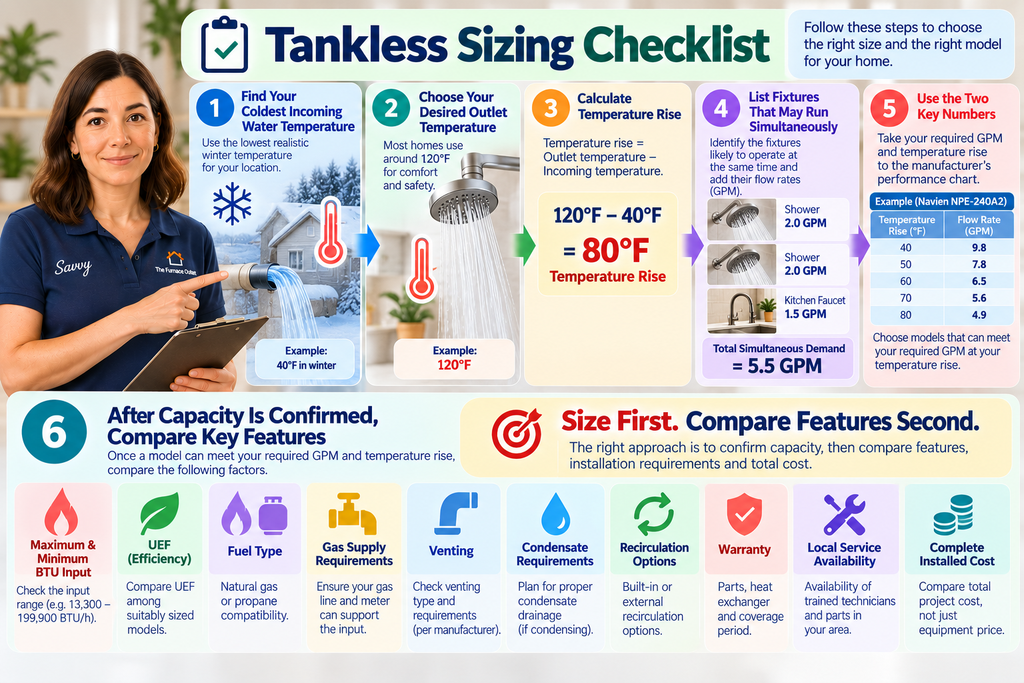
Before selecting a gas tankless water heater, I would identify the coldest realistic incoming-water temperature, choose the desired outlet temperature, calculate the resulting temperature rise, list the fixtures likely to operate simultaneously and add their flow rates. I would then take those two critical numbers—required GPM and required temperature rise—to the manufacturer’s performance chart. Only models capable of meeting that combination would remain on my shortlist.
After capacity is confirmed, I would compare maximum and minimum BTU input, UEF, natural-gas or propane compatibility, gas-supply requirements, venting, condensate requirements, recirculation options, warranty, local service availability and complete installed cost. That order matters. Size first. Compare features second.
Family size alone is not enough to determine tankless capacity. A family of four using two showers simultaneously may require roughly 4–5 GPM before other fixtures are considered, but the heater’s required capacity also depends heavily on incoming-water temperature and desired outlet temperature. Calculate simultaneous demand and temperature rise before selecting a model.
It can be. An actual 8 GPM of hot-water capacity at your required temperature rise can support substantial simultaneous demand. The problem is that a heater marketed with an 8-GPM maximum may produce considerably less than 8 GPM under colder conditions. Check the manufacturer’s temperature-rise chart.
Possibly, but the headline number is not sufficient. Determine how many showers and other fixtures will actually operate simultaneously and compare that demand with the heater’s output at your winter temperature rise.
Subtract your coldest realistic incoming-water temperature from your desired hot-water setpoint. If incoming water is 45°F and the desired outlet temperature is 120°F, use approximately a 75°F temperature rise for sizing.
BTU requirements depend on flow and temperature rise. Whole-home gas tankless models can approach 200,000 BTU/h, but you should not select equipment from BTU input alone. Use the manufacturer’s published flow rate at your required temperature rise.
Colder incoming water requires the heater to add more heat to every gallon. Because the burner’s maximum heating capacity is finite, fewer gallons can be heated to the target temperature each minute.
Not automatically. Select enough capacity to meet realistic peak demand under demanding temperature conditions, then compare efficiency, modulation, installation requirements and cost. Bigger is not inherently better.
Certain manufacturers support cascading multiple units for high-demand applications. The system must be specifically designed and installed according to the manufacturer’s requirements. Most ordinary homes should first determine whether one properly sized unit can meet realistic demand.
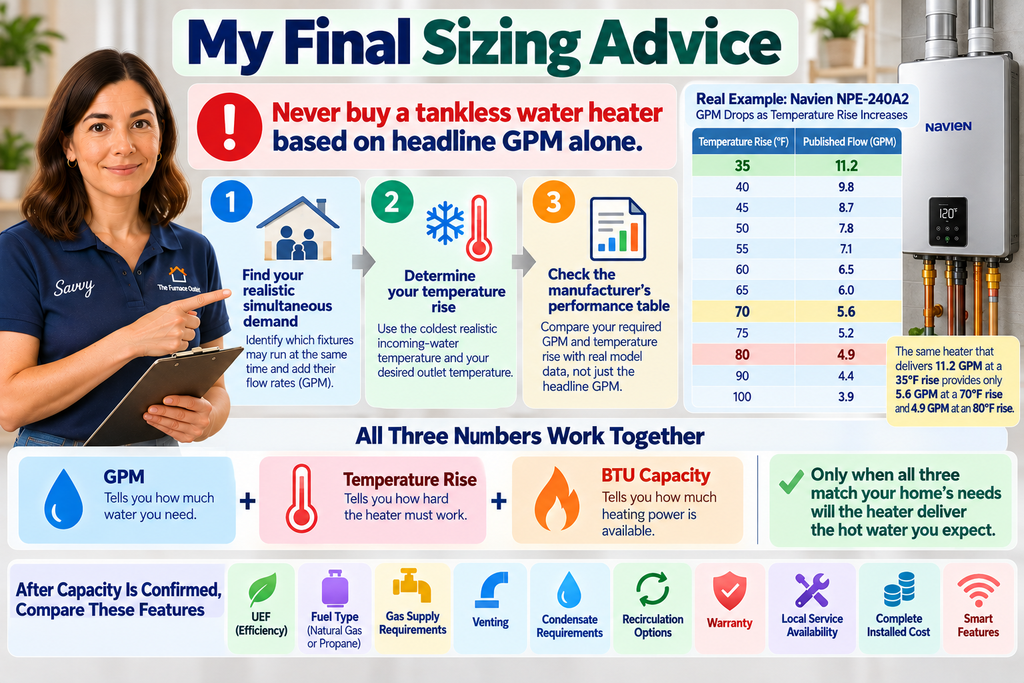
If you remember only one principle from this guide, make it this: never buy a gas tankless water heater based on headline GPM alone. Start with your home’s realistic simultaneous hot-water demand. Then determine the temperature rise required during the coldest meaningful conditions. Finally, compare those numbers against the manufacturer’s published performance table.
A heater advertised at 11.2 GPM can deliver 11.2 GPM under one temperature-rise condition and less than half that flow under a much more demanding condition. Navien’s NPE-240A2 provides an excellent real-world illustration, falling from 11.2 GPM at a 35°F rise to 4.9 GPM at an 80°F rise.
For me, that is the central lesson of tankless sizing. GPM tells you how much water you need. Temperature rise tells you how hard the heater must work. BTU capacity tells you how much heating power is available. All three have to work together.
Once the required capacity is established, then—and only then—would I compare UEF, fuel choice, recirculation, venting, warranty, price and smart features. That approach gives you a tankless system designed around the home rather than a home forced to work around the heater.
For technical verification and further research, I recommend the U.S. Department of Energy Building Science Education guide to gas-fired tankless water heaters, which explains sizing around simultaneous flow and winter temperature rise, and ENERGY STAR’s Whole-Home Tankless Gas Water Heater guidance for consumer-oriented capacity and purchasing information.
For a useful real-product example, Navien’s official NPE-240A2 specifications publish flow rates across temperature rises from 35°F through 140°F as well as maximum and minimum BTU input. The U.S. Department of Energy Consumer Water Heaters resource provides regulatory definitions and current information on consumer water-heater standards, while DOE federal water-heater efficiency guidance explains UEF and performance requirements.
The Furnace Outlet provides this guide for general educational and product-research purposes. Tankless water-heater sizing varies according to actual fixture flow rates, incoming-water temperature, desired outlet temperature, fuel supply, installation conditions and the specifications of the exact equipment being considered. Illustrative calculations in this guide should not replace manufacturer sizing documentation or a project-specific professional assessment.
Gas piping, combustion, venting, electrical connections, condensate management and installation must comply with the manufacturer’s instructions and applicable codes. Have appropriately qualified professionals evaluate the gas supply and installation where required. The Furnace Outlet is an independent informational resource and is not associated with, endorsed by or affiliated with any manufacturer or brand mentioned. Product names and trademarks remain the property of their respective owners.