
Newsletter Subscribe
Enter your email address below and subscribe to our newsletter

HVAC made simple
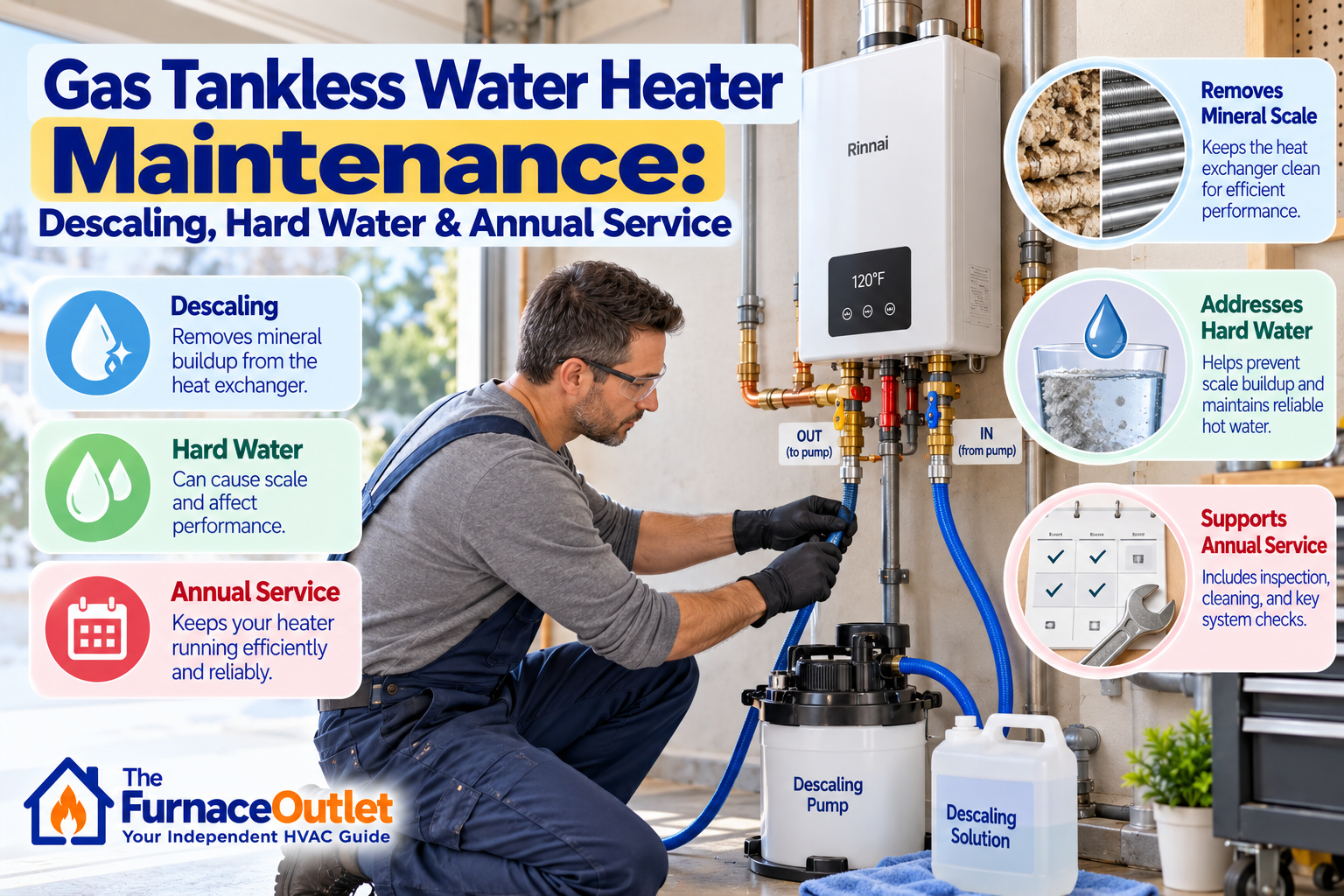
A gas tankless water heater does not have a large storage tank that can accumulate years of sediment in quite the same way as a conventional water heater, but that does not make it maintenance-free. Mineral scale can form inside the heat exchanger, inlet screens can collect debris, condensate systems on condensing models need attention, and combustion-related components must remain clean and operating correctly. The amount of maintenance required depends heavily on water quality, household usage, installation conditions and the manufacturer’s instructions for the exact model.
For me, the most important maintenance principle is to avoid treating every tankless heater and every home the same. A house with very hard water may need much more frequent scale management than a home supplied with naturally soft water. Likewise, a condensing gas tankless heater has maintenance considerations that a non-condensing model may not have. I would therefore build the maintenance schedule around water hardness, appliance design, actual operating conditions and the manufacturer’s current service instructions, rather than relying on a universal internet rule such as “flush every tankless heater once a year.”
Inside a tankless heater, cold water passes through a compact heat exchanger while a gas burner produces a large amount of heat. A whole-home model can approach 200,000 BTU/h at maximum firing, which allows the appliance to heat several gallons of water every minute. That combination of high heat transfer and continuously flowing water makes the condition of the heat exchanger particularly important.
Water naturally contains dissolved minerals. Calcium and magnesium are especially relevant because they can form scale when water is heated. The harder the water and the more hot water the household uses, the greater the potential for mineral accumulation.
Scale can coat heat-transfer surfaces and restrict small water passages. Over time, excessive buildup may interfere with heat transfer, water flow and overall performance. Manufacturers therefore include cleaning, inspection and maintenance procedures in their documentation, although the recommended frequency and procedure vary.
Gas equipment also has a combustion side. Air intake, exhaust venting, burner components and related systems must remain in appropriate condition. A maintenance plan that focuses only on descaling while ignoring the rest of the appliance is incomplete.
Water hardness is usually expressed in milligrams per liter or parts per million of calcium carbonate, or in grains per gallon. The U.S. Geological Survey commonly classifies water as soft at 0–60 mg/L, moderately hard at 61–120 mg/L, hard at 121–180 mg/L and very hard above 180 mg/L.
That classification provides useful context because two identical tankless heaters can experience very different conditions. A heater operating with soft water may accumulate scale relatively slowly, while the same model serving very hard water can face substantially greater mineral deposition.
I would therefore find out the home’s water hardness rather than guessing. Municipal water-quality reports can provide useful information, although hardness can vary by source and location. A simple water-hardness test can provide more specific information for the actual property.
Hard water itself is not necessarily evidence that something is wrong with the water supply. The maintenance issue is what happens when dissolved minerals repeatedly pass through a high-temperature heat exchanger.
Descaling circulates an appropriate cleaning solution through the water side of the tankless heater to dissolve or loosen mineral deposits. Many tankless installations include hot- and cold-water service valves specifically to make this procedure easier.
A typical professional descaling process involves isolating the heater from the home’s domestic-water piping, connecting service hoses, circulating an approved cleaning solution through the heat exchanger and then flushing the system according to the manufacturer’s procedure. The appliance is subsequently returned to normal operation and checked.
The exact cleaning solution, circulation time, valve sequence and flushing procedure should come from the manufacturer’s documentation. I would not assume that a procedure demonstrated for one brand automatically applies to another.
This distinction matters because a tankless water heater contains sensors, valves, seals and heat-exchanger materials that were engineered as a complete system. Descaling should follow the instructions for the actual appliance rather than a generic procedure copied from an unrelated model.
There is no maintenance interval that I would confidently apply to every gas tankless heater. Manufacturer recommendations vary, and water quality can change how frequently cleaning is appropriate.
Rinnai, for example, states that maintenance frequency can depend on water quality and notes that scale buildup can affect performance. Navien likewise provides maintenance procedures and water-quality guidance for its tankless equipment. The manufacturer’s manual for the specific model should therefore be the starting point.
In practice, annual inspection or maintenance is a sensible planning point for many homes, but that does not mean every heater automatically requires an identical chemical descaling procedure exactly every 12 months. A home with very hard water or unusually heavy hot-water use may need more frequent attention, while another installation may have different manufacturer guidance.
I would keep a maintenance record showing the installation date, water hardness, service dates, descaling history and any error codes or repairs. After several years, that record can provide a much better maintenance strategy than a generic calendar reminder.
Scale buildup does not always announce itself with a single obvious symptom. Changes in performance can develop gradually, which makes them easy to overlook.
I would investigate unexplained reductions in hot-water flow, difficulty maintaining the expected outlet temperature, unusual operating noises, recurring error codes or changes in performance that cannot be explained by seasonal incoming-water temperature. None of these symptoms proves that mineral scale is the cause, because gas supply, flow sensors, filters and other components can produce similar problems.
That is another reason I prefer diagnosis over automatically descaling whenever a heater behaves differently. The maintenance procedure should address the actual problem.
Descaling receives most of the attention, but the cold-water inlet filter or screen can be equally important. Debris entering from the water supply can collect at the inlet and restrict flow.
Many manufacturers provide procedures for shutting off the water supply, removing the inlet filter, cleaning it and reinstalling it. Because designs differ, I would follow the exact manual rather than assuming the filter location or removal method.
A partially blocked inlet filter can produce symptoms that homeowners may incorrectly attribute to a failing heater. Including the filter in routine inspection is therefore a relatively simple but valuable maintenance step.
High-efficiency condensing gas tankless heaters recover additional heat from combustion gases. That improves efficiency, but the process also creates liquid condensate that has to leave the appliance through a properly designed drainage system.
During maintenance, I would include the condensate drain, tubing and any trap or related components specified by the manufacturer. A blocked or improperly functioning condensate path can interfere with operation.
Some installations also use a condensate neutralizer to raise the pH before condensate enters the drainage system. Where a neutralizer is installed, its media does not last indefinitely and may require inspection or replacement according to the manufacturer’s recommendations and applicable requirements.
I would not state that every condensing tankless installation universally requires a neutralizer because requirements vary with the appliance, drainage arrangement and local rules. What is universal is that the condensate system cannot simply be ignored during maintenance.
A gas tankless heater needs reliable combustion air and a safe exhaust path. Intake or exhaust openings can potentially be affected by debris, vegetation, insects, snow, ice or other obstructions depending on the installation.
I would visually inspect accessible exterior terminations periodically and have the combustion and venting system evaluated as appropriate during professional service. In cold climates, snow accumulation and frost deserve particular attention because they can interfere with terminations if the installation or surrounding conditions become problematic.
The exact vent material, configuration and service requirements depend on the heater. Maintenance should therefore include checking for conditions such as deterioration, loose connections or obstruction while respecting the manufacturer’s venting instructions.
This part of servicing is especially important because combustion and carbon-monoxide safety are involved. I would leave internal combustion-system inspection, adjustment and gas-related diagnostic work to an appropriately qualified technician.
Not automatically. I would first establish how hard the water actually is, understand the heater manufacturer’s water-quality requirements and then evaluate the entire household’s water-treatment needs.
A conventional ion-exchange water softener can significantly reduce calcium and magnesium hardness, which can help control scale throughout the home’s plumbing system. Other scale-control technologies also exist, but they should not automatically be treated as equivalent to actual softening.
The correct solution depends on the water chemistry. Extremely hard water, iron, sediment, chlorides and other water-quality characteristics can present different issues, so a proper water analysis is more useful than choosing treatment solely because the house has a tankless heater.
Most importantly, I would check the heater manufacturer’s published water-quality limits before designing a treatment strategy.
Even if a home has a water softener or another treatment system, I would not assume that the tankless heater can now be ignored indefinitely. Treatment equipment itself requires maintenance, and other debris or operating conditions can still affect the water heater.
The better approach is to think of water treatment and heater maintenance as complementary. Treatment can reduce the conditions that encourage scale formation, while periodic inspection confirms whether the strategy is actually working.
If a heater previously required frequent descaling and a properly designed treatment system dramatically reduces scale accumulation, the service history can help determine an appropriate future schedule in conjunction with manufacturer guidance.
For a typical whole-home gas tankless heater, I would want annual service to be broader than simply pumping descaling solution through the heat exchanger. The technician should evaluate the appliance according to the manufacturer’s maintenance checklist and the conditions of the installation.
That may include examining and cleaning water inlet screens, evaluating scale accumulation, descaling when appropriate, checking for water or gas leaks, inspecting accessible combustion-air and exhaust components, examining burner or combustion-related components where specified, checking condensate drainage on condensing models and reviewing stored diagnostic or error information.
I would also want confirmation that the appliance operates normally after service. The exact tasks should come from the manufacturer’s documentation because there is no legitimate one-size-fits-all service checklist for every tankless heater.
Some manufacturers provide homeowner-accessible maintenance information, and mechanically experienced homeowners may be comfortable with certain water-side maintenance procedures. However, I would separate water-side descaling from gas-appliance servicing.
Closing service valves and circulating an approved cleaning solution through a properly installed service-valve arrangement is very different from opening combustion components, adjusting gas settings, diagnosing ignition problems or modifying venting. Gas and combustion work can have serious safety consequences if performed incorrectly.
If I were unsure about the valve sequence, cleaning solution, flushing procedure or safe restoration of the heater to service, I would use a qualified professional. I would also use professional service for combustion problems, repeated error codes, gas-pressure concerns, venting issues or suspected carbon-monoxide problems.
Professional tankless maintenance costs vary significantly by market, heater design and what the service includes, so I would avoid presenting one national price as though it applied everywhere. A simple water-side flush is not equivalent to comprehensive diagnostic and combustion service.
The more useful financial comparison is preventive maintenance versus avoidable deterioration. Tankless heaters are relatively sophisticated appliances with heat exchangers, electronic controls, sensors, valves and combustion components. Allowing severe scale accumulation to develop in a high-value appliance simply to avoid periodic service can be false economy.
I would ask contractors to state exactly what their maintenance price includes. If one quote covers only flushing while another includes cleaning, inspection, combustion checks and operational testing, the prices should not be compared as equivalent services.
One of the easiest improvements a homeowner can make costs almost nothing. I would maintain a record containing the heater’s exact model and serial number, installation date, water-hardness measurement, service dates, descaling dates, error codes, repairs and components replaced.
I would also record major changes to the home’s water system, such as installing a softener, replacing a well system or changing filtration equipment.
That history becomes increasingly valuable as the heater ages. If performance begins declining, the homeowner and technician can see whether maintenance has been consistent and whether a particular problem is recurring.
Not necessarily on an identical annual schedule in every home. Maintenance frequency should reflect manufacturer instructions, water hardness, usage and operating conditions. Annual inspection or service is a reasonable planning approach for many installations, while hard-water conditions may justify more frequent scale management.
In water conditions that promote mineral accumulation, scale can build up in the heat exchanger and potentially affect heat transfer, flow and performance. The rate varies substantially with water quality and usage, which is why the manufacturer’s maintenance guidance and actual water hardness matter.
Hard water can promote mineral-scale formation inside the water passages and heat exchanger. Severe or unmanaged scale can interfere with operation and potentially contribute to premature problems. Check the manufacturer’s water-quality specifications and consider appropriate treatment where water conditions warrant it.
Some homeowners perform water-side flushing using manufacturer-approved procedures and properly installed service valves. However, procedures vary by model, and gas, combustion, burner and venting work should be treated separately. When uncertain, I would use an appropriately qualified professional.
I would not assume so. Effective softening can greatly reduce hardness minerals and scale potential, but the heater still requires inspection and maintenance according to manufacturer recommendations. Water-treatment equipment also needs its own maintenance.
They add a condensate-management system that should be inspected and maintained. That does not necessarily make them troublesome; it simply adds components such as condensate drainage and, in some installations, neutralization equipment to the maintenance checklist.
I would approach gas tankless maintenance as preventive care rather than emergency repair. Start by understanding the home’s water hardness and the manufacturer’s water-quality requirements. Keep the inlet filter clean, monitor performance, manage mineral scale according to actual conditions and manufacturer guidance, and include venting, combustion air and condensate components in the broader service plan.
I would also avoid two extremes. The first is assuming that tankless means maintenance-free. The second is assuming that every heater must undergo exactly the same descaling procedure every 12 months regardless of water quality. Neither approach reflects how these appliances actually operate.
For me, the best maintenance strategy is straightforward: know the water quality, follow the exact manufacturer’s maintenance schedule, descale when conditions and instructions warrant it, keep intake and exhaust pathways unobstructed, maintain the condensate system on condensing equipment, investigate performance changes early and keep a service record. That approach gives a gas tankless water heater the best opportunity to maintain reliable flow, efficient heat transfer and dependable hot-water performance over its service life.
For general water-hardness classifications and mineral information, see U.S. Geological Survey — Hardness of Water. For gas tankless operation and maintenance context, see U.S. Department of Energy Building Science Education — Gas-Fired Tankless Water Heaters and ENERGY STAR — Whole-Home Tankless Gas Water Heaters. Manufacturer-specific maintenance requirements should always be checked against the current documentation for the installed equipment, including Rinnai Support and FAQs and Navien Tankless Water Heaters.
The Furnace Outlet provides this article for general educational purposes and not as a substitute for the installation, maintenance or service instructions supplied with a specific appliance. Water chemistry, maintenance intervals and servicing procedures vary by manufacturer, model and installation. Gas, combustion and venting work can create fire, explosion and carbon-monoxide hazards when performed incorrectly and should be handled by appropriately qualified professionals where required.
The Furnace Outlet is an independent informational resource and is not associated with, endorsed by or affiliated with Rinnai, Navien, ENERGY STAR, the U.S. Geological Survey, the U.S. Department of Energy or any manufacturer or organization mentioned. Product names and trademarks are the property of their respective owners.
