Newsletter Subscribe
Enter your email address below and subscribe to our newsletter

HVAC made simple
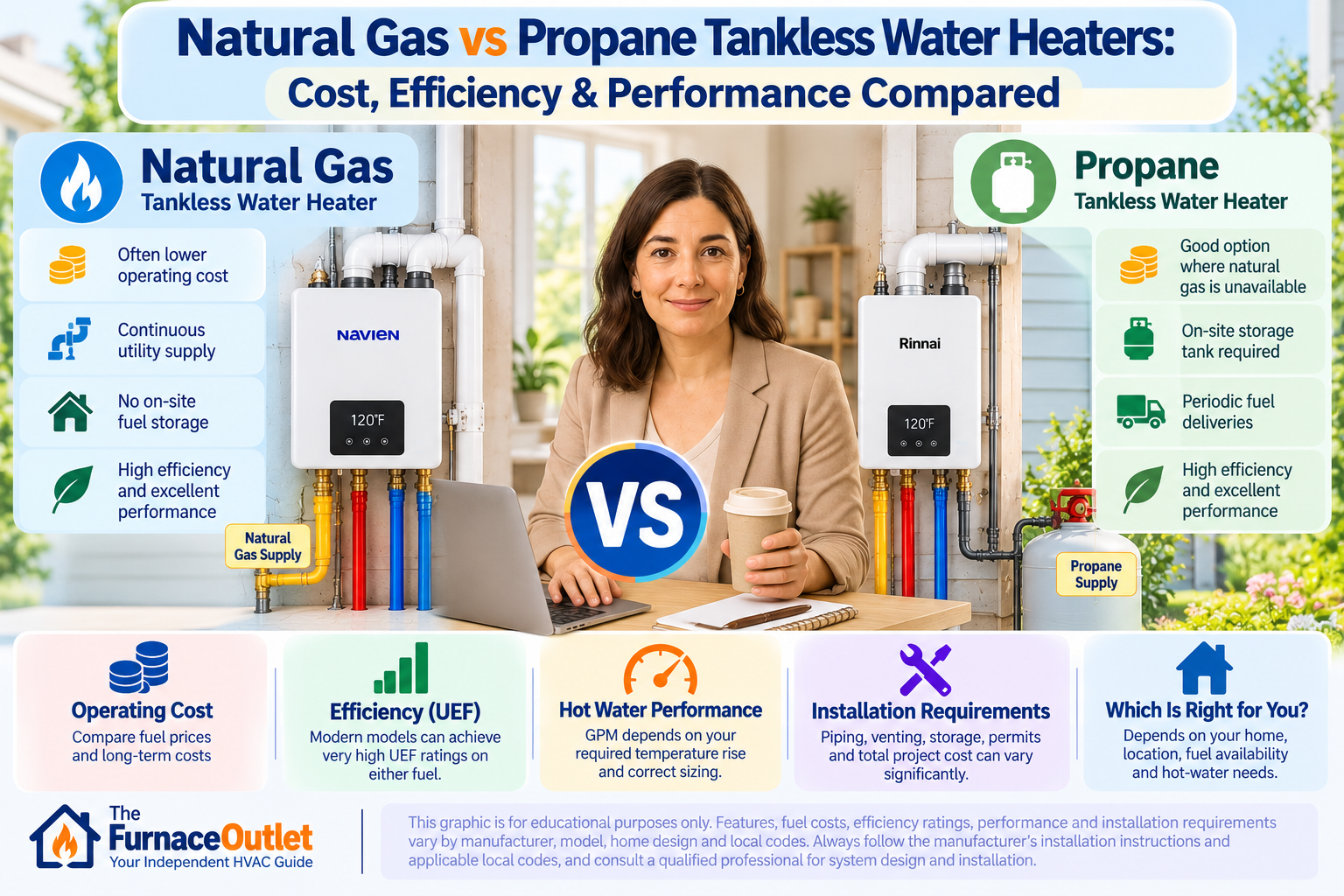
When I compare natural gas and propane tankless water heaters, I start with an important point that is easy to overlook: the fuel does not automatically determine how good the water heater will be. Modern tankless models can deliver excellent hot-water performance on either natural gas or propane, and some premium heaters are designed to operate on either fuel when correctly configured. The bigger differences usually involve fuel availability, local energy prices, gas-supply pressure, storage requirements and the infrastructure needed to deliver enough fuel to the appliance.
For a home already connected to utility natural gas, I would generally choose natural gas because it is convenient, continuously supplied and often less expensive to operate. For a rural property without natural-gas service, however, propane can make a high-output gas tankless heater practical without extending a utility gas main. Propane also stores substantial energy on the property, but the homeowner then needs a propane tank, regulator system and scheduled or monitored fuel deliveries.
The most useful comparison is therefore not simply natural gas versus propane. I would compare the complete installed system and long-term fuel cost while confirming that the exact heater can produce the required GPM at the home’s winter temperature rise.
Both systems operate according to essentially the same tankless principle. When a hot-water fixture opens, cold water begins flowing through the heater. A flow sensor detects demand, the controls activate the burner and the heat exchanger transfers combustion heat into the moving water. When hot-water demand stops, the burner shuts down.
ENERGY STAR explains that gas tankless water heaters save energy by heating water only when needed rather than continuously maintaining a storage tank at temperature. Current ENERGY STAR-certified gas-fired instantaneous water heaters must achieve a UEF of at least 0.95, along with minimum flow-rate, warranty and safety requirements.
That operating principle applies whether the burner receives natural gas or propane. What changes is the fuel-delivery system and the heater’s gas configuration.
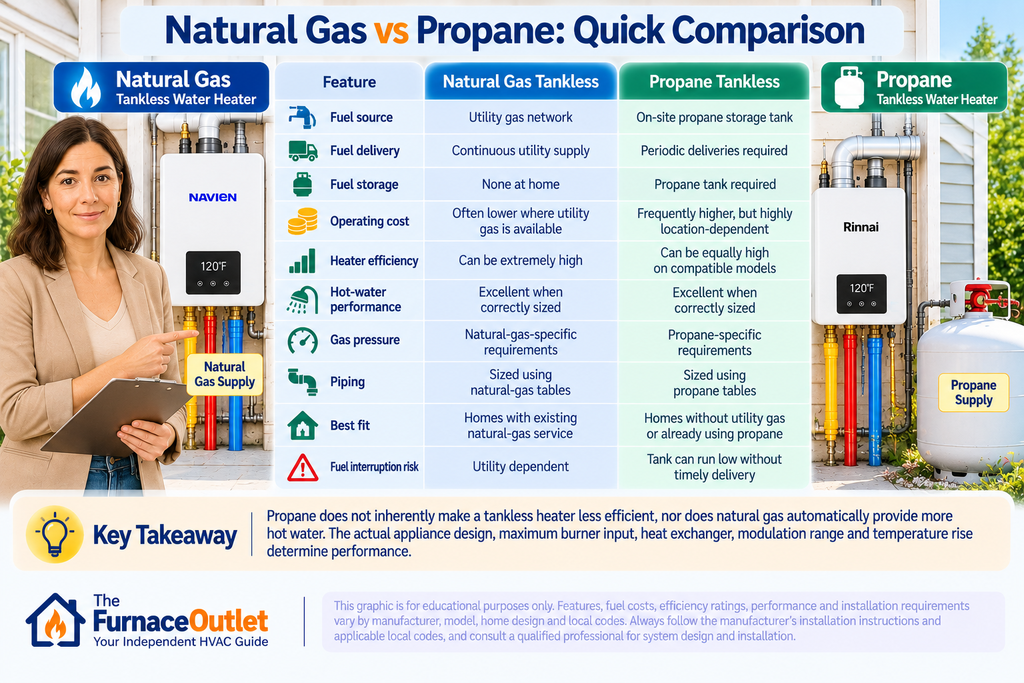
| Feature | Natural Gas Tankless | Propane Tankless |
|---|---|---|
| Fuel source | Utility gas network | On-site propane storage tank |
| Fuel delivery | Continuous utility supply | Periodic deliveries required |
| Fuel storage | None at home | Propane tank required |
| Operating cost | Often lower where utility gas is available | Frequently higher, but highly location-dependent |
| Heater efficiency | Can be extremely high | Can be equally high on compatible models |
| Hot-water performance | Excellent when correctly sized | Excellent when correctly sized |
| Gas pressure | Natural-gas-specific requirements | Propane-specific requirements |
| Piping | Sized using natural-gas tables | Sized using propane tables |
| Best fit | Homes with existing natural-gas service | Homes without utility gas or already using propane |
| Fuel interruption risk | Utility dependent | Tank can run low without timely delivery |
The most important point in this comparison is that propane does not inherently make a tankless heater less efficient, nor does natural gas automatically provide more hot water. The actual appliance design, maximum burner input, heat exchanger, modulation range and temperature rise determine performance.
If efficiency is your main concern, fuel type may matter less than expected. Some modern tankless heaters carry essentially the same efficiency rating whether configured for natural gas or propane.
The Navien NPE-240A2 provides an excellent example. It is field-convertible between natural gas and propane and is rated at 0.95 UEF on either fuel. Its maximum input is also essentially identical at 199,900 BTU/h for natural gas and propane.
Rinnai’s SENSEI RX199iN provides another useful example. Rinnai lists the model for natural gas or propane, with a 0.98 UEF, maximum input of 199,000 BTU/h and maximum domestic hot-water flow rating of 11.1 GPM.
These examples show why I would not say that one fuel is automatically more efficient than the other. Efficiency belongs primarily to the appliance design, while fuel price determines how much that energy ultimately costs the homeowner.
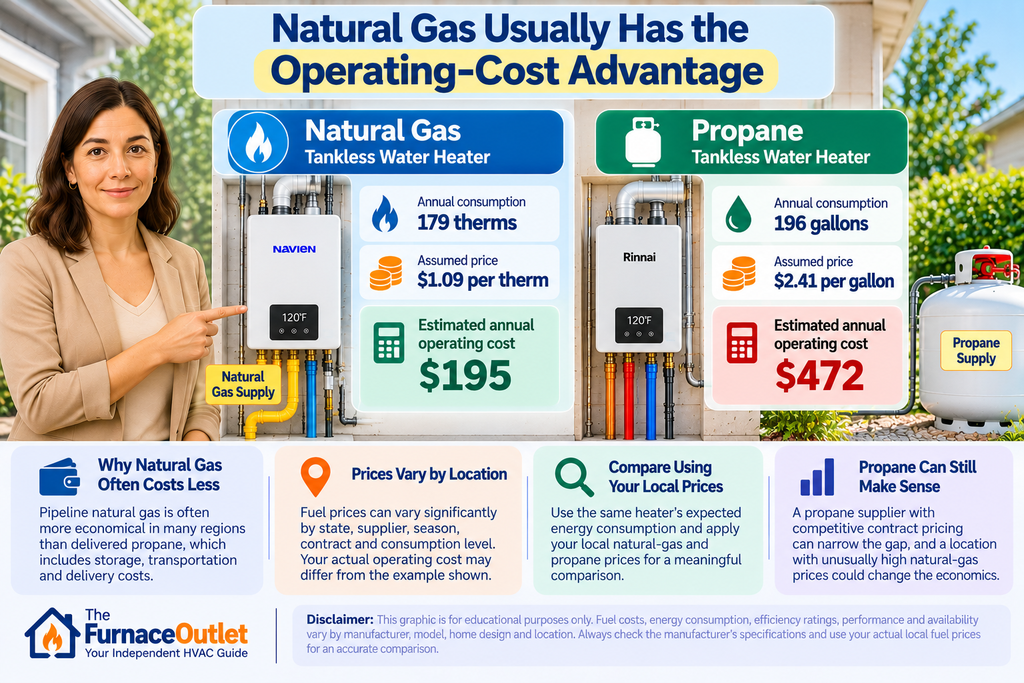
For many U.S. households that already have natural-gas service, operating cost is the strongest argument for natural gas. Pipeline natural gas has historically been a relatively economical residential heating fuel in many regions, whereas delivered propane includes the logistics of storage, transportation and delivery.
Navien provides a particularly useful apples-to-apples illustration for its NPE-240A2. Using the assumptions published on its product page, the manufacturer estimates annual consumption of 179 therms for natural gas versus 196 gallons for propane. Using its stated assumed prices of $1.09 per therm for natural gas and $2.41 per gallon for propane, Navien calculates estimated annual operating costs of $195 on natural gas versus $472 on propane.
I would not use those dollar figures as a prediction for every household. Fuel prices can vary dramatically by state, supplier, season, contract and consumption level. The useful lesson is the methodology: compare the same heater’s expected energy consumption using your actual local natural-gas and propane prices.
A propane supplier offering competitive contract pricing could narrow the gap considerably, while a location with unusually expensive propane could widen it.
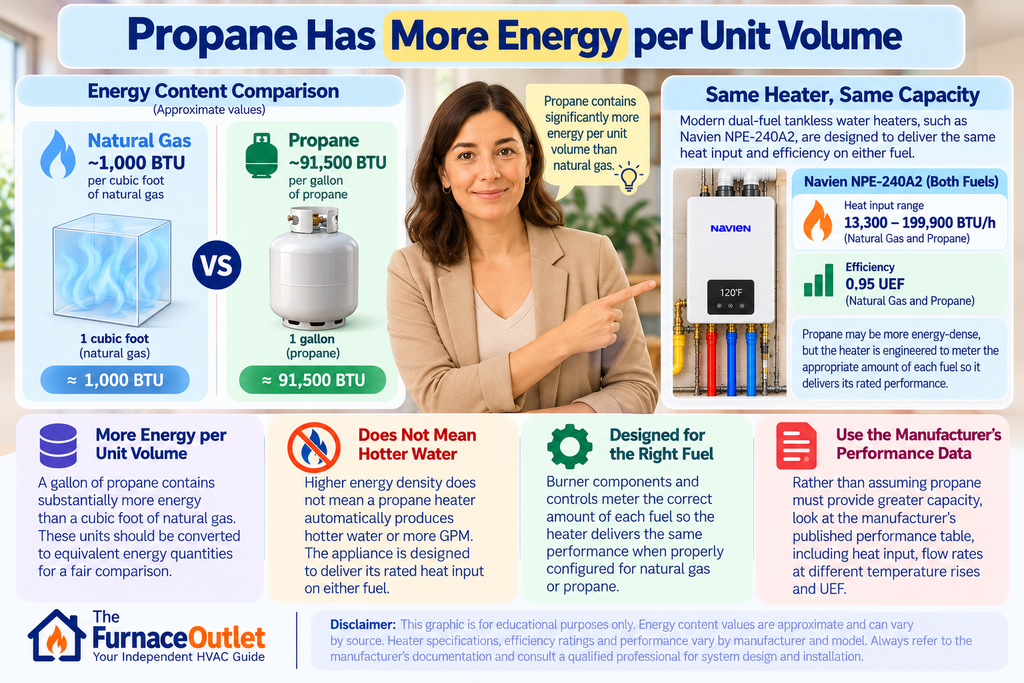
Propane is a highly energy-dense fuel. A gallon of propane contains substantially more energy than a cubic foot of natural gas, although those units should not be compared directly without converting them to equivalent energy quantities.
This higher energy density does not mean a propane tankless heater automatically produces hotter water or more GPM. Burner components and controls are designed to meter the appropriate amount of each fuel so that the appliance delivers its rated heat input.
That distinction matters because homeowners sometimes hear that propane “burns hotter” and conclude that a propane version of the same heater must have greater capacity. Modern dual-fuel-capable equipment demonstrates why that assumption is unreliable. Navien lists the NPE-240A2 at 13,300 to 199,900 BTU/h on both natural gas and propane, with the same 0.95 UEF rating.
The heater’s published performance table is therefore more useful than assumptions about the fuel itself.
When selecting either fuel, I would focus heavily on GPM at the required temperature rise. A tankless heater’s maximum advertised flow rate does not mean it will produce that flow under every condition.
Navien’s NPE-240A2 illustrates this particularly well. The manufacturer publishes approximately 11.2 GPM at a 35°F temperature rise, 7.8 GPM at a 50°F rise, 6.5 GPM at a 60°F rise, 5.6 GPM at a 70°F rise and 4.9 GPM at an 80°F rise.
If winter groundwater enters at 40°F and you want 120°F hot water, the heater must create an 80°F rise. A homeowner who selected the unit based only on the headline 11.2-GPM figure could therefore develop unrealistic expectations.
I would calculate the home’s simultaneous fixture demand, determine the winter temperature rise and then consult the manufacturer’s performance table. That process is the same whether the heater uses natural gas or propane.
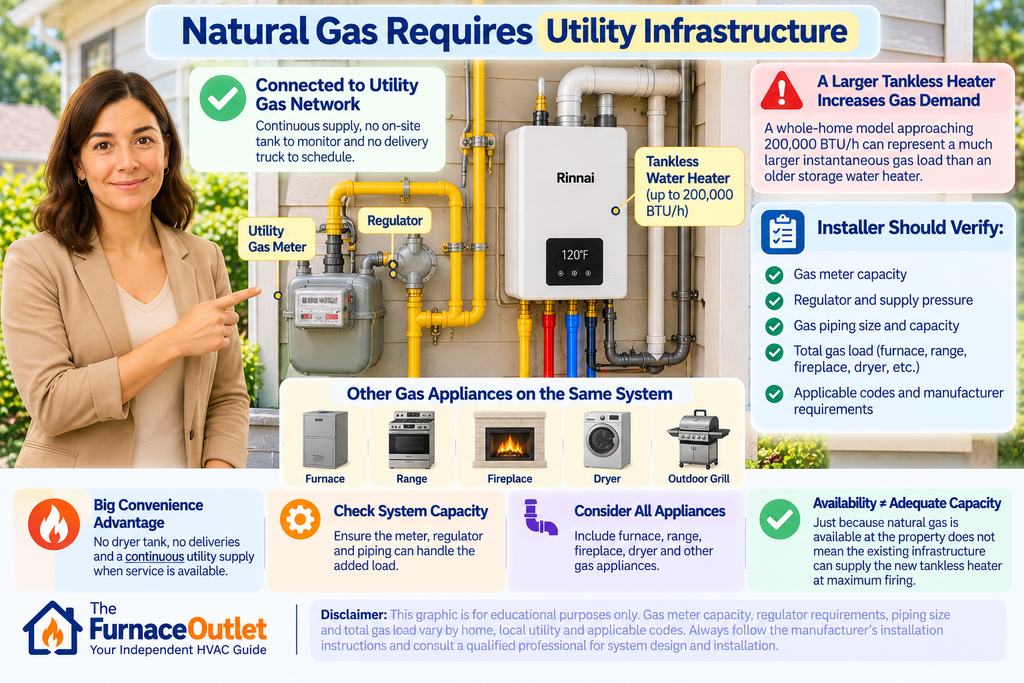
Natural gas has a major convenience advantage when the house is already connected to a utility gas network. There is no outdoor fuel tank to monitor and no delivery truck to schedule. As long as utility service is operating and the home’s gas system has sufficient capacity, fuel is continuously available.
However, installing a large tankless heater can expose limitations in an existing natural-gas system. A whole-home model approaching 200,000 BTU/h can represent a much larger instantaneous gas load than an older storage water heater.
The installer therefore needs to verify the gas meter, regulator, supply pressure and piping capacity while considering the furnace, range, fireplace, dryer and other gas appliances served by the system. The fact that natural gas is available at the property does not prove that the existing infrastructure can supply the new tankless heater at maximum firing.
Propane solves a different problem because it allows a homeowner to use a powerful gas water heater without having a natural-gas utility connection. Fuel is stored on the property in an approved tank and delivered by a propane supplier.
This arrangement can be extremely practical for rural homes. The tradeoff is that fuel inventory becomes the homeowner’s responsibility. The tank needs adequate capacity, regulators must be correctly designed and fuel deliveries need to occur before the supply becomes too low.
Automatic delivery and remote tank monitoring can reduce that inconvenience. Even so, I would consider propane-tank capacity as part of the water-heater decision, particularly if propane also serves the furnace, cooking appliances, fireplace or generator.
A large tankless heater can consume fuel rapidly when operating at high fire, so the entire propane system needs to support the combined household load.
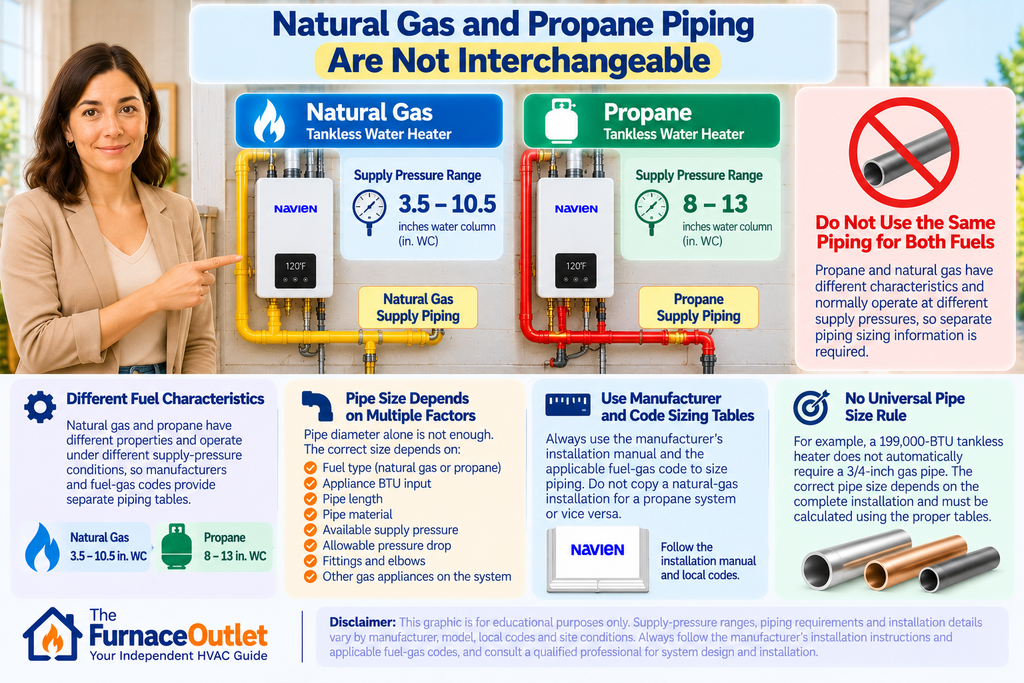
I would never size propane piping by simply copying a natural-gas installation. The fuels have different characteristics and normally operate under different supply-pressure conditions, so manufacturers and fuel-gas codes provide separate sizing information.
Navien’s NPE-240A2 demonstrates the difference clearly. The manufacturer specifies a natural-gas supply-pressure range of 3.5 to 10.5 inches water column, while propane supply pressure is listed at 8 to 13 inches water column.
Pipe diameter alone is not enough to determine whether either system is adequate. The calculation needs to consider fuel type, appliance BTU input, pipe length, material, available pressure, allowable pressure drop, fittings and the other loads served by the piping.
This is why I would not publish a universal rule such as “a 199,000-BTU tankless heater requires a 3/4-inch gas pipe.” The correct pipe size depends on the complete installation.
Sometimes, and this is becoming an attractive feature of certain premium tankless platforms. Rinnai states that its RX199iN can use either natural gas or propane, while Navien describes all NPE-2 models as field-convertible from natural gas to LP.
That flexibility should not be interpreted as permission to switch fuels casually. Gas conversion must follow the manufacturer’s approved procedure and use the required components, settings and commissioning process. Gas pressure and combustion operation need to be correct for the selected fuel.
Some tankless models are sold in fuel-specific versions instead. I would therefore verify the exact model number and manufacturer documentation before purchase rather than assuming every natural-gas heater can be converted to propane.
If utility natural gas does not reach the property, propane often becomes the more practical gas option. Extending a natural-gas main to an isolated property may be impossible or prohibitively expensive, whereas installing a propane storage system can provide fuel for water heating, space heating, cooking and other appliances.
Propane also gives the homeowner an on-site fuel reserve. That can be attractive in locations where energy independence matters, although most modern tankless heaters still require electricity for controls, ignition and fans, so stored propane alone does not guarantee hot water during an electrical outage.
I would therefore compare propane not with hypothetical natural gas that is unavailable, but with the realistic alternatives at the property, including electricity and heat-pump water heating.
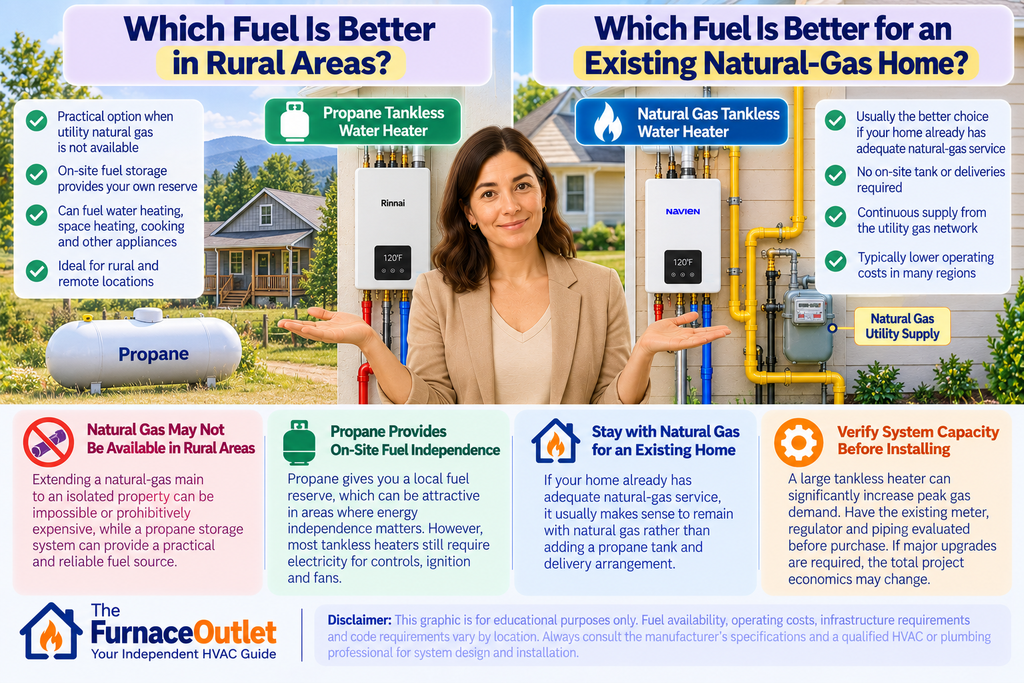
If the house already has adequate natural-gas service, I would usually remain with natural gas unless there were unusual local circumstances. Adding a propane tank and delivery arrangement simply to operate a water heater generally creates infrastructure that the house did not previously need.
The important qualification is adequate service. A 199,000-BTU/h tankless heater can materially increase peak gas demand. Before purchasing it, I would have the existing meter, regulator and piping evaluated rather than discovering after installation that expensive gas-system upgrades are required.
If those upgrades are substantial, the total project economics may change enough to justify reconsidering the equipment or even the energy source.
Natural gas often has an advantage in a home where an adequate utility connection already exists. Propane installation may require a storage tank, regulators, site preparation and new piping in addition to the water heater itself.
The situation can reverse in a rural home that already uses propane. If the property already has a properly sized propane system, adding a compatible tankless heater may be relatively straightforward, whereas obtaining natural-gas service may not be realistic at any price.
I would therefore compare total installed cost, including the heater, gas piping, meter or regulator upgrades, propane tank where applicable, venting, condensate drainage for condensing models, plumbing, electrical work, permits and labor.
Natural gas is often less expensive where utility service is available, but local fuel prices determine the actual answer. Navien’s published NPE-240A2 example estimates $195 annually on natural gas versus $472 on propane using its stated national-price assumptions, but homeowners should substitute their own current local rates.
Not necessarily. Some dual-fuel-capable tankless heaters carry the same UEF on either fuel. Navien lists the NPE-240A2 at 0.95 UEF for both natural gas and propane.
Not automatically. Hot-water output depends primarily on the appliance’s rated capacity and the required temperature rise. Properly configured versions of the same heater can provide comparable performance on either fuel.
Only when the manufacturer specifically approves the model for conversion and its prescribed conversion procedure is followed. Some current platforms, including Navien NPE-2 models, are designed to be field-convertible.
Yes, propane can be an excellent gas option where utility natural gas is unavailable, particularly when the property already uses propane for other appliances. Fuel-storage capacity, delivery logistics and local propane prices should be included in the decision.
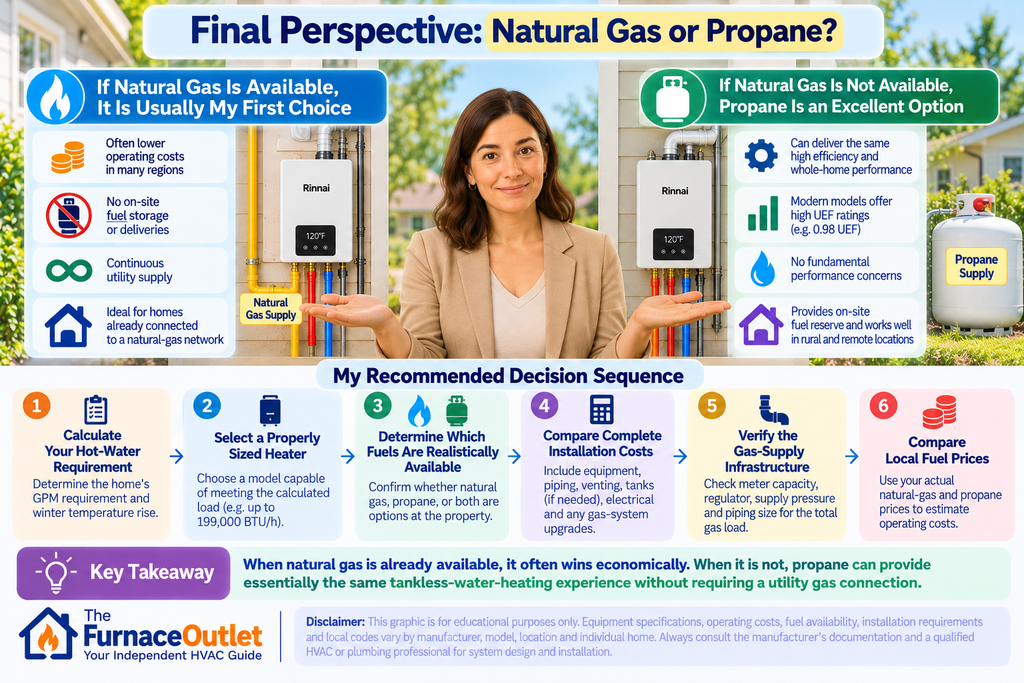
If I had reliable natural-gas service already available at the house, natural gas would usually be my first choice. It eliminates on-site fuel storage and deliveries, provides a continuous utility supply and frequently offers a meaningful operating-cost advantage.
If natural gas were unavailable, I would have no fundamental performance concern about choosing propane. Modern propane-compatible tankless heaters can deliver the same kind of high efficiency and whole-home hot-water performance as their natural-gas counterparts. Rinnai’s RX199iN, for example, is listed for natural gas or propane while delivering a 0.98 UEF rating, up to 199,000 BTU/h input and up to 11.1 GPM maximum flow.
For me, the correct sequence is to calculate the home’s GPM requirement and winter temperature rise first, select a heater capable of meeting that load, determine which fuels are realistically available, compare complete installation costs, verify the gas-supply infrastructure and then compare local fuel prices. When natural gas is already available, it often wins economically. When it is not, propane can provide essentially the same tankless-water-heating experience without requiring a utility gas connection.
For current efficiency requirements, see ENERGY STAR Residential Water Heater Key Product Criteria and ENERGY STAR’s explanation of whole-home gas tankless technology. For real-world dual-fuel specifications and operating-cost examples, see Navien NPE-240A2 specifications and Rinnai SENSEI RX199iN specifications.
The Furnace Outlet provides this guide for general educational and product-research purposes. Fuel prices, tankless performance, gas pressure, piping requirements, propane-storage requirements, installation costs and applicable codes vary by property and jurisdiction. Natural-gas and propane systems involve combustible fuels, so installation, fuel conversion, gas-piping modifications and commissioning should follow the exact manufacturer’s instructions and applicable codes and be performed by appropriately qualified professionals where required.
The Furnace Outlet is an independent informational resource. We are not associated with, endorsed by, sponsored by or affiliated with Rinnai, Navien, ENERGY STAR or any other manufacturer or organization mentioned. Product names and trademarks remain the property of their respective owners, and current manufacturer specifications should always be verified before purchase or installation.