Newsletter Subscribe
Enter your email address below and subscribe to our newsletter

HVAC made simple
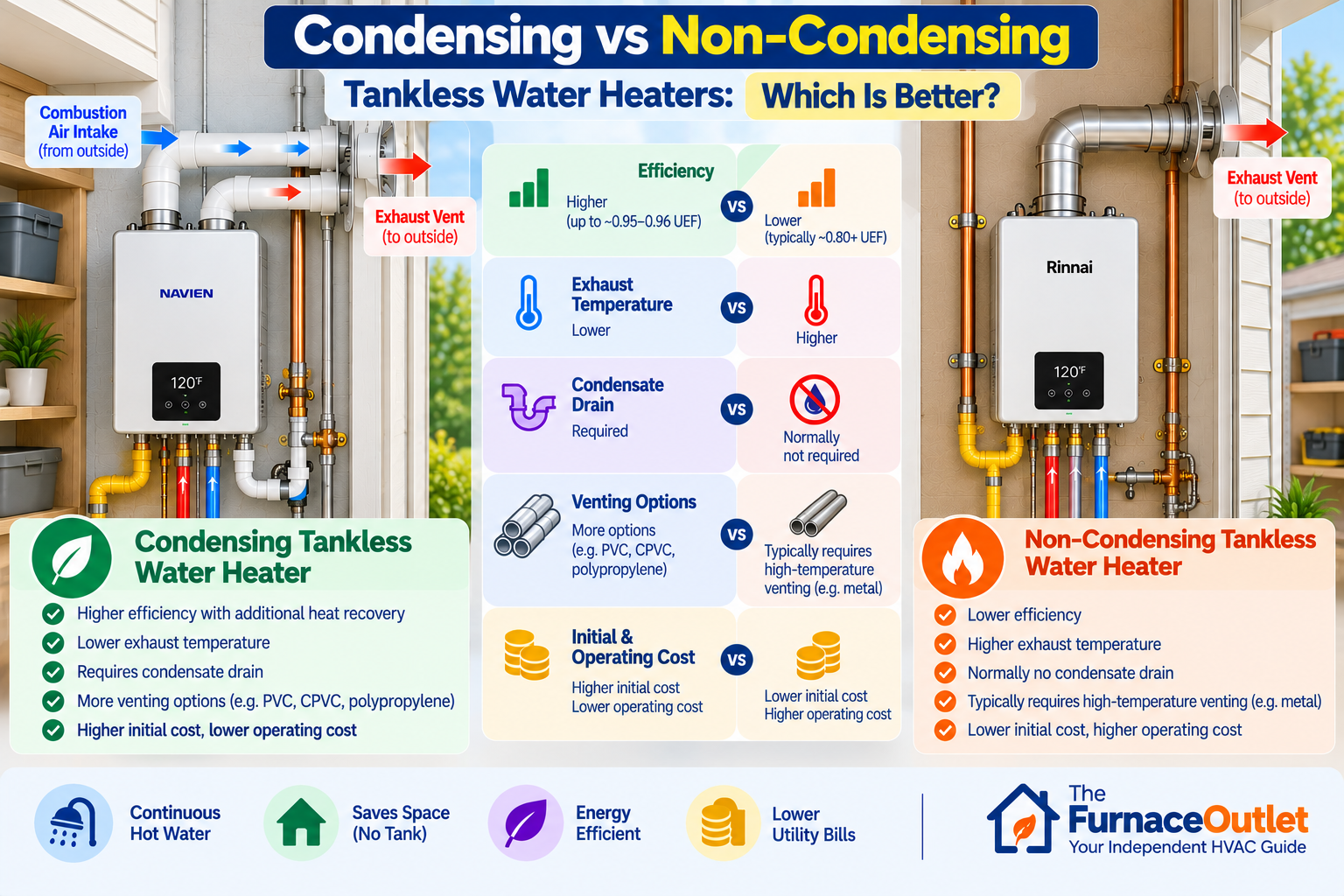
Choosing between a condensing and non-condensing tankless water heater is more complicated than simply comparing efficiency ratings. Both technologies heat water on demand, both can provide continuous hot water when properly sized, and both eliminate the standby losses associated with keeping a conventional storage tank hot. The important difference is what happens to the heat remaining in the combustion gases after the burner has heated the water.
A non-condensing tankless heater allows relatively hot combustion gases to leave the appliance through an approved high-temperature venting system. A condensing heater goes one step further by extracting additional heat from those combustion gases before they leave the unit. That extra heat recovery improves efficiency and lowers exhaust temperature, but it also creates condensate that has to be drained properly.
For most new whole-home installations, I generally prefer a high-efficiency condensing tankless water heater, provided the installation location can accommodate condensate drainage and the rest of the project makes sense. However, non-condensing equipment can still be a practical choice when lower initial equipment cost, simpler drainage requirements or an existing compatible venting arrangement makes it attractive. The right answer depends on the complete installation rather than efficiency alone.
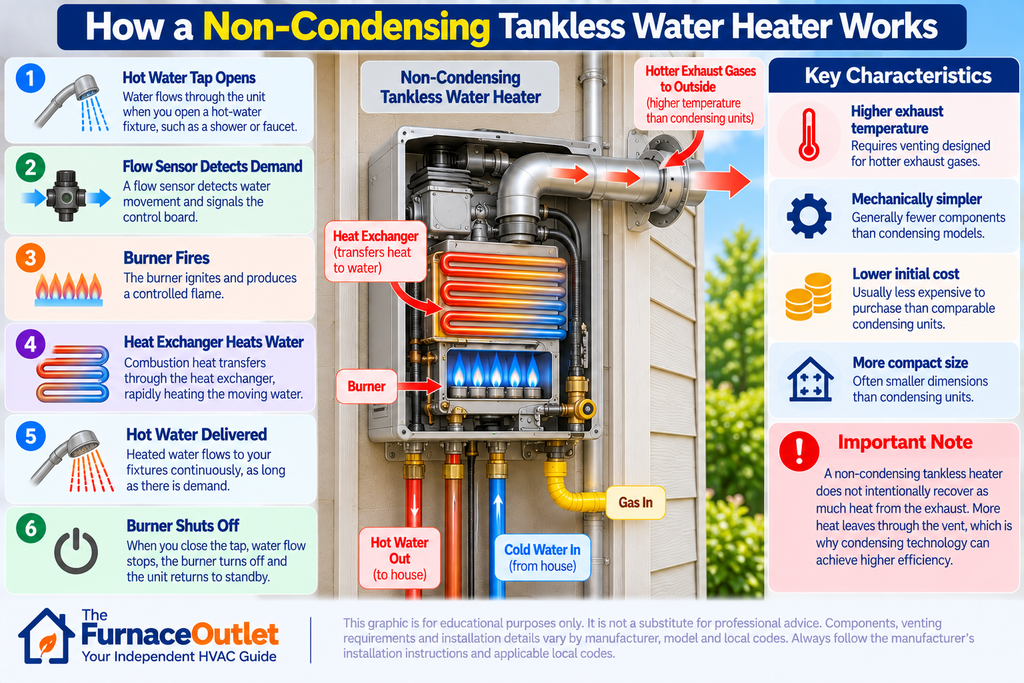
A non-condensing gas tankless water heater follows a relatively straightforward process. When a hot-water fixture opens, water begins flowing through the appliance, a flow sensor detects demand, the burner fires and a heat exchanger transfers combustion heat into the moving water. Once the requested hot-water flow stops, the burner shuts down.
The important distinction is that the appliance does not intentionally recover as much residual heat from the exhaust as a condensing system does. Combustion gases therefore leave the heater at a higher temperature, and the vent system has to be designed for those hotter exhaust conditions.
This can make non-condensing equipment mechanically simpler. Current manufacturer comparisons commonly show non-condensing models with lower initial equipment cost and somewhat smaller dimensions than comparable condensing units. Navien, for example, currently describes its non-condensing equipment as generally less expensive initially, while its comparison material lists non-condensing efficiency above 0.80 UEF and condensing efficiency as high as approximately 0.96 UEF within its product families. Navien
The tradeoff is that heat leaving through the exhaust represents energy that was purchased but was not transferred into the household’s water. That is the fundamental reason condensing technology can achieve higher efficiency.
A condensing tankless water heater adds another stage of heat recovery. After combustion gases transfer heat through the primary heat exchanger, those gases still contain useful thermal energy. Rather than immediately exhausting them outdoors, the appliance routes them through additional heat-exchange surfaces that recover more of that energy.
The incoming cold water can therefore absorb heat that would otherwise leave through the vent. As the combustion gases lose enough heat, water vapor in the exhaust begins condensing into liquid. ENERGY STAR explains that certified gas tankless heaters use a secondary heat exchanger to extract additional energy from combustion gases, cooling them to the point where condensation occurs.
That process explains both major characteristics of condensing equipment. Efficiency increases because more combustion heat reaches the water, while exhaust temperature decreases because more heat has been removed before the gases leave the heater. The condensate produced by the process must then be collected and safely drained.
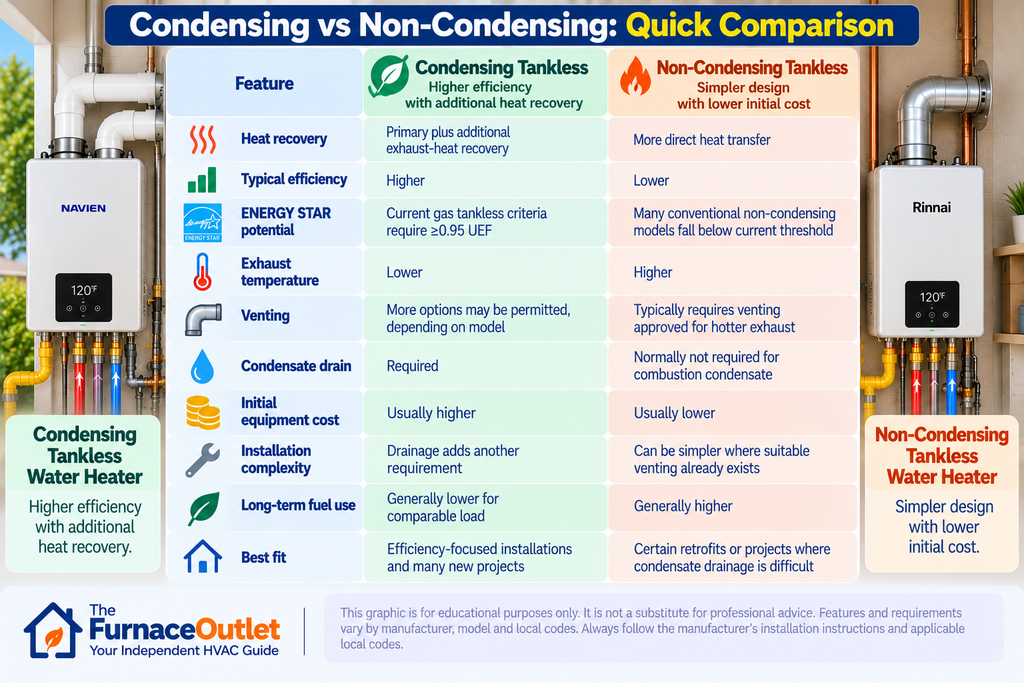
| Feature | Condensing Tankless | Non-Condensing Tankless |
|---|---|---|
| Heat recovery | Primary plus additional exhaust-heat recovery | More direct heat transfer |
| Typical efficiency | Higher | Lower |
| ENERGY STAR potential | Current gas tankless criteria require ≥0.95 UEF | Many conventional non-condensing models fall below current threshold |
| Exhaust temperature | Lower | Higher |
| Venting | More options may be permitted, depending on model | Typically requires venting approved for hotter exhaust |
| Condensate drain | Required | Normally not required for combustion condensate |
| Initial equipment cost | Usually higher | Usually lower |
| Installation complexity | Drainage adds another requirement | Can be simpler where suitable venting already exists |
| Long-term fuel use | Generally lower for comparable load | Generally higher |
| Best fit | Efficiency-focused installations and many new projects | Certain retrofits or projects where condensate drainage is difficult |
These differences are useful for comparison, but I would not use this table to design an installation. Vent material, drain requirements, vent length, clearances and combustion-air arrangements remain specific to the exact appliance and manufacturer’s instructions.
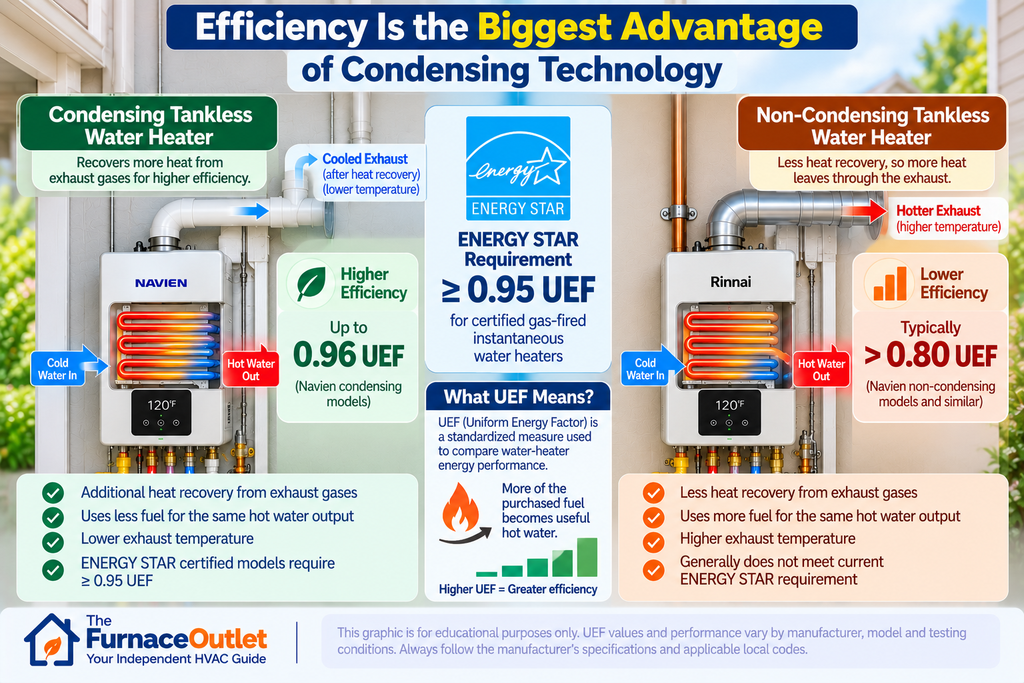
Efficiency is where condensing equipment makes its strongest argument. By recovering heat that a non-condensing appliance would allow to escape through the vent, the heater can produce the required hot water using less fuel under comparable conditions.
Current ENERGY STAR criteria are particularly useful for putting this difference into perspective. ENERGY STAR currently requires a UEF of at least 0.95 for certified gas-fired instantaneous water heaters, together with other performance and warranty requirements.
As a real-world example, Navien states that its condensing tankless range can reach approximately 0.96 UEF, while its current comparison material places its non-condensing technology above 0.80 UEF.
UEF, or Uniform Energy Factor, is a standardized measure designed to compare water-heater energy performance. A higher UEF generally indicates that a greater proportion of purchased energy becomes useful hot water under the standardized test procedure. I would therefore use UEF for comparing appropriately sized products, but I would not confuse it with maximum hot-water capacity. A highly efficient heater can still be undersized for a home’s required GPM and temperature rise.
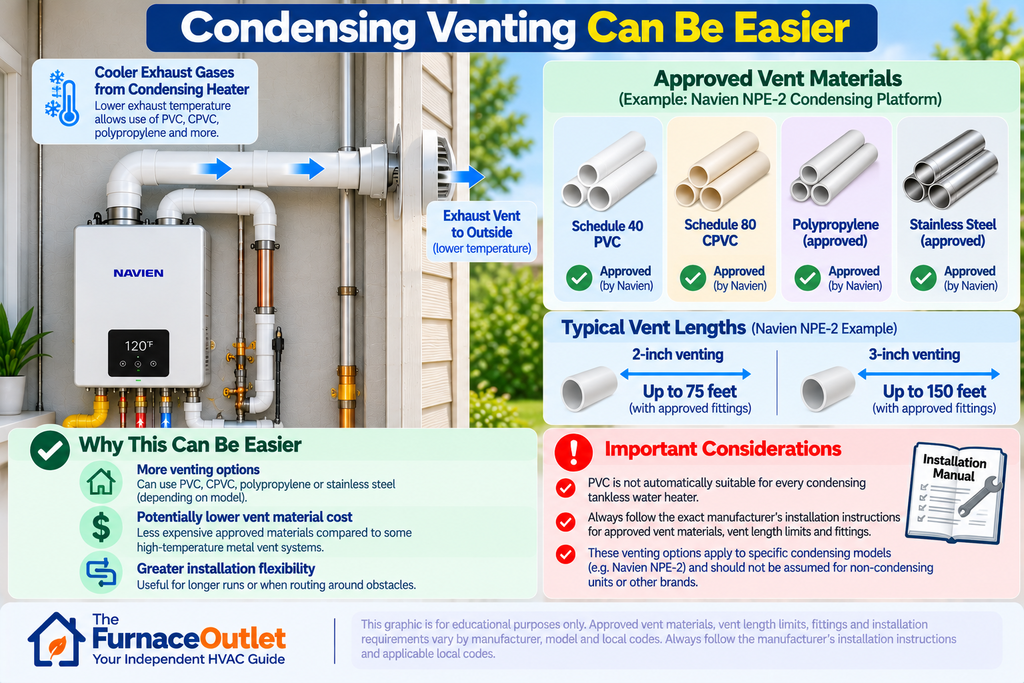
One of the less obvious advantages of condensing technology is that recovering more exhaust heat results in substantially cooler combustion gases. That can allow manufacturers to approve vent materials that would not be suitable for hotter non-condensing exhaust.
For example, Navien currently permits Schedule 40 PVC, Schedule 80 CPVC, approved polypropylene and approved stainless-steel venting on its NPE-2 condensing platform. The manufacturer also allows specified 2-inch vent configurations up to 75 feet and specified 3-inch configurations up to 150 feet, subject to its fitting limitations and installation requirements.
This can be particularly useful when the heater is installed some distance from an exterior wall or when the vent needs to navigate around structural obstacles. Less expensive approved vent materials can also offset part of the higher equipment cost of a condensing heater.
However, PVC is not automatically suitable for every condensing tankless heater, and it certainly should not be assumed suitable for non-condensing equipment. Vent materials must always come from the exact appliance’s installation instructions.
A non-condensing heater allows more thermal energy to remain in the exhaust, which means its venting system must tolerate higher temperatures. Manufacturer requirements can therefore call for specialized metal vent systems or other approved high-temperature materials.
This can change the economics of what initially looks like the cheaper water heater. A non-condensing appliance may cost less to purchase, but if an indoor installation requires an expensive new metal vent run, the difference in total installed cost can become much smaller.
Conversely, a homeowner replacing an existing non-condensing tankless heater may already have an appropriate vent route that can simplify replacement, provided the new appliance manufacturer permits the proposed configuration. This is one reason I would compare complete installed cost rather than equipment price alone.
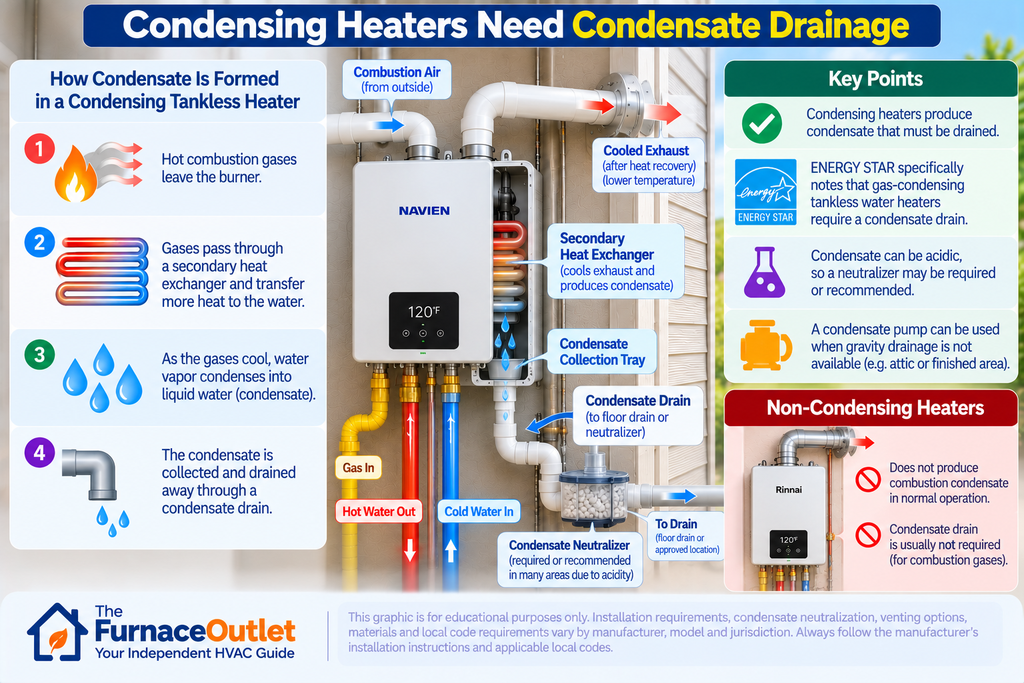
Condensate is the major installation requirement that condensing equipment adds. When water vapor in combustion gases changes into liquid, that liquid cannot simply remain inside the heater. It has to be collected and discharged according to the manufacturer’s instructions and applicable requirements.
ENERGY STAR specifically notes that gas-condensing tankless water heaters require a condensate drain. Depending on the installation and local requirements, condensate neutralization may also be required or recommended because combustion condensate can be acidic.
This can make installation straightforward in a utility room with a convenient approved drain location but more complicated in an attic, finished interior area or another location where gravity drainage is difficult. A condensate pump may be an option in some installations, but that adds another component requiring proper design and maintenance.
A non-condensing tankless heater can therefore have a legitimate installation advantage when providing an appropriate condensate route would be unusually difficult or expensive.
There is no universal winner because the answer depends heavily on the building. Non-condensing equipment generally has a lower purchase price, while condensing equipment can offer more flexible and potentially less expensive venting options.
Imagine an installation where a condensing heater can use a relatively simple manufacturer-approved PVC vent route and discharge condensate into a nearby suitable drain. The project may be quite straightforward despite the heater’s higher purchase price.
Now imagine another location where condensate would need to be pumped a substantial distance while an existing approved high-temperature vent configuration makes a non-condensing replacement relatively simple. The economics could reverse.
For this reason, I would ask an installer to quote the entire project, including heater, venting, combustion-air components, condensate drainage, gas-line work, plumbing modifications, electrical work, permits and labor. Comparing appliance prices on a retail website tells only part of the story.
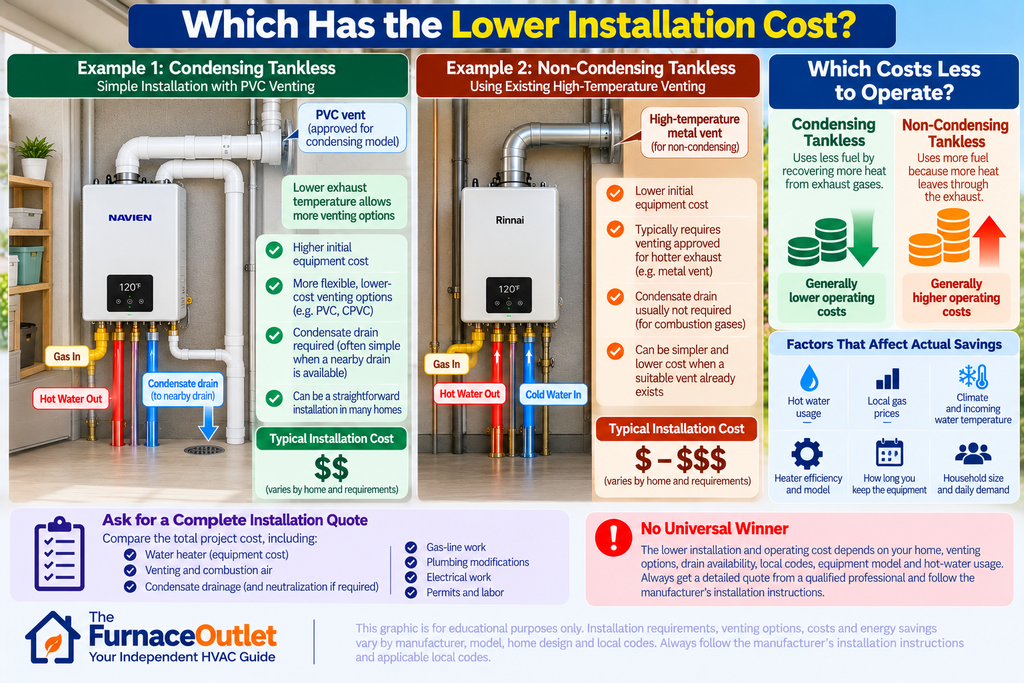
All else being reasonably comparable, the condensing heater should use less fuel because it recovers more energy from combustion. That advantage continues each time the water heater operates, which means a higher initial cost can potentially be recovered gradually through lower energy consumption.
How valuable that efficiency difference becomes depends on hot-water usage, local gas prices, climate, incoming-water temperature, heater efficiency and how long the homeowner keeps the equipment. A household with substantial daily hot-water demand may place greater value on efficiency than a household using relatively little hot water.
I would therefore avoid publishing a universal statement such as “a condensing heater saves $200 per year.” Without assumptions for energy price, usage and competing equipment, that number would have little meaning. Higher efficiency creates the opportunity for lower operating cost; the actual dollar savings depend on the household.
Both types of tankless heater require appropriate maintenance. Scale can accumulate inside water passages, inlet filters can require cleaning, vent and combustion components need to remain unobstructed, and manufacturer-prescribed inspections should be followed.
Condensing equipment adds the condensate system to that maintenance picture. The drain needs to remain functional, and a neutralizer, where installed, may require periodic inspection or replacement of its media.
Navien currently recommends annual service for its condensing equipment in its general comparison while describing its non-condensing products as having lower maintenance requirements. That should not be interpreted as meaning a non-condensing tankless heater requires no maintenance. Water hardness and operating conditions can have a major influence on service requirements for either design.
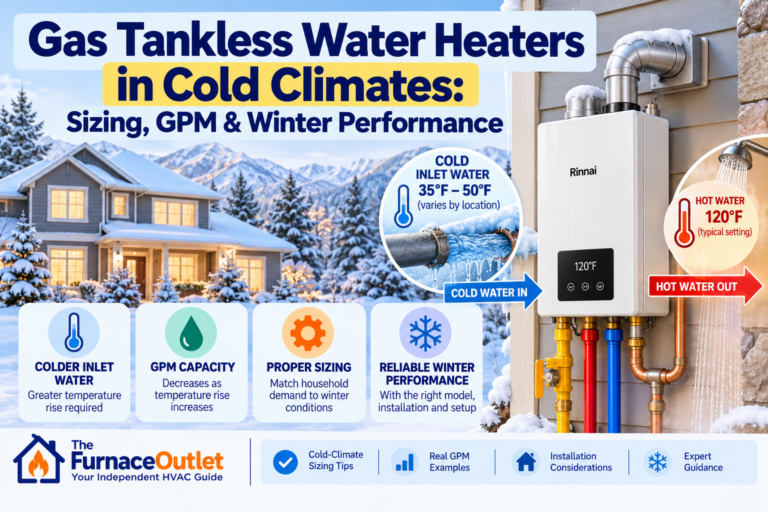
Cold incoming water increases the temperature rise a tankless heater must produce. If 40°F water enters the heater and the desired outlet temperature is 120°F, the appliance has to create an 80°F rise. That is considerably more demanding than heating 70°F incoming water to the same outlet temperature.
I generally appreciate high-efficiency condensing technology in demanding applications because recovering additional heat reduces wasted fuel, but condensing technology does not eliminate the need for correct sizing. The heater still has a finite maximum burner input and maximum flow capability at a particular temperature rise.
I would therefore calculate simultaneous GPM demand and winter temperature rise first, verify the manufacturer’s flow-performance table second, and compare condensing versus non-condensing technology only among products capable of meeting the required load.
For many new indoor installations, I would lean toward a condensing direct-vent model. High efficiency, lower exhaust temperature and flexible manufacturer-approved venting options can make the overall system attractive.
The installation still needs adequate combustion-air and exhaust arrangements, proper termination clearances and condensate drainage. Modern condensing equipment should not be interpreted as allowing casual vent design simply because exhaust temperatures are lower.
Navien’s NPE-240S2, for example, uses forced-draft direct venting and permits several specific 2-inch and 3-inch vent materials, but those options remain governed by the manufacturer’s limits and instructions.
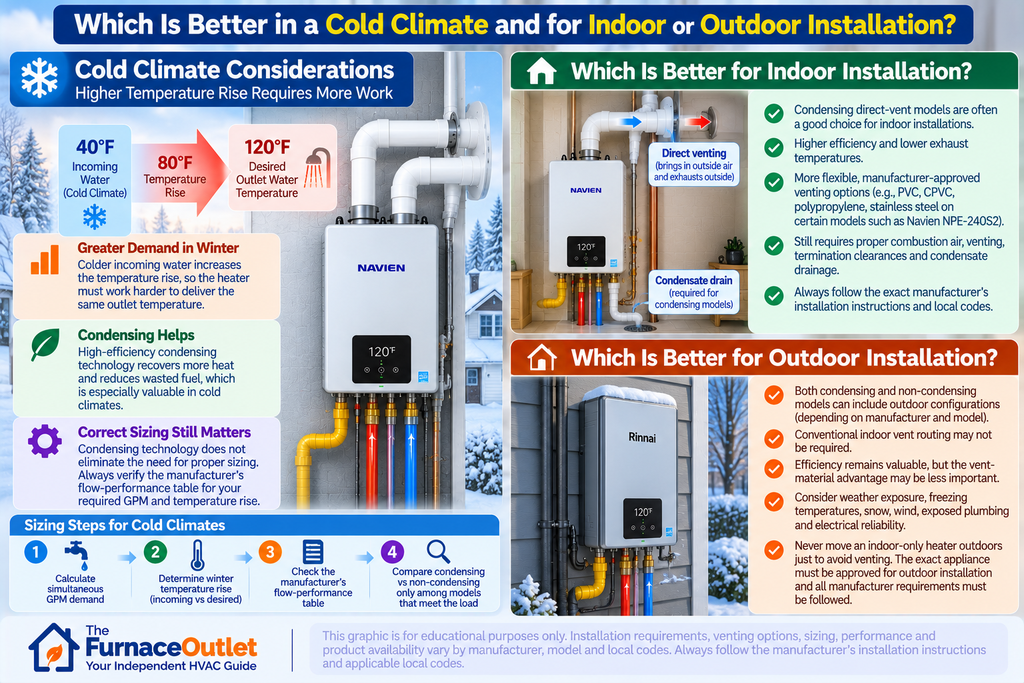
Outdoor installation changes the comparison because conventional indoor vent routing may no longer be required. Both condensing and non-condensing product families can include outdoor configurations, depending on manufacturer and model.
In that situation, the vent-material advantage of condensing technology may become less important, while efficiency remains valuable. Weather exposure, freezing temperatures, snow, wind, exposed plumbing and electrical reliability become more significant considerations.
I would never move an indoor-only heater outdoors merely to avoid venting. The exact appliance must be approved for its intended outdoor configuration, and manufacturer requirements for clearances and freeze protection still apply.
For a new installation or major tankless conversion, condensing would usually be my starting point. I would particularly favor it when efficiency is important, the household uses substantial hot water, condensate drainage can be provided without difficulty and the lower-temperature venting options simplify the installation.
The technology makes intuitive sense to me because energy that would otherwise leave through the exhaust is captured and put to useful work. ENERGY STAR says certified gas tankless water heaters using secondary heat-exchanger technology use about 9% less energy than conventional gas tankless water heaters.
That does not automatically make the most expensive condensing model the best purchase. Correct sizing, reliability, warranty, installer familiarity, service availability and total installed cost remain important.
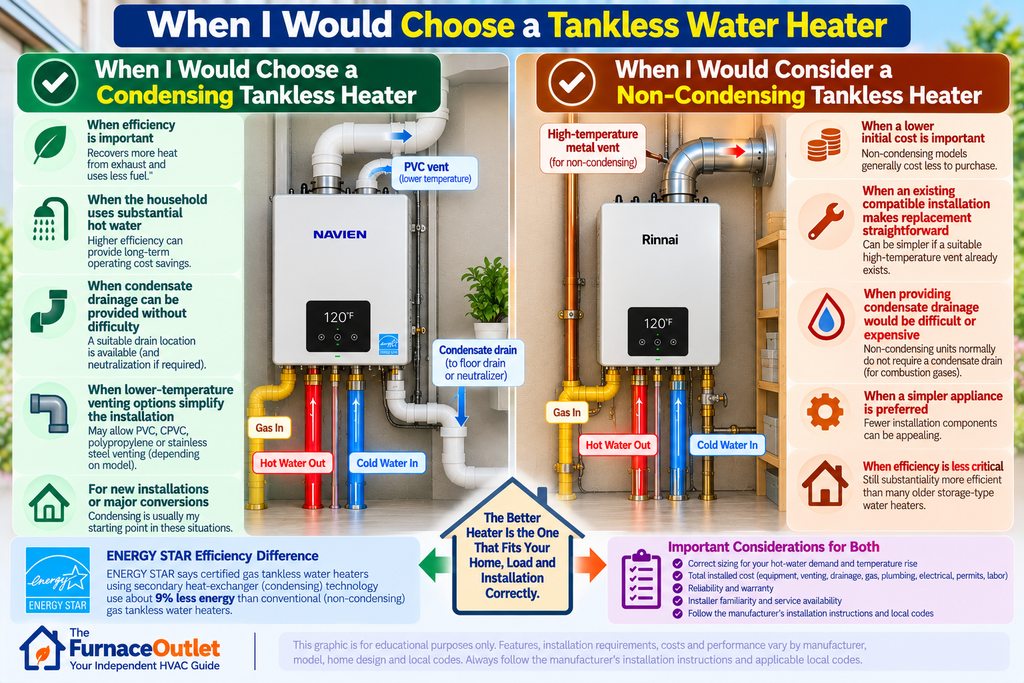
I would consider non-condensing equipment where the lower initial cost is important, where an existing compatible tankless installation makes replacement straightforward, or where providing condensate drainage would be disproportionately difficult.
A simpler appliance can also appeal to homeowners who prioritize fewer installation components. Current non-condensing products remain substantially more efficient than many older storage-type systems, even though they generally cannot match the highest UEF ratings of modern condensing tankless heaters.
The mistake would be dismissing non-condensing technology as automatically obsolete. The better heater is the one that fits the load, building and installation correctly.
For many whole-home installations, I think it can be. Higher efficiency can reduce fuel consumption, and lower exhaust temperatures can permit more flexible manufacturer-approved venting. The economics are strongest when condensate drainage is easy and the household has meaningful hot-water usage.
Yes, combustion condensation has to be removed through an approved drainage arrangement. The exact drain and any neutralization requirements should follow the manufacturer’s instructions and applicable local requirements.
Some can. For example, Navien approves Schedule 40 PVC for its NPE-2 platform, along with specified CPVC, polypropylene and stainless-steel options. This permission should never be generalized to a different heater without checking its manual.
The appliance is generally less expensive than a comparable condensing model, but total installation cost depends on venting, drainage, gas supply and labor. Specialized high-temperature venting can reduce or eliminate some of the equipment-price advantage.
Not automatically. Hot-water capacity depends on the heater’s burner capacity, flow characteristics, incoming-water temperature and required temperature rise. Efficiency and capacity are related aspects of performance, but they are not the same measurement.
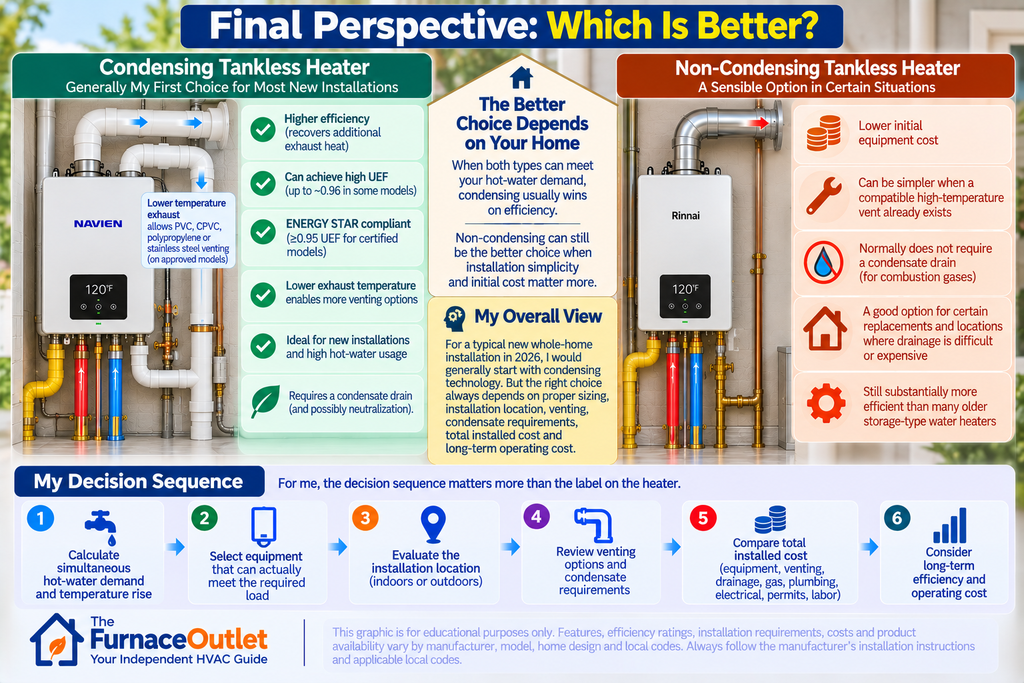
If I were selecting a gas tankless water heater for a typical new whole-home installation in 2026, I would generally start with condensing technology. Modern condensing heaters recover heat that would otherwise escape through the exhaust, can achieve very high UEF ratings and may offer flexible venting options because of their lower exhaust temperatures. Current ENERGY STAR requirements reinforce how far the efficiency benchmark has moved: certified gas-fired instantaneous water heaters must currently achieve at least 0.95 UEF.
I would not choose condensing technology blindly, however. The installation needs an appropriate condensate solution, and the higher purchase price should be evaluated against total project cost. A non-condensing heater can remain a sensible option for certain replacements, difficult drain locations and installations where its simpler configuration offers a genuine advantage.
For me, the decision sequence matters more than the label on the heater. Calculate simultaneous hot-water demand and temperature rise, select equipment that can actually meet that load, evaluate the installation location, venting and condensate requirements, compare total installed cost, and then consider long-term efficiency. When both types satisfy the home’s capacity requirements, condensing usually wins on efficiency, while non-condensing can still win where installation simplicity and initial cost matter more.
For further technical research, ENERGY STAR’s explanation of whole-home gas tankless water heaters explains secondary heat-exchanger and condensing technology, while ENERGY STAR’s current residential water-heater criteria provides the current UEF requirements for certified gas-fired instantaneous water heaters. Navien’s condensing tankless guide and Navien’s non-condensing tankless guide provide manufacturer comparisons of the two technologies, while the Navien NPE-2 technical FAQs provide a useful real-world example of approved condensing vent materials and vent-length limitations.
The Furnace Outlet provides this guide for general educational and product-research purposes. Tankless water-heater sizing, gas supply, combustion air, venting, condensate disposal and installation requirements vary by appliance and jurisdiction. Always follow the current installation manual for the exact model, applicable codes and local permitting requirements, and use appropriately qualified professionals where required.
The Furnace Outlet is an independent informational resource. We are not associated with, endorsed by, sponsored by or affiliated with Navien, Rinnai, Rheem, ENERGY STAR or any other manufacturer or organization mentioned. Product names, trademarks and specifications remain the property of their respective owners, and manufacturer specifications should be verified before purchase or installation.