Newsletter Subscribe
Enter your email address below and subscribe to our newsletter

HVAC made simple
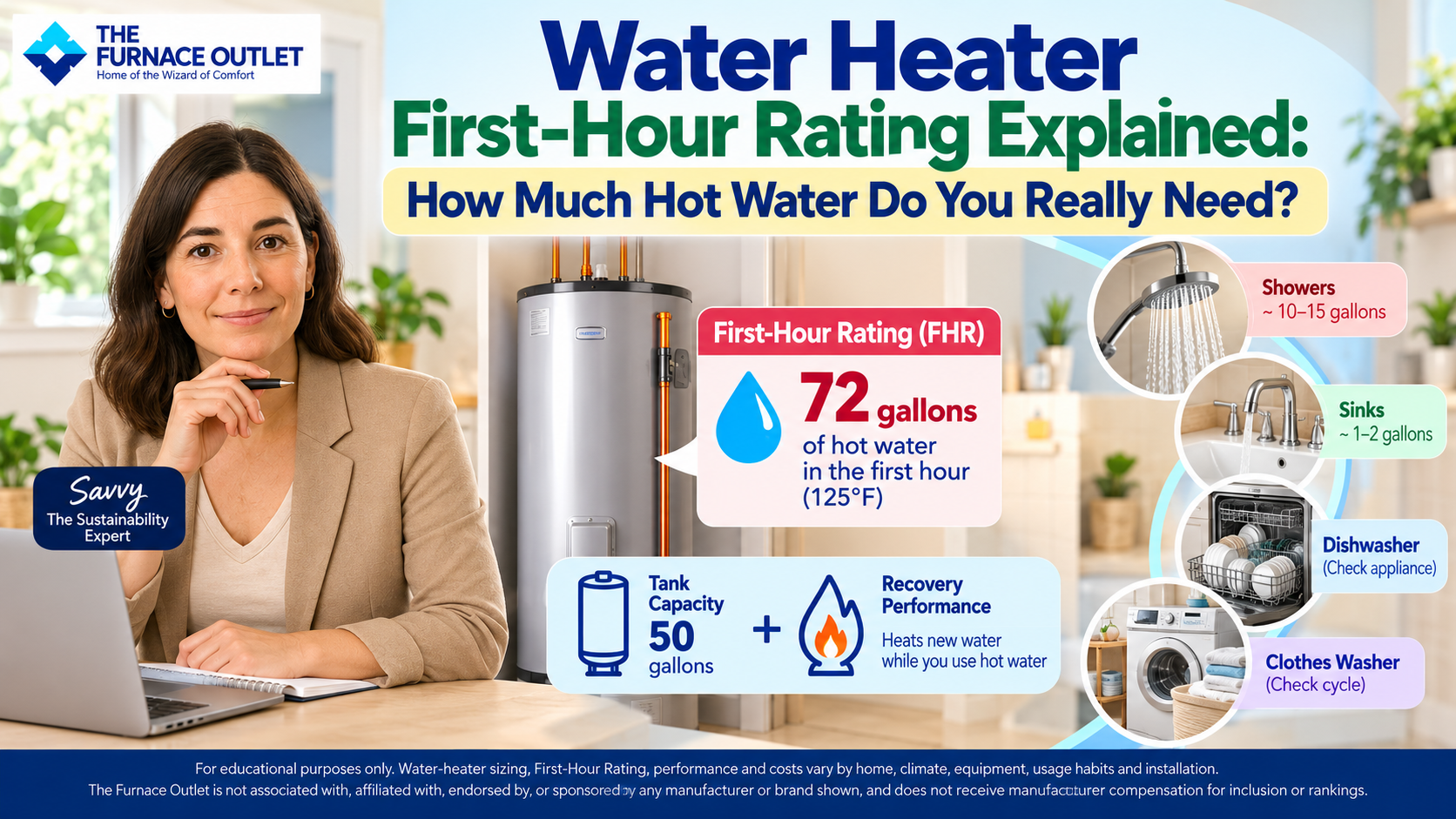
When homeowners shop for a storage water heater, tank capacity is usually the first number they notice. A 40-gallon heater sounds smaller than a 50-gallon heater, while an 80-gallon model sounds as though it should provide considerably more hot water. Tank capacity matters, but it does not tell you how much hot water the complete system can actually supply during the busiest part of your day.
That is where First-Hour Rating, or FHR, becomes one of the most useful water-heater specifications. ENERGY STAR defines FHR as an estimate of the maximum volume of hot water a storage water heater can supply during an hour that begins with the heater fully heated. Under the current Uniform Energy Factor test method, FHR is measured at a 125°F outlet temperature.
I’m Savvy Mavi, Savvy the Sustainability Expert, and when I compare storage water heaters, I would rarely look at tank capacity without also checking FHR. The two numbers answer different questions. Tank capacity tells us approximately how much water is stored, while FHR gives us a better indication of how the heater can perform when several hot-water demands occur within a relatively short period.
First-Hour Rating is easier to understand if we stop thinking of a storage water heater as a container that simply empties. When you take a shower, hot water leaves the tank while cold replacement water enters. At the same time, the burner, electric elements, or heat-pump system begins working to restore the water temperature.
The heater therefore continues producing hot water while you are consuming the water that was already stored. FHR reflects this combination of stored hot water and recovery performance. ENERGY STAR describes FHR as the amount of hot water a unit can deliver during a busy hour under standard test conditions, and recommends considering it alongside storage capacity when selecting equipment.
This explains why a 50-gallon tank does not necessarily have a 50-gallon FHR. Depending on the design and recovery capability, the heater may deliver considerably more than its nominal tank capacity during the first hour.
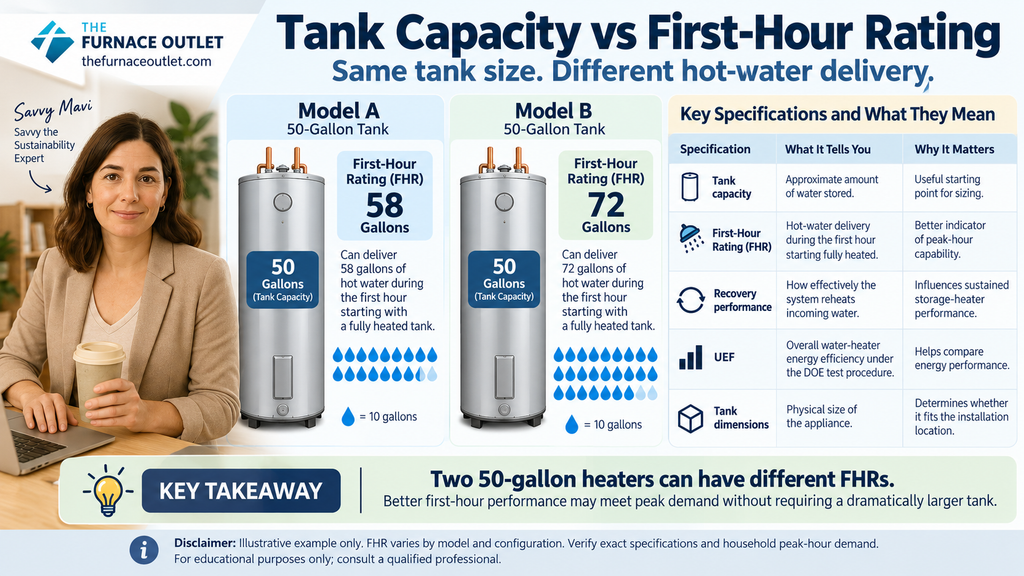
The distinction between tank capacity and FHR is one of the most important concepts in storage water-heater sizing. Tank capacity describes stored volume, whereas FHR provides information about hot-water delivery during a defined high-demand period.
Consider two hypothetical 50-gallon storage heaters. Model A might have an FHR of 58 gallons, while Model B might have an FHR of 72 gallons. Both have approximately the same nominal storage capacity, yet Model B can provide substantially more hot water during the standardized first-hour test because its complete heating and recovery characteristics differ.
| Specification | What It Tells You | Why It Matters |
|---|---|---|
| Tank capacity | Approximate amount of water stored | Useful starting point for sizing |
| First-Hour Rating | Hot-water delivery during the first hour starting fully heated | Better indicator of peak-hour capability |
| Recovery performance | How effectively the system reheats incoming water | Influences sustained storage-heater performance |
| UEF | Overall water-heater energy efficiency under the DOE test procedure | Helps compare energy performance |
| Tank dimensions | Physical size of the appliance | Determines whether it fits the installation location |
This is also why I would not automatically select a larger tank merely because a household occasionally runs short of hot water. A model with better first-hour performance could potentially address the problem without requiring a dramatically larger storage volume.
To make FHR useful, you need something to compare it against. I would start by identifying your household’s peak hour of hot-water demand, which is the period when the greatest amount of hot water is realistically likely to be used. For many households, this occurs in the morning. Several people may shower before work or school while someone uses a bathroom or kitchen faucet. In other homes, the busiest period could be in the evening when bathing, dishwashing, and laundry overlap.
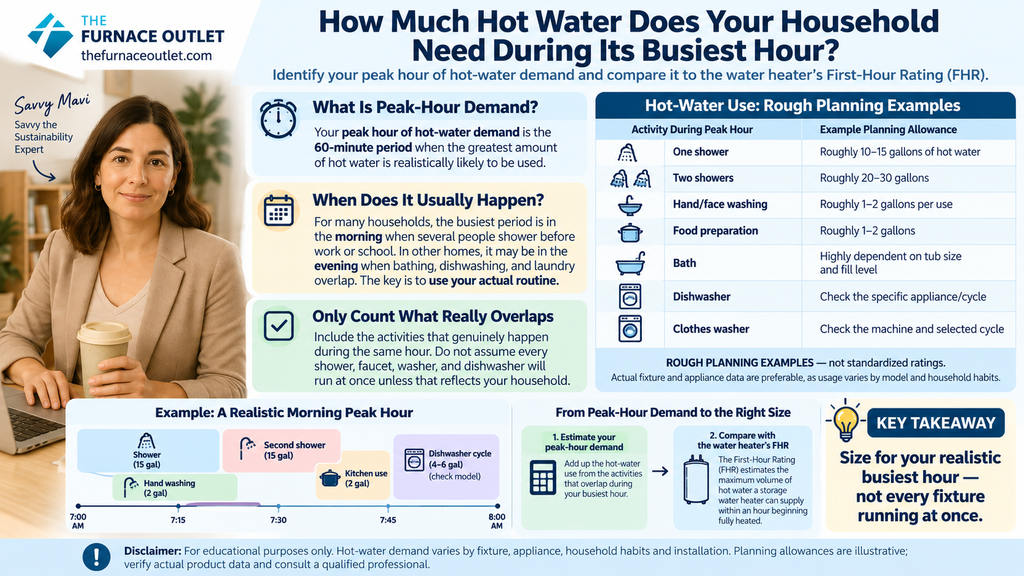
The important word is realistically. I would not assume that every shower, faucet, washing machine, and dishwasher in the home will operate simultaneously unless that genuinely reflects how the household behaves. Exaggerating the load can result in unnecessary oversizing, while underestimating it can leave the household short of hot water.
For preliminary planning, you can record what actually happens during your busiest hour. Fixture efficiency and personal habits vary substantially, so actual fixture and appliance data are preferable to generic assumptions whenever they are available.
| Activity During Peak Hour | Example Planning Allowance |
|---|---|
| One shower | Roughly 10–15 gallons of hot water |
| Two showers | Roughly 20–30 gallons |
| Hand/face washing | Roughly 1–2 gallons per use |
| Food preparation | Roughly 1–2 gallons |
| Bath | Highly dependent on tub size and fill level |
| Dishwasher | Check the specific appliance/cycle |
| Clothes washer | Check the machine and selected cycle |
These figures should be treated as rough planning examples rather than standardized ratings. A low-flow showerhead can produce a very different demand from a high-flow fixture, while a modern efficient dishwasher or clothes washer can use substantially different amounts of hot water from older equipment.
Imagine a four-person household where three people shower between 6:30 and 7:30 a.m. Each shower consumes approximately 12 gallons of hot water, creating 36 gallons of shower demand. During the same hour, bathroom and kitchen hot-water use adds another 6 gallons.
The estimated peak-hour requirement would therefore be around 42 gallons. A storage water heater with an FHR comfortably above that requirement would provide a useful performance margin under comparable conditions.
Now change the household’s habits. Suppose four showers occur during the same hour, a large amount of sink use overlaps with them, and the household occasionally starts another hot-water-consuming appliance during that period. Peak demand could move well above the original 42 gallons even though the number of people living in the house has not changed.
That is why usage pattern matters almost as much as household size.
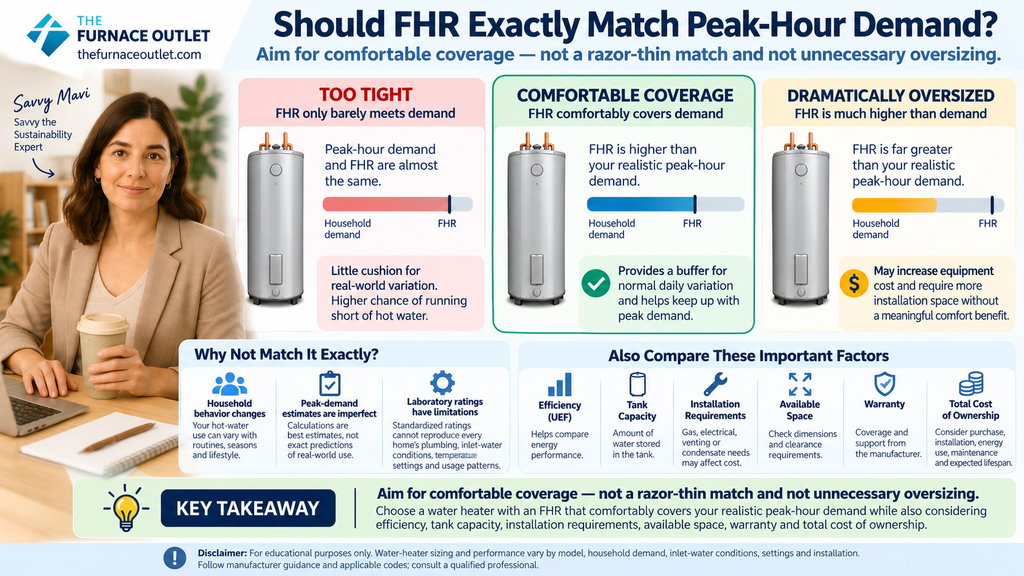
I would not deliberately select a heater whose FHR only barely reaches the calculated household requirement. Household behavior changes, calculations are imperfect, and standardized laboratory ratings cannot reproduce every real home’s plumbing, inlet-water conditions, temperature settings, and usage patterns.
At the same time, there is little reason to buy dramatically more capacity than the household is likely to use simply to create an enormous safety margin. Oversizing can increase equipment cost and physical space requirements without providing a meaningful comfort benefit.
The objective is therefore to find a model whose FHR comfortably covers realistic peak-hour demand, while also considering the heater’s efficiency, tank capacity, installation requirements, available space, warranty, and total cost of ownership.
FHR is influenced by more than storage volume. The heater’s input and recovery characteristics play an important role because replacement water is being heated while hot water is drawn from the tank.
A gas storage heater with substantial burner input can have different recovery characteristics from a conventional electric-resistance heater. A heat-pump water heater behaves differently again because its highly efficient heat-pump cycle may recover more gradually, while many models can use electric-resistance elements to assist during periods of high demand.
This does not mean one technology is universally superior. It means that nominal tank capacity cannot be used as a substitute for the performance specifications of the exact model being considered.
Current ENERGY STAR requirements demonstrate this distinction. Certified integrated heat-pump water heaters in the main qualifying category must achieve a UEF of at least 3.30 and an FHR of at least 45 gallons per hour. Certified gas-fired storage water heaters have separate UEF requirements and must achieve an FHR of at least 51 gallons per hour. These are certification thresholds, not household-sizing recommendations.
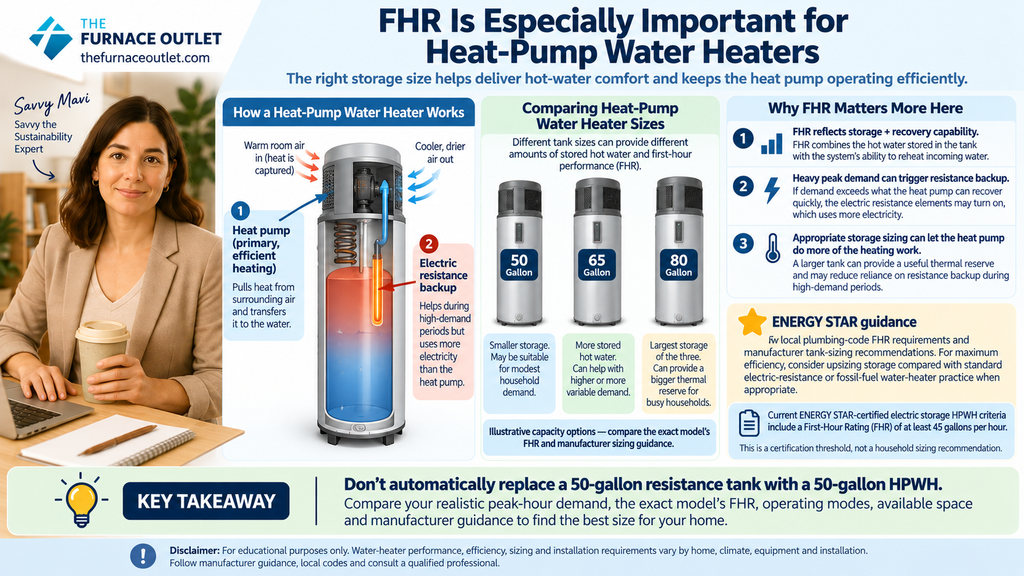
Heat-pump water heaters make FHR particularly interesting because sizing affects both hot-water comfort and the way the appliance operates.
An HPWH transfers heat from surrounding air into the stored water rather than relying exclusively on electric-resistance heating. Many integrated models nevertheless contain resistance elements that can provide additional heating when demand becomes too great for heat-pump-only operation.
That backup helps maintain comfort, but resistance operation is less efficient. ENERGY STAR’s HPWH design guidance therefore recommends following local plumbing-code FHR requirements and manufacturer sizing recommendations while considering upsizing storage capacity for maximum efficiency. Additional stored hot water can reduce reliance on resistance backup during high-demand periods.
For example, I would not automatically replace an existing 50-gallon resistance water heater with a 50-gallon HPWH. If the household has substantial morning demand, I might compare the FHR and operating characteristics of 50-, 65-, and 80-gallon HPWH options. A larger tank can sometimes provide a more useful thermal reserve while allowing the heat pump to perform more of the water-heating work.
FHR applies primarily to storage water heaters. If you are shopping for a tankless water heater, a different sizing method is required because there is no large tank of heated water waiting to be used.
For tankless equipment, I would calculate the hot-water fixtures that may realistically operate simultaneously and add their flow rates in gallons per minute, or GPM. I would then determine how much the heater must raise the incoming-water temperature.
ENERGY STAR currently defines tankless GPM under its test criteria as the amount of hot water that can be supplied while maintaining the specified temperature rise, with the standardized GPM measurement based on a 67°F rise. ENERGY STAR
The distinction is therefore straightforward: FHR helps describe how a storage heater handles a busy hour, while GPM at a specified temperature rise helps describe instantaneous or tankless performance.
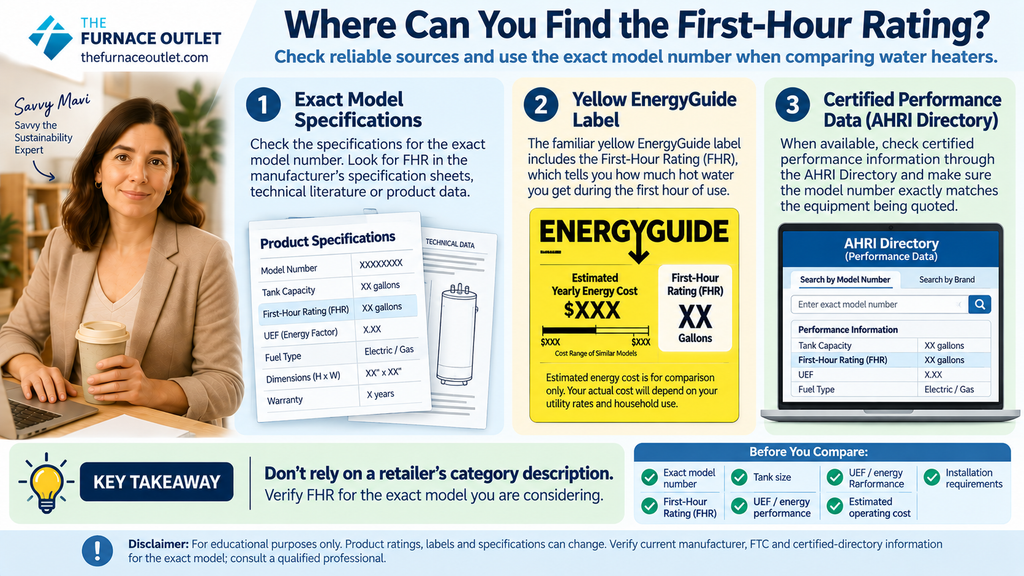
When shopping for a storage water heater, I would first check the specifications for the exact model number rather than relying on a retailer’s category description. Manufacturers commonly provide FHR in specification sheets, technical literature, or product data.
The familiar yellow EnergyGuide label is another useful shopping resource. FTC’s water-heater labeling framework includes First-Hour Rating information, and its sample label describes FHR as the amount of hot water available during the first hour of use. Federal Trade Commission
The FTC also cautions that EnergyGuide operating-cost figures are estimates based on standardized assumptions. Actual costs depend on household usage and local energy prices, so the label should be used for comparison rather than treated as a prediction of the homeowner’s exact utility bill. Consumer Advice
When available, I would also check certified performance information through the AHRI Directory and make sure the model number exactly matches the equipment being quoted. AHR Directory
Before choosing a storage heater, I would identify the household’s busiest hot-water hour and estimate the demand created by showers, baths, faucets, dishwashing, laundry, and other uses that genuinely overlap. I would then compare that requirement with the published FHR of each candidate rather than selecting equipment from tank capacity alone.
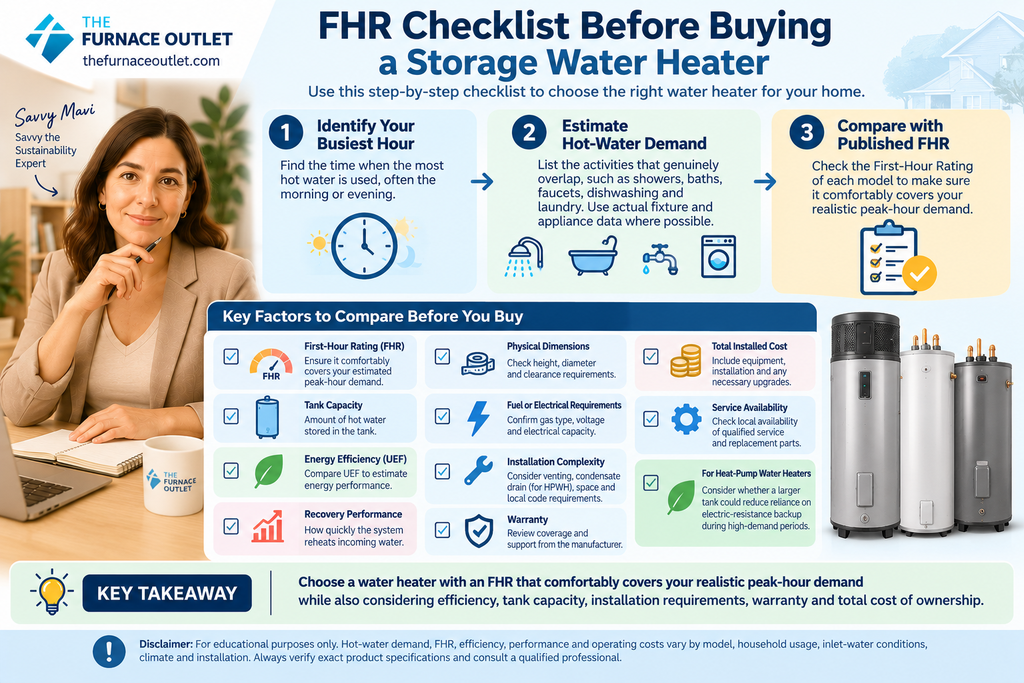
After narrowing the choices, I would compare tank volume, FHR, UEF, recovery characteristics, physical dimensions, fuel or electrical requirements, warranty, installation complexity, service availability, and total installed cost. For a heat-pump water heater, I would pay particular attention to whether greater storage could reduce resistance-backup operation during the household’s normal high-demand periods.
This approach does not produce the simplicity of saying that every four-person family needs a 50-gallon tank, but it produces a much more useful equipment comparison.
No. Tank capacity represents the approximate amount of water stored in the heater, while FHR estimates how much hot water the complete storage system can supply during an hour beginning with the heater fully heated. Because the heater continues recovering while water is being used, FHR can be greater than nominal tank capacity.
A higher FHR means greater first-hour hot-water delivery under the standardized test, but that does not mean every household should purchase the highest FHR available. The useful target is an FHR that comfortably satisfies realistic peak-hour demand while balancing efficiency, purchase price, installation requirements, and space.
There is no universal FHR for four people because hot-water habits differ. A family taking several showers during one concentrated morning period can require considerably more first-hour capacity than another four-person household that spreads showers and appliance use throughout the day. Estimate the household’s peak-hour demand first and then compare it with candidate FHR values.
Not necessarily in a simple one-to-one relationship. Greater storage can contribute to first-hour capability, but FHR also reflects recovery performance and the design of the complete water-heating system. Compare published FHR values for the exact models rather than assuming performance solely from tank volume.
Tankless systems are primarily sized using GPM and temperature rise rather than storage-heater FHR. ENERGY STAR distinguishes storage FHR from instantaneous GPM in its current water-heater criteria.
No. FHR is a standardized performance estimate. Actual hot-water availability can vary with inlet-water temperature, thermostat settings, plumbing conditions, usage patterns, equipment operating modes, installation, and other factors. It is best used as a consistent comparison metric rather than a guarantee of household performance.
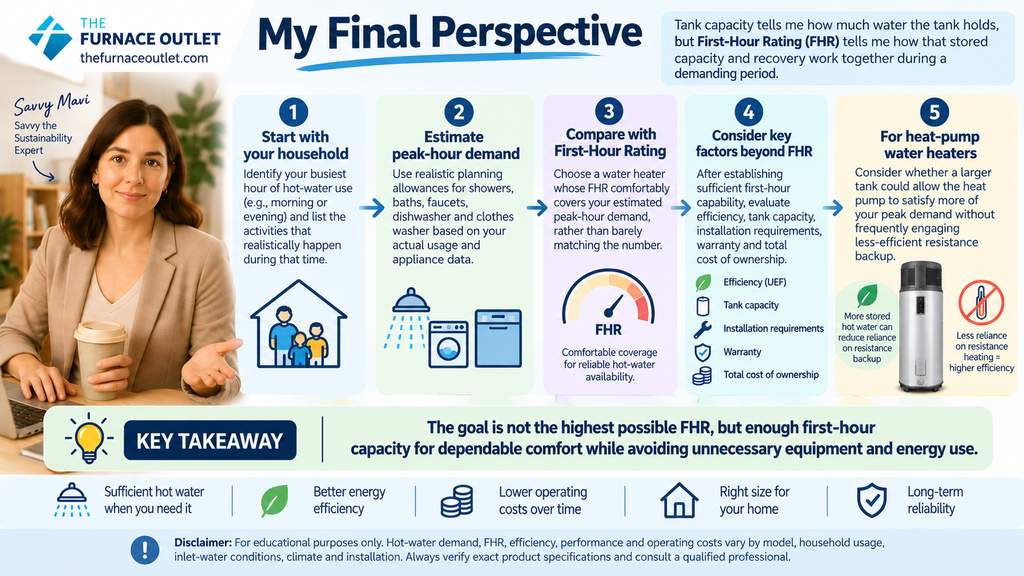
When I compare storage water heaters, tank capacity tells me how much water the appliance holds, but First-Hour Rating tells me much more about how that stored capacity and recovery work together during a demanding period. That distinction becomes especially important for households where several showers, baths, or appliance loads are concentrated within the same hour.
I would therefore begin with the household rather than the appliance. Identify the busiest hour, estimate realistic hot-water demand, and then compare that requirement with the FHR of specific water heaters. After establishing sufficient first-hour capability, I would evaluate efficiency, tank capacity, installation requirements, warranty, operating cost, and the other factors that determine long-term value.
For heat-pump water heaters, I would go one step further and investigate whether additional storage could allow the heat pump to satisfy more of the peak demand without frequently engaging less-efficient resistance backup. The objective is not simply to achieve the largest possible FHR. It is to select enough first-hour capacity for dependable comfort while avoiding unnecessary equipment and energy use.
For homeowners who want to research First-Hour Rating in greater depth, the following independent resources provide useful technical and consumer information.
The Furnace Outlet is an independent informational and educational resource. It is not associated with, affiliated with, endorsed by, or sponsored by any water-heater manufacturer or brand discussed in this article, and it does not receive manufacturer compensation for inclusion or rankings.
First-Hour Rating, tank capacity, recovery performance, hot-water consumption, efficiency, operating cost, and real-world performance vary according to the equipment, household usage, incoming-water temperature, thermostat settings, plumbing fixtures, climate, installation, and other conditions. The consumption examples in this guide are intended for preliminary educational planning rather than as universal sizing requirements. Always verify the current specifications and sizing instructions for the exact equipment being considered and follow applicable plumbing, electrical, fuel-gas, building, and manufacturer requirements.