Newsletter Subscribe
Enter your email address below and subscribe to our newsletter

HVAC made simple
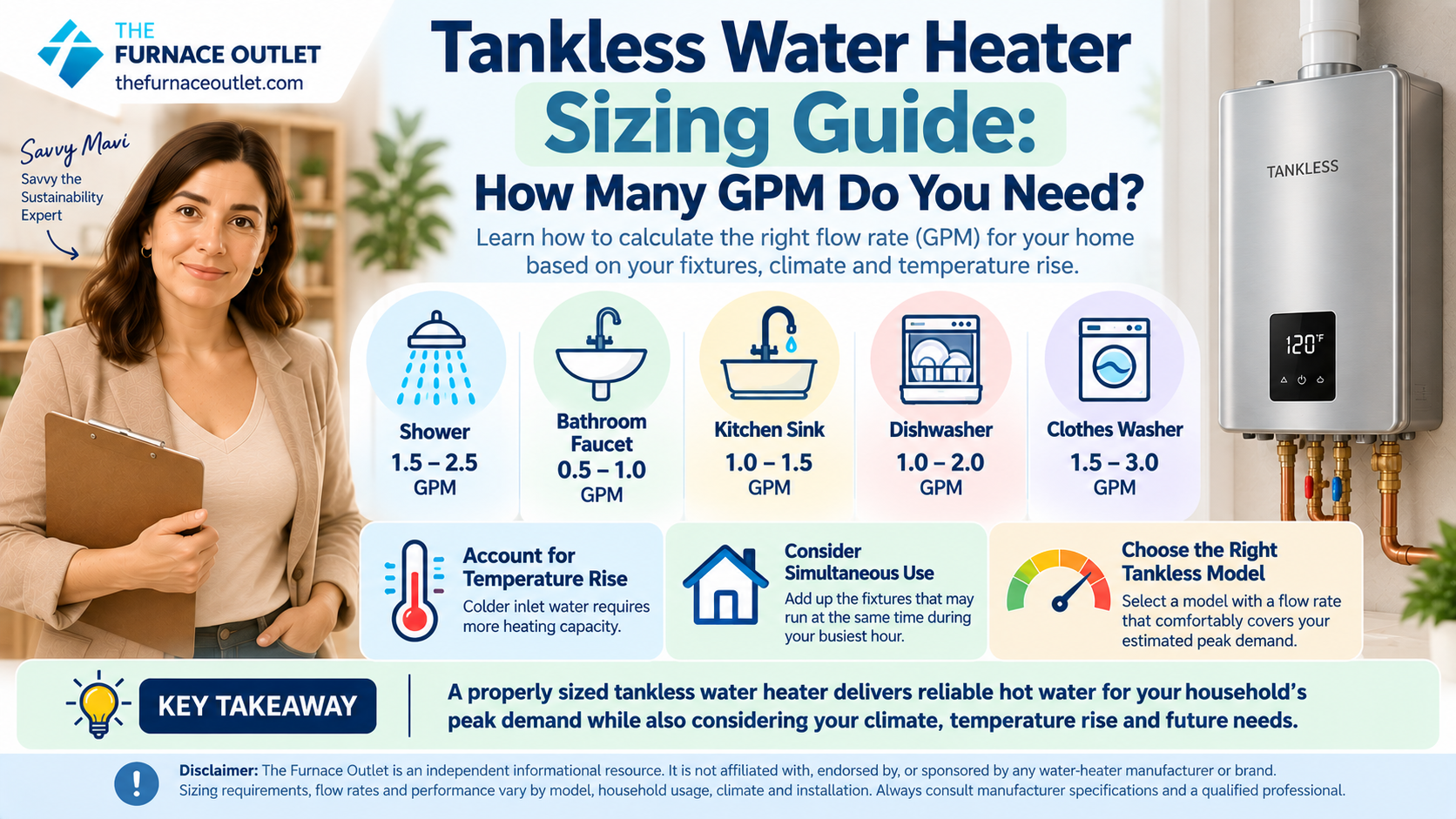
Choosing the right tankless water heater requires a different approach from sizing a conventional storage water heater. With a tank, homeowners usually begin with gallons of storage and First-Hour Rating. With tankless equipment, there is no large reservoir of heated water waiting to be used, so the question changes from “How many gallons should my tank hold?” to “How many gallons of hot water might my household need at the same time?”
That measurement is GPM, or gallons per minute, but GPM alone still does not determine tankless capacity. A water heater’s output also depends on how much it must raise the incoming-water temperature. DOE guidance identifies these as the two central sizing variables: the maximum simultaneous hot-water flow rate and the maximum required temperature rise.
I’m Savvy Mavi, Savvy the Sustainability Expert, and this is where I would resist simple rules such as “a family of four needs an 8-GPM heater.” Household size provides context, but fixtures, simultaneous use, climate, incoming-water temperature, desired outlet temperature, and the exact heater’s performance curve determine the real requirement. Correct sizing means finding a tankless system capable of supplying the household’s realistic peak flow at its realistic temperature rise without paying for capacity that the home is unlikely to use.
GPM means gallons per minute. For tankless water heaters, it describes the rate at which water can pass through the appliance while being heated to the required temperature.
ENERGY STAR explains the basic difference clearly: storage heaters are commonly described by how many gallons fit in the tank, whereas tankless models are rated according to how many gallons of hot water they can produce per minute. The more likely a household is to operate a shower, dishwasher, clothes washer, or other hot-water fixtures together, the greater the required GPM becomes.
This is why the number of bedrooms or occupants does not directly determine tankless size. A two-person household running two showers simultaneously can create a greater instantaneous load than a four-person household where everyone showers at different times.
The other important point is that a tankless heater’s GPM rating must be connected to a temperature rise. A heater cannot necessarily produce its advertised maximum GPM under every condition.
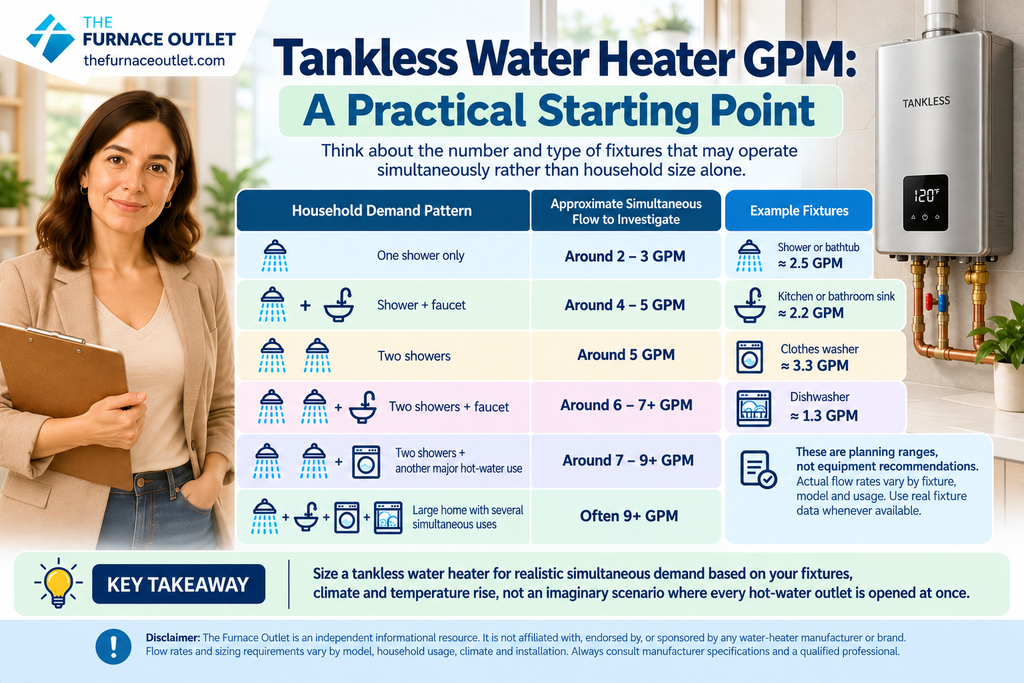
For early planning, I would think about tankless capacity in terms of the number and type of fixtures that may operate simultaneously rather than household size alone.
| Household Demand Pattern | Approximate Simultaneous Flow to Investigate |
|---|---|
| One shower only | Around 2–3 GPM |
| Shower + faucet | Around 4–5 GPM |
| Two showers | Around 5 GPM |
| Two showers + faucet | Around 6–7+ GPM |
| Two showers + another major hot-water use | Around 7–9+ GPM |
| Large home with several simultaneous uses | Often 9+ GPM |
These are planning ranges, not equipment recommendations. ENERGY STAR currently gives average figures of approximately 2.5 GPM for a shower or bathtub, 3.3 GPM for a clothes washer, 2.2 GPM for a kitchen or bathroom sink, and 1.3 GPM for a dishwasher. Actual fixtures and appliances can differ substantially, so I would use their real flow data whenever available.
A household should not add every fixture in the building unless they are genuinely likely to operate together. Tankless sizing should represent realistic simultaneous demand, not an imaginary situation where every hot-water outlet is opened at once.
I would begin by making a simple inventory of the home’s hot-water fixtures and appliances. Then I would identify combinations that realistically occur together. DOE’s tankless sizing guidance uses the same basic approach. It recommends identifying fixtures and appliances and their flow rates, then determining the maximum flow of hot water likely to be demanded at any one time.
For example, suppose a family frequently has two people showering at the same time in the morning. If each shower uses approximately 2.5 GPM, the initial flow requirement would be around 5 GPM. If someone commonly uses a hot-water faucet during those showers, the peak requirement increases.
Now imagine the same family always showers one person at a time. The household may contain exactly the same number of people, but its instantaneous GPM requirement can be much lower. This is why I would size tankless equipment around simultaneous behavior rather than total daily water consumption.
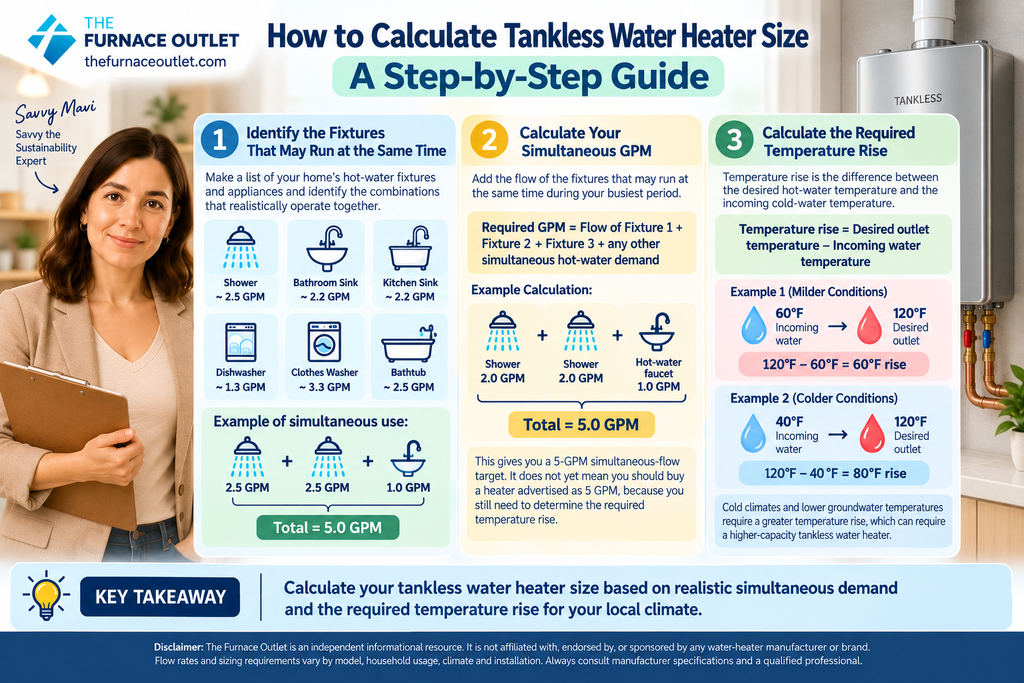
The basic calculation is straightforward: Required GPM = flow of Fixture 1 + Fixture 2 + Fixture 3 + any other simultaneous hot-water demand
Suppose the realistic morning peak includes two 2.0-GPM showers and approximately 1.0 GPM of hot-water faucet flow. The calculation becomes: 2.0 + 2.0 + 1.0 = 5.0 GPM
That gives us a 5-GPM simultaneous-flow target. It does not yet mean we should buy a heater advertised as 5 GPM, because we still need to determine how much temperature rise the unit must produce. A larger household might realistically operate two showers plus another hot-water appliance. If those loads total approximately 7 GPM, I need a heater capable of delivering that output under the home’s actual temperature conditions.
This distinction is critical because tankless water heaters are heating water while it flows through the heat exchanger. As flow increases, the appliance has less opportunity to add heat to each gallon unless it has sufficient heating capacity.
Temperature rise is simply the difference between the incoming cold-water temperature and the desired hot-water temperature: Temperature rise = desired outlet temperature − incoming water temperature
Suppose you want 120°F water and the cold water entering the house is 60°F. The heater must produce a: 120°F − 60°F = 60°F temperature rise
Now consider the same home during colder conditions when incoming water is only 40°F: 120°F − 40°F = 80°F temperature rise
The second condition places a much greater heating demand on the tankless system. DOE guidance specifically recommends determining the maximum temperature rise from the home’s minimum incoming-water temperature and desired output temperature, then combining that information with the maximum flow requirement when sizing the heater.
This is why climate and groundwater temperature can materially affect tankless sizing.
Imagine two homeowners shopping online. Both see a tankless water heater advertised as capable of producing 10 GPM. One lives where incoming water is relatively warm, while the other’s winter incoming water is much colder. The same appliance may not provide 10 GPM at both locations.
As temperature rise increases, the heater must add more heat to every gallon passing through it. The achievable flow rate therefore generally falls as the required temperature rise increases. DOE technical guidance illustrates exactly this relationship and recommends using manufacturer flow tables to determine whether a particular unit can satisfy the required flow at the required rise.
Consequently, I would never select a tankless water heater based only on the largest GPM number shown on a product page. I want to know something much more specific:
How many GPM can this exact model provide at my required temperature rise? That is the number that matters.
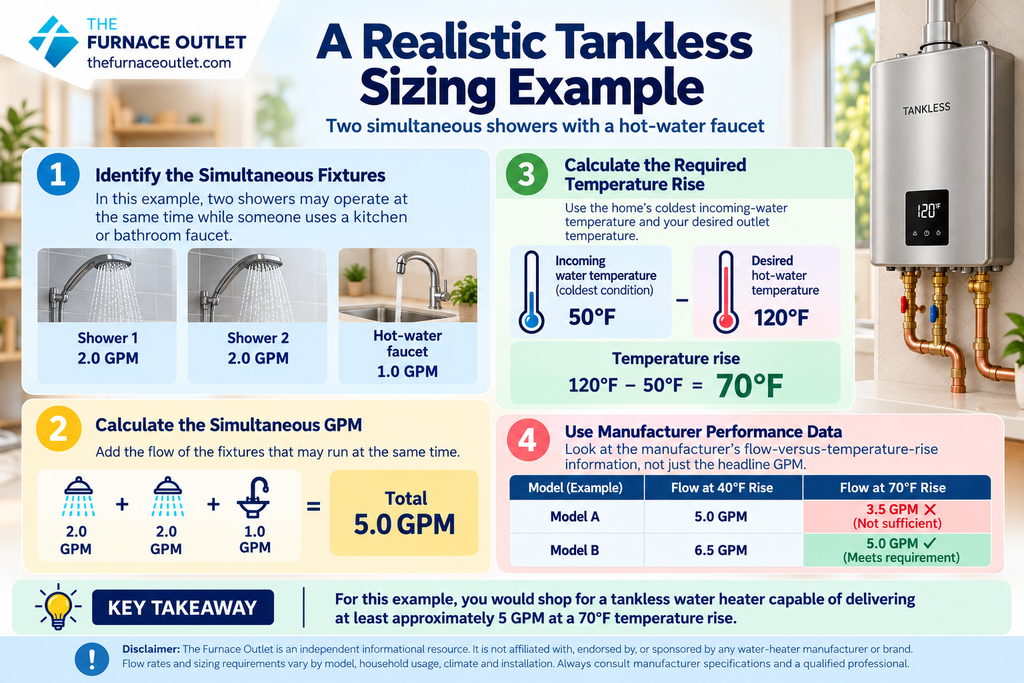
Consider a household where two showers may operate at the same time while someone uses a kitchen or bathroom faucet. Suppose the showers each require 2.0 GPM of hot water and the faucet contributes approximately 1.0 GPM.
The simultaneous requirement is approximately: 2.0 + 2.0 + 1.0 = 5.0 GPM
Now suppose the home’s coldest incoming-water temperature is approximately 50°F and the desired outlet temperature is 120°F. The required temperature rise is: 120°F − 50°F = 70°F
I would therefore shop for equipment capable of delivering at least approximately 5 GPM at a 70°F temperature rise, rather than simply looking for a heater whose headline specification says “5 GPM.”
If a particular model produces 5 GPM at a 40°F rise but only 3.5 GPM at a 70°F rise, it would not satisfy our calculated requirement under the colder condition. The manufacturer’s flow-versus-temperature-rise information is what reveals that limitation.
Two showers provide one of the easiest examples of why fixture flow matters. ENERGY STAR uses approximately 2.5 GPM as an average shower/bathtub flow when helping consumers estimate tankless capacity. Two such showers operating together could therefore represent roughly 5 GPM before any other hot-water demand is added.
However, actual showerheads vary. If your showerheads use 1.75 GPM, two showers could create a much lower load than two 2.5-GPM fixtures. Conversely, larger or specialty shower systems can require substantially more flow.
This is why changing fixtures can sometimes influence tankless requirements. Efficient showerheads reduce water consumption while also reducing the instantaneous heating load the water heater must satisfy.
There is no universal GPM requirement for four people. The more useful question is how many of those four people are likely to use hot water simultaneously. A four-person household taking showers consecutively might require enough capacity for only one shower plus occasional faucet use at any particular moment. Another four-person household with two bathrooms could routinely operate two showers while a dishwasher or faucet is being used.
The first household might have a relatively modest simultaneous requirement. The second could require substantially greater capacity despite having exactly the same number of occupants.
ENERGY STAR therefore recommends estimating tankless capacity from simultaneous hot-water uses rather than providing a fixed GPM requirement according to family size.
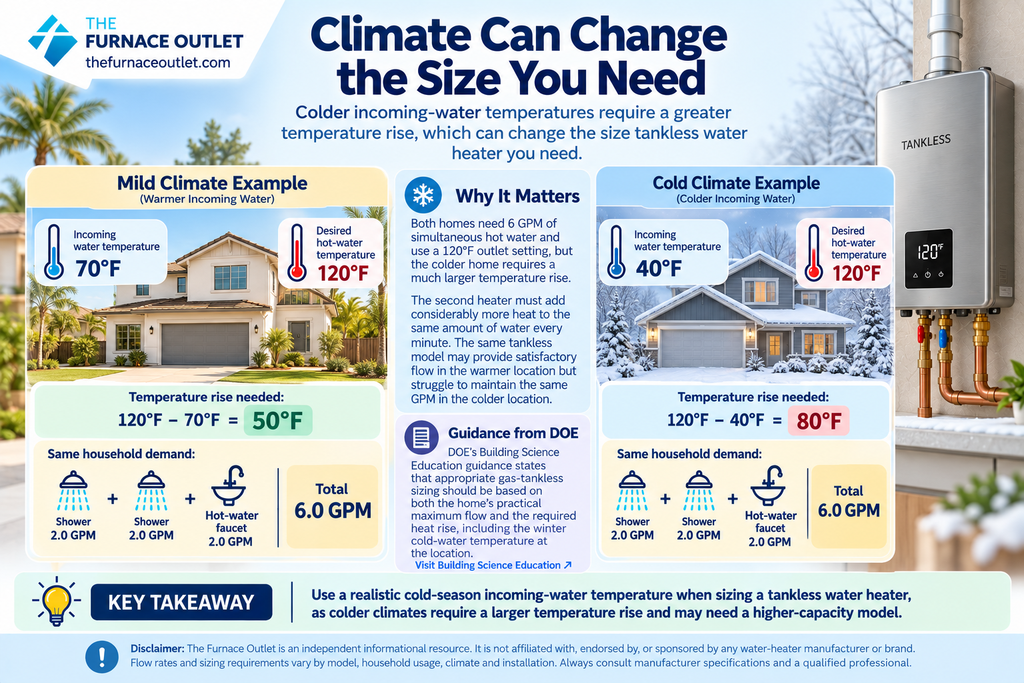
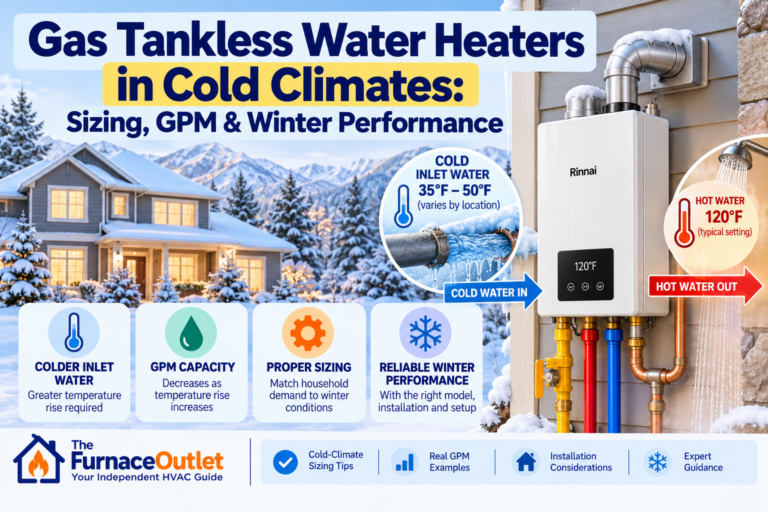
Tankless sizing becomes particularly important in colder climates because incoming-water temperature can fall significantly during winter. Suppose two identical homes each need 6 GPM of simultaneous hot water and both use a 120°F outlet setting. If one home’s incoming water is 70°F, the heater needs a 50°F rise. If the second home’s incoming water is 40°F, it needs an 80°F rise.
The second heater has to add considerably more heat to the same amount of water every minute. Consequently, the same tankless model may provide satisfactory flow in the warmer location but struggle to maintain the same GPM in the colder location. DOE’s Building Science Education guidance similarly states that appropriate gas-tankless sizing should be based on both the home’s practical maximum flow and the required heat rise, including the winter cold-water temperature at the location. Building Science Education
For sizing, I would therefore use a realistic cold-season incoming-water temperature, not an unusually warm summer measurement.
The basic sizing principles are the same for both technologies: determine simultaneous GPM and temperature rise. The infrastructure implications, however, can be very different. A whole-house gas tankless system may require substantial burner capacity to produce high flow at a large temperature rise. ENERGY STAR advises homeowners and installers to confirm whether the existing natural-gas line is adequate, whether electricity is available where needed, and how combustion gases will be vented. ENERGY STAR
Whole-house electric tankless systems avoid combustion and gas venting, but heating several gallons of water every minute can create a substantial electrical load. I would therefore never choose an electric tankless system from GPM alone. The home’s electrical service, panel capacity, breaker requirements, wiring, and exact manufacturer’s installation requirements must also support the selected unit.
A heater that satisfies the theoretical GPM calculation but requires an impractical infrastructure upgrade is not necessarily the right solution.
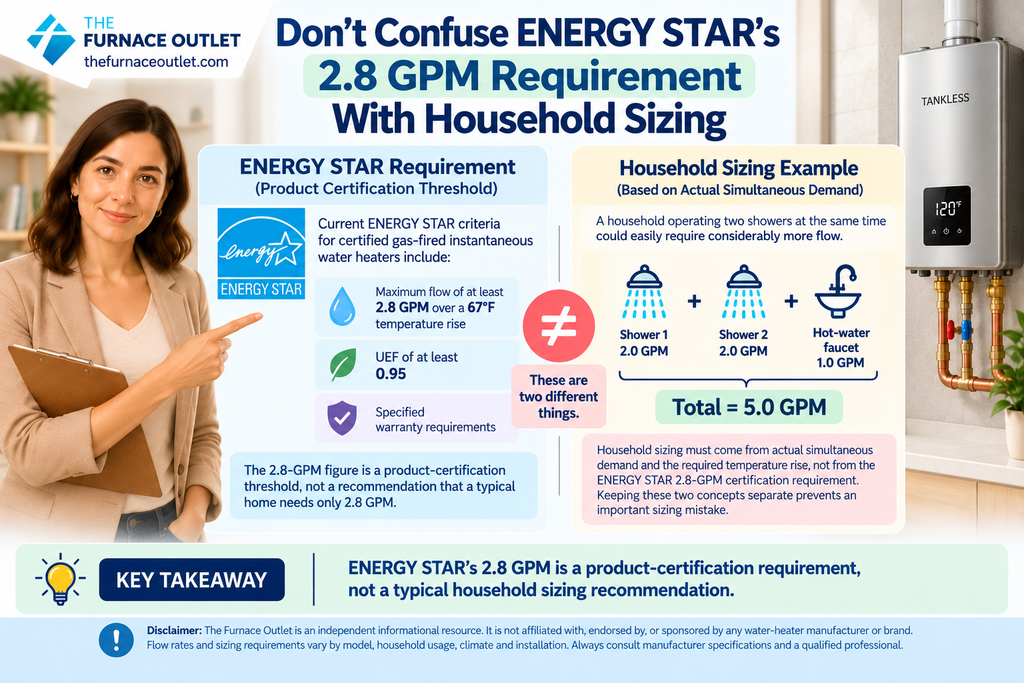
Current ENERGY STAR criteria for certified gas-fired instantaneous water heaters require a maximum flow of at least 2.8 GPM over a 67°F temperature rise, along with a UEF of at least 0.95 and specified warranty requirements.
That 2.8-GPM figure is a product-certification threshold, not a recommendation that a typical home needs only 2.8 GPM.
A household operating two showers simultaneously could easily require considerably more flow. The ENERGY STAR specification is useful for understanding standardized product performance, while household sizing must still come from actual simultaneous demand and temperature rise.
Keeping those two concepts separate prevents an important sizing mistake.
I would avoid selecting equipment that only barely satisfies the calculated load, because fixture estimates, incoming-water temperatures, and household habits are not perfectly predictable. At the same time, there is little reason to dramatically oversize the system simply for reassurance.
Instead, I would calculate realistic peak demand, use conservative cold-season inlet-water conditions, and then compare several models whose performance curves comfortably cover that requirement.
The objective is reasonable capacity margin rather than arbitrary oversizing. Final selection should also account for manufacturer guidance, available fuel or electrical capacity, installation requirements, minimum flow characteristics, venting where applicable, water quality, warranty, and local professional support.
Before buying a tankless heater, I would identify every hot-water fixture and appliance that could realistically operate during the household’s busiest period. I would record their actual flow rates whenever possible and add the simultaneous flows to determine the peak GPM requirement.
I would then establish a realistic cold-season incoming-water temperature and subtract it from the desired outlet temperature to calculate the required temperature rise. With those two numbers in hand—GPM and temperature rise—I would compare the manufacturer’s performance tables for the exact models being considered.
Only after confirming heating capacity would I compare UEF, gas input or electrical requirements, venting, condensate handling, physical dimensions, minimum activation flow, warranty, maintenance requirements, installed cost, and local service availability. That sequence keeps the most important question first: can the heater actually supply the hot water the household expects?
There is no universal GPM requirement for a family of four. A household using one shower at a time can require considerably less instantaneous capacity than another four-person household that routinely operates two showers and another hot-water fixture simultaneously. Calculate the actual simultaneous GPM and required winter temperature rise before choosing equipment.
Five GPM can be sufficient for some households, particularly when simultaneous demand is modest, but the answer depends on temperature rise. A heater advertised at 5 GPM may not deliver 5 GPM when incoming water is very cold. Check the exact model’s performance at the temperature rise your home requires.
ENERGY STAR uses approximately 2.5 GPM as an average shower/bathtub figure in its consumer tankless guidance, so two such fixtures could represent approximately 5 GPM. Actual showerheads may use more or less, so checking the fixtures is preferable to assuming 2.5 GPM.
It may be, but “8 GPM” alone does not answer the question. You need to determine whether the exact heater can produce the required 8 GPM at the home’s cold-season temperature rise. A large family that uses hot water consecutively may require less instantaneous capacity than a smaller household with several simultaneous showers.
Generally, yes. A larger temperature rise requires the heater to transfer more heat to every gallon of water, which can reduce the maximum flow that the unit can heat to the desired outlet temperature. DOE therefore bases tankless sizing on both maximum flow and maximum temperature rise.
Not automatically. Oversizing can increase equipment and potentially installation costs without providing meaningful benefits. I would select enough capacity to comfortably satisfy realistic simultaneous demand at the required temperature rise while ensuring that the home’s gas or electrical infrastructure can support the equipment.
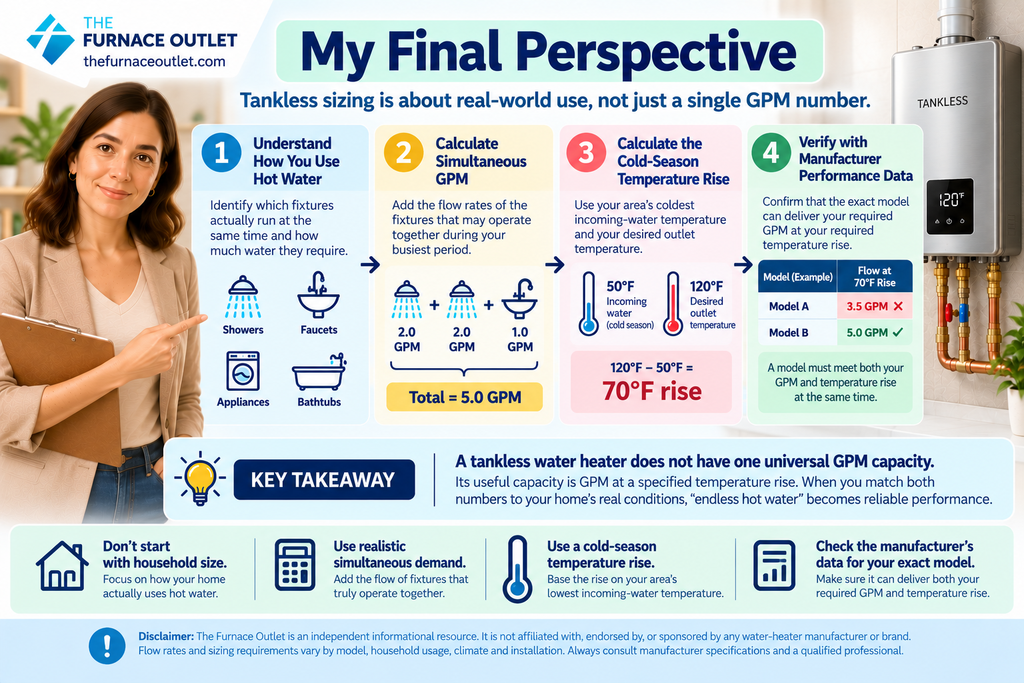
When I size a tankless water heater, I would not start with household size and I would never select a model solely from the maximum GPM printed in large type on its product page. I would start with how the household actually uses hot water. The critical questions are which fixtures operate together, how much water they require, how cold the incoming water becomes, and what outlet temperature the household expects.
Once those conditions are known, the sizing calculation becomes much more meaningful. Add realistic simultaneous fixture flows to establish the required GPM, calculate the cold-season temperature rise, and then verify that the exact heater can deliver both numbers at the same time using manufacturer performance data.
That last point is the one I would remember above everything else: a tankless water heater does not really have one universal GPM capacity. Its useful capacity is GPM at a specified temperature rise. Correctly matching those two variables is what turns “endless hot water” from a marketing phrase into reliable household performance.
For readers who want to go deeper into tankless sizing, these independent resources provide useful technical and consumer guidance. ENERGY STAR — Whole-Home Tankless Gas Water Heaters explains simultaneous fixture demand and provides example flow rates; DOE — Transitioning to a Tankless Water Heater provides detailed guidance on calculating maximum flow and temperature rise; DOE Building Science Education — Gas-Fired Tankless Water Heaters explains sizing in relation to winter incoming-water temperature and practical peak demand; and ENERGY STAR — Residential Water Heater Key Product Criteria provides current standardized GPM, UEF, and certification criteria.
The Furnace Outlet is an independent informational and educational resource. It is not associated with, affiliated with, endorsed by, or sponsored by any water-heater manufacturer or brand discussed in this article, and it does not receive manufacturer compensation for inclusion or rankings.
Tankless-water-heater GPM, temperature rise, heating capacity, efficiency, installation requirements, fuel supply, electrical requirements, venting, costs, and real-world performance vary by equipment, climate, incoming-water temperature, plumbing fixtures, household behavior, water quality, and installation conditions. Flow examples in this guide are preliminary planning illustrations rather than universal sizing requirements. Always verify the performance tables and installation instructions for the exact model being considered and consult an appropriately qualified or licensed plumbing, gas, electrical, or other professional as required by applicable codes.