Newsletter Subscribe
Enter your email address below and subscribe to our newsletter

HVAC made simple
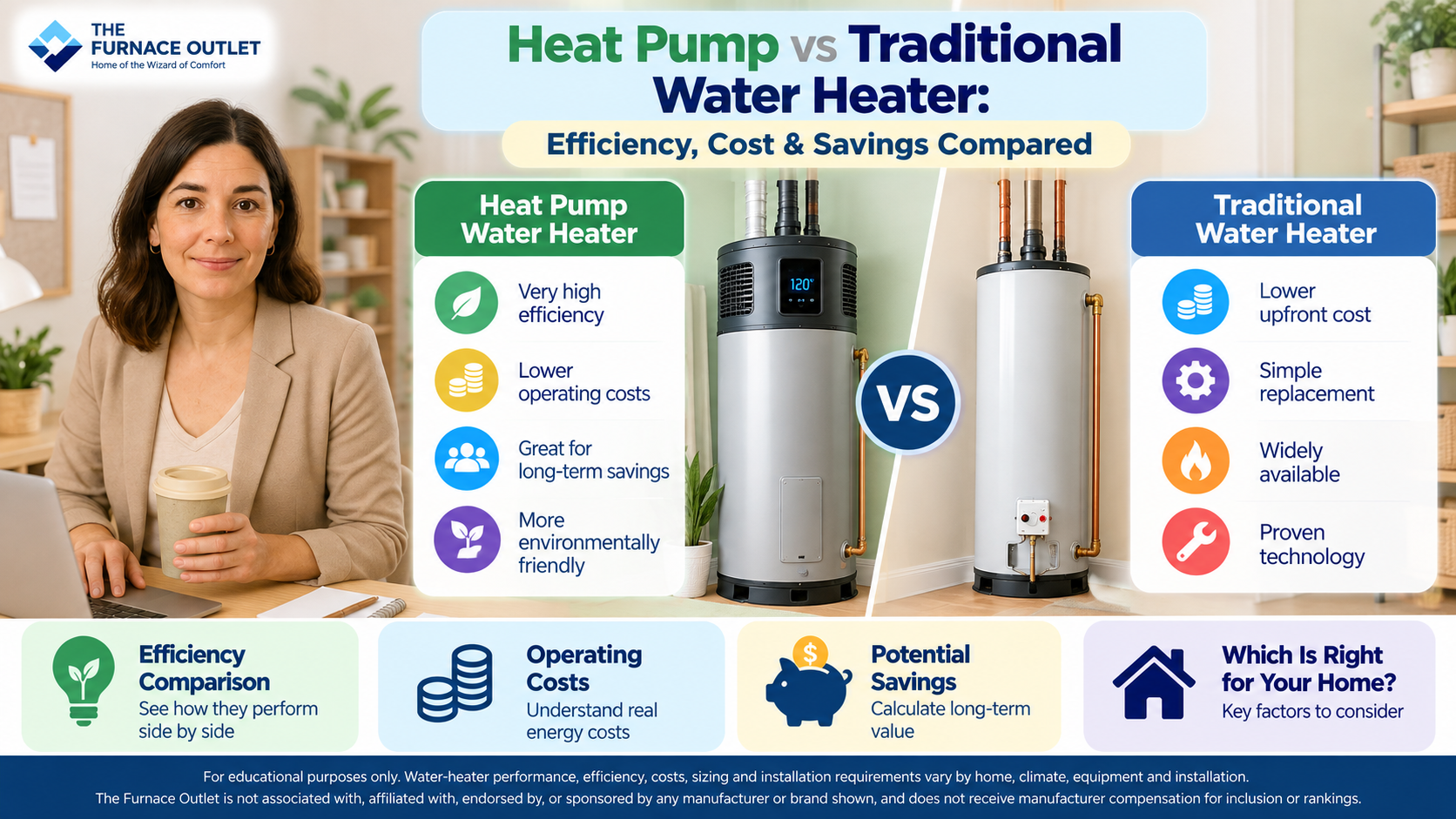
When homeowners compare a heat-pump water heater with a traditional water heater, the conversation often begins with the purchase price. A conventional electric storage heater is familiar, relatively simple, and usually less expensive to buy. A heat-pump water heater costs more upfront, but it can use dramatically less electricity because it does not create all of its heat directly from electric resistance elements. Instead, it transfers heat from the surrounding air into the stored water.
I’m Savvy Mavi, Savvy the Sustainability Expert, and this is one of those comparisons where sustainability and household economics can work in the same direction. ENERGY STAR estimates that a certified heat-pump water heater can save a four-person household about $550 per year compared with a standard electric water heater under its published assumptions. However, I would never apply that figure blindly to every home. Electricity rates, hot-water consumption, installation conditions, tank size, operating mode, climate, and the exact models being compared all influence actual savings.
The better question is therefore not simply whether heat-pump water heaters are more efficient. They clearly can be. The more useful question is whether the additional equipment and installation cost makes sense for your home, your hot-water demand, and your local energy prices.
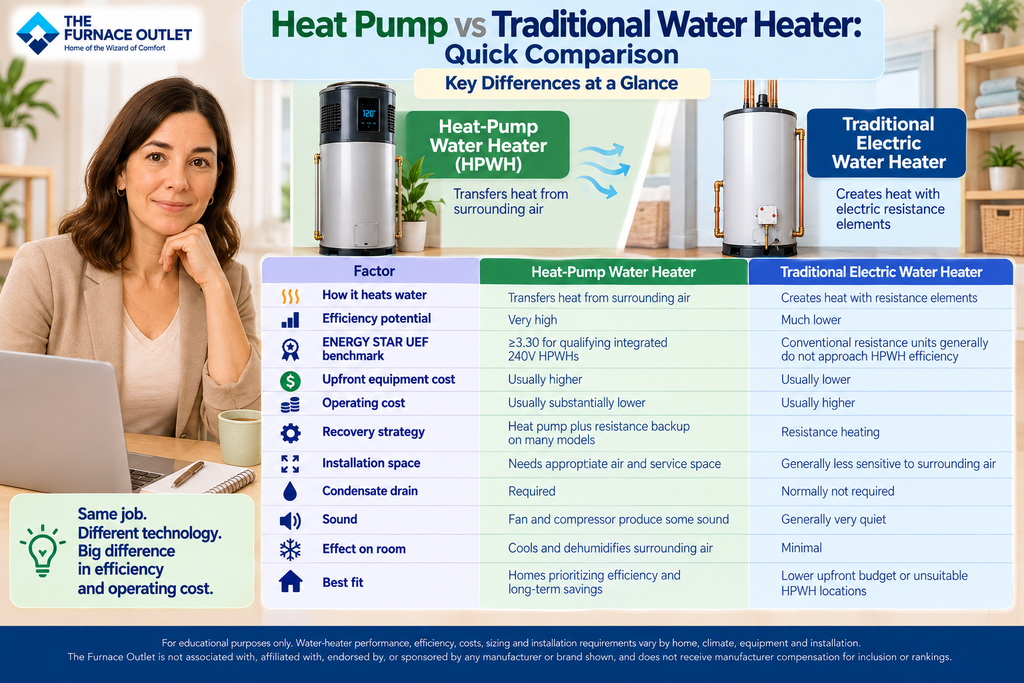
For this guide, I am primarily comparing a heat-pump water heater, or HPWH, with a conventional electric-resistance storage water heater. I will also discuss traditional gas storage systems where relevant, but electric resistance is the clearest comparison because both technologies use electricity while producing hot water in fundamentally different ways.
| Factor | Heat-Pump Water Heater | Traditional Electric Water Heater |
|---|---|---|
| How it heats water | Transfers heat from surrounding air | Creates heat with resistance elements |
| Efficiency potential | Very high | Much lower |
| ENERGY STAR UEF benchmark | ≥3.30 for qualifying integrated 240V HPWHs | Conventional resistance units generally do not approach HPWH efficiency |
| Upfront equipment cost | Usually higher | Usually lower |
| Operating cost | Usually substantially lower | Usually higher |
| Recovery strategy | Heat pump plus resistance backup on many models | Resistance heating |
| Installation space | Needs appropriate air and service space | Generally less sensitive to surrounding air |
| Condensate drain | Required | Normally not required |
| Sound | Fan and compressor produce some sound | Generally very quiet |
| Effect on room | Cools and dehumidifies surrounding air | Minimal |
| Best fit | Homes prioritizing efficiency and long-term savings | Lower upfront budget or unsuitable HPWH locations |
The efficiency difference is significant. DOE’s Building Science Education program describes heat-pump water heaters as roughly two to three times more efficient than conventional electric-resistance water heaters, because the heat pump moves heat rather than producing it directly. Building Science Education
A conventional electric water heater has a straightforward job. Cold water enters an insulated storage tank, and one or more electric resistance elements convert electricity directly into heat. The heated water remains in the tank until a fixture calls for it, after which incoming cold water replaces the hot water that has been used.
There is a lot to like about this simplicity. Conventional electric tanks do not require combustion venting, their installation is familiar to plumbers and electricians, and replacing an existing electric storage heater with a similar unit can be relatively straightforward when the electrical circuit, plumbing and physical space remain compatible.
The drawback is energy consumption. Electric resistance heating essentially has to generate the required heat from electricity every time the water needs reheating. A heat-pump water heater approaches the same problem differently, and that difference is where most of its efficiency advantage comes from.
A heat-pump water heater operates more like a refrigerator working in reverse. Instead of removing heat from inside a refrigerator and rejecting it into the room, the HPWH extracts heat from surrounding air and transfers that energy into the water stored inside its tank.
Electricity still powers the compressor, fan, controls and other components, but the system is using electricity primarily to move heat rather than create all of it directly. DOE identifies this heat-transfer principle as the reason HPWHs can be two to three times more efficient than conventional electric-resistance systems.
Most integrated residential HPWHs are also hybrids. They contain conventional electric resistance elements that can assist when hot-water demand exceeds what the heat pump can recover quickly enough. This provides additional capacity during periods of heavy use, although running resistance elements reduces the efficiency advantage while they are operating.
That hybrid capability is useful, but it also explains why I pay close attention to sizing. A poorly sized HPWH that frequently relies on resistance backup may not achieve the energy savings you expected.
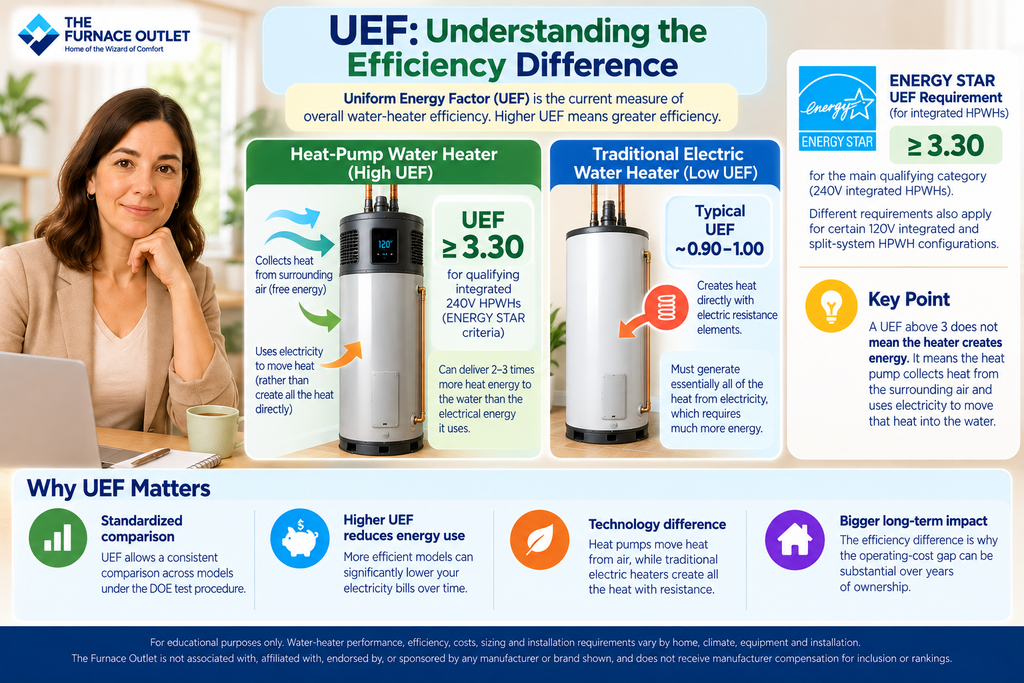
The easiest standardized efficiency number to compare is Uniform Energy Factor, or UEF. ENERGY STAR describes UEF as the current measure of overall water-heater efficiency, with higher values indicating greater efficiency under the DOE test procedure.
Current ENERGY STAR criteria require an integrated heat-pump water heater to achieve a UEF of at least 3.30 for the main qualifying category. ENERGY STAR also establishes different requirements for certain 120-volt integrated and split-system HPWH configurations.
The important lesson is not to interpret a UEF above 3 as though the appliance somehow creates energy. A heat pump can deliver substantially more heat energy to the water than the electrical energy consumed by the compressor because additional heat is being collected from the surrounding air.
That is fundamentally different from resistance heating and is why the operating-cost gap can become substantial over years of ownership.
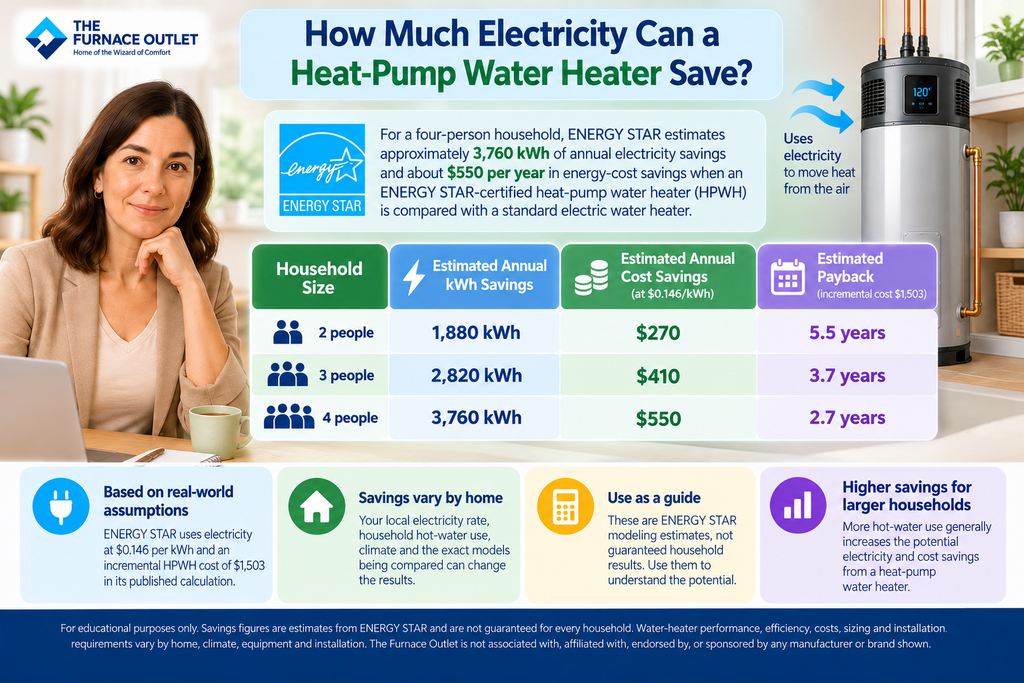
ENERGY STAR’s current consumer savings estimates provide a useful illustration. For a four-person household, it estimates approximately 3,760 kWh of annual electricity savings and about $550 per year in energy-cost savings when an ENERGY STAR-certified HPWH is compared with a standard electric water heater under its assumptions. ENERGY STAR’s published calculation assumes electricity at $0.146 per kWh and an incremental HPWH cost of $1,503.
The same ENERGY STAR analysis estimates different savings according to household size:
| Household | Estimated Annual kWh Savings | Estimated Annual Cost Savings | Estimated Payback |
|---|---|---|---|
| 2 people | 1,880 kWh | $270 | 5.5 years |
| 3 people | 2,820 kWh | $410 | 3.7 years |
| 4 people | 3,760 kWh | $550 | 2.7 years |
These are ENERGY STAR modeling estimates, not guaranteed household results. Your local electricity rate alone can change the economics considerably, and household hot-water consumption can move the numbers even further.
I would therefore use these figures to understand the potential rather than copy them directly into my household budget.
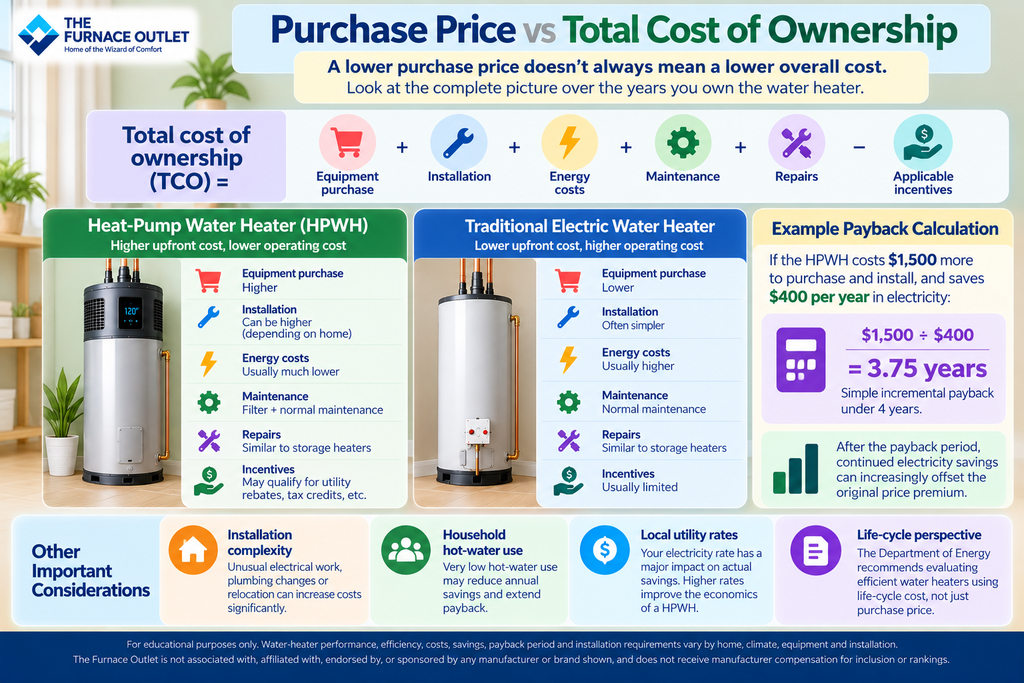
This is where the comparison becomes particularly interesting. A conventional resistance tank often wins when we compare only the price paid on installation day. The heat-pump system can win when we extend the comparison across years of electricity consumption.
I prefer to think of the calculation this way: Total cost of ownership = equipment + installation + energy + maintenance + repairs − applicable incentives.
Suppose a heat-pump water heater costs $1,500 more to purchase and install than a conventional electric tank. If realistic household calculations suggest that it will save $400 annually, the simple incremental payback would be under four years. After that point, continued electricity savings can increasingly offset the original price premium.
However, if an installation requires unusual electrical work, significant plumbing changes or relocation of the heater, the upfront difference could be much larger. Similarly, a household with very low hot-water use may save less each year.
DOE’s Federal Energy Management Program also evaluates efficient water heaters using life-cycle cost, rather than focusing solely on purchase price, which is the approach I would recommend for homeowners as well. The Department of Energy’s Energy.gov
Energy-saving percentages can sound impressive, but your utility rate determines what those saved kilowatt-hours are worth.
If two households save exactly 3,000 kWh annually but one pays $0.12 per kWh and the other pays $0.25, their annual financial savings will be dramatically different. The household paying the higher rate has a much stronger economic incentive to reduce consumption.
This is why I would obtain the EnergyGuide information for the exact models, check recent utility bills for the actual electricity rate, and estimate savings from local numbers rather than a national average.
The same principle applies when comparing an HPWH against natural gas. Electricity and gas prices vary geographically and over time, so an efficiency advantage does not automatically translate into the same financial advantage everywhere.
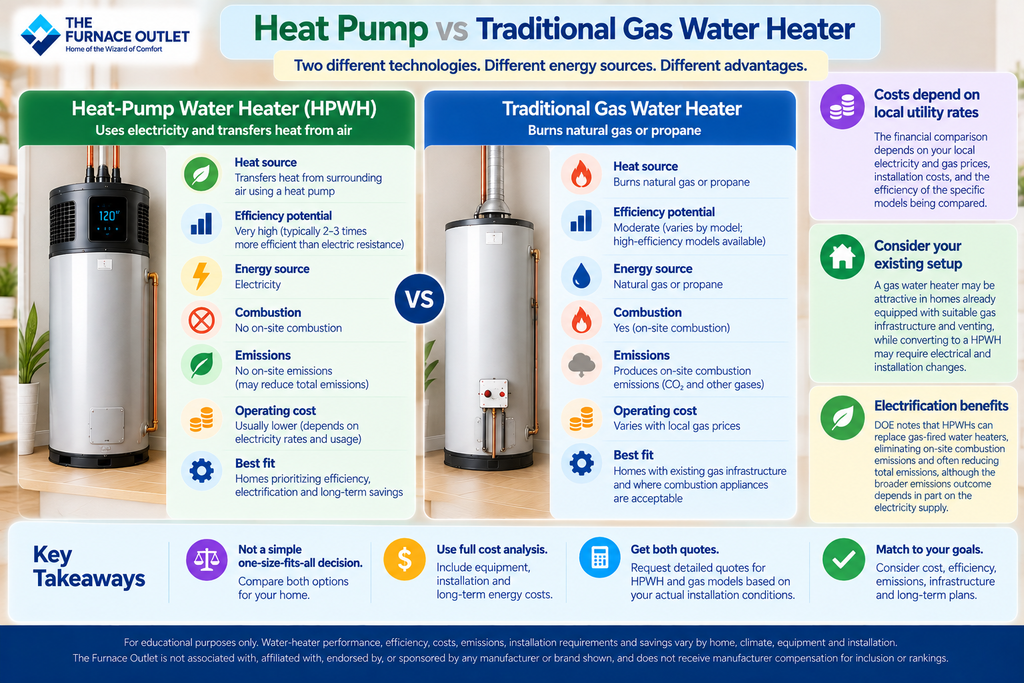
Comparing a heat-pump water heater with a conventional gas storage heater is more complicated than comparing HPWH with electric resistance because the two systems use different energy sources.
A heat-pump system avoids combustion at the appliance and can achieve extremely high electrical efficiency. A gas water heater burns natural gas or propane and may offer strong recovery performance, particularly in homes already equipped with suitable gas infrastructure and venting.
The financial comparison depends on local gas and electricity prices, installation costs, and the efficiency of the specific gas heater. An older conventional gas tank and a modern high-efficiency gas storage system should not be treated as identical.
From an electrification perspective, DOE notes that HPWHs can replace gas-fired water heaters, eliminating on-site combustion emissions and often reducing total emissions, although the broader emissions outcome depends in part on the electricity supply. The Department of Energy’s Energy.gov
For an existing gas household, I would therefore request both quotes before deciding. Converting from gas to HPWH may be attractive, but infrastructure changes need to be included in the economics.
A heat-pump water heater cannot be treated exactly like a conventional electric tank simply because both are storage appliances. The heat pump needs access to surrounding air from which it can collect heat.
ENERGY STAR’s design guidance notes that manufacturers commonly require roughly 450 to 700 cubic feet of free air space, although requirements vary by exact product. Confined installations can sometimes be addressed using transfer grilles, louvered doors or manufacturer-approved ducting arrangements.
This makes basements, garages and utility rooms particularly interesting locations when conditions are appropriate. ENERGY STAR identifies basements as frequently good locations and notes that garages can work well because they often provide substantial air volume, although climate and freezing conditions must be considered.
I would always follow the exact manufacturer’s installation instructions rather than applying a generic minimum-space number to every model.
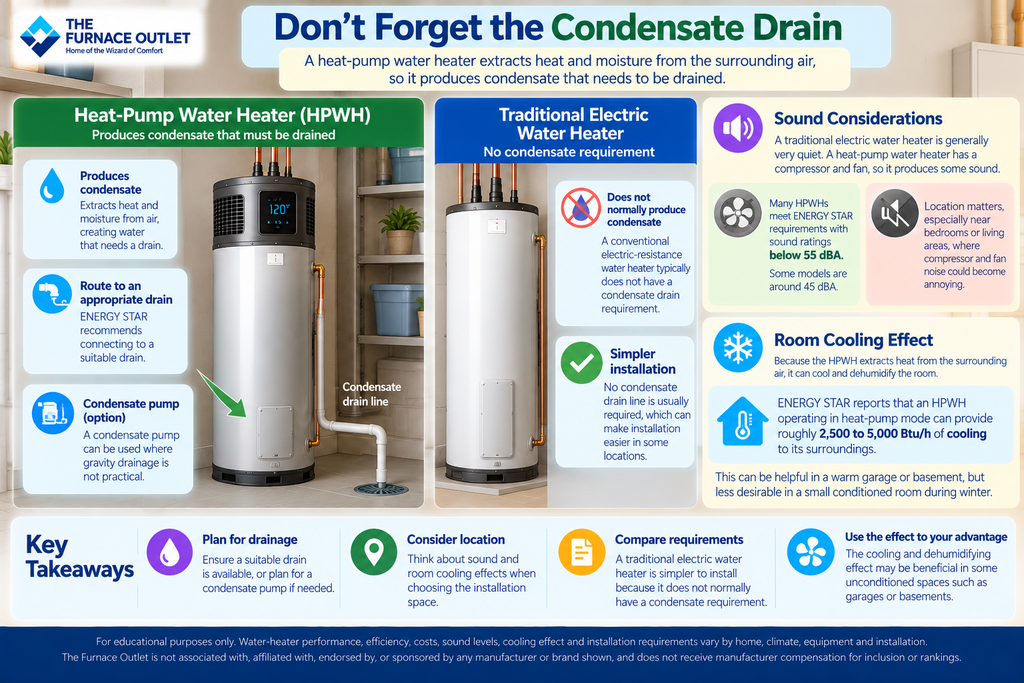
Because an HPWH extracts heat and moisture from surrounding air, it produces condensate. That water needs somewhere to go.
ENERGY STAR recommends routing condensate to an appropriate drain and notes that a condensate pump can be used where gravity drainage is impractical.
This is a relatively manageable requirement in many basements and utility rooms, but it can add complexity if the existing water heater location has no convenient drainage route.
A conventional electric-resistance water heater does not normally have this condensate requirement, giving it an installation-simplicity advantage.
A traditional resistance water heater is generally unobtrusive because there is no compressor or fan operating as part of normal heating. A heat-pump water heater has both.
ENERGY STAR notes that HPWHs meeting its Version 5.0 requirements have sound ratings below 55 dBA, while some products are rated around 45 dBA. That means location still matters, especially near bedrooms, living rooms or other areas where compressor and fan noise could become annoying.
The appliance also cools and dehumidifies the surrounding air because that is where the heat entering the water comes from. In a warm garage or basement, that effect can sometimes be welcome. In a small conditioned room during winter, it can be less desirable.
ENERGY STAR reports that an HPWH operating in heat-pump mode can provide roughly 2,500 to 5,000 Btu/h of cooling to its surroundings. That interaction with the home is another reason installation location should be planned rather than chosen simply because the old tank was there.
One mistake I would avoid is automatically replacing a 50-gallon conventional electric tank with a 50-gallon heat-pump model.
HPWHs typically recover water more slowly when relying exclusively on the highly efficient heat-pump cycle. During heavy demand, hybrid models can activate electric resistance elements to increase recovery. That maintains comfort but reduces efficiency while those elements are operating.
ENERGY STAR therefore recommends considering upsizing HPWH storage capacity where appropriate. Additional stored hot water allows the heat pump to perform more of the heating before resistance backup becomes necessary, particularly in households with concentrated high-demand periods.
This is why a 65- or 80-gallon HPWH can sometimes make more sense than replacing a smaller resistance tank gallon-for-gallon. Bigger is not automatically better, but additional thermal storage can be strategically valuable.
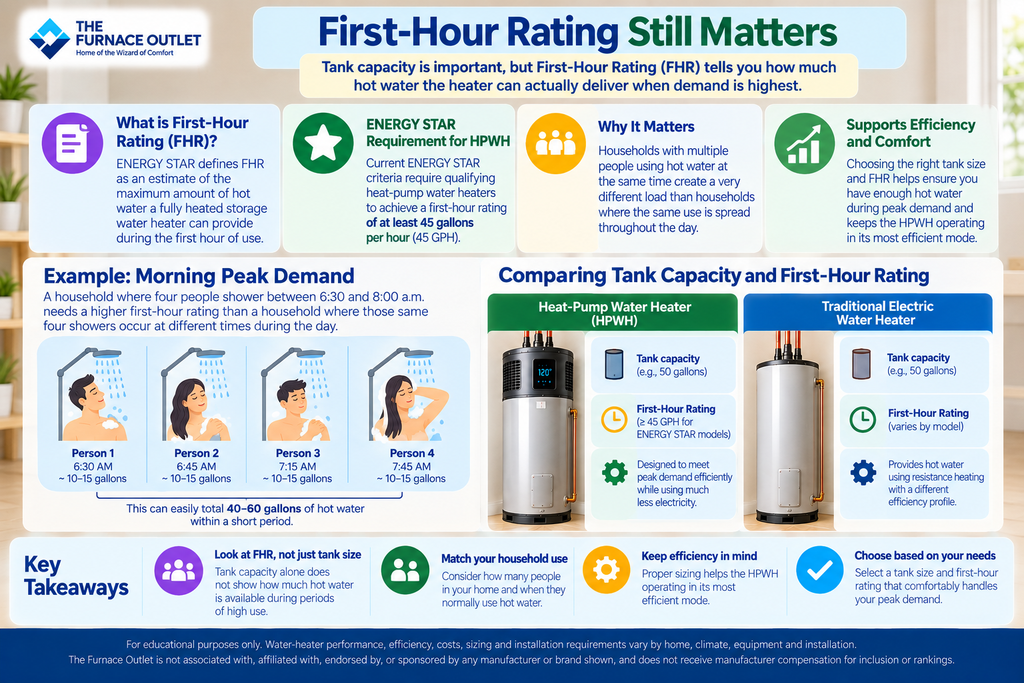
Tank capacity should not be considered alone. I would also compare First-Hour Rating, or FHR.
ENERGY STAR defines FHR as an estimate of the maximum amount of hot water a fully heated storage water heater can provide during the first hour of use. Its current HPWH criteria require qualifying products to achieve at least a 45-gallon-per-hour FHR.
A household where four people shower between 6:30 and 8:00 a.m. creates a different load from a household where those same four showers occur throughout the day. Peak demand should therefore influence both tank size and FHR selection.
Correct sizing is not merely about comfort. It helps keep the HPWH operating in its most efficient mode.
Many hybrid water heaters offer several operating modes. Exact terminology varies by manufacturer, but common choices include heat-pump-only or efficiency-oriented modes, hybrid modes, electric-resistance modes, and vacation settings.
Heat-pump-focused operation generally prioritizes efficiency but can recover more slowly. Hybrid operation allows resistance elements to assist when necessary. Resistance-only operation effectively turns the system into something much closer to a conventional electric heater from an energy-use perspective.
DOE’s FEMP guidance explains that hybrid mode is intended to maximize heat-pump operation while using resistance heating when necessary to meet hot-water demand. The Department of Energy’s Energy.gov
I would therefore avoid buying a high-efficiency HPWH only to operate it routinely in resistance-heavy modes because the unit was undersized for the household.
A traditional electric tank is mechanically straightforward, but it still requires attention to issues such as sediment accumulation, corrosion protection, leaks, plumbing components and manufacturer-recommended tank maintenance.
A heat-pump model adds a refrigeration system, compressor, fan, air filter, electronics and condensate management. The air filter needs to remain clean enough for proper airflow, and the installation should remain unobstructed.
That does not mean HPWHs are experimental or inherently unreliable. ENERGY STAR notes that heat-pump water heaters have been available for more than 40 years and reports that current units have service lives similar to electric storage water heaters, with many products carrying 10-year warranties.
I would compare the exact warranty and local service support rather than assuming one technology automatically lasts longer.
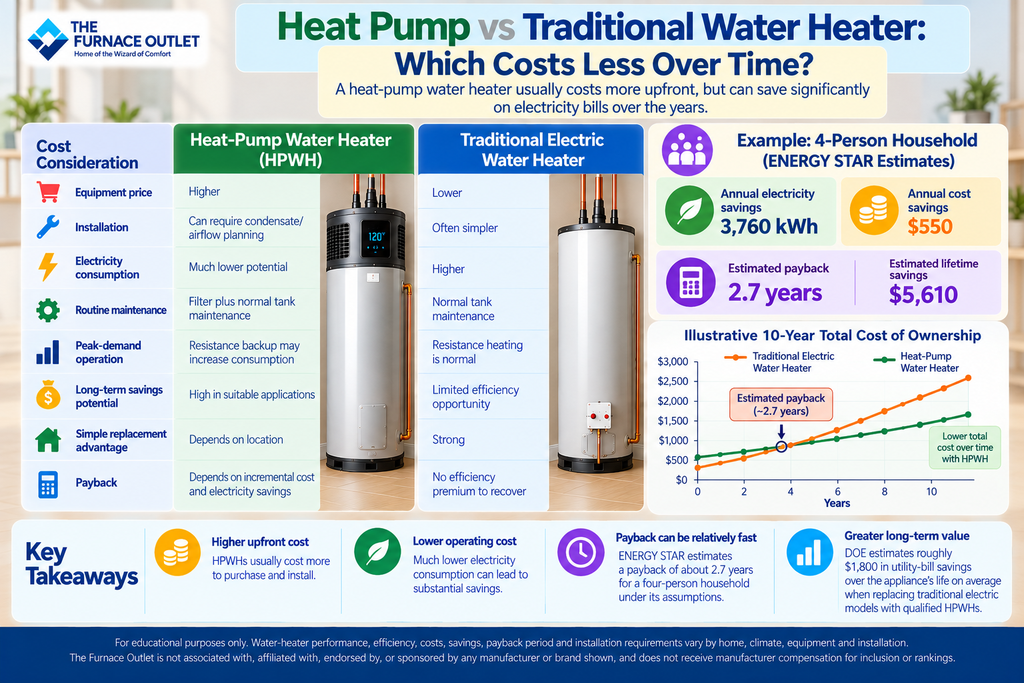
The answer depends on the installation, but this is where HPWHs can become compelling.
| Cost Consideration | Heat Pump | Traditional Electric |
|---|---|---|
| Equipment price | Higher | Lower |
| Installation | Can require condensate/airflow planning | Often simpler |
| Electricity consumption | Much lower potential | Higher |
| Routine maintenance | Filter plus normal tank maintenance | Normal tank maintenance |
| Peak-demand operation | Resistance backup may increase consumption | Resistance heating is normal |
| Long-term savings potential | High in suitable applications | Limited efficiency opportunity |
| Simple replacement advantage | Depends on location | Strong |
| Payback | Depends on incremental cost and electricity savings | No efficiency premium to recover |
ENERGY STAR’s current consumer estimate puts the payback for a four-person household at approximately 2.7 years under its stated assumptions. Its estimated lifetime savings for that household reach about $5,610. Again, these are modeled figures rather than promises, but they demonstrate why paying more upfront can sometimes produce a substantially lower ownership cost..
DOE’s 2024 water-heater efficiency rule analysis likewise estimated that replacing common-size traditional electric-resistance storage heaters with heat-pump equipment meeting the new standards would save consumers roughly $1,800 on utility bills over the appliance’s life on average under DOE’s assumptions.
If I were replacing a conventional electric-resistance water heater and had a suitable basement, garage or utility room, I would put an HPWH near the top of my shortlist. The efficiency improvement is simply too significant to ignore without at least calculating the economics.
I would check the available room volume, ambient temperatures, condensate drainage, electrical requirements, sound, tank size and FHR. I would then compare the HPWH’s installed price with a conventional replacement and calculate savings using my actual electricity rate.
For a larger family, I would seriously consider increasing storage capacity if doing so allows the heat pump to meet more of the household’s demand without activating resistance backup.
A conventional water heater can remain sensible when the initial budget is extremely constrained, the existing installation allows an inexpensive direct replacement, or the available location is poorly suited to heat-pump operation.
A tiny enclosed closet with no practical ventilation solution may make an integrated HPWH difficult. A location where compressor noise would be intrusive can create another problem. An emergency replacement may also leave little time for infrastructure changes.
In those situations, choosing a correctly sized conventional system is not automatically a bad decision. Sustainability also involves avoiding unnecessary construction and selecting equipment that works reliably within the actual building.
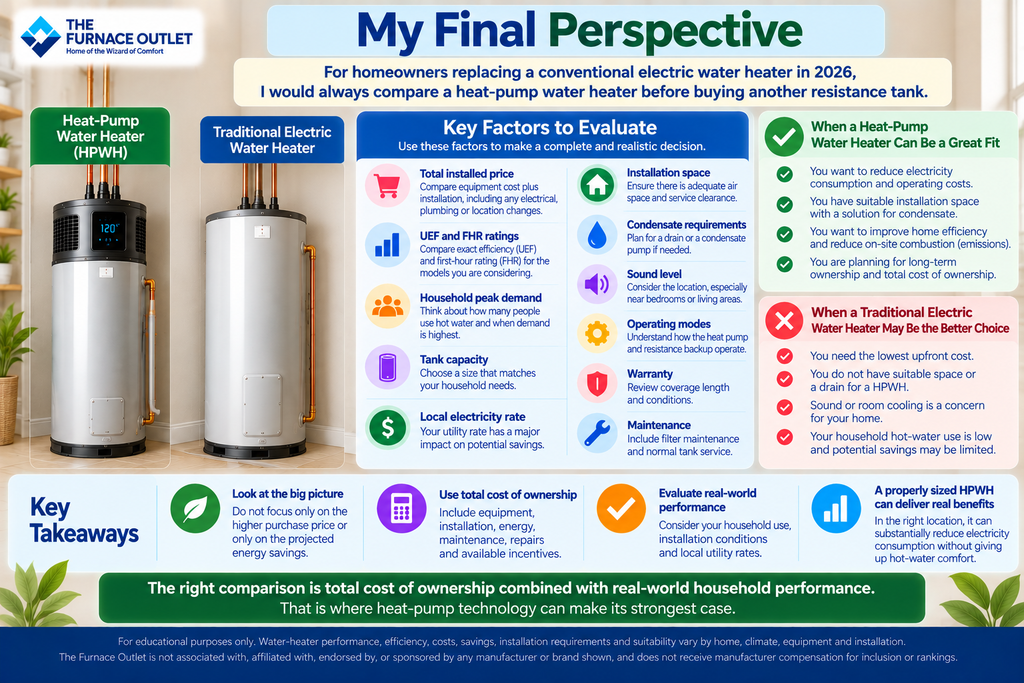
For homeowners replacing a conventional electric water heater in 2026, I would always compare a heat-pump water heater before buying another resistance tank. That does not mean the HPWH automatically belongs in every house. It means its potential efficiency and operating-cost advantages are large enough that it deserves to be evaluated.
I would make that evaluation using the complete installed price, exact UEF and FHR, household peak demand, tank capacity, local electricity rate, available installation space, condensate requirements, sound level, operating modes, warranty and expected maintenance. A properly sized HPWH in an appropriate location can substantially reduce electricity consumption without asking the household to give up hot-water comfort.
The biggest mistake would be focusing exclusively on the higher purchase price. The second biggest would be focusing exclusively on the projected energy savings. The right comparison is total cost of ownership combined with real-world household performance. That is where heat-pump technology can make its strongest case.
Yes. DOE describes HPWHs as approximately two to three times more efficient than conventional electric-resistance water heaters because they transfer heat instead of generating all of it through resistance heating. Current ENERGY STAR criteria require a UEF of at least 3.30 for qualifying integrated HPWHs in its main category. Building Science Education
ENERGY STAR currently estimates that a four-person household could save around $550 annually and approximately $5,610 over the equipment’s lifetime compared with a standard electric water heater under its stated assumptions. Actual household savings can differ substantially because electricity rates, hot-water consumption, installation and equipment operation vary.
Like any storage water heater, it has finite stored capacity. Many HPWHs include resistance elements that can assist during high-demand periods. Proper tank sizing and FHR selection are therefore important, and ENERGY STAR recommends considering larger tanks where concentrated demand could otherwise cause frequent resistance-backup operation.
Not automatically. Household peak demand, first-hour rating and recovery characteristics should determine sizing. ENERGY STAR specifically recommends considering upsizing HPWH storage because additional thermal storage can reduce reliance on less-efficient resistance backup.
They need adequate airflow, although exact requirements depend on the model. ENERGY STAR notes that manufacturers commonly specify around 450–700 cubic feet of free air for many installations, with ventilation or ducting strategies available for some confined locations. Always follow the exact manufacturer’s installation requirements.
They produce some noise because they contain a compressor and fan. ENERGY STAR notes that qualifying Version 5.0 products are below 55 dBA, while some products are rated around 45 dBA. Location should therefore be considered carefully, particularly near bedrooms and living spaces.
Yes. They remove heat from surrounding air and discharge cooler, drier air. ENERGY STAR estimates roughly 2,500–5,000 Btu/h of cooling while an HPWH is actively operating in heat-pump mode. This can be useful in some warm spaces but needs consideration in colder climates and conditioned rooms.
Not automatically. HPWHs offer very high electrical efficiency and eliminate combustion at the appliance, while an existing gas system may have infrastructure and recovery advantages. Compare exact equipment, local electricity and gas prices, conversion costs, household demand and installation conditions before deciding.
For homeowners who want to research beyond manufacturer marketing, I recommend starting with ENERGY STAR’s Heat Pump Water Heater guidance and its more detailed HPWH Design Considerations guide. The ENERGY STAR Water Heater Key Product Criteria is particularly useful for checking current UEF and FHR benchmarks, while DOE’s Building Science Education HPWH overview explains how the technology works and why its efficiency differs from resistance heating. For the financial side, homeowners can review ENERGY STAR’s HPWH savings and payback estimates and DOE FEMP’s energy-efficient residential water-heater guidance.
The Furnace Outlet is an independent informational and educational resource. It is not associated with, affiliated with, endorsed by, or sponsored by any water-heater manufacturer or brand, and it does not receive manufacturer compensation for inclusion or rankings.
Water-heater efficiency, UEF, first-hour rating, electricity consumption, savings, payback, installation requirements, warranties and costs vary by exact equipment, household hot-water demand, climate, utility rates, operating mode and installation. Savings figures in this article are estimates published by ENERGY STAR or DOE under specific assumptions and should not be treated as guaranteed savings for an individual household. Always verify current specifications, EnergyGuide information, manufacturer installation instructions, local codes and available incentives before purchasing. Electrical, plumbing and other regulated work should be performed by appropriately qualified or licensed professionals where required