Newsletter Subscribe
Enter your email address below and subscribe to our newsletter

HVAC made simple
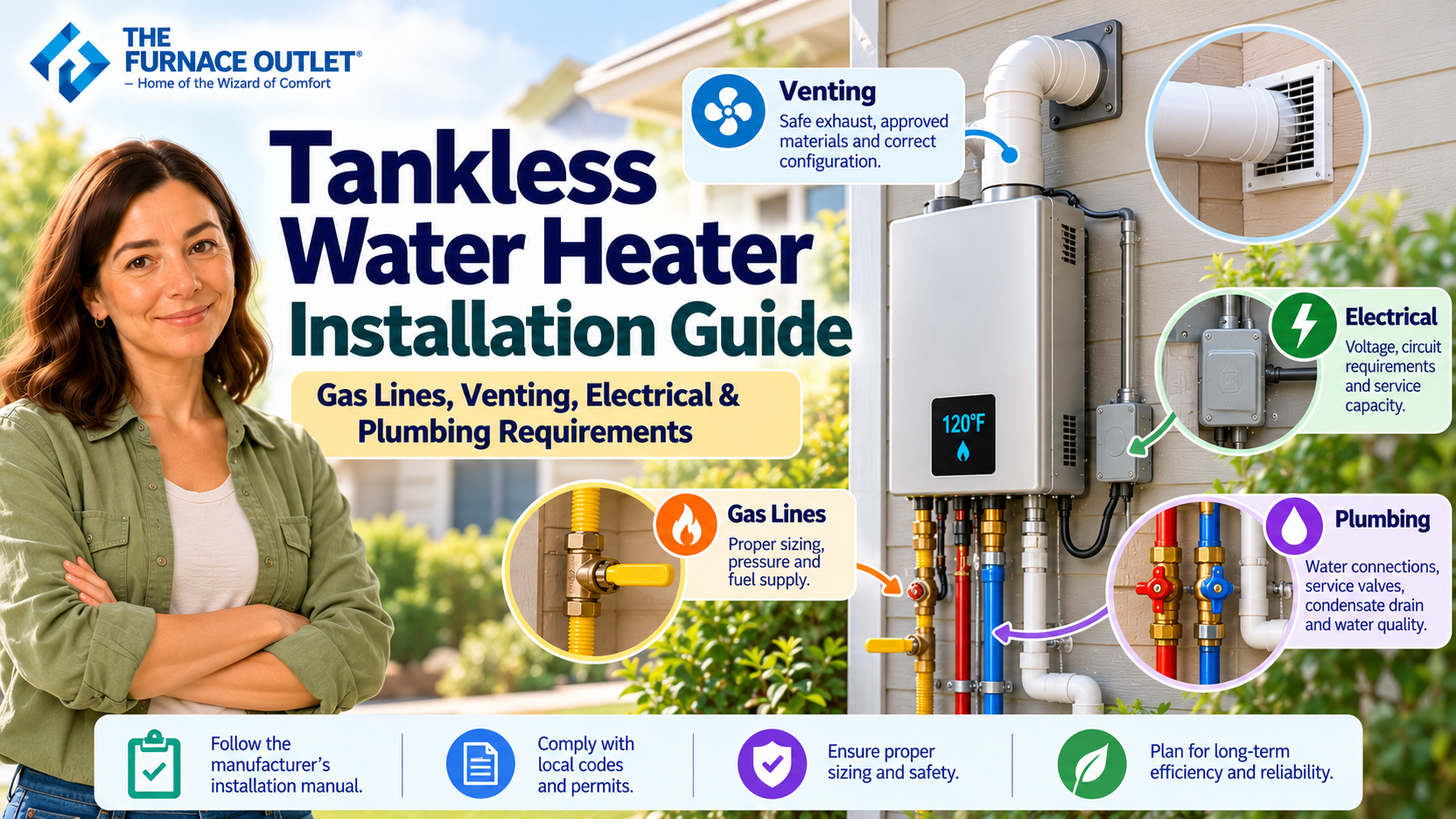
Installing a tankless water heater is very different from simply removing a storage tank and connecting a smaller appliance in its place. The new heater may occupy much less space, but its gas, electrical, venting and plumbing requirements can be considerably different from those of the water heater it replaces.
I’m Savvy, The Furnace Outlet’s sustainability-focused HVAC enthusiast, and when I evaluate a tankless installation, I look beyond the appliance itself. A highly efficient heater cannot perform properly if the gas supply is undersized, the electrical system cannot support it, the venting exceeds manufacturer limits or the plumbing layout creates unnecessary heat and water losses.
That is why I consider installation planning part of equipment selection. Before purchasing a tankless water heater, I would verify the home’s fuel supply, electrical capacity, vent route, water connections, condensate requirements, drainage, water quality and expected hot-water demand. Doing that work first can prevent expensive surprises after the equipment arrives.
Important: This guide explains general installation considerations. Gas piping, combustion venting, electrical wiring and plumbing are regulated work in many jurisdictions. The installation manual for the exact model and applicable local codes always take precedence.
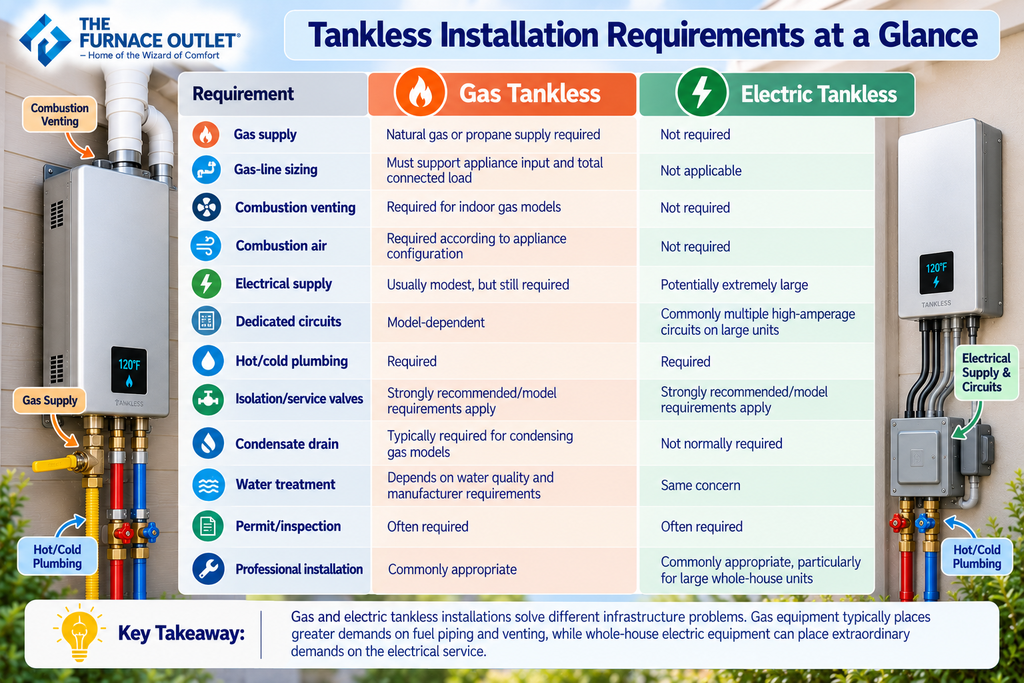
| Requirement | Gas Tankless | Electric Tankless |
|---|---|---|
| Gas supply | Natural gas or propane supply required | Not required |
| Gas-line sizing | Must support appliance input and total connected load | Not applicable |
| Combustion venting | Required for indoor gas models | Not required |
| Combustion air | Required according to appliance configuration | Not required |
| Electrical supply | Usually modest, but still required | Potentially extremely large |
| Dedicated circuits | Model-dependent | Commonly multiple high-amperage circuits on large units |
| Hot/cold plumbing | Required | Required |
| Isolation/service valves | Strongly recommended/model requirements apply | Strongly recommended/model requirements apply |
| Condensate drain | Typically required for condensing gas models | Not normally required |
| Water treatment | Depends on water quality and manufacturer requirements | Same concern |
| Permit/inspection | Often required | Often required |
| Professional installation | Commonly appropriate | Commonly appropriate, particularly for large whole-house units |
The biggest lesson from this table is that gas and electric tankless installations solve different infrastructure problems. Gas equipment can place greater demands on fuel piping and venting, while whole-house electric equipment can place extraordinary demands on the electrical service.
I would never design an installation around the phrase “8-GPM tankless heater” or “199,000-BTU tankless heater.” Installation requirements belong to an exact manufacturer and model number.
The installation manual establishes permitted vent materials, maximum vent length, gas pressure requirements, pipe connections, electrical supply, clearances, condensate arrangements and many other details. Even two heaters with similar capacities can have different installation requirements.
Before work begins, I would therefore obtain the current installation manual and specification sheet and make them the foundation of the project. The AHRI Directory can also be useful for checking certified equipment performance information, while ENERGY STAR’s water-heater resources provide efficiency information for qualifying products.
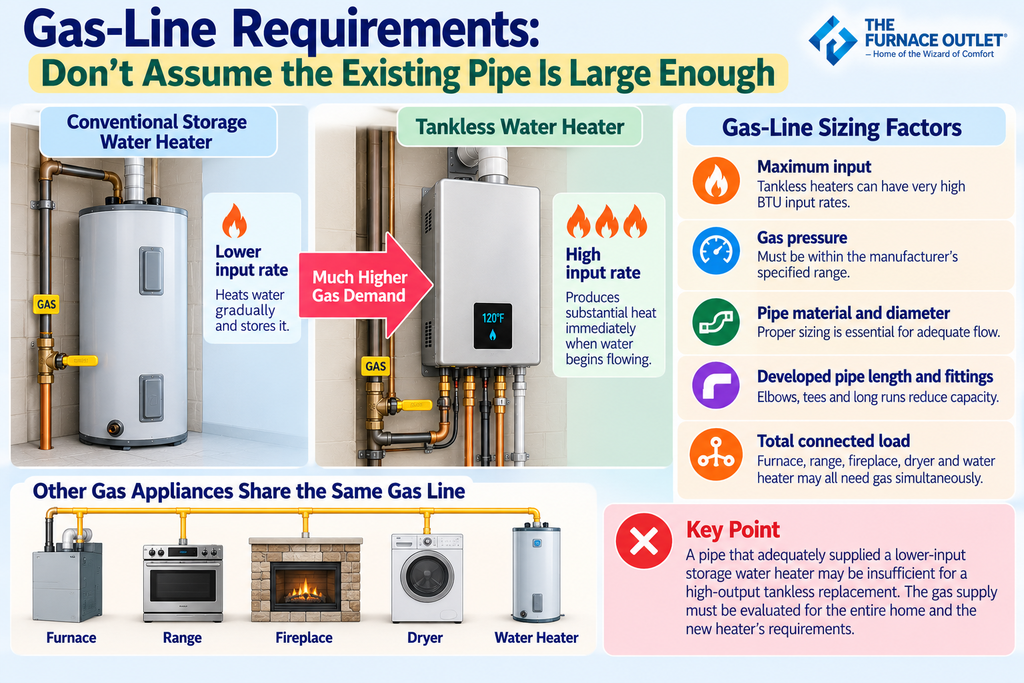
One of the most common mistakes in a gas tankless conversion is assuming that the gas pipe serving the existing storage heater will automatically support the new appliance.
A conventional storage water heater heats water gradually and stores it. A tankless heater must produce substantial heat immediately when water begins flowing. Large whole-house gas tankless heaters can therefore have very high maximum firing rates. That changes the gas-system calculation.
The installer needs to consider the tankless heater’s maximum input, gas pressure, pipe material and diameter, developed pipe length, fittings and the load from other gas appliances sharing the system. A furnace, range, fireplace, dryer and water heater may all need gas simultaneously. A pipe that adequately supplied a lower-input storage heater may therefore be insufficient for a high-output tankless replacement.
Correct pipe diameter alone does not guarantee adequate fuel delivery. The heater also needs gas supplied within the manufacturer’s specified pressure range. If supply pressure falls outside permitted limits when several appliances are operating, the tankless heater may not achieve its intended output or may experience operational problems.
I would therefore want the gas system evaluated under realistic load conditions rather than simply checking whether gas reaches the appliance.
Propane installations have their own supply, regulator and sizing considerations, so natural-gas assumptions should never automatically be transferred to propane equipment. For fuel-gas requirements, applicable codes and the heater manufacturer’s documentation should determine the installation.
Indoor gas tankless heaters need a safe path for combustion gases to leave the building. Depending on the model, they also need an approved method of supplying combustion air. his can involve direct-vent or other manufacturer-approved configurations. A direct-vent system generally brings combustion air from outdoors and sends exhaust gases back outdoors, helping separate the combustion process from the occupied indoor environment.
The exact vent material, pipe diameter, maximum equivalent length, elbows, termination configuration and clearances are model-specific. That means I would never select a vent system merely because it worked with another tankless heater.
Manufacturer guidance from Rinnai’s tankless venting overview illustrates how venting options can vary between appliance designs.
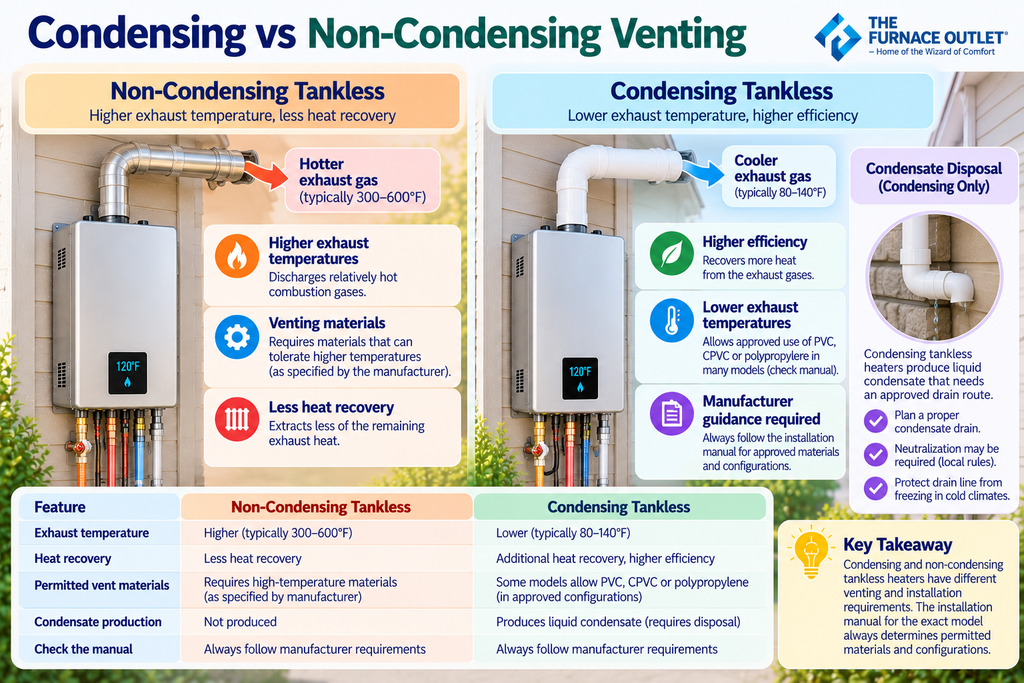
Whether the heater is condensing or non-condensing can significantly affect the vent system. Non-condensing tankless heaters discharge relatively hot combustion gases because they extract less of the remaining exhaust heat. Their vent systems therefore need to tolerate the temperatures specified by the manufacturer.
Condensing tankless heaters use additional heat recovery to cool the exhaust further. Some models consequently permit materials such as PVC, CPVC or polypropylene in approved configurations, but this should never be treated as a universal rule. The installation manual must specify the material. Condensing technology also creates another installation requirement: condensate disposal.
When combustion gases cool sufficiently inside a condensing heater, water vapor condenses into liquid. That condensate needs an approved route away from the appliance. The drain should be planned before installation rather than treated as an afterthought. Depending on the equipment, drainage system and local requirements, condensate neutralization may also be appropriate or required because combustion condensate can be acidic.
Cold climates add another consideration. A condensate line routed through an exposed freezing location can freeze and interfere with appliance operation. The drain route therefore needs to satisfy both manufacturer requirements and actual environmental conditions.
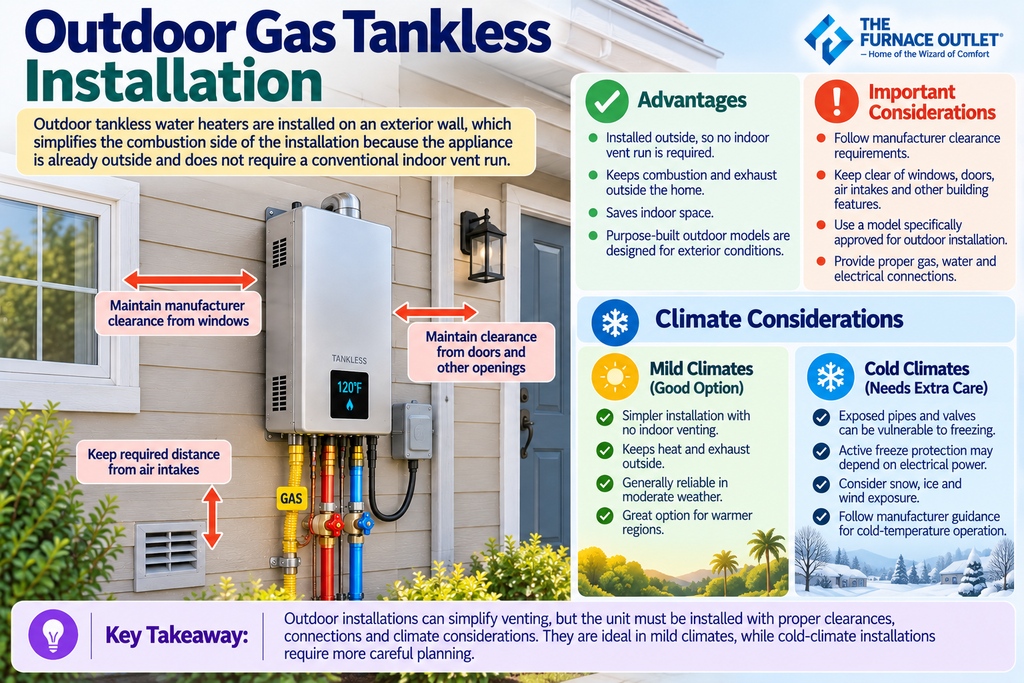
Purpose-built outdoor tankless heaters can simplify the combustion side of an installation because the appliance is already outside. They generally do not require the conventional indoor vent run needed to carry exhaust through the building.
That does not mean the heater can be installed anywhere on an exterior wall. Manufacturer clearances from windows, doors, air intakes and other building features remain important. The appliance must also be approved specifically for outdoor installation.
Climate becomes particularly important. Freeze-protection systems may protect portions of the appliance under specified conditions, but exposed pipes and valves can remain vulnerable. Loss of electrical power during freezing weather can also disable active freeze protection. For that reason, I generally consider outdoor installations particularly attractive in mild climates, while cold-climate installations require much more careful evaluation.
A gas tankless heater still normally requires electricity. Controls, ignition, sensors, fans, freeze-protection components and recirculation equipment where fitted may depend on electrical power.
The electrical load is usually modest compared with a whole-house electric tankless heater, but the appliance still needs the voltage, circuit arrangement, grounding and other electrical provisions specified by its manufacturer. A power outage can therefore stop a modern gas tankless heater even though natural gas remains available.
This distinction is particularly important for outdoor units in freezing conditions because electrical power may also support built-in freeze protection.
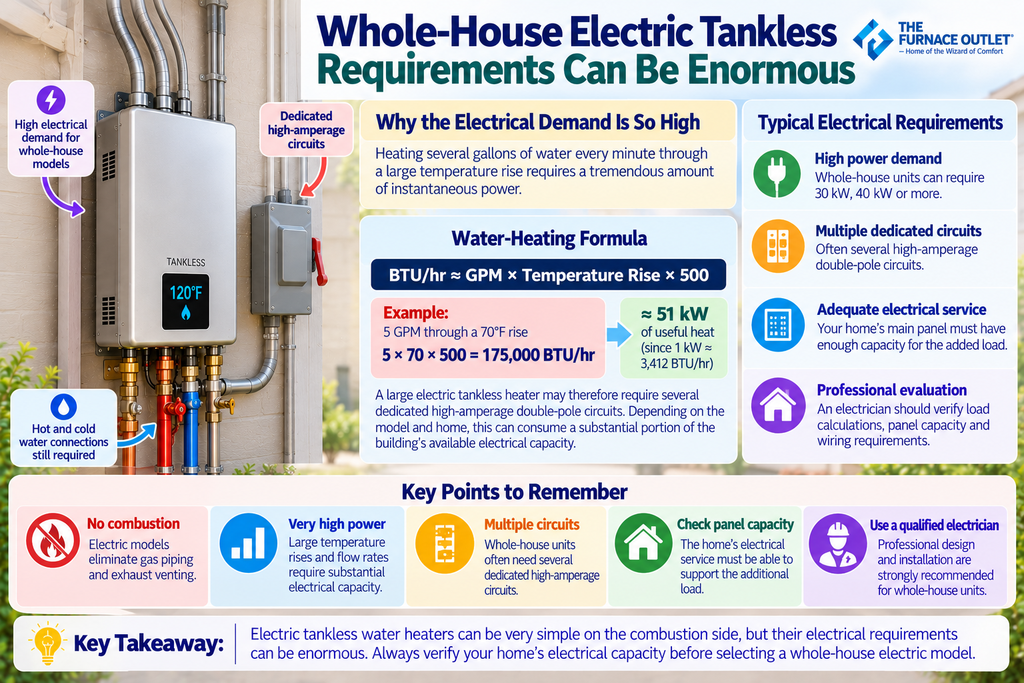
Electric tankless water heaters eliminate combustion, gas piping and exhaust venting, which can make the appliance appear much simpler to install. The electrical side tells a different story.
Heating several gallons of water every minute through a large temperature rise requires tremendous instantaneous power. Using the common water-heating approximation: BTU/hr ≈ GPM × Temperature Rise × 500
Heating 5 GPM through a 70°F rise requires approximately 175,000 BTU/hr of useful heat. That is roughly 51 kW. A large electric tankless heater may consequently require several dedicated high-amperage double-pole circuits. Depending on the model and home, that can consume a substantial portion of the building’s available electrical capacity.
For a whole-house electric tankless project, I would make electrical capacity one of the first feasibility checks, not something investigated after the heater has been purchased.The electrician needs to consider the heater’s required voltage, maximum amperage, number of circuits, breaker sizes, conductor requirements, panel capacity and the home’s overall electrical load.
This becomes increasingly important in electrified homes. A heat pump, EV charger, induction range, clothes dryer and large electric tankless heater can all contribute substantially to peak demand. If the existing service cannot support the additional load, panel or service upgrades may be necessary. Those upgrades can completely change the economics of choosing electric tankless.
Every tankless heater needs correctly configured cold-water inlet and hot-water outlet piping. Pipe sizing should follow the manufacturer’s requirements and applicable plumbing codes. I also place significant value on properly installed service isolation valves. Tankless heat exchangers may require periodic flushing or descaling, particularly where water contains substantial mineral content. A well-designed service-valve arrangement can make maintenance much easier.
A pressure-relief valve or other safety components may also be required according to the appliance instructions and applicable codes. These should never be improvised or omitted simply because a tankless heater lacks a storage tank.
Water chemistry deserves attention before the heater goes into service. Hard water can cause mineral deposits inside heat exchangers and waterways. Scale reduces effective heat transfer and can restrict flow, potentially affecting performance and equipment life.
Manufacturer water-quality limits should therefore be reviewed before installation. Where water conditions are problematic, appropriate treatment may be worthwhile. I prefer addressing water quality during the original installation because adding treatment after scale has already accumulated is less desirable than preventing excessive buildup from the beginning.
Tankless does not mean instantaneous hot water at every fixture. When a faucet opens, the water already sitting between the heater and the fixture must leave the pipe before newly heated water arrives. Long distribution runs therefore increase waiting time, wasted water and distribution heat loss.
DOE building-science guidance emphasizes reducing stored water in hot-water distribution piping and keeping hot-water sources reasonably close to fixtures. DOE Building Science Education — Efficient Hot-Water Distribution
When choosing an installation location, I would therefore map the bathrooms, kitchen and other major hot-water fixtures rather than selecting the wall that happens to be easiest for the installer.
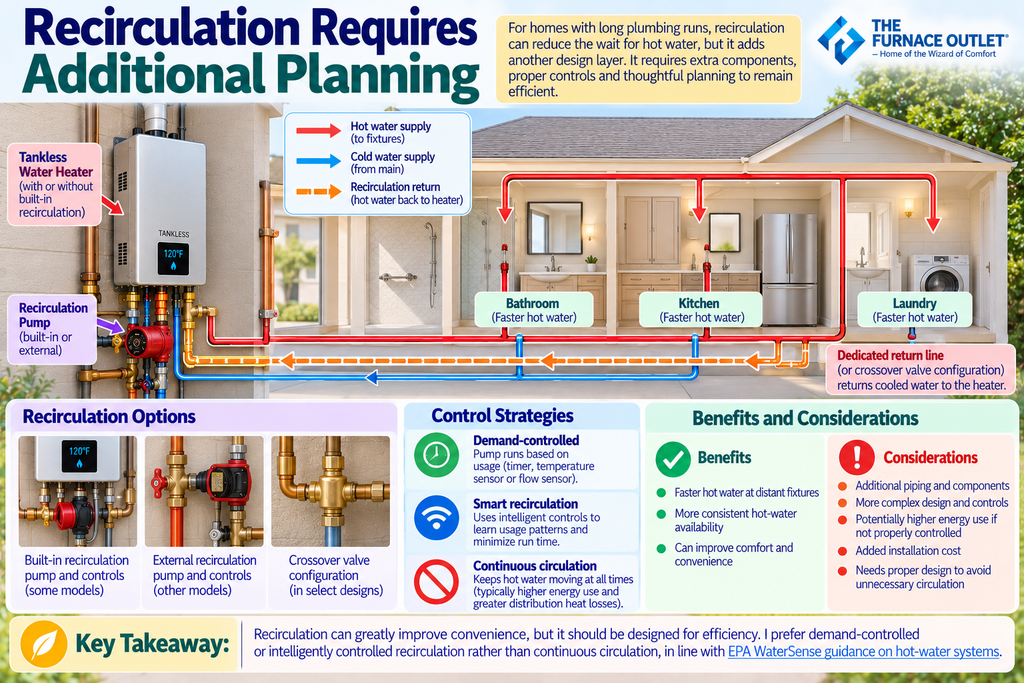
For homes with long plumbing runs, recirculation can reduce the wait for hot water, but it adds another design layer. Some tankless heaters include recirculation pumps or controls, while others support external arrangements. Dedicated return lines, crossover valves, control strategies and pump operation vary by system.
From an efficiency standpoint, I prefer demand-controlled or intelligently controlled recirculation rather than unnecessarily circulating hot water continuously. Continuous circulation can increase distribution heat losses and energy consumption. The EPA WaterSense guidance on hot-water systems provides useful context for designing water-efficient distribution systems.
A heater that fits physically is not necessarily installed in a good location. Tankless units eventually need inspection and maintenance. Filters need to be accessible, service valves need to be reachable, and technicians need enough working clearance to open the cabinet and service internal components.
I would avoid installing equipment behind permanent shelving, high above comfortable working height or in extremely cramped spaces simply because the heater’s compact cabinet makes that possible. The question I like to ask is: Can a technician comfortably maintain this heater ten years from now?
That simple test can prevent years of unnecessary service difficulty.
Before purchasing the heater, I would confirm the home’s required GPM and cold-season temperature rise so the equipment is properly sized. For gas equipment, I would verify fuel type, maximum appliance input, available gas pressure, total connected load, gas-line sizing, combustion-air arrangement, vent route and approved vent materials. For condensing gas equipment, I would also identify an acceptable condensate-drain location.
For electric tankless equipment, I would verify service capacity, panel capacity, voltage, circuit count, breaker sizes and conductor requirements before selecting the heater.
For either technology, I would review plumbing sizes, water pressure, water quality, service-valve arrangement, distribution distance, possible recirculation needs, maintenance clearance and applicable permits. Most importantly, I would compare the complete installed project, not merely the price of the heater.
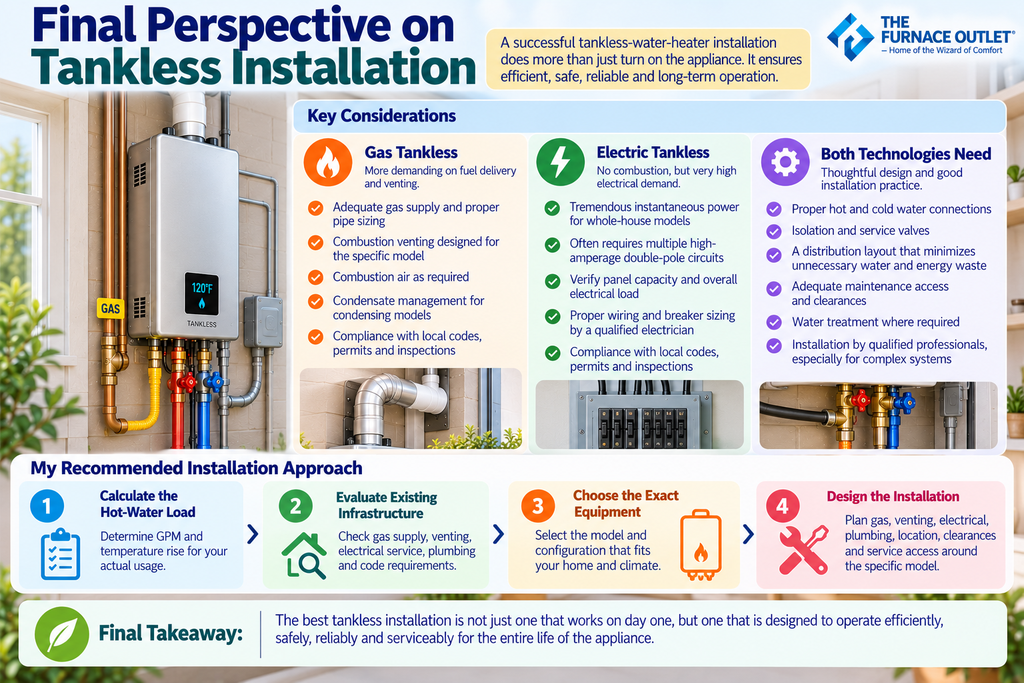
The compact size of a tankless water heater can create the impression that installation should be simpler than installing a conventional storage heater. Sometimes it is, but whole-house tankless equipment can also demand much more from the home’s infrastructure.
Gas systems need adequate fuel delivery and properly designed combustion venting. Condensing models add condensate management. Electric tankless systems avoid combustion entirely but can create exceptionally large electrical loads. Both technologies need thoughtful plumbing, good maintenance access and a distribution layout that does not unnecessarily waste water and energy.
From my sustainability perspective, the best installation is not merely one that successfully turns the heater on. It is an installation that allows the appliance to operate efficiently, safely, reliably and serviceably for its useful life.
That is why I would calculate the hot-water load first, evaluate the existing infrastructure second, choose the exact equipment third and design the installation around that specific model. Doing those steps in the opposite order can turn an attractive tankless-water-heater price into a surprisingly expensive project.
Possibly, but it should not be assumed. Tankless heaters can have substantially higher maximum gas input than storage water heaters. Gas pressure, pipe diameter, developed length and the total connected appliance load need to be evaluated.
Most modern gas tankless heaters do. Electricity can power controls, ignition, sensors, fans, freeze protection and other functions. Check the exact model’s requirements.
An indoor gas-fired tankless heater requires an approved combustion-exhaust arrangement. Vent type, material, length, diameter and termination requirements depend on the exact appliance.
No combustion vent is required because electric resistance heating does not produce combustion exhaust. The major installation consideration is usually electrical capacity.
Large whole-house models generally require dedicated high-amperage hardwired circuits rather than a conventional household receptacle. Follow the exact manufacturer’s electrical specifications.
Condensing gas tankless equipment produces liquid condensate and therefore requires appropriate condensate management. Neutralization requirements depend on the appliance, drainage system and applicable rules.
A properly designed service-valve arrangement can make flushing and maintenance considerably easier. Follow the manufacturer’s installation requirements for the exact heater.
Yes. Maintenance requirements vary with the model, water quality and operating conditions. Heat-exchanger flushing or descaling, filter cleaning and inspection may be required or recommended.
Tankless installation can involve fuel-gas piping, combustion venting, high-amperage electrical work, plumbing, condensate drainage and code compliance. Depending on jurisdiction and scope, licensed or otherwise qualified professionals may be required. Even where DIY work is legally permitted, manufacturer requirements and applicable codes still need to be followed.
I would usually do the opposite. Have the home’s hot-water demand and infrastructure evaluated first. A low-cost heater can become an expensive project if it requires a gas-service upgrade, major vent modifications or substantial electrical work.
The Furnace Outlet provides this guide for general educational and informational purposes. Tankless water-heater installation requirements vary by manufacturer, model, fuel, electrical service, water conditions, building design and jurisdiction. Always follow the current installation manual for the exact appliance and applicable plumbing, fuel-gas, electrical, mechanical and building codes. Gas piping, combustion venting, high-amperage electrical work and other regulated work should be evaluated or performed by appropriately qualified professionals where required. The Furnace Outlet is an independent informational resource and is not a manufacturer, installer or representative of the brands or organizations referenced in this guide