Newsletter Subscribe
Enter your email address below and subscribe to our newsletter

HVAC made simple
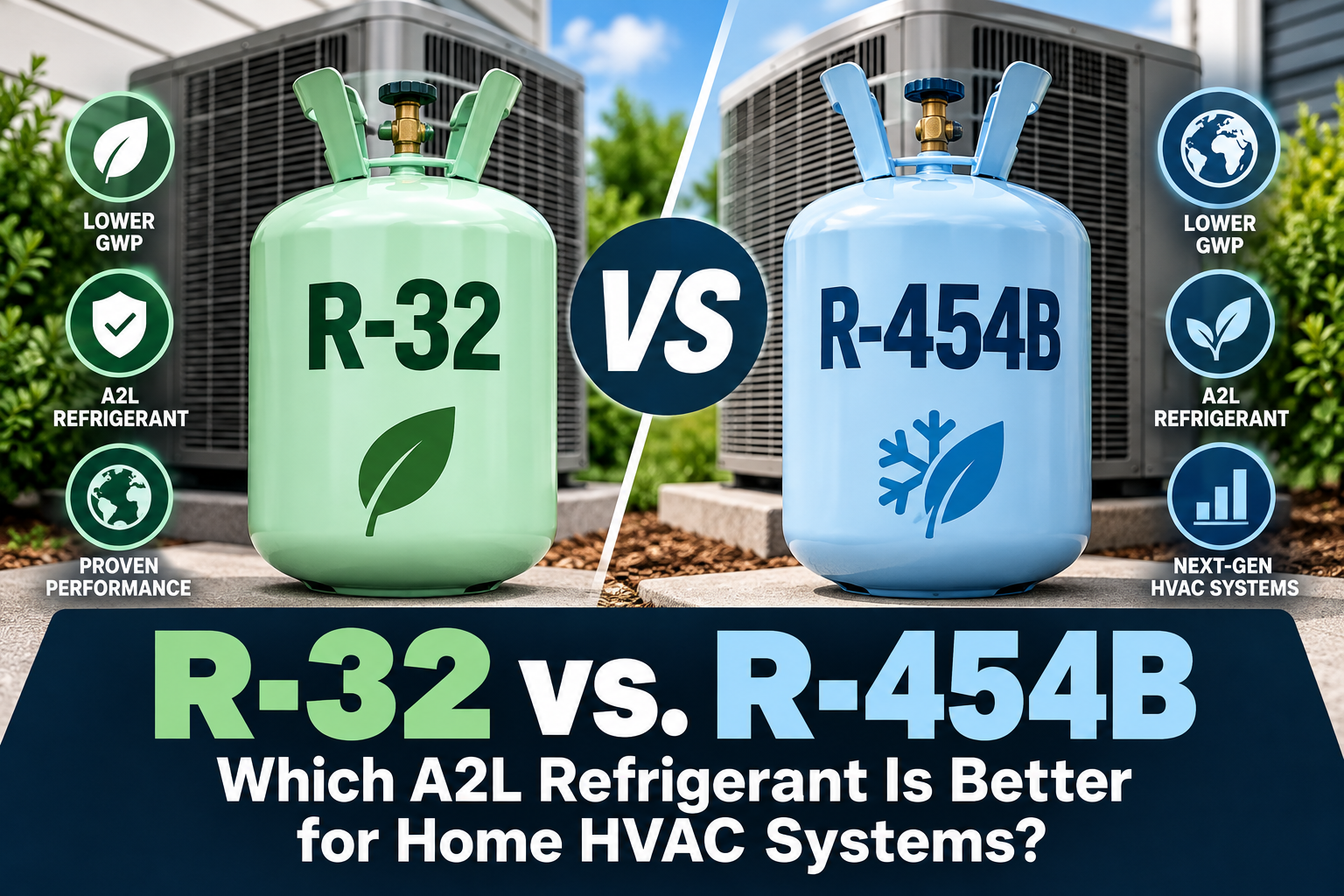
The residential HVAC industry is going through one of its biggest refrigerant transitions in decades. R-410A dominated new residential air conditioners and heat pumps for years, but manufacturers are now building their latest equipment around lower-global-warming-potential refrigerants. In the United States, two names have emerged as particularly important: R-32 and R-454B.
Both are classified as A2L refrigerants, both have substantially lower global warming potential than R-410A, and both are being used in new-generation air conditioners and heat pumps. However, they are not the same refrigerant, and the differences go beyond the number printed on the equipment nameplate.
If I were choosing a new HVAC system today, I would not select equipment solely because it contains R-32 or R-454B. The quality of the equipment, efficiency ratings, heating and cooling performance, installation quality, local contractor support, warranty, replacement-parts availability and long-term serviceability remain more important. Still, refrigerant choice is worth understanding because the system you install today could remain in your home for 15 years or longer.
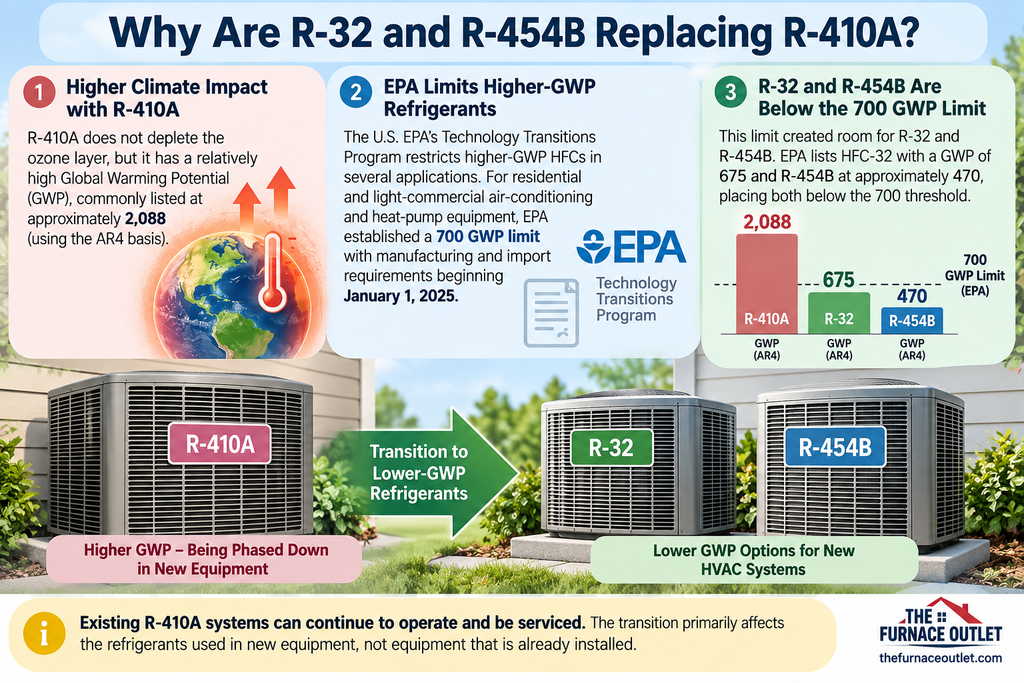
The transition is primarily about reducing the climate impact associated with refrigerants. R-410A does not deplete the ozone layer, but it has a relatively high global warming potential, commonly listed at approximately 2,088 using the AR4 basis.
The U.S. Environmental Protection Agency’s Technology Transitions Program, established under the American Innovation and Manufacturing Act, restricts higher-GWP HFCs in a number of applications. For stationary residential and light-commercial air-conditioning and heat-pump equipment, EPA established a 700 GWP limit with manufacturing and import requirements beginning January 1, 2025.
That limit created room for both R-32 and R-454B. EPA lists HFC-32 with a GWP of 675 and R-454B at approximately 470 on the basis used by its SNAP program, placing both below the 700 threshold. EPA lists both as acceptable for residential and light-commercial air-conditioning and heat-pump applications subject to applicable use conditions.
This does not mean that existing R-410A equipment suddenly became obsolete. An existing R-410A air conditioner or heat pump can continue operating and can still be serviced. The transition primarily affects the refrigerants manufacturers use in newer equipment.
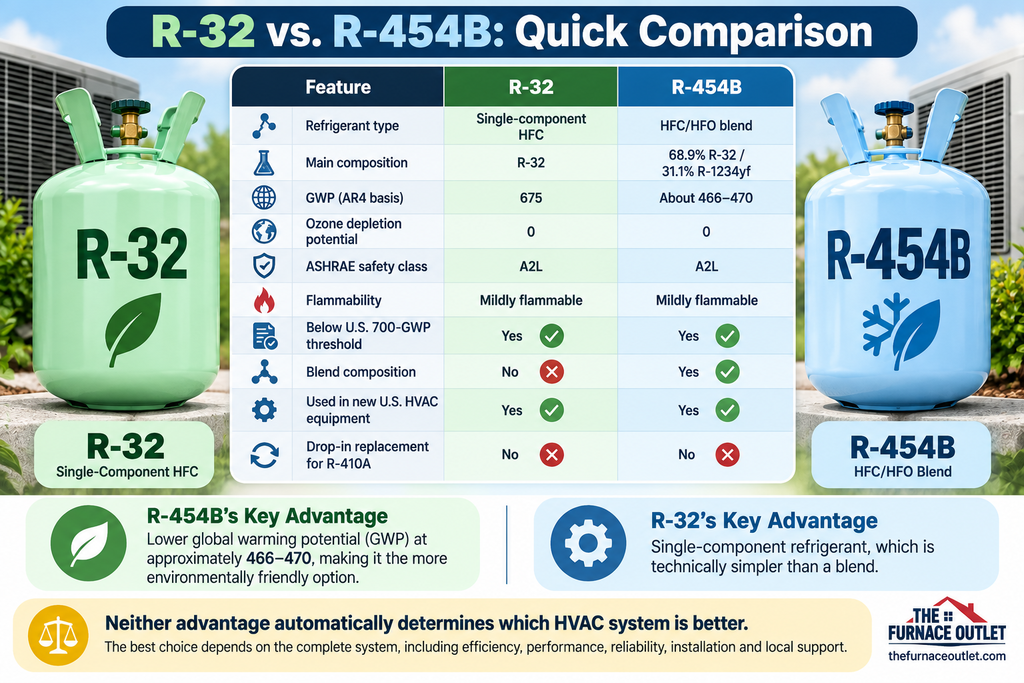
| Feature | R-32 | R-454B |
|---|---|---|
| Refrigerant type | Single-component HFC | HFC/HFO blend |
| Main composition | R-32 | 68.9% R-32 / 31.1% R-1234yf |
| GWP (AR4 basis) | 675 | About 466–470 |
| Ozone depletion potential | 0 | 0 |
| ASHRAE safety class | A2L | A2L |
| Flammability | Mildly flammable | Mildly flammable |
| Below U.S. 700-GWP threshold | Yes | Yes |
| Blend composition | No | Yes |
| Used in new U.S. HVAC equipment | Yes | Yes |
| Drop-in replacement for R-410A | No | No |
The most obvious environmental advantage belongs to R-454B, because its GWP is lower. The most obvious technical simplicity belongs to R-32, because it is a single-component refrigerant rather than a blend.
Neither advantage automatically determines which HVAC system is better.
R-32, or difluoromethane, is not actually new to residential air conditioning. It has been used internationally for years and is also one of the components used to manufacture R-410A. R-410A itself is a blend containing R-32 and R-125.
The major difference is that an R-32 system uses R-32 directly rather than combining it with another refrigerant. This gives R-32 one particularly interesting characteristic: it is a single-component refrigerant. From a service perspective, that eliminates the composition-management concerns associated with zeotropic blends. R-32 has an ozone depletion potential of zero and a GWP substantially below that of R-410A. ASHRAE data list R-32 as an HFC with an A2L safety classification.
R-32 has also accumulated considerable international operating experience. Daikin, one of the manufacturers adopting R-32 in North America, notes that the refrigerant has been used around the world for more than a decade and is now incorporated into its North American residential equipment strategy.
That established global history is one reason I would not describe R-32 as an experimental refrigerant. For American homeowners it may appear new, but globally it has already been used extensively.
R-454B takes a different approach. Instead of being a single refrigerant, it is a blend consisting of approximately 68.9% R-32 and 31.1% R-1234yf. The R-32 portion contributes familiar refrigeration characteristics, while the R-1234yf component helps bring the blend’s overall GWP substantially below that of pure R-32. Using the commonly referenced AR4 values, R-454B has a GWP of approximately 466, compared with 675 for R-32 and 2,088 for R-410A. ASHRAE’s refrigerant data similarly identify R-454B as an HFC/HFO A2L blend and show its GWP well below that of R-410A.
Several major HVAC manufacturers have adopted R-454B for their newer equipment. Carrier, for example, markets R-454B as Puron Advance and identifies it as its lower-GWP successor to R-410A in newer residential equipment. That means the U.S. market is not necessarily converging around one universal R-410A replacement. Different manufacturers have chosen different refrigerant strategies.
If I compare these refrigerants strictly by their direct global warming potential, R-454B wins. Using the commonly cited AR4 values, R-32’s GWP is approximately 675 while R-454B is approximately 466. That puts R-454B roughly 31% below R-32 by this measure.
Both are nevertheless major improvements over R-410A at approximately 2,088. The comparison looks roughly like this: R-410A: 2,088 → R-32: 675 → R-454B: 466
It is important to understand what these numbers mean. GWP estimates the potential warming effect of a greenhouse gas relative to carbon dioxide over a specified period. EPA explains that a gas with a GWP of 700, for example, has 700 times the warming impact per kilogram of carbon dioxide under that metric. Lower is therefore preferable from the standpoint of direct refrigerant emissions.
However, refrigerant GWP is only part of an HVAC system’s environmental footprint. Electricity consumption over 15 or 20 years can also be substantial. A properly sized, highly efficient system using R-32 could conceivably have a better overall environmental outcome than a poorly sized or inefficient system using R-454B. I would therefore compare the complete system, not simply the refrigerant label.
This is where homeowners should be careful with overly simple comparisons. You may see claims that one refrigerant is inherently more efficient than the other, but actual residential HVAC efficiency depends on the entire refrigeration system. Compressor design, heat-exchanger size, expansion-device control, inverter technology, fan and blower efficiency, refrigerant charge, airflow and system controls all contribute to real-world performance.
The refrigerant influences how engineers design that system, but the refrigerant alone does not tell you the finished unit’s SEER2, EER2 or HSPF2 rating. I would therefore compare two actual systems by their published AHRI-rated performance, rather than assuming an R-32 unit automatically beats an R-454B unit or vice versa.
If one heat pump offers 18 SEER2 and substantially better low-temperature heating performance while another offers 15 SEER2, the refrigerant name by itself would not persuade me to choose the less capable system.
One of R-32’s strongest technical arguments is simplicity. Because R-32 is a single-component refrigerant, its composition does not change as different constituents evaporate or leak at different rates. It can therefore be handled without the blend-composition issues associated with some refrigerant mixtures.
R-454B, by comparison, is a zeotropic blend. It has a relatively small temperature glide, so this distinction should not be exaggerated, but technicians still need to follow the manufacturer’s charging procedures and use correct service practices.
For the homeowner, this difference may rarely be noticeable. You should not be servicing your own refrigerant circuit anyway. For technicians and the broader service ecosystem, however, single-component refrigerants can offer practical advantages. This is one category where I give R-32 a modest advantage.
R-454B’s strongest argument is equally straightforward: its GWP is lower. If two otherwise comparable HVAC systems had similar efficiency, reliability, installation quality, warranties and service support, I would consider R-454B’s lower direct climate impact a meaningful benefit. Carrier reports a GWP of 466 for R-454B, representing roughly a 75% reduction compared with R-410A’s 2,088.
R-32 already represents a large improvement over R-410A, so neither option should be portrayed as environmentally equivalent to the refrigerant it is replacing. R-454B simply moves the GWP figure another step downward.
Both R-32 and R-454B carry an A2L safety classification under the refrigerant safety framework used by ASHRAE. The “A” indicates lower toxicity, while “2L” identifies a refrigerant with lower flammability and a relatively low burning velocity. ASHRAE explains that the 2L subclass applies to refrigerants that burn very slowly. The important word is flammable, even though the classification is often described as mildly flammable.
This changes equipment design and service practices compared with traditional A1 refrigerants such as R-410A. Systems may incorporate refrigerant detection or mitigation provisions where required, and technicians need appropriate tools, training and procedures for installing and servicing A2L equipment. Homeowners should not interpret A2L to mean that their new air conditioner is inherently dangerous. These systems are engineered, listed and installed around the properties of the refrigerant they contain. What matters is that the equipment is installed according to manufacturer instructions and applicable codes.
Carrier, for example, says its R-454B equipment incorporates refrigerant detection and dissipation features designed to detect certain leak conditions and activate airflow to help disperse refrigerant.
No. This may be the most important practical point in the entire comparison. Neither R-32 nor R-454B should be treated as a drop-in replacement for R-410A. An existing R-410A air conditioner cannot simply be emptied and refilled with one of these new refrigerants. The equipment must be designed and approved for its specified refrigerant. Components, controls, refrigerant charge, safety provisions and service procedures are selected around that refrigerant.
Carrier specifically warns that R-454B is not a drop-in R-410A replacement. The same basic principle applies to R-32 equipment. If your current R-410A system is operating properly, the refrigerant transition by itself is not a reason to replace it.
For a homeowner buying equipment expected to last well over a decade, this is an important question, but I would avoid predicting that either refrigerant will “win” the U.S. market. R-32 has a substantial global installed base and the simplicity of being a single-component refrigerant. R-454B, meanwhile, has strong support from major North American HVAC manufacturers.
That means future serviceability may depend more on the brand and local dealer network than on the refrigerant itself. Before buying either system, I would ask the contractor how many technicians in the company have been trained on that refrigerant, whether the company already owns the appropriate A2L service equipment, whether replacement parts are stocked locally and how the manufacturer supports warranty claims. Those answers are more useful than simply asking whether R-32 or R-454B is “better.”
If I were comparing refrigerants in isolation, my scorecard would look something like this:
| Category | My Preference |
|---|---|
| Lower GWP | R-454B |
| Single-component simplicity | R-32 |
| Global operating history | R-32 |
| U.S. manufacturer adoption | Both |
| A2L safety classification | Tie |
| Compliance with current sub-700 U.S. limit | Tie |
| Overall HVAC performance | Depends on equipment |
| Homeowner serviceability | Depends on brand/dealer |
So which one would I actually buy? I would buy the better HVAC system, not the refrigerant. If an excellent R-32 heat pump has better efficiency, stronger cold-weather performance, a better warranty and much stronger local dealer support than the R-454B alternative, I would choose the R-32 system.
If two systems are otherwise comparable and the R-454B option has equally strong performance and service support, I would lean toward R-454B because of its lower GWP. That is a much more useful buying strategy than declaring one refrigerant universally superior.
Before choosing a new R-32 or R-454B system, I would first verify that the contractor has performed an appropriate load calculation and that the equipment capacity matches the home’s actual heating and cooling requirements. Next, compare SEER2, EER2 and HSPF2 ratings; heating capacity at low outdoor temperatures if you are buying a heat pump; compressor technology; sound ratings; warranty terms; installer qualifications; local parts availability; and expected maintenance requirements.
Finally, confirm exactly which refrigerant the equipment uses and make sure every matched component is approved for that refrigerant. The refrigerant should be part of your purchasing decision, but it should not dominate it.
If environmental impact from refrigerant leakage is the deciding criterion, R-454B has the advantage. If refrigerant simplicity and international track record receive more weight, R-32 has compelling strengths.
For the typical homeowner, however, I would call the overall comparison effectively a draw. I would rather own an excellent, properly sized and professionally installed R-32 system than an average R-454B system, and I would rather own an excellent R-454B system than an average R-32 system. The name printed beside “refrigerant” on the equipment label matters. The quality of everything surrounding that refrigerant matters considerably more.
Not universally. R-32 is a single-component refrigerant with extensive international experience, while R-454B has a lower global warming potential. The better choice for a homeowner generally depends on the complete HVAC system, efficiency, reliability, installer support and warranty rather than refrigerant alone.
R-454B. Using commonly cited AR4 values, R-32 has a GWP of approximately 675 while R-454B is approximately 466–470. Both are substantially below R-410A at approximately 2,088.
Both are classified as A2L, meaning lower toxicity with lower flammability and a low burning velocity. HVAC equipment designed for these refrigerants incorporates requirements appropriate to their characteristics, and installation and service should be performed by technicians familiar with A2L systems.
Partly. R-454B consists of approximately 68.9% R-32 and 31.1% R-1234yf.
No. R-32 is not a drop-in replacement for R-410A. The HVAC equipment must be specifically designed and approved for the refrigerant it uses.
No. R-454B equipment is designed specifically for R-454B and applicable A2L requirements. Do not convert an existing R-410A system simply by changing refrigerant.
An existing R-410A system does not need to be replaced simply because newer equipment uses lower-GWP refrigerants. When buying an entirely new system, however, I would generally look toward current-generation equipment designed around refrigerants such as R-32 or R-454B.
Based strictly on direct global warming potential, R-454B has the advantage over R-32. However, the HVAC system’s electricity consumption, efficiency, leakage rate, refrigerant charge and service life also contribute to its overall environmental impact.
The U.S. market currently supports both approaches, with different major manufacturers choosing different refrigerants. I would not base a major HVAC purchase on a prediction that one will eliminate the other.
Disclaimer: This article is for general educational purposes and is not a substitute for manufacturer instructions, applicable building and mechanical codes, or professional HVAC advice. Refrigerant systems should be installed, charged, repaired and serviced only by appropriately qualified personnel using procedures and equipment approved for the specific refrigerant and HVAC system.