Newsletter Subscribe
Enter your email address below and subscribe to our newsletter

HVAC made simple
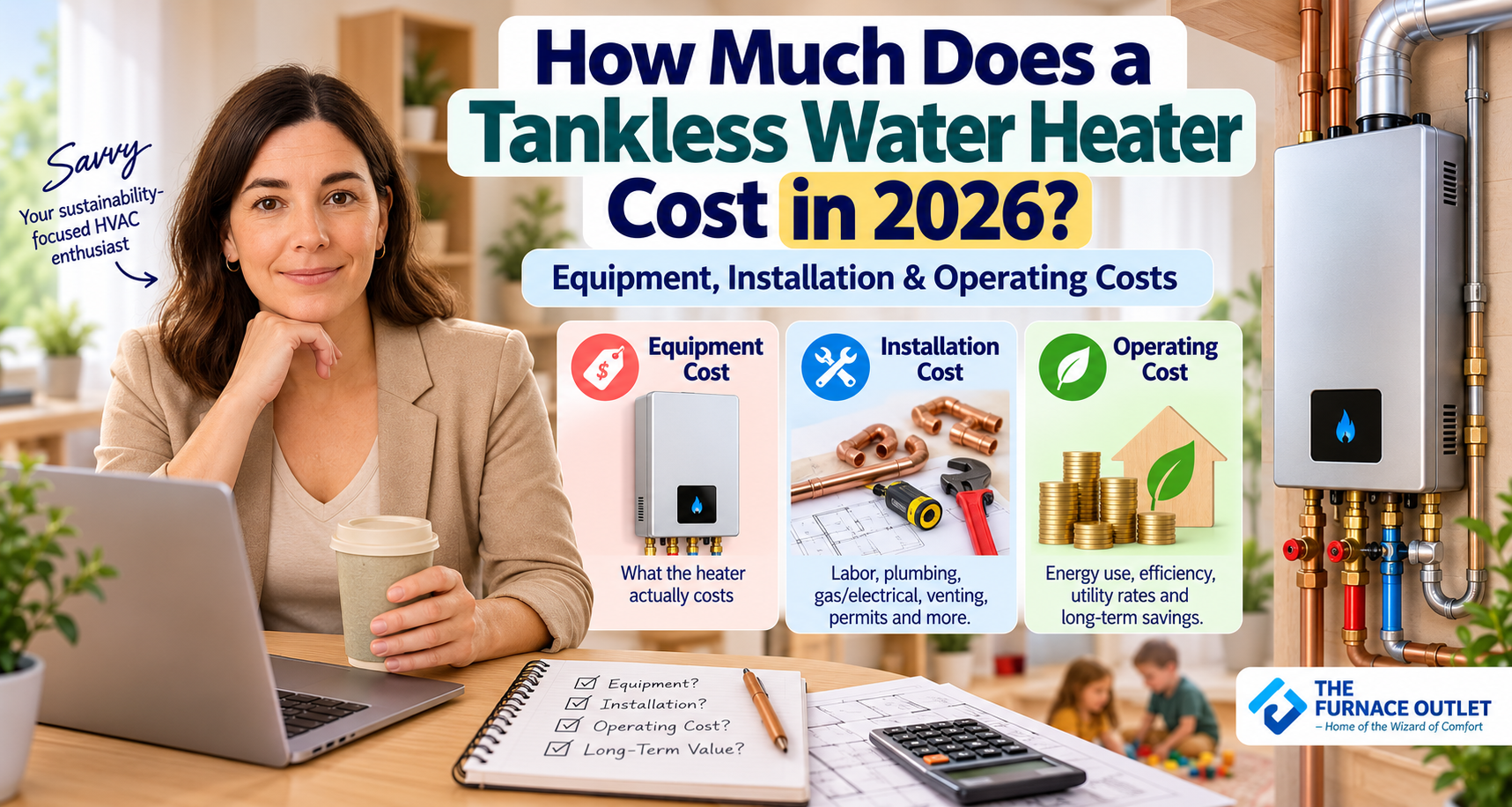
Tankless water heaters are often marketed around two financial ideas: lower energy consumption and longer equipment life. Both can be meaningful advantages, but neither tells you what a tankless system will actually cost to own. The number printed on the appliance is only the beginning. Installation can require gas-line modifications, new venting, condensate drainage, electrical circuits, plumbing changes, permits and removal of the existing water heater.
I’m Savvy, The Furnace Outlet’s sustainability-focused HVAC enthusiast, and when I compare water-heater costs, I separate them into three categories: equipment cost, complete installed cost and long-term operating cost. That approach gives homeowners a much more useful picture than comparing retail prices alone.
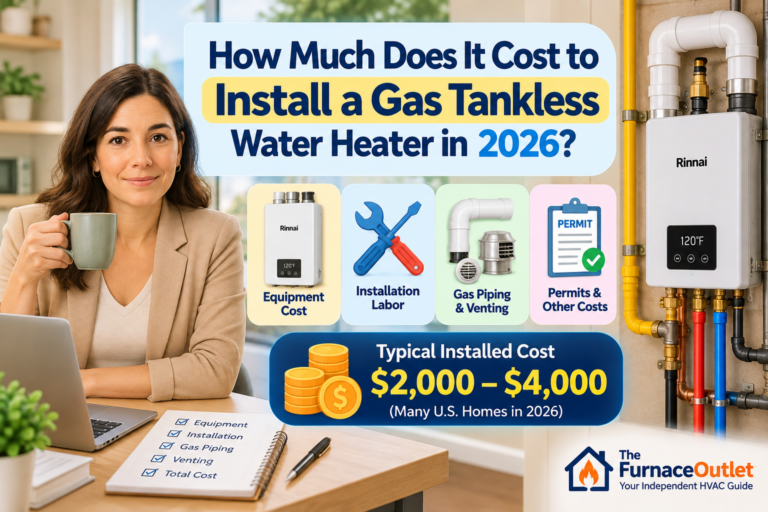
For 2026, current U.S. cost data from Angi puts a typical professional tankless installation at approximately $1,406 to $3,902, with an average around $2,641. Complex conversions and infrastructure upgrades can push projects considerably higher.
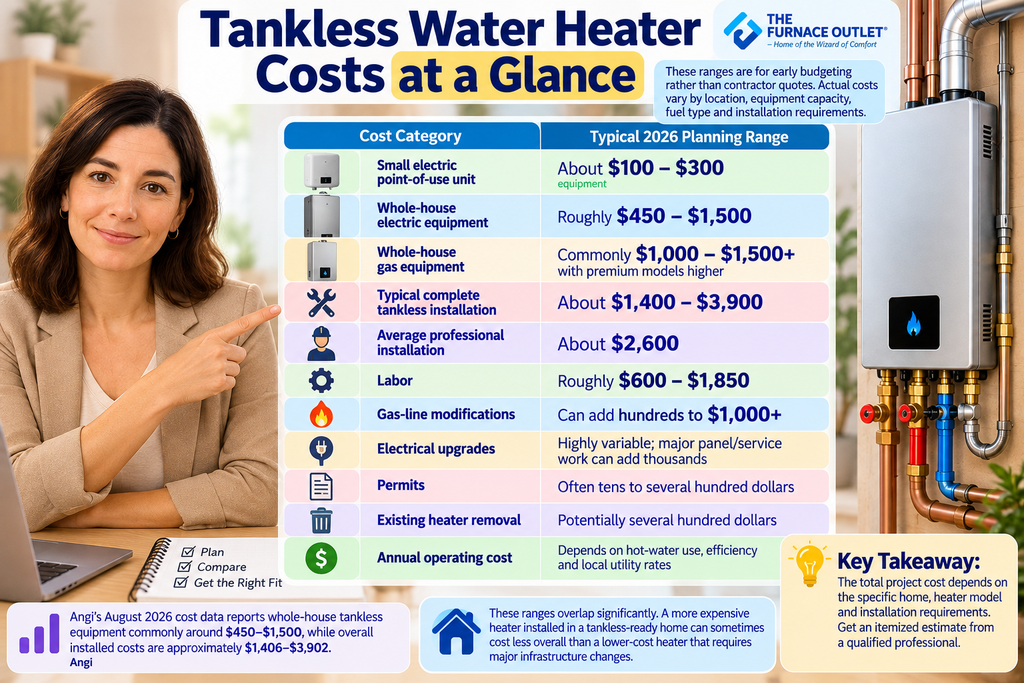
The following ranges are useful for early budgeting rather than contractor quotes. Actual costs vary considerably by location, equipment capacity, fuel type and the amount of infrastructure work required.
| Cost Category | Typical 2026 Planning Range |
|---|---|
| Small electric point-of-use unit | About $100–$300 equipment |
| Whole-house electric equipment | Roughly $450–$1,500 |
| Whole-house gas equipment | Commonly $1,000–$1,500+, with premium models higher |
| Typical complete tankless installation | About $1,400–$3,900 |
| Average professional installation | About $2,600 |
| Labor | Roughly $600–$1,850 |
| Gas-line modifications | Can add hundreds to $1,000+ |
| Electrical upgrades | Highly variable; major panel/service work can add thousands |
| Permits | Often tens to several hundred dollars |
| Existing heater removal | Potentially several hundred dollars |
| Annual operating cost | Depends on hot-water use, efficiency and local utility rates |
Angi’s August 2026 cost data reports whole-house tankless equipment commonly around $450–$1,500 before the broader installation is considered, while its overall installed range is approximately $1,406–$3,902. Angi
The important point is that these ranges overlap dramatically. A relatively expensive heater installed into a tankless-ready home can sometimes produce a lower total project price than an inexpensive heater requiring major infrastructure changes.
A homeowner shopping online may see an electric tankless heater for several hundred dollars or a premium condensing gas model for well over $1,000 and naturally assume that the difference represents the majority of the project cost.
Frequently, it does not. The equipment price buys the heater. The installed price must also account for everything required to make that heater function correctly in the specific home. A gas model may need upgraded fuel piping and a completely new vent system. An electric model may need several dedicated circuits or even increased electrical-service capacity.
This is why I would never choose a tankless heater before understanding the home’s infrastructure. A $600 heater that triggers several thousand dollars of electrical work is not really a $600 water-heating decision.
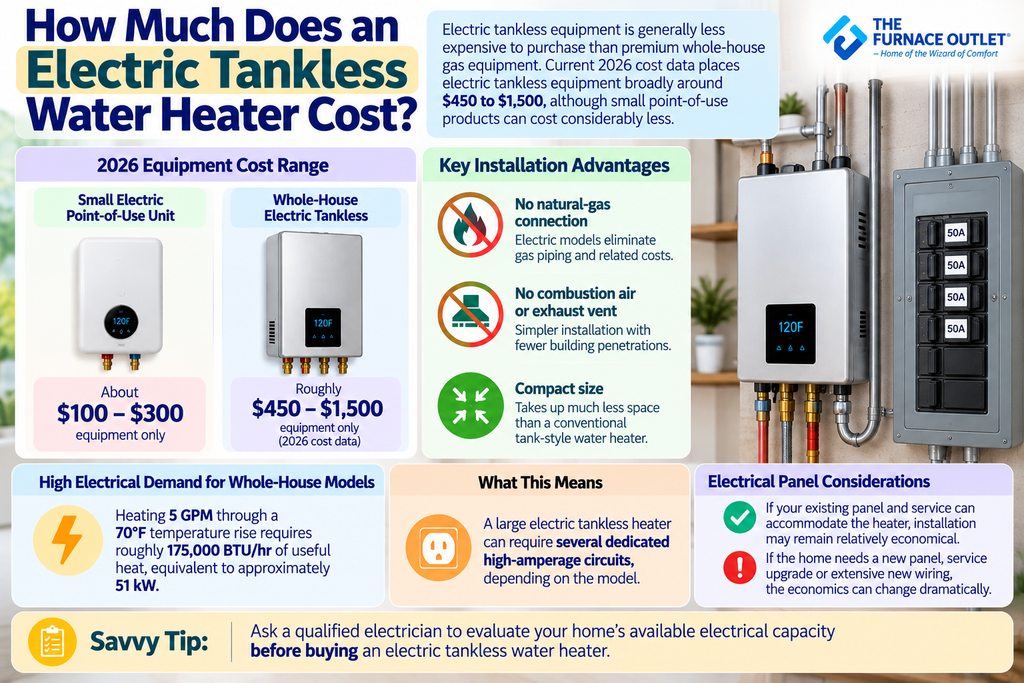
Electric tankless equipment is generally less expensive to purchase than premium whole-house gas equipment. Current 2026 cost data places electric tankless equipment broadly around $450 to $1,500, although small point-of-use products can cost considerably less.
The absence of combustion is a genuine installation advantage. Electric heaters need no natural-gas connection, combustion-air system or exhaust vent. They can also be extremely compact. However, whole-house electric tankless heaters can demand extraordinary electrical power. Heating 5 GPM through a 70°F temperature rise requires roughly 175,000 BTU/hr of useful heating output, equivalent to approximately 51 kW.
That can mean several dedicated high-amperage circuits. If the existing electrical panel and service can accommodate the heater, installation may remain relatively economical. If the home needs a new panel, service upgrade or extensive new wiring, the economics can change dramatically.
For electric tankless, I would therefore ask an electrician to evaluate available capacity before buying the appliance.
Natural-gas and propane tankless heaters generally cost more at the equipment level than basic electric units, particularly when comparing premium condensing whole-house models. Angi’s 2026 data places many natural-gas and propane tankless units around $1,000–$1,500, although actual retail pricing can extend substantially beyond that range depending on capacity, features and equipment class.
Gas tankless equipment becomes particularly attractive for high-demand whole-house applications because a large burner can provide substantial instantaneous heating capacity without placing an enormous load on the electrical system. The installation challenge moves elsewhere: gas supply and venting.
A storage water heater’s existing gas pipe should not automatically be assumed adequate for a high-output tankless replacement. The fuel system needs to support the heater’s maximum firing rate while accounting for other gas appliances operating simultaneously.
If the gas piping needs to be enlarged or rerouted, installation cost rises. Angi notes that gas-line work can add as much as roughly $1,000 in some projects. Angi
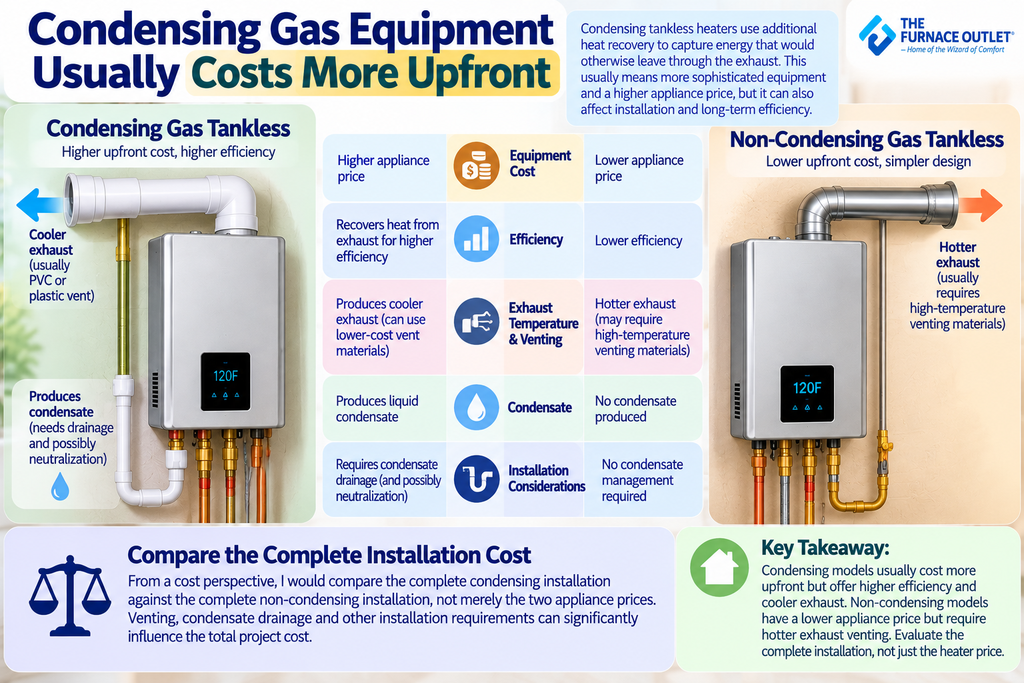
When comparing gas tankless systems, I would also distinguish between condensing and non-condensing equipment. Condensing heaters use additional heat recovery to capture energy that would otherwise leave through the exhaust. That usually means more sophisticated equipment and consequently a higher appliance price.
The installation economics can partially offset that difference. Because condensing equipment produces cooler exhaust, manufacturers may permit lower-cost vent materials in approved configurations. Non-condensing equipment has hotter exhaust and may require higher-temperature-compatible venting. Condensing systems do, however, produce liquid condensate. Drainage and potentially condensate neutralization therefore need to be included in the project.
From a cost perspective, I would compare the complete condensing installation against the complete non-condensing installation, not merely the two appliance prices.
Current 2026 Angi data places tankless installation labor broadly around $600 to $1,850, although complicated projects can obviously exceed ordinary ranges. A straightforward replacement in a home already designed for tankless equipment may remain relatively predictable. A first-time conversion from a conventional storage heater can be much more involved.
The contractor may need to remove the old tank, relocate water lines, install isolation valves, modify the gas system, create a new vent route, provide combustion air, add a condensate drain, install electrical power, obtain permits and commission the equipment. This is why I strongly prefer an itemized installation estimate. A single lump-sum price makes it difficult to understand whether the project is expensive because of the heater or because the house needs substantial modification.
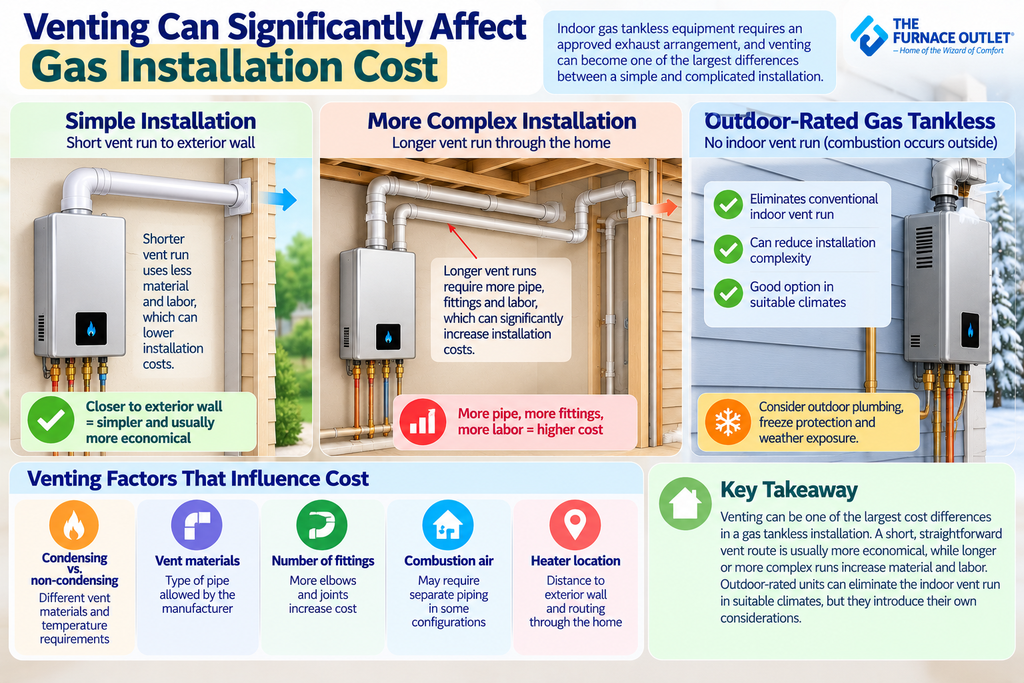
Indoor gas tankless equipment requires an approved exhaust arrangement, and venting can become one of the largest differences between a simple and complicated installation. A heater mounted close to an appropriate exterior wall may need a relatively short vent route. A heater located deep inside the home could require considerably more material and labor.
Vent cost also depends on whether the equipment is condensing or non-condensing, what materials the manufacturer permits, how many fittings are required and whether combustion air needs separate piping. Outdoor-rated gas tankless heaters can eliminate the conventional indoor vent run because combustion occurs outside the building. That can reduce installation complexity in suitable climates, although outdoor plumbing, freeze protection and weather exposure introduce their own considerations.
This is one of the costs I would investigate early. Tankless heaters create heat in real time rather than gradually heating stored water. High-output gas models can therefore have substantial maximum input requirements. An installer needs to consider gas pressure, pipe diameter, developed pipe length, fittings and the combined connected load from other appliances such as furnaces, ranges, dryers and fireplaces.
If the existing system already has adequate capacity, that is excellent. If a larger gas line needs to be run across a finished home, the project can become considerably more expensive. The cheapest way to discover this requirement is before purchasing the heater.
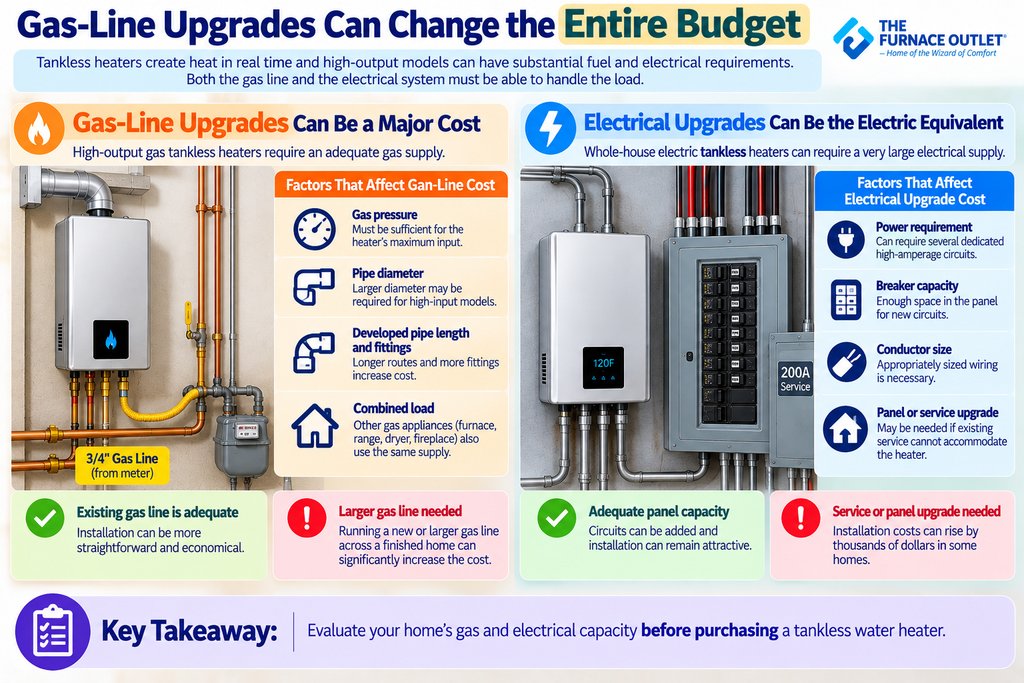
Electric tankless heaters have their own version of the gas-line problem. A physically small whole-house electric heater can require an enormous electrical supply. Depending on the model, multiple dedicated double-pole breakers and appropriately sized conductors may be necessary.
If those circuits can be added to an existing panel with adequate service capacity, the project can remain attractive. If the panel or incoming electrical service needs upgrading, installation cost can rise by thousands of dollars in some homes. That is why I do not automatically describe electric tankless as “cheaper to install.” It can be—but only when the building’s electrical infrastructure is suitable.
Tankless installations also need appropriate hot- and cold-water connections. I generally want to see properly arranged isolation and service valves because future flushing and maintenance become much easier.
Water quality can introduce another cost. Hard water can cause mineral scale inside the heat exchanger. Depending on manufacturer recommendations and local water conditions, water treatment or more frequent descaling may be appropriate. These are smaller expenses than major electrical or gas-system upgrades, but they should still be included when comparing bids. I would rather spend appropriately on a serviceable installation at the beginning than create a system that is unnecessarily difficult to maintain later.
Permits are another small line item that homeowners sometimes overlook. Requirements vary substantially by jurisdiction and project scope. Current cost references put permit expenses anywhere from relatively modest amounts into several hundred dollars, depending on the location and work involved. Existing heater removal and disposal can also add several hundred dollars in some projects.
I would ask whether a contractor’s quotation includes permits, inspection coordination, old-heater removal and disposal rather than assuming these services are included. A quote that appears $300 cheaper may simply exclude work another contractor has already included.
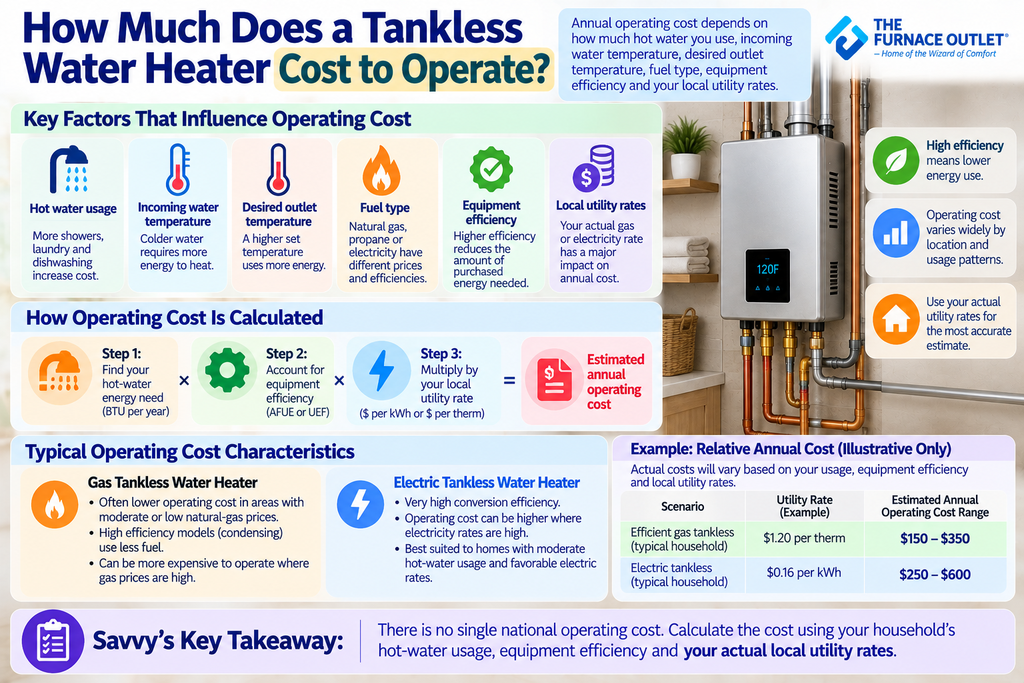
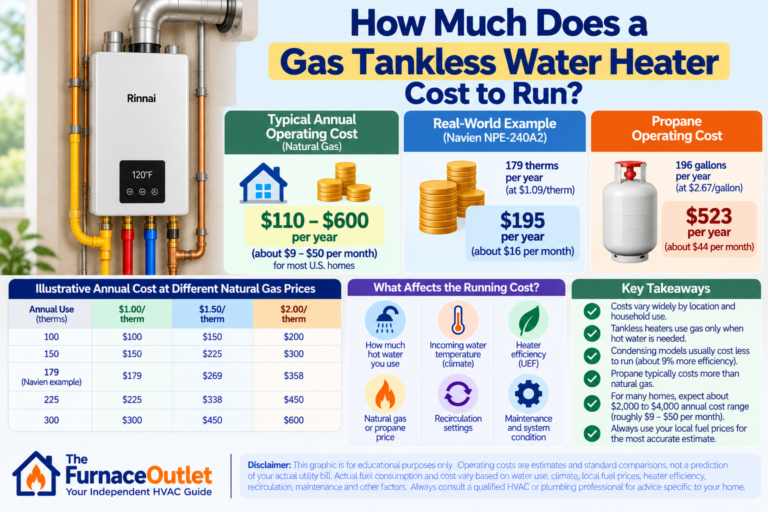
This is where universal dollar estimates become much less useful. Annual operating cost depends on how much hot water the household consumes, incoming-water temperature, desired outlet temperature, fuel type, equipment efficiency and local electricity or gas rates.
The basic principle is straightforward: determine how much useful hot-water energy the household requires, account for equipment efficiency and multiply the purchased energy by the local utility rate. A highly efficient gas heater can still be expensive to operate where gas prices are high. An electric heater can have very high conversion efficiency but still produce a substantial utility bill where electricity is expensive.
For this reason, I would calculate operating cost using your actual utility rates, not a national average.
Tankless heaters eliminate the need to keep a large tank of water hot around the clock, reducing standby energy losses. U.S. Department of Energy guidance states that for homes using 41 gallons or less of hot water per day, demand water heaters can be approximately 24%–34% more energy efficient than conventional storage water heaters. At higher consumption around 86 gallons per day, DOE says the efficiency advantage can be approximately 8%–14%. The Department of Energy’s Energy.gov
Those percentages should not be interpreted as guaranteed utility-bill savings because water heating is only one component of household energy consumption, and equipment/fuel comparisons matter. ENERGY STAR currently estimates that a certified gas tankless heater can save a family of four about $95 per year on gas bills compared with a standard gas storage water heater. ENERGY STAR
ENERGY STAR — Tankless Gas Water Heater Benefits & Savings
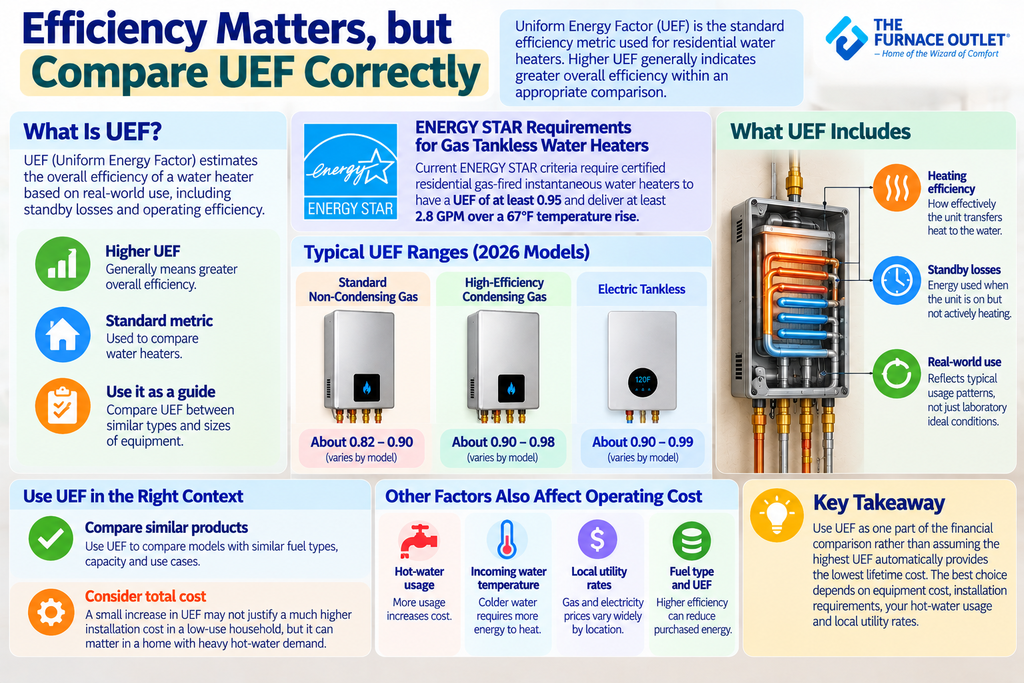
Uniform Energy Factor, or UEF, is the standard efficiency metric used for residential water heaters. Higher UEF generally indicates greater overall efficiency within an appropriate comparison. Current ENERGY STAR criteria require certified residential gas-fired instantaneous water heaters to have a UEF of at least 0.95 and deliver at least 2.8 GPM over a 67°F temperature rise.
ENERGY STAR — Water Heater Key Product Criteria
I would use UEF as one part of the financial comparison rather than assuming the highest UEF automatically provides the lowest lifetime cost. A small efficiency improvement may not financially justify a much more expensive installation in a low-use household, while the same improvement can matter considerably in a home with heavy hot-water demand.
Tankless does not mean maintenance-free. Mineral scale can accumulate inside heat exchangers, particularly in hard-water areas. Filters may need cleaning, gas equipment should have appropriate combustion and venting inspection, and condensing equipment introduces condensate-management components.
The frequency and cost depend on the heater, water quality and manufacturer recommendations. I would include maintenance in the lifetime-cost calculation because skipping required service to make the operating numbers look better is a false economy. A system that loses performance or suffers premature component failure because it was not maintained has not produced genuine savings.
One of the financial arguments for tankless equipment is potential service life. ENERGY STAR states that tankless gas water heaters have a life expectancy of around 20 years, longer than conventional tank-type equipment
That does not guarantee every tankless heater will operate for 20 years. Water quality, installation quality, maintenance, usage and component availability all influence actual life. Still, lifespan matters when comparing total ownership cost. A system that costs more initially but operates substantially longer may have better long-term economics than its purchase price suggests.
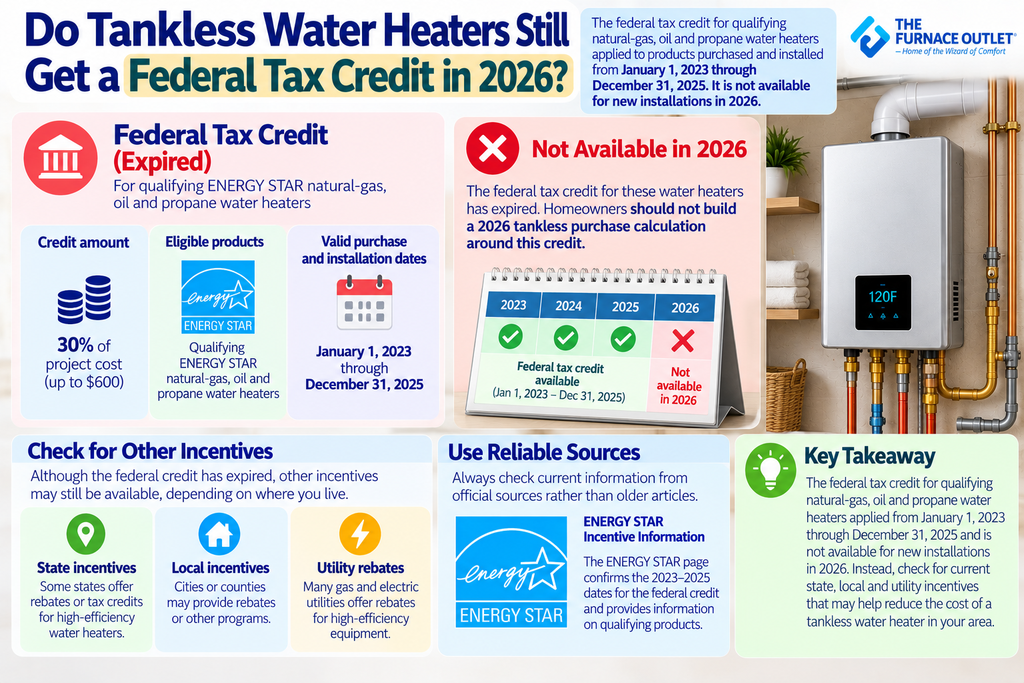
This deserves special attention because older articles can now be misleading. The ENERGY STAR page for the federal natural-gas, oil and propane water-heater tax credit states that the credit applied to qualifying products purchased and installed from January 1, 2023 through December 31, 2025. The listed benefit was 30% of project cost up to $600 for qualifying equipment.
Therefore, I would not build a 2026 tankless purchase calculation around that expired federal credit. Homeowners should instead check for current state, local and utility incentives available where they live.
ENERGY STAR — Water Heater Incentive Information
This is particularly important when comparing older cost guides that still describe the federal credit as though it automatically applies to a new 2026 installation.
Electric usually has an advantage in equipment simplicity and avoids gas piping and combustion venting. Gas generally has an advantage when substantial whole-house hot-water output is required, particularly where the home already has suitable gas infrastructure.
Neither is automatically cheaper. An electric system installed in a home with ample electrical capacity may produce a very economical project. The same heater becomes much less attractive if it triggers a major service upgrade.
A gas heater installed beside an adequate gas supply and straightforward vent route can likewise be cost-effective. If a new gas line and complicated vent system are required, its installed cost can increase substantially. The meaningful number is therefore complete installed cost plus expected operating and maintenance cost over the years you expect to own the equipment.
Before signing a contract, I would want an itemized proposal showing the exact heater model, equipment price, labor, plumbing modifications, gas-line work or electrical work, venting, condensate drainage, isolation valves, permits, existing-heater removal and any water-treatment requirements.
I would then verify the heater’s realistic GPM at the home’s expected winter temperature rise rather than paying for unnecessary capacity. Finally, I would compare UEF, warranty coverage, local utility rates, expected maintenance and likely service life. This approach makes it much harder for an attractive equipment price to hide an expensive infrastructure problem.
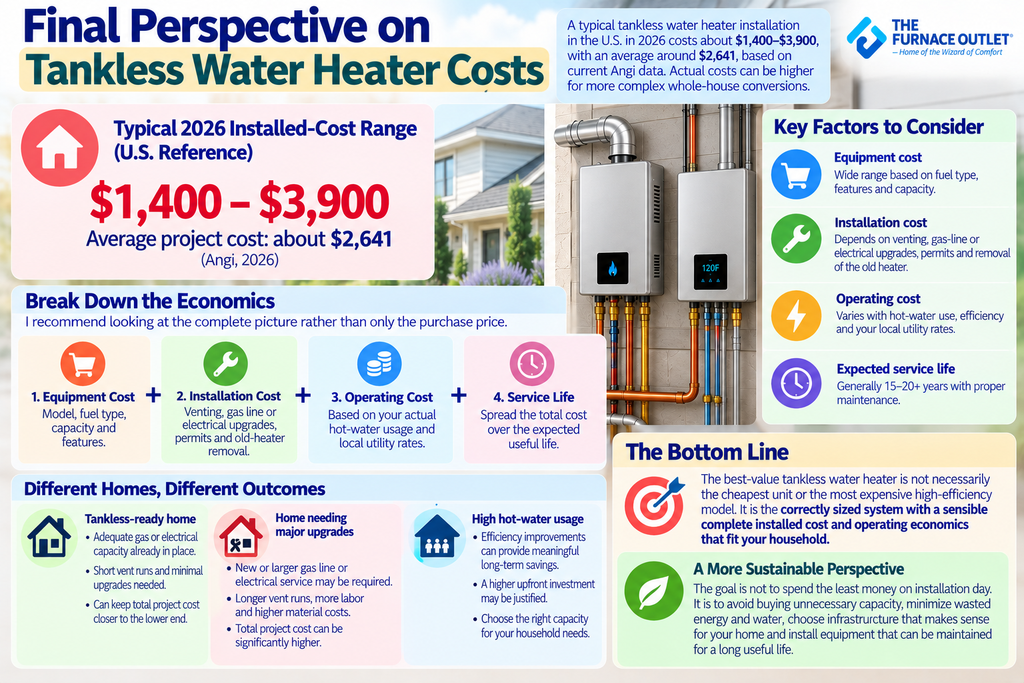
When someone asks me, “How much does a tankless water heater cost in 2026?” I would use roughly $1,400–$3,900 as a useful mainstream U.S. installed-cost reference, while recognizing that complicated whole-house conversions can exceed that range. Current 2026 Angi data puts the average project around $2,641.
But the average is not the number I would use to make a purchasing decision. I would divide the economics into equipment cost, installation cost, operating cost and expected service life.
A cheaper heater that requires a major electrical-service upgrade may not be cheap. A premium condensing gas heater installed into tankless-ready infrastructure may be financially attractive. A highly efficient heater in a household that uses very little hot water may never recover a large installation premium, while efficiency improvements can become more valuable as hot-water consumption rises.
From my sustainability perspective, the goal is not to spend the least money on installation day. It is to avoid buying unnecessary capacity, minimize wasted energy and water, choose infrastructure that makes sense for the home and install equipment that can be maintained for a long useful life.
The best-value tankless water heater is therefore not necessarily the cheapest unit or the most expensive high-efficiency model. It is the correctly sized system with a sensible complete installed cost and operating economics that fit the household.
Current U.S. cost data places typical professional installation around $1,400–$3,900, with an average near $2,600. Complex gas, electrical, venting or plumbing modifications can push the total substantially higher.
Electric equipment is often cheaper to purchase and requires no combustion venting, but large whole-house models can require expensive electrical upgrades. Gas equipment typically costs more upfront but can be advantageous for high-flow applications when adequate gas infrastructure already exists.
The heater may require larger gas piping, new venting, condensate drainage, dedicated electrical circuits, panel or service upgrades, plumbing changes, permits and removal of the existing water heater. First-time tank-to-tankless conversions can therefore cost substantially more than the appliance itself.
DOE guidance says demand heaters can be roughly 24%–34% more energy efficient than conventional storage heaters in homes using 41 gallons or less of hot water daily, with a smaller 8%–14% advantage at around 86 gallons per day. Actual dollar savings depend on fuel prices, usage and equipment. The Department of Energy’s Energy.gov
ENERGY STAR cites a life expectancy of approximately 20 years for tankless gas water heaters. Actual service life depends on installation, water quality, maintenance and operating conditions. ENERGY STAR
It can be, particularly when long service life, space savings, reduced standby losses and continuous hot-water capability have value to the household. The economics are strongest when the home’s infrastructure does not require expensive modifications and the equipment is properly sized.
Yes. I would have the gas, electrical, venting and plumbing requirements evaluated before purchasing equipment. This can identify infrastructure upgrades that materially change the project’s economics.
Absolutely, particularly if energy efficiency and sustainability are priorities. DOE notes that heat-pump water heaters can be two to three times more energy efficient than conventional electric resistance water heaters, so they deserve consideration alongside electric tankless rather than assuming tankless is automatically the most efficient electric option. The Department of Energy’s Energy.gov
The Furnace Outlet provides this guide for general educational purposes. Cost figures are planning estimates based on published U.S. cost information available in 2026 and should not be treated as contractor quotations. Equipment, labor, utility rates, permits, incentives and installation requirements vary significantly by location, home and model. Obtain itemized estimates from appropriately qualified contractors and verify current manufacturer requirements, applicable codes and available incentives before purchasing equipment. The Furnace Outlet is an independent informational resource and is not a manufacturer, installer or representative of the brands or organizations referenced in this article