Newsletter Subscribe
Enter your email address below and subscribe to our newsletter

HVAC made simple
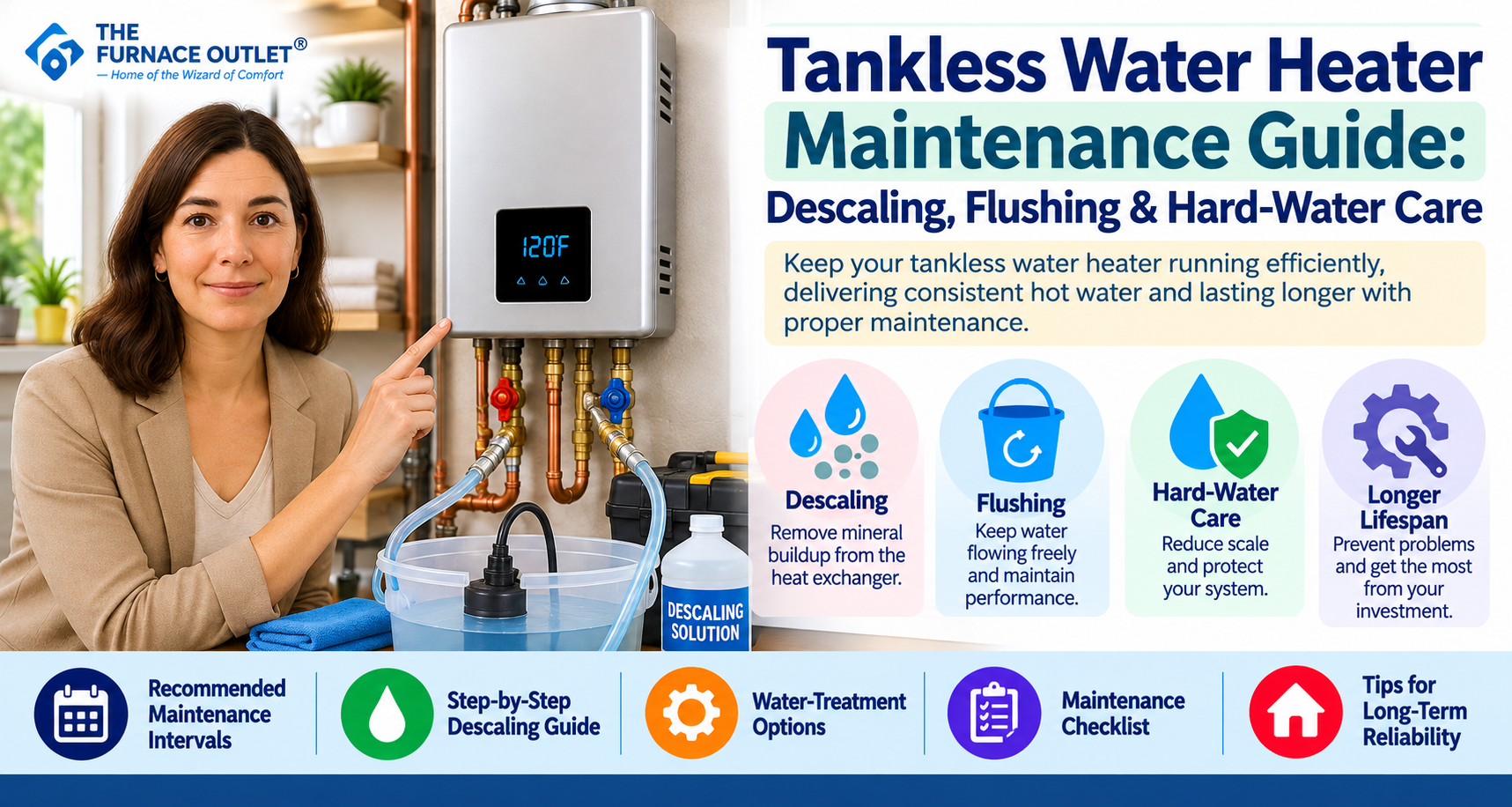
Tankless water heaters eliminate the storage tank, but they do not eliminate maintenance. In fact, because water passes through relatively compact heat-exchanger passages while being heated rapidly, water quality and mineral buildup can have a significant effect on long-term performance. Calcium, magnesium, sediment and other deposits can gradually restrict water passages and interfere with efficient heat transfer.
I’m Savvy, The Furnace Outlet’s sustainability-focused HVAC enthusiast, and I look at tankless maintenance as part of the system’s overall environmental and financial performance. Buying an efficient appliance makes little sense if mineral scale is allowed to reduce its performance or contribute to premature component failure. Routine maintenance can help protect efficiency, maintain dependable hot-water delivery and support a longer useful equipment life.
The maintenance schedule is not identical for every tankless heater or every household. Water hardness, hot-water consumption, temperature settings and the manufacturer’s requirements all matter. Navien, for example, recommends descaling at least annually while explaining that higher mineral content, higher temperature settings and heavier hot-water use can justify more frequent service. Rheem likewise recommends annual tankless maintenance and suggests that hard-water conditions can justify descaling about every six months.
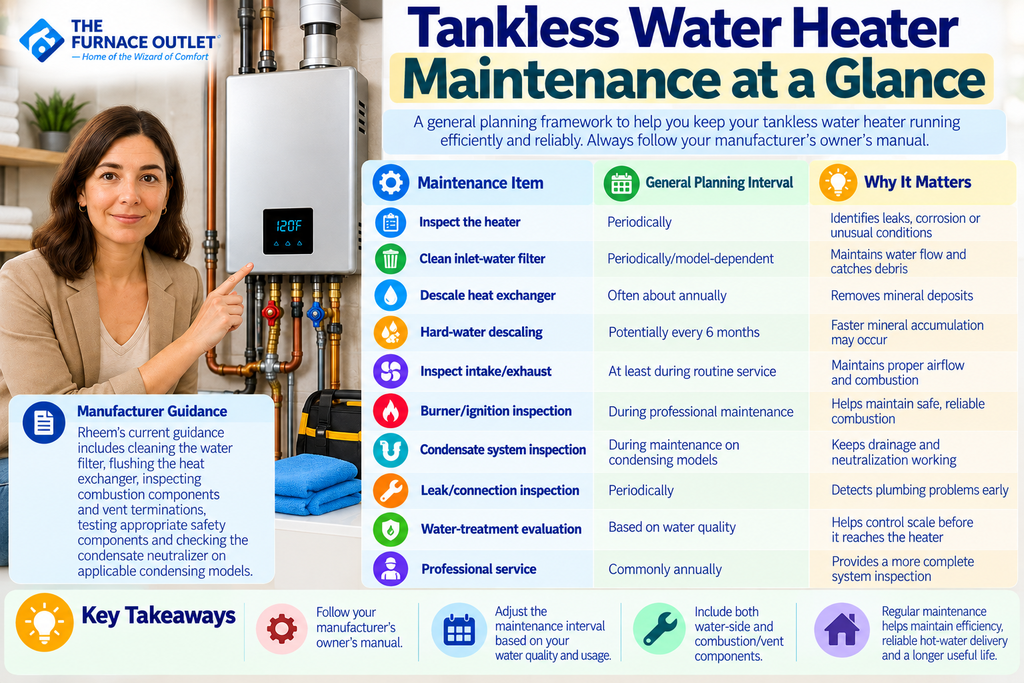
I would treat the following as a general planning framework rather than a replacement for the exact owner’s manual.
| Maintenance Item | General Planning Interval | Why It Matters |
|---|---|---|
| Inspect the heater | Periodically | Identifies leaks, corrosion or unusual conditions |
| Clean inlet-water filter | Periodically/model-dependent | Maintains water flow and catches debris |
| Descale heat exchanger | Often about annually | Removes mineral deposits |
| Hard-water descaling | Potentially every 6 months | Faster mineral accumulation may occur |
| Inspect intake/exhaust | At least during routine service | Maintains proper airflow and combustion |
| Burner/ignition inspection | During professional maintenance | Helps maintain safe, reliable combustion |
| Condensate system inspection | During maintenance on condensing models | Keeps drainage and neutralization working |
| Leak/connection inspection | Periodically | Detects plumbing problems early |
| Water-treatment evaluation | Based on water quality | Helps control scale before it reaches the heater |
| Professional service | Commonly annually | Provides a more complete system inspection |
Rheem’s current guidance includes cleaning the water filter, flushing the heat exchanger, inspecting combustion components and vent terminations, testing appropriate safety components and checking the condensate neutralizer on applicable condensing models. Rheem UK
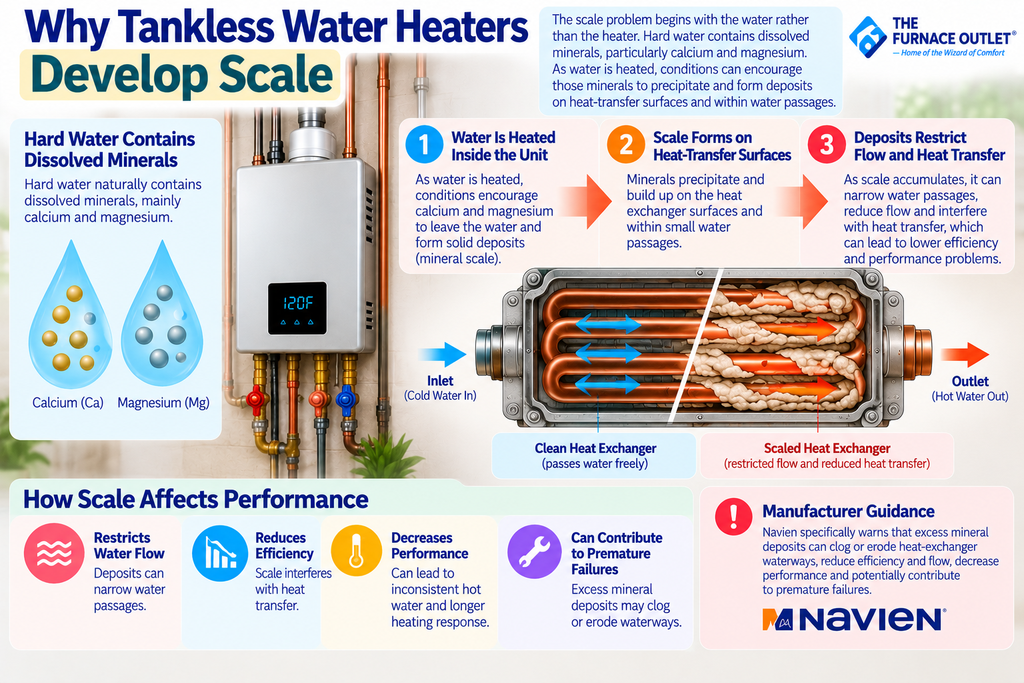
The scale problem begins with the water rather than the heater. Hard water contains dissolved minerals, particularly calcium and magnesium. As water is heated, conditions can encourage those minerals to precipitate and form deposits on heat-transfer surfaces and within water passages.
A tankless heat exchanger needs to transfer substantial heat into moving water quickly. Mineral deposits interfere with that process. As deposits accumulate, they can restrict passages, reduce flow and interfere with heat transfer.
Navien specifically warns that excess mineral deposits can clog or erode heat-exchanger waterways, reduce efficiency and flow, decrease performance and potentially contribute to premature failures. Navien
This is why I would not treat descaling as cosmetic cleaning. It is preventive maintenance for one of the most important and expensive components in the appliance.
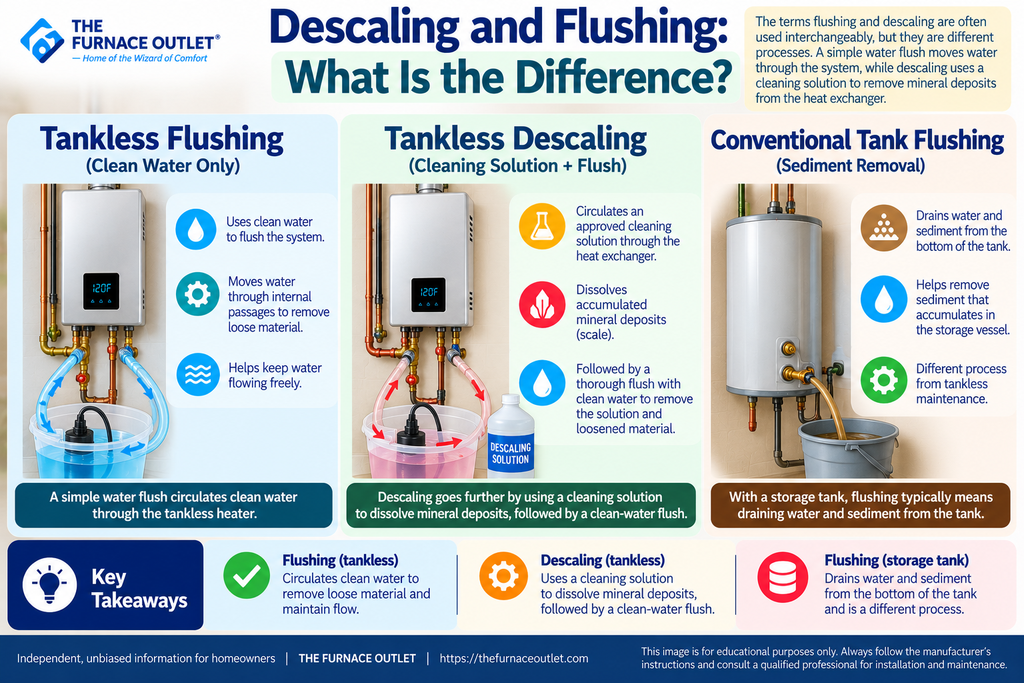
The terms flushing and descaling are frequently used interchangeably when discussing tankless water heaters, but it helps to understand what is actually happening.
A simple water flush moves water through a system. Descaling goes further by circulating an appropriate cleaning solution through the heat exchanger so that accumulated mineral deposits can dissolve. Afterward, the appliance is thoroughly flushed with clean water to remove the solution and loosened material.
That differs from maintaining a conventional storage water heater. With a tank, flushing commonly means draining water and sediment from the bottom of the storage vessel. With a tankless heater, maintenance is primarily concerned with mineral deposits inside the heat exchanger and associated waterways.
Rheem makes this distinction in its current maintenance guidance, noting that tankless heaters require periodic descaling rather than the traditional sediment flushing associated with tanks.
For many households, annual descaling is a reasonable starting point, but I would never turn that into a universal rule.
Navien recommends descaling at least annually and says the required frequency depends on mineral content, temperature setting and hot-water consumption. Rinnai likewise says its units should be flushed periodically, with maintenance frequency depending on household water quality.
Hard-water homes may need more frequent attention. Rheem’s current guidance suggests approximately six-month descaling intervals where mineral levels are high, while annual service may be appropriate under more favorable conditions.
I would therefore think in terms of water conditions rather than calendar alone. If one home has relatively soft treated water and modest hot-water use while another has extremely hard water and a large family taking multiple daily showers, their maintenance requirements should not automatically be identical.
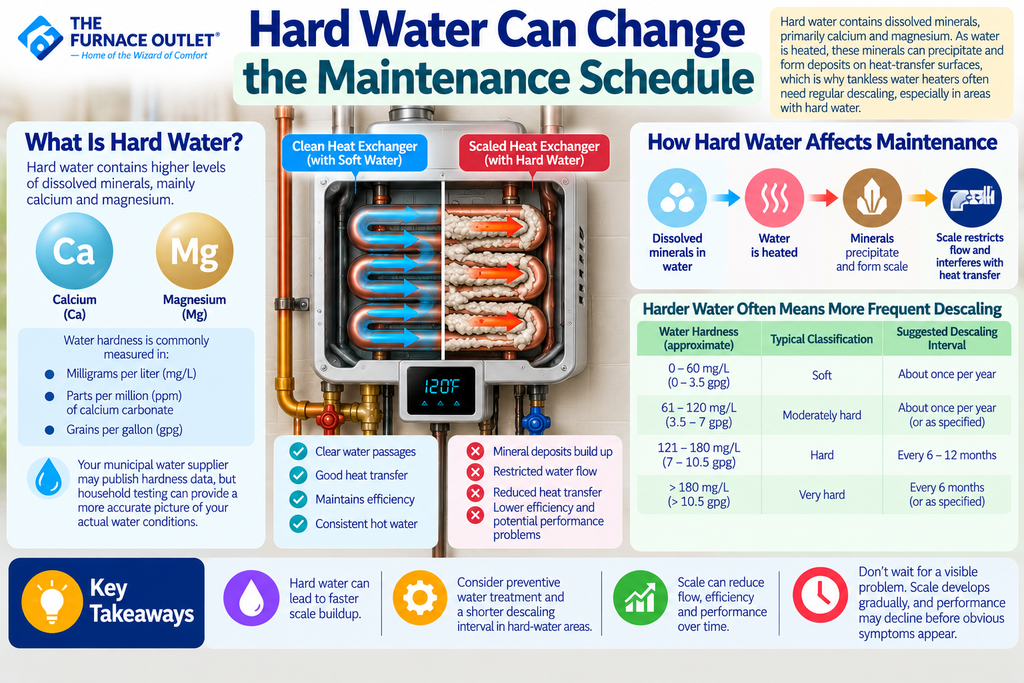
Hard water deserves special attention because tankless equipment is particularly dependent on keeping heat-transfer surfaces clear. Water hardness is commonly expressed as milligrams per liter or parts per million of calcium carbonate, or in grains per gallon. Your municipal water supplier may publish hardness data, but household testing can be worthwhile because actual conditions can vary.
The harder the water, the more seriously I would consider preventive water treatment and a shorter descaling interval. Rheem notes that calcium and magnesium deposits associated with hard water can impair water-heater performance and recommends more frequent maintenance where mineral levels are high.
The important point is not to wait until the heater visibly fails. Scale develops gradually, which means declining performance may occur before the homeowner recognizes an obvious problem.
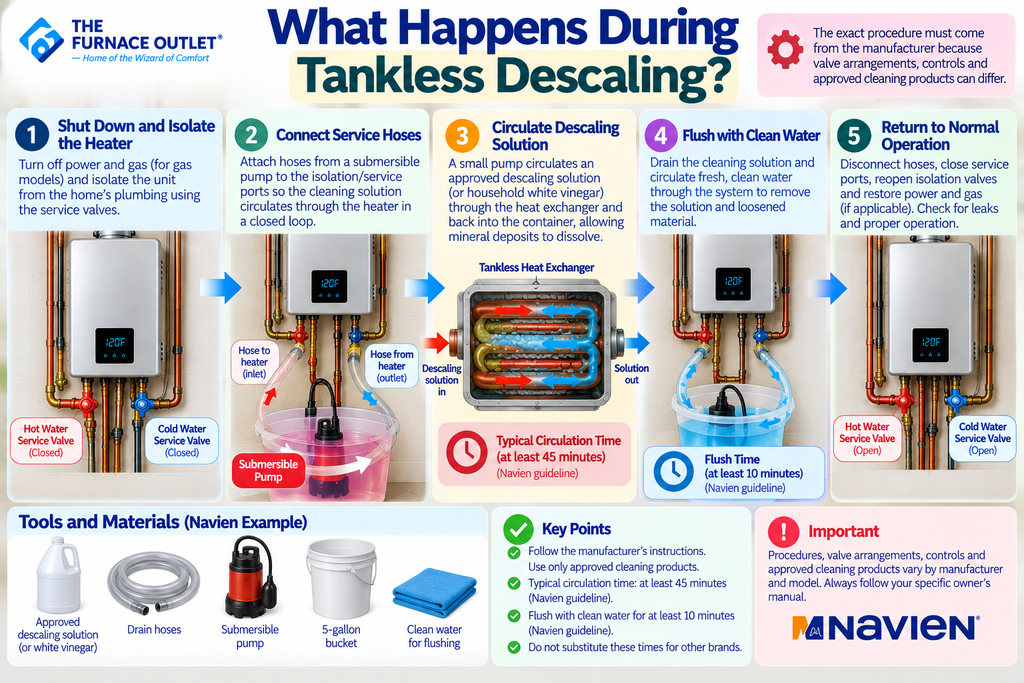
The exact procedure must come from the manufacturer because valve arrangements, controls, isolation procedures and approved cleaning products can differ.
Conceptually, however, descaling usually follows the same pattern. The appliance is safely shut down and isolated from the home’s plumbing. Service hoses are connected to appropriate isolation/service ports. A small circulation pump moves an approved descaling solution through the heat exchanger and back into a container, creating a closed cleaning loop.
After sufficient circulation time, the cleaning solution is removed and the heater is flushed thoroughly with fresh water before being returned to normal operation.
Navien’s published procedure describes using an approved tankless descaling solution or household white vinegar, drain hoses, a submersible pump and a five-gallon bucket. Its guidance calls for circulating the cleaning solution for at least 45 minutes and then flushing with fresh water for at least 10 minutes. Those numbers apply to Navien’s procedure and should not automatically be substituted for another manufacturer’s instructions.
Navien — How to Descale a Tankless Water Heater
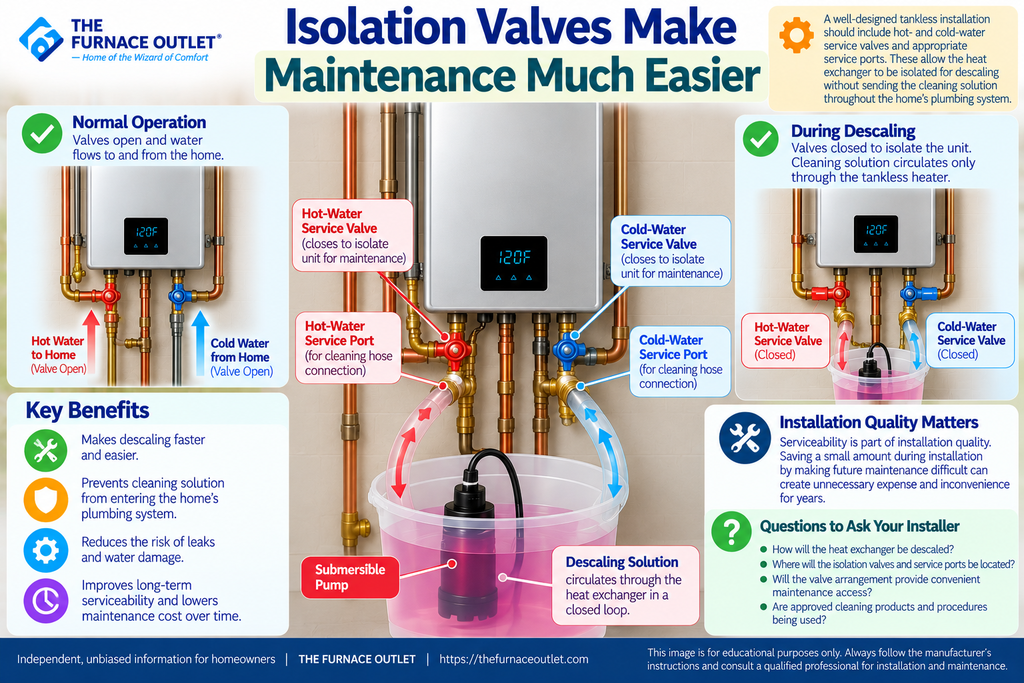
A well-designed tankless installation should anticipate future maintenance from the beginning. Hot- and cold-water service valves allow the heat exchanger to be isolated so that a cleaning solution can circulate through the appliance without being sent throughout the home’s plumbing system. Appropriate service ports then provide convenient hose connections.
This is one reason I consider serviceability part of installation quality. Saving a modest amount during installation by making future maintenance difficult can create unnecessary expense and inconvenience for years.
Before purchasing a tankless heater, I would therefore ask the installer how the heat exchanger will eventually be descaled and whether the proposed valve arrangement provides convenient maintenance access.
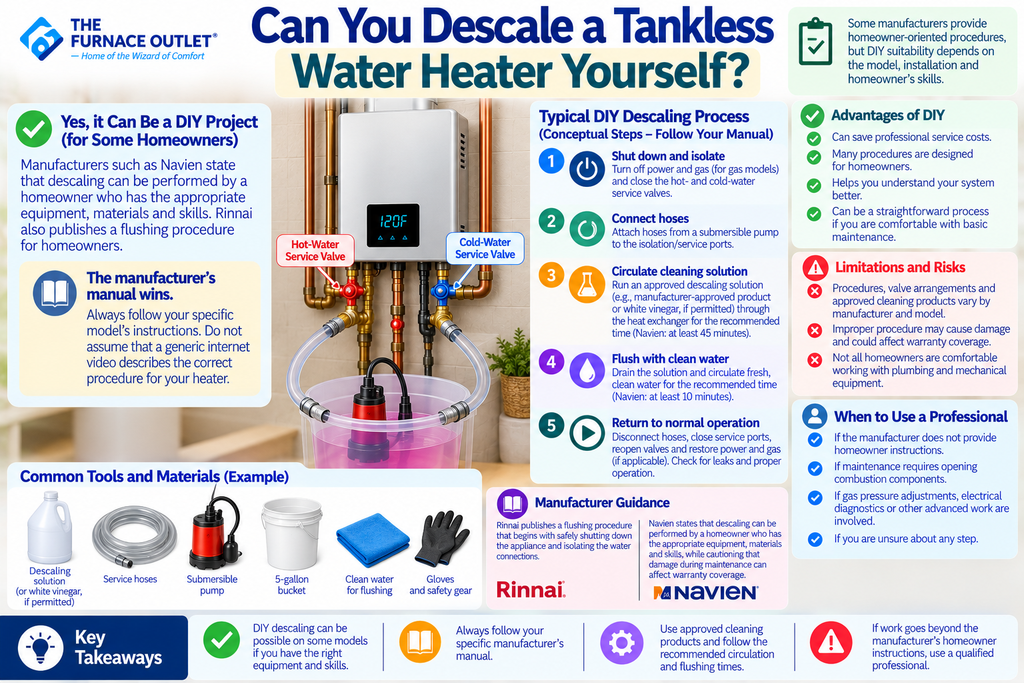
Some manufacturers provide homeowner-oriented procedures, but DIY suitability depends on the model, installation and homeowner’s skills.
Rinnai publishes a flushing procedure that begins with safely shutting down the appliance and isolating the water connections. Navien also states that descaling can be performed by a homeowner who has the appropriate equipment, materials and skills, while cautioning that damage during maintenance can affect warranty coverage.
Rinnai — Tankless Water Heater Flushing Procedure
My rule would be simple: the manufacturer’s manual wins. Do not assume that a generic internet video describes the correct procedure for your heater.
If maintenance requires opening combustion components, adjusting gas pressure, diagnosing electrical equipment or performing work beyond the manufacturer’s homeowner instructions, I would use a qualified professional.
Descaling receives most of the attention, but the inlet-water filter or screen is another important maintenance item.
This small component catches debris before it enters sensitive internal waterways. As material accumulates, a restricted filter can reduce water flow and potentially contribute to operating problems.
Navien recommends removing its applicable inlet filters, rinsing them with clean cold water and using a brush where necessary. Rinnai similarly lists periodic inspection and cleaning of the in-line screen filter as routine maintenance.
Again, access procedures vary. Turn valves and controls only according to the manufacturer’s instructions because removing a filter from a pressurized plumbing system without correctly isolating the appliance can create an unpleasant—and potentially hazardous—surprise.
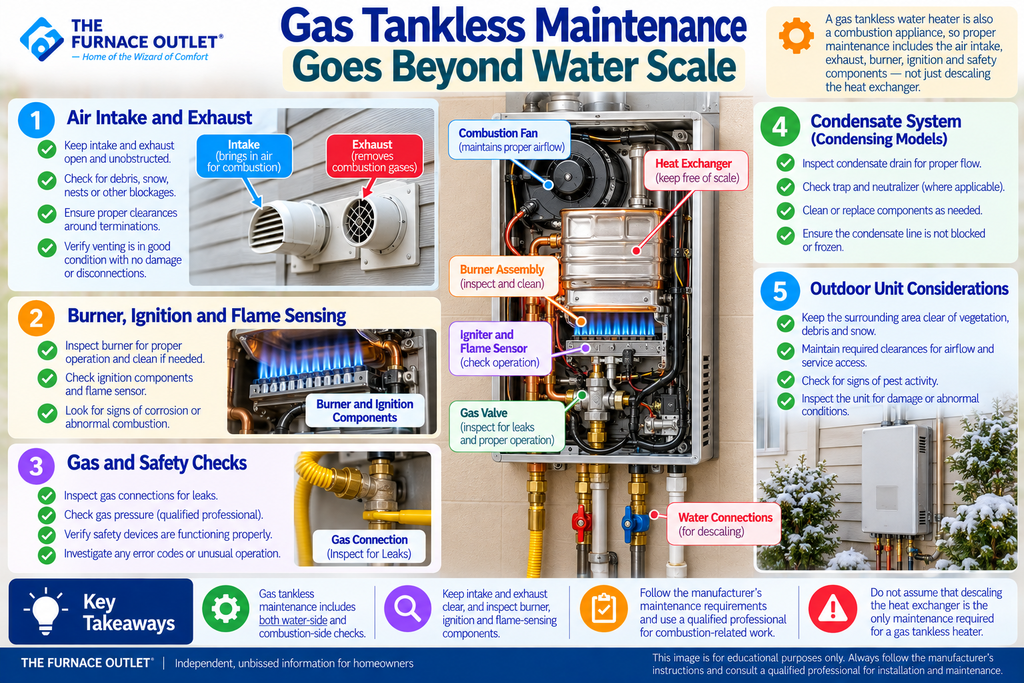
A gas tankless water heater is also a combustion appliance, so water-side descaling is only one part of proper maintenance.
Air intake and exhaust pathways need to remain unobstructed. Burner, ignition and flame-sensing components may need professional inspection. Signs of corrosion, abnormal combustion or leakage should be investigated rather than simply cleaning the heat exchanger and assuming maintenance is complete.
Rheem’s tankless maintenance recommendations include inspection of burners, flame sensors and igniters as well as checking intake and exhaust terminations for debris, snow, pests or other obstructions.
For an outdoor unit, I would also inspect the surrounding area for vegetation, debris, snow accumulation or anything else that could interfere with airflow or service access.
High-efficiency condensing gas tankless heaters extract enough heat from combustion products to create liquid condensate. That improves energy utilization, but it adds another maintenance system.
The condensate drain needs to remain clear and correctly routed. Where a neutralizer is installed, its media may eventually require inspection or replacement according to manufacturer instructions.
Rheem includes inspection of the condensate neutralizer, housing and media in its recommended tankless maintenance checklist for applicable equipment.
I would therefore include condensate components whenever arranging annual maintenance on a condensing heater rather than treating descaling as the entire service visit.
If water hardness is severe, repeatedly removing scale addresses the result rather than the underlying cause.
A properly selected water-treatment system can reduce mineral loading before water enters the tankless heater. Rheem describes a water softener as a long-term strategy for controlling hard-water problems and protecting the broader plumbing system as well as the water heater.
That does not mean every tankless installation automatically needs a conventional salt-based softener. Water chemistry varies, equipment manufacturers can have specific water-quality limits, and different treatment technologies solve different problems.
I would test the water first, review the heater manufacturer’s specifications and then choose treatment based on the actual problem.
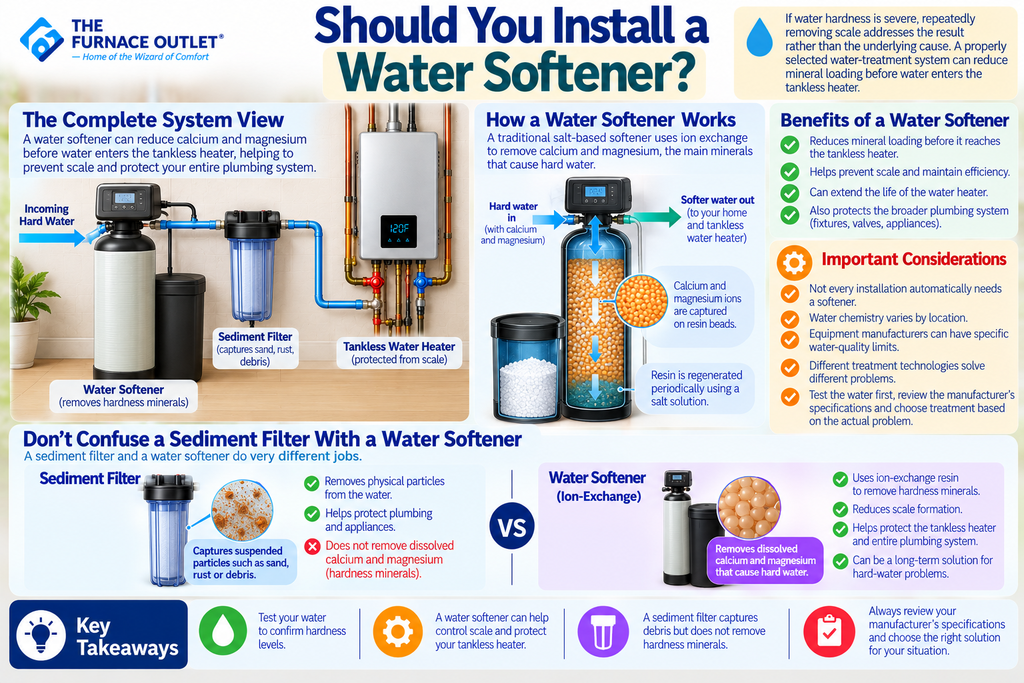
This distinction is important.
A sediment filter can capture suspended particles such as sand, rust or debris. It generally does not remove the dissolved calcium and magnesium responsible for conventional water hardness.
A traditional ion-exchange water softener addresses hardness minerals differently. Other scale-control technologies also exist, but their capabilities and manufacturer acceptance should be evaluated carefully.
If your problem is calcium-scale accumulation, I would not assume that installing a basic cartridge sediment filter has solved it.
Tankless problems can have many causes, so symptoms should not automatically be diagnosed as scale. However, several changes justify investigation, especially in a hard-water home.
Reduced hot-water flow, inconsistent outlet temperature, longer apparent heating response, unexpected shutdowns or error codes can indicate that the system needs attention. A noticeable increase in energy use without a corresponding increase in hot-water demand can also justify inspection.
Visible leakage, corrosion, abnormal combustion odors or persistent fault codes deserve prompt professional attention rather than simply performing another descaling cycle.
The goal is preventive maintenance, not repeatedly cleaning equipment that actually has a different mechanical or installation problem.
For a typical installation, I would start by reviewing the manufacturer’s required maintenance schedule and establishing an annual inspection and descaling routine. I would shorten the interval toward approximately six months if the home has hard water, unusually heavy hot-water consumption or manufacturer guidance indicating more frequent service.
Between major services, I would keep an eye on the inlet filter, water flow, plumbing connections, error history and intake/exhaust openings. For condensing equipment, I would include the condensate system and neutralizer where applicable.
Most importantly, I would keep records. Note the maintenance date, water hardness if known, work performed and any components replaced. That creates a useful history for future technicians and can help establish whether the chosen service interval is appropriate.
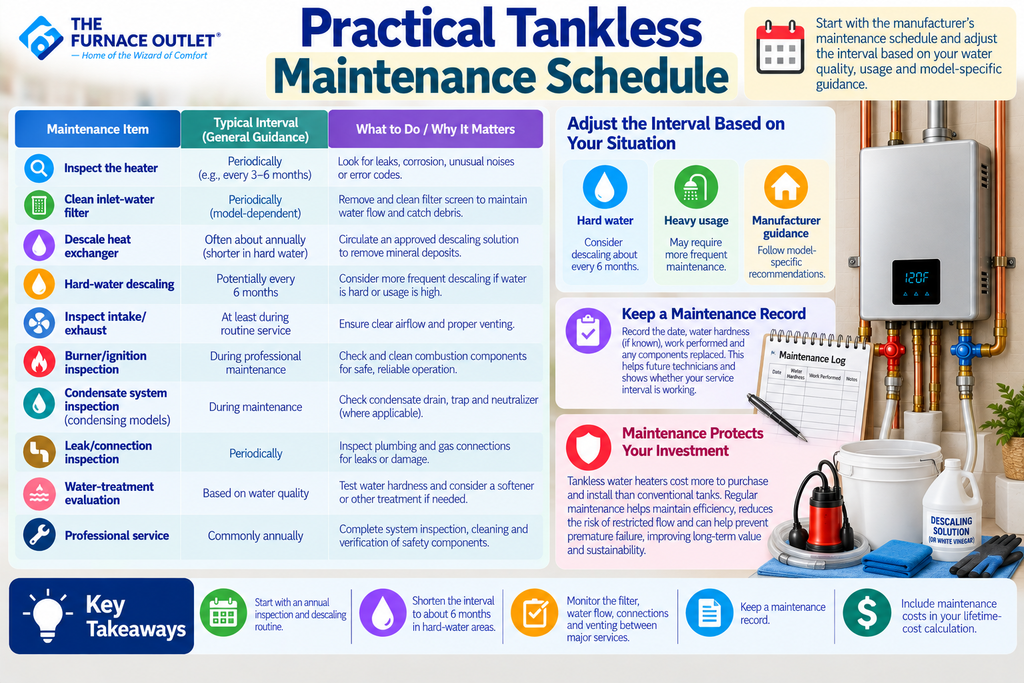
Tankless water heaters frequently cost more to purchase and install than conventional storage equipment, so protecting that investment matters.
Maintenance itself costs money, whether through professional labor or homeowner time and materials. But I would include those costs in the ownership calculation rather than pretending an efficient appliance requires no attention.
A regularly maintained heater that remains efficient and serviceable for many years is a better sustainability outcome than neglected equipment that experiences restricted flow, declining performance or premature failure.
This is especially important with hard water because mineral accumulation is predictable. Once the water conditions are known, maintenance can be planned rather than waiting for a problem.
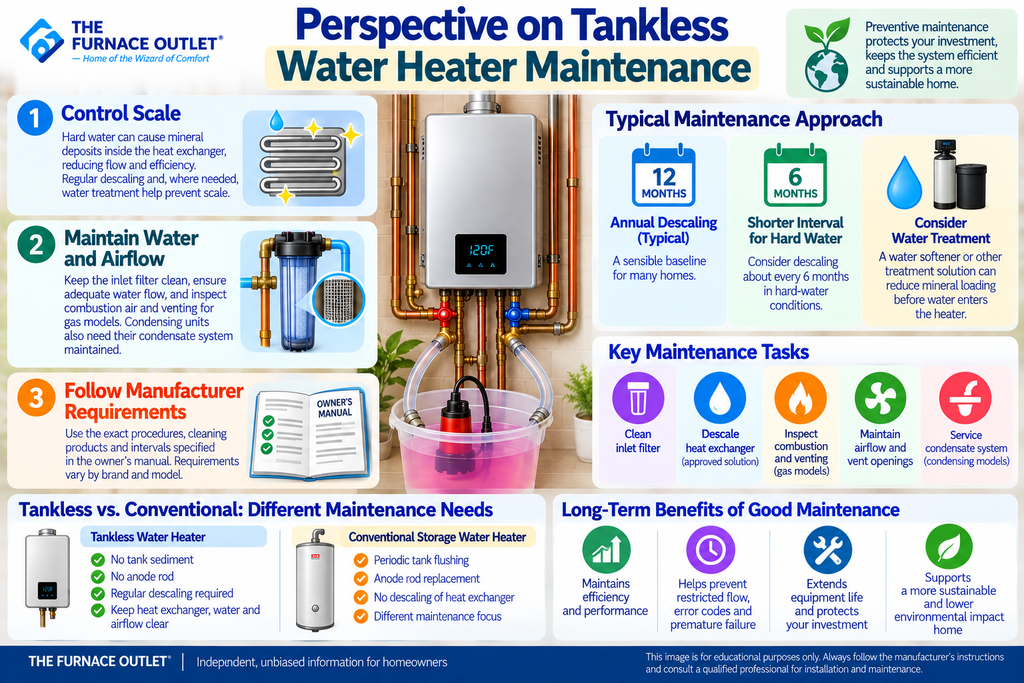
My approach to tankless maintenance comes down to three priorities: control scale, maintain water and airflow, and follow the exact manufacturer’s requirements.
For many homes, annual descaling is a sensible baseline. In hard-water conditions, a six-month interval may be more appropriate, and water treatment can become an important part of the long-term strategy. The inlet filter should remain clean, gas appliances need appropriate combustion and vent inspection, and condensing models need their condensate systems maintained.
I would also resist the idea that tankless means maintenance-free. Removing the storage tank eliminates tank sediment and anode-rod maintenance, but the heat exchanger still operates in contact with the same mineral-containing household water.
From my sustainability perspective, preventive maintenance is one of the simplest ways to protect the environmental benefits of efficient equipment. The objective is not merely to keep the heater running; it is to keep it transferring heat efficiently, delivering the required flow and remaining serviceable for as much of its potential life as possible.
How often should a tankless water heater be descaled? For many systems, approximately once per year is a useful starting point, and Navien recommends at least annual descaling. Hard water, high temperature settings or heavy hot-water consumption can justify more frequent maintenance, potentially around every six months. Always follow the exact manufacturer’s requirements. Navien
Can I use vinegar to descale a tankless water heater? Some manufacturers permit it in their procedures. Navien, for example, identifies household white vinegar or an approved tankless descaling solution. Do not assume that automatically applies to every heater; use only cleaning products and procedures approved for your specific model.
Does hard water damage tankless water heaters? Hard water can create calcium and magnesium scale inside the heat exchanger and waterways. Accumulation can restrict flow and interfere with efficient heat transfer, which is why hard-water installations often need more frequent maintenance.
Does a water softener eliminate tankless maintenance? No. Reducing hardness can help control scale, but the heater still has filters, plumbing connections and other components requiring inspection. Gas models also have combustion, air-intake and exhaust systems, while condensing units have condensate-management components.
Is tankless flushing the same as flushing a storage water heater? Not exactly. Storage tanks are typically flushed to remove sediment accumulated in the vessel. Tankless maintenance commonly involves circulating a descaling solution through the heat exchanger and then flushing the system with fresh water.
Should tankless maintenance be performed professionally? Some manufacturers provide homeowner procedures for certain maintenance tasks, but professional service is appropriate when working with combustion components, gas systems, electrical systems or procedures beyond the homeowner instructions. Warranty requirements should also be checked before DIY servicing.
For further technical reading, I recommend the Navien tankless descaling guide, Navien tankless maintenance guidance, Rinnai flushing procedure, Rinnai maintenance FAQ and Rheem tankless maintenance guide.
This article is provided by The Furnace Outlet for general educational purposes and is not a substitute for the installation, operation or maintenance instructions supplied with your specific water heater. Maintenance requirements, approved descaling products, valve arrangements, water-quality limits and service intervals vary by manufacturer and model. Work involving gas, combustion, electrical components or unfamiliar plumbing procedures should be performed by appropriately qualified professionals. Always follow applicable codes and the manufacturer’s current documentation.