Newsletter Subscribe
Enter your email address below and subscribe to our newsletter

HVAC made simple
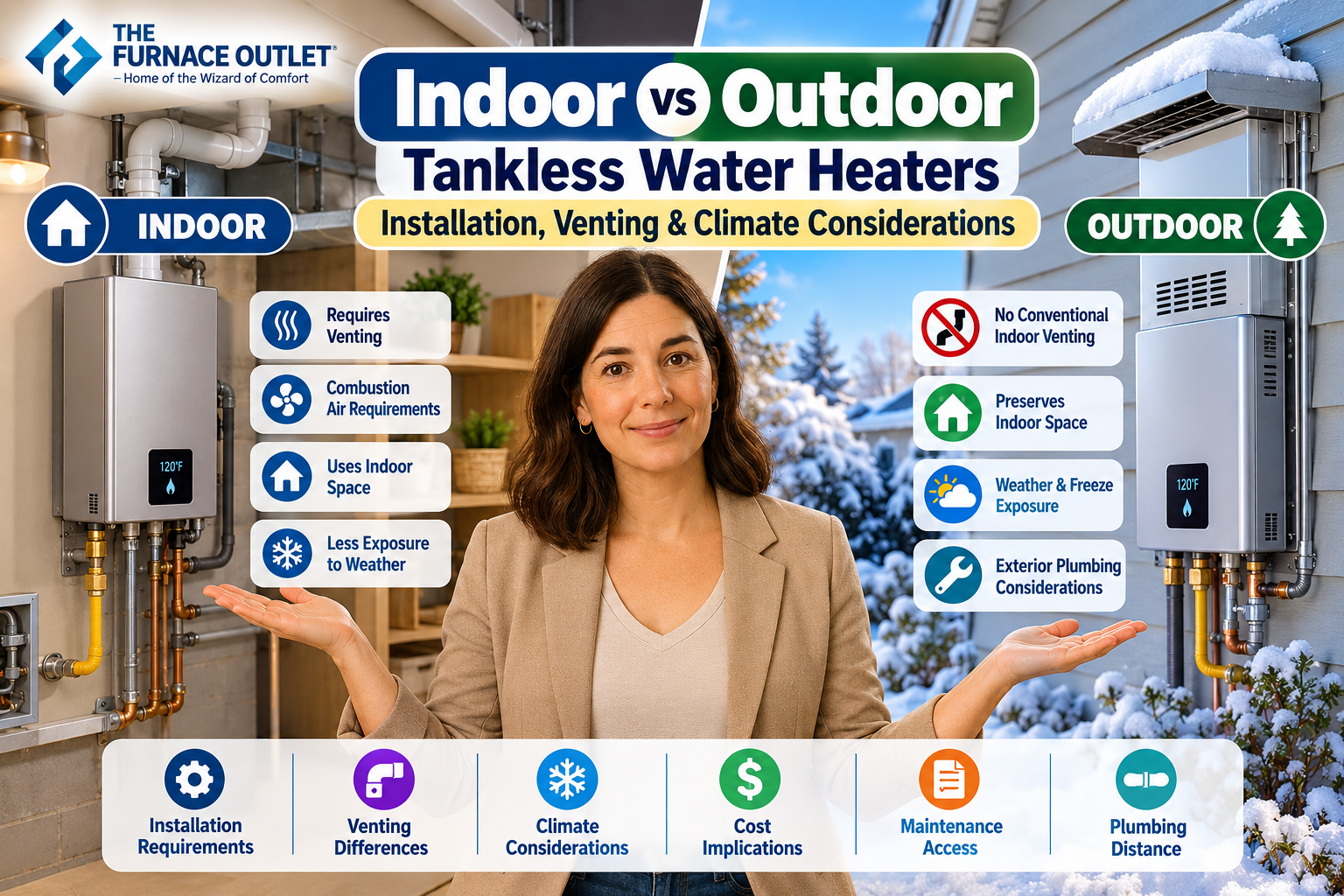
When I compare indoor and outdoor tankless water heaters, I do not treat the installation location as a minor detail to decide after selecting the equipment. Location is part of the water-heating system itself. It affects venting, combustion air, freeze exposure, plumbing distance, maintenance access, weather protection and ultimately the complete installed cost.
I’m Savvy, The Furnace Outlet’s sustainability-focused HVAC enthusiast, and I particularly like tankless equipment because its compact dimensions give homeowners considerably more placement flexibility than a conventional storage tank. That flexibility should be used strategically, however. Putting a heater outdoors can eliminate an indoor combustion-vent route and preserve valuable interior space, but it also exposes the equipment and connecting pipes to weather. Installing indoors protects the heater from direct outdoor exposure, but combustion equipment then needs an approved method of bringing in combustion air and safely exhausting combustion gases.
The best location is therefore not automatically indoors or outdoors. I would evaluate the climate, exact model, venting route, plumbing layout, fuel and electrical connections, freeze risk, service access and manufacturer installation requirements before deciding where the heater belongs.
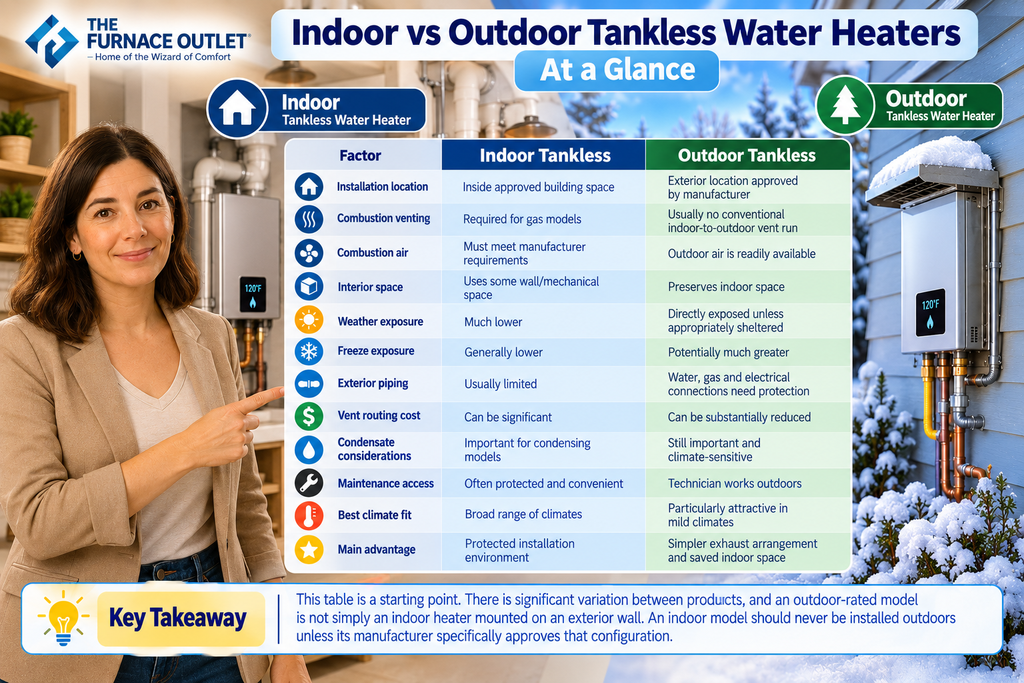
| Factor | Indoor Tankless | Outdoor Tankless |
|---|---|---|
| Installation location | Inside approved building space | Exterior location approved by manufacturer |
| Combustion venting | Required for gas models | Usually no conventional indoor-to-outdoor vent run |
| Combustion air | Must meet manufacturer requirements | Outdoor air is readily available |
| Interior space | Uses some wall/mechanical space | Preserves indoor space |
| Weather exposure | Much lower | Directly exposed unless appropriately sheltered |
| Freeze exposure | Generally lower | Potentially much greater |
| Exterior piping | Usually limited | Water, gas and electrical connections need protection |
| Vent routing cost | Can be significant | Can be substantially reduced |
| Condensate considerations | Important for condensing models | Still important and climate-sensitive |
| Maintenance access | Often protected and convenient | Technician works outdoors |
| Best climate fit | Broad range of climates | Particularly attractive in mild climates |
| Main advantage | Protected installation environment | Simpler exhaust arrangement and saved indoor space |
I use this table only as a starting point because there is enormous variation between products. An outdoor-rated model is not simply an indoor heater mounted on an exterior wall, and an indoor model should never be moved outdoors unless its manufacturer specifically approves that configuration.
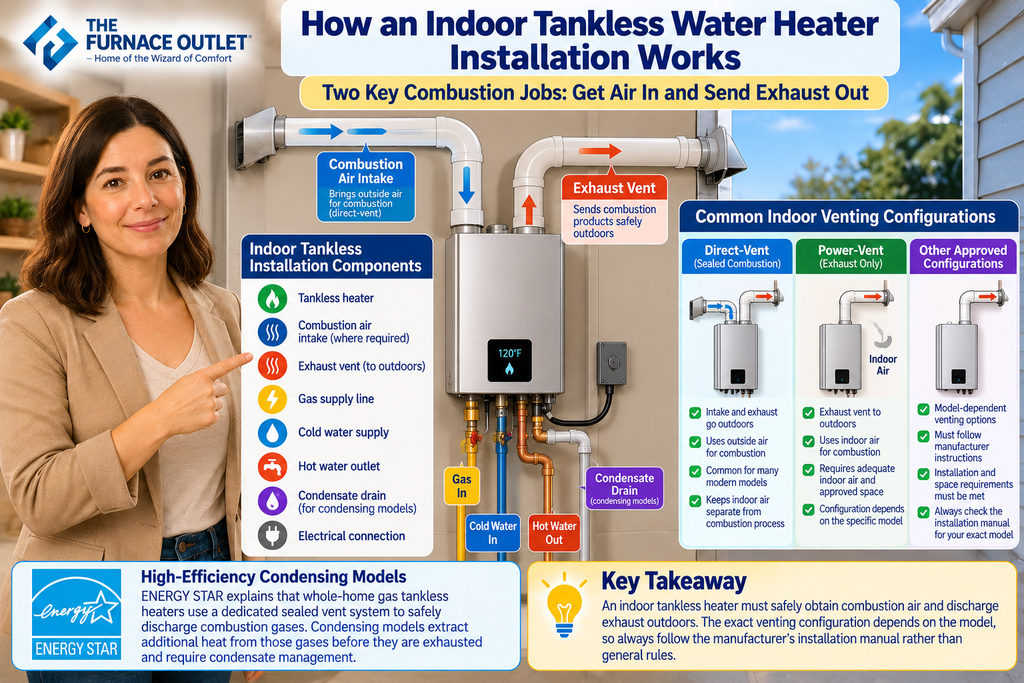
An indoor gas tankless heater needs to perform two combustion-related jobs safely: obtain the air required for combustion and discharge the combustion products outdoors.
Modern equipment can accomplish this through several manufacturer-approved vent configurations. Direct-vent systems generally obtain combustion air from outside and exhaust combustion products outdoors through a dedicated arrangement. Other configurations may use room air for combustion while venting exhaust outdoors, provided the installation and space meet the manufacturer’s requirements.
Rinnai explains that direct-vent tankless systems obtain combustion air from outside and have intake and exhaust pathways, while power-vent arrangements use an exhaust vent and require adequate indoor air for combustion. The exact configuration depends on the model, so this is an area where the installation manual matters far more than general rules. Rinnai
ENERGY STAR similarly explains that whole-home gas tankless heaters use a dedicated sealed vent system to safely discharge combustion gases. High-efficiency condensing models extract additional heat from those gases before they are exhausted.
ENERGY STAR — How Whole-Home Gas Tankless Water Heaters Work
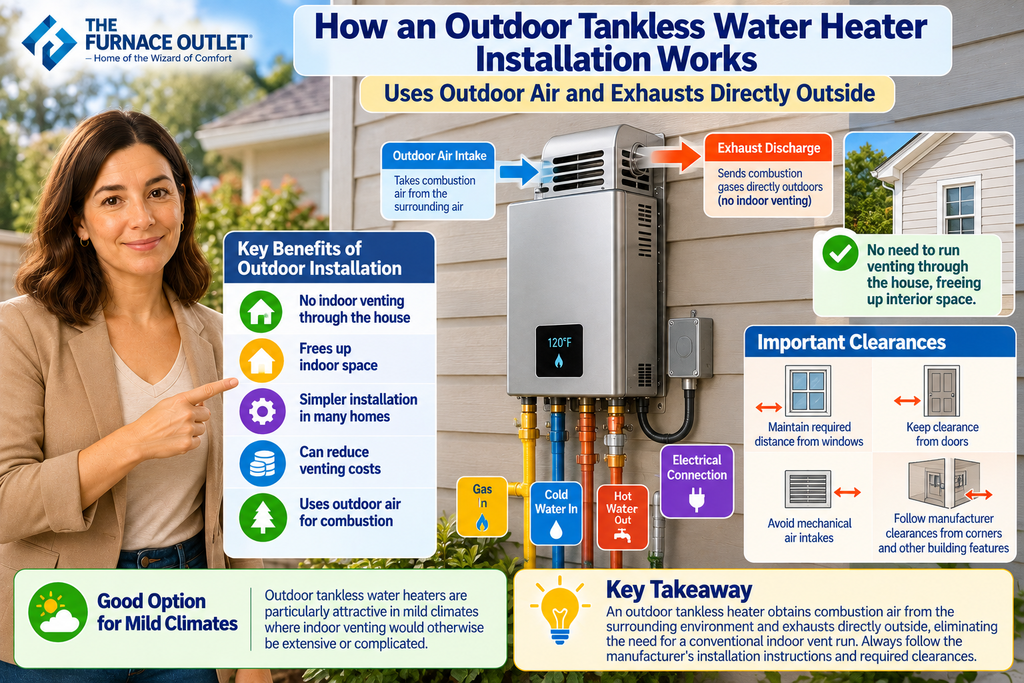
A purpose-built outdoor gas tankless heater takes advantage of the fact that the appliance is already outside the building envelope. The heater can obtain combustion air directly from the surrounding environment and discharge its combustion gases outdoors without running a conventional vent system through the house.
That can dramatically simplify some installations. There may be no need to route a vent vertically through several floors or horizontally through finished interior spaces. It can also avoid sacrificing closet, basement, garage or utility-room space.
Rinnai notes that outdoor models eliminate the need for additional indoor venting and can free interior space. Navien likewise describes outdoor tankless equipment as potentially useful in milder regions where installing an indoor model would otherwise require extensive or complicated venting. Rinnai
Outdoor installation does not mean “install anywhere outside.” Clearances from windows, doors, air intakes and other building features remain important because combustion products must not be allowed to enter the home. Navien specifically notes the need for proper separation from openings and ventilation intakes. Navien
For gas-fired equipment, venting is usually the clearest distinction between indoor and outdoor installations. An indoor gas tankless heater must safely carry combustion gases from the appliance to an approved exterior termination. The vent material, diameter, equivalent length, number of fittings, termination location, intake arrangement and clearances all need to comply with the manufacturer’s instructions and applicable codes.
The requirements can also change between condensing and non-condensing tankless heaters. Condensing equipment removes more heat from combustion gases, producing cooler exhaust but also liquid condensate. Non-condensing equipment generally has hotter exhaust and can require venting suitable for those higher temperatures.
Outdoor models remove much of the indoor vent-routing problem because the appliance exhausts directly outdoors. That can make an exterior model economically attractive where an indoor installation would require a long or complicated vent path.
I would therefore never compare indoor and outdoor heaters by equipment price alone. I would compare the heater plus the complete venting and installation package.
This distinction is important because saying that an outdoor tankless heater “does not need venting” can be misleading. It usually does not need the conventional vent piping required to carry exhaust from an indoor appliance through the building envelope, but the combustion gases still need to discharge safely.
The manufacturer’s required clearances around the exhaust outlet therefore remain critical. Nearby windows, doors, soffits, building corners, mechanical-air intakes and neighboring structures can affect whether a proposed location is acceptable. An outdoor installation on a large open exterior wall may be straightforward. Trying to fit the same heater into a narrow exterior alcove beside an operable window or air intake can be very different.
This is one reason I would choose the location before ordering the exact model, rather than purchasing equipment first and trying to find somewhere to put it afterward.
Climate is one of my biggest considerations when evaluating outdoor tankless equipment. In a warm or mild climate, an exterior installation can be extremely attractive. It saves interior space, avoids a conventional indoor exhaust route and can simplify combustion-air arrangements. In a climate that experiences prolonged freezing conditions, however, the analysis becomes much more complicated.
Tankless heaters contain heat exchangers and internal water passages that can be vulnerable to freezing. Outdoor plumbing connections are also directly exposed to ambient temperatures and wind.
Some manufacturers incorporate active freeze-protection features, but those protections have very specific limitations. They should never be interpreted as permission to install every outdoor heater in every cold climate.
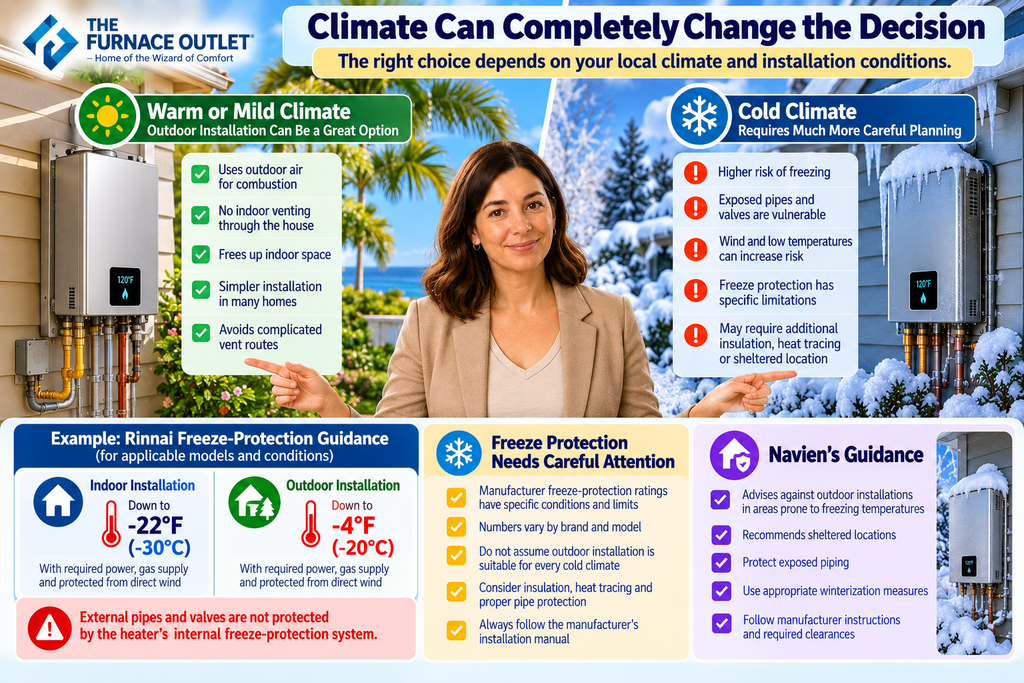
Rinnai states that certain tankless models have built-in freeze protection that, when the unit is protected from direct wind and has the necessary power and gas supply, can protect indoor installations to lower temperatures than outdoor installations. Its current guidance cites protection down to -22°F (-30°C) for applicable indoor installations and -4°F (-20°C) for applicable outdoor installations under stated conditions. Importantly, Rinnai also says that external pipes and valves are not protected by the heater’s internal freeze-protection system.
Those numbers should not be generalized to other brands or even assumed for every Rinnai product. They illustrate why I read the exact installation manual before considering an outdoor heater in a freezing climate.
Navien takes a particularly cautious position in its consumer guidance, advising against outdoor tankless installations in areas prone to freezing temperatures and recommending sheltered locations, pipe protection and appropriate winterization where outdoor equipment is used. .
Navien — Tankless Water Heater Freeze-Protection Guidance
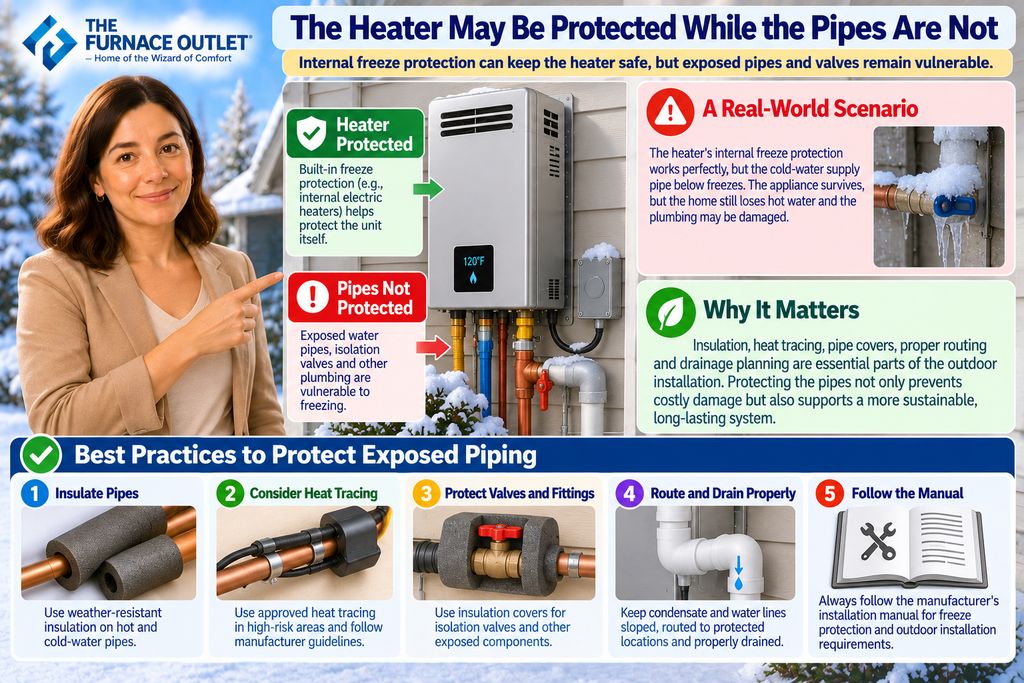
This is one of the most important details in outdoor tankless planning.
A heater may contain internal electric heaters or other freeze-protection strategies, but the exposed water pipes, isolation valves and other plumbing outside the cabinet may not receive the same protection. Rinnai specifically warns that external pipes and valves remain vulnerable and recommends protecting exposed piping appropriately.
Imagine an outdoor heater whose internal freeze protection works perfectly while the cold-water supply pipe immediately below it freezes. The appliance itself has survived, but the household still has no functioning water-heating system and the plumbing may be damaged.
Insulation, approved heat tracing where appropriate, pipe covers, proper routing and drainage planning therefore become part of the outdoor installation—not optional accessories to think about later. From my sustainability perspective, this also matters because equipment that suffers premature freeze damage is hardly an environmentally responsible installation, regardless of how efficient the appliance was when operating.
Active freeze protection usually requires electricity, and some systems also depend on an uninterrupted fuel supply. That means the exact moment when freeze protection is most valuable—a severe winter storm—can also be a time when electrical service is vulnerable. If power is lost during freezing weather, the heater’s internal protection may no longer function.
Rinnai’s installation guidance warns that loss of power or gas during freezing conditions can require draining the heater to prevent damage and recommends an optional drain-down arrangement for applicable outdoor installations. This changes how I evaluate outdoor equipment in colder regions. I would ask not only, “Does this heater have freeze protection?” but also, “What happens if the house loses power for eight hours during the coldest night of the year?” That is a much more useful design question.
Temperature alone does not describe the environment surrounding an outdoor water heater. Strong cold winds can increase heat loss from the appliance and exposed plumbing. Manufacturer freeze-protection ratings can therefore depend on protection from direct wind exposure. Rinnai explicitly includes that qualification in its published freeze-protection guidance.
A sheltered exterior wall may consequently be preferable to an exposed north-facing location subject to severe winter winds, assuming all required appliance clearances can still be maintained. Sheltering does not mean enclosing the heater in an improvised cabinet. Any enclosure, recess or cover needs to maintain the combustion, ventilation, clearance and service-access requirements established by the manufacturer.
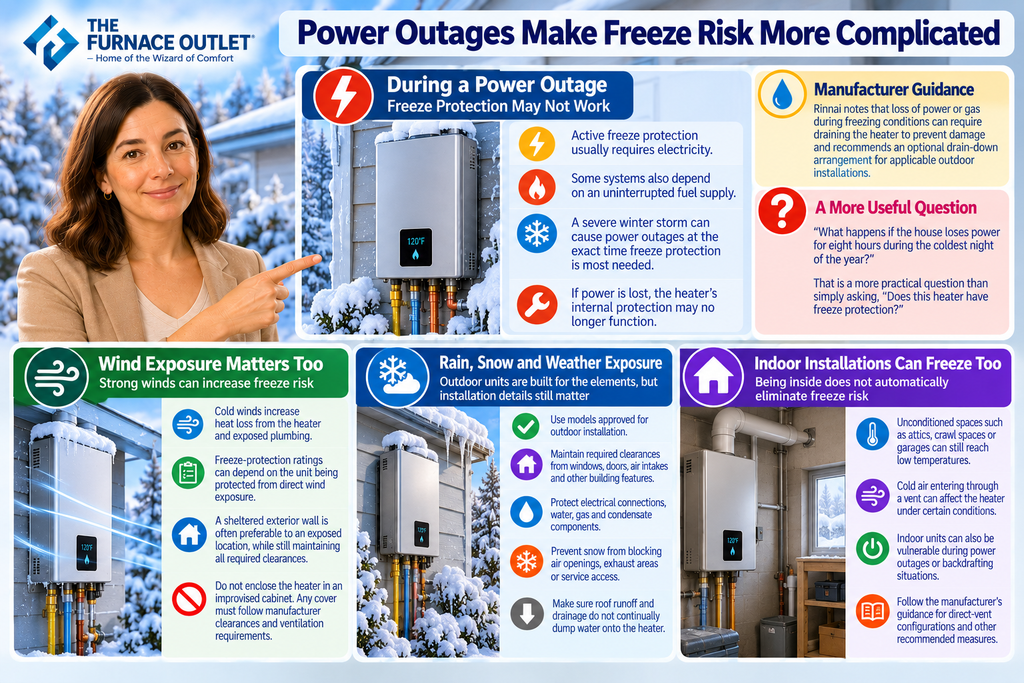
An outdoor-rated tankless heater is designed for exterior use, but that does not mean installation details stop mattering. The mounting surface must be appropriate, required clearances must be maintained, electrical connections need suitable protection, and water, gas and condensate components need to be installed for the conditions they will encounter.
Snow accumulation deserves special consideration. An exhaust area, air opening or service space that is clear during summer should not become obstructed after heavy snowfall. Similarly, roof runoff and drainage should not continually dump water onto the heater. The objective is to use equipment approved for outdoor exposure while still choosing a sensible location rather than unnecessarily subjecting it to harsh conditions.
I would not assume that moving a heater indoors completely eliminates freeze risk. An indoor heater installed in an unconditioned attic, crawl space or cold garage can still encounter low temperatures. Cold air entering through a vent can also affect internal components under certain conditions.
Navien notes that indoor tankless heaters can be vulnerable during power outages or where backdrafting draws cold air through the appliance, and it discusses direct-vent intake and exhaust arrangements as one strategy for reducing cold-air movement through applicable installations. A location being technically “inside” the building therefore does not automatically mean it is warm.
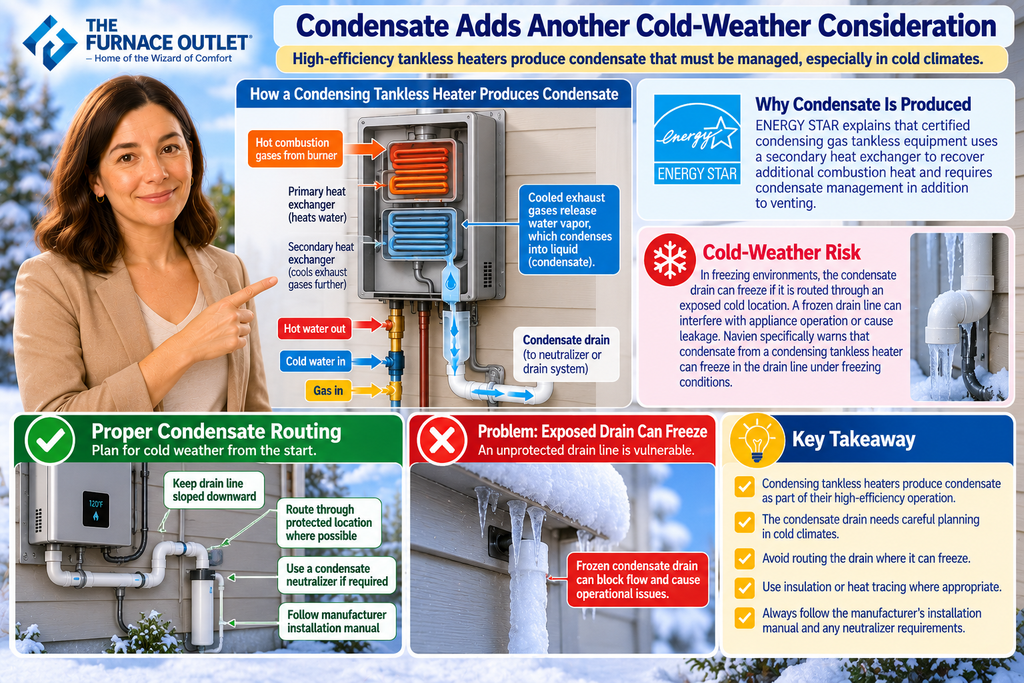
High-efficiency condensing gas tankless heaters produce condensate because they extract enough heat from combustion gases for water vapor to condense.
ENERGY STAR explains that certified condensing gas tankless equipment uses a secondary heat exchanger to recover additional combustion heat and requires condensate management in addition to venting. ENERGY STAR
In freezing environments, the condensate drain itself becomes another component that needs careful planning. A drain line routed through an exposed cold location can freeze, potentially interfering with appliance operation or causing leakage.
Navien specifically warns that condensate from a condensing tankless heater can freeze in the drain line under freezing conditions. That is why I treat condensate routing as part of climate design rather than simply plumbing a small tube wherever it is convenient.
Tankless equipment is already compact compared with conventional storage heaters, but moving the appliance outdoors can preserve even more usable interior space. ENERGY STAR highlights the wall-mounted, space-saving nature of gas tankless equipment and specifically notes that outdoor models can free additional indoor space.
That can be valuable in smaller homes where utility space competes with storage, laundry equipment or living space. However, I would not move the heater outdoors merely to save a few square feet if doing so creates a serious freeze problem or requires a much longer plumbing run. The best location balances space efficiency with system efficiency and reliability.
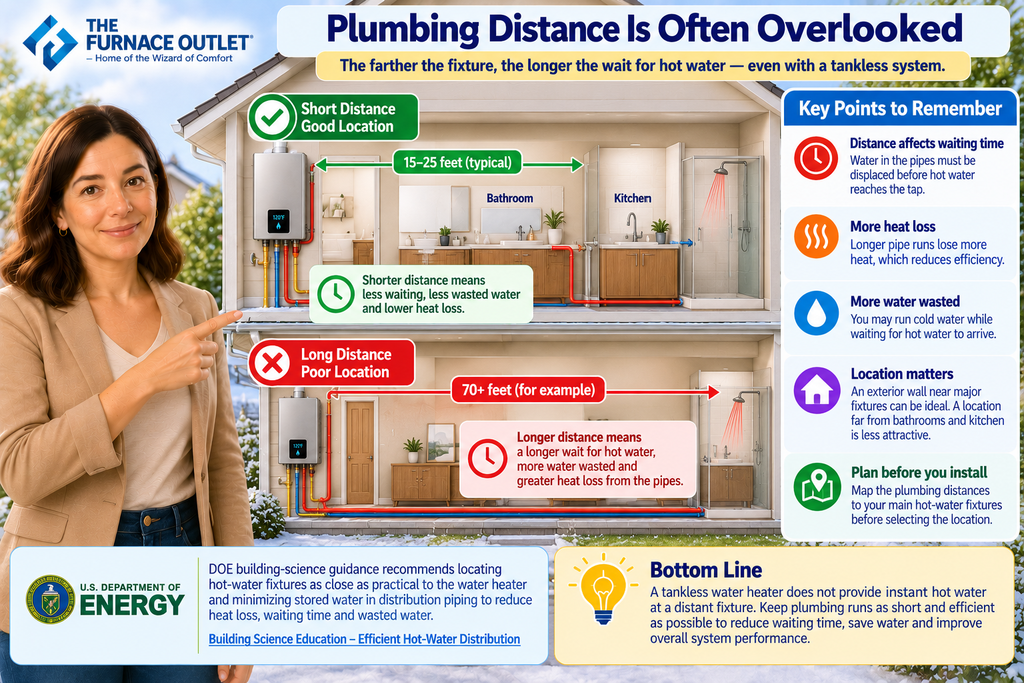
The physical distance between the water heater and the fixtures matters regardless of whether the heater is tankless. A tankless heater does not magically provide immediate hot water at a distant faucet. Water sitting in the pipe between the heater and fixture still needs to be displaced before newly heated water reaches the tap.
DOE building-science guidance recommends locating hot-water fixtures as close as practical to the water heater and minimizing stored water in distribution piping to reduce heat loss, waiting time and wasted water. Building Science Education
U.S. Department of Energy — Efficient Hot-Water Distribution Guidance
This can affect indoor-versus-outdoor placement. An exterior wall directly behind the home’s primary bathrooms may be an excellent outdoor location. An exterior wall 70 feet from the major hot-water fixtures may be much less attractive. I would therefore map the plumbing distances before selecting the location.
A recirculation system can reduce the wait for hot water at distant fixtures, but it should not be used as an excuse for unnecessarily poor heater placement. Recirculation adds pumps, controls and additional heat loss potential, although well-designed demand-controlled systems can address these issues much more effectively than continuous circulation.
If choosing between two otherwise suitable heater locations, I generally prefer the location that produces shorter, more efficient hot-water distribution paths. Reducing the amount of hot water sitting in pipes can save both water and energy. This is one of those situations where sustainable design comes from looking at the entire plumbing system, not merely buying the appliance with the highest efficiency rating.
Eliminating a conventional vent run does not eliminate the rest of the installation. An outdoor gas tankless heater still needs an appropriately sized fuel supply, water connections, electrical power and usually controls or communications connections depending on the system.
Gas piping can become particularly important because high-output tankless heaters may have substantially higher maximum firing rates than the storage water heater they replace. The existing gas line should not automatically be assumed adequate. Outdoor electrical components and connections also need to meet applicable requirements for their location. The vent may disappear from the project budget, but additional exterior plumbing, fuel piping, electrical work or weather protection can offset some of those savings.
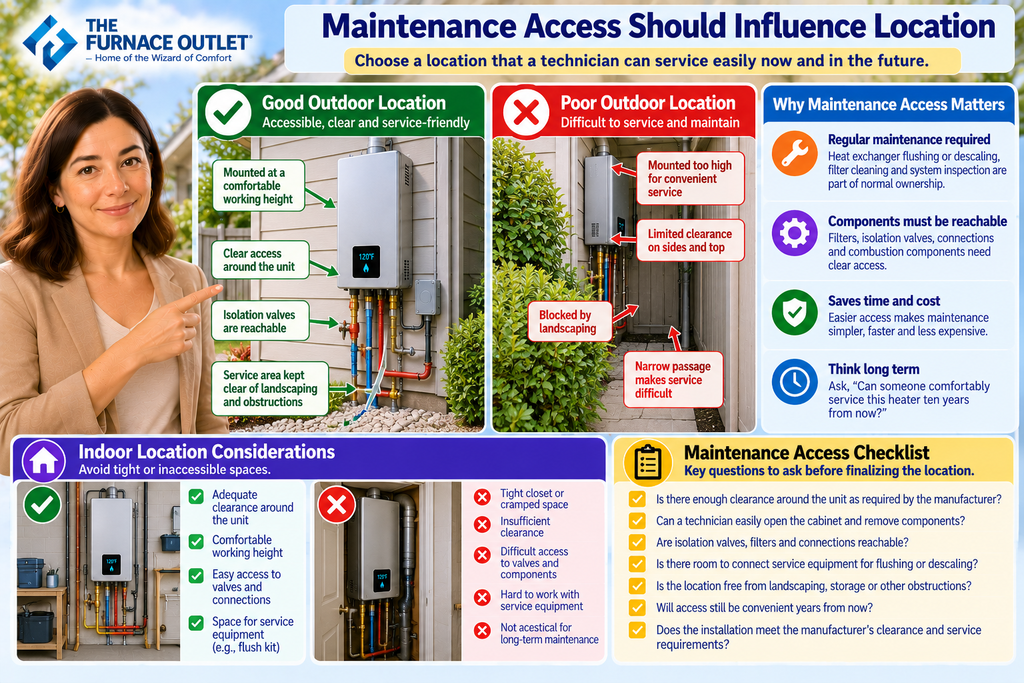
I always ask a simple question before approving a proposed installation location: Can someone comfortably service this heater ten years from now? Tankless heaters require inspection and maintenance. Depending on water quality and manufacturer recommendations, the heat exchanger may need periodic flushing or descaling. Filters need access, isolation valves need to be reachable, and combustion equipment may require inspection.
An outdoor heater mounted at a comfortable working height on an accessible wall can be very serviceable. A unit positioned high above the ground, behind landscaping or in an inaccessible side passage can be much less convenient.
Indoor installations have similar problems when equipment is squeezed into extremely tight closets or inaccessible attic spaces. Installation drawings should consider the technician who will eventually need to open the cabinet, remove components and connect service equipment—not merely whether the heater physically fits.
There is no universal answer because the building determines much of the cost. Outdoor installation can save money where indoor venting would otherwise be long, complicated or expensive. It can also avoid consuming finished interior space. In a mild climate with an appropriate exterior location close to the existing gas, water and electrical connections, outdoor installation can be very attractive.
Indoor installation can be more economical when an appropriate mechanical location and simple vent path already exist. It may also avoid costs associated with freeze protection, exterior pipe protection or long plumbing runs.
I would request complete installed quotes for the realistic alternatives. Those quotes should include the heater, venting, gas piping, electrical work, plumbing modifications, condensate management, freeze protection where applicable, permits and labor. Comparing appliance prices tells you surprisingly little about the final project cost.
Simply mounting the same class of heater indoors or outdoors does not create a meaningful universal efficiency winner. Equipment efficiency is primarily determined by the heater’s design and tested performance rather than whether it hangs on an interior or exterior wall.
Current ENERGY STAR criteria for certified residential gas-fired instantaneous water heaters require a UEF of at least 0.95 and at least 2.8 GPM over a 67°F temperature rise, along with specified warranty and safety requirements.
What location can influence is system-level performance. Long hot-water pipes lose heat and increase waiting time. Exposed exterior piping can experience additional heat loss. Poor condensate routing can cause problems, while an unnecessarily complicated vent system can increase installation cost. That is why I look beyond the UEF number.
I would generally lean toward an indoor installation in climates with significant freeze exposure, particularly where a suitable protected mechanical location and straightforward approved vent route already exist. Indoor installation can also be attractive when gas, water and electrical infrastructure is already concentrated in a utility room and relocating those services outdoors would add unnecessary cost.
A well-designed indoor direct-vent installation can provide a protected environment while separating combustion air from the home’s occupied space. The exact vent arrangement still needs to follow the manufacturer’s requirements. For cold-climate homes, the reduced exposure of both the appliance and connecting plumbing can be a major practical advantage.
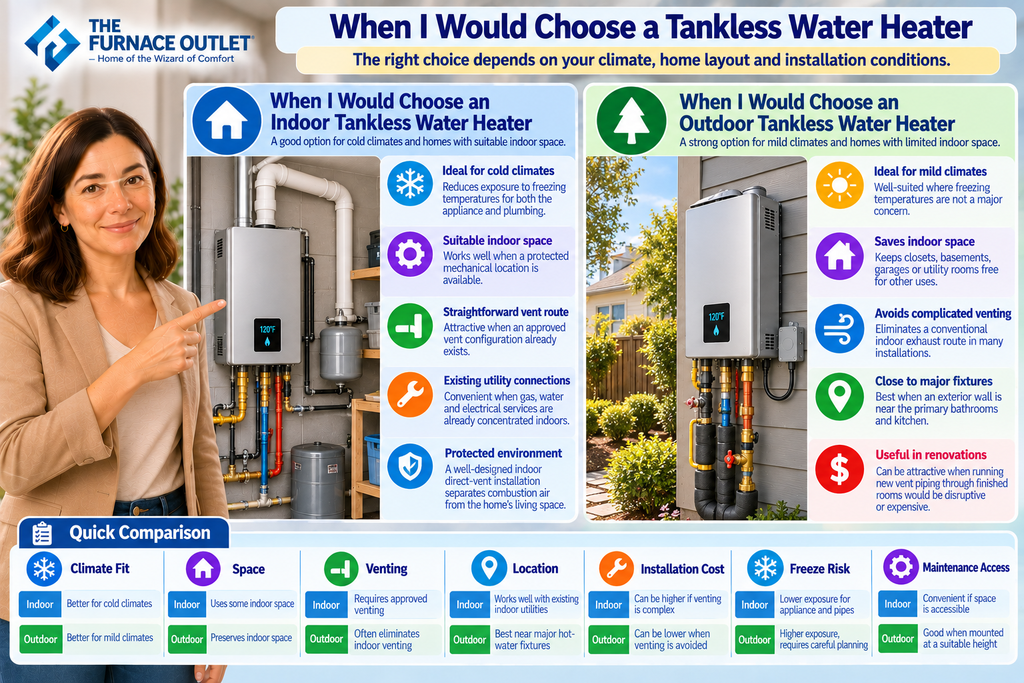
Outdoor installation becomes especially attractive in mild climates, homes with limited mechanical space and projects where indoor venting would be unusually difficult. I particularly like the concept when an appropriate exterior wall is close to major hot-water fixtures and existing utility connections. That combination can eliminate an extensive vent route without creating excessive hot-water distribution distance.
I would also consider outdoor equipment during renovations where running new vent piping through finished rooms would be disruptive or expensive. However, I would verify climate suitability first. Navien’s guidance specifically points toward outdoor installations in milder regions while warning against outdoor placement where freezing temperatures are a concern.
Before choosing the location, I would first confirm that the exact heater is approved for that installation type. I would then examine the coldest expected outdoor conditions, freeze-protection requirements, wind exposure and the vulnerability of external plumbing. For indoor equipment, I would evaluate the complete combustion-air and exhaust arrangement; for outdoor equipment, I would verify termination clearances and weather exposure.
Next, I would map the gas, water, electrical and condensate connections and measure the plumbing distance to the major hot-water fixtures. I would confirm that the heater can be comfortably accessed for flushing, inspection and future repairs. Finally, I would compare the complete installed cost for the realistic alternatives. That means looking beyond the heater itself and accounting for venting, piping, electrical work, freeze protection, drainage, permits, accessories and labor.
Only after those questions are answered would I decide whether indoors or outdoors is the better location.
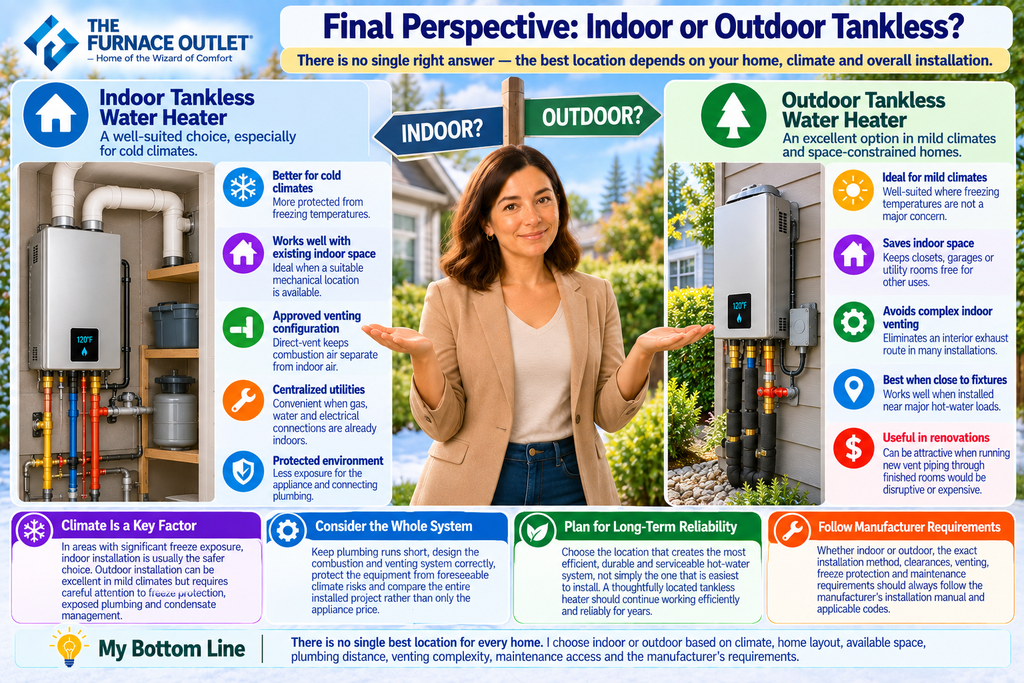
I like outdoor tankless installations because they can be remarkably elegant solutions in the right home. Moving the combustion appliance outside can free indoor space and eliminate a potentially complicated interior vent route. In a mild climate with a convenient exterior wall near the home’s major hot-water loads, that can make excellent practical sense.
In a cold climate, I would approach outdoor installation much more cautiously. Freeze protection depends on the exact model and installation conditions, exposed plumbing remains vulnerable, and active protection can depend on uninterrupted power. Condensate from high-efficiency equipment adds another component that needs to remain functional during cold weather. Manufacturer requirements should determine whether outdoor installation is appropriate rather than a general assumption that all modern tankless heaters can survive freezing conditions.
Indoor installation brings its own requirements, particularly combustion air, venting, condensate drainage and sufficient service access. But it provides a more protected environment and can therefore be the more sensible choice where winter conditions are severe.
From my sustainability perspective, I would not choose the location that simply makes the appliance easiest to install. I would choose the location that creates the most efficient, durable and serviceable overall hot-water system. Keep plumbing runs short, protect the equipment from foreseeable climate risks, design the combustion and venting system correctly, preserve maintenance access and compare the entire installed project rather than the box price. A thoughtfully located tankless heater should not merely work on installation day; it should continue working efficiently and reliably for years.
Outdoor gas tankless heaters generally do not require the conventional vent piping used to carry combustion gases from an indoor appliance through the building. However, they still discharge combustion gases and must be installed with manufacturer-required clearances from windows, doors, air intakes and other building features.
Yes. Outdoor equipment and particularly its exposed plumbing can be vulnerable to freezing. Some models incorporate active freeze protection, but operating limits and requirements vary substantially. Rinnai, for example, publishes specific temperature limits that depend on installation type, power, fuel availability and protection from direct wind.
Generally, an indoor location offers greater environmental protection, but an indoor heater can still freeze when installed in an unconditioned area or under certain power-loss, venting or backdraft conditions. The exact installation and manufacturer instructions remain important.
Do not assume an outdoor-rated appliance can simply be installed in a garage. For example, Navien states that its outdoor units are intended for outdoor installation and should not be installed in a garage. Always follow the installation classification and manual for the exact model.
It can be when outdoor placement eliminates a long or complicated indoor vent system, but the total project may still require additional exterior plumbing, gas piping, electrical work and freeze protection. Compare complete installed quotes rather than appliance prices.
I generally prefer evaluating an indoor installation first in areas experiencing substantial freezing weather. Some outdoor models can operate under freezing conditions when their manufacturer requirements are satisfied, but exposed plumbing, wind, outages and condensate drainage all require careful consideration.
All else being equal, shorter hot-water distribution distances are beneficial. DOE building-science guidance recommends locating hot-water sources and fixtures to minimize pipe length and stored water, helping reduce waiting time, water waste and distribution heat loss.
Not automatically. Delivery time depends largely on the volume of water sitting in the pipe between the heater and fixture. An outdoor unit located far from a bathroom may actually increase the wait unless the plumbing design or an appropriate recirculation strategy addresses that distance.
Outdoor location alone does not determine the appliance’s rated efficiency. Compare the UEF and performance specifications of the exact models. Current ENERGY STAR criteria for certified residential gas-fired instantaneous heaters require at least 0.95 UEF and at least 2.8 GPM over a 67°F temperature rise.
Only if the manufacturer explicitly approves the exact equipment and configuration. Indoor and outdoor models can differ in cabinet design, combustion arrangements, exhaust systems, weather protection and installation requirements. Never assume that removing the indoor vent turns an indoor appliance into an outdoor one.
The Furnace Outlet provides this guide for general educational purposes. Tankless water-heater installation requirements vary by manufacturer, model, fuel type, climate, jurisdiction and building conditions. Always follow the current installation manual for the exact appliance and applicable plumbing, fuel-gas, electrical, mechanical and building codes. Gas piping, combustion venting, electrical connections and other regulated work should be performed or evaluated by appropriately qualified professionals where required. Manufacturer freeze-protection features do not necessarily protect external plumbing or guarantee protection during power or fuel interruptions. The Furnace Outlet is an independent informational resource and is not a manufacturer, installer or representative of the brands or organizations referenced in this article.