Newsletter Subscribe
Enter your email address below and subscribe to our newsletter

HVAC made simple
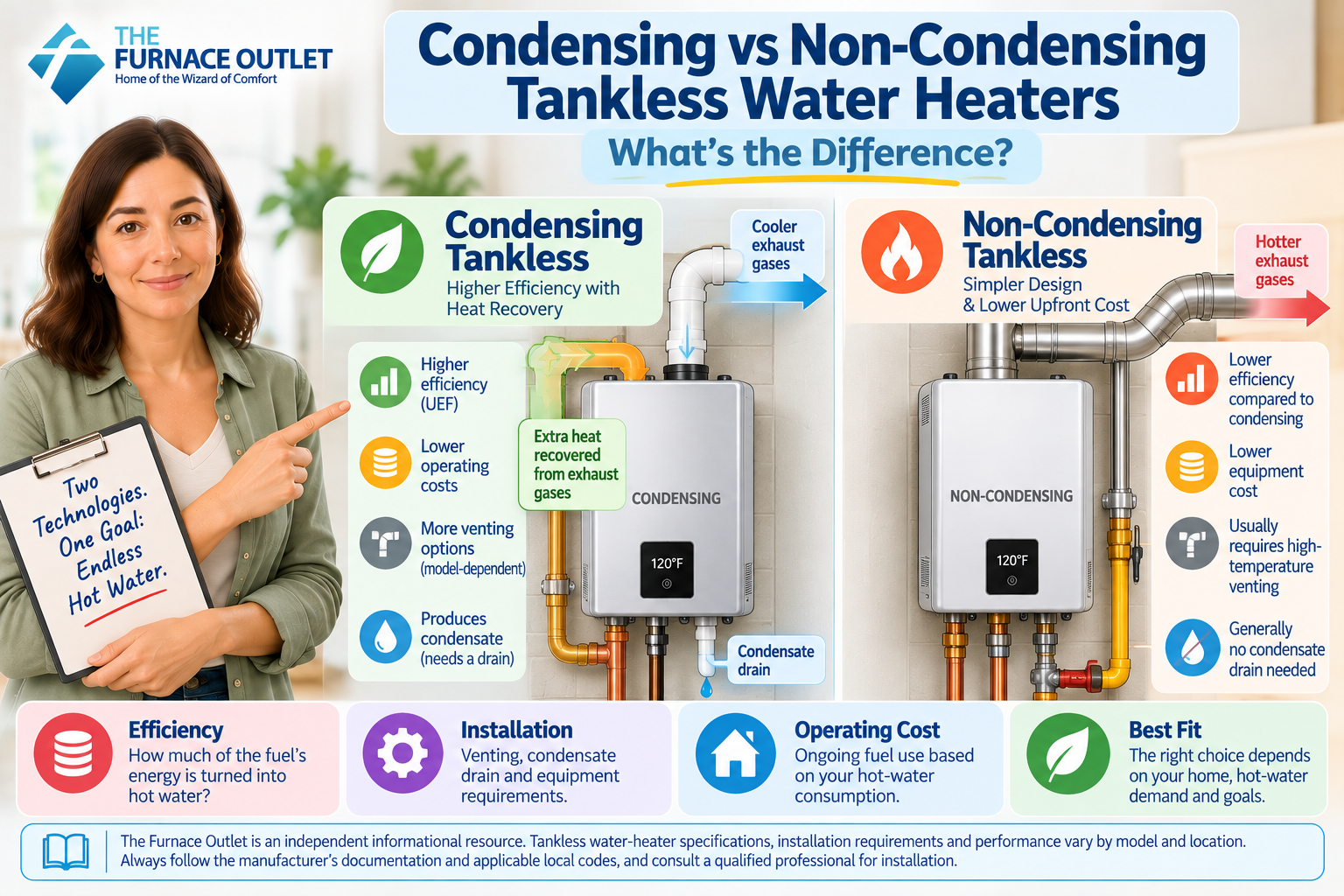
When homeowners compare gas tankless water heaters, one of the first technical choices they encounter is condensing versus non-condensing. Both technologies heat water on demand, both eliminate the need to keep a large storage tank hot around the clock, and both can provide continuous hot water when properly sized. The important difference is what happens to the heat produced by combustion after the burner has done its primary job.
I’m Savvy, The Furnace Outlet’s sustainability-focused HVAC enthusiast, and this is a comparison where I pay particular attention to energy that would otherwise be wasted. A conventional non-condensing tankless heater transfers heat from the burner into the water through a primary heat exchanger and then sends the remaining hot combustion gases outdoors. A condensing heater goes a step further by extracting additional useful heat from those exhaust gases before they leave the appliance.
That additional heat recovery can improve efficiency considerably, but it also changes the installation. Condensing equipment produces liquid condensate that must be drained appropriately, while its cooler exhaust can permit different venting options depending on the exact manufacturer and installation. Non-condensing equipment is mechanically simpler in this respect because it normally does not intentionally condense combustion moisture inside the heater, but its hotter exhaust typically requires venting designed for those higher temperatures. Navien
Understanding these differences makes it much easier to determine whether the higher efficiency of condensing technology is worth the additional equipment and installation considerations for your home.
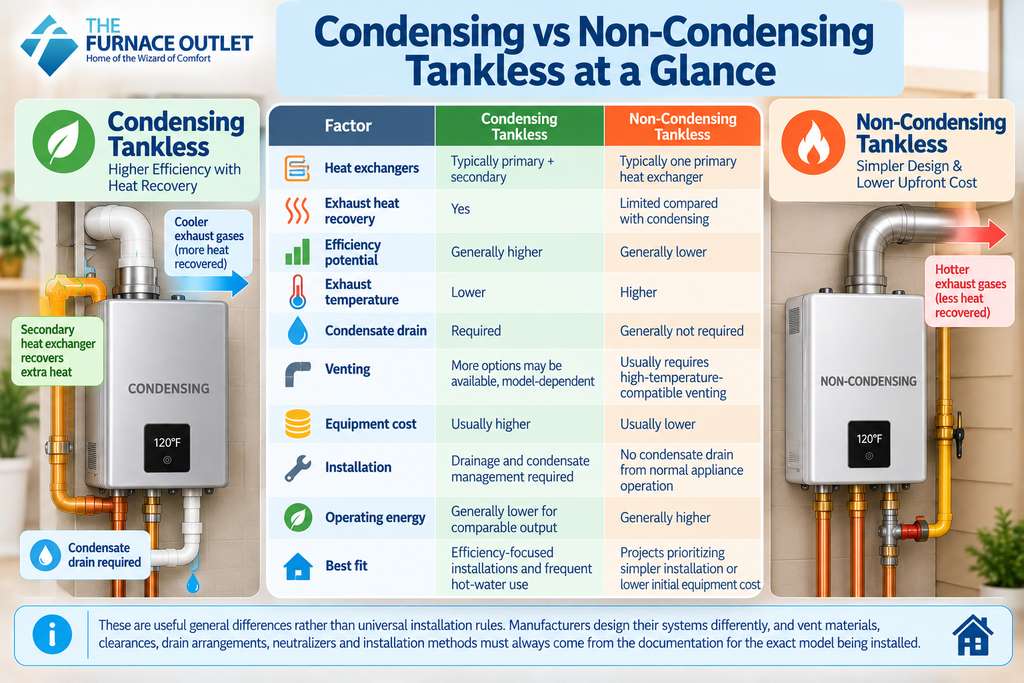
| Factor | Condensing Tankless | Non-Condensing Tankless |
|---|---|---|
| Heat exchangers | Typically primary + secondary | Typically one primary heat exchanger |
| Exhaust heat recovery | Yes | Limited compared with condensing |
| Efficiency potential | Generally higher | Generally lower |
| Exhaust temperature | Lower | Higher |
| Condensate drain | Required | Generally not required |
| Venting | More options may be available, model-dependent | Usually requires high-temperature-compatible venting |
| Equipment cost | Usually higher | Usually lower |
| Installation | Drainage and condensate management required | No condensate drain from normal appliance operation |
| Operating energy | Generally lower for comparable output | Generally higher |
| Best fit | Efficiency-focused installations and frequent hot-water use | Projects prioritizing simpler installation or lower initial equipment cost |
These are useful general differences rather than universal installation rules. Manufacturers design their systems differently, and vent materials, clearances, drain arrangements, neutralizers and installation methods must always come from the documentation for the exact model being installed.
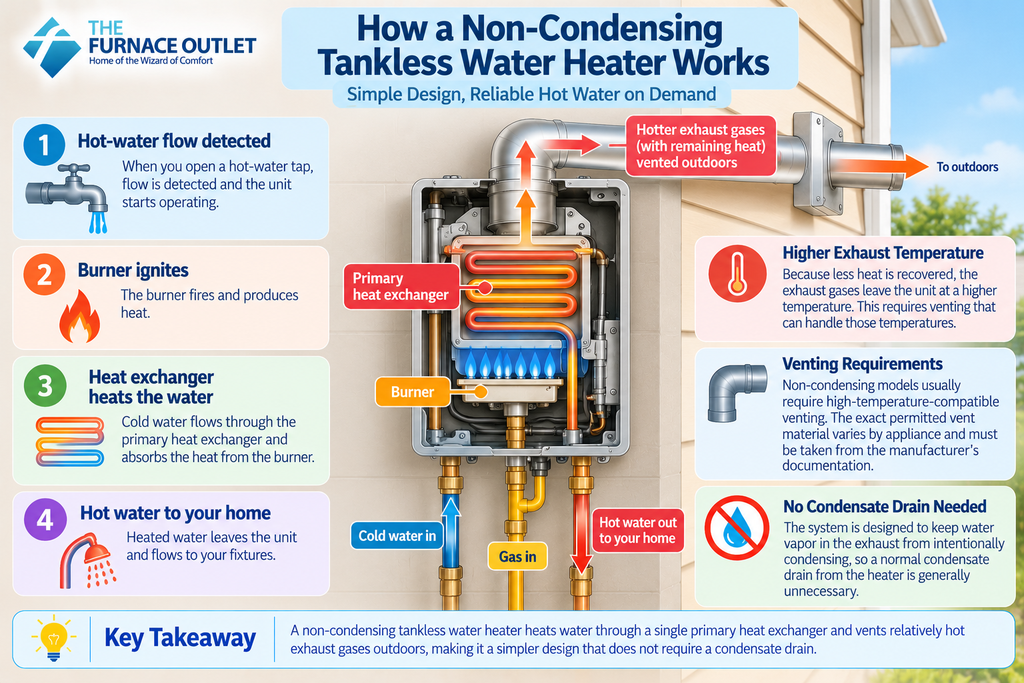
A non-condensing gas tankless water heater starts operating when it detects hot-water flow. The burner ignites and produces heat, which passes through a primary heat exchanger. Cold water traveling through the heat exchanger absorbs that energy before leaving the heater as hot water.
The process is straightforward, but not all of the combustion heat transfers into the water. The exhaust gases leaving the primary heat exchanger still contain useful thermal energy, and a non-condensing system generally vents those relatively hot gases outdoors instead of deliberately cooling them enough to recover their latent heat.
That higher exhaust temperature affects installation. Manufacturer guidance from Navien, for example, explains that its non-condensing models have hotter exhaust and use venting capable of tolerating those temperatures. The exact permitted vent material varies by appliance, so I would never generalize one manufacturer’s venting instructions to another brand or model. Navien
The advantage of this arrangement is relative simplicity. Because the heater is designed to keep water vapor in the exhaust from intentionally condensing inside the appliance, a normal condensate drain from the heater is generally unnecessary. That can make a non-condensing unit attractive where providing suitable drainage for a condensing heater would be difficult.
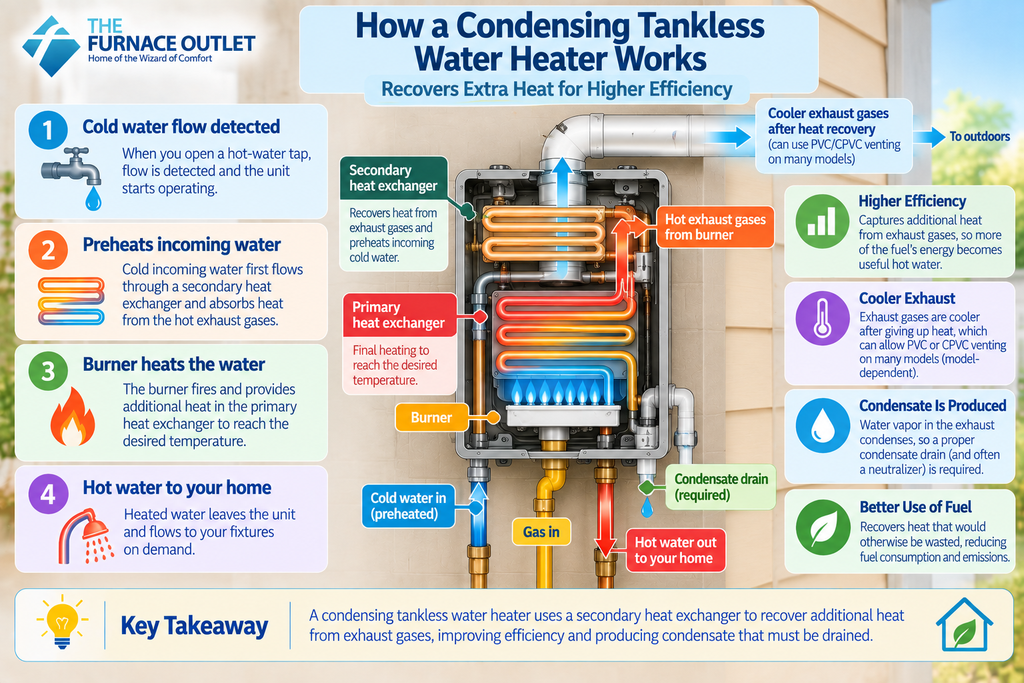
A condensing tankless heater begins in much the same way, but it does more with the combustion exhaust before sending it outdoors. After the primary heat-transfer process, the hot exhaust passes through an additional heat-recovery stage, commonly involving a secondary heat exchanger. Incoming cold water can absorb heat from those exhaust gases before reaching the primary heating stage. The burner therefore has less work to do to bring that water to the desired temperature, and more of the fuel’s energy ultimately becomes useful hot water instead of escaping through the vent.
Navien describes this arrangement as using a secondary heat exchanger to transfer additional exhaust heat to incoming water. As the exhaust cools sufficiently, water vapor formed during combustion condenses, which is the reason these systems are called condensing water heaters.
From my sustainability perspective, that principle is compelling. If I am already burning a fuel, I would generally prefer equipment that captures more of its usable heat rather than throwing that heat outdoors, provided the complete installation makes practical and economic sense.
The efficiency advantage comes largely from recovering energy that a non-condensing system allows to remain in the exhaust. Think of the combustion process as producing a fixed energy budget. Some energy becomes useful heat in the domestic water, while some can leave through the exhaust or be lost elsewhere. Recovering additional exhaust heat increases the proportion that performs useful work.
This difference appears in Uniform Energy Factor, or UEF, which is the current U.S. Department of Energy test-based metric used to characterize residential water-heater efficiency. ENERGY STAR explains that a higher UEF indicates greater overall water-heater efficiency within the applicable test conditions.
Current ENERGY STAR criteria for residential gas-fired instantaneous water heaters require UEF of at least 0.95, along with a maximum-flow requirement of at least 2.8 GPM over a 67°F temperature rise and specified warranty and safety criteria. ENERGY STAR
Individual condensing models can go higher. Rinnai, for example, currently publishes UEF ratings reaching as high as 0.98 for certain RXP condensing models. That is a manufacturer-specific example rather than a number that should be assumed for every condensing tankless heater. Rinnai
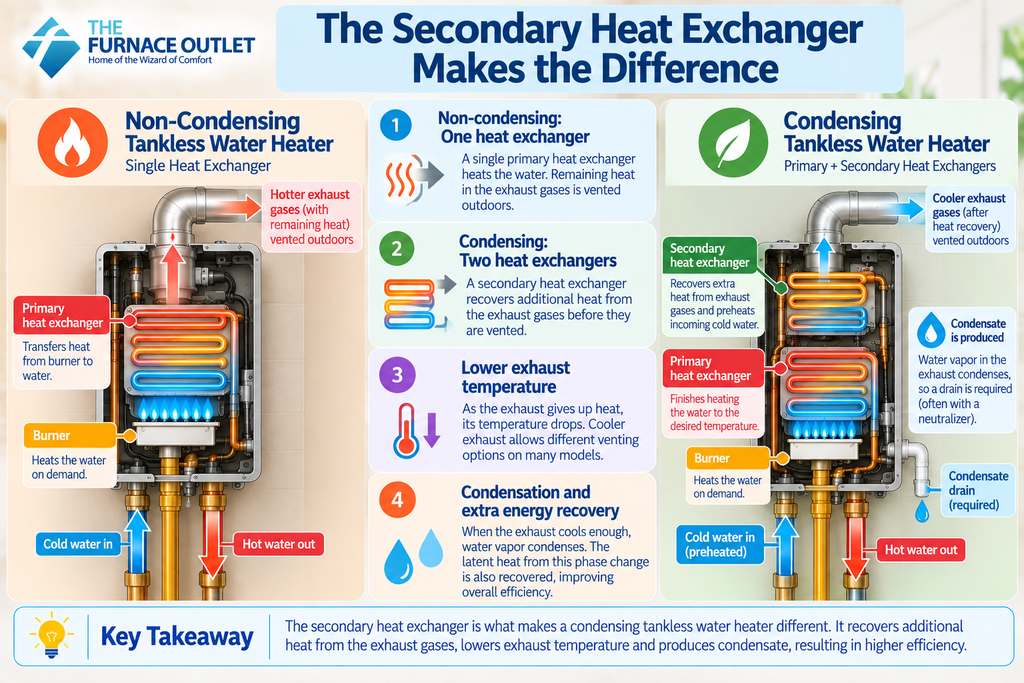
The secondary heat exchanger is one of the easiest ways to visualize the distinction between the two technologies. In a typical non-condensing design, the primary heat exchanger performs the principal water-heating job and the remaining hot combustion gases leave the appliance. In a condensing design, another heat-transfer stage extracts additional energy from those gases.
As the exhaust gives up heat, its temperature drops. Once conditions allow water vapor in the combustion products to condense, additional energy associated with that phase change can be recovered. This is why the difference is more significant than simply adding another component. Condensing technology changes how deeply the appliance extracts useful energy from the combustion process.
It also explains the two major installation consequences of condensing operation: cooler exhaust and liquid condensate.
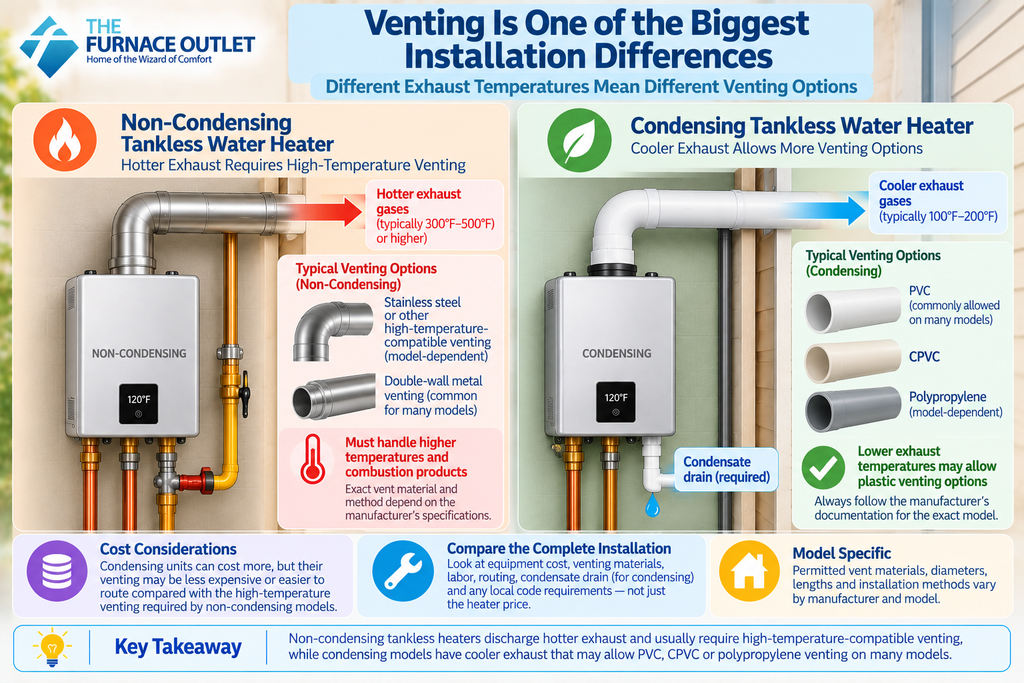
Venting can substantially affect the installed cost of a gas tankless water heater, especially during a conversion from another type of water heater. Non-condensing tankless heaters discharge hotter exhaust, so their vent systems must be compatible with those temperatures and the combustion products involved. Depending on the model, specialized metallic or other approved high-temperature venting may be required.
Condensing units extract substantially more heat before the exhaust leaves the appliance. Because exhaust temperatures are lower, manufacturers may permit vent materials such as PVC, CPVC or polypropylene in certain installations. Navien, for example, identifies plastic and polypropylene options for applicable condensing equipment, while Rinnai separately specifies the approved venting arrangements for its products.
This can create an interesting cost tradeoff. The condensing heater itself may cost more, but its permitted venting system can sometimes be less expensive or easier to route than the high-temperature venting required by a comparable non-condensing unit. I would therefore compare the complete vent installation, not just the appliance price.
Capturing additional exhaust heat creates one requirement that non-condensing shoppers do not usually have to address: condensate disposal. Natural gas and propane combustion produce water vapor. When a condensing heater cools the combustion gases sufficiently, some of that vapor becomes liquid water. The appliance needs a suitable route for that condensate to leave the system.
Condensate can also be acidic. Navien explains that carbon dioxide from combustion can dissolve into the condensed water and form carbonic acid; its guidance notes condensate in the approximate pH 3–5 range for its condensing tankless products. Depending on the appliance, local requirements and drainage materials, a condensate neutralizer may be appropriate or required.
This is one reason I would identify the drain location before selecting a condensing unit. If a convenient approved drain is nearby, condensate management may be straightforward. If the proposed heater location makes drainage difficult, installation cost and complexity can increase.
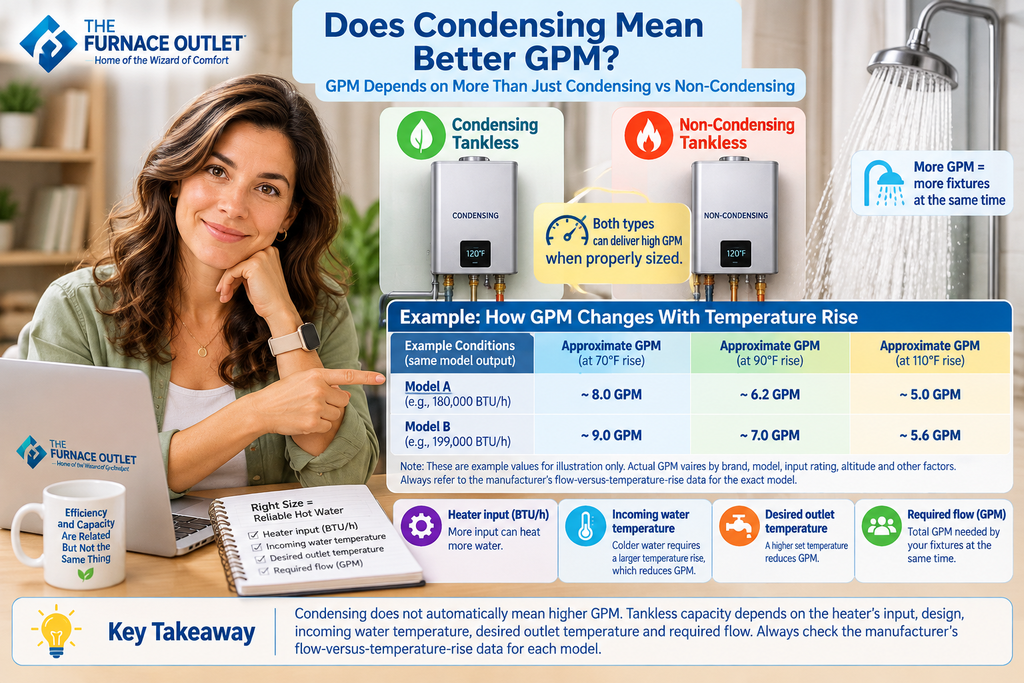
Condensing technology can help make more productive use of available fuel input, but I would not choose a water heater simply because the word “condensing” appears on its specification sheet. Tankless capacity still depends on the heater’s input, design, incoming-water temperature, desired outlet temperature and required flow. The familiar relationship between GPM and temperature rise remains just as important.
A household needing 7 GPM during a large winter temperature rise must select equipment capable of delivering that performance regardless of whether it is condensing or non-condensing.
When comparing two models, I would look at the manufacturer’s flow-versus-temperature-rise data rather than assuming the condensing model automatically has greater capacity. Efficiency and capacity are related aspects of equipment performance, but they are not the same specification.
Condensing tankless water heaters generally have a higher equipment price than comparable non-condensing models because their heat-recovery systems are more sophisticated. That does not necessarily mean the condensing installation will be proportionally more expensive. Venting, condensate drainage, existing infrastructure, labor and the difficulty of the installation can substantially alter the final project cost.
A non-condensing heater may have a lower purchase price but require a more expensive high-temperature venting arrangement. A condensing unit may cost more at the equipment level while benefiting from a simpler approved vent route, although it will require condensate management.
For this reason, I would ask contractors for complete installed prices for both alternatives rather than comparing online equipment prices.
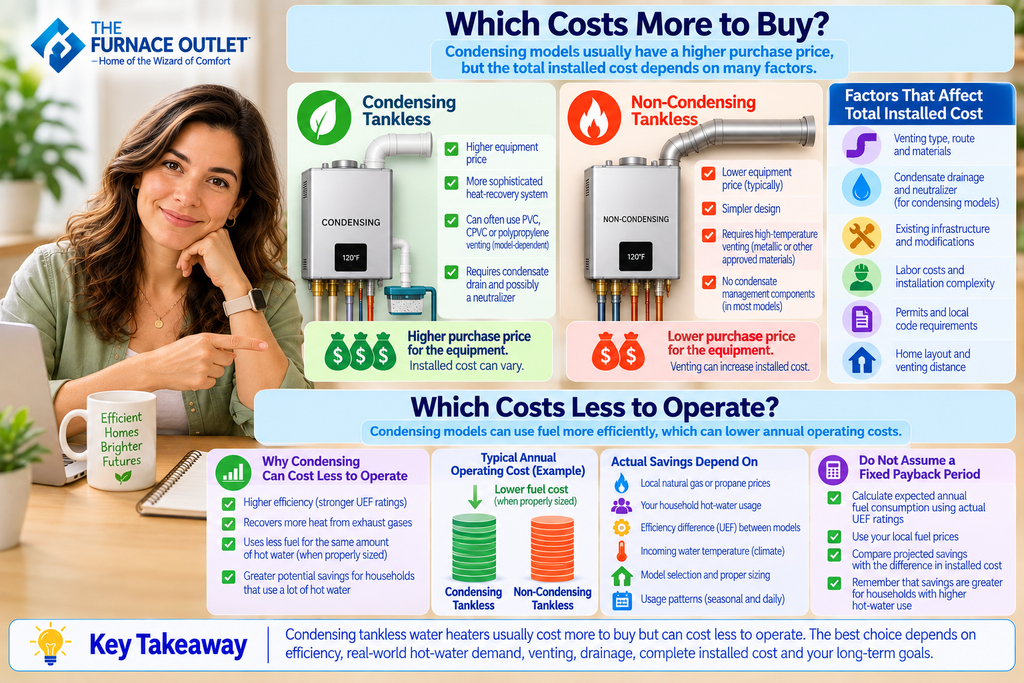
If two appropriately sized heaters provide the same amount of hot water and one extracts more useful energy from each unit of fuel, the more efficient heater should require less fuel for that equivalent useful output under comparable conditions.
That gives condensing technology an operating-cost advantage in principle. The actual dollar savings depend on hot-water consumption, local natural-gas or propane prices, efficiency difference, usage patterns and the specific models being compared. A household using large quantities of hot water has more opportunity to recover the higher purchase price through efficiency savings than a very low-use household.
I would therefore avoid promising a universal payback period. Calculate expected annual fuel consumption using the actual UEF ratings and local fuel costs, then compare that projected saving with the difference in installed cost.
Condensing tankless equipment is particularly attractive to me in high-use households because greater hot-water consumption gives efficiency improvements more opportunities to produce savings. A large family with multiple bathrooms may operate the water heater much more frequently than a one-person household. If the home also has cold winter groundwater and substantial simultaneous demand, a high-capacity condensing system can combine strong water-heating performance with high fuel utilization.
However, family size does not determine tankless capacity. I would still calculate simultaneous fixture flow and required temperature rise before selecting the equipment.
The correct sequence remains load first, technology second, model third.
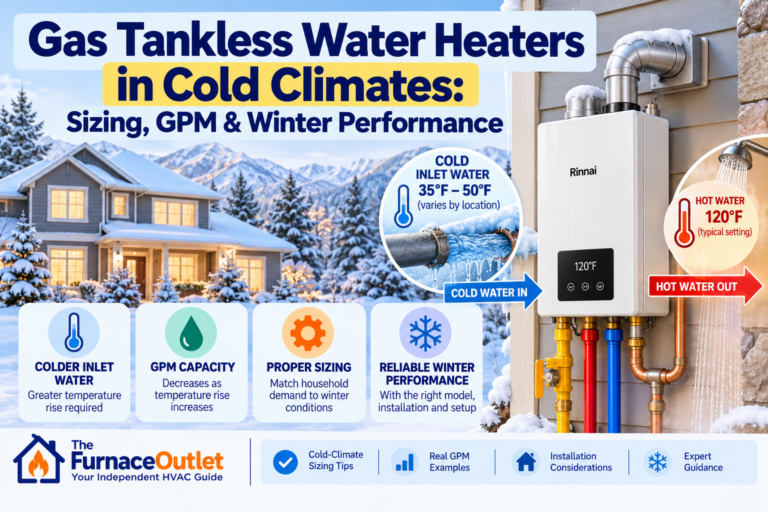
Cold climates can strengthen the case for high-efficiency condensing equipment, particularly in homes with substantial hot-water demand. Colder incoming water means a larger temperature rise is required to reach the target outlet temperature. That increases the amount of heating energy needed for each gallon of hot water.
Capturing additional combustion heat can therefore be valuable, although the heater still needs sufficient actual capacity to satisfy the load. Rinnai, for example, specifically positions its current condensing line as suitable for colder climates with lower groundwater temperatures. Freeze protection, vent termination, condensate routing and outdoor installation requirements also become especially important in cold environments, so climate affects more than efficiency alone.
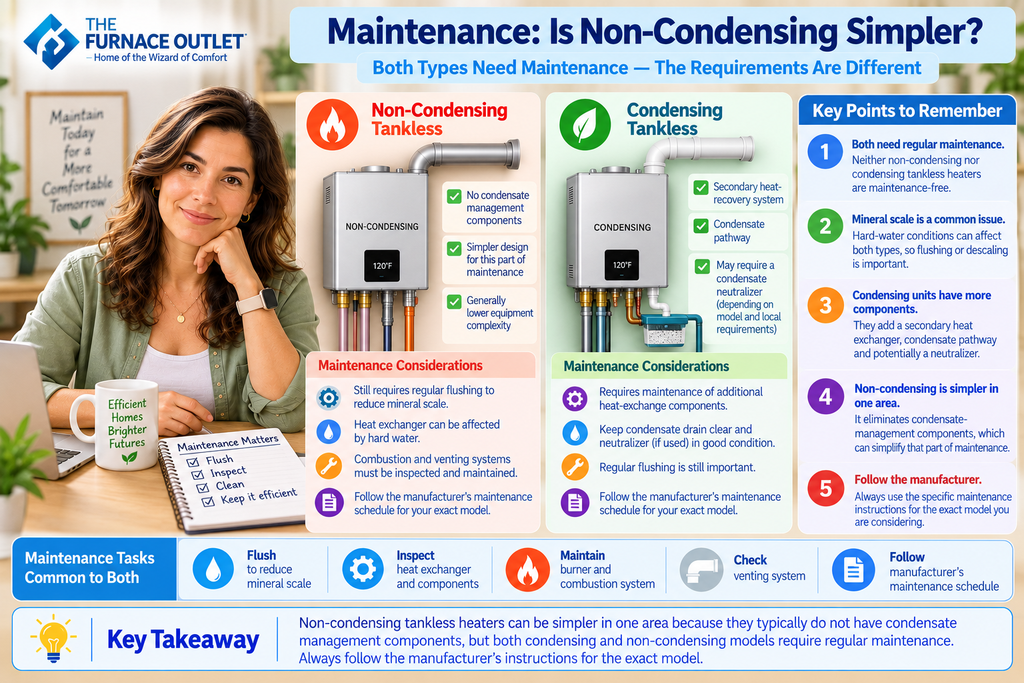
Non-condensing equipment can eliminate the condensate-management components associated with condensing operation, which can simplify one part of maintenance. Condensing equipment adds a secondary heat-recovery system, condensate pathway and potentially a condensate neutralizer.
That does not mean non-condensing tankless heaters are maintenance-free. Both technologies pass domestic water through heat exchangers and can be affected by mineral scale. Hard-water conditions can increase the importance of flushing, descaling or water treatment according to manufacturer recommendations. Gas-burning equipment also needs its combustion and venting systems maintained appropriately.
I would therefore compare maintenance instructions for the exact models rather than choosing based on a broad assumption that one technology requires no attention.
I would be cautious with claims that either condensing or non-condensing technology automatically lasts longer. Actual service life is influenced by water quality, installation quality, maintenance, operating intensity, freeze exposure, combustion conditions and parts availability. Heat-exchanger materials and manufacturer design also differ between product families.
From a sustainability perspective, I place considerable value on serviceability. A high-efficiency appliance is more attractive when replacement components are readily available and qualified technicians can repair it rather than replacing the entire heater because one component fails. Warranty terms and local service support therefore deserve a place alongside UEF when comparing products.
I would lean toward condensing technology when the household uses substantial amounts of hot water, long-term energy efficiency is important, and the installation can accommodate condensate drainage without unreasonable complexity. It is particularly appealing for a new installation where the venting and drainage can be planned from the beginning. I would also give condensing equipment serious consideration when replacing an older water heater in a high-use household, provided the total installed economics are sensible.
The current ENERGY STAR threshold is another reason high-efficiency shoppers will encounter condensing technology frequently. Certified residential gas-fired instantaneous models must currently achieve at least 0.95 UEF.
For me, the fundamental attraction remains simple: if fuel is being burned anyway, recovering more useful heat from that fuel is generally preferable.
Non-condensing tankless water heaters should not be dismissed as obsolete simply because condensing models can achieve higher efficiency. A non-condensing model can make sense where the initial budget is important, an appropriate high-temperature venting arrangement is straightforward, condensate drainage would be unusually difficult, or household hot-water consumption is low enough that the incremental efficiency savings would take a long time to recover the additional installed cost.
Installation location can be particularly influential. If an existing setup already provides an approved vent arrangement but creating a reliable condensate drain would require substantial work, the economic comparison can change. The right answer comes from the building rather than from a universal rule.
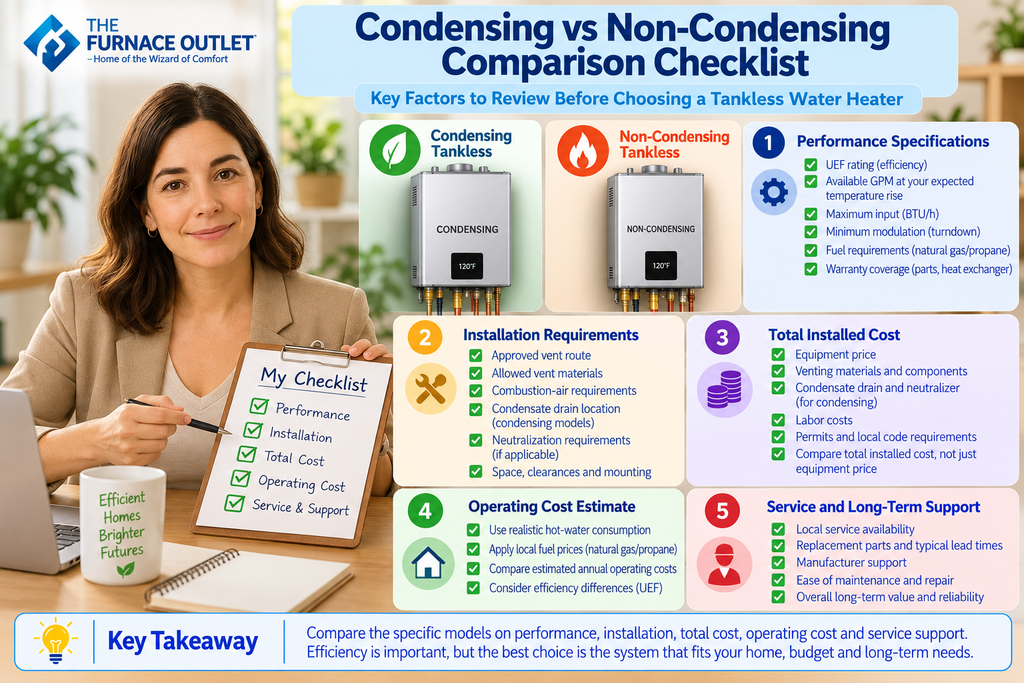
Before choosing between these technologies, I would compare the exact models’ UEF ratings, available GPM at the home’s expected temperature rise, maximum input, minimum modulation, fuel requirements and warranty coverage. I would then examine the physical installation, including the approved vent route, vent materials, combustion-air requirements, condensate drain location and any neutralization requirements.
Next, I would compare complete installed costs rather than equipment prices. After that, I would estimate annual operating costs using realistic hot-water consumption and local fuel prices.
Finally, I would investigate local service availability, replacement parts and manufacturer support. Saving a little fuel each year is valuable, but equipment that cannot be conveniently maintained or repaired may not deliver the long-term sustainability advantage expected from its efficiency rating.
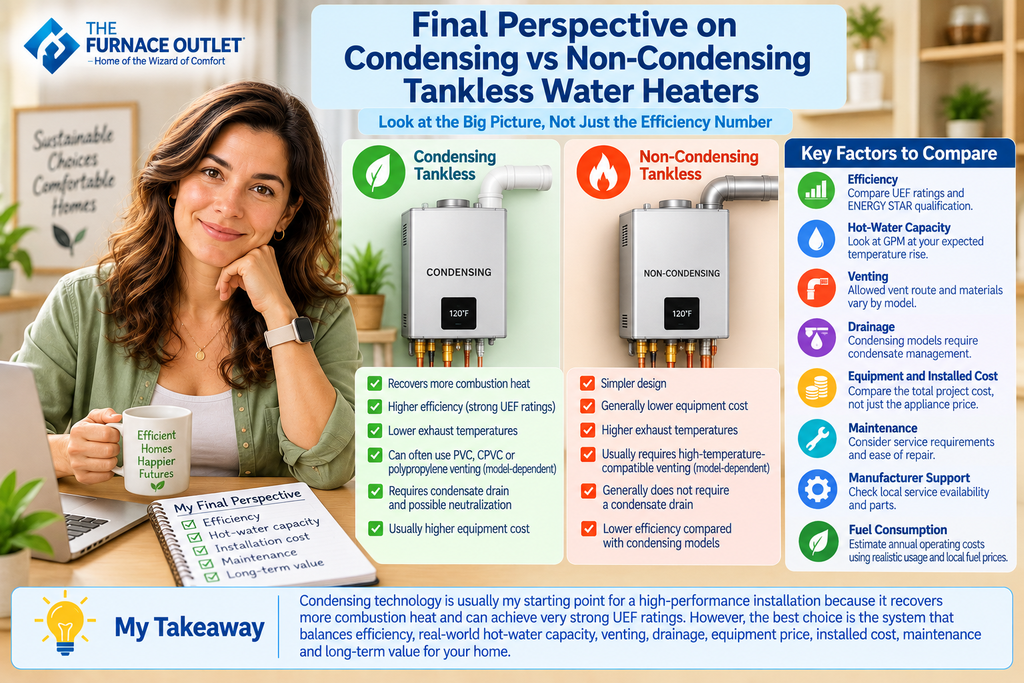
If I were designing a new high-performance gas tankless installation today, condensing technology would usually be my starting point because recovering additional combustion heat reduces wasted energy and modern high-efficiency models can achieve very strong UEF ratings. The current ENERGY STAR requirement of at least 0.95 UEF for residential gas-fired instantaneous heaters provides a useful efficiency benchmark when comparing qualifying products.
I would not make the decision from efficiency alone, however. Condensing equipment needs appropriate condensate management, while non-condensing equipment generally sends hotter exhaust through venting designed for those conditions. Those differences can substantially affect installation cost.
The best comparison therefore combines efficiency, real-world hot-water capacity, venting, drainage, equipment price, installed cost, maintenance and expected fuel consumption.
From my sustainability perspective, the goal is not simply to buy the heater with the highest efficiency number. It is to build a system that uses fuel responsibly, satisfies the home’s actual hot-water demand, can be maintained properly and makes economic sense over its useful life.
The principal difference is exhaust-heat recovery. Condensing heaters typically use an additional heat-exchange stage to capture more heat from combustion gases before exhausting them, while non-condensing heaters discharge hotter exhaust without intentionally recovering as much of that remaining heat.
Generally, yes. Recovering additional heat from the combustion exhaust allows condensing equipment to convert more fuel energy into useful water heating. Compare the UEF ratings of the exact models rather than assuming every condensing unit has identical efficiency.
Yes, condensing operation produces liquid condensate that needs an approved drainage arrangement. Depending on the equipment and installation requirements, condensate neutralization may also need to be considered.
Non-condensing heaters generally discharge hotter combustion gases because less heat has been extracted before the exhaust leaves the appliance. Venting therefore needs to tolerate the temperatures and combustion products specified by the manufacturer.
Some condensing models permit PVC or other plastic vent materials because their exhaust temperatures are lower, but this is not a universal permission. Only use vent materials, diameters, lengths and fittings specifically approved in the installation manual for the exact heater.
It can be, particularly in households with substantial hot-water consumption where higher efficiency has more opportunity to reduce fuel use. The correct comparison should include equipment price, venting, condensate drainage, installation labor, expected fuel savings and ownership period.
Not automatically. Tankless capacity depends on heating input, design, incoming-water temperature and required temperature rise. Compare each model’s published flow performance at the conditions expected in your home.
Rather than using the design label as a shortcut, check whether the specific model is ENERGY STAR certified. Current ENERGY STAR residential gas-fired instantaneous criteria require at least 0.95 UEF, at least 2.8 GPM over a 67°F rise, and specified warranty and safety requirements.
A high-efficiency condensing heater can be attractive for a high-use household, but it still must be correctly sized. Calculate simultaneous GPM and cold-season temperature rise first, then compare qualifying condensing and non-condensing models capable of satisfying that load.
Yes. Mineral scale can affect heat-transfer surfaces and water passages in both condensing and non-condensing tankless heaters. Follow the manufacturer’s water-quality and maintenance recommendations for the exact equipment.
For current efficiency definitions and certification requirements, I recommend the ENERGY STAR Water Heater Key Product Criteria, which provides the current UEF, flow, warranty and safety requirements for residential gas-fired instantaneous water heaters. ENERGY STAR also maintains a dedicated Whole-Home Tankless Gas Water Heater guide for consumers considering this technology.
For manufacturer-level technical explanations of the two designs, the Navien Condensing Tankless Guide and Navien Non-Condensing Tankless Guide provide useful explanations of heat exchangers, exhaust temperature, venting and condensate. The Rinnai Tankless 101 guide provides another manufacturer perspective and current examples of both condensing and non-condensing equipment.
The Furnace Outlet provides this article for general educational and informational purposes. Tankless water-heater efficiency, GPM, venting, condensate management, fuel supply, maintenance requirements and installation methods vary by model and location. Always verify current specifications using the manufacturer’s documentation for the exact equipment being considered. Gas piping, combustion venting, condensate disposal, plumbing, electrical work and permitting must comply with applicable codes and should be evaluated or performed by appropriately qualified professionals where required. The Furnace Outlet is an independent informational resource and is not a manufacturer, installer or representative of the brands or organizations referenced in this guide.