Newsletter Subscribe
Enter your email address below and subscribe to our newsletter

HVAC made simple
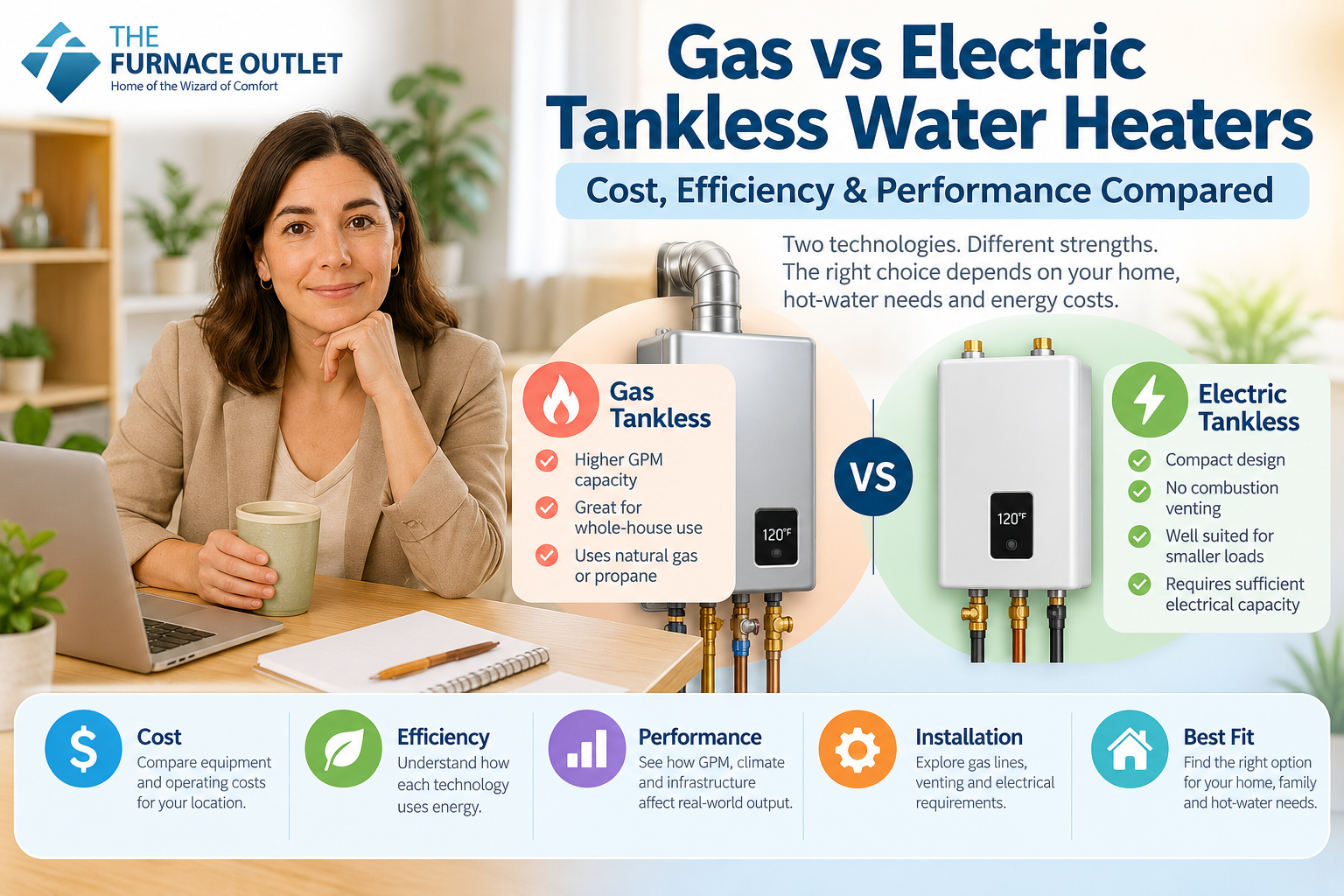
Once you decide that a tankless water heater could make sense for your home, the next major question is usually whether to choose gas or electric. At first glance, the decision can look simple. Gas tankless heaters generally offer greater whole-house heating capacity, while electric models are compact, avoid combustion venting and can be highly efficient at converting electricity into heat.
I’m Savvy, The Furnace Outlet’s sustainability-focused HVAC enthusiast, and I think the comparison deserves more depth than that. The best choice depends on how much hot water your household needs at the same time, how cold your incoming water becomes, whether natural gas or propane is already available, how much electrical capacity the home has, local energy prices and what installation changes are required.
There is also an environmental dimension. An electric tankless heater produces no combustion exhaust at the appliance, but its overall emissions depend partly on how the electricity is generated. A gas heater burns fuel directly at the home, while high-efficiency condensing models can capture a large proportion of that fuel’s useful heat. For me, the sensible comparison is therefore not simply gas versus electric. It is the complete installed system versus the complete installed system.
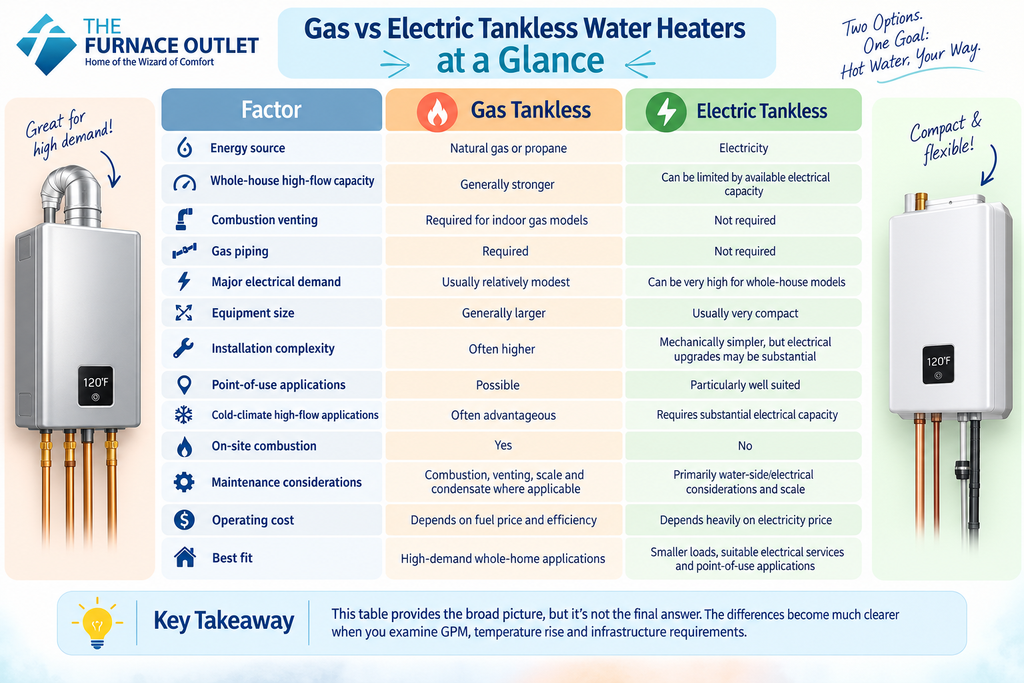
| Factor | Gas Tankless | Electric Tankless |
|---|---|---|
| Energy source | Natural gas or propane | Electricity |
| Whole-house high-flow capacity | Generally stronger | Can be limited by available electrical capacity |
| Combustion venting | Required for indoor gas models | Not required |
| Gas piping | Required | Not required |
| Major electrical demand | Usually relatively modest | Can be very high for whole-house models |
| Equipment size | Generally larger | Usually very compact |
| Installation complexity | Often higher | Mechanically simpler, but electrical upgrades may be substantial |
| Point-of-use applications | Possible | Particularly well suited |
| Cold-climate high-flow applications | Often advantageous | Requires substantial electrical capacity |
| On-site combustion | Yes | No |
| Maintenance considerations | Combustion, venting, scale and condensate where applicable | Primarily water-side/electrical considerations and scale |
| Operating cost | Depends on fuel price and efficiency | Depends heavily on electricity price |
| Best fit | High-demand whole-home applications | Smaller loads, suitable electrical services and point-of-use applications |
This table provides the broad picture, but I would never choose from it alone. The differences become much clearer once we examine GPM, temperature rise and infrastructure requirements.
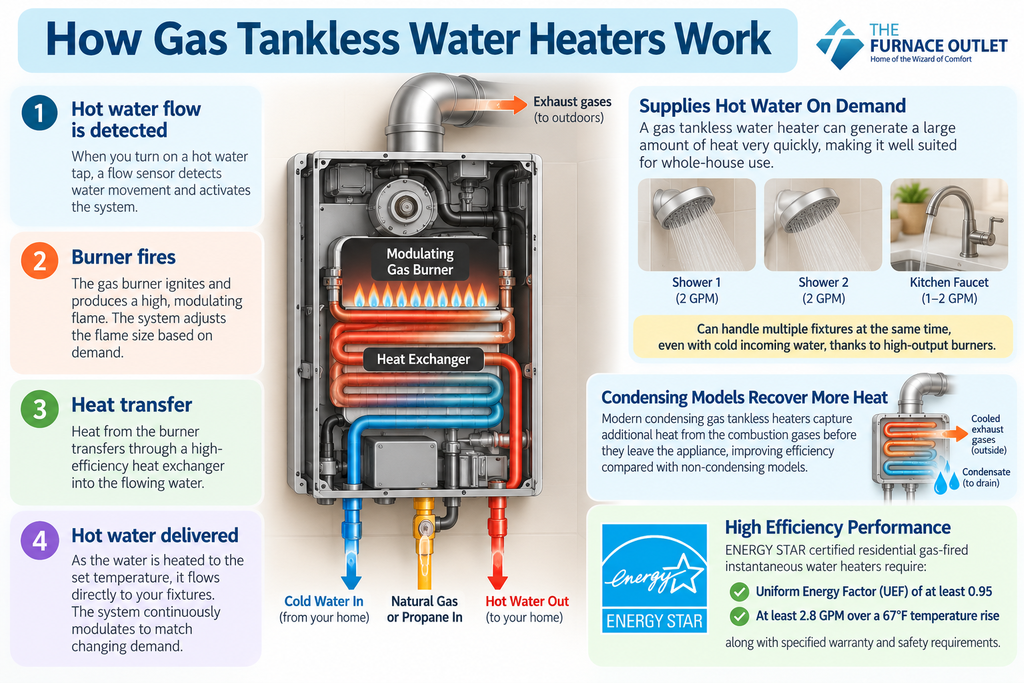
A gas tankless water heater uses natural gas or propane to create heat when hot-water flow is detected. The burner fires, heat transfers through a heat exchanger into the flowing water, and the system modulates its output as demand changes.
This ability to generate a large amount of heat very quickly is one of the biggest advantages of gas tankless equipment.
Imagine a household where two showers are operating simultaneously while another fixture needs hot water. If incoming water is cold, the heater may need to add a substantial amount of energy every minute. High-output gas burners can make this type of whole-house demand practical without requiring an enormous electrical load.
Modern condensing gas tankless heaters can also recover additional heat from combustion gases before those gases leave the appliance. ENERGY STAR’s current criteria for certified residential gas-fired instantaneous water heaters require a Uniform Energy Factor of at least 0.95 and at least 2.8 GPM over a 67°F temperature rise, along with specified warranty and safety requirements.
That makes modern condensing gas equipment very different from older assumptions about gas water-heater efficiency.
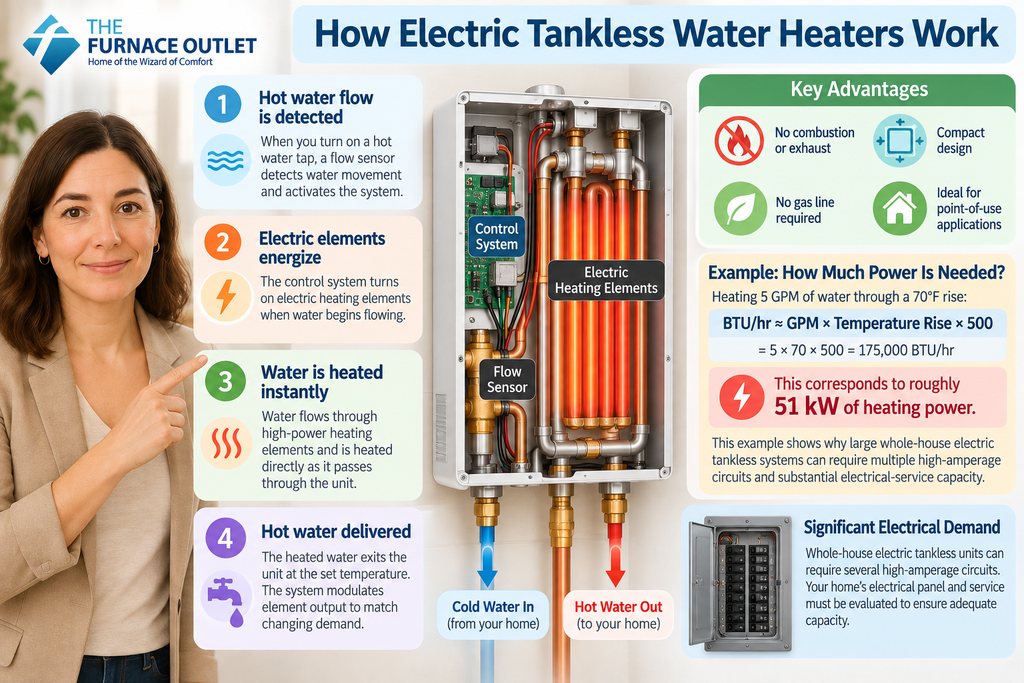
Electric tankless heaters use electric heating elements rather than combustion. When water begins flowing, the equipment energizes its heating elements and transfers heat directly into the water.
The design has several appealing characteristics. There is no burner, no combustion exhaust and therefore no combustion vent to route outdoors. Electric units can also be remarkably compact, which makes them attractive where mechanical-room space is limited. The challenge appears when we ask an electric heater to produce a large amount of hot water through a substantial temperature rise.
Heating 5 GPM of water through a 70°F rise requires roughly 175,000 BTU/hr of useful heat, based on the common approximation: BTU/hr ≈ GPM × Temperature Rise × 500
That corresponds to roughly 51 kW of heating power. This example demonstrates why large whole-house electric tankless systems can require multiple high-amperage circuits and substantial electrical-service capacity. Electric tankless is therefore not inherently a “small” electrical appliance simply because the physical box is small.
For demanding whole-house applications, gas generally has the advantage in maximum practical heating capacity.
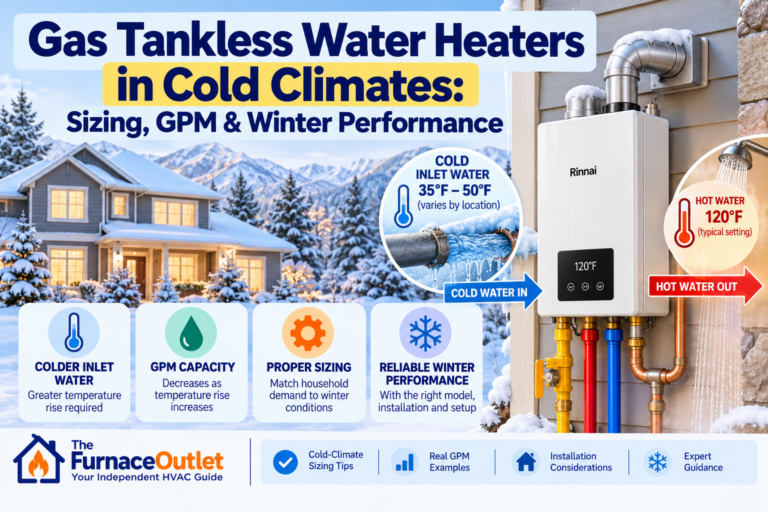
A high-output gas tankless heater can deliver substantial heat without placing an enormous load on the home’s electrical service. This becomes especially valuable in colder climates because low incoming-water temperatures create a larger temperature rise.
Suppose incoming water is 40°F and the desired heater outlet is 120°F. The heater must produce an 80°F rise. Maintaining a high GPM under those conditions requires considerable heating capacity.
An electric system can theoretically do the same job if it has sufficient power, but the required amperage can become the limiting factor.
For smaller homes, warmer climates or households with modest simultaneous demand, that gas capacity advantage may be much less important.
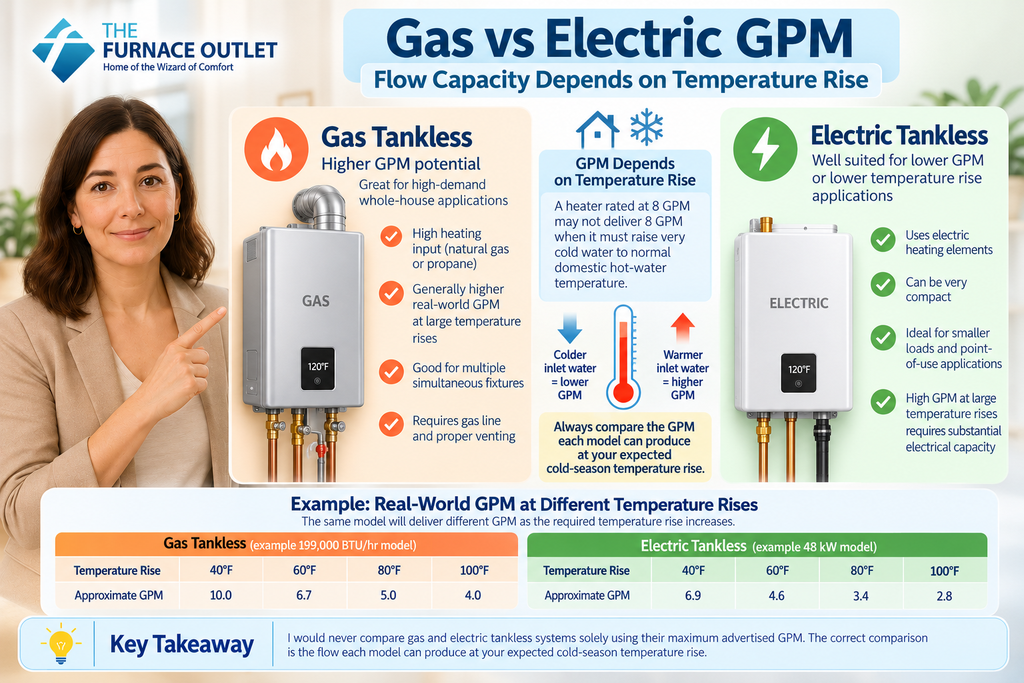
I would never compare gas and electric tankless systems solely using their maximum advertised GPM. As I explained in our tankless GPM guide, flow capacity depends heavily on temperature rise.
A heater advertised at 8 GPM may not provide anything close to 8 GPM when it must raise very cold water to normal domestic hot-water temperature.
The correct comparison is the flow each model can produce at your expected cold-season temperature rise.
This often favors gas for high-flow whole-house applications because of its greater available heating input. Electric can remain very competitive when the required flow or temperature rise is lower.
This question requires careful wording because appliance efficiency and total energy cost are not the same thing.
Electric resistance heating converts electricity into heat at the point of use very directly, and there are no combustion exhaust losses at the appliance. Gas heaters necessarily involve combustion, although modern condensing designs recover much more of the combustion energy than older non-condensing equipment.
For certified gas-fired instantaneous water heaters, ENERGY STAR currently requires UEF of at least 0.95.
However, it would be misleading to conclude that whichever appliance has the higher point-of-use conversion efficiency automatically has the lowest environmental impact or operating cost.
Electricity has to be generated and delivered to the home. The emissions associated with that electricity vary substantially depending on the generation mix. Natural gas, meanwhile, produces direct combustion emissions at the appliance and has upstream impacts associated with production and distribution.
From my sustainability perspective, the answer therefore depends partly on where you live and where your electricity comes from, in addition to equipment efficiency.
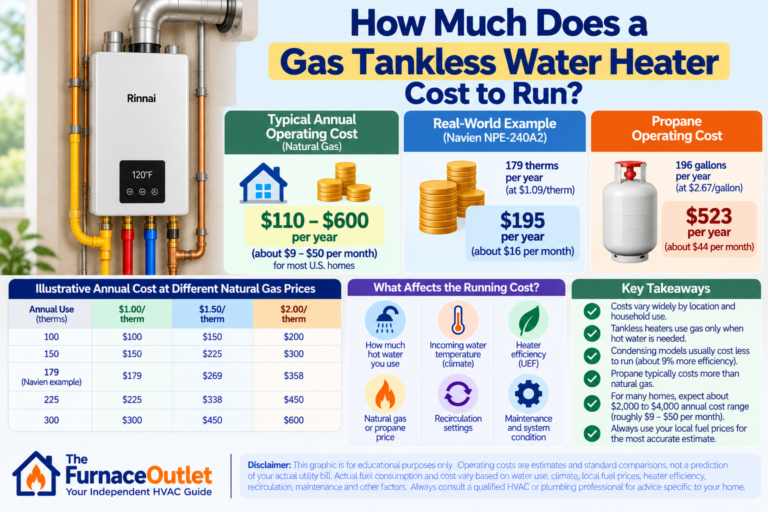
There is no nationally universal winner because electricity and gas prices vary considerably by location. The basic operating-cost comparison is straightforward. Estimate annual hot-water energy demand, account for the efficiency of the equipment, and multiply the required purchased energy by the applicable local utility rate.
A highly efficient electric tankless heater may still cost more to operate in a region where electricity is expensive and natural gas is relatively inexpensive. In another location, particularly one with favorable electricity pricing or substantial on-site solar generation, the economics may look very different.
This is why I would avoid claims such as “gas always costs less” or “electric always saves more.” Use actual utility rates and realistic household hot-water consumption.
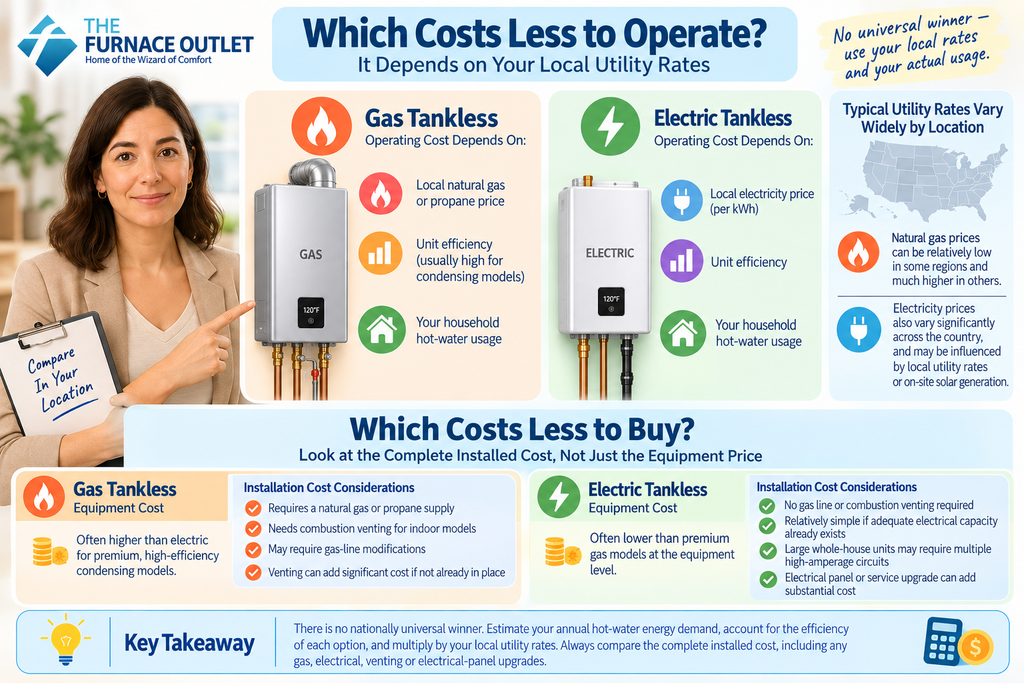
Electric tankless equipment is often less expensive at the equipment level than premium condensing gas tankless systems, but purchase price is only the first number I would compare.
Electric installation can appear straightforward because no combustion venting or gas line is needed. If the home already has adequate electrical capacity and suitable circuits can be installed easily, the total project can remain relatively simple. The picture changes dramatically if the electrical panel or service cannot support the heater. A large whole-house electric tankless unit may require multiple dedicated high-amperage circuits. Upgrading the electrical panel, service entrance or utility-side equipment can turn an inexpensive heater into an expensive project.
Gas has the opposite infrastructure issue. If an adequately sized gas supply and appropriate venting route already exist, installation may be relatively manageable. If the gas line needs substantial modification or a new venting system must be installed, project cost rises. The only comparison that matters is therefore complete installed cost.
One of the biggest mistakes in gas tankless planning is assuming that the existing storage water heater’s gas line can automatically serve the replacement tankless heater. Tankless heaters generate hot water in real time and can have high maximum firing rates. The fuel system must be able to supply that demand while other gas appliances are operating.
Gas pressure, pipe diameter, developed pipe length and the combined connected appliance load all need to be evaluated. I would have this checked before purchasing the equipment. Discovering after delivery that substantial gas-system modifications are required is an avoidable surprise.
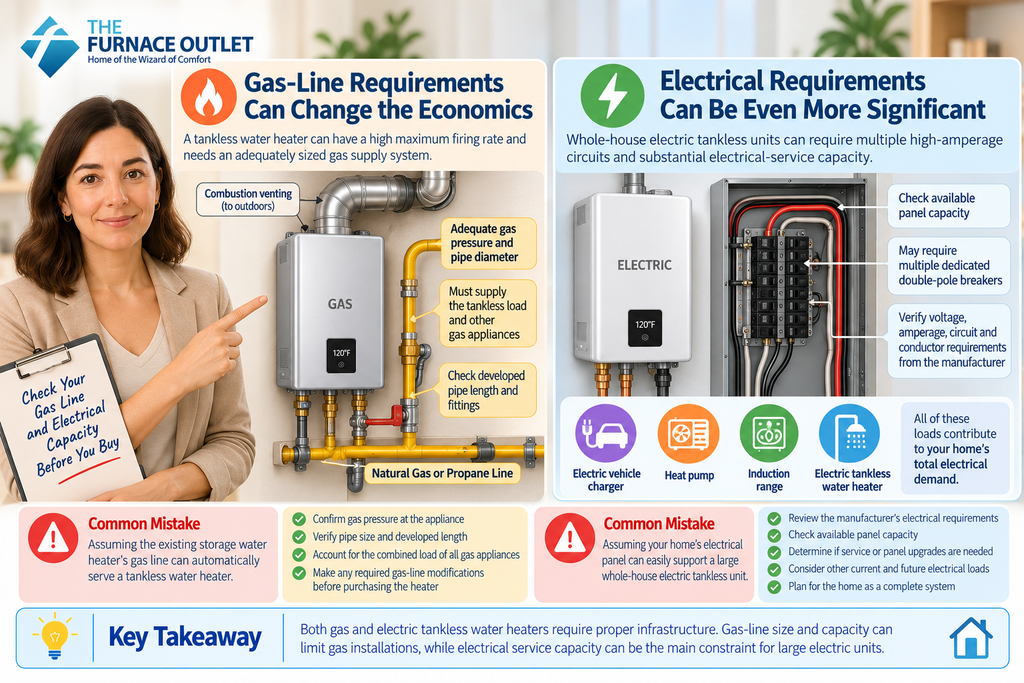
For whole-house electric tankless systems, electrical capacity should be one of the first things investigated. The exact heater documentation will specify voltage, amperage, circuit and conductor requirements. Large units can require several dedicated double-pole breakers and significant available panel capacity.
A home with a heavily loaded electrical service may therefore be a poor candidate for large electric tankless equipment without upgrades. This issue is becoming even more important as households electrify other loads. An electric vehicle charger, heat pump, induction range and electric tankless water heater can all contribute to peak electrical demand.
Good electrification planning looks at the building as a system rather than selecting each appliance independently.
Electric tankless heaters do not produce combustion gases, so they do not require combustion venting. That can simplify placement and reduce installation constraints. Gas tankless systems require venting arrangements appropriate to the exact appliance. Condensing and non-condensing models can have different venting requirements, and installation must follow manufacturer instructions and applicable codes.
Condensing equipment also produces condensate that needs to be managed correctly. I would not consider those requirements reasons to avoid gas. They are simply part of the total installation that needs to be priced and planned.
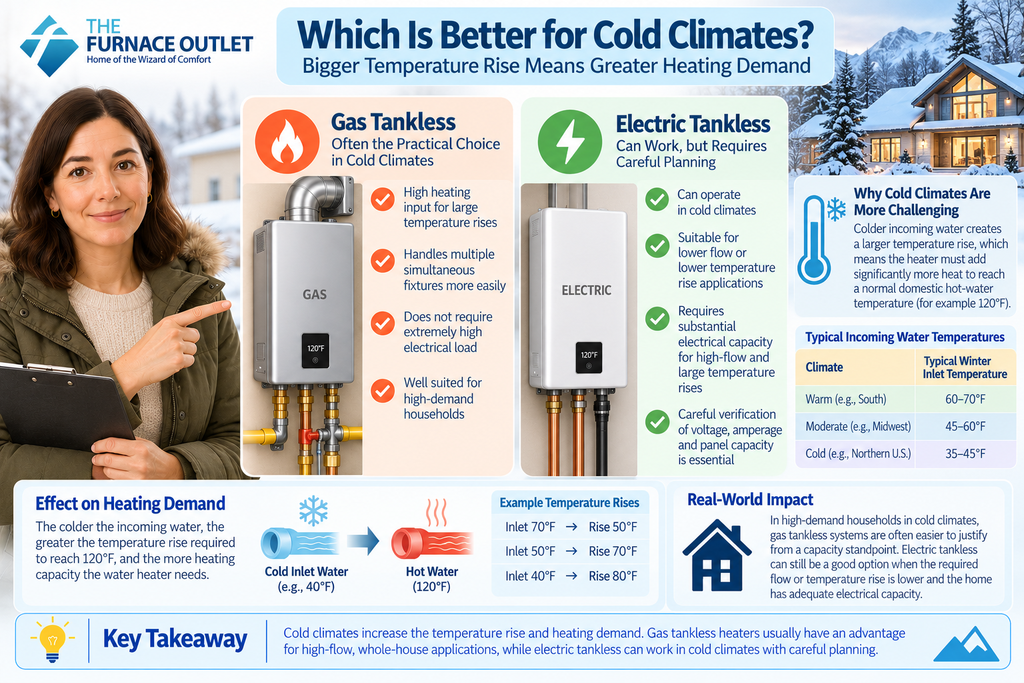
For high-demand households in cold climates, I generally find gas tankless equipment easier to justify from a capacity standpoint. Cold incoming water creates a larger temperature rise. If the home also needs multiple showers or fixtures simultaneously, heating demand can become substantial.
Gas can deliver high heating input without requiring the extraordinary electrical load that an equivalent large electric resistance system might impose. That does not mean electric tankless cannot operate in cold climates. It means the required flow, temperature rise and electrical capacity need especially careful verification.
Electric tankless becomes increasingly attractive as hot-water demand decreases. A small home, apartment, studio, cabin or low-demand residence may not need the enormous capacity associated with premium whole-house gas systems. Electric equipment can offer compact dimensions, no combustion venting and straightforward point-of-use installation where electrical capacity is suitable.
For one bathroom or carefully managed simultaneous demand, the economics can be compelling. This is where I think blanket gas-versus-electric recommendations fail. A technology that makes excellent sense for a 4,000-square-foot home with four bathrooms may be unnecessarily complicated for a compact one-bathroom residence.
For large households with frequent simultaneous hot-water use, I usually begin by evaluating high-output condensing gas tankless systems. The reason is capacity rather than brand preference. Two or three showers operating simultaneously can create substantial demand, particularly when winter inlet water is cold. Large electric systems may satisfy that load, but the electrical infrastructure required needs careful consideration.
Household size alone still should not determine equipment selection. Calculate simultaneous GPM and temperature rise first.
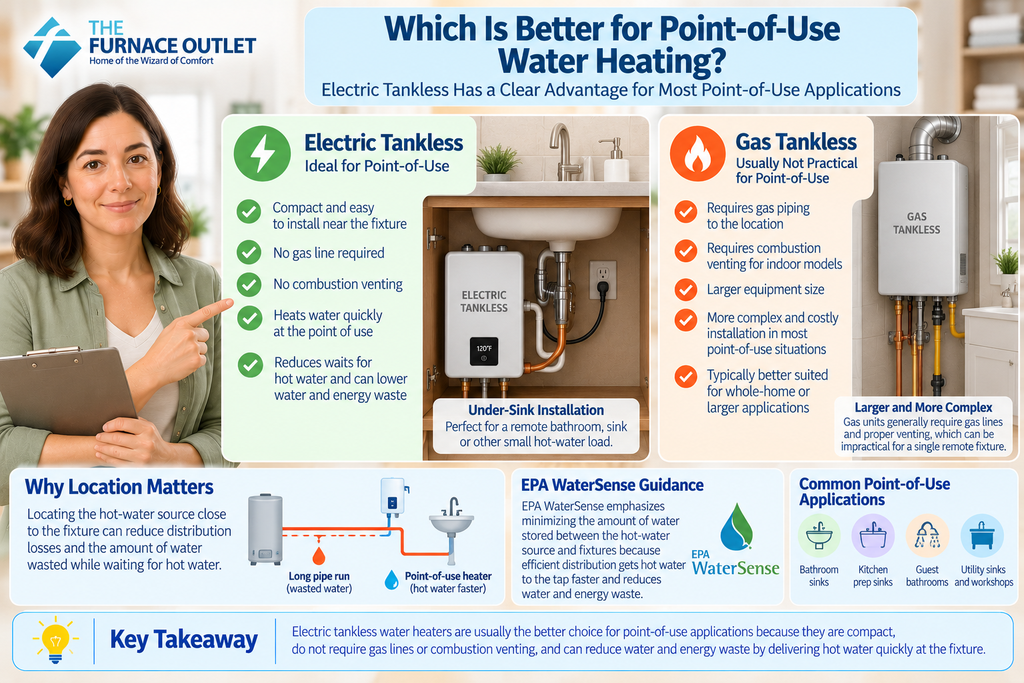
Electric tankless has a particularly strong advantage in point-of-use applications. A compact electric heater can be located near a remote sink, bathroom or other modest hot-water load without installing gas piping and combustion venting to that location.
Locating the hot-water source close to the fixture can also reduce distribution losses and water wasted while waiting for hot water. EPA WaterSense emphasizes minimizing the amount of water stored between the hot-water source and fixtures because efficient distribution gets hot water to the tap faster and reduces water and energy waste.
This is a good example of why the location of the heater can matter almost as much as its efficiency rating.
A tankless heater does not automatically provide instant hot water at every faucet. If a bathroom is far from the heater, the cooled water sitting in the pipe still has to leave before newly heated water arrives. A larger heater does not solve that problem.
EPA WaterSense recommends efficient distribution layouts and recognizes demand-initiated recirculation as an option where longer piping runs are unavoidable. EPA notes that efficient hot-water delivery can reduce water and energy waste, while unnecessarily maintaining hot recirculation can increase energy use. Whether you choose gas or electric, distribution design deserves attention.
Neither gas nor electric tankless water heaters are immune to mineral scale. Hard water can leave deposits on heat-transfer surfaces and restrict water passages over time. That can reduce performance and potentially shorten component life if maintenance is neglected.
Water quality, manufacturer instructions and household usage should determine the appropriate maintenance strategy. I would therefore compare not only equipment cost and efficiency but also service accessibility. A system designed with appropriate isolation valves and adequate working space can be much easier to maintain.
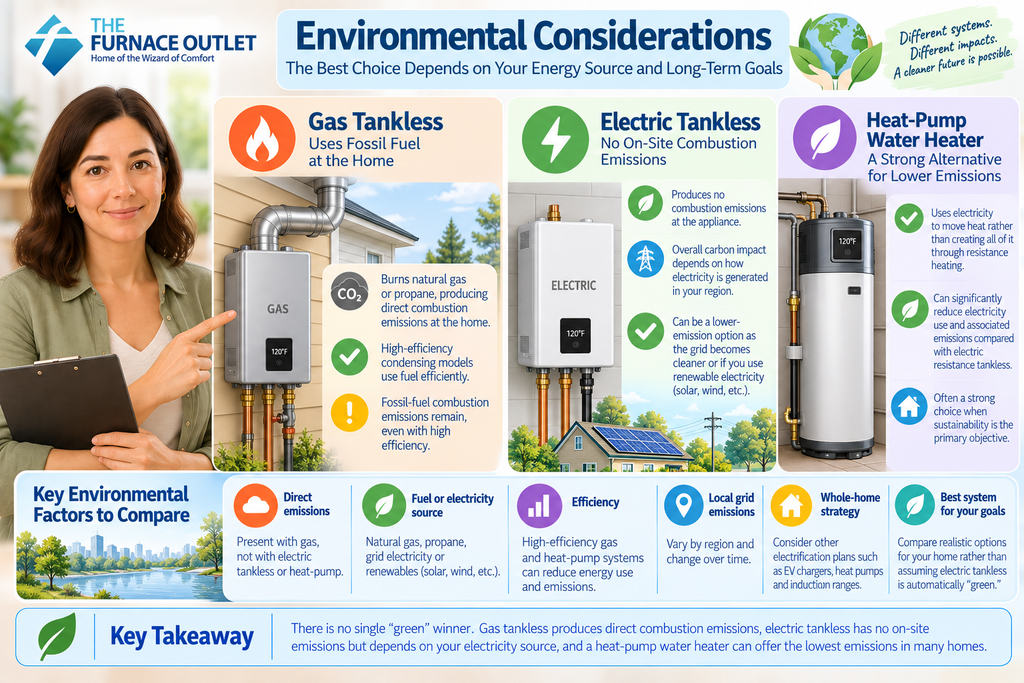
This is the part of the comparison I find most interesting because the answer changes as the energy system changes. Gas tankless water heaters burn fossil fuel at the home. High-efficiency condensing designs can use that fuel efficiently, but direct combustion emissions remain.
Electric tankless heaters produce no combustion emissions at the appliance. Their broader carbon impact depends on electricity generation, which can vary substantially between regions and over time. Homes with renewable electricity or a progressively cleaner grid may therefore find electrification increasingly attractive.
However, I would also compare electric tankless with heat-pump water heating when sustainability is the primary objective. Tankless electric resistance heating and heat-pump water heating use electricity in fundamentally different ways, and a heat-pump water heater can move heat rather than creating all of it through electric resistance.
The best environmental decision is therefore not automatically “choose electric tankless.” It is to compare the realistic alternatives available for that particular home.
I would start with the home’s required GPM and cold-season temperature rise, because those numbers establish the heating capacity we actually need. Next, I would identify existing infrastructure: natural gas or propane availability, gas-line capacity, electrical-service size, available panel capacity and feasible venting locations.
Then I would obtain complete installed prices rather than equipment-only prices. Those quotes should account for gas piping, venting, condensate management, electrical circuits, service upgrades, plumbing changes, permits and any required recirculation work.
Finally, I would compare expected operating cost using current local energy prices and consider maintenance, parts availability, service support and expected ownership period. That process usually makes the correct direction much clearer.
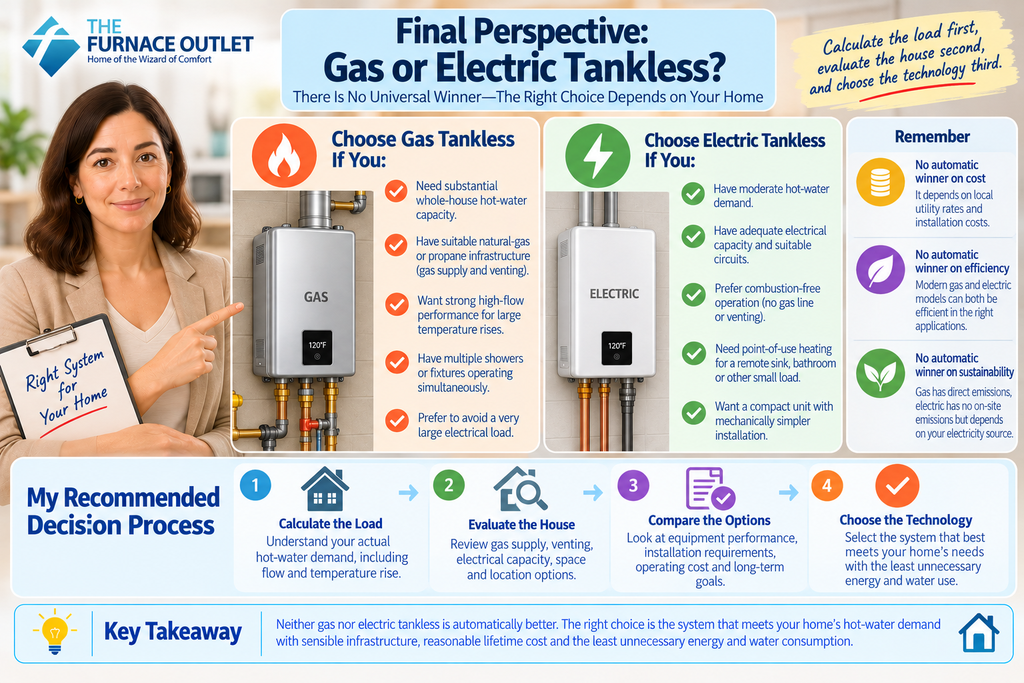
I would choose gas tankless primarily where substantial whole-house hot-water capacity is required, particularly when the home already has suitable natural-gas or propane infrastructure. High-efficiency condensing gas models can deliver impressive flow through large temperature rises without imposing an enormous electrical load.
I would choose electric tankless where demand is moderate, electrical capacity is suitable, combustion-free operation is desirable or point-of-use heating makes sense. Electric equipment can be compact and mechanically straightforward, but whole-house installations need careful electrical planning.
Neither technology wins automatically on cost, efficiency or sustainability. The better system is the one that meets the home’s actual hot-water demand with sensible infrastructure, reasonable lifetime cost and the least unnecessary energy and water consumption. That is why I always come back to the same principle: calculate the load first, evaluate the house second, and choose the technology third.
It depends on local electricity and gas prices, household hot-water consumption and equipment efficiency. Gas can have a cost advantage where natural gas is inexpensive, while electric economics can improve where electricity rates are favorable. Compare actual local utility prices rather than relying on a national rule.
Electric resistance tankless heaters avoid combustion losses at the appliance, but point-of-use conversion efficiency does not by itself determine operating cost or total environmental impact. Modern condensing gas tankless equipment can also achieve high UEF ratings; current ENERGY STAR gas-fired instantaneous criteria require UEF of at least 0.95.
High-output gas tankless systems are often easier to match to large simultaneous whole-house loads, especially where incoming water is cold. The final decision should be based on calculated GPM and temperature rise rather than family size alone.
Not necessarily a special panel, but large whole-house units can require substantial amperage and multiple dedicated circuits. The existing electrical service and panel capacity should be evaluated against the exact manufacturer’s requirements before purchasing.
Most modern gas tankless water heaters use electricity for controls, ignition and other components even though gas provides the primary heating energy. Requirements vary by model and should be verified from the installation documentation.
Indoor gas-fired tankless water heaters require an approved combustion venting arrangement appropriate to the exact model. Condensing systems also require appropriate condensate management. Electric tankless heaters do not require combustion venting.
It can be advantageous because there is no on-site fuel combustion, particularly where electricity comes increasingly from low-carbon sources. However, overall environmental impact depends on electricity generation, equipment requirements and household use. Heat-pump water heaters should also be considered when reducing electricity consumption is a major priority.
Service life depends heavily on installation quality, water chemistry, maintenance, usage and component availability. I would not choose between gas and electric solely from generalized lifespan claims. Manufacturer warranty terms and local service support provide more useful purchasing information.
For general information about water-heating technologies and energy use, consult U.S. Department of Energy Energy Saver. For current certified water-heater efficiency requirements and gas-fired instantaneous criteria, use ENERGY STAR Water Heaters and the ENERGY STAR Water Heater Key Product Criteria.
For efficient hot-water distribution and demand-initiated recirculation guidance, consult EPA WaterSense Hot Water Guidance. For independently certified equipment-performance information, the AHRI Directory of Certified Product Performance is another useful research resource.
The Furnace Outlet provides this article for general educational and informational purposes. Cost examples, heating-load calculations and comparisons are planning guidance and should not replace manufacturer specifications, code requirements, utility information or a professional site evaluation. Actual performance and operating cost depend on incoming-water temperature, flow rate, fuel and electricity prices, equipment efficiency, water chemistry, installation conditions and household usage. Gas piping, combustion venting, electrical service, plumbing, condensate disposal and permitting should comply with applicable requirements and be evaluated or performed by appropriately qualified professionals where required. Always verify specifications and installation requirements for the exact equipment being considered. The Furnace Outlet is an independent informational resource and is not a manufacturer, installer or representative of the brands or organizations referenced