Newsletter Subscribe
Enter your email address below and subscribe to our newsletter

HVAC made simple

By Jake Lawson — Jake the HVAC Specialist
When homeowners compare DIY mini splits with conventional ductless systems, the conversation often focuses on the equipment itself: efficiency ratings, heating performance, indoor-unit style, smart controls and price. From an installation standpoint, however, one of the biggest differences can be hidden inside something that looks relatively simple—the refrigerant line set connecting the indoor unit to the outdoor condenser.
A conventional mini-split line set and a purpose-built quick-connect line set perform the same basic job: they provide the refrigerant path between the indoor and outdoor equipment. The important difference is how that refrigerant circuit is assembled and prepared for operation. Conventional systems generally rely on field-prepared connections followed by manufacturer-specified testing and evacuation procedures. Certain purpose-built DIY systems instead use factory-prepared, sealed or pre-charged line assemblies with proprietary connectors designed to eliminate conventional field evacuation for approved configurations.
That distinction affects the tools you need, the installation skills involved, routing flexibility, what you can modify, and when professional HVAC help becomes appropriate. If you’re deciding between the two, don’t think of quick-connect as simply an easier version of ordinary copper tubing. It is a different installation approach with its own advantages and limitations.
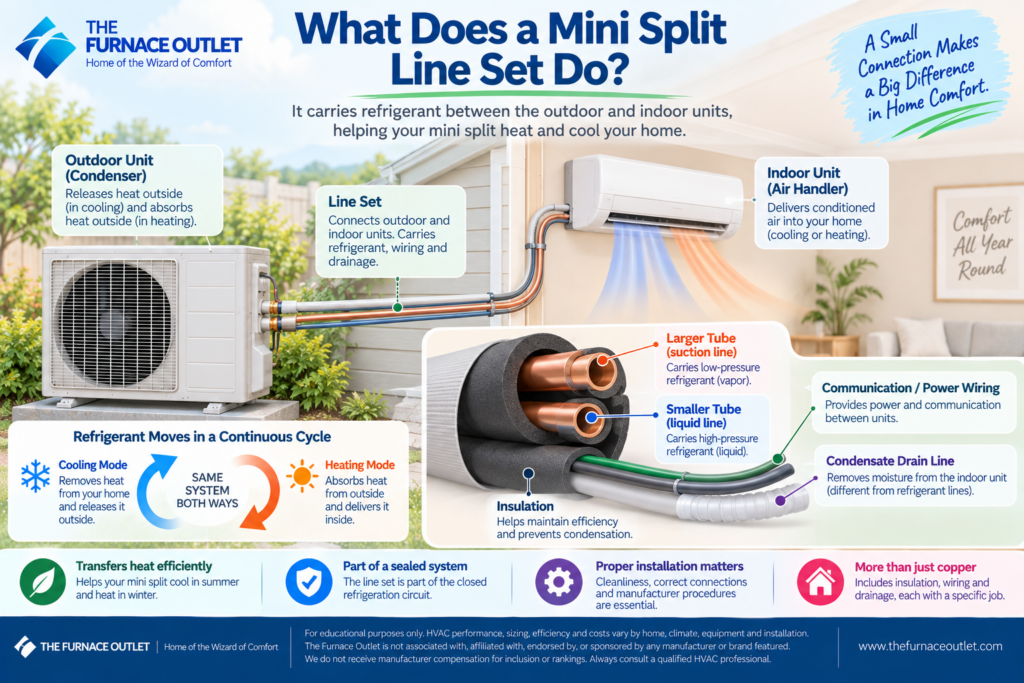
A mini split generally has an outdoor condenser and one or more indoor air handlers. Refrigerant moves between those components through copper tubing, allowing the system to transfer heat. In cooling mode, that heat-transfer process removes heat from the conditioned space and rejects it outdoors. With a heat-pump mini split, the refrigeration cycle can reverse so the equipment can provide heating as well.
A typical line set contains two refrigerant tubes of different diameters. The exact dimensions depend on the equipment, and the tubing is insulated as specified by the manufacturer. Alongside the refrigerant piping, an installation may also include communication or power wiring and condensate drainage, but those components have different jobs and should not be confused with the refrigerant lines.
The critical point is that the line set becomes part of the sealed refrigeration circuit. Once you understand that, the difference between conventional and quick-connect installations becomes much easier to appreciate. Connecting refrigerant piping isn’t equivalent to connecting a garden hose. Cleanliness, moisture control, connection integrity, tubing dimensions, refrigerant charge and the manufacturer’s commissioning procedure all matter.
With a conventional mini split, the outdoor condenser commonly arrives from the factory containing refrigerant for an approved piping configuration. The copper tubing installed between the outdoor and indoor equipment, however, generally begins as ordinary field-installed tubing rather than a sealed, pre-charged assembly specifically prepared for homeowner connection.
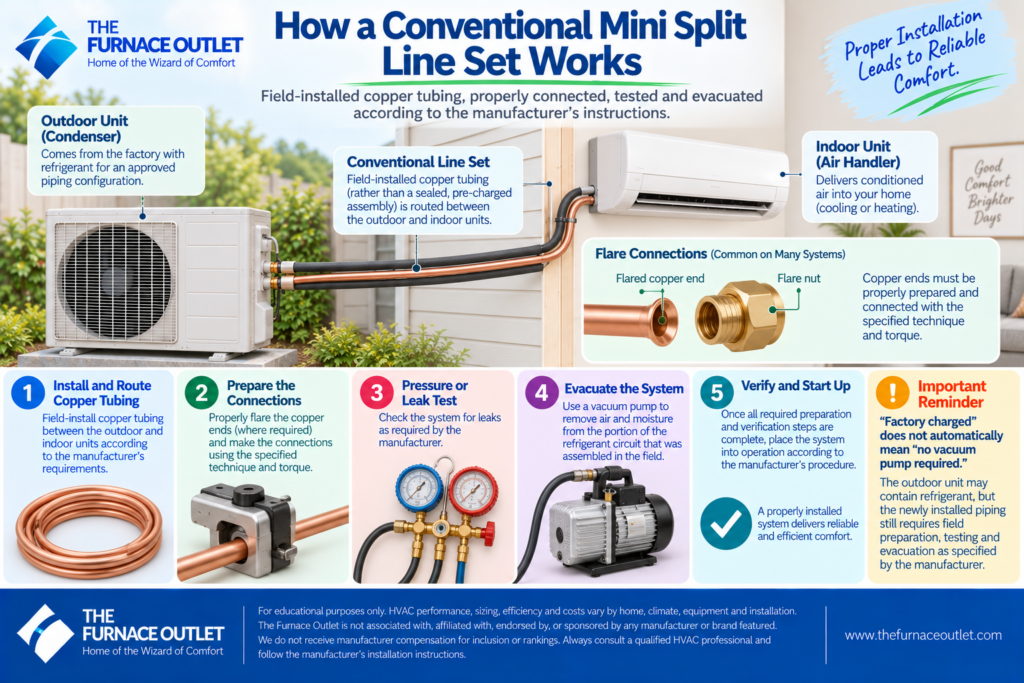
That tubing must be routed and connected according to the equipment manufacturer’s requirements. Many ductless systems use flare connections, which means the copper ends must be properly prepared and connected with the specified technique and torque. The completed refrigerant circuit is then checked and prepared according to the manufacturer’s installation and commissioning instructions.
This typically includes leak or pressure testing and evacuation. Evacuation removes unwanted air and moisture from the portion of the refrigerant circuit that was assembled in the field. Only after the required preparation and verification are complete should the system be placed into operation according to the manufacturer’s procedure.
This is why the phrase “factory charged” does not automatically mean “no vacuum pump required.” The outdoor unit may contain refrigerant while the newly installed piping still requires field preparation and evacuation.
Ordinary atmospheric air contains moisture, and neither belongs inside a properly prepared refrigeration circuit. When conventional copper tubing is installed in the field, that tubing has been exposed to the atmosphere. Simply connecting it to a factory-charged condenser doesn’t remove what is inside.
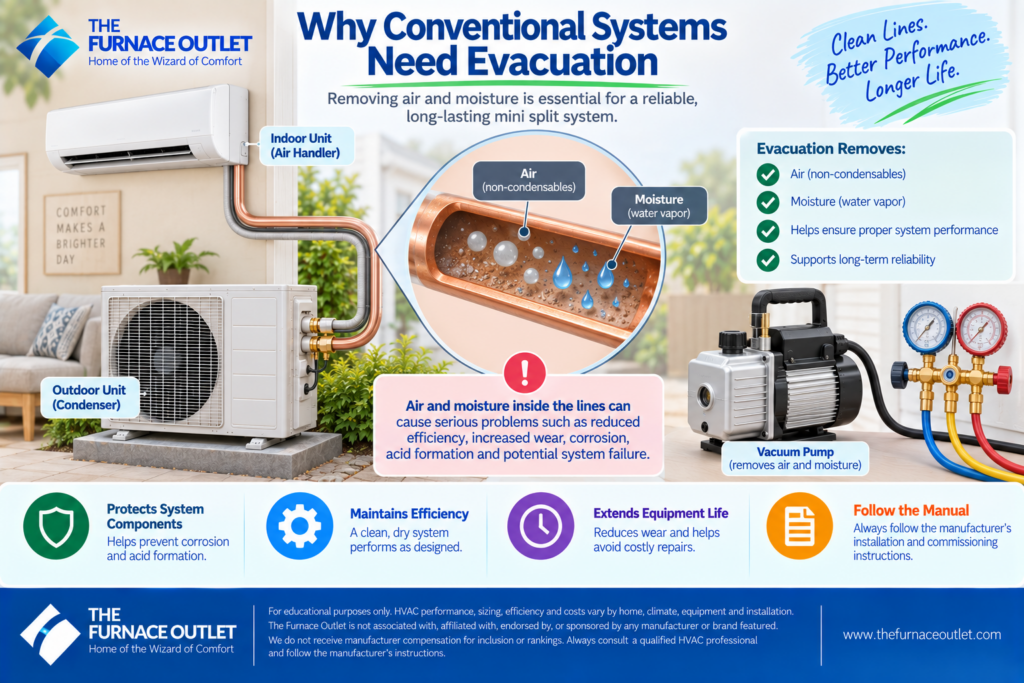
Evacuation is therefore not an optional ritual performed because HVAC technicians like using vacuum pumps. It is part of preparing the refrigerant circuit for operation when the equipment manufacturer specifies it.
I also wouldn’t judge the quality of an installation simply by asking whether someone owns a vacuum pump. Proper commissioning can involve correctly made connections, appropriate torque, pressure or leak testing, evacuation to the manufacturer’s requirements and verification that the circuit is tight and adequately dry. The exact procedure belongs to the installation manual for the specific equipment.
This is one of the fundamental distinctions between a conventional mini split and a genuine no-vacuum DIY design: the DIY design changes how the refrigerant connection is delivered and completed rather than pretending conventional evacuation isn’t important.
A purpose-built quick-connect system takes a different approach. Instead of asking the installer to create and prepare a conventional refrigerant connection entirely in the field, the manufacturer provides compatible factory-prepared components and proprietary connectors.
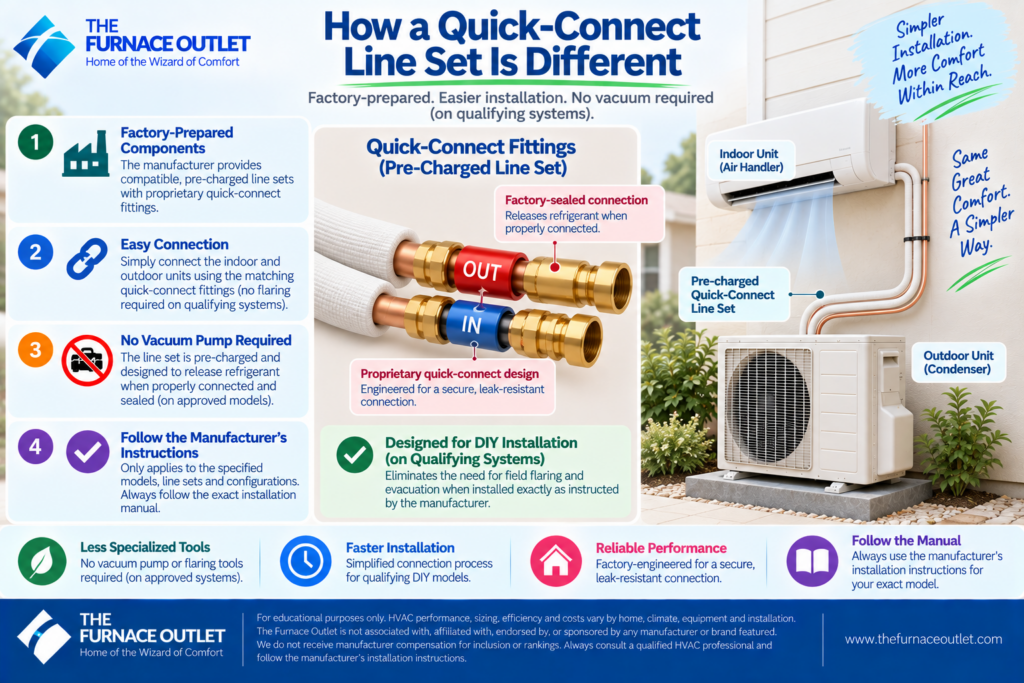
MRCOOL provides a useful current example. Its No-Vac Quick Connect documentation describes pre-charged line sets with a double-sealing arrangement and an automatic safety-valve design that releases refrigerant when the indoor and outdoor equipment are properly connected and sealed. For those specified configurations, MRCOOL states that vacuuming and adding refrigerant are not required.
MRCOOL No-Vac Quick Connect installation documentation
That is a fundamentally different installation architecture. Instead of connecting atmospheric copper piping and subsequently evacuating it, the installer works with a factory-prepared assembly intended to maintain the required condition of the refrigerant circuit when connected exactly as instructed.
The practical advantage is obvious: a qualifying quick-connect system can remove several specialized refrigerant-installation steps from the homeowner’s portion of the project. But that advantage only applies to the models, line sets, connectors and configurations that the manufacturer specifically approves.
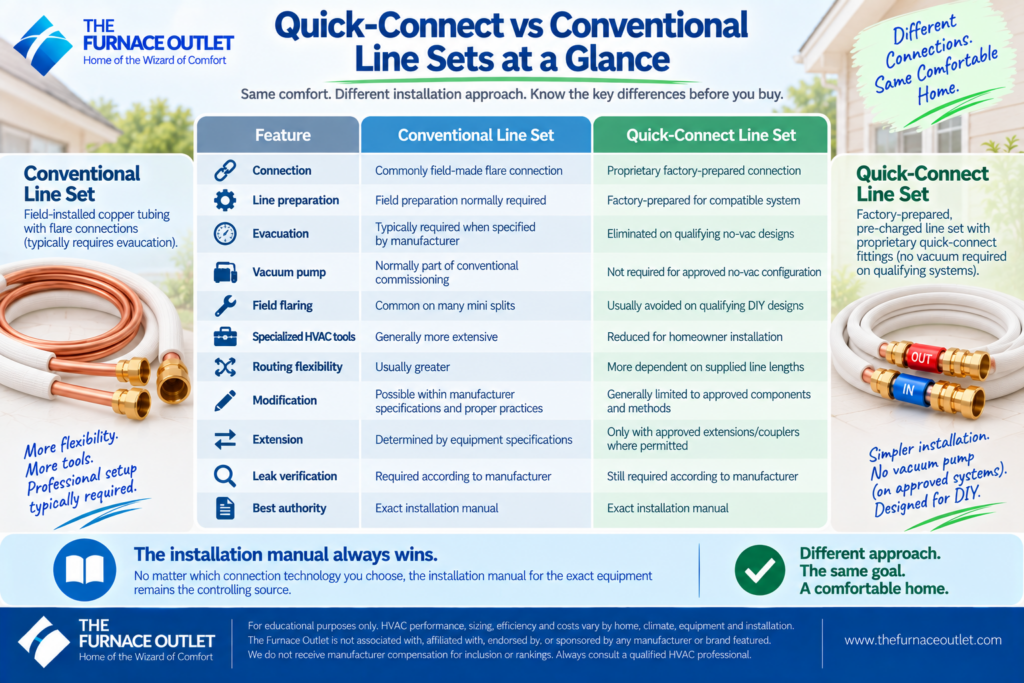
| Feature | Conventional line set | Purpose-built quick-connect line set |
|---|---|---|
| Connection | Commonly field-made flare connection | Proprietary factory-prepared connection |
| Line preparation | Field preparation normally required | Factory-prepared for compatible system |
| Evacuation | Typically required when specified by manufacturer | Eliminated on qualifying no-vac designs |
| Vacuum pump | Normally part of conventional commissioning | Not required for approved no-vac configuration |
| Field flaring | Common on many mini splits | Usually avoided on qualifying DIY designs |
| Specialized HVAC tools | Generally more extensive | Reduced for homeowner installation |
| Routing flexibility | Usually greater | More dependent on supplied line lengths |
| Modification | Possible within manufacturer specifications and proper practices | Generally limited to approved components and methods |
| Extension | Determined by equipment specifications | Only with approved extensions/couplers where permitted |
| Leak verification | Required according to manufacturer | Still required according to manufacturer |
| Best authority | Exact installation manual | Exact installation manual |
The final row is intentionally the same. No matter which connection technology you choose, the installation manual for the exact equipment remains the controlling source.
One of the easiest mistakes to make is assuming that quick-connect fittings work like standardized plumbing fittings. They don’t.
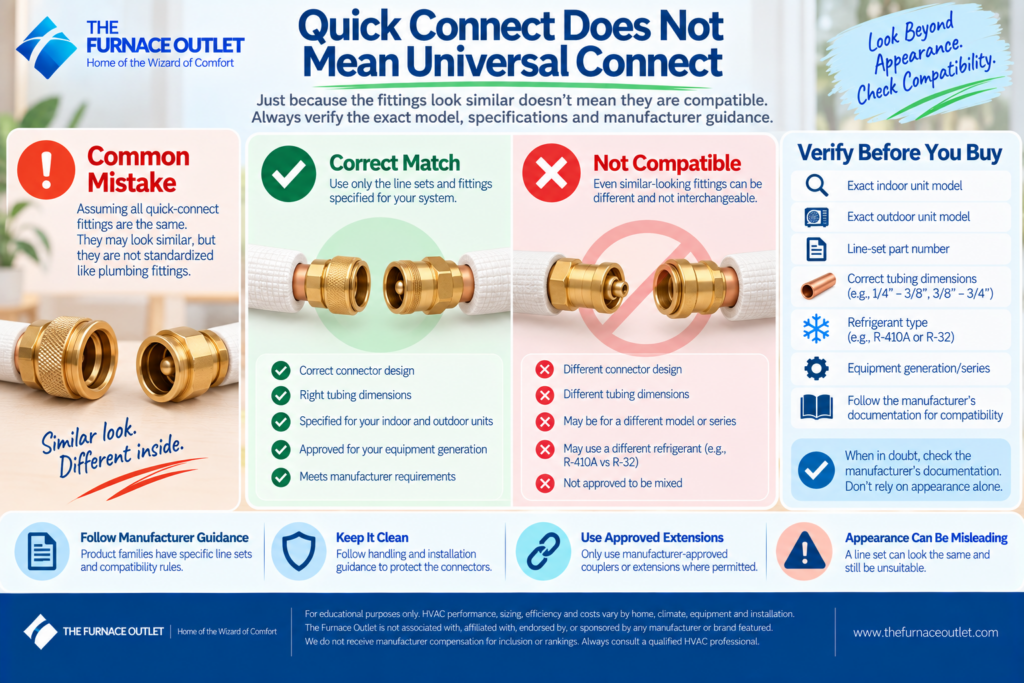
A line set can physically resemble another line set and still be unsuitable because the tubing dimensions, refrigerant, connector design, equipment generation or required charge differs. Even products from the same manufacturer shouldn’t automatically be mixed unless their documentation establishes compatibility.
MRCOOL, for example, identifies specific pre-charged line sets for particular product families and explicitly notes compatibility limitations. Its support documentation for a Universal Series No-Vac line set identifies the line dimensions, refrigerant and compatible connection type while advising installers to keep fittings clean, avoid kinking the line, manage excess length appropriately and perform a leak test before opening valves.
MRCOOL No-Vac line-set compatibility and installation guidance
The lesson extends beyond any one brand: never purchase a quick-connect line set based on connector appearance alone. Verify the exact indoor unit, outdoor unit, line-set part number, tubing dimensions, refrigerant and equipment generation.
Conventional copper has an important advantage that sometimes gets overlooked in DIY discussions: it generally gives a qualified installer considerable flexibility when designing the refrigerant route, provided the final installation stays within the equipment manufacturer’s allowable specifications.
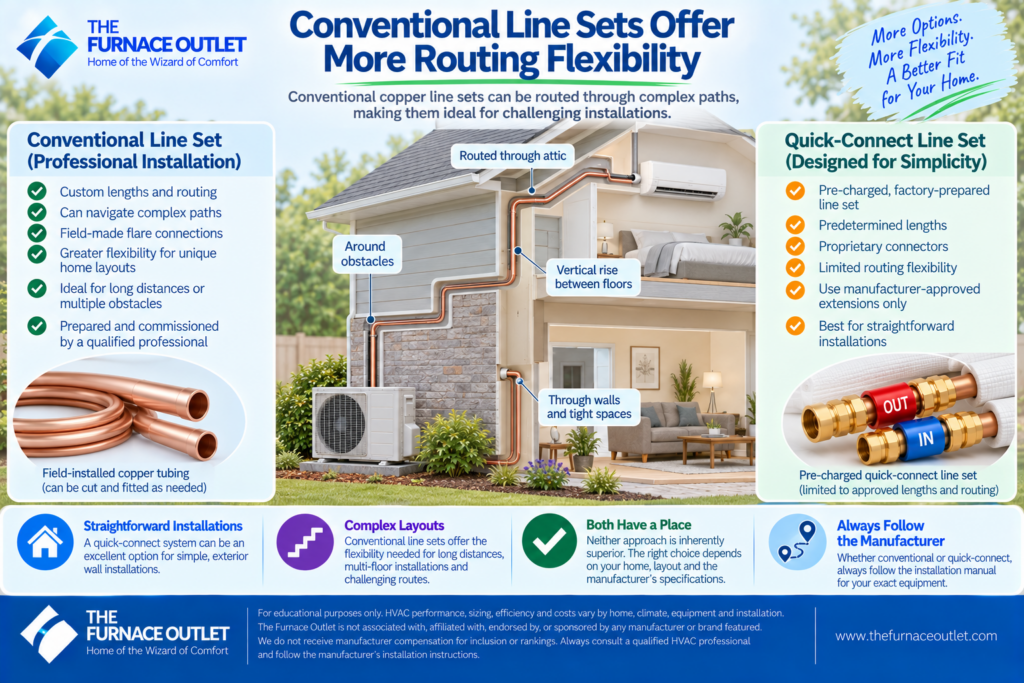
A technician can select appropriate tubing, plan the route, prepare the connections and commission the completed circuit according to the manufacturer. This can be valuable when the indoor and outdoor equipment are separated by a complicated path, when line lengths don’t match convenient preassembled sizes or when multiple architectural obstacles have to be accommodated.
Quick-connect systems trade some of that flexibility for easier refrigerant connection. You may have predetermined line-set lengths, proprietary connectors and specific extension options. If the physical distance is shorter than the supplied line set, you shouldn’t simply cut a sealed pre-charged assembly as though it were conventional copper. The manufacturer may instead instruct you to manage the excess length in a particular way.
Neither approach is inherently superior in every installation. A straightforward single-zone system on an exterior wall may be an excellent candidate for a purpose-built DIY connection. A complicated custom route may make the flexibility of a professionally installed conventional system more attractive.
Sometimes, but manufacturer approval is what matters.
Some product families provide compatible couplers and additional line-set sections. MRCOOL’s documentation for certain No-Vac line sets, for example, identifies Quick Couplers as an extension method while emphasizing model and series compatibility.
That doesn’t mean a quick-connect line can be extended indefinitely. Mini-split manufacturers establish acceptable piping configurations, and those specifications can include minimum and maximum line lengths, tubing dimensions, indoor/outdoor equipment combinations and other requirements.
Before ordering equipment, measure the actual installation route rather than the straight-line distance between the units. Include corners, vertical rises, wall penetrations, clearances and the path necessary to avoid overly tight bends.
A condenser may look only a short distance from the indoor air handler when viewed through a window, while the practical line route can be considerably longer.
This deserves special emphasis because the physical material can be misleading. A proprietary pre-charged line assembly contains copper tubing, but that doesn’t mean you should treat it exactly like ordinary field-installed copper.
Its fittings, internal condition, refrigerant charge and approved configuration are part of an engineered system. Cutting the line can destroy the feature that made it suitable for no-vacuum installation in the first place and can involve refrigerant release or servicing requirements.
If a quick-connect line set is longer than you need, consult the manufacturer’s instructions. If it is too short, determine whether an approved extension or coupler exists. Do not cut, splice, substitute fittings or improvise unless the exact manufacturer’s instructions specifically authorize the procedure.
The same conservative approach should be used whenever a connection is damaged or appears to leak. A DIY installation should not turn into improvised refrigeration service.
Quick-connect technology simplifies an installation; it doesn’t erase refrigerant regulations.
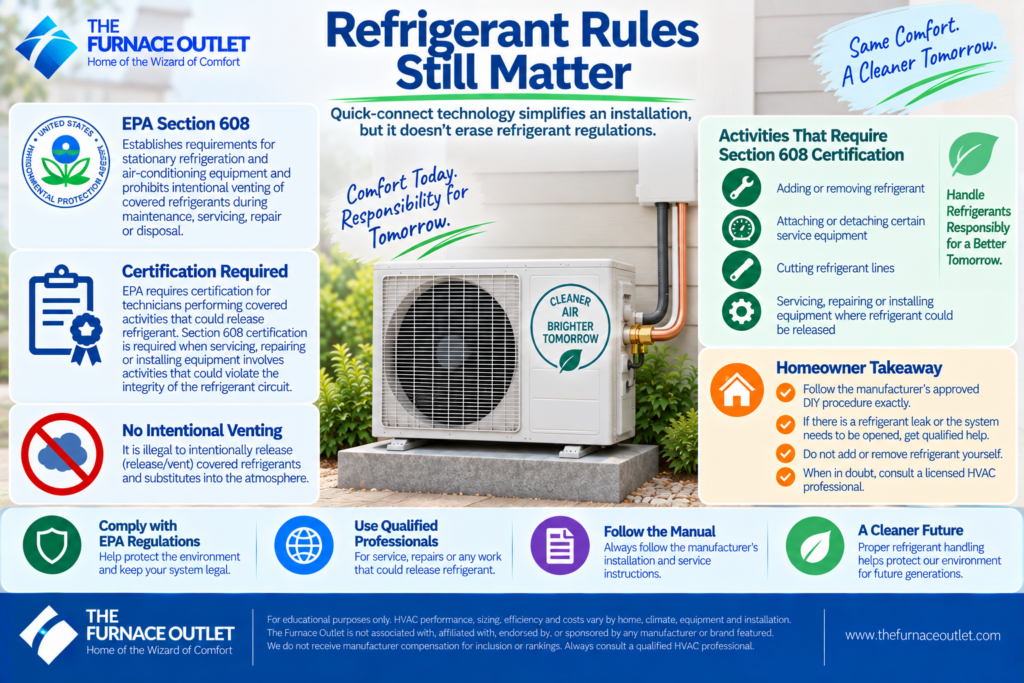
EPA Section 608 establishes requirements for stationary refrigeration and air-conditioning equipment and prohibits intentional venting of covered refrigerants and substitutes during maintenance, servicing, repair or disposal. EPA also requires certification for technicians performing covered activities that could release refrigerant.
EPA specifically explains that Section 608 certification is required when servicing, repairing or installing equipment involves activities reasonably expected to violate the integrity of the refrigerant circuit. Its guidance identifies activities such as adding or removing refrigerant, attaching or detaching certain service equipment, and cutting refrigerant lines.
EPA Section 608 refrigerant requirements
For a homeowner, the practical rule is simple. Follow the manufacturer’s approved DIY procedure exactly. If the installation develops a refrigerant leak, requires the circuit to be opened, needs refrigerant added or removed, or moves beyond the approved sealed-connection procedure, get appropriately qualified help rather than improvising.
A quick-connect system reduces specialized refrigerant work, but it does not turn the entire mini-split installation into a tool-free appliance setup.

You still need to determine an appropriate indoor-unit location, install the mounting plate correctly, create the wall penetration, route the line assembly without damaging it, establish reliable condensate drainage, position and secure the outdoor condenser, maintain required clearances and protect the installation from weather and physical damage.
Electrical requirements remain separate. Depending on the equipment and jurisdiction, the project can involve a dedicated circuit, breaker, disconnect, correctly sized conductors, grounding, outdoor-rated electrical components, permits and inspections. A homeowner-installable refrigerant connection doesn’t automatically mean the electrical installation is homeowner-permitted work.
There is nothing contradictory about purchasing a genuine DIY mini split and hiring a licensed electrician for the electrical portion. In many situations, that’s an intelligent division of labor.
I wouldn’t choose between conventional and quick-connect equipment on the assumption that one connection style automatically produces better heating or cooling performance.

The finished system’s performance depends on the complete matched equipment combination, sizing, climate, installation quality and operating conditions. If you want to verify certified performance for a specific equipment combination, the AHRI Directory of Certified Product Performance is a useful independent resource. Its certified categories include variable-speed mini-split and multi-split air conditioners and heat pumps.
AHRI Directory of Certified Product Performance
This matters because homeowners sometimes become so focused on whether they can install the equipment themselves that they overlook whether they are selecting the right equipment in the first place. Connection convenience should never replace proper sizing and equipment selection.
The difference between conventional and quick-connect piping becomes even more important with multi-zone equipment because you are planning several refrigerant paths rather than one. Each indoor unit can require its own line-set route, condensate drain and connection to the outdoor equipment. The manufacturer may also specify acceptable indoor-unit combinations, line dimensions, line-length limits and total connected capacity.
A purpose-built multi-zone DIY system can make the refrigerant connections more accessible, but it doesn’t make the overall design as simple as installing several independent single-zone systems. Every additional indoor unit creates another route that has to be planned before equipment is mounted.
I recommend drawing the house layout and mapping every indoor unit, drain route and refrigerant path before ordering. Then compare your plan with the exact manufacturer’s installation documentation.
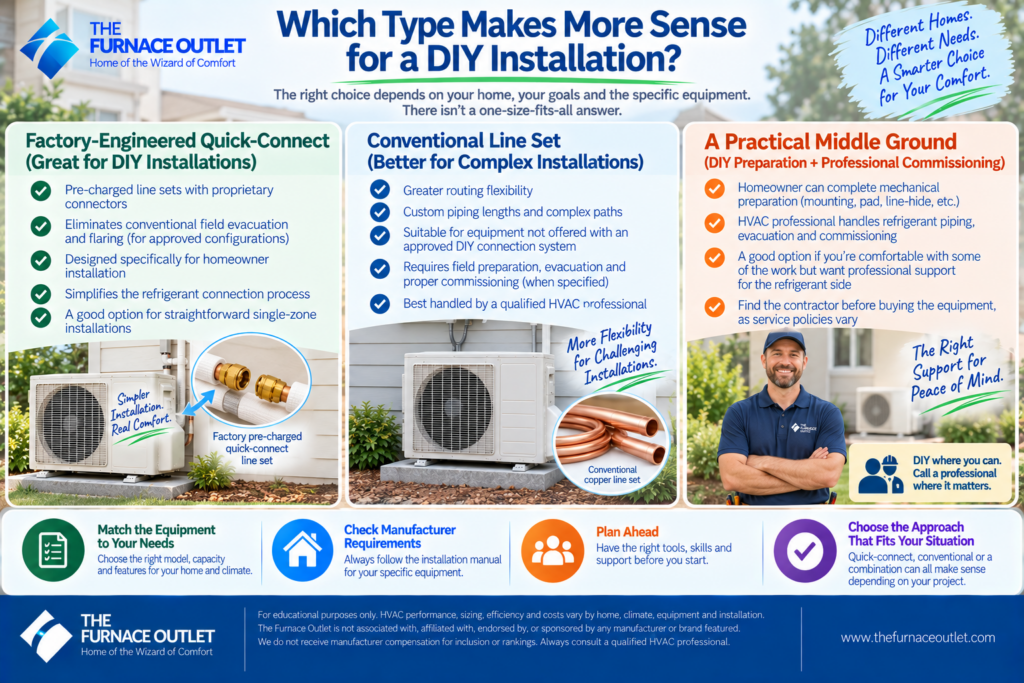
For homeowners specifically seeking to perform much of the installation themselves, a genuine factory-engineered quick-connect system has an obvious advantage: it can eliminate conventional field evacuation and flaring for the configurations the manufacturer has designed for that purpose. MRCOOL, for example, currently markets specified DIY equipment with factory pre-charged Quick Connect line sets that eliminate the need for vacuum pumps or conventional refrigerant handling during the approved connection procedure.
MRCOOL DIY system documentation
A conventional line set can make more sense when the project requires greater routing flexibility, custom piping lengths or equipment that isn’t offered with an approved DIY connection system. In that situation, I would plan for qualified HVAC commissioning rather than trying to convert conventional equipment into a DIY no-vac installation.
There is also a perfectly reasonable middle ground. A homeowner can complete appropriate mechanical preparation—such as mounting equipment, preparing an outdoor pad or installing line-hide—and have an HVAC professional handle conventional refrigerant piping and commissioning. If you want to use that approach, find the contractor before buying the equipment because service policies vary.
Before I call any mini split “DIY,” I want to see the manufacturer’s documentation. Retailer descriptions, marketplace listings and installation videos are secondary sources.

I would confirm that the exact model is explicitly intended for the proposed installation method, determine whether the line set is conventional or factory-prepared, verify the required refrigerant and tubing sizes, check allowable line lengths, identify whether field flaring or evacuation is specified, review the approved extension method and understand what the manufacturer requires for leak checking, electrical installation, registration and warranty coverage.
Pay particular attention to wording such as “pre-charged condenser.” That phrase alone doesn’t establish that the line set is a no-vacuum DIY design. What you want to know is how the entire refrigerant connection between the indoor and outdoor equipment is supposed to be completed.
If the manual specifies conventional field evacuation, assume it needs to be performed correctly. If the manufacturer explicitly documents a compatible factory-prepared no-vacuum connection, follow that procedure instead.
The easiest way I can summarize the difference is that conventional line sets prioritize installation flexibility, while purpose-built quick-connect systems prioritize simplified refrigerant connection. Conventional copper can accommodate a wide variety of installation layouts when handled by someone with the proper skills, tools and qualifications. The tradeoff is that the field-created refrigerant circuit normally requires specialized preparation, testing, evacuation and commissioning according to the manufacturer’s instructions.
A genuine quick-connect DIY system shifts more of that preparation to the factory. The homeowner receives compatible components designed to connect without conventional field flaring and evacuation for the approved configuration. The tradeoff is that you become more dependent on the manufacturer’s line lengths, connectors, compatibility rules and approved extension methods.
Neither technology eliminates the need for careful installation. A quick connector is still a refrigerant connection. A pre-charged line set is still part of a refrigeration circuit. And “DIY” still means following the manufacturer’s engineering—not inventing your own installation method.
For a straightforward single-zone project where the manufacturer explicitly supports homeowner installation, quick-connect technology can remove one of the biggest technical barriers to DIY. For complex routing, unusual line lengths, demanding multi-zone layouts or projects where the selected equipment uses conventional piping, professional refrigerant installation may provide the flexibility the project requires.
The right question therefore isn’t simply, “Which line set is better?” It is whether the connection method fits the equipment, the building, the planned route, the homeowner’s skills and the manufacturer’s installation requirements. Get those pieces right, and either approach can become part of a properly planned mini-split installation.
Is every pre-charged mini split a quick-connect system?
No. An outdoor condenser can contain a factory refrigerant charge while still using conventional field-installed copper that requires preparation and evacuation. Look for explicit manufacturer documentation identifying the approved quick-connect or no-vacuum installation method.
Does a quick-connect mini split ever need a vacuum pump?
A qualifying no-vacuum design does not require conventional field evacuation when installed in the exact configuration and manner specified by its manufacturer. Do not assume this applies to another model simply because it uses similar-looking connectors.
Can I convert a conventional mini split into a quick-connect system?
You should not add aftermarket or unrelated connectors merely to avoid conventional commissioning. Use only connection systems and accessories specifically approved by the equipment manufacturer for your exact model.
Can I shorten a pre-charged quick-connect line set?
Do not cut or shorten it unless the manufacturer specifically provides an approved procedure for that exact line set and equipment combination. Follow the manufacturer’s method for managing excess length.
Can I extend a quick-connect line set?
Some systems provide manufacturer-approved couplers or additional compatible line-set sections. Extensions remain subject to equipment compatibility and line-length restrictions, so verify the exact model documentation before ordering components.
Are conventional line sets more difficult to install?
They generally require more specialized refrigerant-installation skills and tools because field connections, testing, evacuation and commissioning may be necessary. That doesn’t make conventional piping inferior; it provides flexibility that can be valuable in complicated installations.
Does quick-connect mean I don’t need an electrician?
No. Refrigerant connection and electrical installation are separate parts of the project. Electrical requirements, licensing rules, permits and inspections still apply according to the equipment and local jurisdiction.
What happens if a quick-connect fitting leaks?
Follow the manufacturer’s troubleshooting procedure and stop if correcting the problem requires opening or servicing the refrigerant circuit. At that point, qualified HVAC assistance may be required, and EPA Section 608 requirements can become relevant.
Where should I verify the performance of a mini split?
Manufacturer specifications are useful, while AHRI’s Directory of Certified Product Performance can be used to check certified ratings for participating matched equipment combinations.
Editorial Disclosure: The Furnace Outlet is not associated with, affiliated with, endorsed by, or sponsored by any manufacturer or brand mentioned in this article. We do not receive manufacturer compensation for inclusion or rankings. Equipment specifications, refrigerants, connection technologies, compatibility and installation requirements can change by model and generation. Always verify the current installation manual for the exact equipment and use qualified HVAC or electrical professionals where the work requires them
https://thefurnaceoutlet.com/best-diy-mini-split-systems-of-2026-no-hvac-technician-required/