Newsletter Subscribe
Enter your email address below and subscribe to our newsletter

HVAC made simple
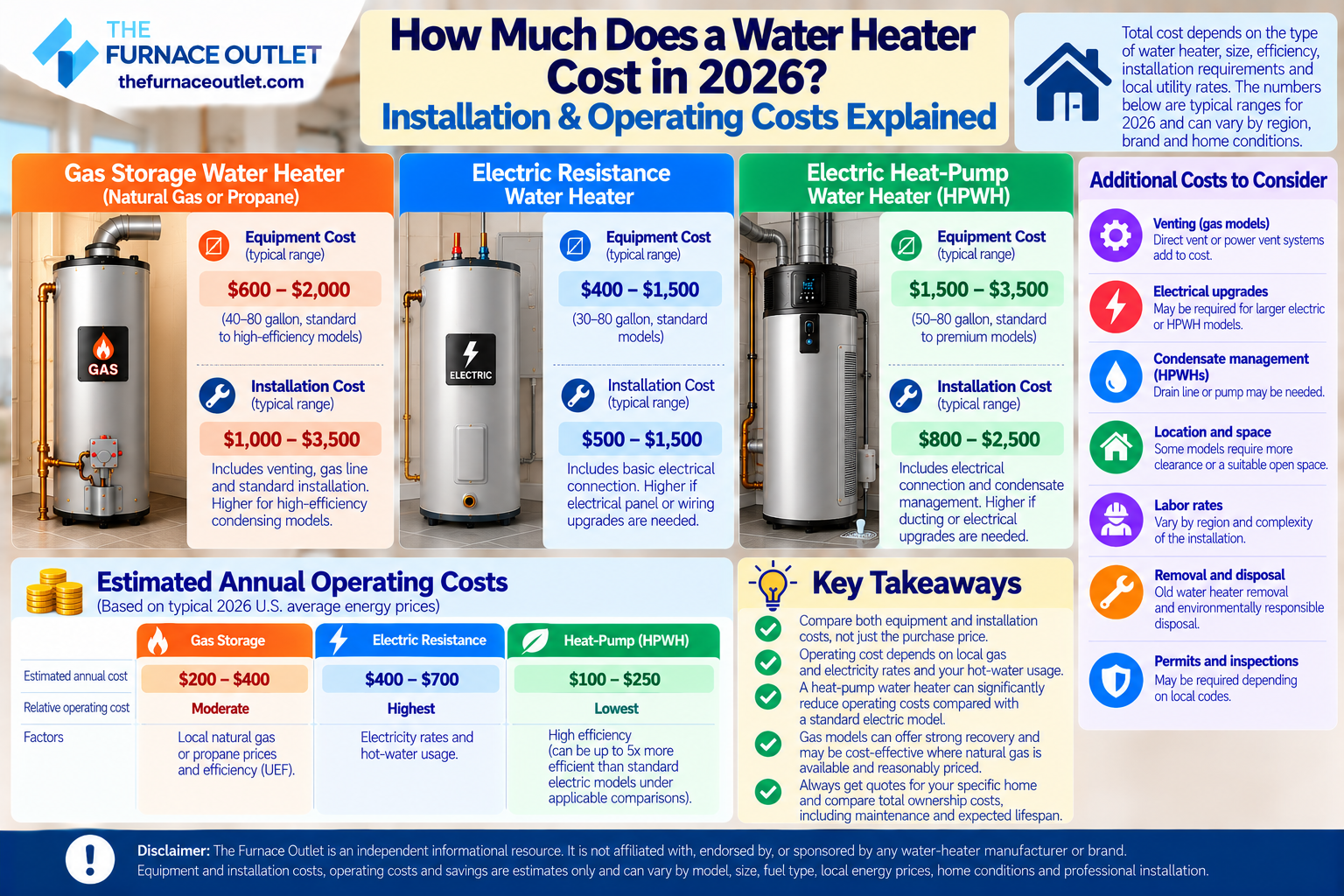
A water heater can look like a relatively simple appliance purchase until installation costs enter the picture. A homeowner may see a conventional tank for several hundred dollars, a heat-pump water heater for considerably more, or a premium tankless system and assume the equipment price represents most of the project. In reality, the final cost can include labor, permits, plumbing modifications, gas-line work, venting, electrical upgrades, condensate drainage, disposal of the old heater, and sometimes changes to the installation space.
For 2026, current U.S. cost guides illustrate just how wide that range can be. HomeGuide estimates roughly $600–$3,100 installed for a standard tank replacement, $1,400–$5,600 for tankless, and $2,000–$4,600 for a hybrid heat-pump water heater. Another 2026 source, This Old House, estimates overall water-heater installation at approximately $1,600–$5,400 depending on equipment and project conditions. These are national planning ranges rather than quotes for a particular home, and local labor markets can move them substantially.
I’m Savvy Mavi, Savvy the Sustainability Expert, and I would look beyond the purchase price. A water heater can remain in service for many years, so the more useful question is not simply “What does the water heater cost?” but “What will this water heater cost to install and operate over the years I own it?”
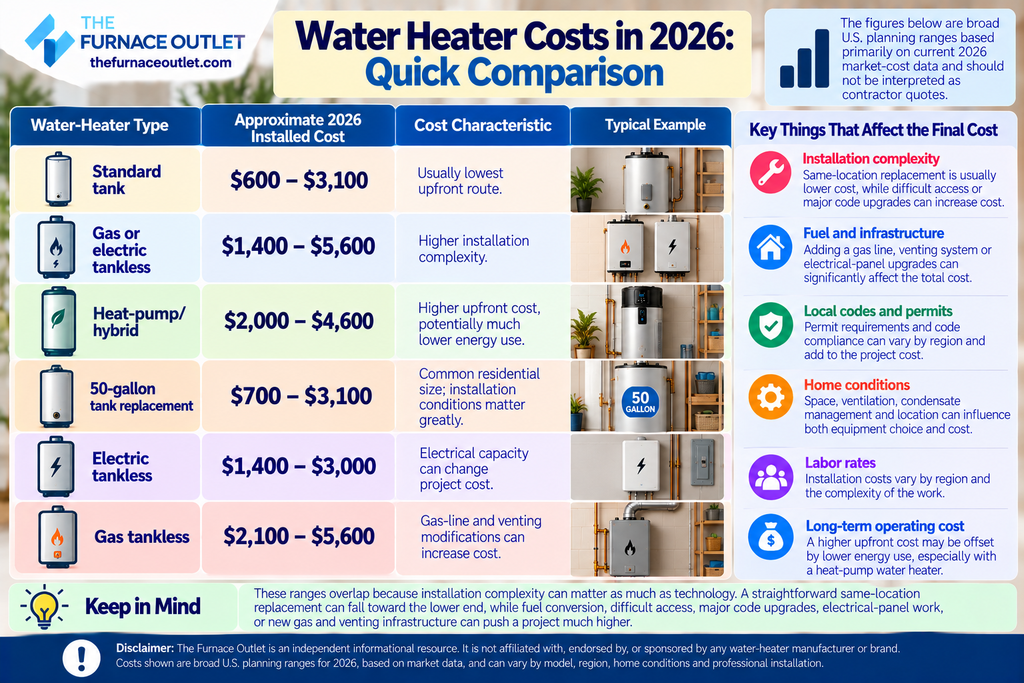
The table below provides a useful starting point for budgeting. The figures are broad U.S. planning ranges based primarily on current 2026 market-cost data and should not be interpreted as contractor quotes.
| Water-Heater Type | Approximate 2026 Installed Cost | Cost Characteristic |
|---|---|---|
| Standard tank | $600–$3,100 | Usually lowest upfront route |
| Gas or electric tankless | $1,400–$5,600 | Higher installation complexity |
| Heat-pump/hybrid | $2,000–$4,600 | Higher upfront cost, potentially much lower energy use |
| 50-gallon tank replacement | $700–$3,100 | Common residential size; installation conditions matter greatly |
| Electric tankless | $1,400–$3,000 | Electrical capacity can change project cost |
| Gas tankless | $2,100–$5,600 | Gas-line and venting modifications can increase cost |
These ranges overlap because installation complexity can matter as much as technology. A straightforward same-location replacement can fall toward the lower end, while fuel conversion, difficult access, major code upgrades, electrical-panel work, or new gas and venting infrastructure can push a project much higher.
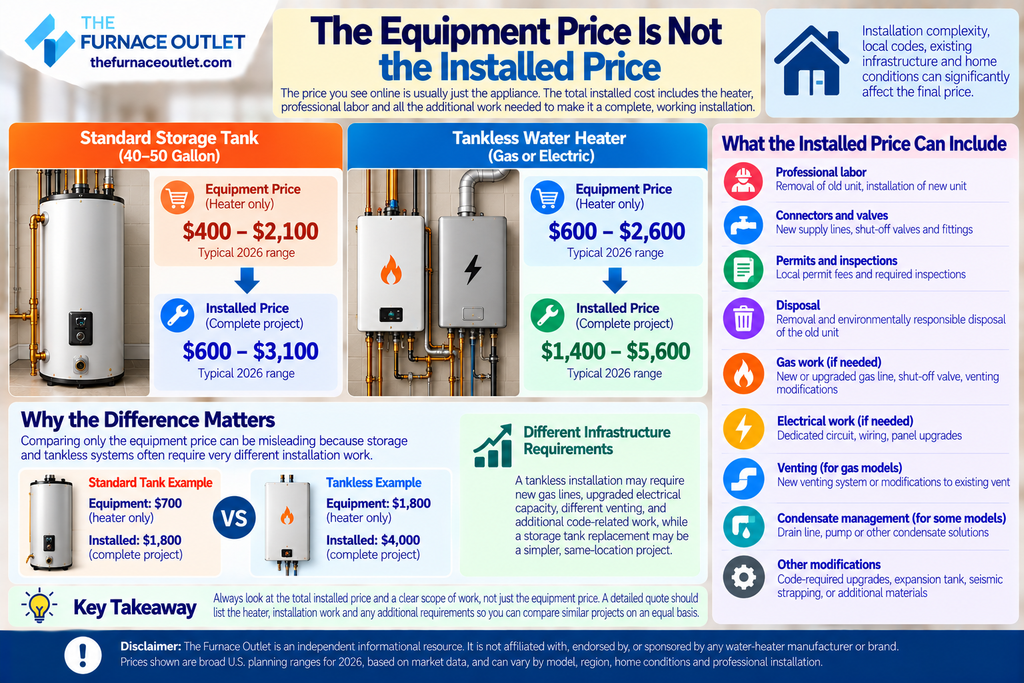
This distinction is one of the most important parts of budgeting for a water heater. The price shown online or on a store shelf usually represents the appliance, not the complete working installation.
For example, HomeGuide’s 2026 data places a typical 40- to 50-gallon standard tank at approximately $400–$2,100 for the equipment, while the installed project range rises to approximately $600–$3,100. Tankless equipment is estimated at approximately $600–$2,600 for the heater, while complete installation can reach approximately $1,400–$5,600.
The difference can include professional labor, connectors and valves, permits, disposal, gas or electrical work, venting and other modifications. That is why I would never compare a $700 storage heater with a $1,800 tankless unit and conclude that the tankless project costs only $1,100 more. The two installations may require completely different supporting infrastructure.
A useful contractor quote should therefore identify equipment and installation scope, not simply provide one unexplained total.
For homeowners seeking the lowest initial investment, a conventional storage water heater often remains the starting point. Current 2026 HomeGuide data estimates approximately $600–$3,100 for a standard tank replacement, depending on tank size, fuel, equipment quality, and installation conditions.
Another current source, Angi, places tank-style replacement at approximately $882–$1,825 for its typical project range. The difference between published estimates illustrates why national cost guides should be treated as budgeting references rather than precise predictions. Each service uses different project data, assumptions, locations, and definitions of a typical installation.
A straightforward like-for-like replacement is usually the least complicated scenario. If the old heater is electric and the replacement uses the same electrical arrangement, or an existing gas installation can properly support the replacement model, fewer modifications may be necessary.
The price rises when the project requires relocated plumbing, upgraded venting, a different gas supply, code-related changes, expansion-tank work, drain modifications, difficult equipment access, or other site-specific improvements.
Tankless systems generally have a higher upfront project cost than standard tank replacements. HomeGuide’s January 2026 cost data places complete tankless installation at approximately $1,400–$5,600, including equipment and installation. It estimates electric tankless systems at approximately $1,400–$3,000 installed and gas tankless projects at approximately $2,100–$5,600.
Other 2026 estimates are somewhat narrower. This Old House reports a typical tankless installation range of approximately $1,200–$3,500, averaging around $2,800 in its research, while Angi reports approximately $1,406–$3,902.
The wide range makes sense because tankless installation can involve much more than mounting a box on a wall. A gas tankless heater may require a larger or modified gas supply, dedicated venting, condensate drainage for a condensing model, plumbing changes and electrical power for controls and ventilation. ENERGY STAR specifically recommends that installers verify the home’s hot-water requirement, gas-line capacity, electricity availability and combustion-venting arrangement before quoting a gas tankless project.
Electric tankless equipment eliminates gas and combustion venting but can require substantial electrical capacity. A large whole-house electric tankless heater may therefore become expensive if the existing service or panel cannot support it.
A heat-pump water heater, or HPWH, generally costs more upfront than a basic electric-resistance tank, but its operating economics can be dramatically different. HomeGuide’s current 2026 figures estimate approximately $1,500–$3,000 for hybrid heat-pump equipment and $2,000–$4,600 installed. Angi’s July 2026 data gives a professional installation range of approximately $3,200–$4,700, again demonstrating how project assumptions and regional pricing can affect published estimates.
An HPWH installation also needs to be evaluated differently from a conventional electric tank. The appliance extracts heat from surrounding air, so installation-space and airflow requirements matter. It produces condensate that needs drainage, and the electrical requirements must match the selected model.
A homeowner replacing an existing electric water heater may have a relatively favorable conversion scenario, but I would still have the installer verify the electrical circuit, physical space, airflow, condensate route, clearances and exact manufacturer requirements before purchasing the equipment.
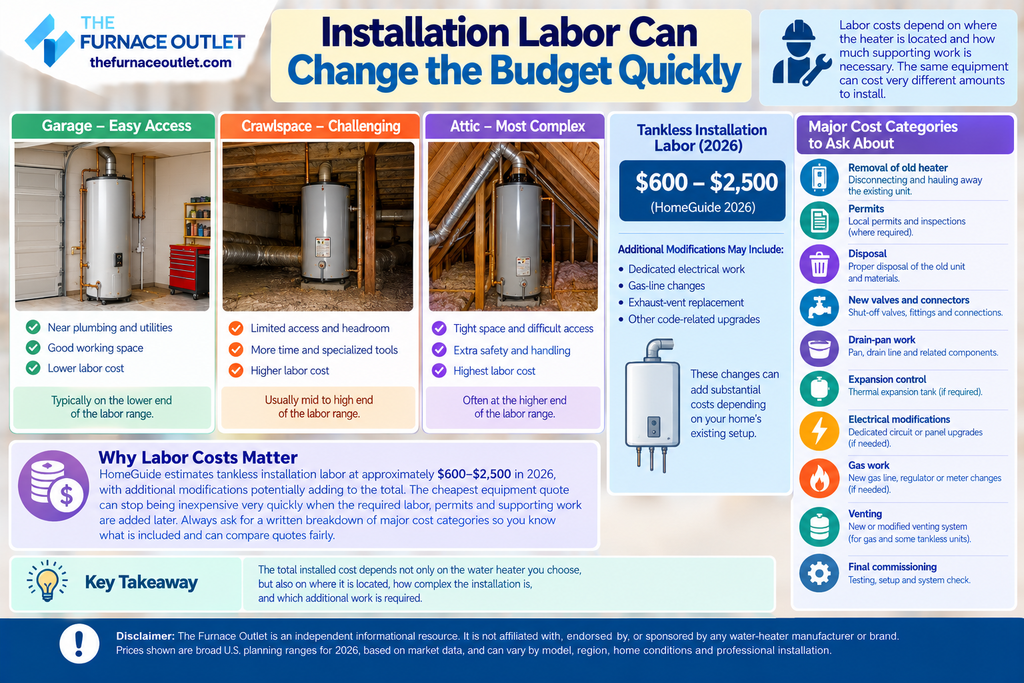
Labor costs depend on where the heater is located and how much supporting work is necessary. A water heater in an accessible garage next to compatible plumbing and utilities presents a very different project from equipment located in a difficult attic, crawlspace or confined interior utility area.
Current 2026 tankless cost data illustrates the range. HomeGuide estimates tankless installation labor at approximately $600–$2,500, with additional modifications potentially including dedicated electrical work, gas-line changes and exhaust-vent replacement.
I would therefore ask installers to identify major cost categories in writing. That does not require every fitting to have its own line item, but homeowners should understand whether the proposal includes removal of the old heater, permits, disposal, new valves, drain-pan work, expansion control, electrical modifications, gas work, venting and final commissioning.
The cheapest equipment quote can stop being inexpensive very quickly when those items are added later.
Replacing like with like is generally simpler than changing the home’s water-heating energy source. Moving from electric to gas can require a new or upgraded gas line, combustion venting and related code work. Moving from gas to an electric HPWH may eliminate combustion but require an appropriate electrical circuit and condensate drainage.
This is why I would be cautious about choosing technology from operating cost before calculating conversion cost. Suppose one option saves $150 annually but requires several thousand dollars of additional infrastructure compared with a suitable alternative. The savings may still be worthwhile over a long ownership period, but the payback calculation is very different.
Conversely, a high-efficiency option can become financially attractive when infrastructure is already available or when rebates substantially reduce the initial premium. Installed cost and operating cost have to be evaluated together.
There is no single annual operating cost that applies nationwide. Electricity and gas prices differ by utility and location, while household hot-water consumption can vary dramatically. A two-person household using modest amounts of hot water should not be expected to have the same annual water-heating bill as a six-person household with frequent showers and heavy laundry use.
Equipment efficiency matters as well. A standard electric-resistance heater, an ENERGY STAR heat-pump model, a conventional gas tank and a condensing gas tankless heater can use very different amounts of purchased energy to provide hot water. Rather than publishing one generic annual dollar figure, I would estimate operating cost from the exact model’s energy-use information and the homeowner’s actual utility rate. That produces a far more defensible result than assuming everyone in the United States pays the same electricity or gas price.
DOE’s purchasing guidance takes a similar approach by treating Uniform Energy Factor, annual energy consumption, annual energy cost and lifetime energy cost as related but separate considerations when evaluating water-heating equipment.
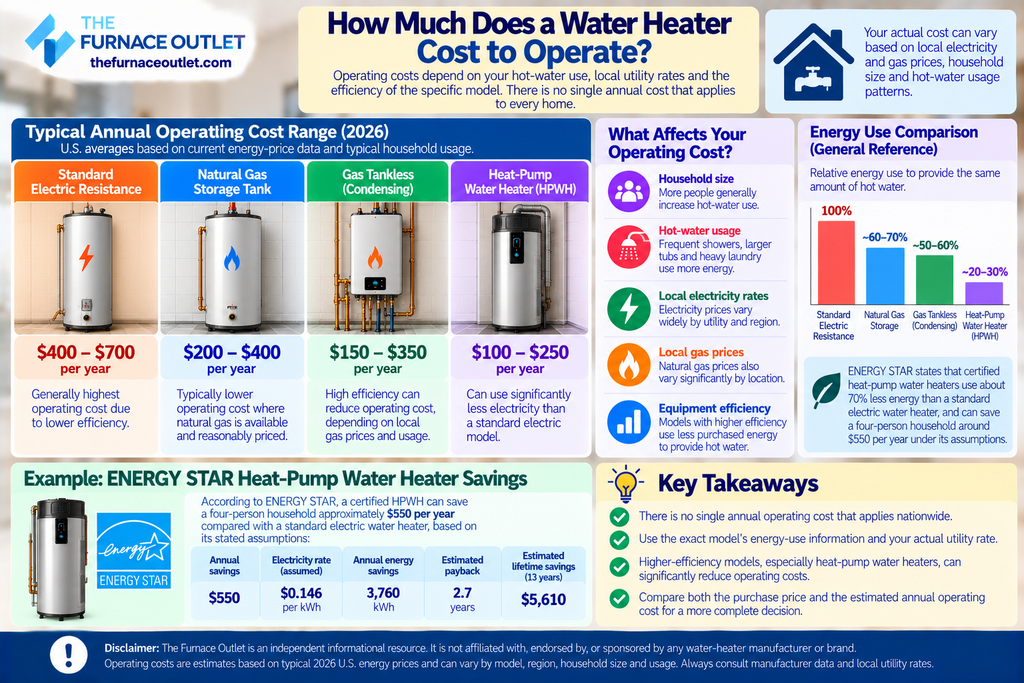
Heat-pump water heaters deserve special attention because their higher purchase price can be offset by significantly lower electricity consumption compared with conventional electric resistance.
ENERGY STAR currently estimates that a certified HPWH can save a four-person household approximately $550 per year compared with a standard electric water heater under its stated assumptions. Its published model uses electricity priced at $0.146 per kWh and estimates annual savings of 3,760 kWh for a four-person household. ENERGY STAR estimates approximately $5,610 of lifetime savings and a 2.7-year payback on a modeled $1,503 incremental equipment cost.
Those numbers are useful, but I would not present them to a homeowner as guaranteed savings. ENERGY STAR’s calculation depends on assumed electricity price, household size, incremental cost and a 13-year modeled lifespan. Your electricity rate and hot-water use may be higher or lower.
The underlying efficiency opportunity is still significant. ENERGY STAR states that certified HPWHs use approximately 70% less energy than a standard electric water heater and notes that savings relative to natural gas can also occur, although that comparison depends on local utility rates.
Tankless systems can reduce standby losses because they heat water when it is requested instead of keeping a storage tank hot continuously. ENERGY STAR explains that certified gas tankless equipment uses condensing technology and a secondary heat exchanger to extract additional heat from combustion gases.
For a family of four, ENERGY STAR currently estimates approximately $95 per year in gas-bill savings for a certified gas tankless heater compared with a standard gas storage heater, with approximately $1,800 in modeled lifetime savings. Compared with a conventional gas tankless heater, ENERGY STAR estimates the certified model saves around $20 annually.
Again, these are standardized program estimates rather than household guarantees. Local gas prices, hot-water consumption, equipment sizing and installation all influence actual savings.
This comparison also demonstrates why payback is important. A tankless installation may cost substantially more than a straightforward gas-tank replacement. Energy savings are one benefit, but homeowners may also value continuous hot-water capability, compact wall-mounted equipment and the elimination of a large storage tank.
High-efficiency gas storage water heaters offer another path for homeowners who want to retain a tank configuration. ENERGY STAR currently states that a certified gas storage water heater uses about 8% less energy than a standard model, estimating approximately $25 per year in savings for a family of four under its assumptions.
That is considerably smaller than the modeled savings ENERGY STAR reports when replacing standard electric resistance with an HPWH. It demonstrates why the economic benefit of “high efficiency” depends strongly on the starting technology.
I would therefore ask “efficient compared with what?” whenever a savings claim appears. Replacing a standard electric tank with a heat pump is a different energy transition from replacing a conventional gas tank with a somewhat more efficient gas storage heater.
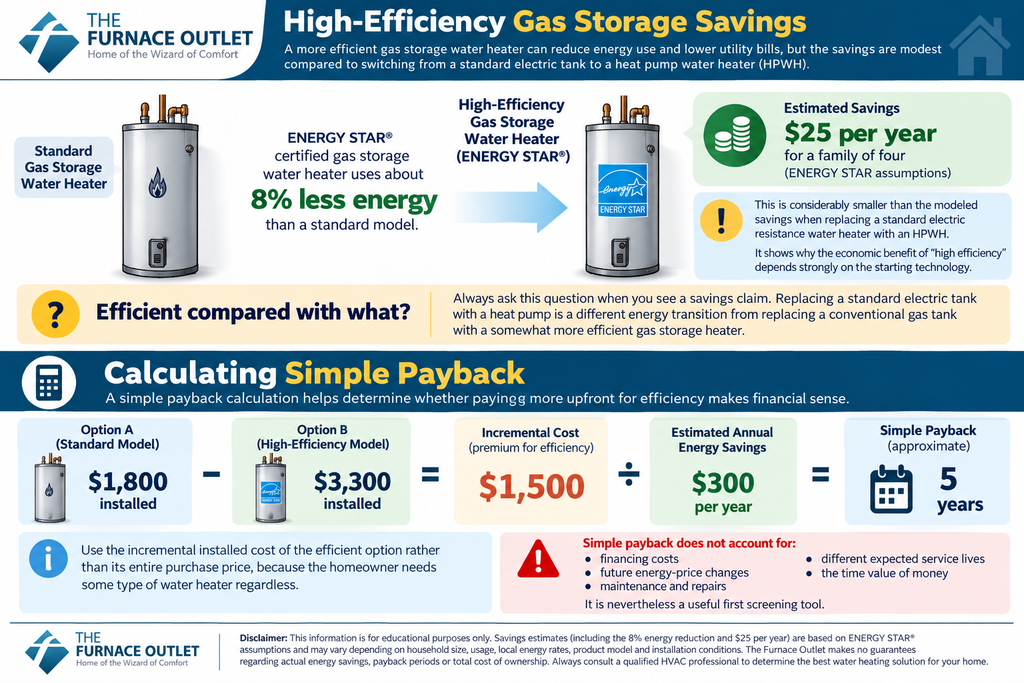
A simple payback calculation can help determine whether paying more upfront for efficiency makes financial sense. I would calculate the incremental installed cost of the efficient option rather than its entire purchase price, because the homeowner needs some type of water heater regardless.
Suppose Option A costs $1,800 installed and Option B costs $3,300. The incremental cost of Option B is $1,500. If credible energy estimates suggest that Option B saves $300 per year, the simple payback is approximately five years.
That does not mean Option B automatically becomes the better choice in year six. Simple payback does not account for financing costs, future energy-price changes, maintenance, repairs, different expected service lives or the time value of money. It is nevertheless a useful first screening tool.
For a more complete comparison, I prefer total cost of ownership.
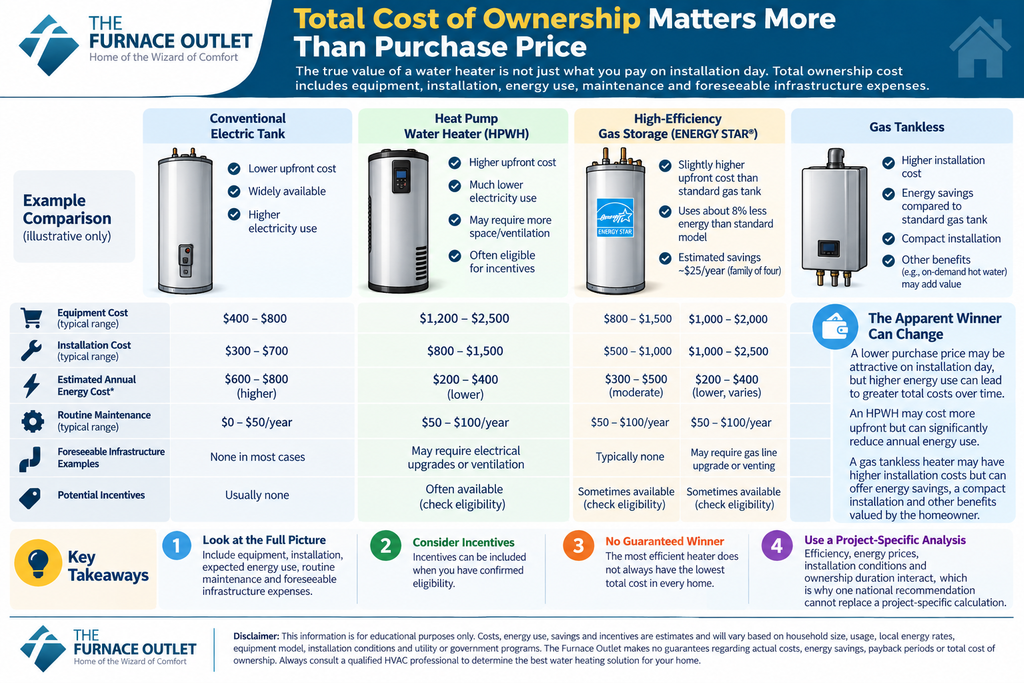
Total ownership cost should include equipment, installation, expected energy use, routine maintenance and foreseeable infrastructure expenses. Incentives can also be included when the homeowner has confirmed eligibility.
This approach can change the apparent winner. A low-cost conventional electric tank might be attractive on installation day but consume more electricity over its life. An HPWH might require a larger initial investment while lowering annual energy use. A gas tankless heater may have higher installation costs but offer energy savings, compact installation and other benefits valued by the homeowner.
There is no guarantee that the most efficient heater has the lowest total cost in every home. Efficiency, energy prices, installation conditions and ownership duration interact, which is why one national recommendation cannot replace a project-specific calculation.
Rebates can materially reduce the cost of some high-efficiency water heaters, particularly HPWHs. ENERGY STAR recommends checking available incentives when considering qualifying equipment.
One important 2026 detail is that homeowners should not automatically rely on older articles describing the previous federal Energy Efficient Home Improvement Tax Credit for water heaters. ENERGY STAR’s current page states that the federal credit for qualifying natural-gas, oil and propane water heaters applied to products purchased and installed through December 31, 2025.
For a 2026 purchase, I would therefore verify current federal, state, local and utility programs before including an incentive in the budget. Do not assume that a credit available in 2025 still applies to a 2026 installation.
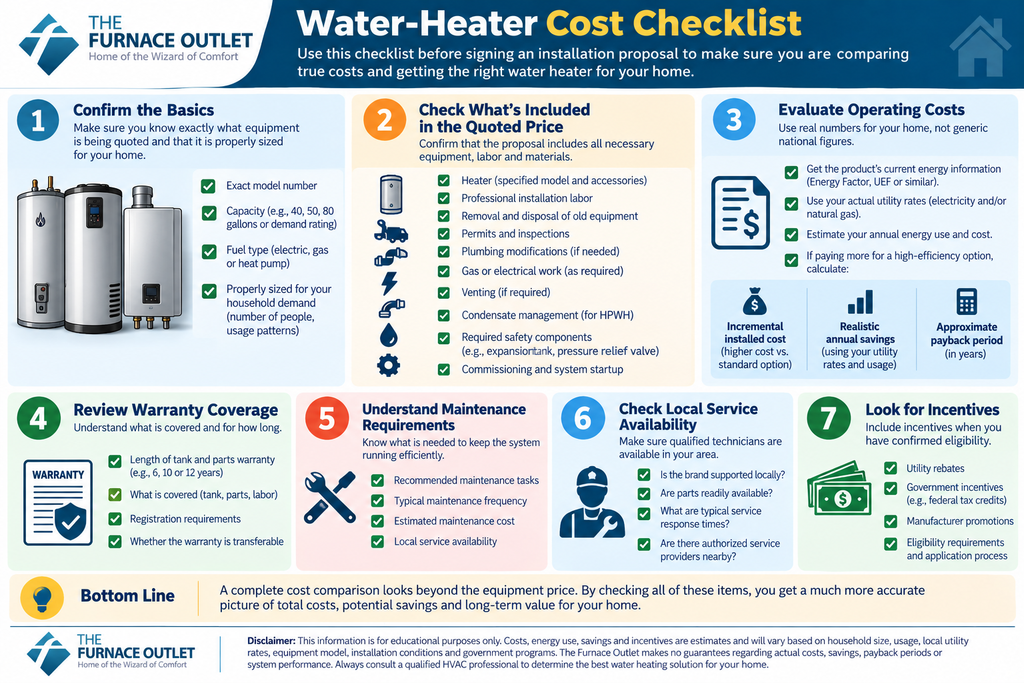
Before signing an installation proposal, I would confirm the exact model number, capacity and fuel type and make sure the equipment is properly sized for household demand. I would then ask whether the quoted price includes the heater, professional labor, removal and disposal of the old equipment, permits, plumbing modifications, gas or electrical work, venting, condensate management, required safety components and commissioning.
For operating costs, I would obtain the product’s current energy information and use my actual utility rates rather than a generic national figure. If I am paying more for a high-efficiency option, I would calculate the incremental installed cost, realistic annual savings and approximate payback.
Finally, I would check warranty coverage, maintenance requirements, local service availability and currently available rebates. That gives me a much more useful picture than comparing equipment prices on a retailer’s website.
For a conventional tank replacement, current national cost guides show broad ranges. HomeGuide estimates approximately $600–$3,100 for standard tank installation, while Angi reports a narrower typical range of approximately $882–$1,825. Location, capacity, fuel type and installation complexity can move an actual quote outside these ranges.
HomeGuide’s current 2026 data estimates approximately $700–$3,100 installed for a 50-gallon water heater.he exact price depends on whether it is gas or electric, equipment quality and whether plumbing, venting or electrical modifications are necessary.
Usually, yes, compared with a straightforward conventional-tank replacement. Current 2026 estimates place tankless projects roughly between $1,400 and $5,600, with gas supply, electrical requirements, venting and plumbing modifications among the variables that can raise cost.
It can be financially attractive when replacing conventional electric resistance, particularly for households with significant hot-water consumption and favorable electricity rates. ENERGY STAR’s current model estimates approximately $550 per year in savings for a four-person household, but actual savings and payback depend on local rates, usage, installation cost and operating conditions.
I would compare total installed and ownership cost instead. The lowest equipment price can become less attractive after installation or years of energy consumption are considered. Capacity and reliability also matter because an inexpensive but undersized heater is not a successful purchase.
The best method is an on-site estimate based on the exact equipment and installation location. For tankless gas systems specifically, ENERGY STAR recommends having an installer verify household GPM requirements, gas-line capacity, electrical availability and venting before providing a final project price.
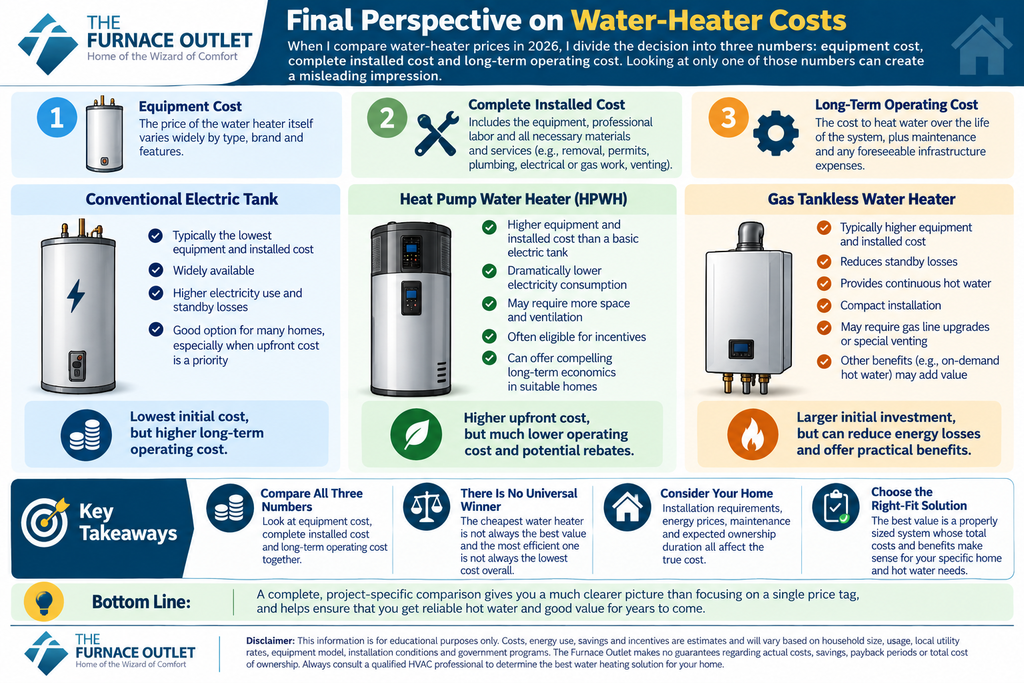
When I compare water-heater prices in 2026, I would divide the decision into three numbers: equipment cost, complete installed cost, and long-term operating cost. Looking at only one of those numbers can create a misleading impression.
A conventional tank frequently offers the lowest initial cost. Tankless equipment typically requires a larger investment but can reduce standby losses and provide other practical benefits. Heat-pump water heaters usually cost more than basic resistance tanks upfront, but their dramatically lower electricity consumption can make the long-term economics compelling in suitable homes.
The best value is therefore not necessarily the cheapest water heater and not automatically the most efficient one. It is the properly sized system whose installation requirements, annual energy use, maintenance and expected ownership costs make sense for the particular home. That is the comparison I would make before spending thousands of dollars on equipment expected to provide hot water every day for years.
For additional research, these resources provide useful independent guidance and current efficiency information. ENERGY STAR — Heat Pump Water Heater Benefits & Savings provides modeled savings and payback examples; ENERGY STAR — Heat Pump Water Heater Guide covers operating costs and installation considerations; and ENERGY STAR — Gas Tankless Benefits & Savings explains current gas-tankless savings estimates.
For broader comparison and purchase planning, DOE — Residential Water Heater Purchasing Guidance provides life-cycle cost guidance, while ENERGY STAR — Whole-Home Gas Tankless Water Heaters explains sizing, installation and rebate considerations. For the current 2026 market-price context, HomeGuide — Water Heater Installation Cost provides equipment and installed-cost ranges by technology.
The Furnace Outlet is an independent informational and educational resource. It is not associated with, affiliated with, endorsed by, or sponsored by any manufacturer or brand discussed in this article, and it does not receive manufacturer compensation for inclusion or rankings.
All dollar amounts in this article are general U.S. planning estimates based on cited sources available in 2026 and are not contractor quotes or guarantees. Water-heater prices, labor rates, utility costs, rebates, permits, taxes and installation requirements vary significantly by location, equipment, capacity, household demand and site conditions. Savings and payback examples from ENERGY STAR are based on specified assumptions and should not be interpreted as guaranteed household savings. Obtain written local estimates, verify current incentives and equipment specifications, and use appropriately qualified or licensed plumbing, electrical, gas or other professionals where required.