Newsletter Subscribe
Enter your email address below and subscribe to our newsletter

HVAC made simple
A water heater can operate quietly for years with very little attention, which makes it easy to forget that the appliance is gradually aging every time it heats another tank or sends hot water through a heat exchanger. Eventually, corrosion, mineral accumulation, component wear, combustion issues, or refrigeration-system problems can turn a dependable water heater into an unreliable one. The difficult question for homeowners is deciding whether a problem calls for routine maintenance, a repair, or complete replacement.
I’m Savvy Mavi, Savvy the Sustainability Expert, and I would not use age alone to decide when a water heater has reached the end of its useful life. Age is an important warning signal, but water quality, installation, maintenance, operating conditions, technology, and household demand can all influence longevity. A well-maintained system operating under favorable conditions can have a very different service history from an identical model exposed to severe scale or corrosion.
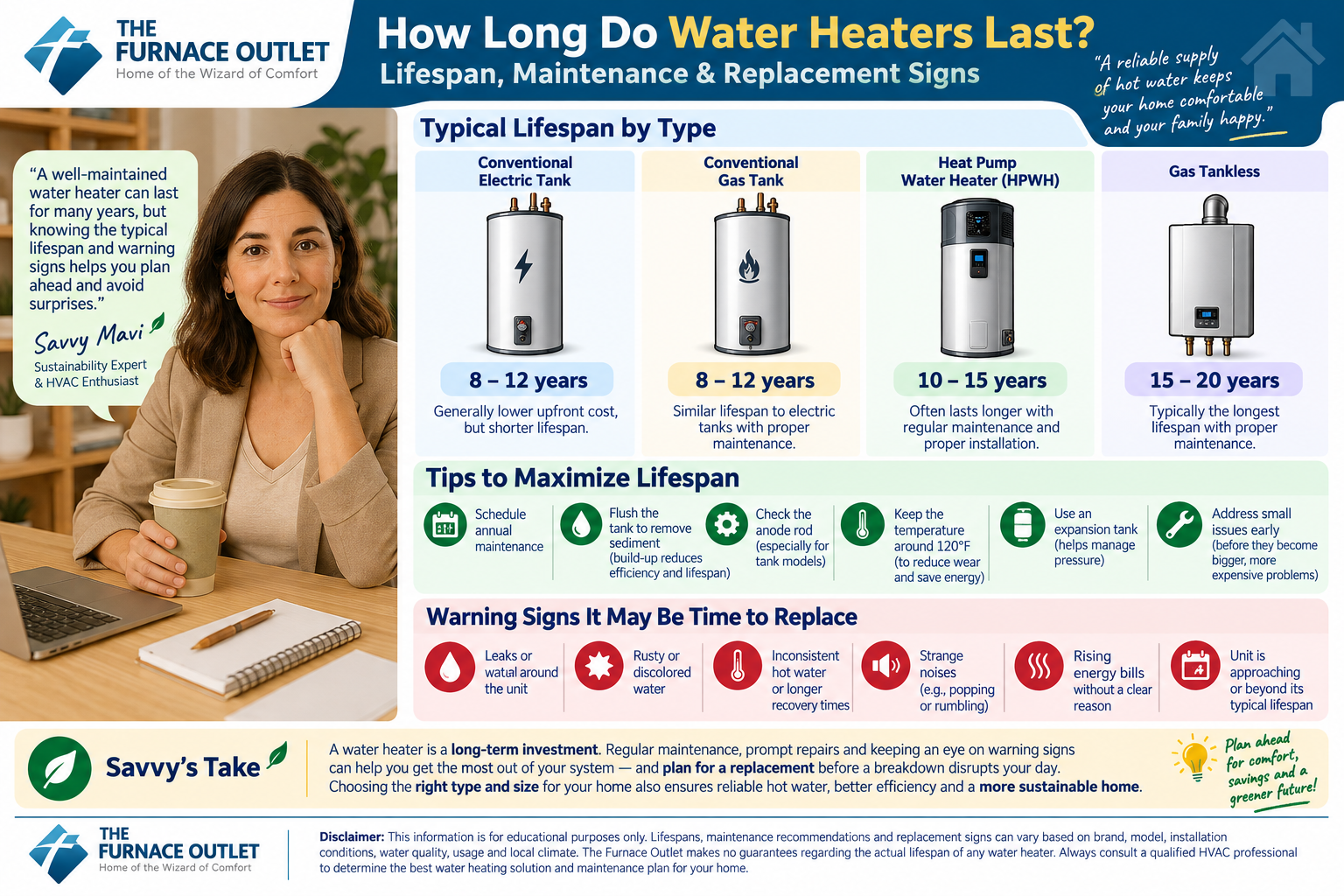
For planning purposes, older U.S. Department of Energy technical guidance has commonly placed traditional tank-type water heaters around 10–15 years, while tankless equipment can reach roughly 20 years or more. ENERGY STAR currently describes certified gas tankless water heaters as having a life expectancy of about 20 years, while its current heat-pump guidance says HPWHs have lifespans similar to electric storage water heaters. Energy Efficiency and Renewable Energy
Those figures are useful planning ranges, not expiration dates. The condition of the actual appliance matters more than a number on a calendar.
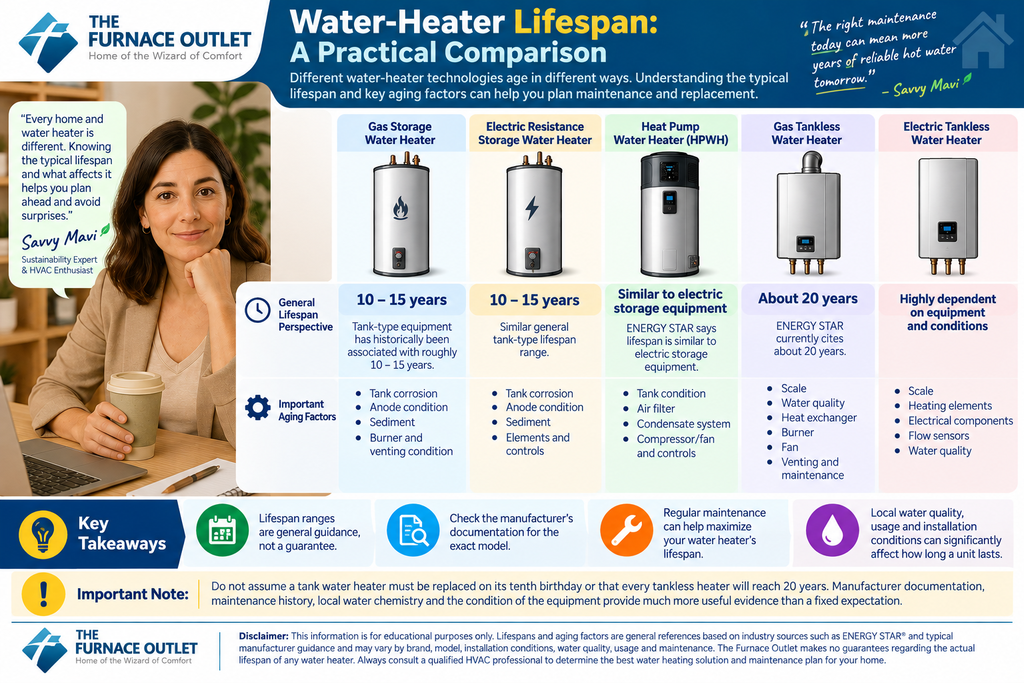
Different technologies age in different ways. Storage water heaters have a tank that remains filled with water, while tankless systems eliminate the large storage vessel but introduce heat exchangers, flow sensors, burners or electric heating components, controls, and other serviceable parts. Heat-pump water heaters combine a storage tank with refrigeration-system components.
| Water-Heater Type | General Lifespan Perspective | Important Aging Factors |
|---|---|---|
| Gas storage | Tank-type equipment has historically been associated with roughly 10–15 years | Tank corrosion, anode condition, sediment, burner and venting condition |
| Electric resistance storage | Similar general tank-type lifespan range | Tank corrosion, anode condition, sediment, elements and controls |
| Heat-pump water heater | ENERGY STAR says lifespan is similar to electric storage equipment | Tank condition, air filter, condensate system, compressor/fan and controls |
| Gas tankless | ENERGY STAR currently cites about 20 years | Scale, water quality, heat exchanger, burner, fan, venting and maintenance |
| Electric tankless | Highly dependent on equipment and conditions | Scale, heating elements, electrical components, flow sensors and water quality |
I would not turn these ranges into a promise that a tank water heater should automatically be replaced on its tenth birthday or that every tankless heater will reach 20 years. Manufacturer documentation for the exact model, maintenance history, local water chemistry, and the condition of the equipment provide much more useful evidence.
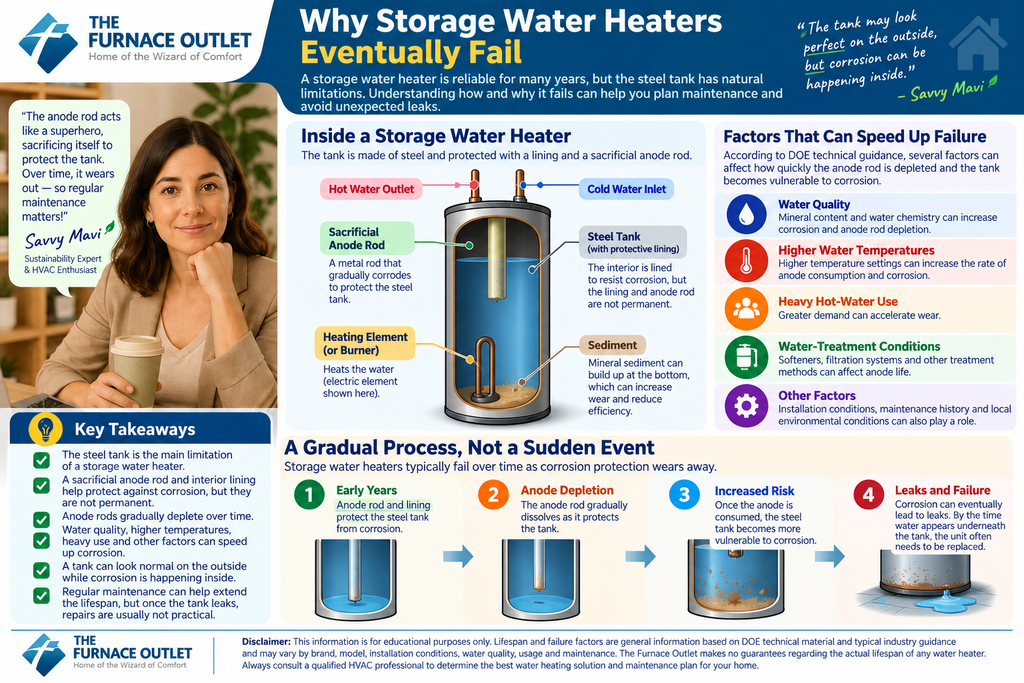
The steel tank is one of the most important limitations of a conventional storage water heater. Manufacturers protect the interior from corrosion with a lining and a sacrificial anode rod, but neither should be treated as permanent protection.
DOE-hosted technical material explains that the anode rod gradually depletes as it protects the tank from corrosion. Once that sacrificial material has been consumed, the steel tank becomes more vulnerable to corrosion and can eventually leak. The same material notes that water quality, higher temperatures, heavy hot-water use, water-treatment conditions, and other factors can affect the rate of anode depletion.
This is why I think of storage-water-heater life as a gradual process rather than a sudden event. A tank can look perfectly normal from the outside while corrosion protection is deteriorating internally. By the time water appears underneath a corroded tank, maintenance may no longer be the solution.
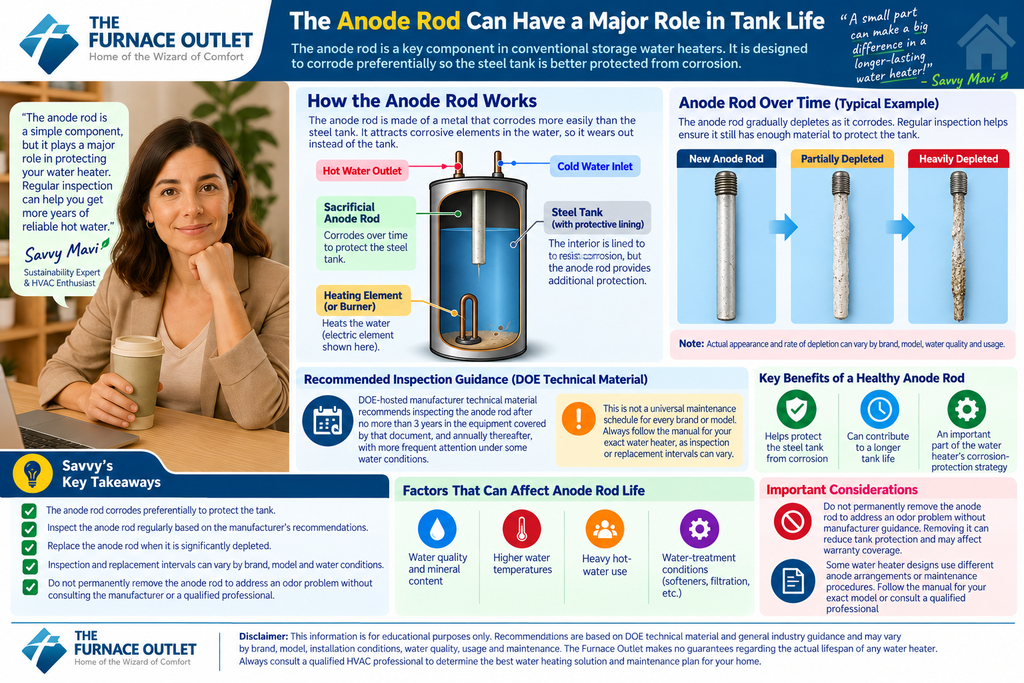
If I owned a conventional storage water heater, the anode rod is one component I would not ignore. Its purpose is to corrode preferentially so that the steel tank is better protected.
DOE-hosted manufacturer technical material recommends inspecting the anode after no more than three years in the particular equipment covered by that document and annually thereafter, with more frequent attention under some water conditions. That should not be treated as a universal maintenance schedule for every brand or model, but it demonstrates why the anode deserves attention.
The correct inspection or replacement interval should come from the manual for the exact water heater. Some designs make anode service relatively straightforward, while others use different arrangements or maintenance procedures.
I would also avoid permanently removing an anode simply to address an odor problem without consulting the manufacturer or a qualified professional. The anode is part of the tank’s corrosion-protection strategy, and altering it can have consequences for tank life and potentially warranty coverage.
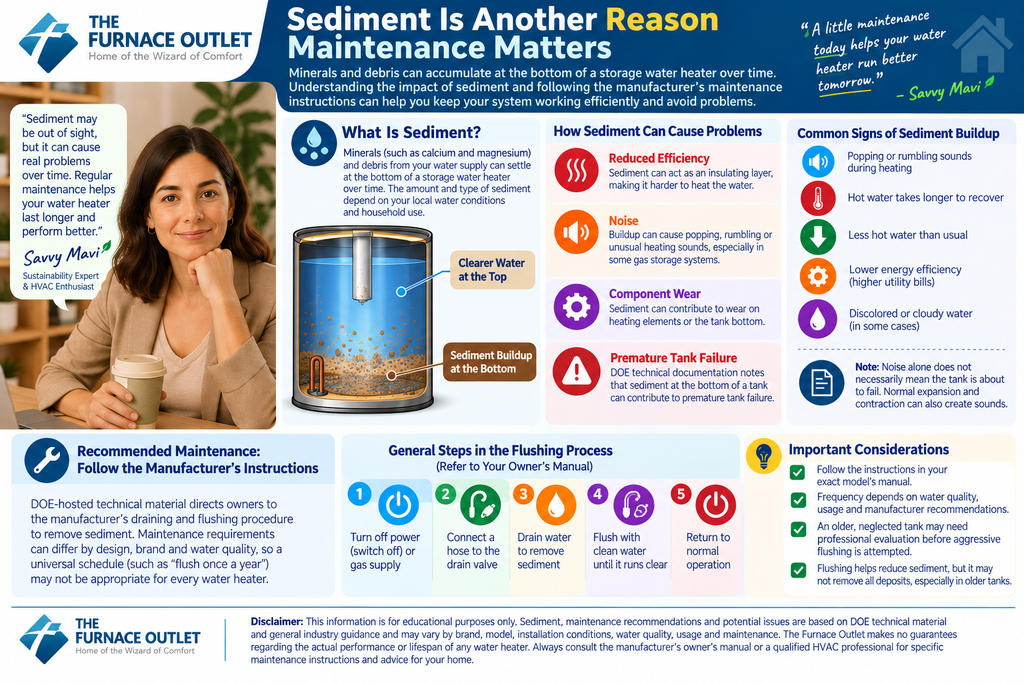
Minerals and debris can accumulate at the bottom of a storage water heater over time. The severity depends heavily on local water conditions and household use.
Sediment is not merely a cosmetic problem. DOE-hosted technical documentation notes that buildup at the bottom of a tank can create noise and contribute to premature tank failure, and it directs owners to the manufacturer’s draining and flushing procedure.
A homeowner might notice popping, rumbling, or unusual heating sounds as deposits accumulate, particularly in some gas storage systems. However, noise alone does not prove that the tank is about to fail because normal expansion and contraction can also create sounds.
I would therefore follow the manufacturer’s flushing instructions rather than applying a universal internet rule such as “flush every water heater once a year.” Maintenance requirements can differ by design and water quality, and an older neglected tank can deserve professional evaluation before aggressive flushing is attempted.
Tankless water heaters eliminate the large storage tank, changing one of the major failure mechanisms associated with conventional equipment. ENERGY STAR currently states that certified gas tankless water heaters have a life expectancy of approximately 20 years, which it describes as substantially longer than conventional tank-type water heaters.
Older DOE technical guidance similarly describes tankless equipment as capable of lasting more than 20 years compared with roughly 10–15 years for traditional tank heaters.
That does not mean tankless equipment is maintenance-free. The heat exchanger can accumulate scale, particularly where water is hard. Gas systems also contain burners, fans, ignition components, sensors, venting and condensate components in condensing designs.
A tankless heater’s potential longevity is therefore partly dependent on proper installation and maintenance. I would follow the exact manufacturer’s descaling and inspection instructions, particularly in hard-water locations, rather than assuming that eliminating the tank also eliminates maintenance.
Two identical water heaters installed in different homes can age very differently because they may be exposed to different water chemistry.
Hard water can encourage mineral accumulation in tanks and heat exchangers. Other water conditions can influence corrosion. Water treatment can also affect equipment in ways homeowners may not expect; DOE-hosted technical material, for example, notes that artificially softened water can increase corrosive conditions affecting anode depletion in the equipment it discusses.
This does not mean homeowners should avoid water treatment. It means that water-heater maintenance should account for the water actually entering the appliance. If scale repeatedly develops in a tankless heat exchanger or an anode is disappearing unusually quickly, I would investigate the underlying water conditions rather than treating each maintenance event as an isolated problem.
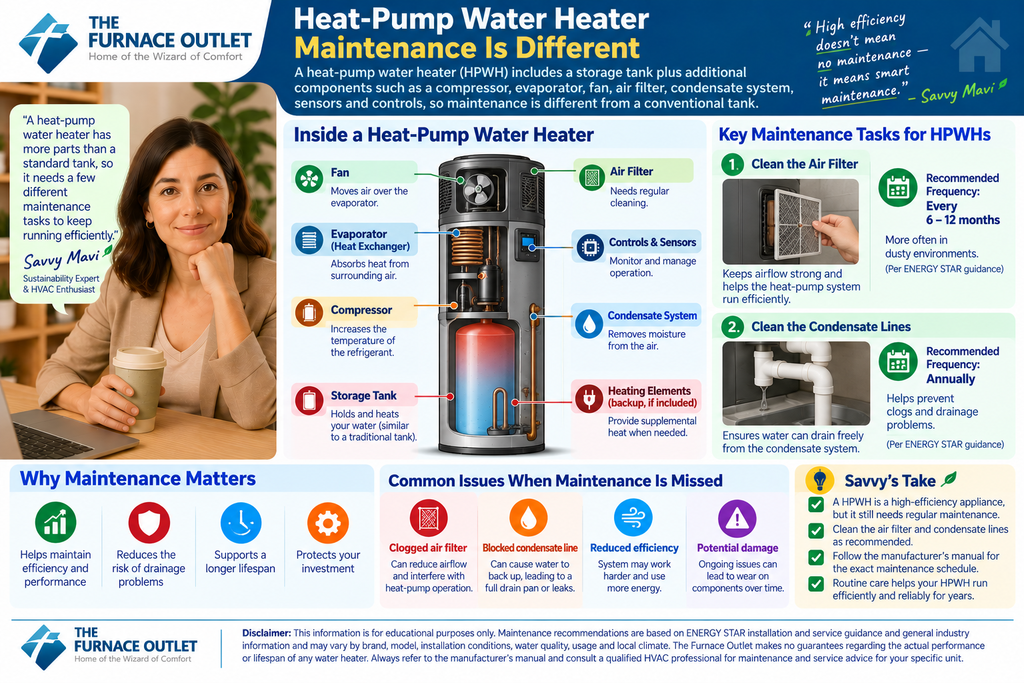
A heat-pump water heater contains a storage tank, so tank-related considerations still matter, but it also adds a compressor, evaporator, fan, air filter, condensate system, sensors, and controls.
ENERGY STAR’s current installation and service guidance says common HPWH-specific routine maintenance includes cleaning the air filter and condensate lines. It recommends cleaning air filters every six to twelve months, with more frequent attention in dusty environments, and cleaning condensate lines annually so that water can drain freely. The manufacturer manual should determine the final maintenance schedule for the exact unit.
A clogged air filter can interfere with airflow through the heat-pump system, while a blocked condensate line can create drainage problems. Standing water in a drain pan may indicate that condensate is not flowing correctly.
These are relatively modest maintenance tasks, but they illustrate an important point: buying a highly efficient appliance does not eliminate the need to maintain it.
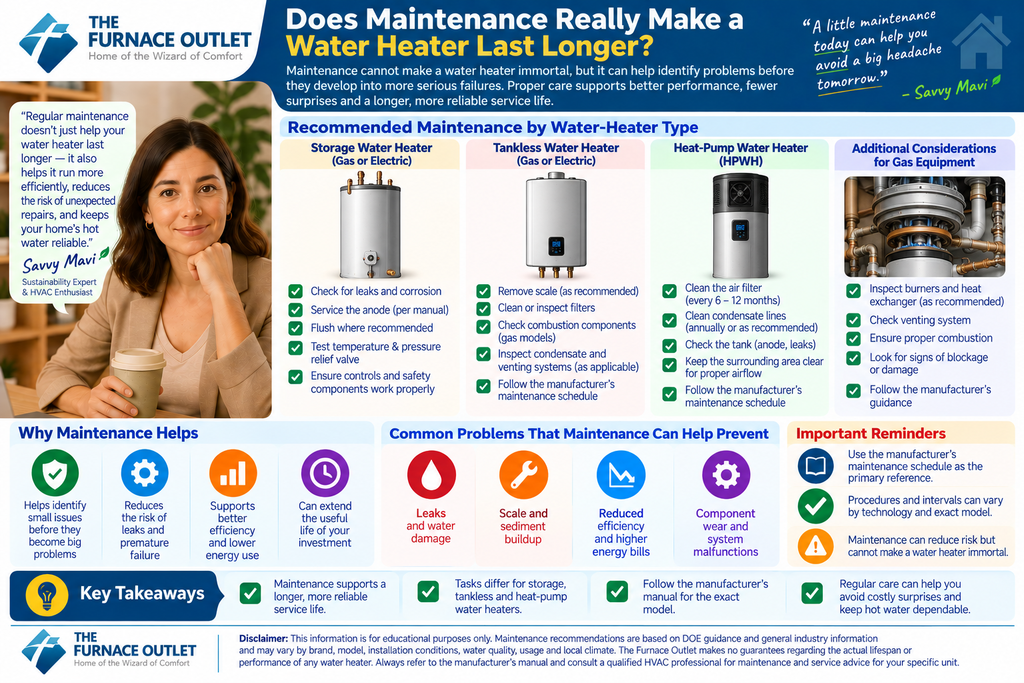
Maintenance cannot make a water heater immortal, but it can help identify problems before they develop into more serious failures. DOE’s broader operations-and-maintenance guidance emphasizes that inadequate maintenance of water-using equipment can contribute to leaks, losses, and premature equipment failure.
For a storage heater, useful maintenance may include checking for leaks and corrosion, servicing the anode according to manufacturer guidance, flushing where recommended, and ensuring safety components remain functional. Gas equipment additionally requires attention to combustion and venting components.
For tankless equipment, maintenance may involve scale removal, cleaning or inspection of filters and combustion components, and checking condensate and venting systems as applicable. HPWH maintenance adds air-filter and condensate attention.
I would use the manufacturer’s maintenance schedule as the primary reference, because the appropriate procedure and interval can vary significantly by technology and exact model.
A small amount of water near a water heater does not automatically mean that the storage tank itself has failed. Water can come from plumbing connections, a drain valve, condensate, the temperature-and-pressure relief system, or another nearby source. A confirmed leak through a corroded storage tank is much more serious. Once the tank structure itself has failed, replacing a fitting or valve does not repair the underlying tank corrosion.
I would treat unexplained water around a heater as something to investigate promptly rather than placing a towel underneath it and waiting. Water damage can become far more expensive than the water heater itself, particularly when equipment is installed above finished living space.
ENERGY STAR’s HPWH installation guidance recommends a drain pan connected to suitable drainage as a best practice, especially where leakage could damage the surrounding floor or building.
If a water heater that once handled normal household demand begins running out of hot water much sooner, something has changed. Sediment, failing electric heating elements, thermostat or control problems, burner issues, a damaged dip tube on applicable equipment, or other faults can affect delivery.
This symptom does not automatically justify replacement. A serviceable component may be responsible, particularly when the tank itself is in good condition and the heater is not near the end of its expected service period.
Age changes the economics, however. I would be more willing to invest in a straightforward repair on a relatively young heater than to spend heavily repairing an older appliance showing several additional signs of deterioration.
The decision should compare the repair cost, equipment condition, efficiency of the existing heater, warranty status, and cost of an appropriate replacement.
Visible corrosion around fittings or the water heater deserves attention. Rust-colored water can also justify investigation, although discoloration does not automatically prove that the tank is failing because plumbing and water-supply conditions can have other causes.
The condition of the anode becomes particularly relevant in a glass-lined steel storage tank. As the sacrificial rod becomes depleted, corrosion protection can diminish. DOE-hosted documentation specifically warns that once an anode is exhausted, the tank can begin corroding and ultimately develop a leak.
I would therefore have persistent rust or corrosion diagnosed rather than simply treating the discoloration. If corrosion is occurring in the tank structure of an older heater, replacement can become much more sensible than continuing to repair peripheral components.
Water heaters are not silent appliances. Expansion, contraction, burners, fans, heat pumps, and flowing water can all create normal operating sounds.
New or increasingly severe rumbling, popping, banging, or other unusual noises deserve investigation. Sediment at the bottom of a storage tank can contribute to noise, while tankless and HPWH equipment have different components capable of producing abnormal sounds when something is wrong.
DOE-hosted technical guidance specifically identifies sediment buildup as one possible source of storage-water-heater noise and notes that heavy buildup may contribute to premature tank failure.
The useful question is therefore not simply whether the water heater makes noise, but whether the sound has changed from its normal operating behavior.
One repair does not necessarily mean a water heater should be replaced. A serviceable valve, sensor, thermostat, heating element, igniter, or other component can fail while the rest of the equipment remains in good condition. Repeated repairs change the calculation. If an aging heater has already needed several service calls and another expensive component fails, continuing to repair it can become poor economics.
I would add the likely repair cost to what has already been spent recently and compare that with the installed price of a properly sized replacement. I would also consider whether replacing the old heater creates an opportunity to improve efficiency, hot-water performance, leak protection, or fuel choice.
This is particularly important because emergency replacement usually gives homeowners less time to research alternatives.
Age becomes most useful when combined with condition. An older tank that remains dry, delivers adequate hot water, operates safely, and has been maintained is different from an equally old tank showing corrosion, leaks, declining performance, and repeated component failures.
I would therefore avoid a rigid rule such as “replace every tank heater at exactly ten years.” The 10–15-year historical range for tank-type equipment is a planning reference, not an automatic expiration date.
Once a storage heater enters an older stage of service, however, I would inspect it more deliberately and begin researching replacement options before failure. Planning ahead creates time to compare conventional tanks, HPWHs, gas tankless systems, available electrical capacity, installation requirements, and current incentives.
ENERGY STAR similarly advises homeowners to plan ahead for water-heater replacement when possible rather than waiting for an emergency.
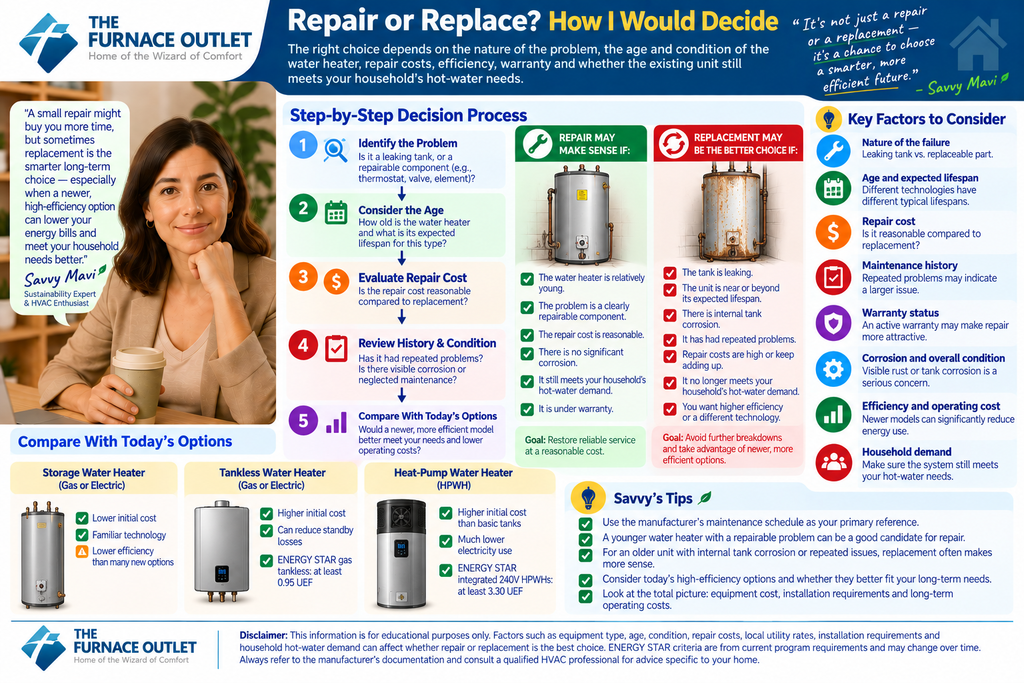
My decision would begin with the nature of the failure. A leaking tank is fundamentally different from a replaceable thermostat or serviceable valve. I would then consider age, repair cost, maintenance history, warranty, corrosion, efficiency, and whether the existing heater still satisfies household demand.
For a younger water heater with a clearly repairable problem, repair may be entirely sensible. For an older storage heater with internal tank corrosion or repeated problems, putting additional money into the appliance may only delay an inevitable replacement.
I would also compare the old heater with today’s alternatives. ENERGY STAR’s current criteria, for example, require qualifying integrated 240V HPWHs to reach at least 3.30 UEF, while qualifying gas tankless heaters require at least 0.95 UEF. An old heater may therefore present an opportunity to reconsider technology rather than automatically purchasing an identical replacement.
For a storage water heater, I would periodically inspect the appliance and surrounding area for moisture, corrosion, unusual noises, or changes in hot-water performance. I would follow the manufacturer’s instructions for tank flushing, anode inspection, safety-device maintenance, and other service rather than applying a generic schedule to every model.
For a tankless heater, I would follow manufacturer guidance for scale control or descaling, filters, combustion-system inspection, condensate management, and venting where applicable. Water hardness can make scale-related maintenance particularly important.
For an HPWH, I would add air-filter and condensate-line maintenance. ENERGY STAR currently recommends filter cleaning every six to twelve months and condensate-line cleaning annually as general best practices, while emphasizing that the manufacturer’s manual should determine the exact procedure.
The objective is not simply to stretch the heater’s lifespan as far as physically possible. Good maintenance also supports reliable operation, efficiency, safety, and earlier detection of problems.
DOE technical guidance has historically used roughly 10–15 years as an expected range for traditional tank-type water heaters.Actual service life can be shorter or longer depending on water quality, tank construction, anode condition, maintenance, installation, usage, and other factors, so I would use that range for planning rather than as an expiration date.
ENERGY STAR currently gives certified gas tankless water heaters a life expectancy of about 20 years, while older DOE guidance similarly describes tankless equipment as capable of lasting more than 20 years. Scale, water quality, maintenance, installation, and component condition can still substantially affect actual lifespan.
ENERGY STAR states that current HPWHs have lifespans similar to electric storage water heaters and notes that many come with ten-year warranties. Warranty length should not be interpreted as a guaranteed lifespan, and the exact manufacturer’s warranty and maintenance documentation should always be checked.
Not solely because it has reached ten years. I would consider age together with leaks, corrosion, declining hot-water delivery, unusual noises, repair history, maintenance, warranty status, and the consequences of an unexpected failure. An older tank in a location where leakage could cause major damage deserves particularly careful planning.
Flushing can help manage sediment when it is recommended for the equipment, and DOE-hosted technical material notes that sediment buildup can contribute to noise and premature tank failure. The correct flushing procedure and interval should come from the manufacturer, particularly for an older heater that has not previously been maintained.
It depends on the source of the leak. Connections, valves, condensate systems, or other components may be repairable. A confirmed leak through the storage tank itself generally indicates a much more serious structural problem, so the source should be identified promptly by a qualified professional.
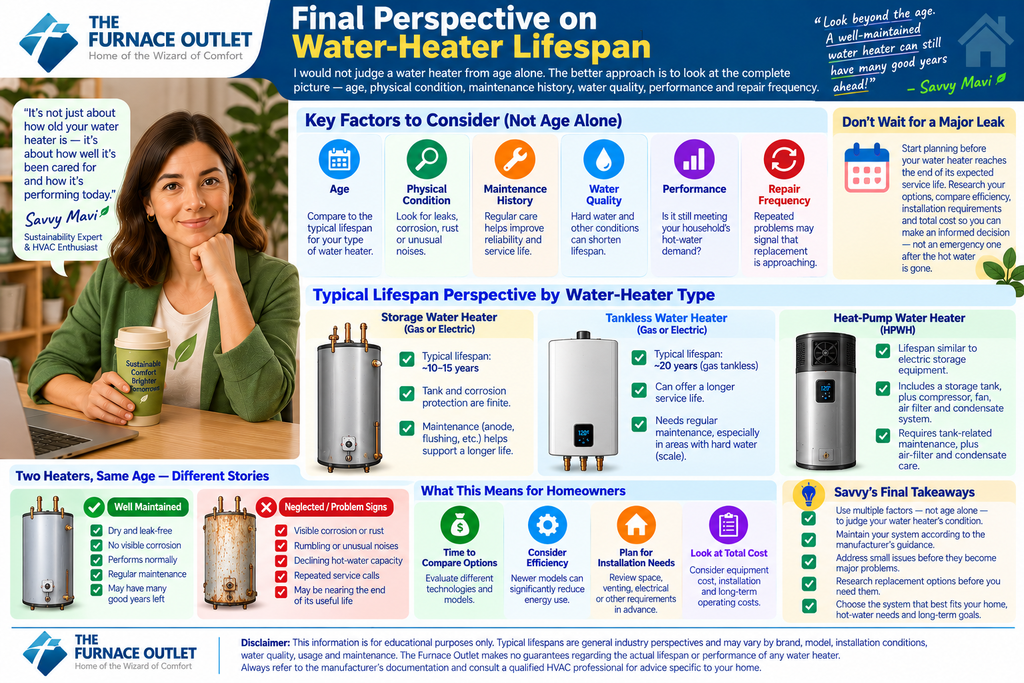
I would not judge a water heater from age alone. The better approach is to combine age, physical condition, maintenance history, water quality, performance, and repair frequency. A ten-year-old heater that is dry, well maintained, and performing normally tells a very different story from one of the same age with corrosion, rumbling, declining capacity, and repeated service calls.
Storage heaters deserve particular attention because the tank and its corrosion protection are finite. Tankless systems can offer a longer service life, but they still need maintenance, especially where scale is a concern. Heat-pump water heaters add air-filter and condensate maintenance to the familiar requirements of a storage tank.
Most importantly, I would not wait for a major leak to begin thinking about the next water heater. As an appliance approaches the later part of its expected service life, researching replacement technologies in advance gives homeowners time to compare sizing, efficiency, installation requirements, and total cost rather than making an emergency decision after the hot water disappears.
For homeowners who want to explore maintenance, longevity, and replacement planning in greater detail, these resources provide useful independent technical guidance.
The Furnace Outlet is an independent informational and educational resource. It is not associated with, affiliated with, endorsed by, or sponsored by any water-heater manufacturer or brand discussed in this article, and it does not receive manufacturer compensation for inclusion or rankings.
Water-heater lifespan figures are general planning estimates rather than guarantees. Actual equipment life depends on manufacturer and model, tank and heat-exchanger construction, installation, water chemistry, water hardness, household usage, temperature settings, maintenance, environmental conditions, and component failures. Maintenance procedures and intervals also vary by product, so the manufacturer’s current instructions for the exact model should take precedence over generalized guidance. Water heaters involve hot water, electricity, gas, combustion, pressure, and potentially scalding temperatures; inspection, repair, alteration, and replacement should be performed by appropriately qualified or licensed professionals where required.