Newsletter Subscribe
Enter your email address below and subscribe to our newsletter

HVAC made simple
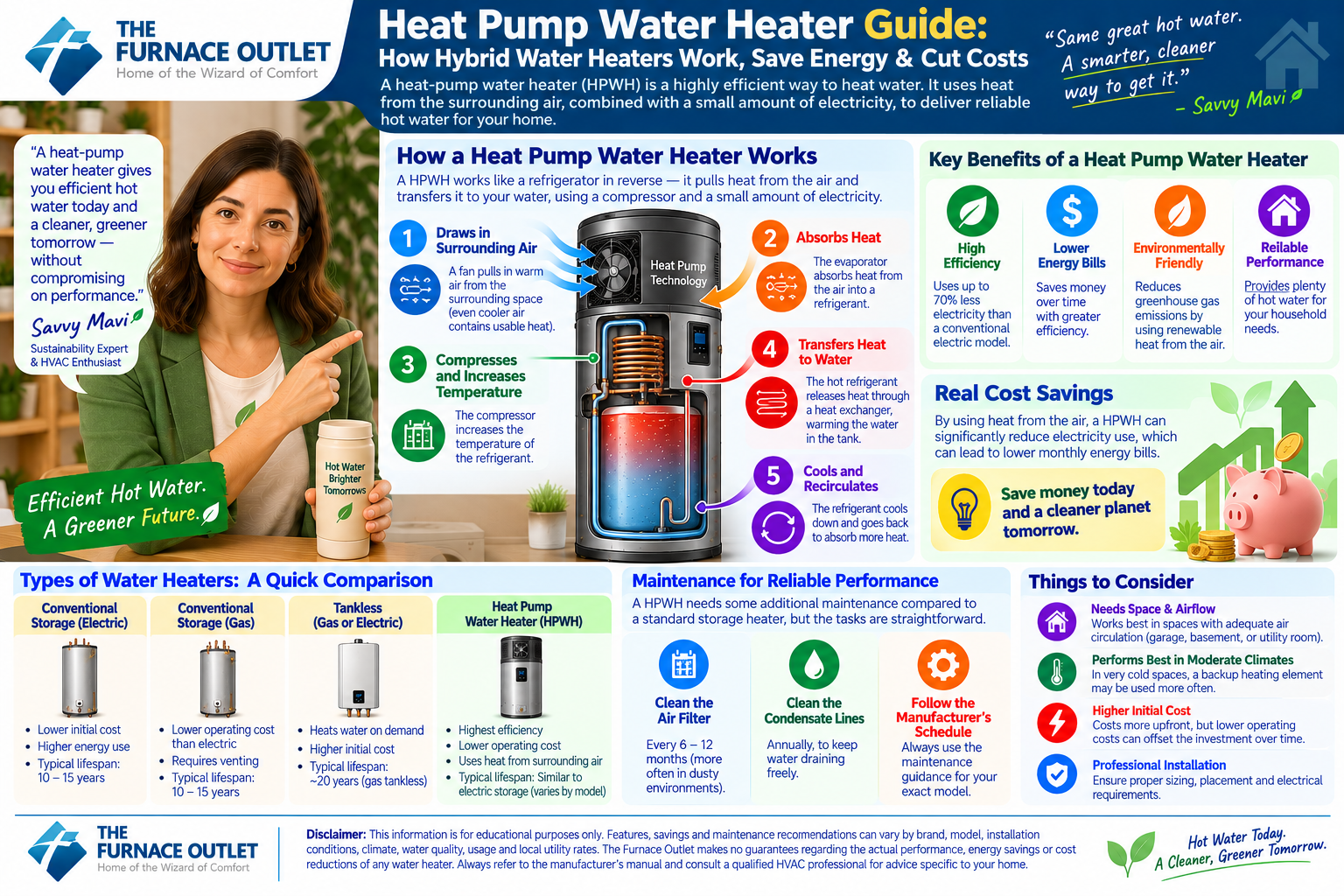
Heat-pump water heaters have moved from being a relatively specialized efficiency upgrade to becoming one of the most important technologies to consider when replacing an electric water heater. They look somewhat like conventional storage tanks, but the equipment sitting on top of the tank changes how most of the water heating happens. Instead of relying primarily on electric-resistance elements to create heat, a heat-pump water heater uses electricity to move heat from the surrounding air into the stored water.
I’m Savvy Mavi, Savvy the Sustainability Expert, and what interests me most about heat-pump water heaters is that they can improve efficiency without asking a household to give up the convenience of stored hot water. Many models also include conventional electric-resistance elements for periods of unusually high demand, which is why you will frequently see them called hybrid water heaters. That combination gives homeowners an efficient primary heating method together with backup capacity when additional recovery is required.
The potential energy savings are substantial. ENERGY STAR says certified heat-pump water heaters use about 70% less energy than a standard electric water heater, while its current consumer model estimates approximately $550 per year in electricity savings for a four-person household under specified assumptions. Those figures deserve attention, but they should not be treated as guaranteed savings for every home because electricity rates, household size, installation conditions, hot-water demand, and operating mode all affect actual performance.
A heat-pump water heater, usually abbreviated HPWH, is an electrically powered storage water heater that uses a refrigeration cycle to capture heat from the surrounding environment and transfer it into the water.
ENERGY STAR offers an easy analogy: think of a refrigerator working in reverse. A refrigerator removes heat from its interior and releases that heat into the room. An integrated HPWH instead pulls heat from the surrounding air and transfers it into the water stored inside its tank.
The major components typically include an evaporator, compressor, refrigerant circuit, condenser or heat exchanger, fan, water-storage tank, controls, and—in many integrated models—electric-resistance heating elements. The heat-pump components are usually incorporated into the top portion of the appliance, which explains why an HPWH can be taller than a conventional electric storage heater.
The important distinction is that electricity is being used primarily to operate a heat-transfer process, rather than producing all of the required heat directly through resistance elements. That is the foundation of the technology’s efficiency advantage.
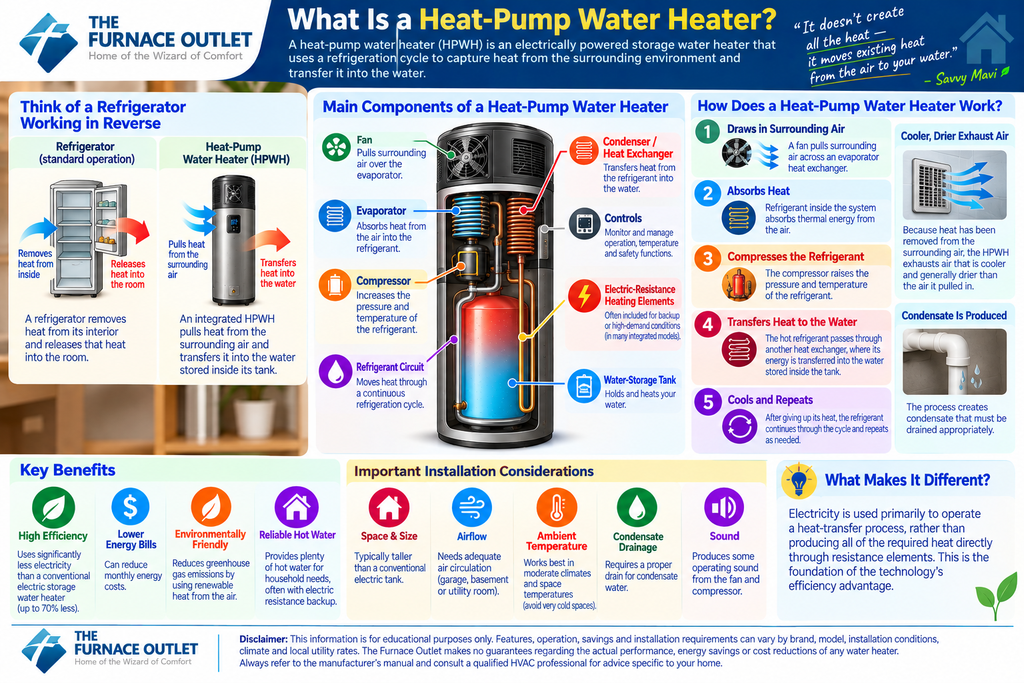
The operating sequence begins when a fan pulls surrounding air across an evaporator heat exchanger. Refrigerant inside the heat-pump system absorbs thermal energy from that air.
The compressor then raises the pressure and temperature of the refrigerant. That hotter refrigerant passes through another heat exchanger, where its energy is transferred into the water stored inside the tank. After giving up its heat, the refrigerant continues through the refrigeration cycle and repeats the process as needed. ENERGY STAR’s technical guide describes the same sequence of capturing room-air heat, compressing the refrigerant, and transferring the resulting heat into the stored water.
Because heat has been removed from the surrounding air, the HPWH exhausts air that is cooler and generally drier than the air it pulled in. The appliance also creates condensate that must be drained appropriately.
This interaction with the surrounding room is one reason an HPWH cannot simply be treated as a drop-in electric tank in every installation. Space, airflow, ambient temperature, condensate drainage, and sound all deserve consideration before selecting the equipment.
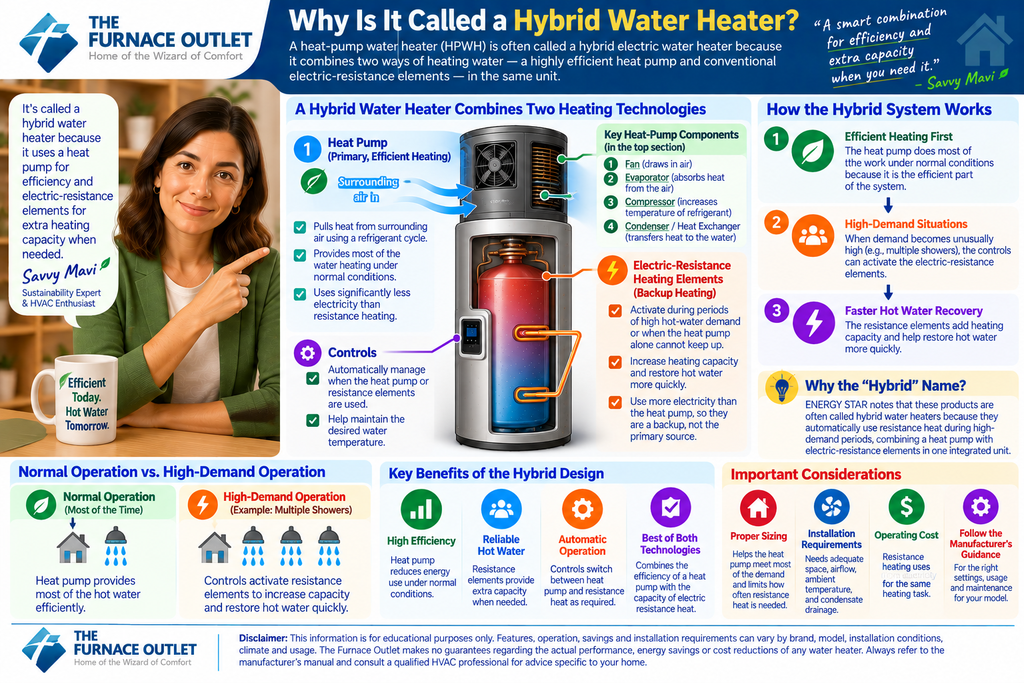
The terms heat-pump water heater and hybrid electric water heater are frequently used for the same general category because many integrated HPWHs contain both a heat pump and conventional electric-resistance elements.
Under ordinary conditions, the heat pump does most of the work because that is the efficient part of the system. When demand becomes unusually high, the controls can activate resistance elements to increase heating capacity and restore hot water more quickly. ENERGY STAR specifically notes that this automatic use of resistance heat during high-demand periods is why these products are often called hybrid water heaters.
I think of this arrangement as an efficiency-first system with a backup accelerator. The heat pump should ideally perform as much of the routine water heating as practical, while resistance elements provide additional capacity when the household needs more hot water than the heat pump can restore quickly enough on its own.
That balance is important because resistance heating uses substantially more electricity for the same water-heating task. Correct sizing therefore affects not only comfort but also how efficiently the HPWH operates in real life.
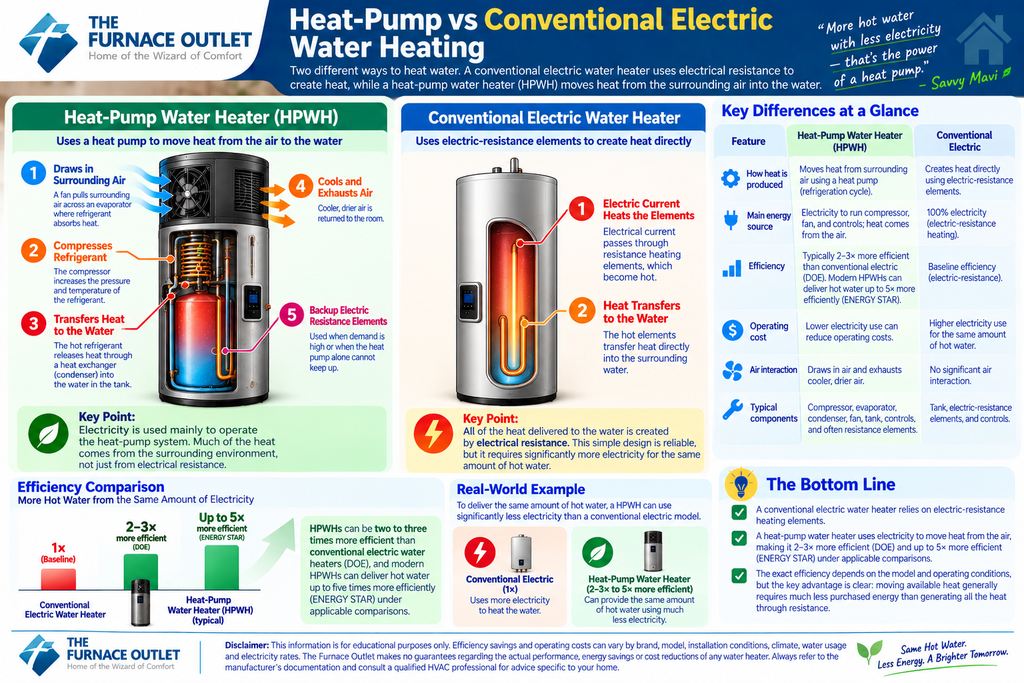
A standard electric-resistance water heater is conceptually simple. Electrical current passes through resistance heating elements, which become hot and transfer that heat into the water. A heat-pump water heater takes a different approach. It uses electricity to operate the compressor, fan, controls, and refrigeration cycle, while much of the heat delivered to the water originates in the surrounding environment.
DOE’s Building Science Education program says HPWHs can be two to three times more efficient than conventional electric-resistance water heaters, while ENERGY STAR’s broader technical guidance states that modern HPWHs can deliver hot water up to five times more efficiently than standard electric-resistance, gas, and propane water heaters under applicable comparisons.
The exact efficiency varies by model and operating conditions, but the underlying advantage is clear: moving available heat generally requires considerably less purchased energy than generating all the required heat through resistance.
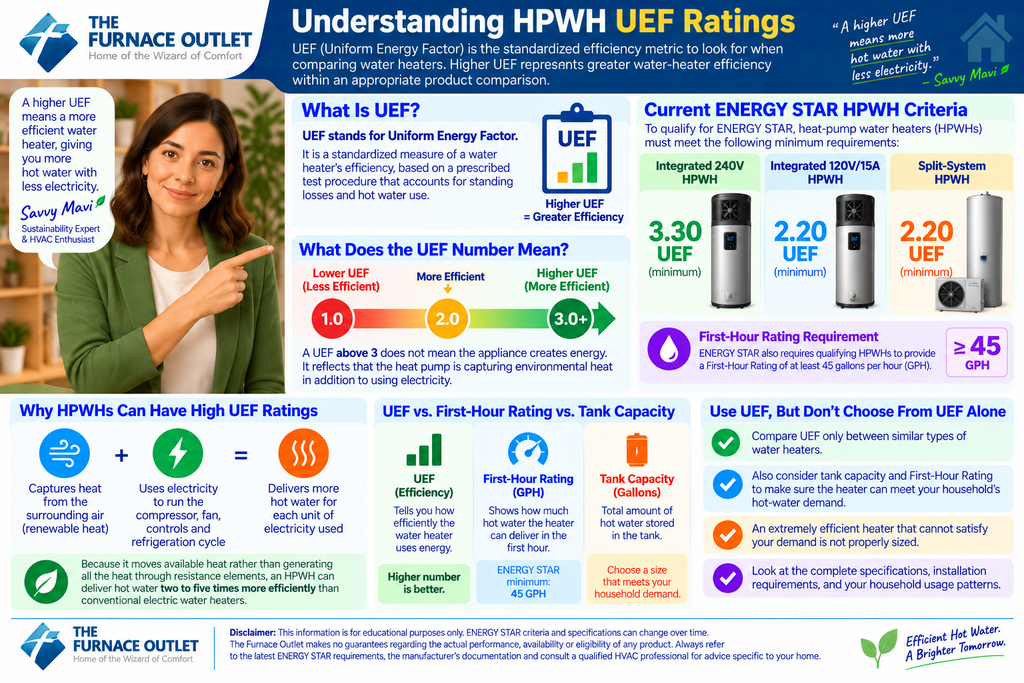
The standardized efficiency metric to look for is UEF, or Uniform Energy Factor. Higher UEF represents greater standardized water-heater efficiency within an appropriate product comparison.
Current ENERGY STAR criteria require an integrated 240V heat-pump water heater to achieve at least 3.30 UEF. Integrated 120V/15A and split-system HPWH configurations currently have a minimum ENERGY STAR criterion of 2.20 UEF. ENERGY STAR also requires qualifying HPWHs to provide a First-Hour Rating of at least 45 gallons per hour.
A UEF above 3 does not mean the appliance somehow creates energy. It reflects the fact that the heat pump is capturing environmental heat in addition to consuming electricity.
I would use UEF to compare appropriate HPWH models, but I would not choose from UEF alone. Tank capacity and First-Hour Rating still matter, because an extremely efficient heater that cannot satisfy the household’s hot-water demand is not properly sized.
ENERGY STAR currently says certified HPWHs use approximately 70% less energy than a standard electric water heater. For a four-person household, its current modeling estimates annual electricity savings of about 3,760 kWh and approximately $550 per year.
The published ENERGY STAR example assumes electricity costing $0.146 per kWh, an incremental HPWH cost of $1,503, and a 13-year modeled lifespan. Under those assumptions, ENERGY STAR estimates an approximately 2.7-year payback and more than $5,600 in lifetime savings for a household of four.
Household size changes the modeled result. ENERGY STAR currently estimates approximately $270 per year for a two-person household and $410 for three people under the same basic assumptions, with higher savings for the modeled four-person household because more hot water means more opportunity for the efficient technology to save energy.
These numbers are useful benchmarks rather than promises. If electricity costs significantly more or less than the ENERGY STAR assumption, or if your household uses a different amount of hot water, the dollar savings and payback will change.
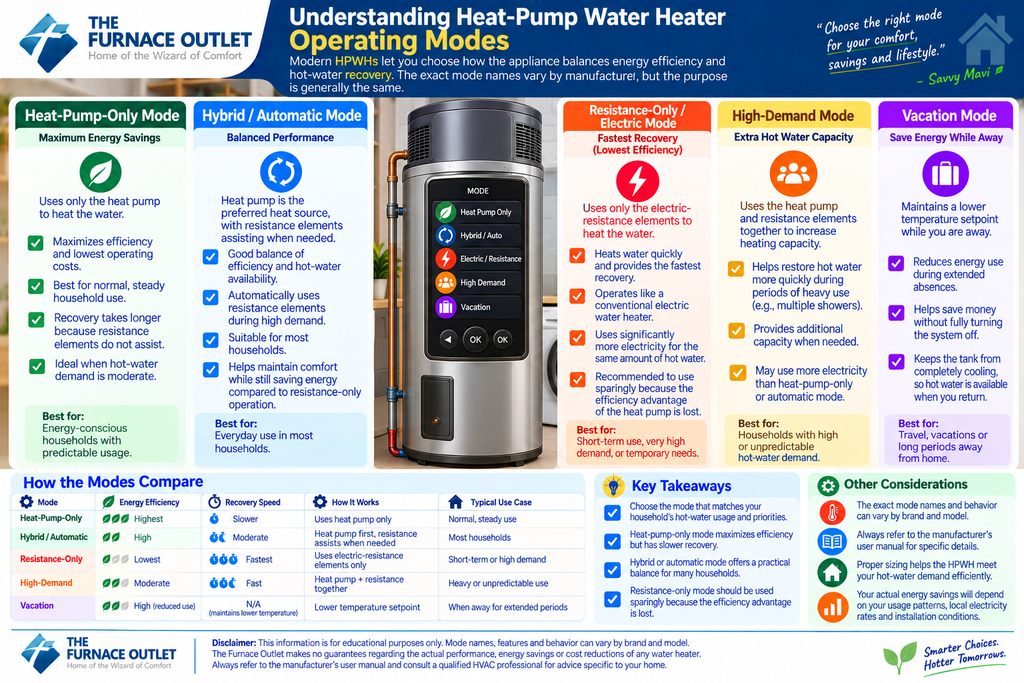
One advantage of a modern HPWH is that the homeowner can often choose how aggressively the appliance prioritizes efficiency versus recovery speed. The exact names differ by manufacturer, but common modes include heat-pump-only, hybrid or automatic, resistance-only, high-demand, and vacation settings.
In heat-pump-only mode, the appliance relies primarily or exclusively on the refrigeration system. This can maximize energy savings, but recovery takes longer because resistance elements are not helping restore the tank rapidly. In hybrid or automatic operation, the heat pump remains the preferred heating source while resistance elements can assist when demand requires additional recovery. This can provide a practical balance between efficiency and hot-water availability for many households.
A resistance-only or electric mode effectively turns the appliance into something much closer to a conventional electric water heater for that period. DOE guidance recommends using this type of operation sparingly because the efficiency advantage of the heat pump is lost while resistance heating is doing the work.
This is where I would be particularly careful. If an HPWH is too small for the household’s peak demand, it may repeatedly call on its resistance elements to recover more quickly. The family may still have hot water, but some of the efficiency advantage that justified purchasing the heat pump can be reduced.
I would therefore compare First-Hour Rating, not just tank gallons. FHR estimates how much hot water a storage heater can supply during an hour beginning with a fully heated tank.
ENERGY STAR’s HPWH installation guidance notes that a properly sized system can satisfy typical demand without triggering resistance heating as frequently. Its broader design guidance also encourages consideration of storage capacity when the objective is to maximize heat-pump operation.
For that reason, I would not automatically replace a 50-gallon resistance heater with a 50-gallon HPWH simply because the nominal tank size matches. Depending on household demand, comparing 50-, 65-, and 80-gallon HPWH configurations can make sense. The correct choice should be based on the exact model’s FHR, household peak-hour demand, available space, and manufacturer sizing guidance rather than a universal gallons-per-person rule.
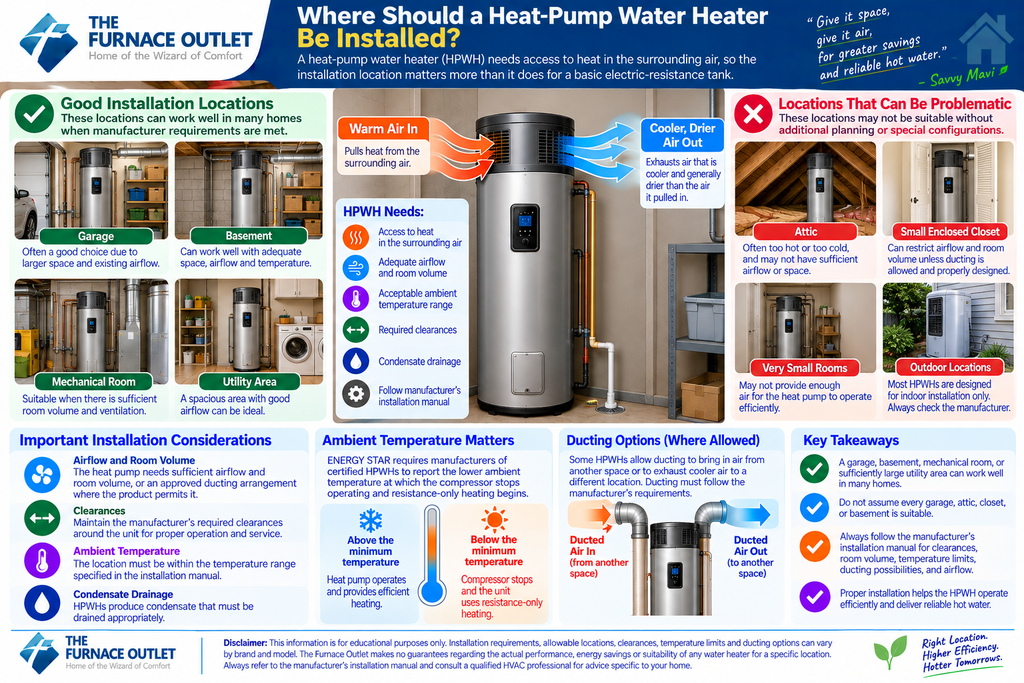
An HPWH needs access to heat in the surrounding air, so installation location matters more than it does for a basic resistance tank. A garage, basement, mechanical room, or sufficiently large utility area can work well in many homes, provided the exact manufacturer’s requirements are satisfied. Small enclosed spaces can require additional planning because the heat pump needs sufficient airflow and room volume, or an appropriate ducting arrangement where the product permits it.
Ambient temperature also affects heat-pump operation. ENERGY STAR requires manufacturers of certified HPWHs to report the lower ambient temperature at which the compressor stops operating and resistance-only heating begins.
I would therefore never assume that every garage, attic, closet, or basement is automatically suitable. The exact installation manual should determine required clearances, room volume, temperature limits, ducting possibilities, and airflow.
Because an HPWH removes heat from surrounding air, it exhausts cooler air back into the space. That can be an advantage or disadvantage depending on location and climate. In a warm garage or basement, the cooling and dehumidifying effect may be welcome. In a conditioned room during winter, however, the building’s heating system may need to replace some of the heat extracted by the water heater.
This interaction is another reason I prefer installation-specific analysis instead of declaring that HPWHs belong in one universal location. Climate, whether the room is conditioned, surrounding heat sources, ducting options, and household priorities can all influence the best arrangement.
The important point is that an HPWH is exchanging heat with its environment. That environment becomes part of the water-heating system.
The refrigeration process can remove moisture from the air, which means an integrated HPWH produces condensate. That water needs somewhere to go. ENERGY STAR’s installation guidance discusses appropriate condensate drainage and recommends installation practices that reduce the risk of condensate problems.
Where gravity drainage is available, the solution can be relatively straightforward. In other locations, a condensate pump may be needed, subject to the manufacturer’s instructions and applicable codes.
I would include condensate planning in the installation quote rather than treating it as a small detail to solve after the heater arrives. A technically excellent HPWH installed without a reliable drainage strategy is not a good installation.
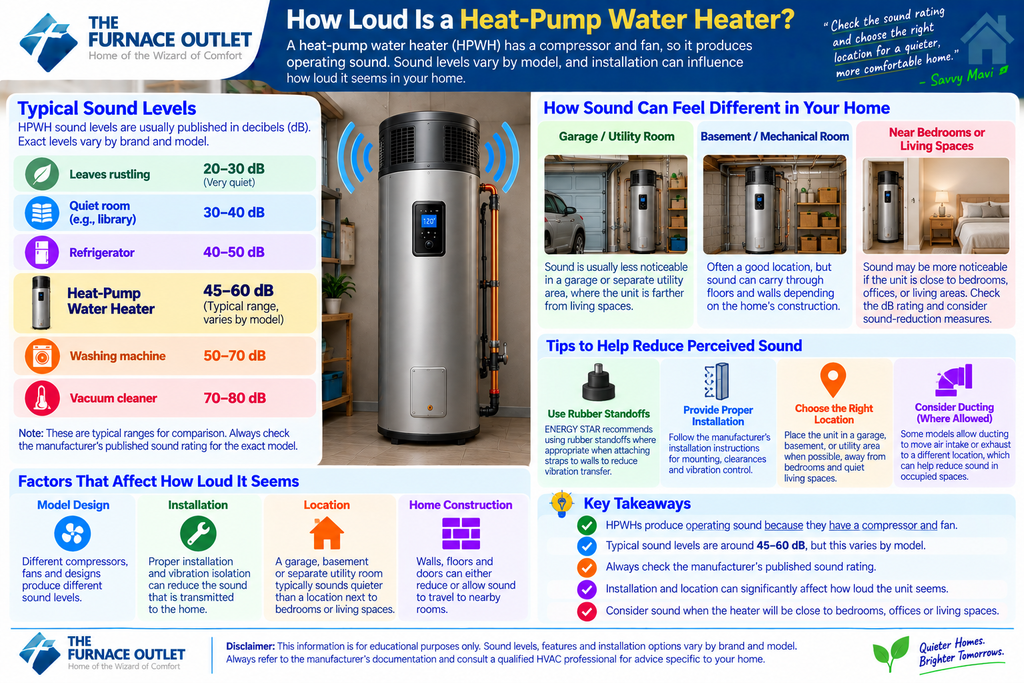
Unlike a basic electric-resistance tank, an HPWH has a compressor and fan. That means it produces operating sound. Sound levels vary by model, so I would check the published rating when the heater will be close to bedrooms, offices, or living spaces. Equipment located in a garage may present a very different acoustic concern from the same appliance installed immediately behind a bedroom wall.
Installation can also influence perceived sound. ENERGY STAR recommends practices such as using rubber standoffs where appropriate when attaching straps to walls to reduce vibration transfer. I would therefore treat sound as another specification to compare rather than assuming every HPWH is either “quiet” or “noisy.”
HPWH maintenance includes familiar storage-water-heater considerations plus a few tasks associated with the heat pump.
The air filter needs attention because the heat pump relies on airflow. ENERGY STAR’s current installation and service guidance recommends cleaning the air filter approximately every six to twelve months, with more frequent cleaning in dusty environments. It also recommends cleaning condensate lines annually so that water can drain freely.
Tank maintenance should follow the manufacturer’s instructions, including any recommendations concerning flushing, sediment management, anode inspection, or other service. The exact requirements can differ by product and local water conditions. These tasks are not especially complicated, but ignoring them can undermine the performance of an appliance purchased specifically for its efficiency.
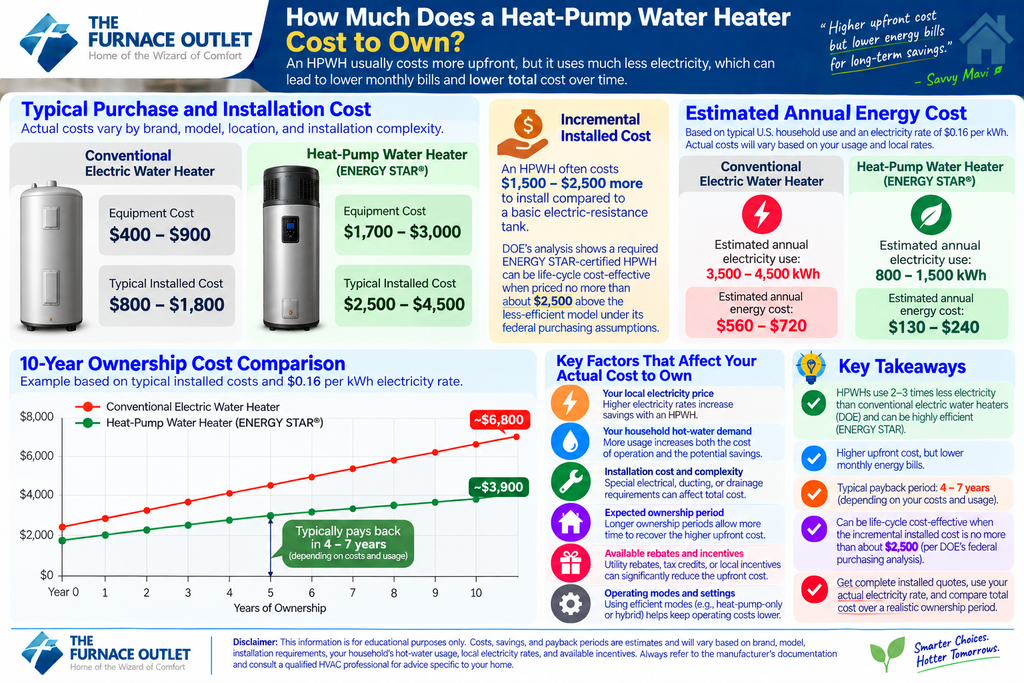
The purchase price of an HPWH is generally higher than a basic electric-resistance tank, so I would compare incremental installed cost against realistic annual savings rather than equipment price alone.
DOE’s Federal Energy Management Program currently concludes that a required ENERGY STAR-certified residential HPWH can be life-cycle cost-effective when priced no more than about $2,500 above the less-efficient model under its federal purchasing assumptions. Its analysis also shows meaningful lifetime cost savings for efficient HPWH equipment.
That does not mean every homeowner should willingly pay an extra $2,500. Your local electricity price, installation quote, household demand, expected ownership period, and available incentives determine the real calculation.
I would obtain complete installed quotes for both alternatives, estimate annual energy cost using current local electricity rates, and compare those costs over a realistic ownership period.
The strongest HPWH candidates are often homes replacing conventional electric-resistance water heaters where an appropriate installation location is available. The infrastructure can be relatively compatible while the reduction in electricity consumption can be substantial.
An HPWH can also be considered when replacing gas equipment, but the economics become more location-specific. Gas and electricity rates differ, and converting fuels can require electrical upgrades or other installation changes.
From a sustainability perspective, eliminating on-site combustion can also be relevant. DOE notes that HPWHs run on electricity rather than natural gas, eliminating on-site Scope 1 combustion emissions and often reducing total emissions as well.
I would nevertheless evaluate cost, installation, performance, and environmental goals together rather than assuming electrification automatically makes every individual project financially attractive.
A heat-pump water heater is not automatically the right solution for every installation. A severely constrained space, unsuitable ambient temperatures, difficult condensate routing, insufficient electrical infrastructure, or unusually demanding hot-water patterns can complicate the project.
Heavy peak demand deserves particular attention. If the household repeatedly forces an undersized hybrid heater into resistance operation, the system may deliver adequate comfort while sacrificing some of the expected efficiency.
I would also investigate local service support. Heat-pump technology is well established, but an HPWH contains more specialized components than a basic resistance tank. Availability of qualified service and replacement parts deserves consideration alongside warranty coverage.
The goal is not to install a heat pump simply because it has an impressive UEF. It is to install one where the home allows the technology to operate as intended.
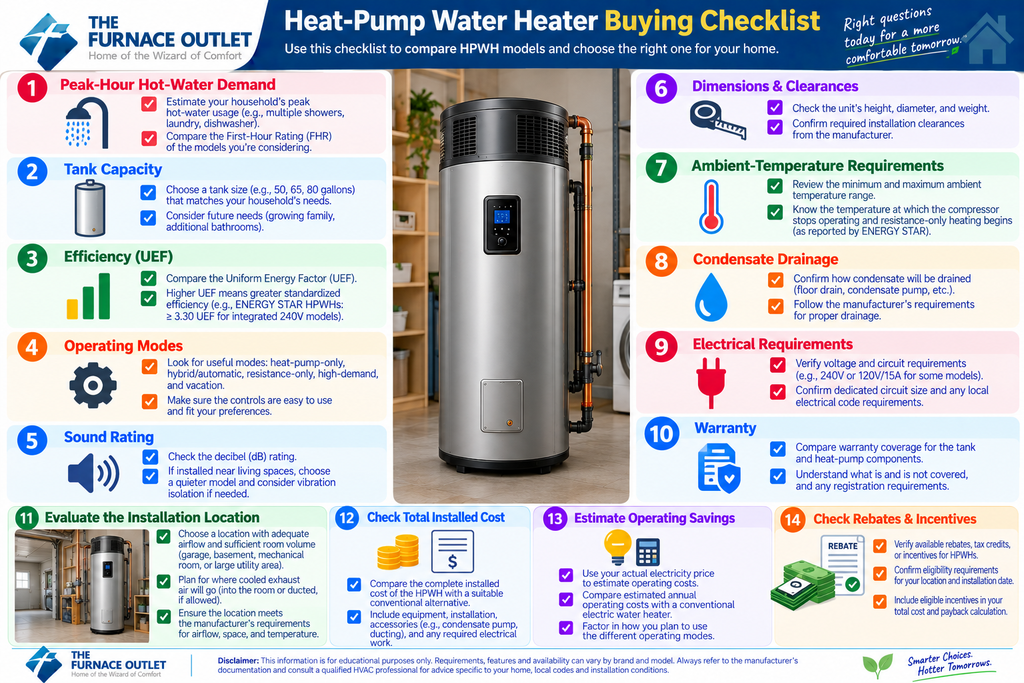
I would start by calculating realistic peak-hour hot-water demand and comparing the FHR of the exact HPWH models under consideration. Next, I would check tank capacity, UEF, operating modes, sound rating, dimensions, installation clearances, ambient-temperature requirements, condensate drainage, electrical requirements, and warranty.
I would then examine the proposed installation location. The heat pump needs suitable air, and I want to understand where the cooled exhaust air and condensate will go. If the heater will be close to occupied rooms, I would pay additional attention to sound and vibration.
Finally, I would compare the complete installed cost with a suitable conventional alternative and estimate operating savings using my actual electricity price. Any rebates or incentives should be verified for the installation date and location before I include them in the financial calculation.
The terms are commonly used interchangeably for integrated HPWHs that combine heat-pump technology with electric-resistance backup. ENERGY STAR specifically explains that these products are often called hybrid water heaters because resistance heat can supplement the heat pump during high-demand periods.
ENERGY STAR currently says certified HPWHs use about 70% less energy than a standard electric water heater. Its modeled four-person household saves approximately 3,760 kWh and $550 annually under stated assumptions. Actual savings vary with rates, household use, model, climate, installation, and operating mode.
Many integrated HPWHs contain resistance elements that can supplement heat-pump operation when additional recovery is needed. This helps maintain hot-water availability but increases electricity consumption compared with heat-pump-only operation. Proper sizing can reduce unnecessary reliance on resistance backup.
Yes, integrated HPWHs generally produce condensate because their refrigeration process removes moisture from surrounding air. The installation needs an appropriate condensate drainage strategy that follows manufacturer requirements and applicable codes.
They produce some sound because they contain a compressor and fan, unlike a basic resistance tank. Actual sound levels vary by model and installation, so I would compare published ratings when the heater will be near regularly occupied rooms.
It can be particularly attractive when replacing conventional electric resistance because the energy savings can be substantial. ENERGY STAR’s current four-person model estimates about a 2.7-year payback on an assumed $1,503 incremental cost, but that is a modeled example rather than a guarantee. A homeowner should calculate payback from the actual installed-price difference and local electricity rate.
What makes a heat-pump water heater compelling is not simply that it is electric. It is that the appliance uses electricity primarily to move available heat rather than creating all of its heat through resistance. That change in operating principle can reduce energy consumption dramatically while retaining the familiar convenience of a storage water heater.
The hybrid design adds flexibility because resistance elements can support the heat pump during unusually heavy demand. At the same time, that backup reminds us why sizing matters. A well-sized HPWH operating primarily through its heat pump can deliver very different energy performance from an undersized unit frequently forced into resistance heating.
For a homeowner replacing an electric-resistance water heater, I would make an HPWH one of the first alternatives to investigate. I would verify peak-hour demand, FHR, installation space, airflow, condensate drainage, electrical requirements, sound, local electricity rates, and complete installed cost before making the final choice.
When those pieces fit, a heat-pump water heater can combine strong hot-water performance, significantly lower energy consumption, useful smart controls, and reduced operating costs. That combination is why hybrid water heating deserves much more attention than simply treating it as a premium version of an ordinary electric tank.
For readers who want to explore the technology and current performance criteria in more detail, the ENERGY STAR Heat Pump Water Heater Guide provides detailed information on integrated HPWH design, installation, efficiency, and operation. The ENERGY STAR How Heat Pump Water Heaters Work guide provides a simpler explanation of the refrigeration cycle and hybrid operating modes.
The ENERGY STAR HPWH Benefits & Savings page provides current savings and payback examples, while the ENERGY STAR Residential Water Heater Key Product Criteria lists current UEF, FHR, warranty, and safety requirements.
For additional government technical information, the DOE Building Science Education HPWH resource explains efficiency and installation fundamentals, while the DOE FEMP Heat Pump Water Heater resource discusses the technology’s energy and emissions implications. Building Science Education
The Furnace Outlet is an independent informational and educational resource. It is not associated with, affiliated with, endorsed by, or sponsored by any water-heater manufacturer or brand discussed in this article, and it does not receive manufacturer compensation for inclusion or rankings.
Heat-pump water-heater efficiency, UEF, FHR, operating cost, savings, payback, sound, recovery performance, resistance-backup use, installation requirements, and expected performance vary by model, capacity, climate, ambient conditions, household hot-water demand, electricity rates, operating mode, and installation. ENERGY STAR savings figures discussed above are modeled estimates based on stated assumptions and are not guaranteed household savings. Product criteria and incentive programs can also change. Verify specifications for the exact equipment being considered and follow manufacturer instructions and applicable plumbing, electrical, condensate, and building-code requirements. Use appropriately qualified or licensed professionals where required for sizing and installation.