Newsletter Subscribe
Enter your email address below and subscribe to our newsletter

HVAC made simple
Tankless water heaters have a wonderfully simple idea behind them: instead of keeping 40, 50, or 80 gallons of water hot around the clock, heat the water when someone actually needs it. From an energy-efficiency perspective, that immediately caught my attention. From a practical homeowner’s perspective, however, choosing the right tankless water heater is considerably more complicated than choosing between gas and electric or buying the model with the biggest advertised gallons-per-minute number.
I’m Savvy, The Furnace Outlet’s sustainability-focused HVAC enthusiast, and when I compare tankless water heaters, I look beyond the marketing headline. I want to know how efficiently a unit converts energy into usable hot water, whether it can maintain the required flow during a realistic temperature rise, what infrastructure the house needs to support it, how much water may be wasted waiting for hot water to reach distant fixtures, and whether the installation makes economic and environmental sense over the life of the equipment.
That whole-system approach matters because the water heater is only one part of the hot-water system. Pipe length, groundwater temperature, fixture flow rates, household usage patterns, fuel availability, electrical capacity, recirculation strategy and water hardness can all influence the final result. EPA WaterSense emphasizes efficient hot-water distribution for exactly this reason: shorter and better-designed distribution systems can reduce the water and energy wasted while occupants wait for hot water to arrive.
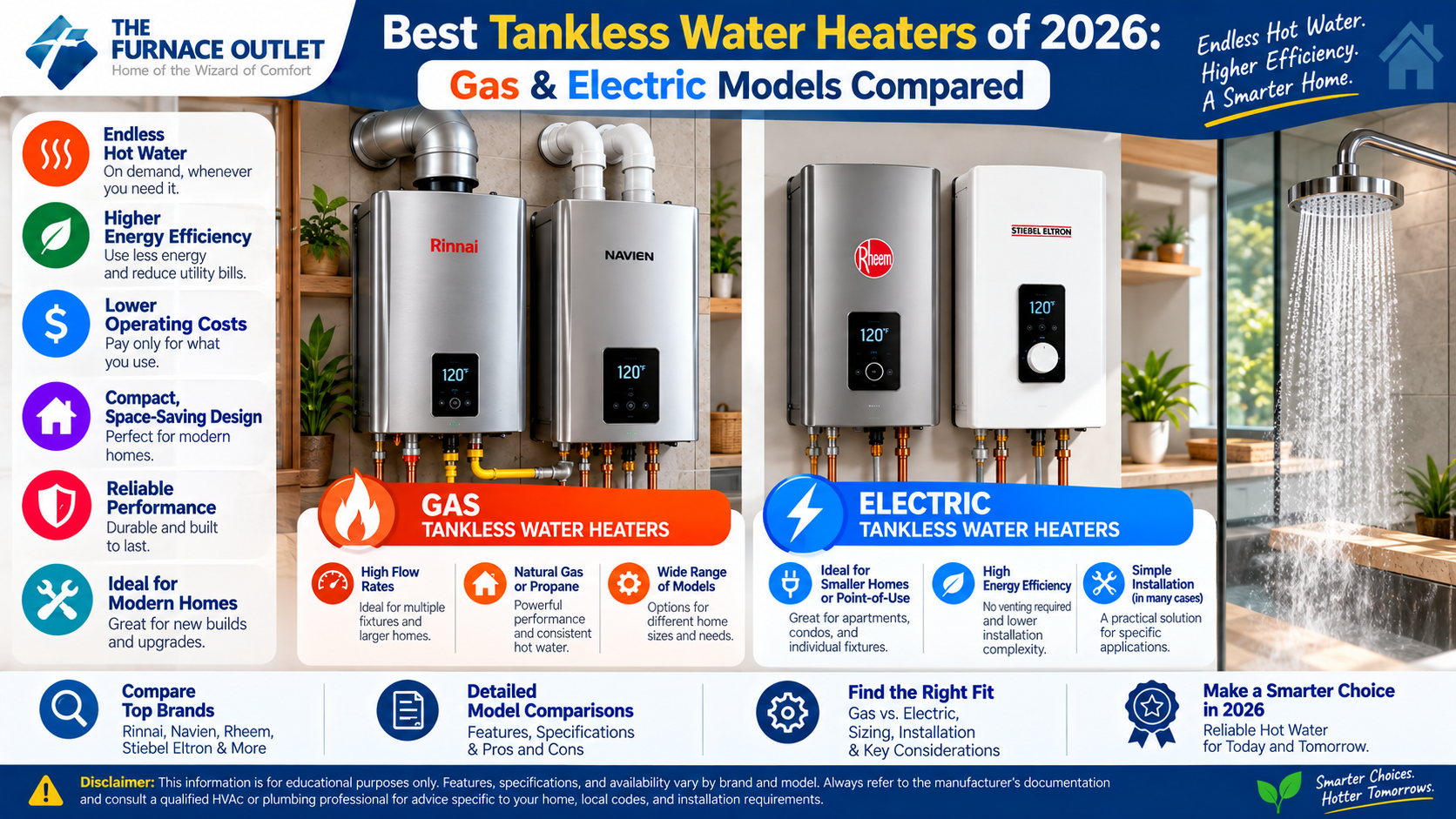
For 2026, my strongest tankless choices come from established manufacturers including Rinnai, Navien, Rheem, Noritz, Takagi, EcoSmart and Stiebel Eltron. I would not choose between them solely on brand reputation, though. The correct model needs to match the home, climate, fuel supply and expected simultaneous hot-water demand.
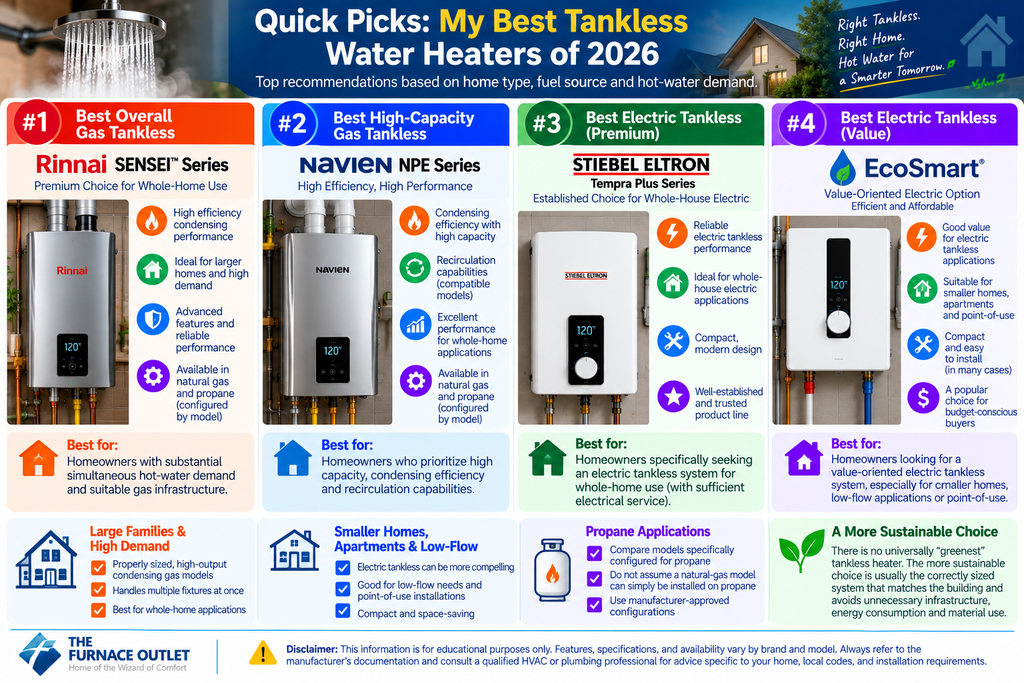
For homeowners who want the short version before we get into sizing and installation, my overall preference is a high-efficiency condensing gas tankless platform from an established manufacturer when the home has substantial simultaneous hot-water demand and suitable gas infrastructure. Rinnai’s SENSEI family remains one of the product lines I would investigate first for a premium whole-home installation, while Navien’s NPE family deserves serious consideration where high capacity, condensing efficiency and recirculation capabilities are priorities.
For homeowners who already have appropriate natural-gas infrastructure, Rinnai and Navien are among my leading starting points. For propane applications, I would again compare appropriately configured models from established gas-tankless manufacturers rather than assuming a natural-gas model can simply be installed on propane without the manufacturer-approved configuration.
For homeowners specifically seeking an electric tankless system, Stiebel Eltron’s Tempra Plus series is one of the first families I would compare because of its established position in whole-house electric tankless water heating. EcoSmart is also worth comparing for value-oriented electric applications. The important qualification is that whole-house electric tankless heaters can impose a very large electrical demand, so the electrical service and required circuits need to be evaluated before the purchase decision is made.
For large families and high simultaneous demand, I generally lean toward properly sized high-output condensing gas models. For smaller homes, apartments, low-flow applications and point-of-use installations, electric tankless can become much more compelling. That distinction is important because there is no universally “greenest” tankless heater. The more sustainable choice is usually the correctly sized system that matches the building and avoids unnecessary infrastructure, energy consumption and material use.
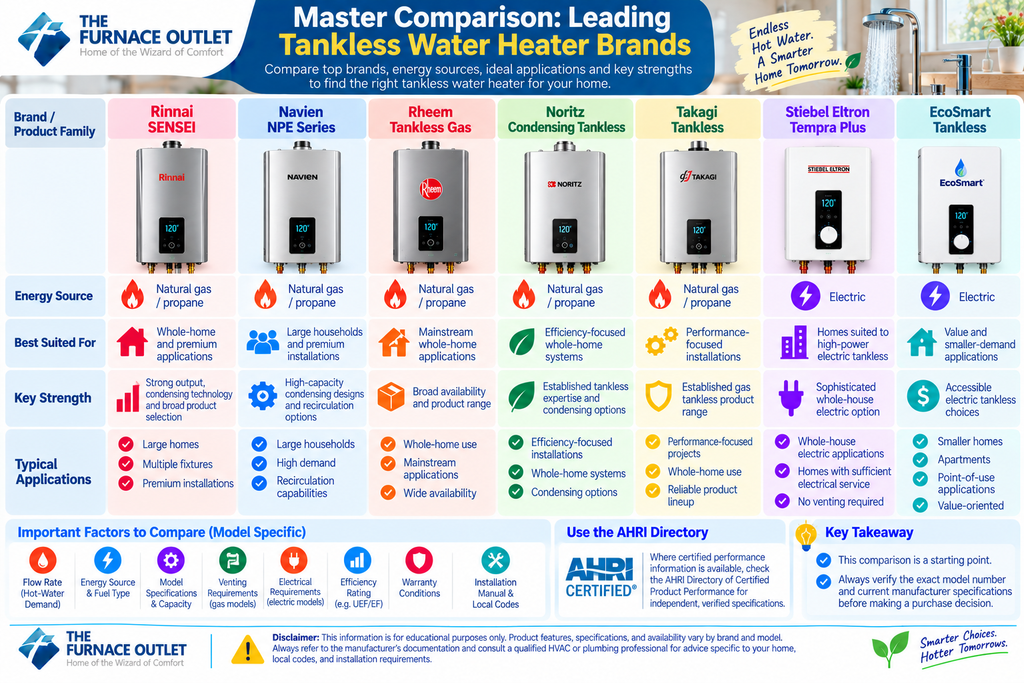
| Brand / Product Family | Energy Source | Best Suited For | Key Strength |
|---|---|---|---|
| Rinnai SENSEI | Natural gas / propane | Whole-home and premium applications | Strong output, condensing technology and broad product selection |
| Navien NPE Series | Natural gas / propane | Large households and premium installations | High-capacity condensing designs and recirculation options |
| Rheem Tankless Gas | Natural gas / propane | Mainstream whole-home applications | Broad availability and product range |
| Noritz Condensing Tankless | Natural gas / propane | Efficiency-focused whole-home systems | Established tankless expertise and condensing options |
| Takagi Tankless | Natural gas / propane | Performance-focused installations | Established gas tankless product range |
| Stiebel Eltron Tempra Plus | Electric | Homes suited to high-power electric tankless | Sophisticated whole-house electric option |
| EcoSmart Tankless | Electric | Value and smaller-demand applications | Accessible electric tankless choices |
I deliberately treat this table as a starting point rather than a substitute for model-specific engineering. Tankless product families contain multiple capacities, fuel configurations and installation requirements, and manufacturers periodically update their lineups. Before buying, I would verify the exact model number, published flow curve, efficiency rating, fuel type, electrical requirements, venting requirements, warranty conditions and installation manual.
Where certified performance information is available, I also recommend checking the AHRI Directory of Certified Product Performance rather than relying exclusively on retailer descriptions. The directory exists to provide certified equipment-performance information and can be especially useful when specifications need independent verification.
If I were beginning a premium whole-home gas tankless comparison in 2026, Rinnai’s SENSEI platform would be one of my first stops. Rinnai has extensive experience with tankless technology, and its higher-end condensing equipment combines the characteristics I want to see in a modern whole-home system: strong hot-water delivery, high-efficiency combustion, compact installation and sophisticated controls.
The reason I prefer a condensing platform for many new gas installations is that a condensing water heater is designed to recover additional heat from the combustion exhaust instead of allowing as much of that energy to leave through the vent. That can improve efficiency, although it also introduces condensate-management requirements that need to be incorporated into the installation.
I would still size a Rinnai by its temperature-rise performance rather than its maximum advertised GPM. A unit capable of impressive flow under mild incoming-water conditions may deliver substantially less water when very cold groundwater must be heated to a normal domestic hot-water temperature. That is not a defect in Rinnai; it is basic thermodynamics and applies to every tankless water heater.
For homeowners with several bathrooms, simultaneous shower use or substantial peak hot-water demand, the correct SENSEI configuration can make a very strong whole-home solution. For a household with modest demand, however, buying the highest-capacity model simply because it is available is not automatically the smartest approach.
Navien’s NPE series belongs near the top of my list for homeowners seeking a premium natural-gas tankless system. Navien has built a strong presence around high-efficiency condensing equipment, and its tankless platforms are particularly interesting for larger homes where capacity and hot-water convenience both matter.
Recirculation deserves attention here because large houses frequently have long plumbing runs. A tankless heater may generate hot water quickly, but it cannot instantly remove the cold water already sitting in 40 or 60 feet of pipe between the heater and an upstairs bathroom. That distinction surprises many homeowners after installation.
A well-designed demand-based recirculation strategy can reduce that wait and the associated water waste. EPA WaterSense specifically recognizes demand-initiated recirculation as a potential solution for layouts where longer piping runs would otherwise create inefficient hot-water delivery. EPA also cautions against unnecessarily maintaining hot recirculation continuously because doing so can increase energy use.
That makes Navien particularly interesting where recirculation is part of the overall plumbing design rather than simply an accessory added after installation.
For homes without natural gas, propane tankless water heating can provide the high heating input needed for demanding whole-house applications without requiring the enormous electrical capacity that a large whole-house electric tankless heater may need.
Rinnai, Navien, Rheem, Noritz and Takagi all deserve consideration when comparing propane-capable equipment. I would make the selection based on the exact model’s flow at the required temperature rise, efficiency, local service support, venting arrangement and propane requirements rather than selecting a winner from the brand name alone.
This is also an area where professional installation matters. Fuel supply sizing needs to support the water heater at maximum firing rate along with other connected appliances. A powerful tankless heater added to a fuel system that was designed around much smaller loads may require changes upstream.
For electric tankless water heating, the Stiebel Eltron Tempra Plus family remains one of my preferred starting points. Electric tankless equipment eliminates combustion and combustion venting at the appliance, provides compact installation and can be very effective where the electrical system is already capable of supporting the load.
The sustainability discussion is more nuanced than saying “electric equals green,” however. A large whole-house electric tankless water heater can require considerable instantaneous electrical power. Depending on the exact model, the home may need multiple high-amperage circuits, substantial conductor capacity and enough electrical-service headroom to support the heater while other major loads are operating.
That means I would ask an electrician to evaluate the service before buying the unit, not after it arrives. If the existing panel or service requires a major upgrade, that expense needs to be included in the economic comparison.
Electric tankless becomes especially attractive for lower-demand applications, smaller residences, warm-groundwater climates and point-of-use installations. It can also fit an electrification strategy particularly well where the home has suitable electrical capacity and increasingly low-carbon electricity.
Large households are where tankless sizing becomes especially important. The question is not simply how many people live in the house; it is how many hot-water fixtures may operate at the same time.
Imagine two showers operating while someone uses a bathroom faucet and the dishwasher is drawing hot water. The heater must satisfy the combined flow while raising the incoming water to the desired outlet temperature. In a cold climate, that can become a demanding load very quickly.
For these homes, I would usually begin with high-output condensing gas models from Rinnai, Navien, Rheem or another established manufacturer. In unusually demanding applications, properly engineered multiple-unit configurations may be considered. The decision should come from calculated peak demand rather than household size alone.
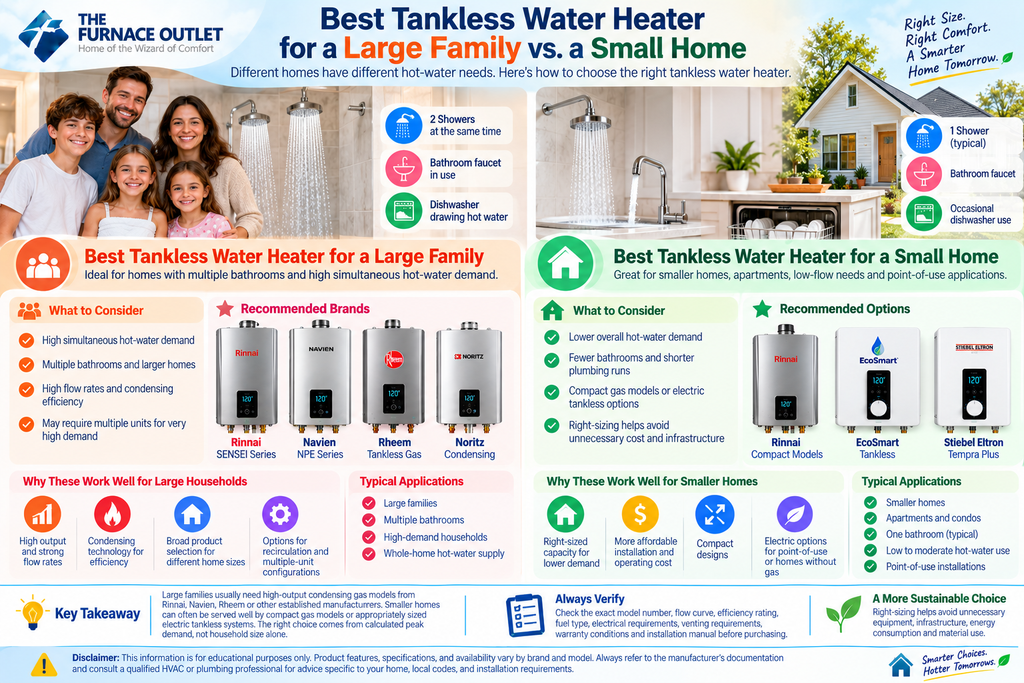
A small home presents almost the opposite challenge. Overspending on a very large premium gas system may make little sense if the household rarely operates multiple hot-water fixtures simultaneously.
This is where compact gas models or appropriately sized electric tankless systems can shine. A smaller residence with one bathroom, short plumbing runs and moderate hot-water consumption may need substantially less capacity than a four-bathroom suburban home.
From my sustainability perspective, right-sizing matters because efficiency is not only about the number printed on an EnergyGuide label. It is also about avoiding unnecessary equipment, electrical upgrades, oversized fuel infrastructure and excessive project cost.
Maximum GPM is one of the most frequently misunderstood tankless specifications. A manufacturer may advertise a large flow number, but that number is meaningful only when you understand the conditions under which it is achieved.
ENERGY STAR defines GPM for instantaneous water heaters as the amount of hot water supplied while maintaining the specified temperature rise during steady-state operation. Its current criteria for certified residential gas-fired instantaneous water heaters require a UEF of at least 0.95 and at least 2.8 GPM over a 67°F temperature rise.
For high-demand homes, I would therefore compare the manufacturers’ flow curves at the temperature rise appropriate to the actual location rather than ranking units by the biggest number printed on a product page.
Value is not the same thing as lowest purchase price. I define value as a combination of equipment cost, installation requirements, efficiency, expected service life, warranty support, parts availability and suitability for the home.
Rheem can be particularly attractive in this part of the market because it offers a broad range of water-heating products and is widely recognized by contractors and homeowners. EcoSmart deserves consideration on the electric side where the application suits its capacity.
The least expensive unit can become an expensive mistake if local technicians will not service it or replacement components are difficult to obtain. I therefore place meaningful weight on local service infrastructure.
For a premium installation, I would compare Rinnai and Navien closely. At this level, I am looking beyond raw heating capacity toward modulation, controls, recirculation capabilities, efficiency, installation flexibility, diagnostics and the service ecosystem surrounding the equipment.
A premium system should also be paired with premium system design. Spending more for a sophisticated heater while leaving inefficient long hot-water piping untouched can undermine some of the comfort and efficiency gains you expected to receive.
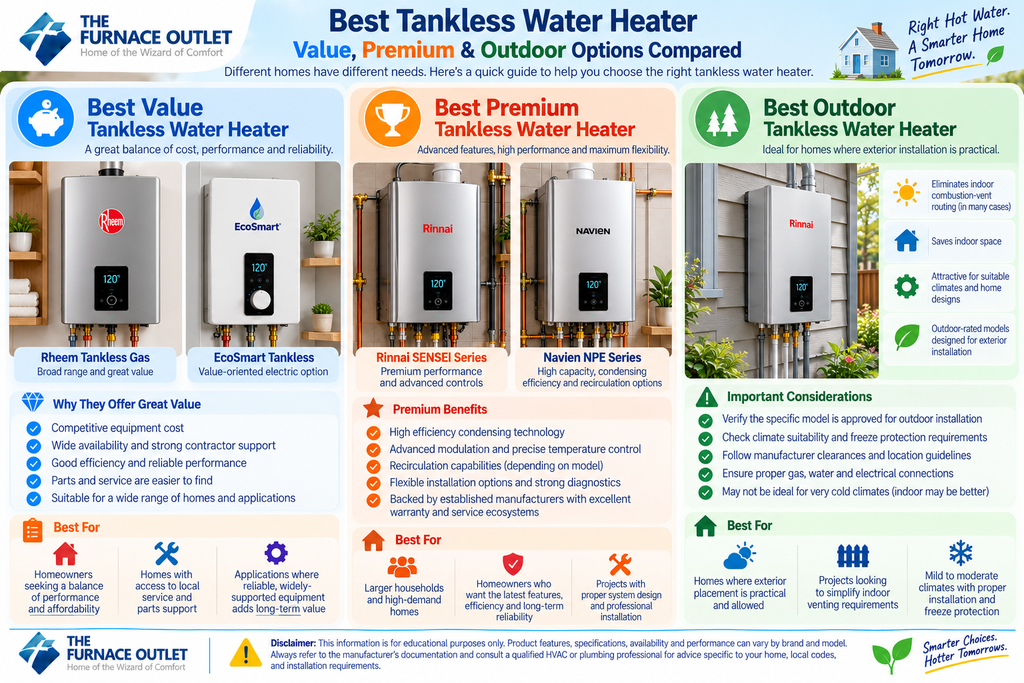
Outdoor tankless installation can simplify some projects because it can eliminate conventional indoor combustion-vent routing. It can be particularly attractive in appropriate climates and homes where exterior placement is practical.
Climate, freeze protection, clearances and manufacturer requirements become critical, though. I would never assume that an outdoor-rated unit can simply be mounted anywhere on an exterior wall. The installation manual needs to determine allowable locations, clearances and protection requirements.
In colder climates, indoor installation may provide advantages despite requiring an appropriate venting system. The correct choice is therefore site-specific rather than a universal indoor-versus-outdoor rule.
Gallons per minute tells us how quickly water is flowing. To size a tankless heater, estimate which fixtures could operate simultaneously and add their expected hot-water flow requirements.
If two showers each require approximately 2 GPM of hot water and another fixture adds additional demand, the water heater must be able to support that combined requirement at the required temperature rise. Actual fixture characteristics and hot/cold mixing affect the precise calculation, so simplified examples should be treated as screening tools rather than engineering calculations.
This is why my first question is never simply, “How many bedrooms does the house have?” Peak simultaneous demand is much more informative.
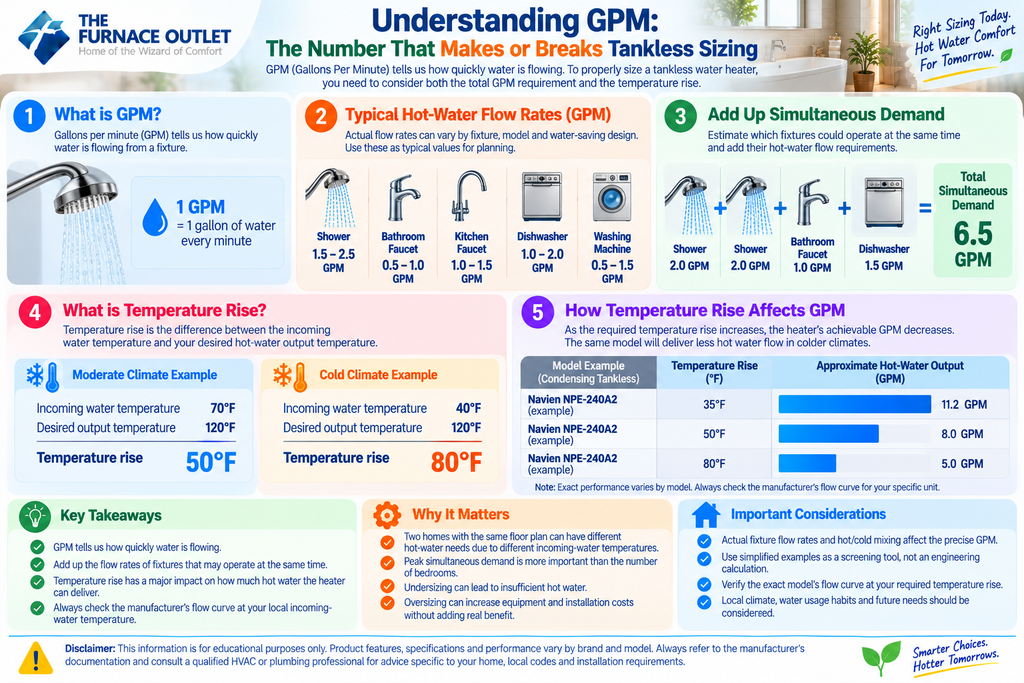
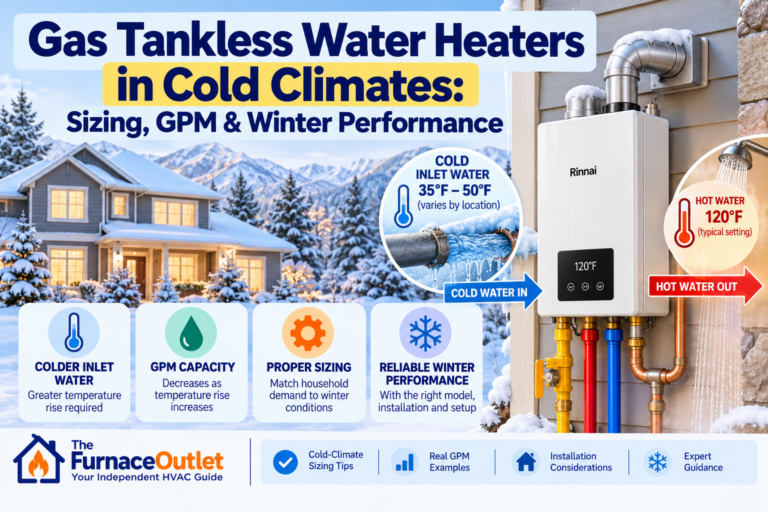
Temperature rise is the difference between incoming water temperature and desired output temperature. If incoming water is 70°F and the heater needs to produce 120°F water, the required rise is 50°F. If incoming water is only 40°F, producing the same 120°F output requires an 80°F rise.
The second situation requires much more heating energy for the same flow. Consequently, the heater’s achievable GPM decreases as required temperature rise increases.
This is one of the most important concepts in tankless shopping. Two homes with identical floor plans and identical families can require different water-heating capacities simply because their incoming-water temperatures differ.
Groundwater temperature is why I am reluctant to publish one universal square-footage or family-size recommendation for tankless equipment. Tankless heaters do not experience the same workload everywhere.
Homeowners in warmer regions may achieve substantially higher flow from the same heater than homeowners dealing with very cold winter inlet water. Always use a manufacturer’s temperature-rise or flow-rate chart when sizing the exact model.
If a retailer advertises only “up to X GPM,” I would keep looking until I find the underlying performance data.
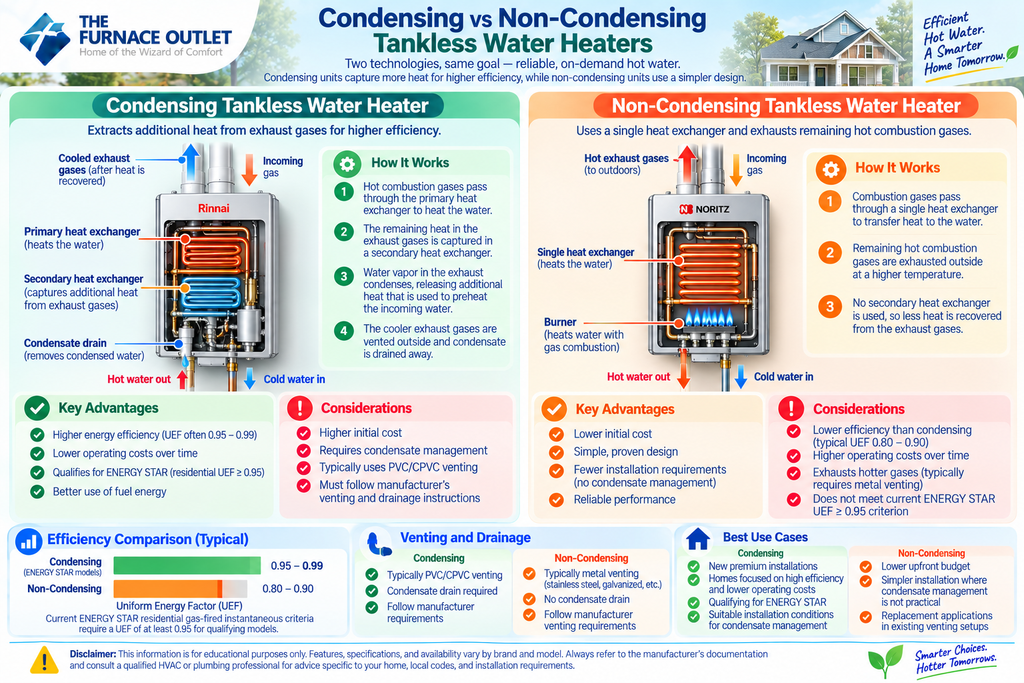
A conventional non-condensing gas tankless heater uses a heat exchanger to transfer combustion heat into the water and exhausts the remaining hot combustion gases. A condensing design extracts additional heat from those gases, allowing water vapor in the exhaust to condense and improving energy utilization.
For a new premium gas installation, I generally favor condensing technology when the economics and installation conditions make sense. Current ENERGY STAR residential gas-fired instantaneous criteria requiring UEF of at least 0.95 also provide a useful benchmark when comparing high-efficiency equipment.
Condensing equipment is not installation-free, however. The condensate needs to be managed appropriately, and the manufacturer’s venting and drainage instructions must be followed.
One of the most expensive surprises in a tankless conversion can be discovering that the existing gas system is inadequate. Tankless gas heaters can have substantial maximum firing rates because they must generate large amounts of heat immediately instead of slowly heating stored water.
The installer should evaluate available gas pressure, pipe diameter, developed length, other connected appliances and the water heater’s input requirement. I would not assume that a gas line serving an old storage heater is automatically suitable for its tankless replacement.
This is why a realistic installation quote should be based on a site assessment rather than equipment price alone.
Gas tankless heaters generally still need electricity for controls, ignition and related components, while whole-house electric tankless heaters may require dramatically more electrical capacity.
Before selecting a large electric system, confirm voltage, amperage, breaker requirements, conductor requirements and available service capacity using the documentation for the exact model. A panel or service upgrade can materially change project economics.
For some houses, electric tankless is elegant and logical. For others, the electrical infrastructure makes it impractical.
Tankless does not mean maintenance-free. Hard water can deposit minerals inside heat-exchanger passages, reducing heat transfer and potentially restricting flow.
Homes with significant hardness should consider appropriate water treatment and should follow the manufacturer’s maintenance schedule. The correct descaling interval depends on water quality, usage and manufacturer guidance rather than a universal calendar rule.
This is one area where spending a little time on water quality can protect a much larger investment.
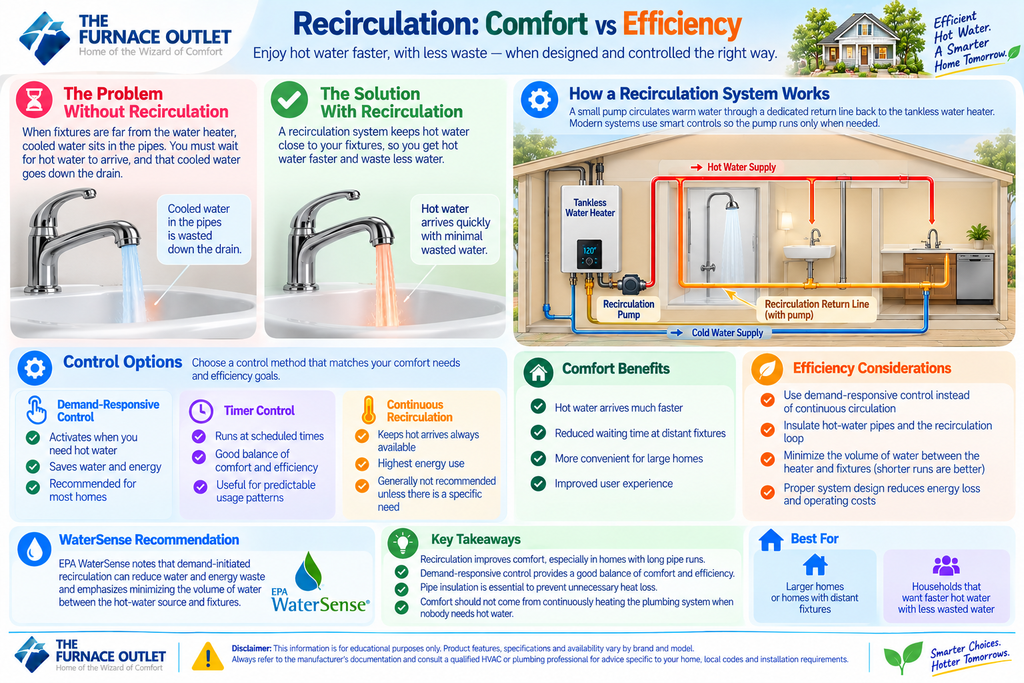
Recirculation can dramatically improve the user experience in homes where fixtures are far from the water heater. Instead of sending cooled water down the drain while waiting for hot water, an intelligently controlled system can reduce the delay.
From a sustainability perspective, I strongly prefer demand-responsive control over unnecessarily circulating hot water continuously. EPA WaterSense notes that demand-initiated recirculation can reduce water and energy waste and emphasizes minimizing the volume of water between the hot-water source and fixtures.
Pipe insulation also matters because a recirculation loop effectively creates additional heat-emitting surface area. Comfort improvements should not come from continuously heating the plumbing system when nobody needs hot water.
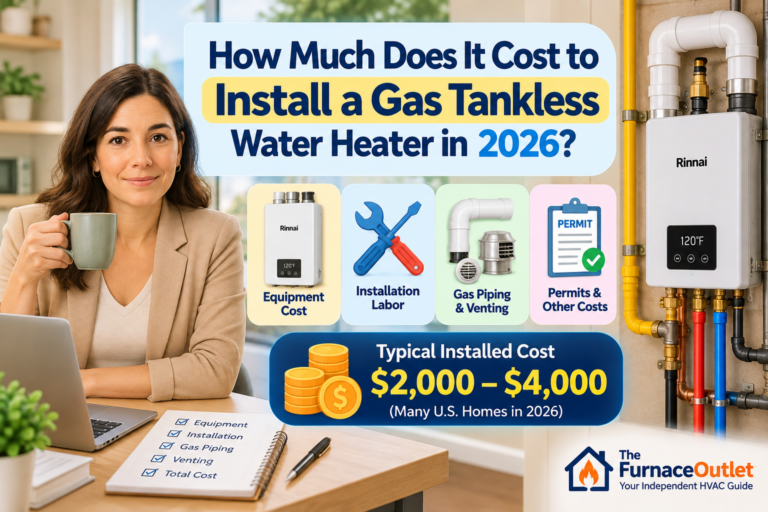
Tankless installation cost varies far too much for one equipment-price number to describe the project accurately. A straightforward replacement in a compatible installation can be very different from converting an older storage heater to a condensing tankless system.
Potential costs include gas-line modifications, venting, condensate drainage, water piping changes, isolation/service valves, electrical work, permits, exterior penetrations, recirculation plumbing and removal of existing equipment. Electric tankless installations can involve additional circuits or, in some cases, electrical-service upgrades.
My advice is to compare complete installed cost, not online appliance price. Ask contractors to specify what is included so competing quotes can be evaluated fairly.
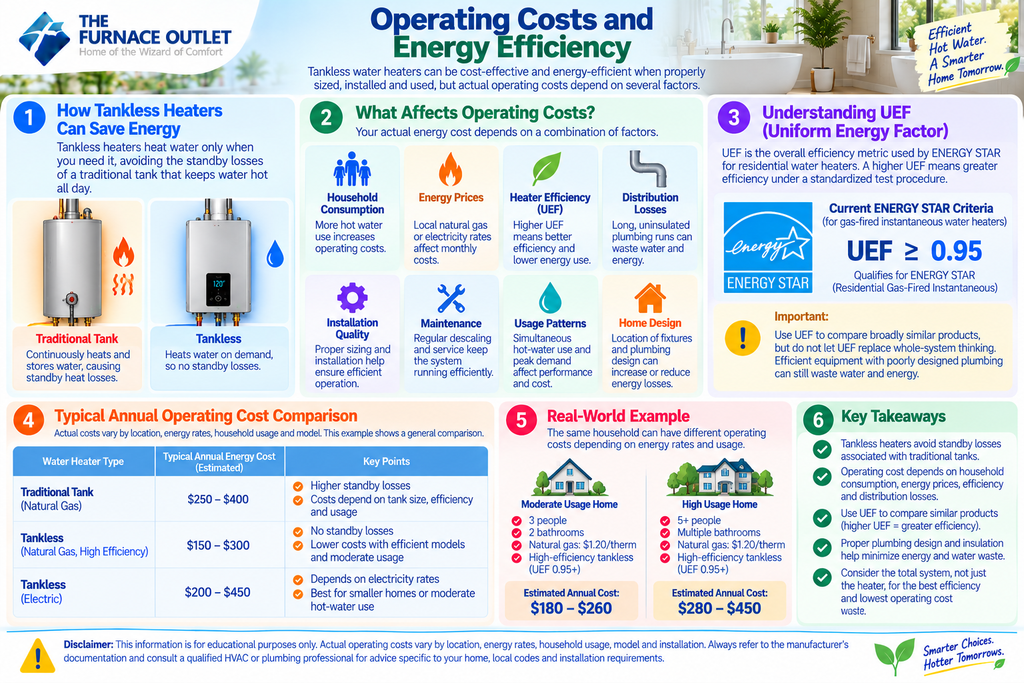
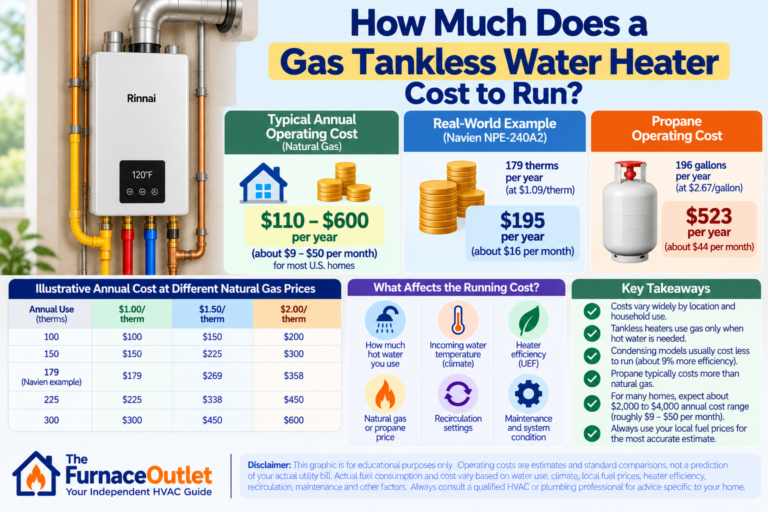
Tankless heaters avoid the traditional standby losses associated with maintaining a large tank of hot water, but actual operating cost still depends on household consumption, energy prices, heater efficiency and distribution losses.
The current ENERGY STAR program uses Uniform Energy Factor, or UEF, as the overall efficiency metric for residential water heaters, with a higher UEF representing greater efficiency under the standardized test procedure. For gas-fired instantaneous water heaters, current ENERGY STAR criteria require UEF of at least 0.95.
I would use UEF to compare broadly similar products, but I would not let UEF replace whole-system thinking. Efficient equipment connected to poorly designed long plumbing runs can still waste water and energy.
Every tankless owner should understand the service requirements before purchasing. Periodic inspection and, where appropriate, heat-exchanger flushing or descaling help maintain performance, particularly in hard-water areas.
Gas appliances may also require inspection of combustion and venting components according to manufacturer instructions. Intake and exhaust pathways need to remain unobstructed, and condensate components on condensing equipment need appropriate attention.
Isolation valves installed during the original project can make future servicing substantially easier. I consider serviceability part of good sustainable design because equipment that is easy to maintain is more likely to be maintained and kept in operation rather than prematurely replaced.
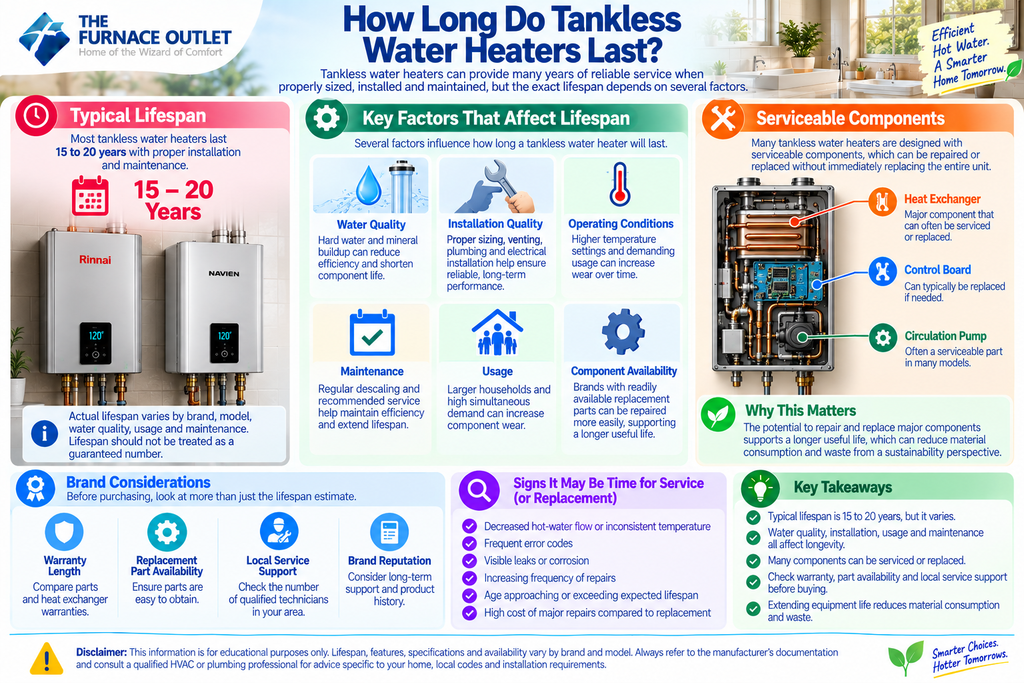
Tankless water heaters are often purchased partly because homeowners expect long service life, but lifespan should never be treated as a guaranteed number. Water quality, installation quality, operating conditions, maintenance, usage and component availability all matter.
One advantage of quality tankless equipment is that major components may be serviceable rather than requiring immediate replacement of the entire appliance. That potential repairability matters to me from a sustainability standpoint because extending useful equipment life reduces material consumption and waste.
Before purchasing, I would therefore ask not only about warranty length but also about replacement-part availability and the number of qualified technicians who service the brand locally.
No water-heating technology wins every application. Tankless offers compact dimensions, on-demand heating and potentially lower standby energy use, but it can carry higher installation costs and infrastructure requirements.
Conventional storage heaters remain practical and cost-effective in many homes, while modern heat-pump water heaters deserve particular attention when electrification and high energy efficiency are priorities. Tankless is therefore one option within a broader water-heating decision rather than the automatic environmental winner.
My preferred approach is to evaluate the entire project: energy source, efficiency, expected usage, electrical or gas infrastructure, installation cost, climate, water quality, distribution design and likely service life.
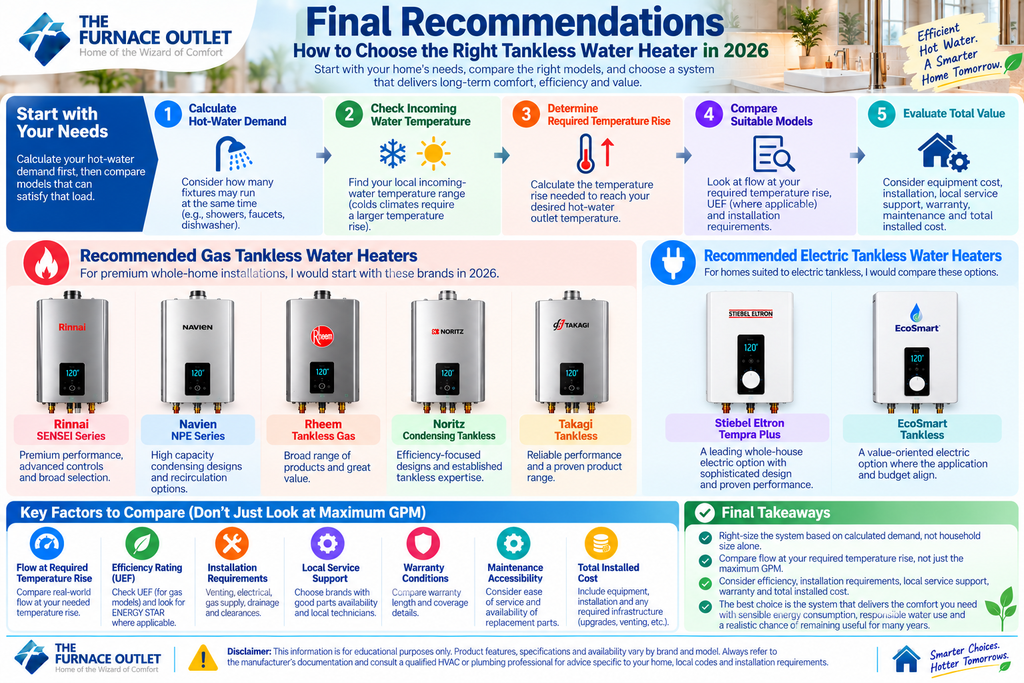
If I were shopping for a tankless water heater in 2026, I would begin with the load rather than the brand. I would calculate realistic simultaneous hot-water demand, establish the local incoming-water temperature range and determine the required temperature rise. Only then would I compare specific models capable of satisfying that load.
For a premium whole-home gas installation, I would start my comparison with Rinnai SENSEI and Navien NPE-series equipment, while also examining suitable Rheem, Noritz and Takagi models. For electric tankless, Stiebel Eltron Tempra Plus would be one of my first whole-house comparisons, with EcoSmart worth investigating where the application and budget align.
More importantly, I would not buy an oversized heater merely because its maximum GPM looks impressive. I would compare flow at the required temperature rise, UEF where applicable, installation requirements, local service support, warranty conditions, maintenance accessibility and the total installed cost.
That is the part of sustainable home improvement that I think gets overlooked. The best environmental choice is rarely the product with the most impressive marketing claim. It is the system that delivers the comfort you actually need with sensible energy consumption, responsible water use, appropriate infrastructure and a realistic chance of remaining useful for many years.
There is no single model that is best for every house because capacity depends heavily on simultaneous hot-water demand and incoming-water temperature. For premium whole-home gas applications, Rinnai SENSEI and Navien NPE-series equipment are strong starting points for comparison. Stiebel Eltron Tempra Plus is one of the electric product families I would investigate for homes with suitable electrical capacity.
Add the flow requirements of the hot-water fixtures likely to operate simultaneously, then determine whether the heater can support that flow at your required temperature rise. Do not size solely from the advertised maximum GPM because achievable flow decreases as the heater must produce a larger temperature increase.
Gas tankless systems are often better suited to high simultaneous whole-house demand because of their substantial heating input. Electric tankless can be excellent for smaller loads, point-of-use applications and homes with sufficient electrical capacity. Installation infrastructure, energy prices and household demand should drive the decision.
Condensing gas tankless heaters can capture more useful heat from combustion and achieve high efficiency. For new premium gas installations, I generally consider them first, provided condensate drainage, venting, maintenance and installation costs are properly addressed.
Yes, if it is sized to provide the combined hot-water flow at the required temperature rise. Whether a particular unit can handle two showers plus additional fixtures depends on fixture flow, inlet-water temperature, desired outlet temperature and the model’s actual heating capacity.
Not necessarily. The heater can begin heating when flow is detected, but water already sitting in the pipe between the heater and faucet still needs to move before newly heated water arrives. Efficient plumbing design or demand-initiated recirculation can reduce this delay.
Yes. Maintenance requirements depend on the model, fuel and local water conditions. Hard-water installations may require periodic descaling, while gas units also have combustion, venting and condensate-related components that should be maintained according to manufacturer instructions.
Sometimes, but often not. A gas conversion may require changes to gas supply, venting, condensate drainage, water piping or electrical supply. A whole-house electric tankless conversion may require multiple circuits or additional electrical-service capacity. A site assessment should occur before equipment selection.
They can reduce energy associated with storing hot water, but environmental performance depends on the energy source, equipment efficiency, household usage, plumbing design and local electricity generation. A correctly sized tankless system can be an efficient solution, but tankless technology is not automatically the lowest-impact option in every home.
A higher UEF indicates higher overall efficiency under the standardized test procedure when comparing similar water heaters. As of 2026, ENERGY STAR’s criteria for certified residential gas-fired instantaneous water heaters require a UEF of at least 0.95, along with additional performance, warranty and safety requirements.
Indoor models can work well across a wide range of climates but require appropriate combustion venting for gas equipment. Outdoor-rated units can simplify venting in suitable locations but introduce weather, clearance and freeze-protection considerations. Follow the requirements for the exact model rather than choosing solely for installation convenience.
It is extremely important because colder incoming water requires a larger temperature rise. As temperature rise increases, a tankless heater can generally provide less flow at the target outlet temperature. Groundwater conditions should therefore be considered during sizing rather than relying on maximum advertised GPM.
For readers who want to verify efficiency standards and dig deeper into water-heating performance, I recommend starting with the U.S. Department of Energy Energy Saver for federal consumer guidance on water heating. For efficiency certification, use the ENERGY STAR Residential Water Heater Criteria and ENERGY STAR Whole-Home Tankless Gas Water Heaters. ENERGY STAR currently specifies UEF, minimum flow-performance, warranty and safety requirements for qualifying gas-fired instantaneous equipment.
For independently certified equipment-performance information, I recommend checking the AHRI Directory of Certified Product Performance. For the water-efficiency side of the equation, the EPA WaterSense Hot Water Guidance explains how distribution design and demand-initiated recirculation can reduce water and energy waste. Finally, the current ENERGY STAR Residential Water Heater Specification Version 3.2 is useful for readers who want the technical certification requirements rather than a simplified consumer explanation.
The Furnace Outlet provides this guide for general educational and informational purposes. Water-heater sizing, gas piping, electrical service, venting, combustion air, condensate disposal, plumbing, freeze protection, permits and code requirements vary by equipment and location. Product specifications, certifications, warranties and model availability can also change. Always verify current information using the manufacturer’s documentation for the exact model being considered and consult appropriately licensed plumbing, electrical, HVAC or gas professionals where required. The Furnace Outlet is an independent informational resource and is not a manufacturer, installer or representative of the brands discussed in this guide.