Newsletter Subscribe
Enter your email address below and subscribe to our newsletter

HVAC made simple
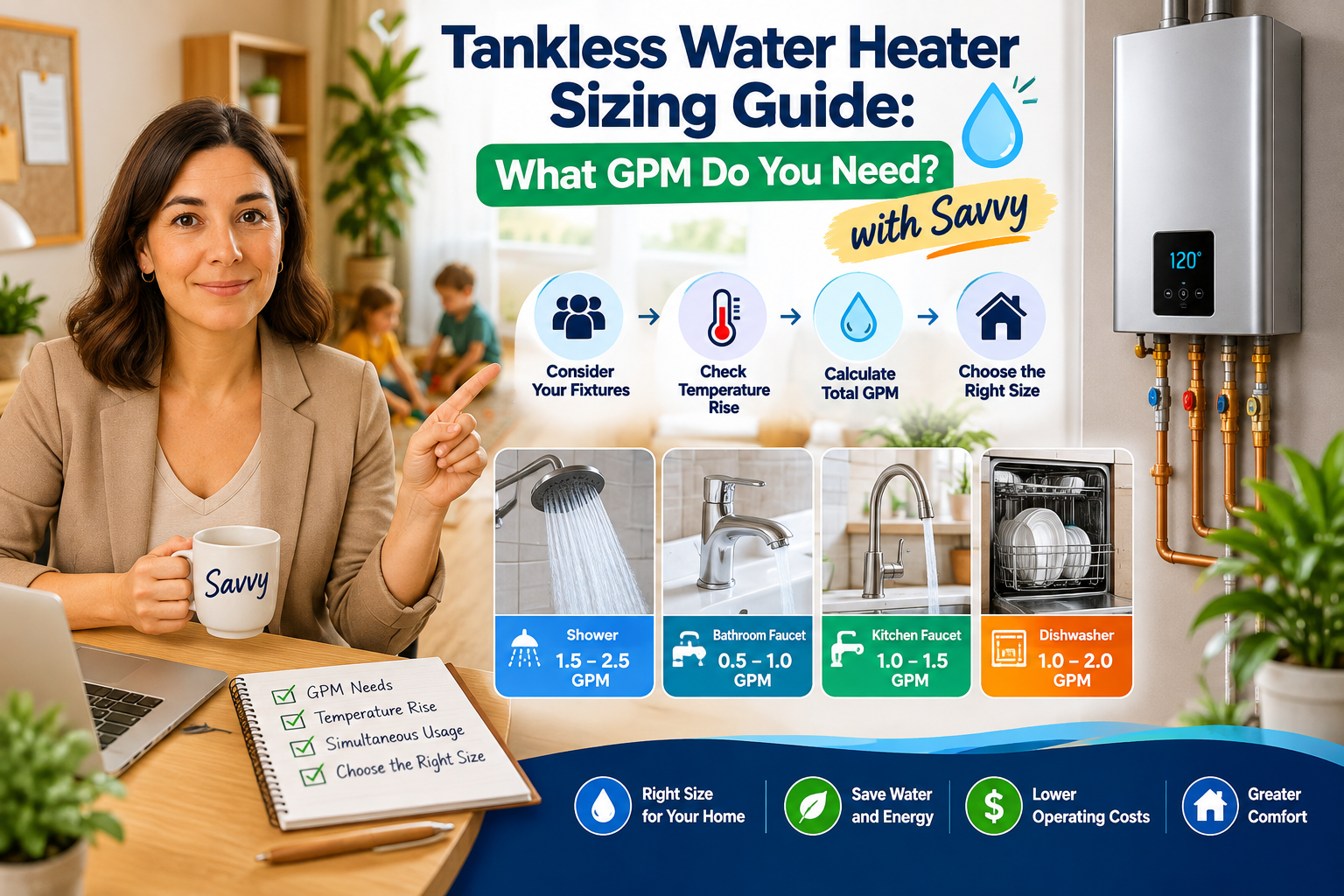
Choosing the right size tankless water heater is less about the number of people living in your house and more about what happens when several of those people need hot water at the same time. A household of five that usually showers at different times may have a lower peak hot-water demand than a household of three where two showers routinely run while the dishwasher is operating.
I’m Savvy, The Furnace Outlet’s sustainability-focused HVAC enthusiast, and this is why I prefer to size tankless water heaters from actual demand rather than broad rules such as “one unit for a three-bedroom house.” Tankless water heaters heat water as it flows through the equipment, so the heater has to keep up with the amount of water moving through it at that moment. Once demand exceeds its heating capacity, something has to give, whether that means reduced flow, lower delivered temperature or disappointing performance at one or more fixtures.
The two numbers I pay the most attention to are flow rate, measured in gallons per minute (GPM), and temperature rise, measured in degrees Fahrenheit. Once you understand how these interact, tankless sizing becomes much easier. You can estimate how much hot water your household might demand simultaneously, determine how much the incoming water needs to be heated, and then compare those requirements with manufacturer performance data. That is a much better approach than buying the tankless water heater with the biggest GPM number printed on the box.
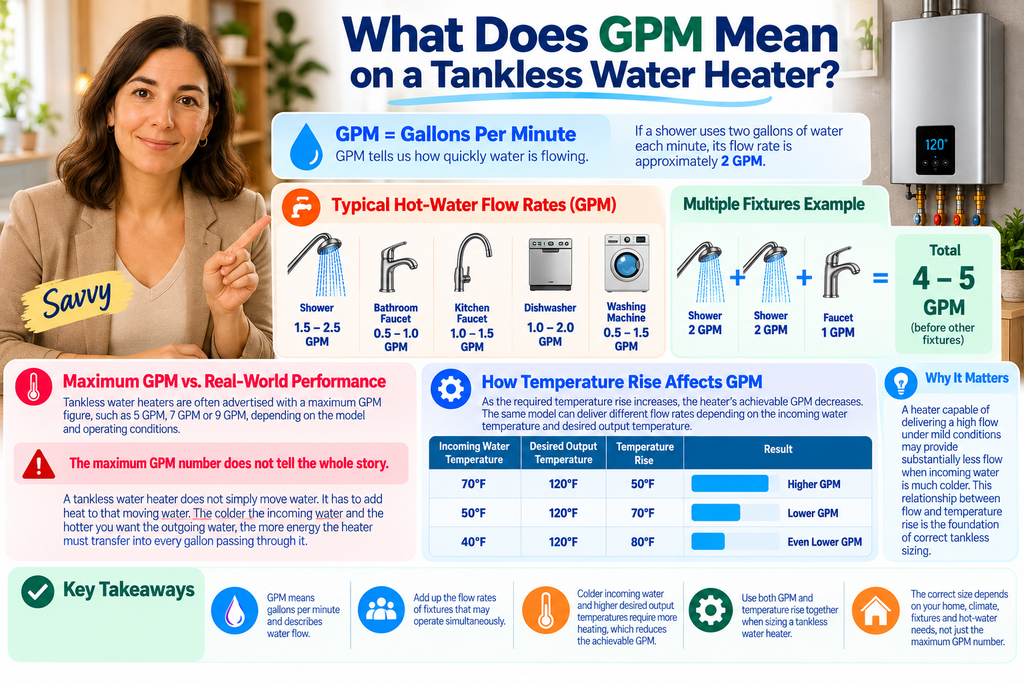
GPM means gallons per minute, and it describes water flow. If a shower uses two gallons of water each minute, its flow rate is approximately 2 GPM. If two similar showers operate simultaneously, their combined flow is approximately 4 GPM before we account for other fixtures. Tankless water heaters are frequently marketed using a maximum GPM figure. You might see systems advertised around 5 GPM, 7 GPM, 9 GPM or even higher, depending on the model and operating conditions.
The problem is that the maximum GPM number does not tell the whole story. A tankless water heater does not simply move water. It has to add heat to that moving water. The colder the incoming water and the hotter you want the outgoing water, the more energy the heater must transfer into every gallon passing through it.
That means a heater capable of delivering a high flow under relatively mild conditions may provide substantially less flow when incoming water is much colder. This relationship between flow and temperature rise is the foundation of correct tankless sizing.
One of the most common questions I hear is, “What size tankless water heater do I need for a family of four?”. The answer is that family size alone is not enough information. Imagine two four-person households. In the first home, everyone showers at different times and there is rarely more than one major hot-water fixture operating. In the second, two bathrooms are used simultaneously every morning while someone starts the dishwasher. The second household has a much larger peak demand even though both homes contain four people.
For tankless sizing, I therefore focus on the maximum realistic simultaneous hot-water demand. You do not necessarily need to add every hot-water fixture in the house as though all of them will operate simultaneously. Instead, think realistically about the busiest hot-water period in your household.
If two showers commonly operate at the same time, include both. If someone regularly uses a bathroom sink during that period, include it. If the dishwasher or another hot-water appliance commonly overlaps, consider that demand as well. This gives you a much more useful starting point than bedroom count or household population.
The following figures are useful for preliminary planning, although actual fixtures vary and their published specifications should be used whenever possible.
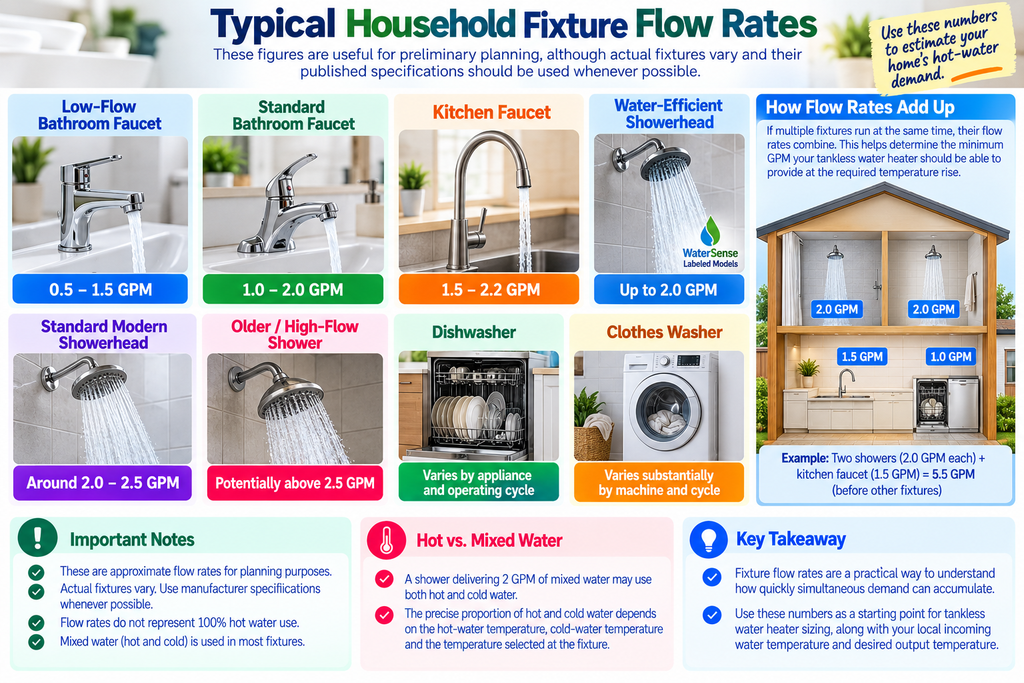
| Fixture or Appliance | Approximate Flow Rate |
|---|---|
| Low-flow bathroom faucet | 0.5–1.5 GPM |
| Standard bathroom faucet | 1.0–2.0 GPM |
| Kitchen faucet | 1.5–2.2 GPM |
| Water-efficient showerhead | Up to 2.0 GPM for WaterSense-labeled models |
| Standard modern showerhead | Around 2.0–2.5 GPM |
| Older/high-flow shower | Potentially above 2.5 GPM |
| Dishwasher | Varies by appliance and operating cycle |
| Clothes washer | Varies substantially by machine and cycle |
These numbers should not be interpreted as universal hot-water requirements. A shower delivering 2 GPM of mixed water, for example, may use both hot and cold water. The precise proportion depends on hot-water temperature, cold-water temperature and the temperature selected at the shower.
For a conservative initial sizing estimate, however, fixture flow rates provide a practical way to understand how quickly simultaneous demand can accumulate.
Start by identifying your household’s busiest hot-water scenario. Suppose your normal morning routine could involve two showers and one bathroom faucet operating at the same time. If each shower flows at approximately 2 GPM and the faucet contributes another 1 GPM, the combined fixture flow is approximately: 2 GPM + 2 GPM + 1 GPM = 5 GPM
That gives us a preliminary peak flow requirement of approximately 5 GPM. Now consider a larger home where three showers might occasionally operate simultaneously. Three 2-GPM showers would create approximately 6 GPM of total mixed-water flow before any additional fixtures are considered.
This is why large households can quickly move into the capacity range where high-output gas tankless water heaters become attractive. The calculation is not finished yet, however, because GPM without temperature rise is incomplete.
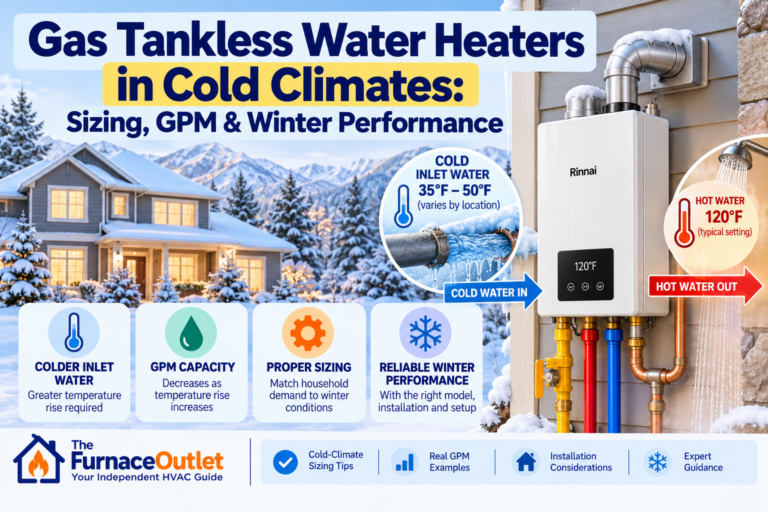
Incoming-water temperature is one of the most important variables in tankless performance, yet it is frequently overlooked during online shopping. Water entering a home can be considerably warmer in a mild southern climate than in a cold northern climate during winter. A tankless water heater installed in a warm region may therefore have much less heating work to perform than the identical unit installed somewhere with very cold winter inlet water.
This is why I would not size a tankless heater using climate assumptions alone. Determine a reasonable cold-season incoming-water temperature for the specific property whenever possible.
You can measure cold-water temperature directly, although seasonal variation needs to be considered. Manufacturer sizing tools and regional groundwater-temperature information can also provide useful guidance. The key principle is simple: the colder the incoming water, the greater the required temperature rise and the lower the flow a given tankless heater can generally support.
Many residential water-heating discussions use approximately 120°F as a common reference temperature, although actual settings and household requirements vary. The U.S. Department of Energy discusses lowering water-heater temperature to around 120°F as a way to reduce energy consumption and slow mineral buildup while also reducing scalding risk. Households should still follow equipment instructions and consider individual health and safety circumstances when selecting a temperature.
Once you know the incoming-water temperature and target hot-water temperature, you can calculate the temperature rise. The formula is straightforward: Temperature Rise = Desired Outlet Temperature − Incoming Water Temperature
If incoming water is 60°F and the desired output is 120°F, the required temperature rise is: 120°F − 60°F = 60°F, If winter incoming water is only 40°F, the same 120°F target requires: 120°F − 40°F = 80°F, That 20°F difference has a major effect on the amount of water the heater can supply.
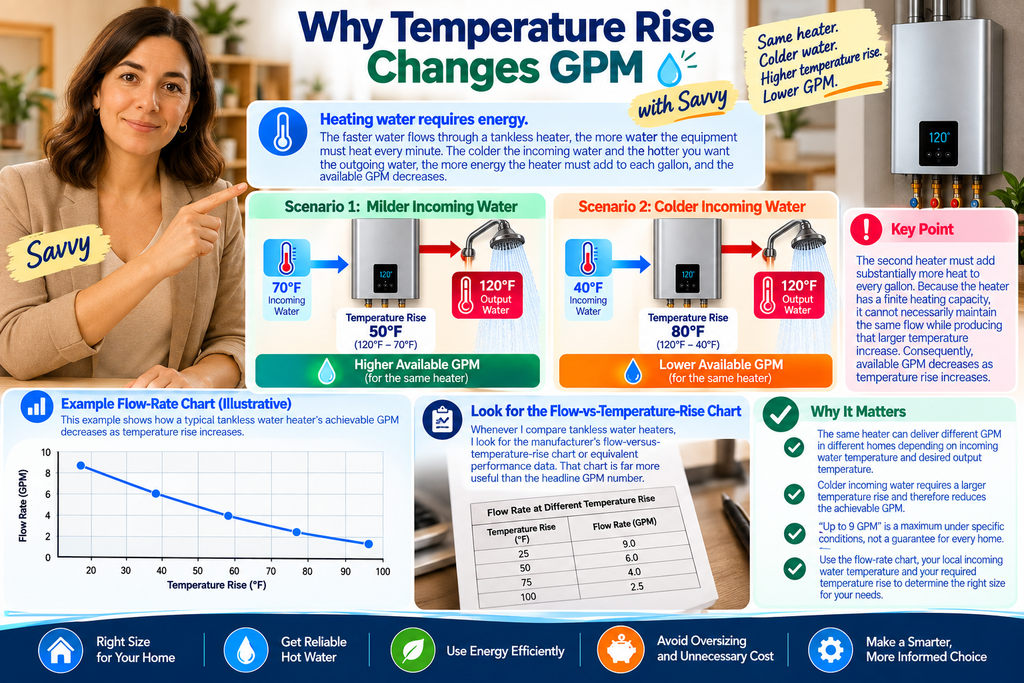
Heating water requires energy. The faster water flows through a tankless heater, the more water the equipment must heat every minute. Imagine two identical tankless heaters. One receives 70°F incoming water and needs to produce 120°F water, creating a 50°F rise. The other receives 40°F water and also needs to produce 120°F water, creating an 80°F rise.
The second heater must add substantially more heat to every gallon. Because the heater has a finite heating capacity, it cannot necessarily maintain the same flow while producing that larger temperature increase. Consequently, available GPM decreases as temperature rise increases.
This explains why an advertisement saying “up to 9 GPM” should never be interpreted as a guarantee that the heater will provide 9 GPM in every home. Whenever I compare tankless water heaters, I look for the manufacturer’s flow-versus-temperature-rise chart or equivalent performance data. That chart is far more useful than the headline GPM number.
Suppose a family expects the following fixtures to operate simultaneously during its busiest period:
| Fixture | Estimated Flow |
|---|---|
| Shower 1 | 2.0 GPM |
| Shower 2 | 2.0 GPM |
| Bathroom faucet | 1.0 GPM |
| Combined flow | 5.0 GPM |
Now assume the winter incoming-water temperature is approximately 50°F and the desired hot-water temperature is 120°F.
The required temperature rise is: 120°F − 50°F = 70°F
The homeowner should therefore look for a tankless water heater capable of satisfying the household’s required hot-water demand at approximately a 70°F temperature rise. Do not simply search for a heater advertised as “5 GPM.” Instead, open the manufacturer’s performance documentation and determine what flow the exact model can maintain at around a 70°F rise.
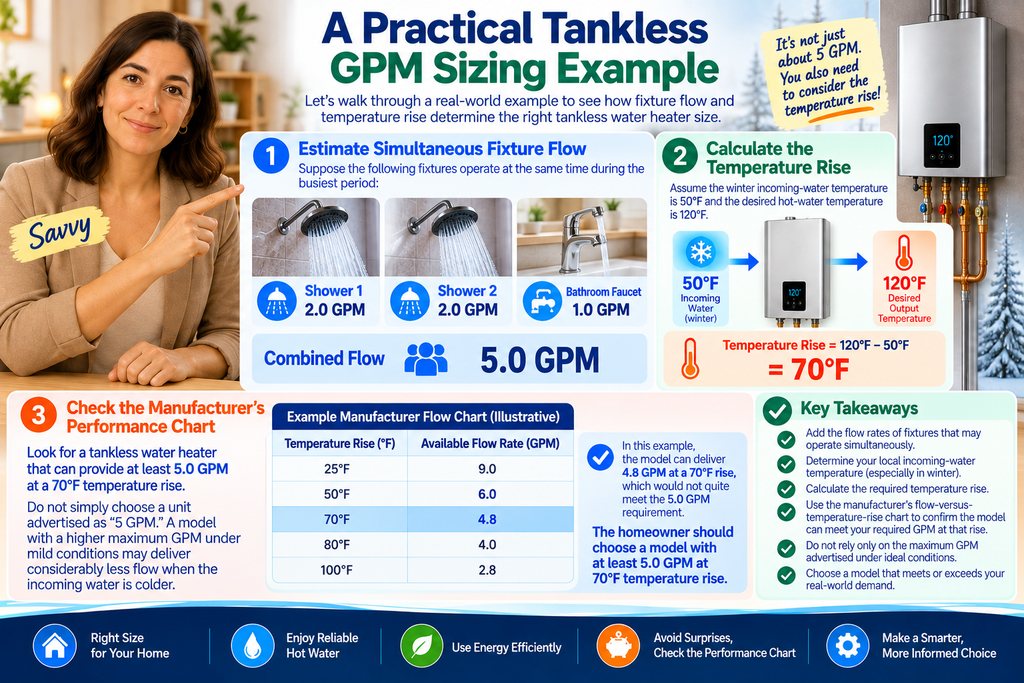
A unit advertised at a much higher maximum GPM under mild conditions might deliver considerably less under this colder-water scenario.
Two simultaneous showers are one of the most useful sizing benchmarks because this is a common real-world situation. If both showerheads operate at approximately 2 GPM, total mixed-water flow is approximately 4 GPM. A pair of 2.5-GPM showerheads could approach 5 GPM.
Remember that the total shower flow is not necessarily 100 percent hot water because the shower valve mixes hot and cold water to achieve the desired bathing temperature. Nevertheless, a tankless sizing calculation should provide sufficient capacity under realistic operating conditions rather than depending on ideal assumptions.
If two showers plus a faucet routinely operate simultaneously, the total fixture flow could move toward approximately 5–6 GPM depending on the fixtures. Again, temperature rise determines whether a particular heater can support that demand.
For a family of four, I would generally start by examining the household routine rather than assigning one fixed GPM number. A family that typically uses only one shower at a time may have relatively modest peak demand. Another four-person household with two simultaneous showers and additional fixture use may require substantially more capacity.
For planning purposes, many whole-home scenarios fall somewhere around 5–8 GPM of potential simultaneous fixture flow, but that is not a universal sizing rule. Homes with luxury showers, multiple showerheads, large soaking tubs or three simultaneously occupied bathrooms can require considerably more. This is precisely why the phrase “for a family of four” should be treated as a rough shopping category rather than an engineering specification.
Larger households increase the probability of simultaneous use, but population still does not determine GPM by itself. A family of six with carefully staggered showers might place less instantaneous demand on its water heater than a family of four that frequently runs two showers simultaneously.
For a larger household, I would model at least the most demanding routine that occurs regularly. If two showers, a kitchen faucet and another hot-water load can realistically overlap, calculate that combination and then check the manufacturer’s flow data at the home’s winter temperature rise. Homes that regularly require high simultaneous flow are where powerful gas-fired condensing tankless systems frequently become attractive.
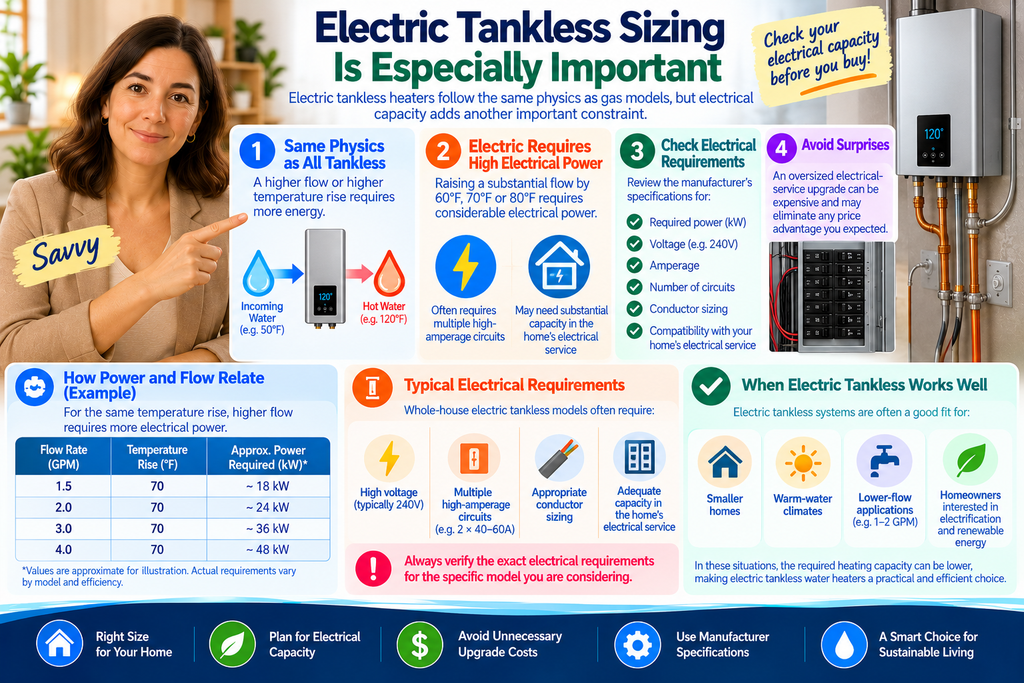
Electric tankless heaters follow exactly the same basic physics, but electrical capacity introduces another constraint. A whole-house electric tankless heater capable of raising a substantial water flow by 60°F, 70°F or 80°F requires considerable electrical power. Large models may require multiple high-amperage circuits, appropriate conductor sizing and substantial capacity in the home’s electrical service.
This is why I strongly recommend checking electrical requirements before selecting the heater. From a sustainability perspective, electrification can be very appealing, particularly as electrical grids incorporate more renewable generation. But forcing a house into an oversized electrical-service upgrade simply because an electric tankless heater looked inexpensive online may not produce the economic result the homeowner expected.
Smaller homes, warm-water climates and lower-flow applications are often particularly favorable for electric tankless systems because required heating capacity can be lower.
Gas tankless heaters can provide substantial heating capacity, which makes them particularly useful for large households and high simultaneous demand. The tradeoff is that the gas supply must support the heater. Tankless gas units can have much higher maximum firing rates than traditional storage water heaters. An existing gas line that adequately supplied an older tank heater should not automatically be assumed to support a high-output tankless replacement.
Gas-pipe diameter, available pressure, pipe length and other connected appliances all matter. Venting and combustion requirements must also be addressed according to the exact appliance and installation instructions. Correct water-heater sizing therefore needs to be coordinated with correct fuel-system sizing.
A little capacity margin can be sensible, but I do not recommend treating “bigger is always better” as a sizing philosophy. The objective is to select equipment capable of meeting realistic peak demand at the required temperature rise while operating within the manufacturer’s intended range.
Buying dramatically more capacity than the household needs can increase equipment cost without delivering meaningful additional comfort. It may also require larger infrastructure than necessary. I prefer to build a realistic demand model, include reasonable operating margin, and then compare suitable models rather than simply purchasing the largest available unit.
Absolutely, and undersizing is one of the fastest ways to become disappointed with tankless water heating. If demand exceeds the heater’s ability to add sufficient heat, the system cannot magically create additional heating capacity. Depending on the equipment and operating conditions, users may experience inadequate temperature, restricted flow or difficulty satisfying multiple fixtures simultaneously.
This problem can become more noticeable during winter because colder inlet water increases the required temperature rise. A heater that seemed adequate during summer may therefore feel underpowered during the coldest part of the year if the original sizing calculation ignored seasonal inlet-water conditions.
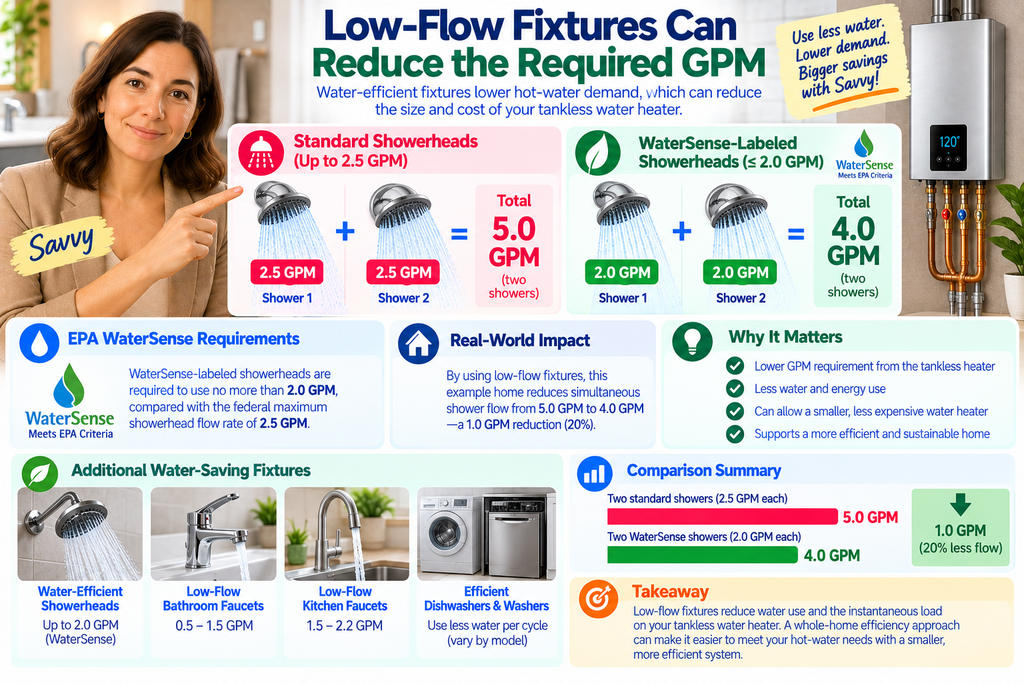
One of my favorite parts of tankless sizing is that efficiency improvements elsewhere in the home can sometimes reduce the capacity required from the water heater. A water-efficient showerhead can reduce both water consumption and the amount of hot water the heater needs to produce. EPA WaterSense-labeled showerheads are required to use no more than 2.0 GPM, compared with the federal maximum showerhead flow rate of 2.5 GPM.
Consider two simultaneous showers. Two 2.5-GPM showerheads could produce up to 5 GPM of combined fixture flow, while two 2.0-GPM WaterSense showerheads would use up to 4 GPM.
That difference can reduce water use while also reducing the instantaneous load placed on the water-heating system. This is a good example of why I prefer a whole-home efficiency approach rather than treating the water heater as an isolated appliance.
Recirculation is sometimes confused with increased water-heating capacity, but the two solve different problems. Tankless sizing determines whether the heater can produce enough hot water for simultaneous demand. Recirculation addresses how quickly that hot water reaches distant fixtures.
A large house may have a correctly sized 8-GPM or 10-GPM-capable system and still make someone wait for hot water at an upstairs bathroom because several gallons of cooled water are sitting in the pipe between the heater and fixture. EPA WaterSense encourages efficient hot-water distribution design and recognizes demand-initiated recirculation as a strategy for reducing water waste where long plumbing runs exist.
From my perspective, the best system combines appropriate heater capacity with efficient distribution.
Hard water does not necessarily change the initial GPM calculation, but it can affect the heater’s ability to maintain performance over time. Mineral scale can accumulate on heat-transfer surfaces and inside water passages. If maintenance is neglected, heat transfer and flow can be affected.
That means a perfectly sized heater on installation day may not continue performing as intended if water quality and maintenance are ignored. Where water hardness is significant, I would discuss treatment options with a qualified professional and follow the manufacturer’s recommended inspection and descaling schedule.
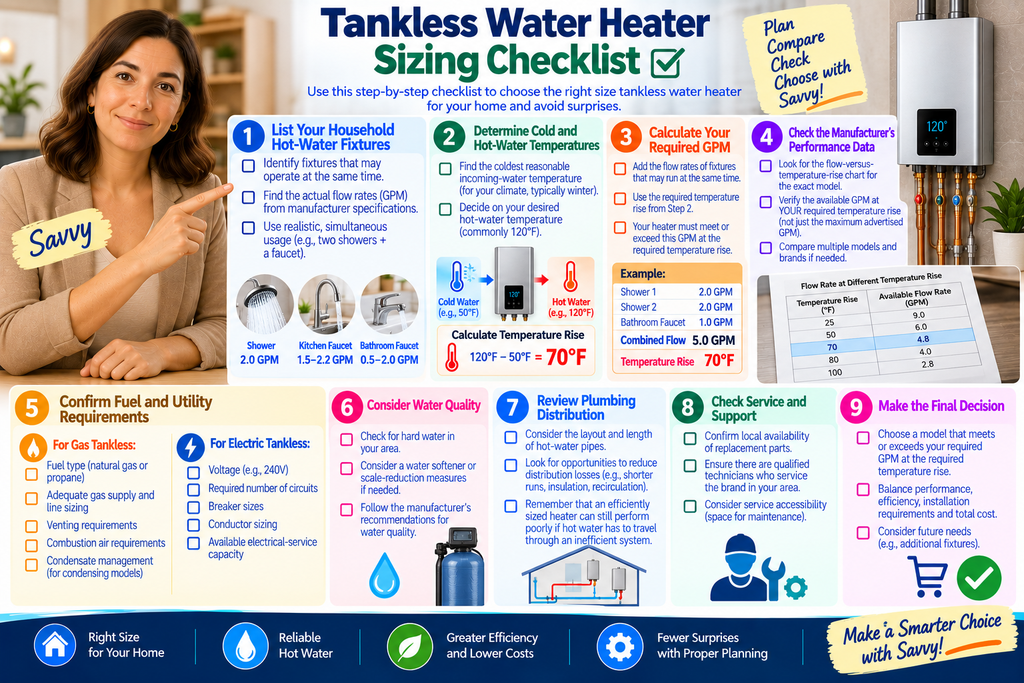
Before purchasing a tankless water heater, I would document the household’s realistic simultaneous hot-water fixtures and their actual flow rates. I would then establish the coldest reasonable incoming-water temperature, decide on the intended hot-water temperature and calculate the resulting temperature rise.
Next, I would compare those requirements against the manufacturer’s performance data for the exact model, paying particular attention to available GPM at the required temperature rise rather than maximum advertised GPM.
For gas equipment, I would confirm fuel type, available gas supply, venting, combustion and condensate requirements. For electric equipment, I would confirm voltage, required circuits, breaker sizes and available electrical-service capacity.
Finally, I would consider water hardness, service accessibility, local parts availability and the plumbing distribution layout. That final step matters because the best-sized water heater can still produce a disappointing experience if hot water has to travel through an inefficient distribution system.
If there is one thing I want homeowners to remember from this guide, it is that GPM by itself does not size a tankless water heater. GPM and temperature rise have to be considered together.
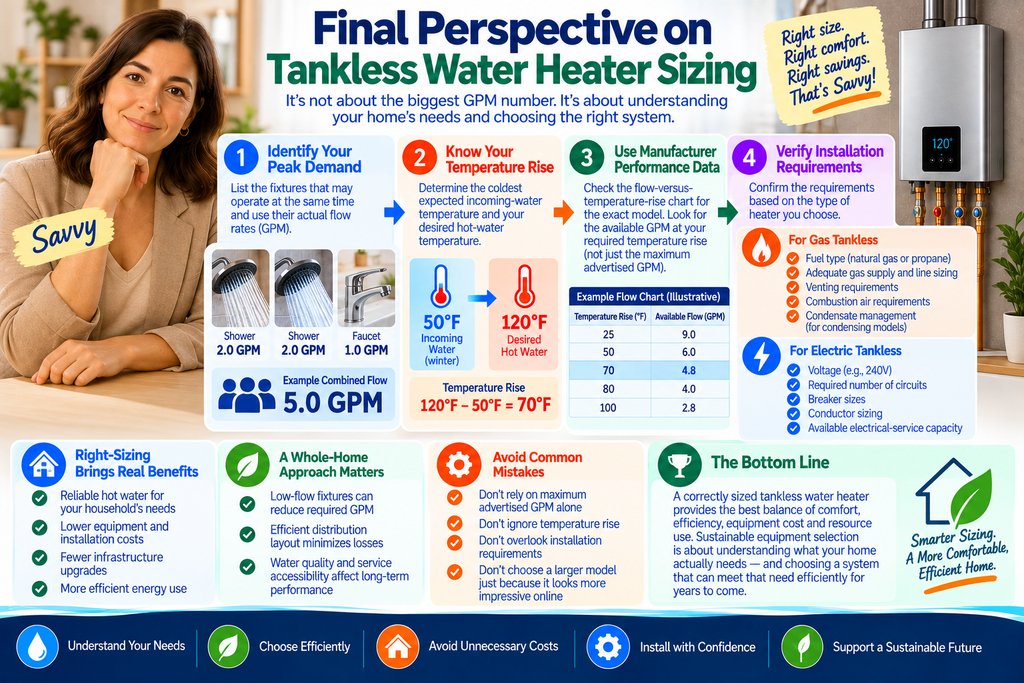
Start with your realistic peak simultaneous demand. Then determine the incoming-water temperature during the coldest conditions the system is expected to experience. Subtract that temperature from your desired hot-water temperature to establish the required rise. Only after you know those two numbers should you begin comparing tankless water heaters.
I would rather install a correctly sized system with modest-looking specifications than an expensive model selected because its marketing page displayed the largest maximum GPM number. Right-sizing generally produces a better balance of comfort, equipment cost, infrastructure requirements and resource use.
For me, that is what sustainable equipment selection should look like. It is not about buying the biggest appliance or chasing a single efficiency number. It is about understanding what the home actually needs and choosing equipment capable of meeting that need efficiently for years to come.
The correct size depends primarily on your maximum simultaneous hot-water demand and the temperature rise between incoming water and desired outlet water. Add the flow rates of fixtures likely to operate simultaneously, calculate the required temperature rise and then verify that the exact water-heater model can provide the required flow under those conditions.
A 5-GPM capability may be sufficient for homes with modest simultaneous demand, but the answer depends on temperature rise. A heater advertised at a maximum of 5 GPM may not actually provide 5 GPM when incoming water is very cold. Always check its flow performance at the required temperature rise.
It may be, but family size alone cannot answer the question. If two showers and other fixtures regularly operate simultaneously, calculate their combined demand and compare it with the heater’s output at the required temperature rise. A household that staggers hot-water use may require much less instantaneous capacity.
Two 2-GPM showerheads create approximately 4 GPM of total mixed-water flow, while two 2.5-GPM showerheads could reach approximately 5 GPM. Actual hot-water demand can be lower because shower valves mix hot and cold water, but sizing should still account for realistic simultaneous use and the required temperature rise.
Three 2-GPM showerheads could create approximately 6 GPM of combined fixture flow. Three 2.5-GPM showerheads could reach approximately 7.5 GPM. Whether a tankless heater can support that demand depends heavily on incoming-water temperature and the heater’s available output at the required temperature rise.
Winter inlet water can be substantially colder. The heater therefore has to add more heat to each gallon to reach the target outlet temperature. Because the heater has finite heating capacity, the maximum sustainable flow generally decreases as required temperature rise increases.
No. Headline GPM figures may be measured under different temperature-rise conditions, and your home may not need that much capacity. Compare both units at the temperature rise relevant to your installation and consider efficiency, fuel requirements, electrical requirements, modulation, installation cost and service support.
Use a realistic cold-season incoming-water temperature for your location and your intended water-heater outlet temperature. If incoming water is 50°F and the target is 120°F, for example, calculate performance using approximately a 70°F temperature rise.
Multiple tankless heaters can be used in appropriately engineered installations where one unit cannot efficiently satisfy the required load or where zoning provides practical advantages. The configuration, controls, plumbing, fuel or electrical supply and manufacturer requirements should be designed by qualified professionals.
Not necessarily. Available flow depends on heating capacity and required temperature rise. Large gas tankless heaters can provide substantial heating input, while whole-house electric units may require significant electrical capacity to produce comparable high flows under large temperature-rise conditions.
Usually, you should size around the maximum realistic simultaneous demand, not an improbable scenario in which every hot-water fixture in the house operates simultaneously. Consider how your household actually uses hot water during its busiest periods and include a reasonable margin.
A tankless heater can continue producing hot water for an extended period as long as it has energy and water available, but its instantaneous capacity is limited. It cannot supply unlimited GPM. If simultaneous demand exceeds its heating capacity, performance will be constrained.
For broader water-heating guidance, the U.S. Department of Energy Energy Saver provides useful information about tankless or demand-type water heaters, efficiency, sizing considerations and water-heating energy use.
For water-efficient fixtures and hot-water distribution, the U.S. Environmental Protection Agency WaterSense program provides guidance on showerheads and residential hot-water systems. WaterSense information is available at epa.gov/watersense/showerheads and epa.gov/watersense/watersense-labeled-homes-hot-water.
For water-heater efficiency certification and current performance criteria, consult ENERGY STAR at energystar.gov/products/water_heaters. For certified HVAC and water-heating equipment performance information where applicable, the AHRI Directory of Certified Product Performance is available at ahridirectory.org.
These resources are particularly useful because they provide government or independently administered efficiency and performance information rather than relying on retailer rankings or affiliate product comparisons.
The Furnace Outlet provides this tankless water heater sizing guide for general educational and informational purposes. GPM examples, fixture flow rates, temperature-rise calculations and household sizing scenarios are intended as planning guidance and should not replace manufacturer engineering data or a professional site evaluation. Actual tankless water-heater capacity depends on incoming-water temperature, desired outlet temperature, flow rate, fuel or electrical supply, plumbing design, elevation, equipment configuration and other installation conditions. Gas piping, electrical work, venting, combustion systems, plumbing and permitting may be regulated by local codes and should be designed or performed by appropriately qualified professionals where required. Always verify sizing, installation requirements and current specifications using the documentation supplied for the exact water-heater model being considered. The Furnace Outlet is an independent informational resource and is not a manufacturer, installer or representative of the brands or organizations referenced in this guide.