Newsletter Subscribe
Enter your email address below and subscribe to our newsletter

HVAC made simple
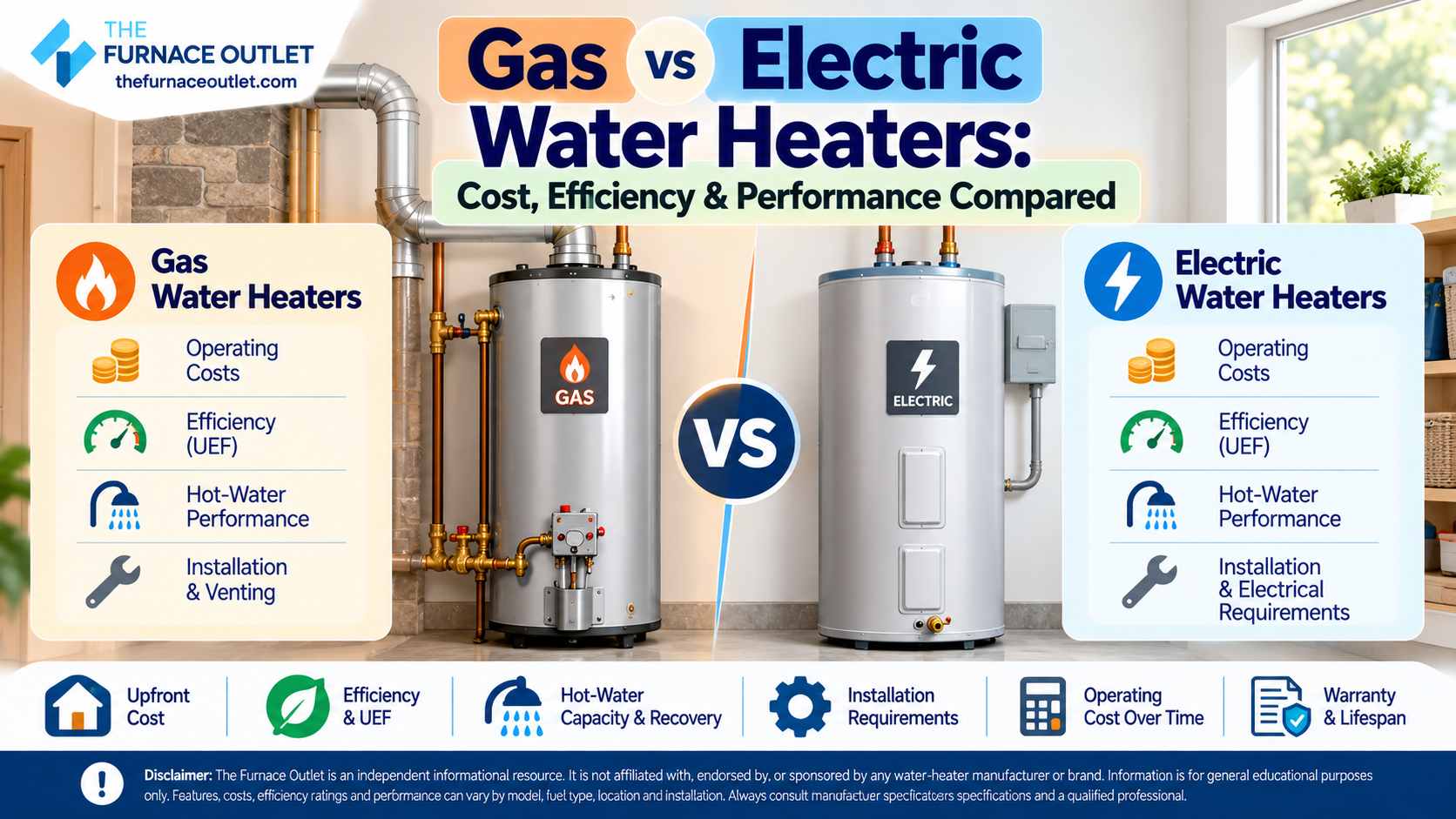
Choosing between a gas and an electric water heater sounds simple until you begin comparing the actual equipment. Gas can offer fast recovery and strong hot-water delivery, while electric equipment can be simpler to install and avoids combustion inside the home. Add modern heat-pump water heaters to the electric side of the comparison, and the efficiency difference becomes even more significant.
I’m Savvy Mavi, Savvy the Sustainability Expert, and I would not make this decision from fuel type alone. The right comparison should consider the home’s existing infrastructure, household hot-water demand, local utility prices, efficiency, installation cost, available space, maintenance, and expected ownership period. A house already equipped for a gas water heater presents a very different replacement project from an all-electric home, while replacing a conventional electric resistance heater with a heat-pump water heater can substantially change the operating-cost calculation.
The key is also to distinguish conventional electric resistance water heaters from electric heat-pump water heaters. Both use electricity, but they are fundamentally different technologies. ENERGY STAR explains that heat-pump water heaters transfer heat from surrounding air into the water rather than generating all their heat directly, allowing substantially greater efficiency than conventional resistance heating.
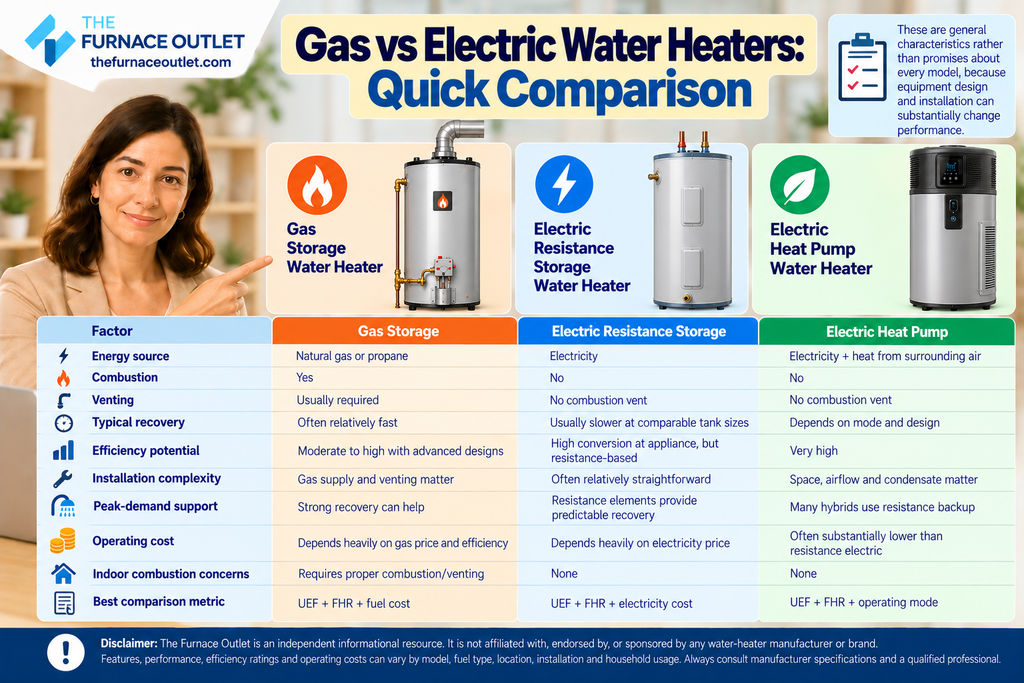
Before getting into the details, this is how I would frame the major differences. These are general characteristics rather than promises about every model, because equipment design and installation can substantially change performance.
| Factor | Gas Storage | Electric Resistance Storage | Electric Heat Pump |
|---|---|---|---|
| Energy source | Natural gas or propane | Electricity | Electricity + heat from surrounding air |
| Combustion | Yes | No | No |
| Venting | Usually required | No combustion vent | No combustion vent |
| Typical recovery | Often relatively fast | Usually slower at comparable tank sizes | Depends on mode and design |
| Efficiency potential | Moderate to high with advanced designs | High conversion at appliance, but resistance-based | Very high |
| Installation complexity | Gas supply and venting matter | Often relatively straightforward | Space, airflow and condensate matter |
| Peak-demand support | Strong recovery can help | Resistance elements provide predictable recovery | Many hybrids use resistance backup |
| Operating cost | Depends heavily on gas price and efficiency | Depends heavily on electricity price | Often substantially lower than resistance electric |
| Indoor combustion concerns | Requires proper combustion/venting | None | None |
| Best comparison metric | UEF + FHR + fuel cost | UEF + FHR + electricity cost | UEF + FHR + operating mode |
I would use this table only as a starting point. The home’s existing fuel connections and the exact products being compared can shift the economics considerably.
A conventional gas storage water heater uses a burner to heat water held in an insulated tank. When hot water leaves the tank, cold water enters and the burner operates as needed to bring the stored water back toward the thermostat setting.
Gas storage heaters have traditionally been attractive where natural gas is already available because a substantial burner can provide relatively rapid recovery. Recovery matters when a household uses a large amount of hot water over a short period, because the appliance begins reheating incoming cold water while hot water is still being drawn.
Efficiency varies considerably among gas designs. ENERGY STAR explains that higher-efficiency gas storage models can improve performance through better insulation, heat traps and more efficient burners. More advanced condensing models can use a secondary heat exchanger to recover additional energy from combustion gases, although condensing equipment introduces additional venting and condensate-management considerations.
This is why I would never assume that all gas storage water heaters perform alike. Two similar-looking tanks can have meaningfully different efficiency, recovery, First-Hour Rating and installation requirements.
A conventional electric storage water heater usually heats water with electric-resistance elements installed inside the tank. There is no burner, combustion-air requirement or flue carrying combustion gases out of the home.
That simplicity is one of the technology’s major advantages. Where appropriate electrical service already exists, replacement can be comparatively straightforward because the project does not require a gas connection or combustion venting system. The actual electrical circuit, breaker and wiring requirements must still match the exact appliance and applicable codes.
Electric resistance heating also has a straightforward operating principle: electrical energy is converted directly into heat. What it does not do is multiply the electrical input by harvesting substantial additional heat from the environment. That distinction becomes important when we compare a conventional electric heater with a heat-pump water heater.
DOE’s 2024 residential water-heater standards reflect this efficiency difference. The amended standards, with compliance generally beginning in 2029 for covered consumer water heaters, are expected to push many common-size newly manufactured electric storage water heaters toward heat-pump technology. The Department of Energy’s Energy.gov
If someone asks me whether gas or electric is more efficient, my first response would be to ask which kind of electric water heater.
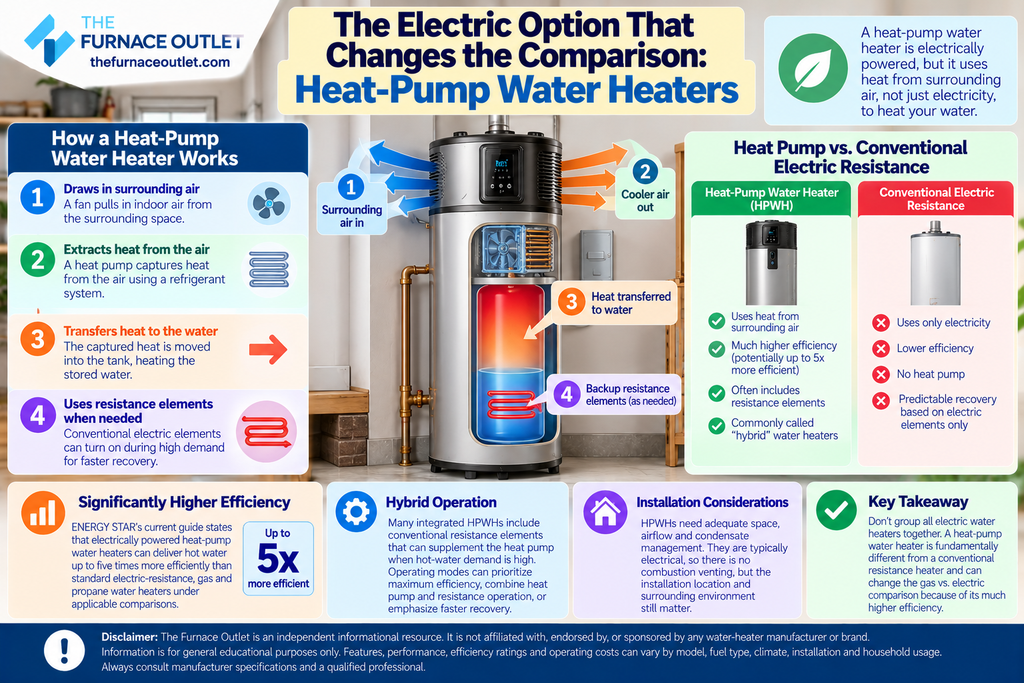
A heat-pump water heater is electrically powered, but it works very differently from a conventional resistance heater. ENERGY STAR compares the basic process to a refrigerator operating in reverse: instead of removing heat from an enclosed space and releasing it into the room, the water heater extracts heat from surrounding air and transfers that energy into the stored water.
Many integrated HPWHs also contain conventional resistance elements. Those elements can supplement the heat pump when hot-water demand is high, which is why these products are frequently called hybrid water heaters. Operating modes can prioritize maximum heat-pump efficiency, combine heat-pump and resistance operation, or emphasize faster recovery when necessary.
ENERGY STAR’s current guide states that electrically powered HPWHs can deliver hot water up to five times more efficiently than standard electric-resistance, gas and propane water heaters under applicable comparisons. This is a major reason I would not group conventional resistance and heat-pump water heaters together simply because both plug into an electrical system.
There are two different questions hidden inside the word “efficient.” The first is how efficiently the appliance uses the energy delivered to it. The second is what that efficiency means for operating cost and broader energy use in a particular home.
UEF, or Uniform Energy Factor, is the standardized residential water-heater efficiency metric used in the United States. Higher UEF represents greater standardized efficiency within an appropriate comparison, but UEF ranges differ substantially among technologies.
Current federal purchasing guidance, for example, lists an integrated heat-pump water heater at UEF 3.3 or greater for the relevant category. Gas storage and gas instantaneous equipment occupy much lower numerical UEF ranges because they operate through fundamentally different processes.
A heat pump can have a UEF substantially above 1 because it is moving environmental heat rather than generating all of the useful heat from its electrical input. That does not mean homeowners should simply divide the UEF of a heat pump by the UEF of a gas heater to predict their utility bills. Electricity and gas have different prices, and installation and usage conditions also differ.
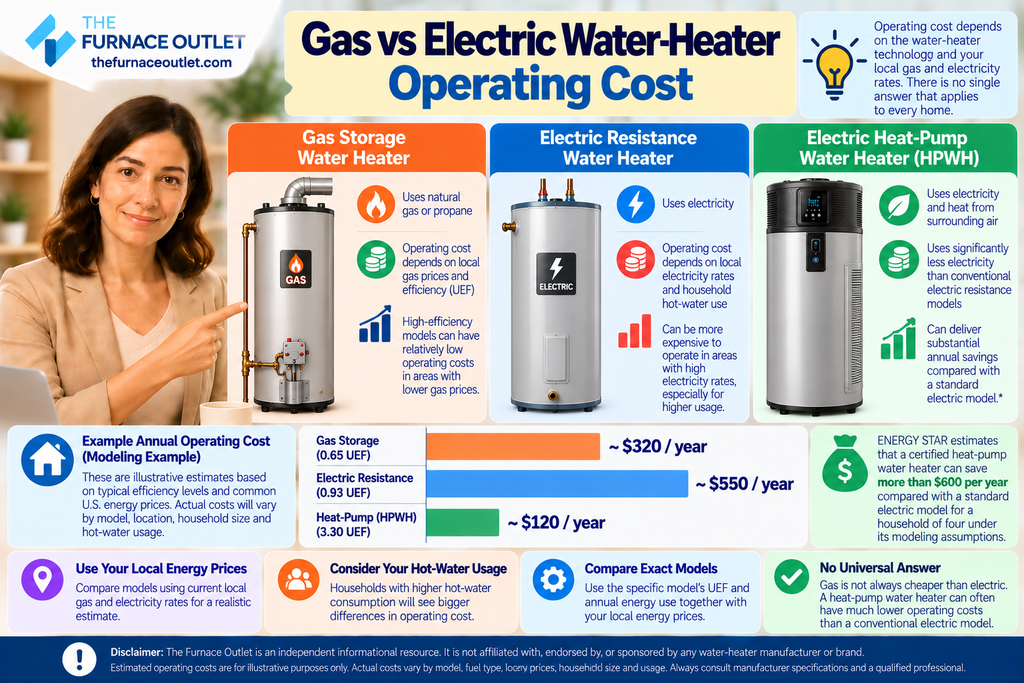
Operating cost is where I would be particularly careful about blanket statements such as “gas is always cheaper than electric.” The answer depends on which electric technology is being compared and what local energy costs are.
Conventional electric resistance water heating can become expensive where electricity rates are high, particularly for households with substantial hot-water consumption. Gas may have favorable operating economics in locations with relatively inexpensive natural gas, but a high-efficiency heat-pump water heater can use dramatically less electricity than conventional resistance equipment.
ENERGY STAR currently estimates that a certified heat-pump water heater can produce substantial annual savings compared with a standard electric model, although the actual amount varies with household size, rates and usage. Its consumer material cites savings of more than $600 per year for a household of four under its modeling assumptions. I would treat that as a program estimate rather than a guarantee for an individual home.
When comparing gas and electric options, I would use the exact model’s energy information together with current local gas and electricity rates. That approach is much more meaningful than relying on a national rule of thumb.
The price printed on the water heater is only one part of the project. Installation conditions can sometimes matter more than the difference in equipment price.
Replacing an existing conventional electric tank with another electric tank may require relatively modest infrastructure changes if the electrical circuit, physical space and plumbing remain suitable. Replacing an existing atmospheric gas heater with another compatible gas model may likewise be straightforward when the gas supply and venting system are appropriate.
Fuel switching changes the calculation. Converting from electric to gas can involve gas piping, combustion venting, permits and other work. Moving from gas to an HPWH may require electrical work, condensate drainage and changes to the installation space. I would therefore compare complete installed project cost, not equipment price. A water heater that costs several hundred dollars less at the store can become the more expensive project if it requires substantial infrastructure work.
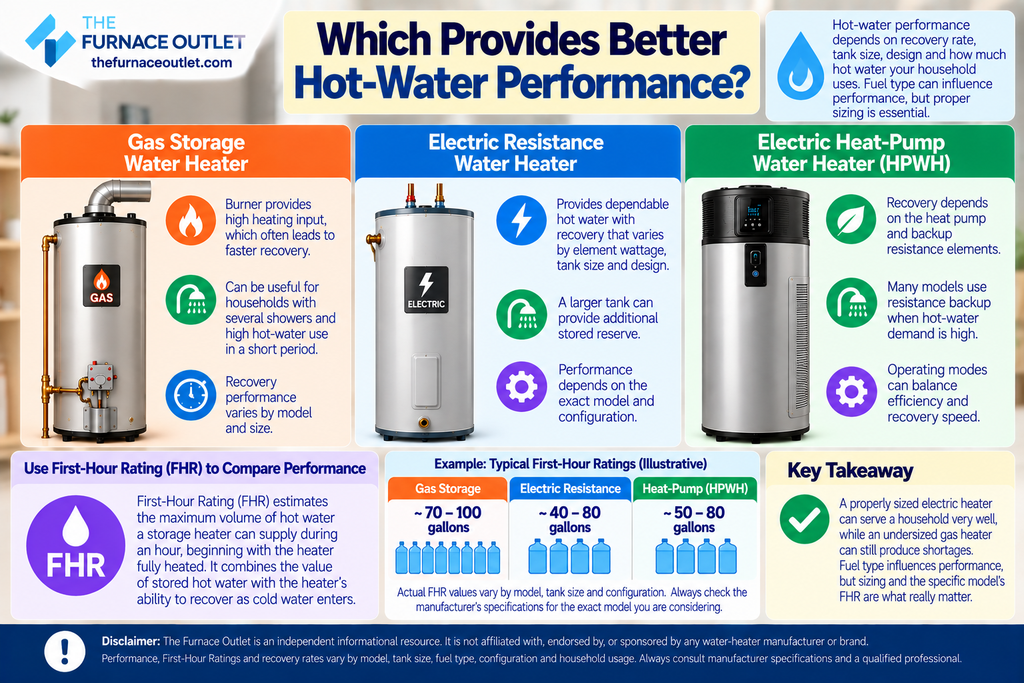
Gas storage heaters often have an advantage in recovery because their burners can deliver substantial heating input. That can be useful in homes where several showers and other hot-water activities occur within a relatively short period.
Electric resistance tanks can also provide dependable hot water, but recovery characteristics vary according to element wattage, tank size and design. A larger tank can provide additional stored reserve, but tank volume by itself still does not describe peak-hour performance.
For storage equipment, I would compare First-Hour Rating rather than making assumptions from fuel type. FHR estimates the maximum volume of hot water that a storage heater can supply during an hour beginning with the heater fully heated. It combines the value of stored hot water with the heater’s ability to recover as cold water enters.
A properly sized electric heater can therefore serve a household very well, while an undersized gas heater can still produce shortages. Fuel type influences performance, but sizing remains essential.
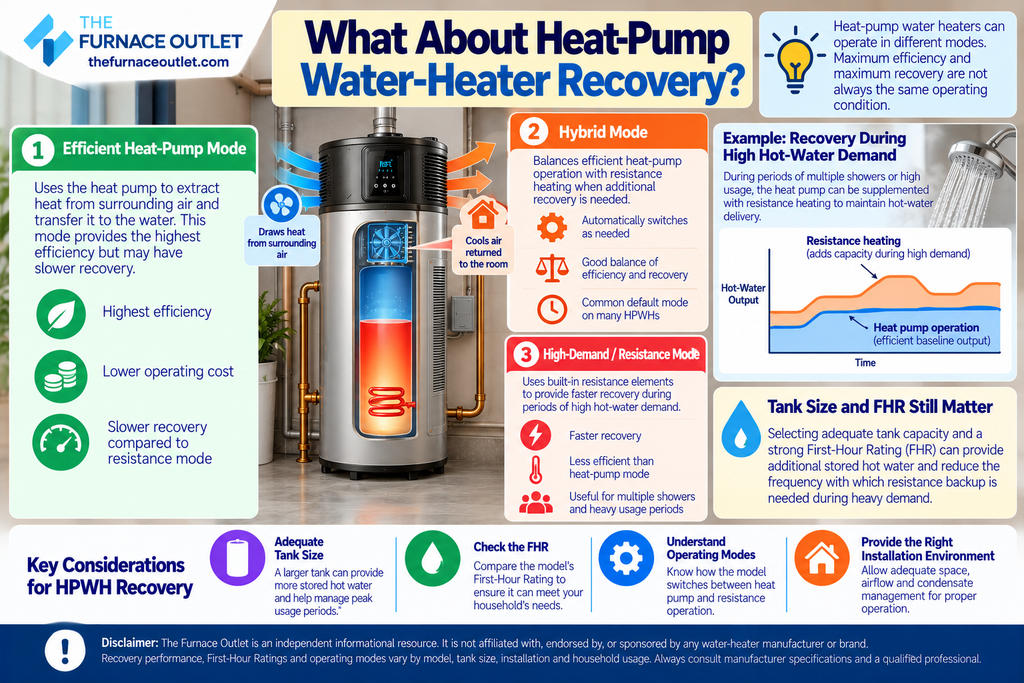
Heat-pump water heaters introduce another layer to the performance discussion because maximum efficiency and maximum recovery are not always the same operating condition. ENERGY STAR explains that many HPWHs can automatically use resistance heating during periods of high demand. Efficiency-oriented modes rely more heavily on the heat pump, while hybrid operation balances efficient heat-pump operation with additional resistance heating when needed.
That backup provides useful flexibility, but resistance operation is less efficient. I would therefore pay particular attention to tank size and FHR when choosing an HPWH. In some households, selecting more storage capacity can provide additional thermal reserve and reduce the frequency with which resistance backup is needed during heavy demand.
The goal is not simply to buy the smallest tank that technically satisfies the household. I want a system that can provide comfortable hot-water delivery while spending as much operating time as practical in its efficient heat-pump mode.
Gas water heaters introduce combustion requirements that electric equipment avoids. Depending on the design, gas appliances require an appropriate fuel supply, combustion air and a properly designed exhaust system. Condensing gas models can also require condensate drainage.
ENERGY STAR notes that high-efficiency condensing gas storage water heaters extract additional heat from combustion gases and therefore produce condensate that must be managed appropriately. Venting requirements vary by product, so the exact manufacturer’s installation manual should drive the final design.
Conventional electric storage heaters avoid gas piping and combustion venting but require an appropriate electrical circuit. HPWHs also avoid combustion, although they introduce their own requirements for installation space, airflow, ambient operating conditions, sound and condensate drainage.
I would therefore describe electric installation as different rather than automatically easier. A simple electric-resistance replacement can be straightforward, while converting an unsuitable location to a large HPWH can require meaningful planning.
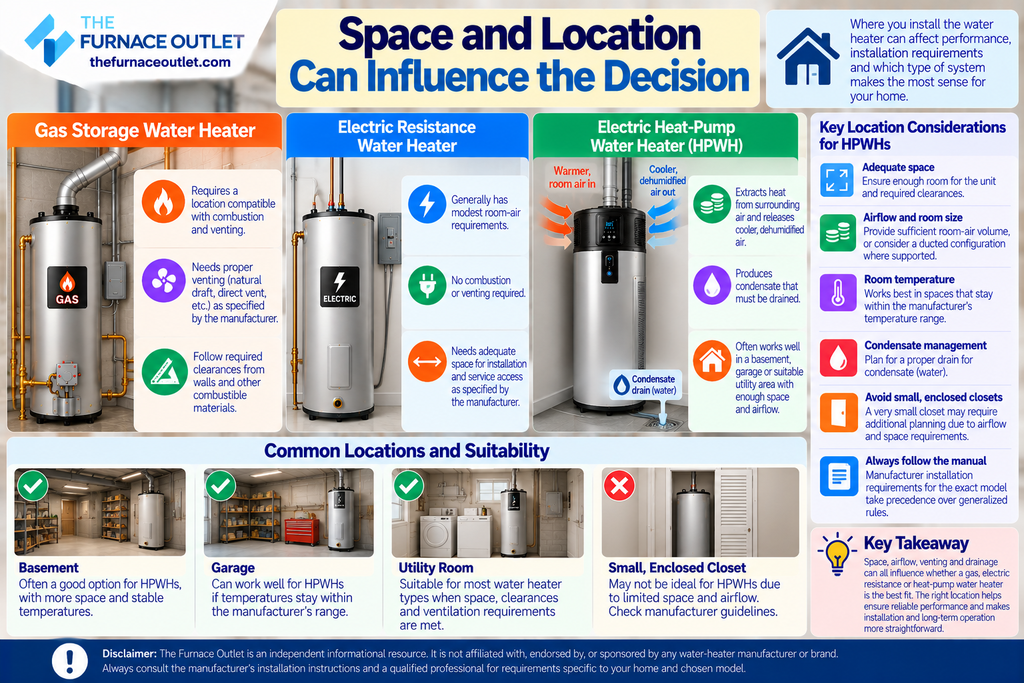
A conventional electric resistance tank generally has relatively modest room-air requirements because it does not burn fuel or extract substantial heat from surrounding air. A gas appliance requires a location compatible with its combustion and venting system.
An HPWH interacts more directly with the room in which it operates. It extracts heat from surrounding air and releases cooler, dehumidified air while producing condensate. ENERGY STAR’s HPWH guidance notes that integrated units typically harvest heat from surrounding air, although some configurations can use ducting.
That can make a basement, garage or appropriate utility area attractive in some homes, while a very small enclosed closet may require additional planning. Manufacturer installation requirements for the exact model should always take precedence over generalized rules.
Neither fuel type is maintenance-free. Storage tanks can accumulate sediment, safety devices need to remain functional, plumbing connections should be inspected, and manufacturer-recommended maintenance should be followed.
Gas appliances add combustion and venting components that should remain safe and correctly adjusted. Condensing gas equipment also has condensate components that require appropriate installation and maintenance.
Heat-pump water heaters introduce a refrigeration system, air filter, fan and condensate-management components in addition to the storage tank and backup heating system. Filter maintenance is generally straightforward, but it is still something the homeowner needs to remember.
For me, this is another reason not to choose from UEF or purchase price alone. Parts availability, warranty terms and local service capability matter when the appliance may remain in the home for many years.
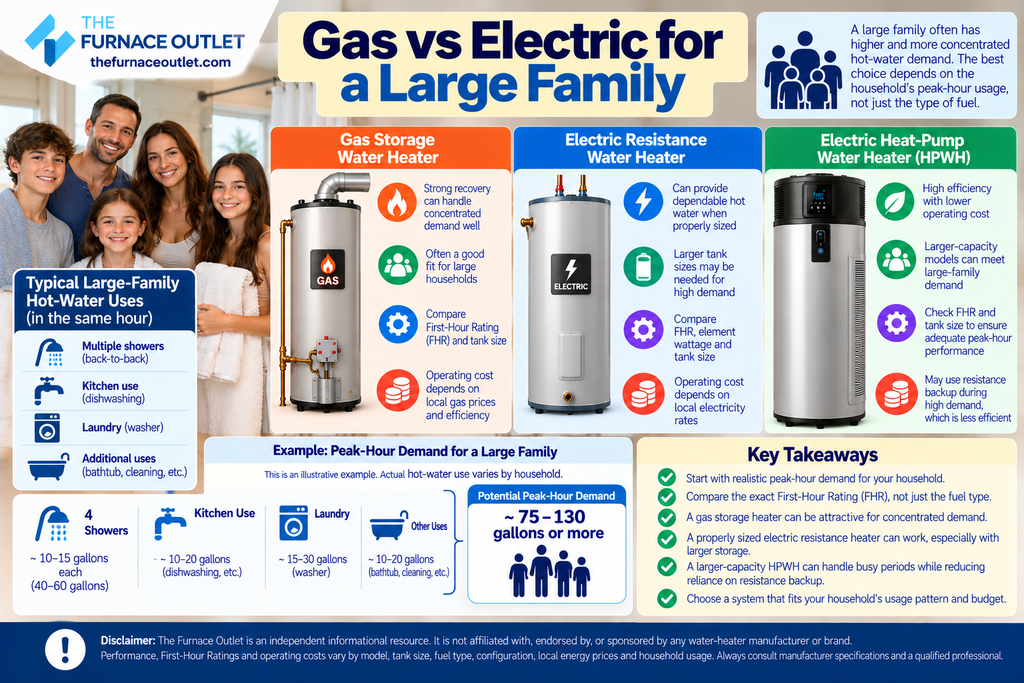
For a large household, I would start with peak-hour demand, not fuel preference. If several people routinely shower within the same hour while kitchen and laundry hot-water use overlaps, the heater needs sufficient first-hour performance regardless of whether it uses gas or electricity.
A gas storage heater with strong recovery can be attractive for concentrated demand. A properly sized electric resistance heater can also work, although additional storage may be necessary depending on recovery characteristics.
For an HPWH, I would pay particularly close attention to FHR and storage capacity. A larger-capacity HPWH can sometimes provide the thermal reserve needed to handle busy periods while reducing dependence on less-efficient resistance backup.
In every case, I would compare the exact FHR with a realistic estimate of household peak-hour demand rather than using a rule such as “five people need gas.”
A smaller household often has more flexibility because peak hot-water demand may be relatively modest. If only one shower normally operates at a time and laundry or dishwashing occurs separately, extremely high recovery may provide little practical benefit.
In that situation, installation simplicity and operating cost can become more influential. An existing electric-resistance heater might be inexpensive to replace, while an appropriately sized HPWH could substantially reduce electricity consumption over a longer ownership period.
A gas system may still make sense where the infrastructure already exists and local fuel economics are attractive. The important point is that smaller households should not automatically buy oversized equipment simply because larger capacity appears more comfortable.
From a sustainability perspective, I would separate appliance efficiency from the energy source supplying it. A gas water heater burns fuel at the home, producing combustion emissions. Electric resistance and HPWH equipment have no on-site combustion, but the environmental impact of their electricity depends partly on how the local grid generates power.
Heat-pump water heaters are especially interesting because their high efficiency can substantially reduce electricity consumption relative to resistance water heating. ENERGY STAR also notes that switching from fossil-fuel water heating to an HPWH removes a source of carbon monoxide and nitrogen dioxide from inside the home.
The emissions comparison between gas and electric equipment can therefore vary by location and over time as electricity-generation mixes change. I would avoid presenting one universal emissions number for every U.S. household.
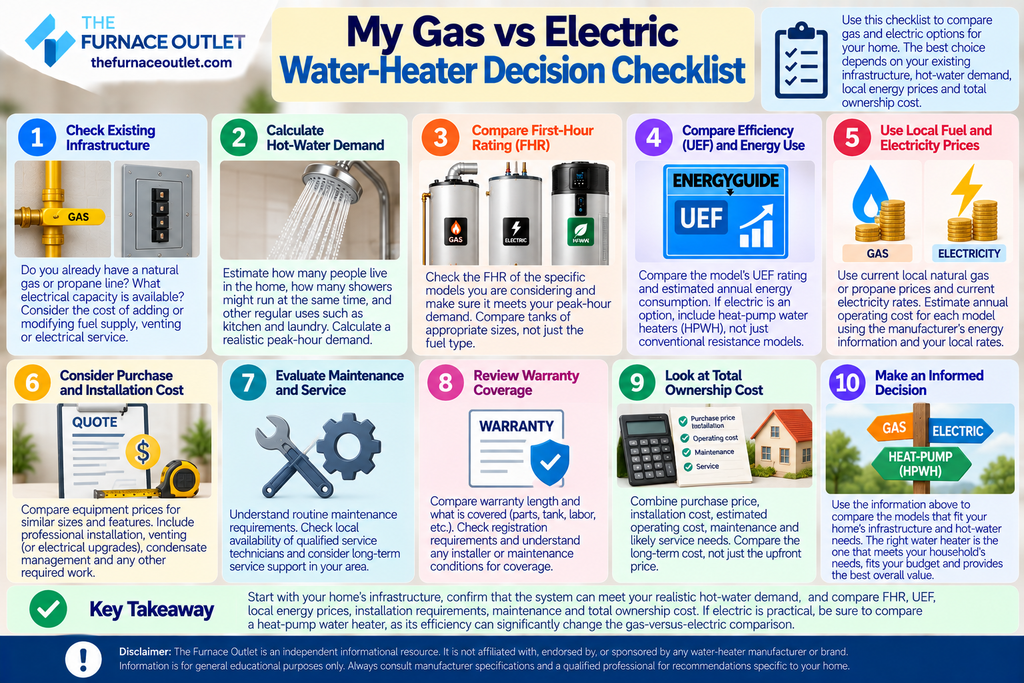
I would begin with the infrastructure already in the home because changing fuels can materially affect installation cost. Next, I would calculate realistic peak-hour hot-water demand and compare the FHR of appropriately sized storage heaters.
After confirming capacity, I would compare UEF and expected energy consumption, then apply actual local gas and electricity prices. Purchase price, professional installation, venting or electrical upgrades, condensate management, maintenance, warranty and local service support should all be included in the ownership calculation.
If electric equipment is practical, I would specifically compare a heat-pump water heater rather than limiting the electric option to conventional resistance heating. Modern HPWH technology changes the gas-versus-electric efficiency comparison too significantly to ignore.
There is no universal answer because operating cost depends on equipment efficiency, household hot-water use and local gas and electricity rates. Conventional resistance electric heating can be relatively expensive where electricity prices are high, while an HPWH can use substantially less electricity. Gas can be economically attractive where fuel prices are favorable, so I would calculate costs using the exact models and local rates.
Conventional gas storage heaters often provide relatively strong recovery because of their burner input, but actual performance varies by model. Electric resistance and heat-pump equipment have different recovery characteristics. For storage heaters, First-Hour Rating is more useful than assuming performance solely from fuel type.
The answer depends on the electric technology. Conventional resistance electric and gas equipment operate very differently, while modern heat-pump water heaters can achieve much higher standardized efficiency because they transfer environmental heat into the water. ENERGY STAR says HPWHs can deliver hot water up to five times more efficiently than standard electric-resistance, gas and propane water heaters in applicable comparisons.
A conventional electric resistance or heat-pump water heater does not require combustion venting because it does not burn gas in the appliance. An HPWH still has installation requirements involving airflow, space and condensate drainage, so the absence of a combustion vent does not mean that it can be installed anywhere.
An HPWH can offer dramatically better energy efficiency, but installation location, available space, ambient conditions, condensate management, sound, FHR and purchase cost should be evaluated. I would compare the complete installed project and long-term energy cost rather than judging the technologies from equipment price alone.
Fuel switching deserves a whole-project analysis. I would compare the cost of electrical work and any other conversion requirements against the expected operating economics of the new equipment. If considering electric, an HPWH deserves particular attention because its efficiency is fundamentally different from conventional electric resistance heating.
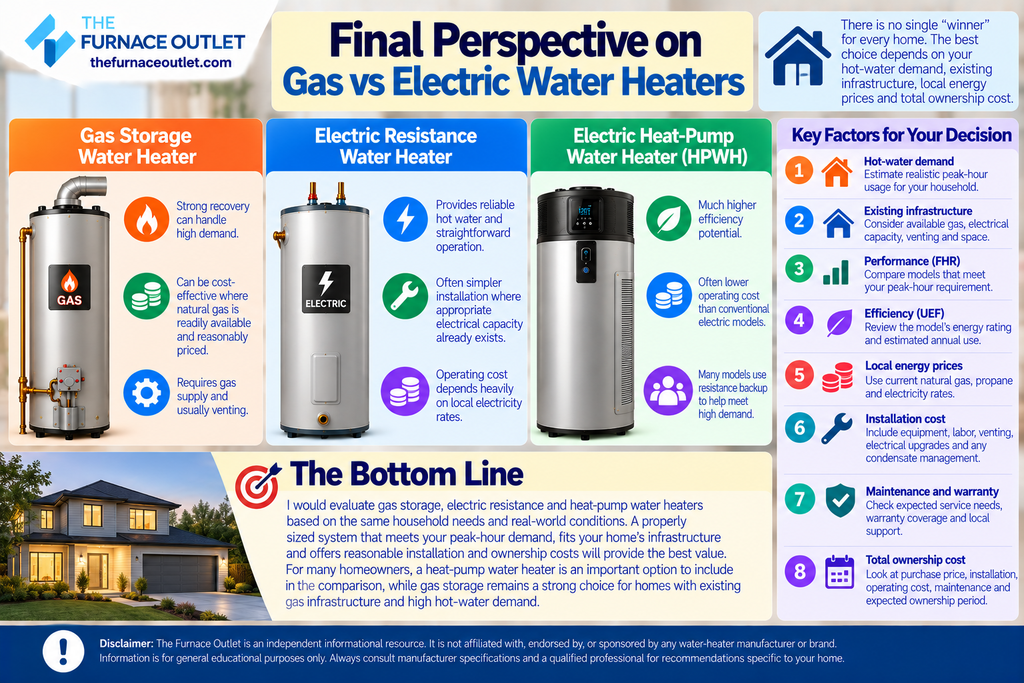
I would not declare gas or electric the automatic winner because the category “electric” now contains two very different technologies. A conventional resistance heater offers straightforward operation and can be relatively simple to install where appropriate electrical infrastructure already exists. Gas storage equipment can provide strong recovery and may have favorable operating economics where natural gas is readily available and reasonably priced. A heat-pump water heater adds a third path, combining electric operation with much higher efficiency potential.
The best decision begins with hot-water demand and the home’s existing infrastructure. Once I know how much hot water the household needs during its busiest hour, I can compare equipment that actually satisfies that requirement. From there, UEF, local utility rates, installation cost, maintenance, warranty and expected ownership period provide a much better basis for choosing between technologies.
For homeowners focused on long-term efficiency, I would make sure a modern heat-pump water heater is included in the comparison whenever the installation conditions are suitable. For homes with existing gas infrastructure and demanding hot-water patterns, gas equipment remains an important option to evaluate. The goal is not to choose a fuel by reputation but to find the system that provides the required comfort with sensible installation and ownership economics.
For additional research, the ENERGY STAR Heat Pump Water Heater Guide explains HPWH operation and installation considerations, while ENERGY STAR — How Heat Pump Water Heaters Work provides a consumer-friendly explanation of heat-pump and resistance-backup operation.
For gas equipment, ENERGY STAR — How High-Efficiency Gas Storage Water Heaters Work explains conventional and condensing gas designs. The DOE Consumer Water Heaters resource provides information on federal water-heater standards, while DOE Residential Water Heater Purchasing Guidance is useful for comparing efficiency and life-cycle economics. Finally, ENERGY STAR Water Heater Key Product Criteria provides current UEF and hot-water-delivery criteria. The Department of Energy’s Energy.gov
The Furnace Outlet is an independent informational and educational resource. It is not associated with, affiliated with, endorsed by, or sponsored by any water-heater manufacturer or brand discussed in this article, and it does not receive manufacturer compensation for inclusion or rankings.
Water-heater efficiency, performance, energy consumption, operating cost, installation cost, hot-water delivery and environmental impact vary according to equipment type, model, household demand, climate, incoming-water temperature, fuel and electricity prices, utility generation mix, installation conditions and maintenance. Gas, electrical, plumbing, combustion venting and condensate requirements are also subject to manufacturer instructions and applicable codes. Verify specifications for the exact equipment being considered and consult appropriately qualified or licensed plumbing, electrical, gas or other professionals where required.