Newsletter Subscribe
Enter your email address below and subscribe to our newsletter

HVAC made simple
By Jake Lawson | HVAC Specialist | The Furnace Outlet
Updated October 2026 | Heat Pump Troubleshooting & Winter Heating Guide
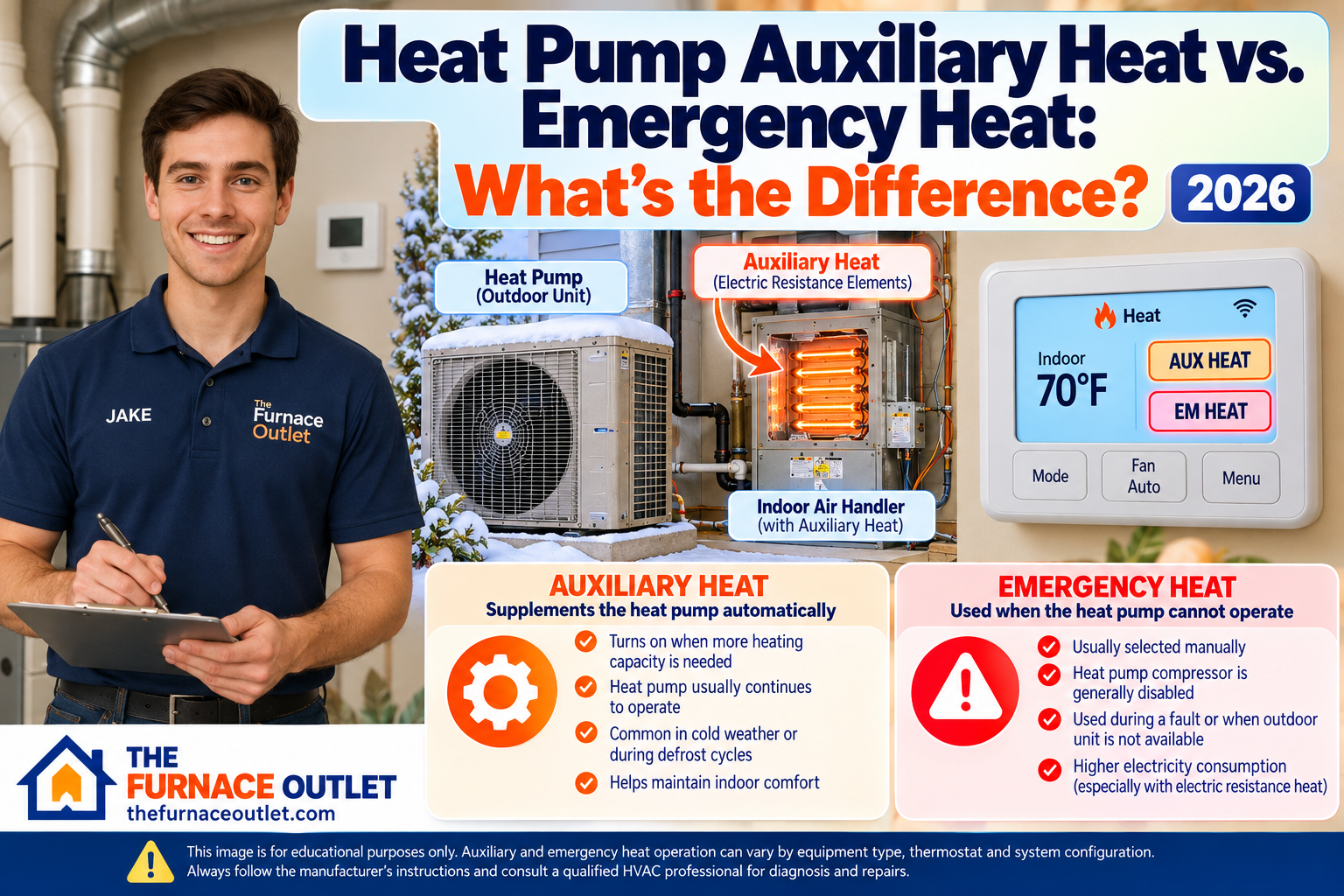
If you own a heat pump, you may have noticed two settings on your thermostat that sound remarkably similar: Auxiliary Heat (AUX HEAT) and Emergency Heat (EM HEAT). Both are associated with supplemental heating, but they serve different purposes, operate under different circumstances, and can affect your winter electricity bills in very different ways.
As an HVAC specialist with more than 10 years of experience working with residential and commercial heating systems, I frequently encounter homeowners who assume auxiliary heat and emergency heat are interchangeable. Some believe emergency heat provides a faster way to warm their home, while others worry whenever the AUX HEAT indicator appears during freezing weather. These misunderstandings can lead to unnecessary service calls, higher energy consumption, or incorrect thermostat operation.
The distinction is straightforward: auxiliary heat normally supplements the heat pump automatically, while emergency heat is a separate operating mode generally intended for situations where the primary heat pump cannot be used. However, the precise behavior depends on the thermostat, heating equipment, and system configuration. Understanding those differences can help you maintain comfort without unnecessarily increasing heating costs.
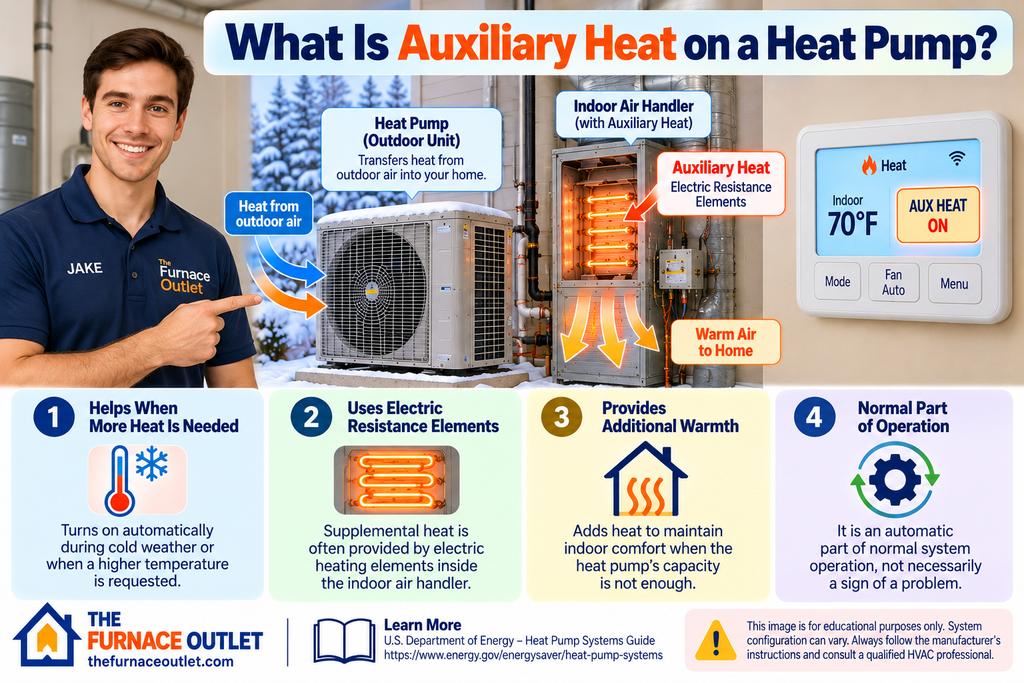
Auxiliary heat is a supplemental heating source that helps the primary heat pump maintain indoor comfort when additional heating capacity is required. In many all-electric ducted systems, this supplemental heating comes from electric resistance elements installed inside the indoor air handler. In dual-fuel installations, a gas furnace may serve as an alternative heating source, although its control sequence may differ from electric auxiliary heating.
During normal heating, the heat pump transfers thermal energy from outdoor air into the home. When outdoor temperatures fall or the thermostat requests a substantial temperature increase, the available heat pump capacity may not be sufficient to satisfy the heating demand quickly. Under appropriate conditions, the system’s controls can activate supplemental heating automatically.
For example, if your thermostat is set to 70°F and the indoor temperature begins falling during unusually cold weather, auxiliary heat may activate to provide additional warmth. Once the heating demand decreases, the controls can reduce or deactivate supplemental heating according to the system’s design.
The important point is that auxiliary heat is generally an automatic part of normal system operation, not necessarily evidence that something is broken. Some cold-climate heat pumps can meet substantial heating loads without frequent backup operation, while other systems are intentionally designed to use supplemental heating under particular winter conditions.
The U.S. Department of Energy’s heat pump systems guide provides useful background on how heat pumps deliver heating and why their operating capacity changes with outdoor conditions.
Emergency heat is a thermostat operating mode that generally disables the primary heat pump’s normal compressor-based heating and relies on an alternative heating source. On many all-electric systems, that source is the same electric resistance heating equipment used for auxiliary heat. In dual-fuel configurations, emergency operation may involve a backup furnace, depending on how the equipment and controls are designed.
The purpose of emergency heat is to provide an alternative way to heat the home when the primary heat pump is unavailable, malfunctioning, or has been intentionally taken out of service. It is not simply a stronger version of ordinary heating and should not be treated as a routine method for increasing indoor temperature more quickly.
For example, if an outdoor heat pump develops a serious mechanical problem and a qualified technician advises you not to operate it, emergency heat may provide temporary indoor heating until repairs are completed. However, some systems have no emergency heat mode, and others use different control arrangements.
On an all-electric installation, emergency heat can be substantially more expensive to operate because electric resistance heating typically delivers less heat per unit of electricity than an efficiently operating heat pump. Homeowners should therefore understand their specific system before selecting this mode.
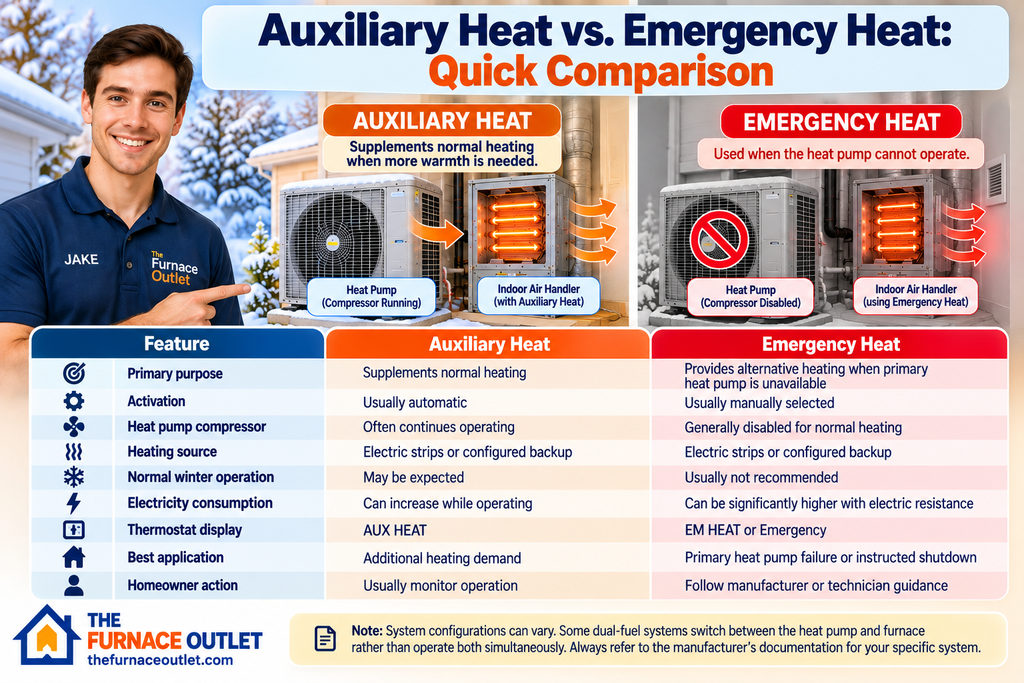
| Feature | Auxiliary Heat | Emergency Heat |
|---|---|---|
| Primary purpose | Supplements normal heating | Provides alternative heating when primary heat pump is unavailable |
| Activation | Usually automatic | Usually manually selected |
| Heat pump compressor | Often continues operating | Generally disabled for normal heating |
| Heating source | Electric strips or configured backup | Electric strips or configured backup |
| Normal winter operation | May be expected | Usually not recommended |
| Electricity consumption | Can increase while operating | Can be significantly higher with electric resistance |
| Thermostat display | AUX HEAT | EM HEAT or Emergency |
| Best application | Additional heating demand | Primary heat pump failure or instructed shutdown |
| Homeowner action | Usually monitor operation | Follow manufacturer or technician guidance |
Although this comparison describes common residential arrangements, equipment-specific control strategies can differ. Certain dual-fuel systems intentionally switch between the heat pump and furnace rather than operate both simultaneously, and advanced thermostats may use outdoor-temperature limits or other control logic. The manufacturer’s documentation remains the best source for determining exactly how your system operates.
Auxiliary heat may activate when the home’s heating demand exceeds the heat pump’s available capacity or when the thermostat determines that additional heating is needed. This commonly happens during particularly cold weather, although the actual activation conditions depend on the equipment, thermostat configuration, and installation.
Another situation involves recovery from a substantial thermostat setback. If a homeowner reduces the indoor temperature overnight and then requests a rapid increase the following morning, some controls activate supplemental heat to accelerate recovery. This can increase electricity consumption, particularly when electric resistance elements provide the additional heating.
Auxiliary heat may also operate during heat pump defrost cycles. During defrost, many heat pumps temporarily change refrigerant flow to warm the outdoor coil and remove accumulated frost. Supplemental indoor heating can help maintain comfort while the primary refrigeration circuit is temporarily unavailable for normal heating.
However, not every heat pump uses auxiliary heat during defrost, and not every system requires supplemental heating simply because outdoor temperatures fall below freezing. Modern cold-climate equipment can maintain useful heating capacity at very low temperatures, making manufacturer-specific performance information essential.
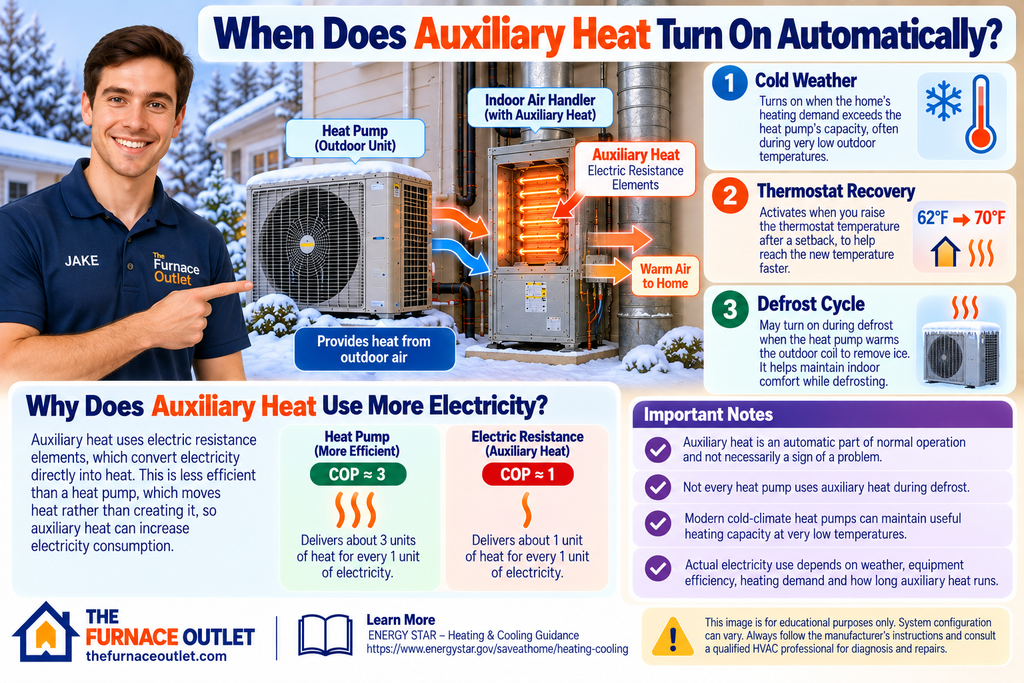
In many all-electric heat pump systems, auxiliary heating relies on electric resistance elements. These components convert electrical energy directly into heat and can deliver substantial heating output, but they generally do not achieve the same energy efficiency as a heat pump operating under suitable conditions.
A heat pump moves thermal energy rather than producing all of its heating through electrical resistance. Under favorable operating conditions, it can deliver multiple units of heating energy for each unit of electricity consumed. Electric resistance heating, by comparison, delivers approximately one unit of heat for each unit of electrical energy used at the equipment.
For example, if a heat pump operates at a coefficient of performance of 3, it delivers approximately three units of heat for every unit of electricity consumed. Electric resistance heating has a coefficient of performance close to 1 at the point of use. This simplified comparison explains why extensive resistance heating can increase electricity consumption.
Actual operating costs depend on outdoor conditions, equipment efficiency, electricity rates, heating demand, and the duration of supplemental heating operation. Auxiliary heat is not inherently wasteful when genuinely needed, but unnecessary activation can make winter heating more expensive.
The ENERGY STAR heating and cooling guidance offers additional information on maintaining efficient HVAC operation and improving household energy performance.
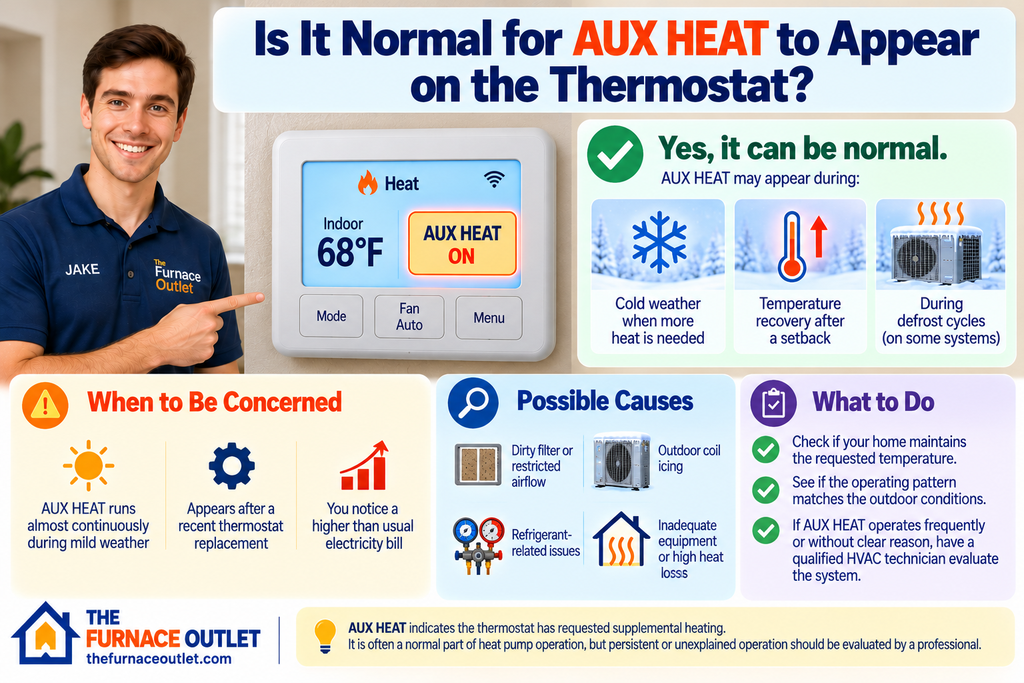
Yes. Seeing AUX HEAT occasionally during cold weather, substantial temperature recovery, or certain defrost operations can be normal. The indicator usually means that the thermostat has requested supplemental heating, although it does not independently confirm that every associated component is operating correctly.
I would become more concerned if auxiliary heat operates almost continuously during relatively mild weather, appears after a recent thermostat replacement, or accompanies an unexpected increase in electricity consumption. These symptoms may indicate incorrect control settings, insufficient primary heating capacity, equipment problems, or excessive building heat loss.
A thermostat can also request supplemental heating because the indoor temperature is not rising as expected. The underlying cause might involve dirty filters, restricted airflow, heavy outdoor coil icing, refrigerant-related problems, or inadequate equipment sizing rather than a defective thermostat.
Instead of assuming the auxiliary heat indicator proves a malfunction, observe whether the home maintains its requested temperature and whether the operating pattern makes sense for the outdoor conditions. Persistent unexplained operation deserves professional evaluation.
Emergency heat is generally appropriate when the primary heat pump cannot operate safely or effectively and the system has a functioning backup heating source designed for independent operation. A common example is a compressor or outdoor-unit failure that prevents normal heating, while the indoor electric heating elements remain operational.
Another possible situation involves a serious equipment problem for which a technician has instructed the homeowner to disable the primary heat pump. Emergency heat may temporarily maintain indoor comfort until the fault is repaired, provided the system is designed to operate in that configuration.
However, emergency heat should not automatically be selected whenever outdoor temperatures drop below freezing. A properly designed heat pump may continue providing efficient heating in cold conditions, and switching unnecessarily to resistance heating can increase operating costs.
If the system emits a burning electrical smell, repeatedly trips breakers, produces smoke, or shows other signs of a serious electrical fault, do not assume emergency heat is safe. Stop operation when safe and obtain professional guidance, because the backup heating equipment may share electrical or control components with the affected system.
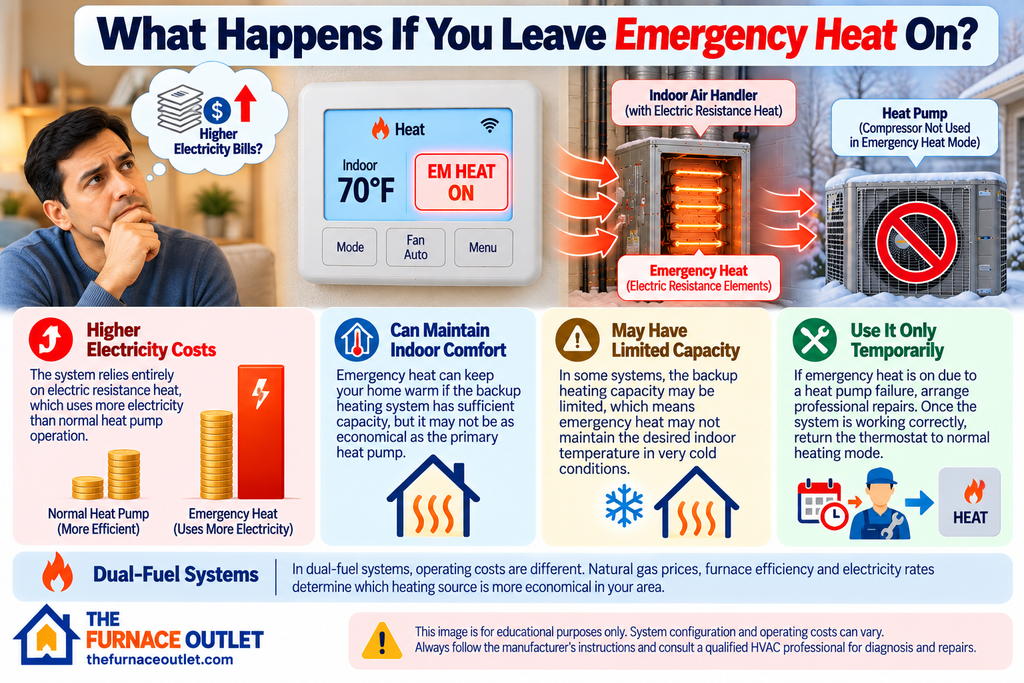
Leaving emergency heat selected for an extended period can significantly increase heating costs in an all-electric system because the home may rely entirely on resistance heating instead of the heat pump’s refrigeration cycle. The exact increase depends on the home’s heating demand, electricity rates, equipment configuration, and how efficiently the primary heat pump would otherwise operate.
Emergency heat can maintain indoor comfort when the backup system has sufficient capacity, but it may not deliver the same operating economy as the primary heat pump. In some installations, backup heating capacity may also be limited, meaning emergency mode cannot necessarily maintain the desired indoor temperature under every condition.
If emergency heat was selected temporarily because of a heat pump failure, arrange professional repairs rather than treating the setting as a permanent solution. Once the technician confirms that the primary system is operating correctly, return the thermostat to its normal heating mode according to manufacturer instructions.
For dual-fuel systems, operating costs require a separate comparison because natural gas prices, furnace efficiency, and electricity rates determine which heating source is more economical under particular conditions.
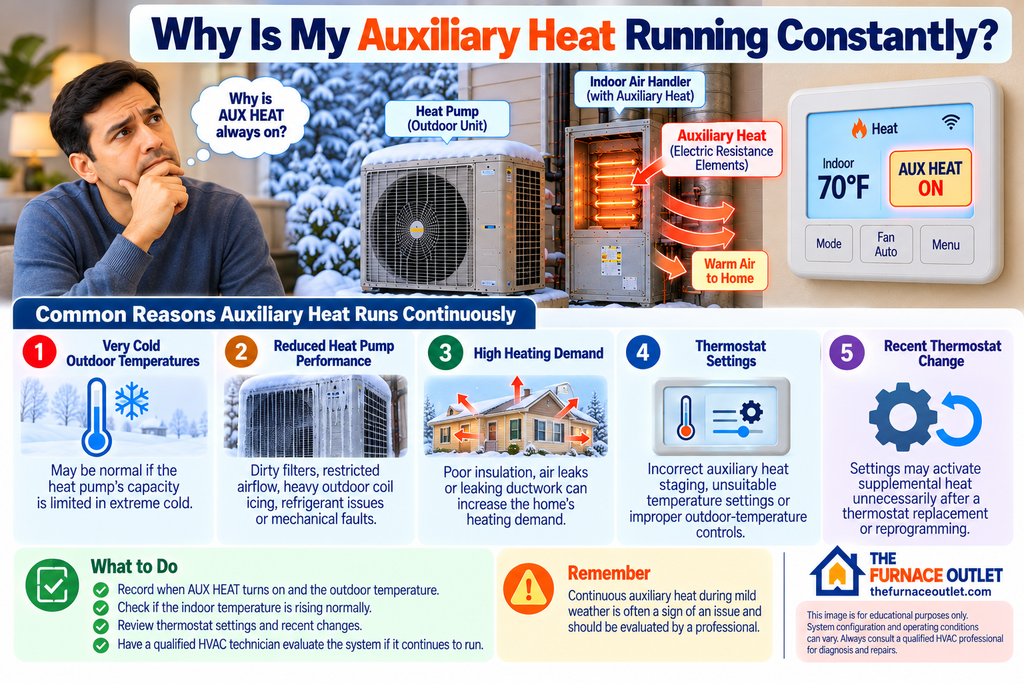
Persistent auxiliary heat operation can indicate that the heat pump is unable to satisfy the home’s heating demand without supplemental assistance. During extreme cold, this may be consistent with the system’s intended design. However, continuous auxiliary heating during milder conditions may suggest that something is wrong.
One possible cause is inadequate primary heat pump performance. Restricted airflow, heavy outdoor coil icing, refrigerant-related problems, or mechanical faults can reduce heating output and cause the thermostat to request additional heat more frequently. Poor insulation, leaking ductwork, and excessive air infiltration may also increase the home’s heating demand.
Thermostat configuration is another consideration. Incorrect auxiliary heat staging, unsuitable temperature settings, or improperly configured outdoor-temperature controls can activate supplemental heating unnecessarily. These issues are particularly relevant when a thermostat has recently been replaced or reprogrammed.
I recommend recording when auxiliary heat activates, the outdoor temperature, and whether the indoor temperature is increasing normally. A qualified technician can use this information to evaluate heating performance, control settings, and backup heating operation.
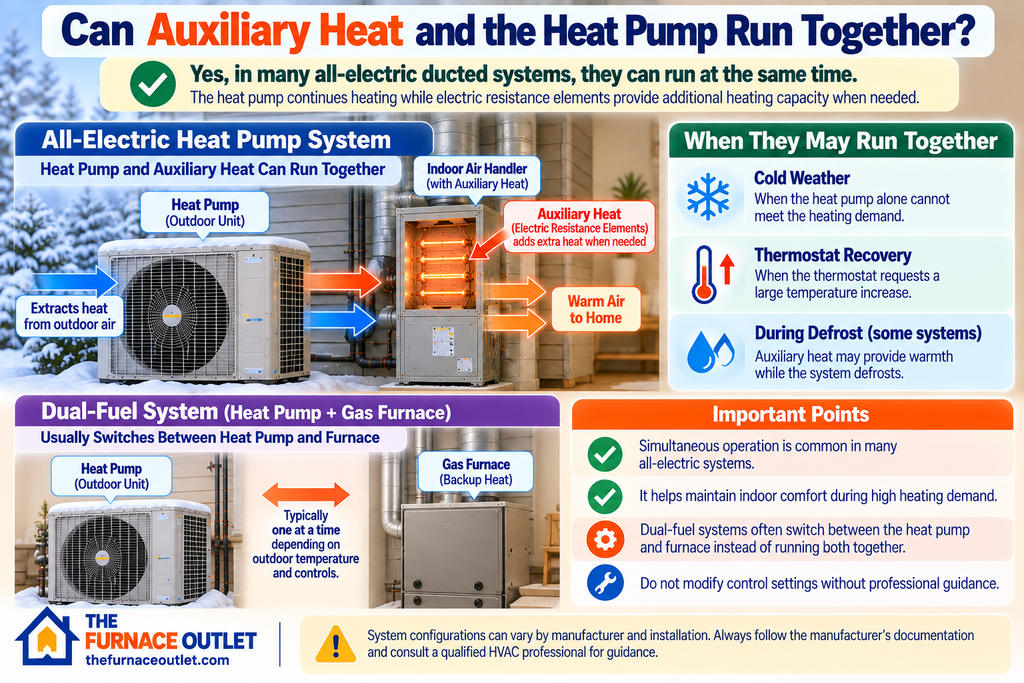
Yes, in many all-electric ducted systems, the primary heat pump and electric auxiliary heating elements can operate simultaneously. The heat pump continues transferring energy from outdoors while resistance elements provide additional heating capacity when required.
This arrangement allows the system to maintain indoor comfort when the heat pump alone cannot satisfy the heating load. It may also provide supplementary warmth during thermostat recovery or certain defrost sequences, depending on equipment design.
However, dual-fuel systems frequently operate differently. When a gas furnace serves as the backup heating source, the controls may switch between the heat pump and furnace rather than operate both together. The appropriate sequence depends on the equipment and how the system was engineered.
Homeowners should not attempt to modify these control arrangements without professional guidance. Incorrect staging or simultaneous operation of incompatible equipment can create performance and safety problems.
Reducing unnecessary auxiliary heating begins with ensuring that the primary heat pump operates correctly. Regularly inspect accessible air filters, maintain clear supply and return vents, and keep snow, leaves, and vegetation from obstructing the outdoor equipment. Proper airflow and clean heat exchangers help the system deliver its intended heating performance.
Thermostat strategy also matters. Large temperature setbacks may cause certain controls to activate supplemental heating during recovery. Many heat pump installations benefit from relatively consistent temperature settings, although the ideal strategy depends on equipment type, occupancy, and thermostat capabilities.
Building improvements can reduce heating demand as well. Sealing air leaks, improving attic insulation, repairing leaking ducts, and addressing poorly insulated spaces can help the heat pump maintain comfort with less supplemental assistance.
Professional maintenance should include checking thermostat configuration, auxiliary heating stages, electrical connections, defrost controls, blower operation, and actual heating performance. The ENERGY STAR HVAC maintenance checklist provides useful recommendations for routine servicing.
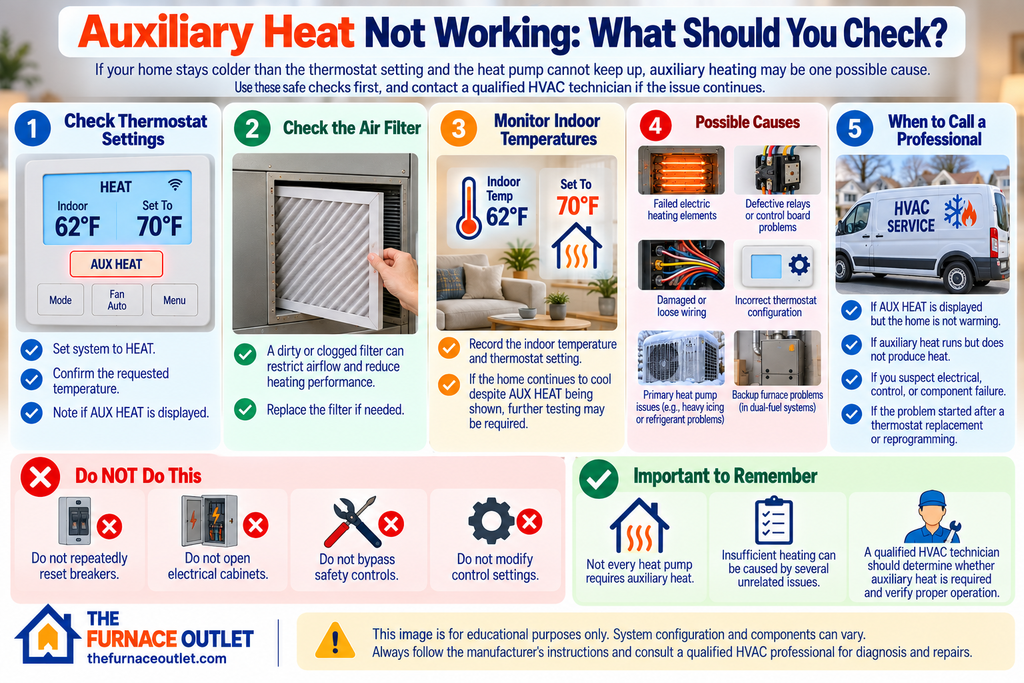
If your home becomes progressively colder during severe weather and the heat pump cannot maintain the thermostat setting, malfunctioning auxiliary heating may be one possible explanation. However, not every heat pump requires backup heating, and insufficient heating can result from several unrelated faults.
Begin with safe observations. Confirm that the thermostat is set to HEAT, record the indoor and requested temperatures, and check the accessible air filter. If the thermostat displays AUX HEAT but the home continues cooling, professional evaluation may be appropriate.
Potential faults include failed electric heating elements, defective relays, damaged wiring, control board problems, incorrect thermostat configuration, or issues involving the backup furnace in a dual-fuel installation. These components require qualified diagnostic testing.
Do not repeatedly reset breakers, bypass safety controls, or open electrical cabinets to investigate. A technician should determine whether auxiliary heating is required, whether it is being requested correctly, and whether the installed backup equipment is delivering its intended heating output.
No. Auxiliary heat normally supplements the primary heat pump automatically, while emergency heat generally selects an alternative heating mode that bypasses normal compressor-based heating. Both may use the same electric heating elements in certain systems, but their operating purposes differ.
Not simply because outdoor temperatures are below freezing. Many heat pumps are designed to operate efficiently in cold weather. Emergency heat should generally be reserved for situations where the primary heat pump cannot be used and the backup system is suitable for operation.
The thermostat may be requesting supplemental heating because of low outdoor temperatures, a substantial temperature recovery demand, or a defrost-related operating sequence. Occasional activation can be normal, but persistent unexplained operation deserves investigation.
Not necessarily. Heating speed depends on backup equipment capacity, system design, and control configuration. Emergency heat is not intended as a routine fast-heating setting, and using electric resistance backup unnecessarily can increase operating costs.
Do not automatically switch modes simply because frost is visible. Light frost and temporary defrost cycles can be normal. Heavy persistent icing warrants professional inspection, and emergency heating should be used only when appropriate for the equipment and situation.
No. Some ductless systems and cold-climate installations do not include separate backup heating equipment. Thermostat features and available heating modes depend on the system’s design and configuration.
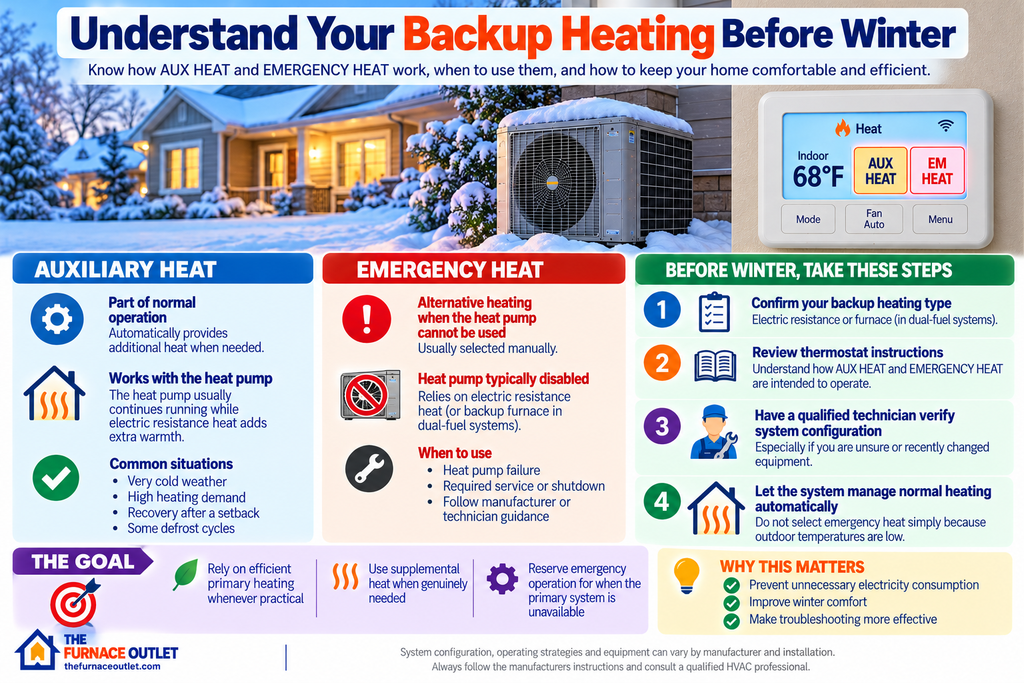
When homeowners ask me whether auxiliary heat or emergency heat is better, I explain that the two settings are not competing heating options. They are different operating strategies intended for different situations. Auxiliary heat is generally part of normal automatic heating operation, while emergency heat is intended to provide an alternative when the primary heat pump cannot be used.
My preferred approach is to let a properly configured heat pump manage normal heating and supplemental operation automatically. I would not recommend selecting emergency heat simply because outdoor temperatures are low or because the heat pump runs for long periods. Instead, I would evaluate whether the system maintains indoor comfort and whether auxiliary heating activates appropriately for the weather and equipment design.
Understanding these controls can help prevent unnecessary electricity consumption, improve winter comfort, and make troubleshooting more effective. Before the heating season begins, I recommend confirming which backup heating equipment is installed, reviewing the thermostat’s operating instructions, and having a qualified technician verify the system’s configuration if anything is unclear.
A properly designed heat pump should use its available heating resources intelligently. The goal is to rely on efficient primary heating whenever practical, use supplemental heat when genuinely needed, and reserve emergency operation for circumstances where the primary system is unavailable.
This article is published by The Furnace Outlet for general educational purposes only and does not replace manufacturer instructions, professional HVAC diagnosis, or applicable safety requirements. Auxiliary and emergency heating configurations vary by equipment type, thermostat, climate, and installation. Electrical repairs, gas appliance servicing, refrigerant work, and internal equipment modifications should be performed by appropriately qualified professionals. The Furnace Outlet publishes independent educational content; external references do not imply affiliation or endorsement.
© 2026 The Furnace Outlet. All rights reserved.