Newsletter Subscribe
Enter your email address below and subscribe to our newsletter

HVAC made simple

By Jake Lawson — the HVAC Specialist
A DIY mini split can look especially attractive in a cold-climate home. You get ductless heating and cooling, variable-speed operation, room-by-room comfort and the possibility of reducing installation costs by doing some of the work yourself. But heating a home when outdoor temperatures fall well below freezing is a much tougher assignment than cooling a room on a warm summer afternoon. A system that performs beautifully in mild weather may lose substantial heating capacity as temperatures drop, which makes equipment selection, sizing and installation planning especially important.
Cold-climate performance also changes what “DIY” should mean. The fact that a mini split is marketed for homeowner installation doesn’t automatically tell you whether it can carry your home’s winter heating load, how it handles defrost, what happens during extreme cold or whether you need another heat source. Before buying equipment, I would look at the heating performance of the exact indoor/outdoor combination, compare it with the home’s calculated heating requirement and then decide whether the proposed installation method makes sense.
The first question shouldn’t be whether the mini split has quick-connect fittings. It should be whether the equipment is suitable for the winter conditions where it will operate.
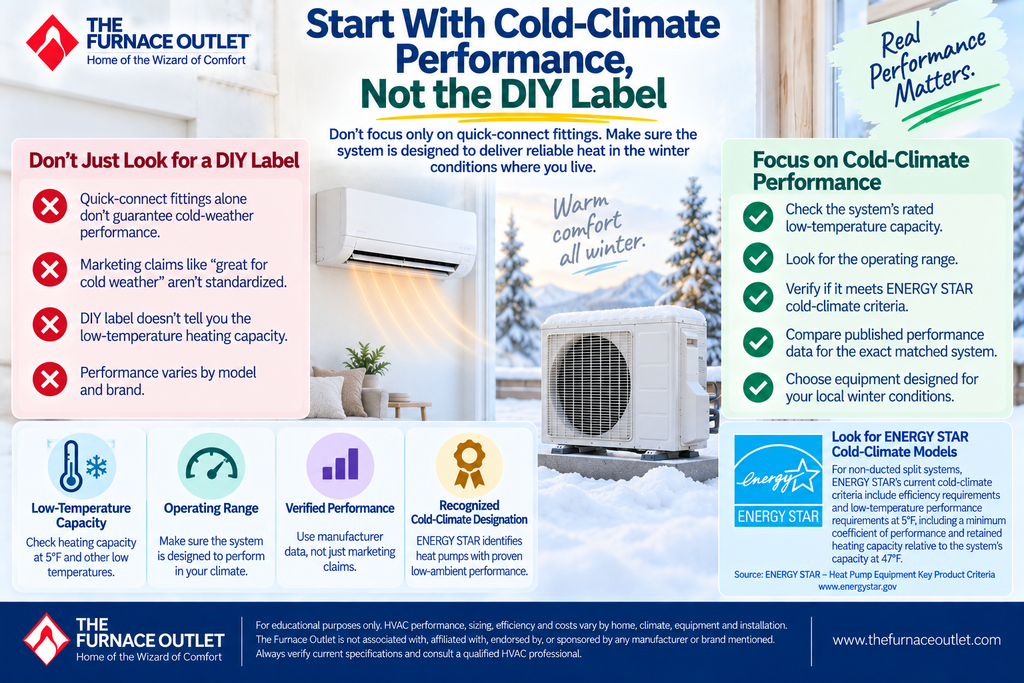
Modern cold-climate heat pumps can continue providing useful heat at temperatures that would have been challenging for earlier generations. Variable-speed compressors and improved controls allow many systems to operate across a broad outdoor-temperature range, but performance isn’t identical from one model to another. ENERGY STAR has specific cold-climate criteria intended to identify heat pumps with demonstrated low-ambient performance. For non-ducted split systems, its current cold-climate criteria include efficiency requirements plus low-temperature performance requirements at 5°F, including a minimum coefficient of performance and retained heating capacity relative to the system’s capacity at 47°F.
ENERGY STAR — Heat Pump Equipment Key Product Criteria
That gives homeowners a much better starting point than a seller’s description saying a unit is “great for cold weather.” Marketing language isn’t standardized enough to replace published performance data. Look for the exact matched system’s rated low-temperature capacity and operating range, and verify whether it carries a recognized cold-climate designation.
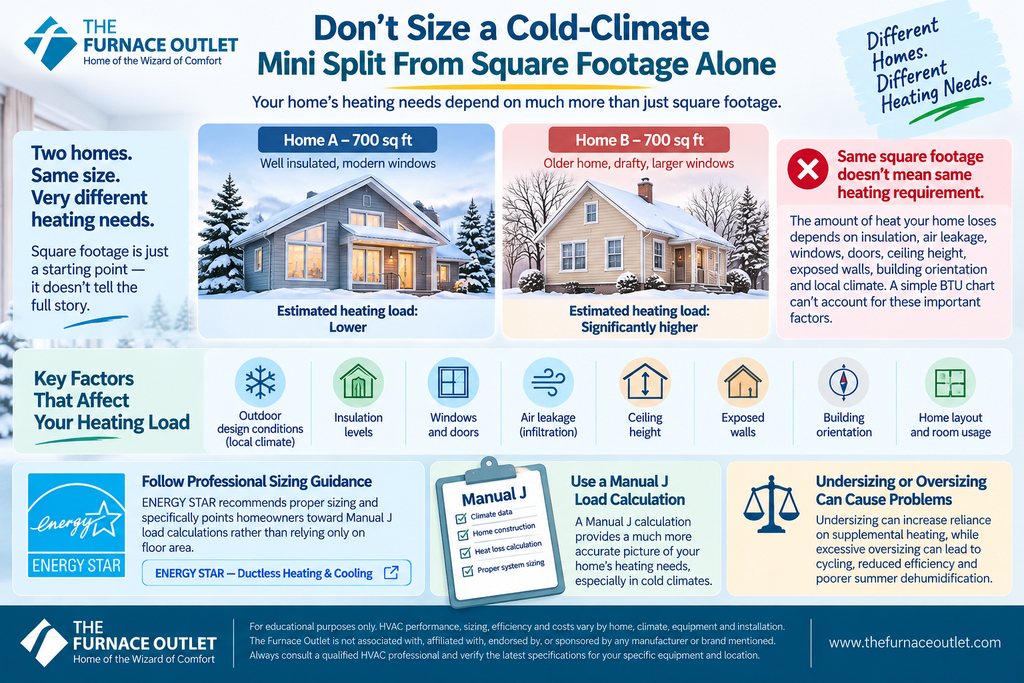
A common DIY approach is to take the room’s square footage, match it with an online BTU chart and order the nearest 9,000, 12,000, 18,000 or 24,000 BTU mini split. That may be useful for a very rough first look, but it isn’t a dependable cold-climate heating calculation.
The amount of heat a home loses depends on outdoor design conditions, insulation, air leakage, windows and doors, ceiling height, exposed walls, building orientation and other factors. Two 700-square-foot spaces can therefore have very different winter heating loads. ENERGY STAR recommends proper sizing and specifically points homeowners toward Manual J load calculations rather than relying only on floor area.
ENERGY STAR — Ductless Heating & Cooling
Cold climates make this particularly important because you are matching two changing numbers. The home’s heating requirement generally increases as outdoor temperature falls, while the heat pump’s available heating capacity can change with temperature. The question isn’t simply whether you purchased an “18,000 BTU mini split.” You need to know what that specific system can deliver around the winter design conditions relevant to your home.
Oversizing isn’t an ideal solution either. NEEP notes that undersizing can increase reliance on supplemental heating, while excessive oversizing can contribute to cycling, reduced efficiency and poorer summer dehumidification. A well-selected variable-capacity system should be considered against both the peak winter requirement and the loads it will encounter during milder weather.
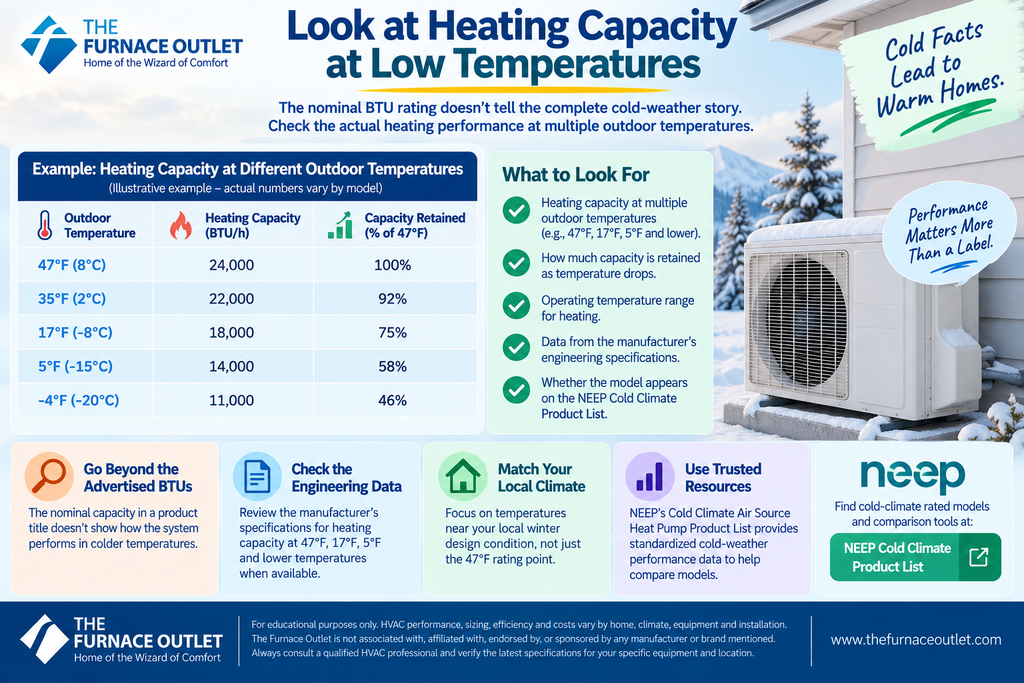
The familiar nominal capacity printed in a product title doesn’t tell the complete cold-weather story. When comparing equipment, I want to see extended heating-performance information. Check the manufacturer’s engineering data for heating capacity at multiple outdoor temperatures. Pay particular attention to temperatures approaching your local winter design condition rather than evaluating the unit only at the traditional 47°F heating rating point. Also look at how capacity changes at 17°F, 5°F and lower temperatures when those data are available for the model.
NEEP’s Cold Climate Air Source Heat Pump Product List was developed specifically to provide standardized cold-weather information and help differentiate equipment suitable for colder applications. Its sizing tools use extended performance information to help match heat-pump capacity with a home’s peak and annual heating needs.
NEEP — Cold Climate Air Source Heat Pump Specification & Product List
For a homeowner comparing DIY-capable equipment, this type of data is far more valuable than simply comparing maximum advertised BTUs.
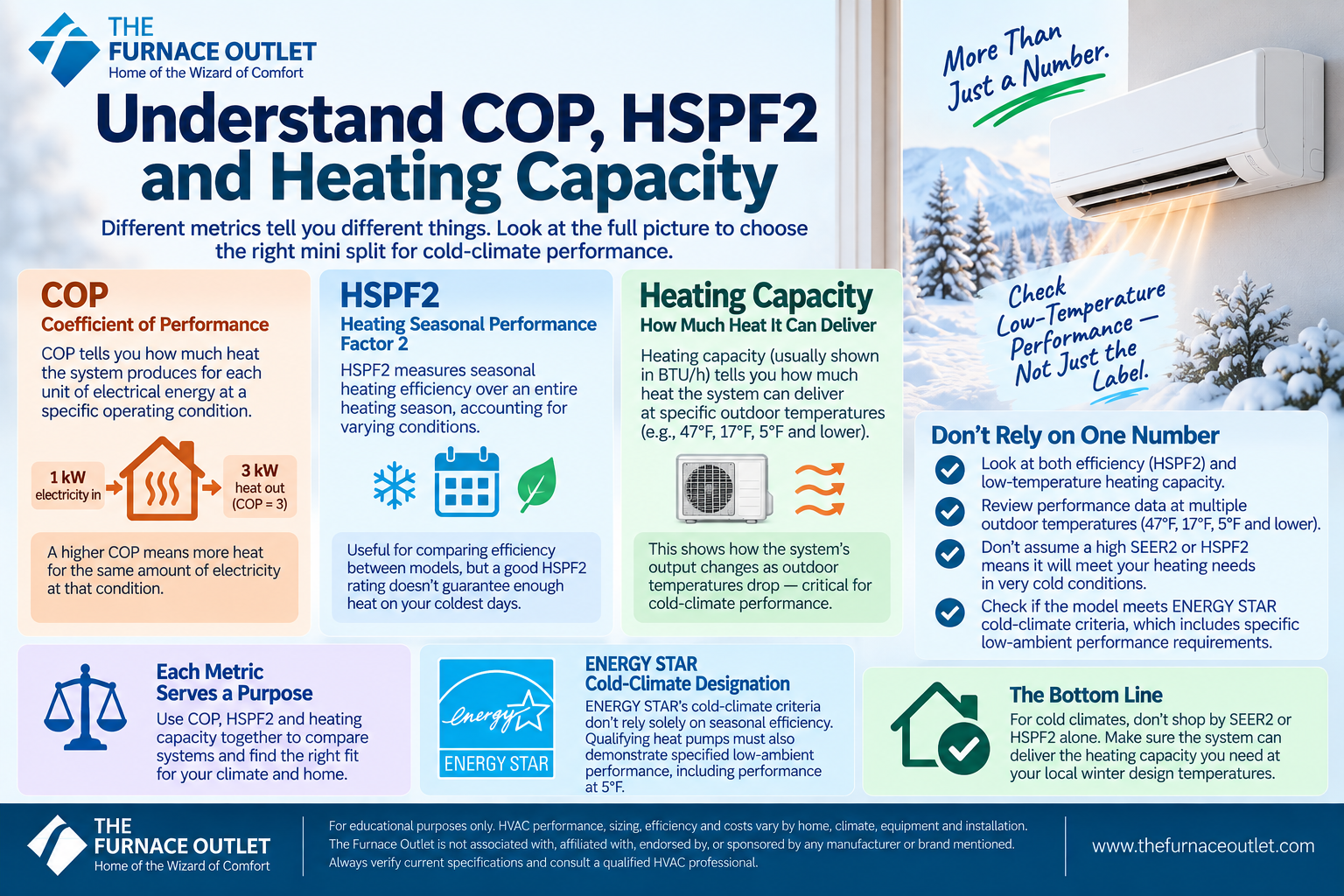
Several specifications can appear together on a mini-split product page, and they don’t tell you exactly the same thing. HSPF2 is a seasonal heating-efficiency metric. It is useful when comparing heat pumps, but a good seasonal efficiency rating doesn’t by itself answer whether a system can provide enough heat during your coldest conditions. Heating capacity tells you how much heat the system can deliver under specified conditions, while coefficient of performance, or COP, describes the relationship between useful heat output and electrical energy input at a particular operating condition.
For cold-climate selection, I therefore wouldn’t shop by SEER2 or HSPF2 alone. Cooling efficiency can be excellent while the characteristics that matter most during an extremely cold night still require closer examination. Look at efficiency and low-temperature heating performance.
ENERGY STAR’s cold-climate designation illustrates this distinction. Its criteria don’t rely solely on seasonal efficiency; qualifying equipment must also demonstrate specified low-ambient performance.
Before installation, decide what job you expect the mini split to perform. A system heating a garage while another heating system protects the rest of the house has a very different responsibility from a mini split intended to become the primary heating source for a bedroom, living area or entire home. If the heat pump is supplemental, a temporary capacity shortfall during extreme weather may be manageable because another heating source remains available.
If the mini split is expected to provide most or all of the heating, the consequences of poor sizing are much greater. You need to understand how much of the design heating load the selected equipment can serve and what happens when outdoor conditions become more severe than the design assumption.
This is where a qualified HVAC designer can add substantial value even if you intend to perform some permitted installation work yourself. DIY installation and professional load analysis aren’t mutually exclusive.
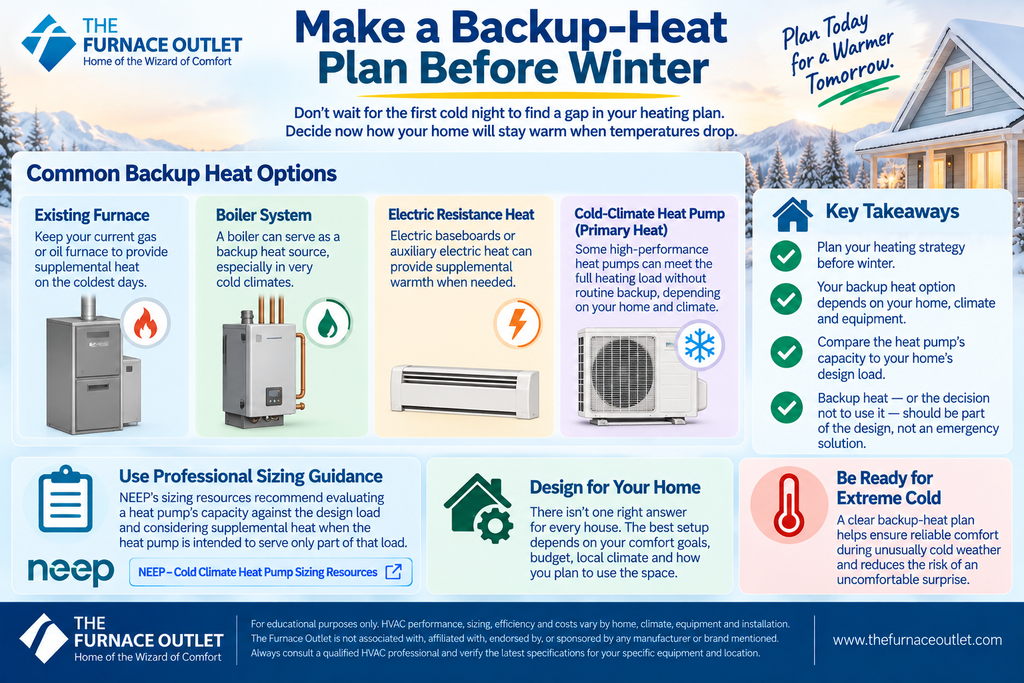
Don’t wait for the first unusually cold night to discover that your heating strategy has a gap. Depending on the home, climate and selected equipment, supplemental heat might come from an existing furnace, boiler, electric resistance equipment or another properly designed heating source. Some homeowners intentionally design a heat pump to handle most seasonal heating while retaining an existing system for specific conditions. Others design around a cold-climate heat pump capable of carrying the intended load without routine backup.
There isn’t one correct arrangement for every house. What matters is that backup heat—or the deliberate decision not to use it—is part of the design rather than an emergency improvisation.
NEEP’s sizing resources specifically encourage evaluating a heat pump’s capacity against the design load and considering supplemental heat when the heat pump is intended to serve only part of that load.
Cold-climate installation isn’t just about selecting the compressor. The outdoor condenser has to live through the climate you’re asking it to operate in. Snow accumulation, drifting snow, freezing rain, roof runoff and ice can affect the installation location. The unit still requires the airflow clearances and service access specified by its manufacturer, and its support arrangement must meet the manufacturer’s instructions and applicable requirements.
Think about what the location will look like in February, not only what it looks like during installation in September. A spot that appears perfectly clear in autumn may become surrounded by accumulated or drifting snow later in winter. Likewise, placing the unit beneath a roof edge can expose it to runoff or falling snow and ice.
Do not invent your own mounting height from a generic internet diagram. Snow conditions vary substantially by location, and equipment requirements vary by manufacturer. Follow the exact installation manual and applicable local requirements when determining the mounting arrangement.
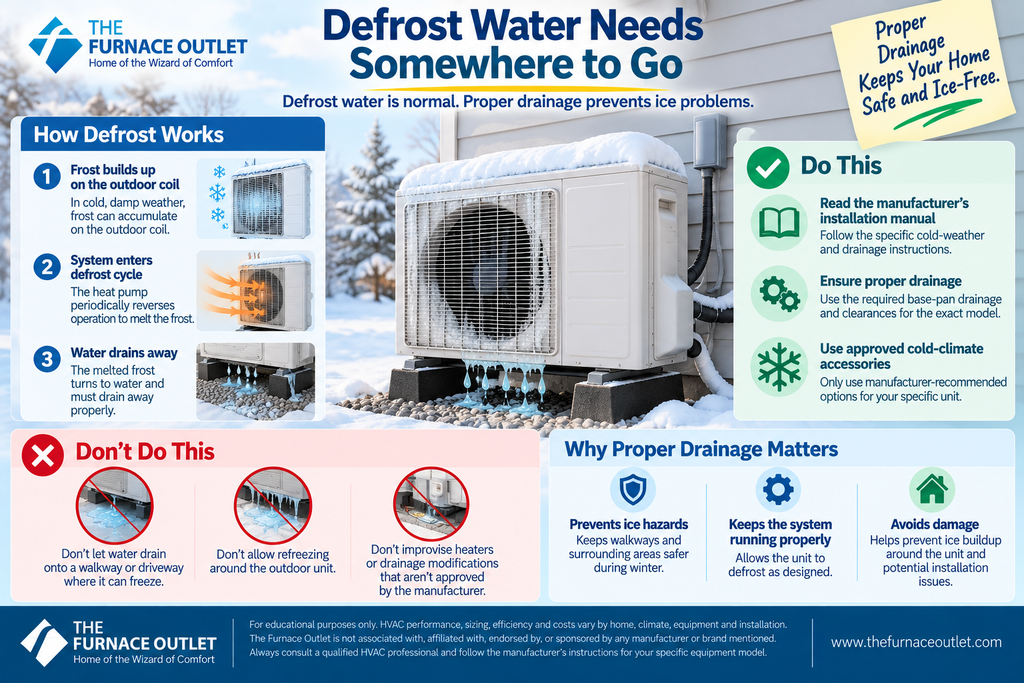
Heat pumps operating in cold, damp weather can accumulate frost on the outdoor coil. The system periodically enters a defrost cycle to remove that frost, and the resulting water must drain away appropriately. This is normal heat-pump operation, but poor installation planning can turn normal defrost water into an ice problem. Water repeatedly draining onto a problematic surface or refreezing around the outdoor unit can create undesirable conditions.
Before installing the condenser, read the manufacturer’s cold-weather and drainage instructions. Pay attention to base-pan drainage, required clearances and any manufacturer-approved cold-climate accessories relevant to the exact model. Don’t improvise heaters or drainage modifications because somebody used them on a different mini split.
Homeowners sometimes try to protect a condenser from winter weather by surrounding it with a homemade enclosure. That can create another problem: restricted airflow. The outdoor coil must exchange heat with outdoor air. Walls, fences, vegetation, accumulated snow and homemade covers can interfere with the clearances the manufacturer designed around the equipment. A shelter intended to protect the system can therefore become counterproductive if it restricts intake or discharge airflow.
Use manufacturer-specified clearances rather than universal numbers copied from another installation. If a snow or weather protection strategy is appropriate, make sure it is consistent with the manufacturer’s instructions.
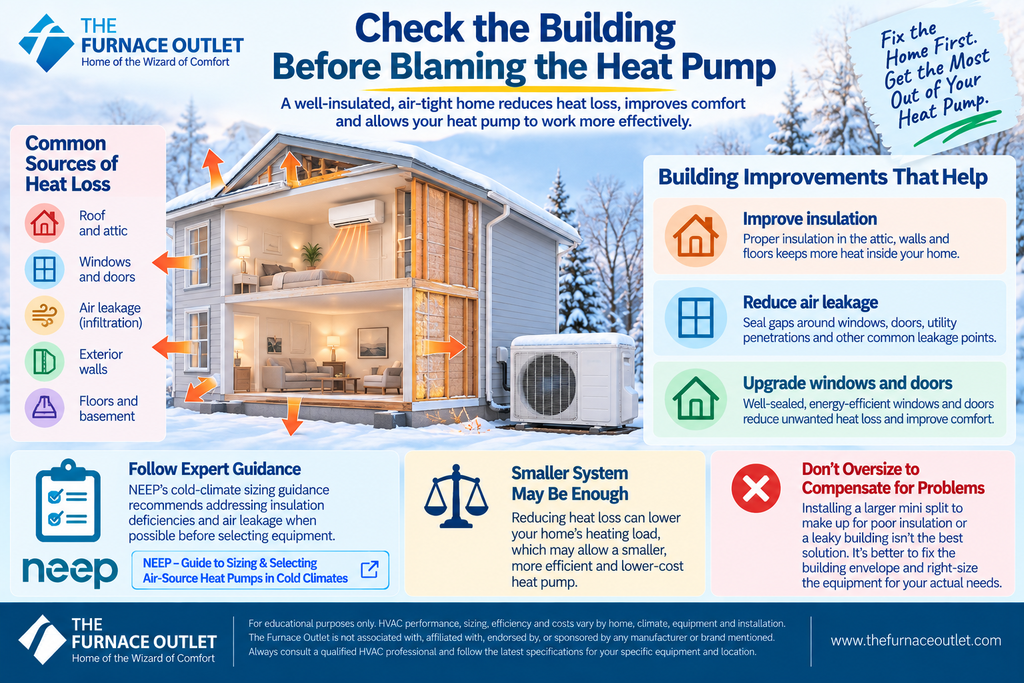
A cold-climate heat pump has an easier job in a house that isn’t leaking large amounts of heat. Air sealing, insulation and other building-envelope improvements can reduce the heating load, improve comfort and potentially allow smaller equipment. NEEP’s cold-climate sizing guidance recommends addressing building-envelope issues such as insulation deficiencies and air leakage when possible before selecting equipment.
NEEP — Guide to Sizing & Selecting Air-Source Heat Pumps in Cold Climates
For DIY projects, this is easy to overlook because most attention goes toward equipment. But spending money on a larger mini split to compensate for correctable heat loss isn’t necessarily the best solution.
Cold-climate capability doesn’t eliminate normal mini-split electrical requirements. Depending on the equipment, installation may involve a dedicated branch circuit, appropriate overcurrent protection, conductors, grounding, an outdoor disconnect and indoor/outdoor interconnecting wiring.
Do not select breaker or conductor sizes from the mini split’s BTU rating or from a video showing a similar-looking unit. Use the exact equipment nameplate and manufacturer’s documentation together with applicable electrical requirements.
This is another place where “DIY mini split” can create confusion. A purpose-built homeowner refrigerant connection does not automatically mean every electrical task is homeowner work. If a new circuit, panel modification or other work requires professional electrical involvement under applicable rules—or simply exceeds your qualifications—include that cost and scheduling in the project before purchasing the equipment.
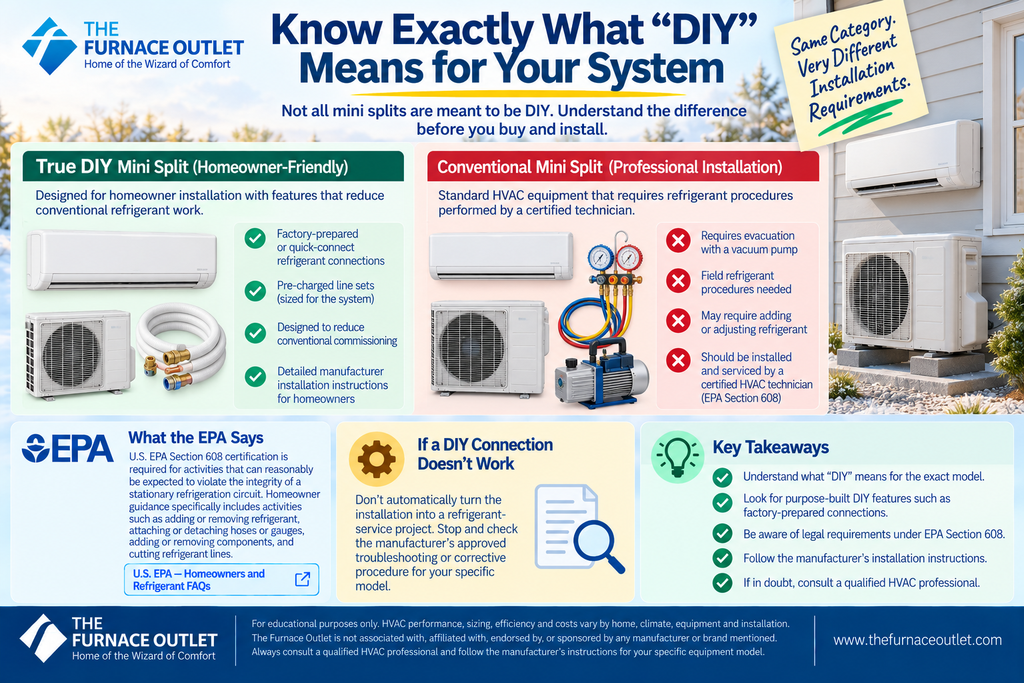
Some mini splits are genuinely designed around homeowner installation, while others are conventional HVAC equipment that happen to be available for consumers to purchase online. A true DIY-oriented product may use factory-prepared connections or another manufacturer-designed method intended to reduce conventional refrigerant commissioning work. A conventional system can require field refrigerant procedures, evacuation and other work that should not simply be treated as DIY because the homeowner has purchased a vacuum pump and gauges.
This distinction matters legally as well as technically. The U.S. Environmental Protection Agency explains that Section 608 technician certification is required for activities reasonably expected to violate the integrity of a stationary refrigeration circuit. EPA’s homeowner guidance specifically discusses activities such as adding or removing refrigerant, attaching or detaching hoses or gauges, adding or removing components, and cutting refrigerant lines.
U.S. EPA — Homeowners and Refrigerant FAQs
If a purpose-built DIY connection doesn’t work as intended, don’t automatically turn the installation into a refrigerant-service project. Stop and determine the manufacturer-approved corrective procedure.
Cold-climate equipment can represent a significant investment, so warranty conditions deserve attention before installation begins. Check whether homeowner installation is permitted for the exact product family, whether registration is required for particular benefits, whether professional electrical or refrigerant work must be documented, and whether installation-related damage is excluded. Keep purchase records, model and serial numbers, registration confirmation and invoices from any professionals involved.
Most importantly, don’t assume every product sold under one manufacturer’s name follows identical rules. Warranty conditions can differ among DIY and technician-install product families.
A mini split still needs maintenance after installation. Indoor filters need cleaning, indoor and outdoor coils need to remain appropriately maintained, condensate systems require attention and outdoor equipment must remain accessible.
Cold-climate installations add another reason to think about access: you may need to inspect the outdoor unit during snowy conditions. A condenser installed in a location that becomes difficult or unsafe to reach during winter makes routine observation and future professional service more difficult. Aesthetics matter, but I wouldn’t hide equipment so aggressively that maintenance and service become unnecessarily difficult.
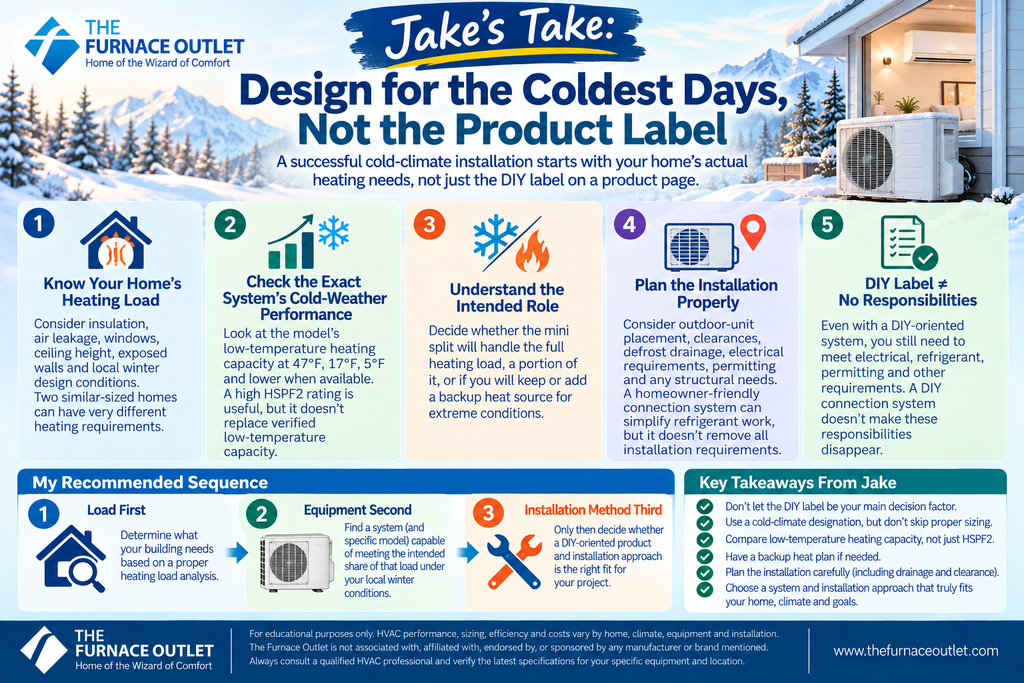
When homeowners ask me whether a DIY mini split can work in a cold climate, my answer isn’t determined by the letters “DIY.” I want to know the home’s heating load, local winter design conditions, the exact system’s low-temperature capacity, the intended role of the mini split, outdoor-unit placement and what backup strategy exists if one is needed.
A cold-climate designation is useful, but it doesn’t replace sizing. A high HSPF2 rating is useful, but it doesn’t replace checking low-temperature capacity. A homeowner-friendly connection system is useful, but it doesn’t make electrical, refrigerant, permitting or structural requirements disappear.
My preferred sequence is therefore load first, equipment second and installation method third. Determine what the building needs, find equipment capable of meeting the intended share of that load under relevant winter conditions, and only then decide whether a DIY-oriented product and installation approach fit the project. That sequence is much more reliable than choosing an attractive DIY system online and trying to make the house fit the equipment afterward.
Can a DIY mini split heat a home below freezing?
Many modern heat pumps can provide heating below freezing, and equipment carrying a recognized cold-climate designation must demonstrate specified low-ambient performance. The amount of heat available still varies by model and outdoor temperature, so check the exact system’s published performance rather than relying on a general brand claim.
Is the advertised BTU rating enough for sizing?
No. Cold-climate selection should consider a calculated heating load and the system’s available heating capacity at relevant outdoor temperatures. Square footage can provide an initial reference, but it does not account adequately for insulation, air leakage, windows, climate and other important load factors.
Does a cold-climate mini split always need backup heat?
Not necessarily. Whether supplemental heating is appropriate depends on the home’s load, equipment capacity, climate, system design and how much of the heating load the heat pump is intended to serve. The decision should be made during system planning rather than after an extreme-weather shortfall occurs.
Should I cover the outdoor unit during winter?
Do not install a homemade enclosure that conflicts with the manufacturer’s airflow and clearance requirements. Snow protection and mounting strategies should follow the exact equipment instructions and conditions at the installation site.
Can I install a cold-climate mini split completely by myself?
That depends on the equipment and work involved. Some systems are specifically designed for homeowner installation, but electrical work, permits and refrigerant-related activities can have separate requirements. EPA Section 608 rules remain relevant to activities that can violate refrigeration-circuit integrity.
Is a cold-climate mini split automatically better than a standard mini split?
“Better” depends on the application. Cold-climate performance becomes particularly important where the system must provide substantial heating during low outdoor temperatures. Equipment should be matched to the home’s actual heating and cooling requirements rather than selected from a label alone.
Editorial Disclosure: The Furnace Outlet is not associated with, affiliated with, endorsed by, or sponsored by any manufacturer or brand mentioned in this article. We do not receive manufacturer compensation for inclusion or rankings. HVAC performance, sizing, efficiency and operating limits vary by home, climate, equipment and installation. Always verify current specifications and installation requirements for the exact matched system and consult qualified HVAC and electrical professionals where appropriate.
https://thefurnaceoutlet.com/best-diy-mini-split-systems-of-2026-no-hvac-technician-required/