Newsletter Subscribe
Enter your email address below and subscribe to our newsletter

HVAC made simple
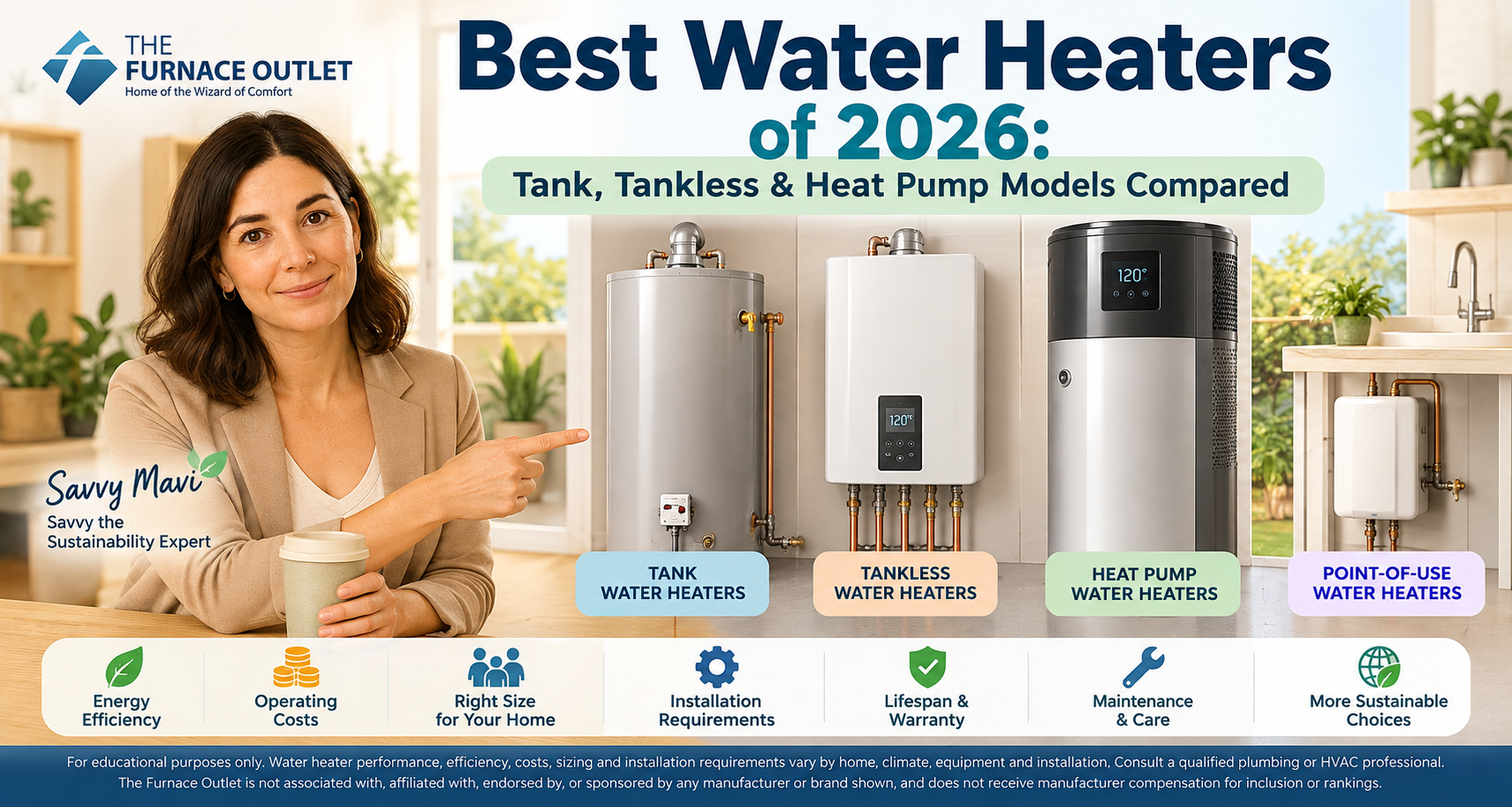
Choosing a water heater in 2026 is no longer as simple as deciding whether you want a 40-gallon or 50-gallon tank. Homeowners can now choose among traditional gas storage heaters, electric storage heaters, high-efficiency condensing tankless systems, heat-pump or hybrid water heaters, whole-house electric tankless systems, and compact point-of-use equipment. Each technology approaches the same job differently, and those differences can have a major effect on installation cost, energy consumption, available hot water, maintenance, and long-term ownership costs.
I’m Savvy Mavi, Savvy the Sustainability Expert, and when I compare water heaters, efficiency is naturally one of the first things I look at. However, I do not believe the most sustainable choice is automatically the product with the highest efficiency rating. A water heater also needs to be correctly sized for the household, compatible with the home’s fuel and electrical infrastructure, practical to install, maintainable over its expected service life, and capable of delivering enough hot water during the household’s busiest periods.
That is why this guide compares much more than brands. I look at tank capacity, first-hour rating, tankless flow rate, Uniform Energy Factor (UEF), fuel availability, installation requirements, operating costs, maintenance, warranties, and total cost of ownership. I also compare leading water-heater manufacturers including Rheem, A.O. Smith, Bradford White, Rinnai, Navien, Noritz, and Stiebel Eltron, while keeping one important principle in mind: specifications can vary substantially between models within the same product family.

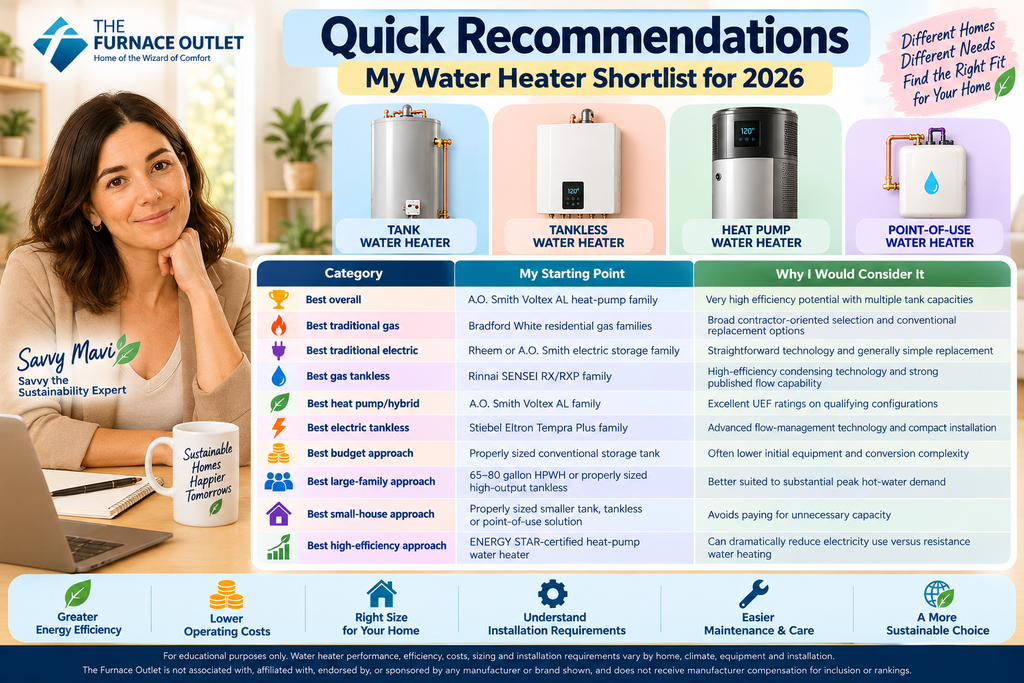
For homeowners who want a starting point before diving into the technical details, the following table summarizes the categories I would investigate first. These are not universal prescriptions, because the right water heater depends heavily on household demand and the building itself, but they provide a practical shortlist for comparing technologies and product families.
| Category | My Starting Point | Why I Would Consider It |
|---|---|---|
| Best overall | A.O. Smith Voltex AL heat-pump family | Very high efficiency potential with multiple tank capacities |
| Best traditional gas | Bradford White residential gas families | Broad contractor-oriented selection and conventional replacement options |
| Best traditional electric | Rheem or A.O. Smith electric storage family | Straightforward technology and generally simple replacement |
| Best gas tankless | Rinnai SENSEI RX/RXP family | High-efficiency condensing technology and strong published flow capability |
| Best heat pump/hybrid | A.O. Smith Voltex AL family | Excellent UEF ratings on qualifying configurations |
| Best electric tankless | Stiebel Eltron Tempra Plus family | Advanced flow-management technology and compact installation |
| Best budget approach | Properly sized conventional storage tank | Often lower initial equipment and conversion complexity |
| Best large-family approach | 65–80 gallon HPWH or properly sized high-output tankless | Better suited to substantial peak hot-water demand |
| Best small-house approach | Properly sized smaller tank, tankless or point-of-use solution | Avoids paying for unnecessary capacity |
| Best high-efficiency approach | ENERGY STAR-certified heat-pump water heater | Can dramatically reduce electricity use versus resistance water heating |
My preference for heat-pump technology in several categories is deliberate, but it comes with an important qualification. Heat-pump water heaters need the right installation environment, and their efficiency advantage does not eliminate the need to evaluate tank size, first-hour rating, available space, condensate drainage, sound, electrical requirements, and recovery characteristics. ENERGY STAR specifically recommends considering installation conditions and even suggests upsizing heat-pump storage capacity in some situations so that the heat pump can handle more of the load without relying heavily on less-efficient resistance backup.
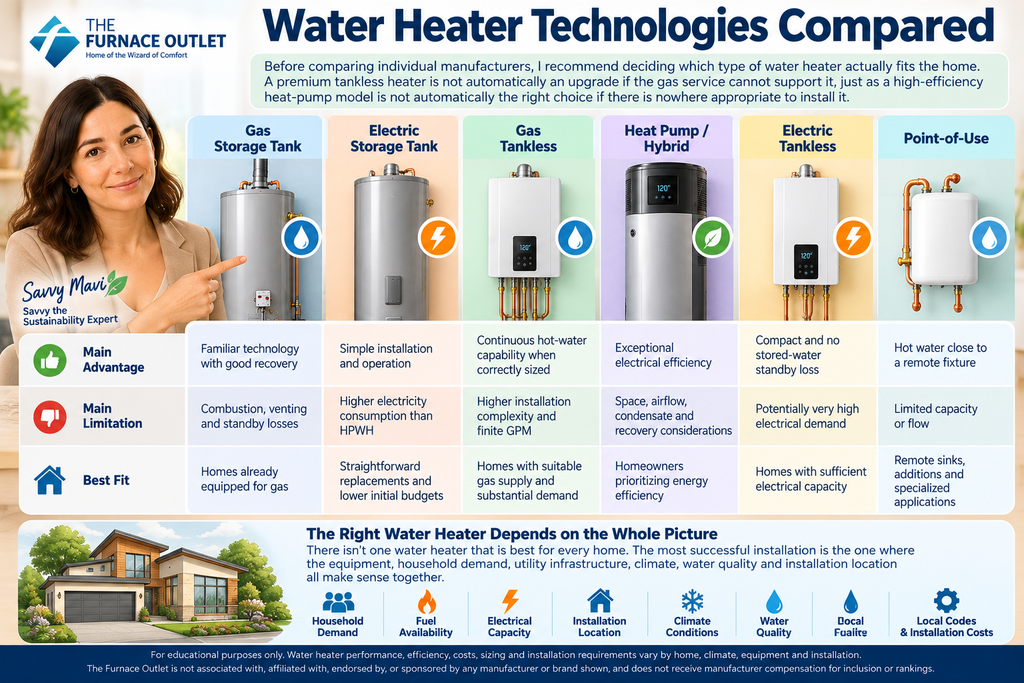
Before comparing individual manufacturers, I recommend deciding which type of water heater actually fits the home. A premium tankless heater is not automatically an upgrade if the gas service cannot support it, just as a high-efficiency heat-pump model is not automatically the right choice if there is nowhere appropriate to install it.
| Water-Heater Type | Main Advantage | Main Limitation | Best Fit |
|---|---|---|---|
| Gas storage tank | Familiar technology with good recovery | Combustion, venting and standby losses | Homes already equipped for gas |
| Electric storage tank | Simple installation and operation | Higher electricity consumption than HPWH | Straightforward replacements and lower initial budgets |
| Gas tankless | Continuous hot-water capability when correctly sized | Higher installation complexity and finite GPM | Homes with suitable gas supply and substantial demand |
| Heat pump/hybrid | Exceptional electrical efficiency | Space, airflow, condensate and recovery considerations | Homeowners prioritizing energy efficiency |
| Electric tankless | Compact and no stored-water standby loss | Potentially very high electrical demand | Homes with sufficient electrical capacity |
| Point-of-use | Hot water close to a remote fixture | Limited capacity or flow | Remote sinks, additions and specialized applications |
The table also illustrates why I avoid declaring one technology universally superior. Water heating is a system-design decision. The most successful installation is usually the one where the equipment, household demand, utility infrastructure, climate, water quality, and installation location all make sense together.
For homeowners who have a suitable installation location and are willing to invest in efficiency, the A.O. Smith Voltex AL heat-pump family is one of my strongest starting points for 2026. Heat-pump water heaters use a refrigeration cycle to move heat from surrounding air into the stored water instead of producing all of the required heat through electric resistance. That basic difference is what allows modern heat-pump systems to achieve efficiency levels that conventional resistance tanks cannot approach.
A.O. Smith states that its Voltex AL family includes 50-, 66-, and 80-gallon configurations. Particularly notable is the published 4.02 UEF for its 66-gallon model, while the 50-gallon configuration is listed at 3.8 UEF. Those figures illustrate how dramatically heat-pump technology has advanced, although homeowners should always verify the exact model being quoted rather than applying one model’s specification to the entire product family.
What I particularly like about the heat-pump approach is that efficiency and storage can work together. A larger tank does not necessarily mean wasteful oversizing in the same way homeowners sometimes imagine. ENERGY STAR guidance notes that upsizing a heat-pump water heater can reduce reliance on auxiliary resistance elements during high-demand periods, allowing the more efficient heat pump to do a greater share of the work.
There are still practical compromises. A heat-pump water heater extracts heat from its surroundings, so installation location, available air volume, ambient temperature, noise, and condensate disposal all need consideration. I would therefore compare the complete installation rather than simply replacing a conventional electric tank with an HPWH of the same nominal gallon capacity.
A traditional gas tank can still make excellent practical sense in 2026, particularly when the house already has suitable natural-gas or propane infrastructure, appropriate venting, and an existing storage-water-heater location. Converting technologies can be worthwhile, but conversion costs should be evaluated rather than assuming that every household needs to abandon its existing fuel.
Bradford White is one of the manufacturers I would include when obtaining quotes for a traditional gas replacement. The company offers several residential gas configurations, and the exact choice can vary according to venting arrangement, capacity, recovery needs, efficiency goals, and installation conditions. Rather than treating “Bradford White gas heater” as a single product, I would ask the contractor for the exact model number and then compare its UEF, first-hour rating, burner input, tank capacity, venting requirements, and warranty.
A gas storage heater’s biggest practical advantage is familiarity. In an existing gas installation, replacement may require fewer changes than converting to a completely different technology. The disadvantage is that the appliance maintains a stored volume of hot water and relies on combustion, so its efficiency characteristics and installation requirements differ significantly from those of heat-pump water heaters.
For homeowners interested in reducing household energy consumption, I would still obtain a heat-pump quote alongside the gas replacement quote. That allows the decision to be based on actual installed costs and expected energy use rather than habit.
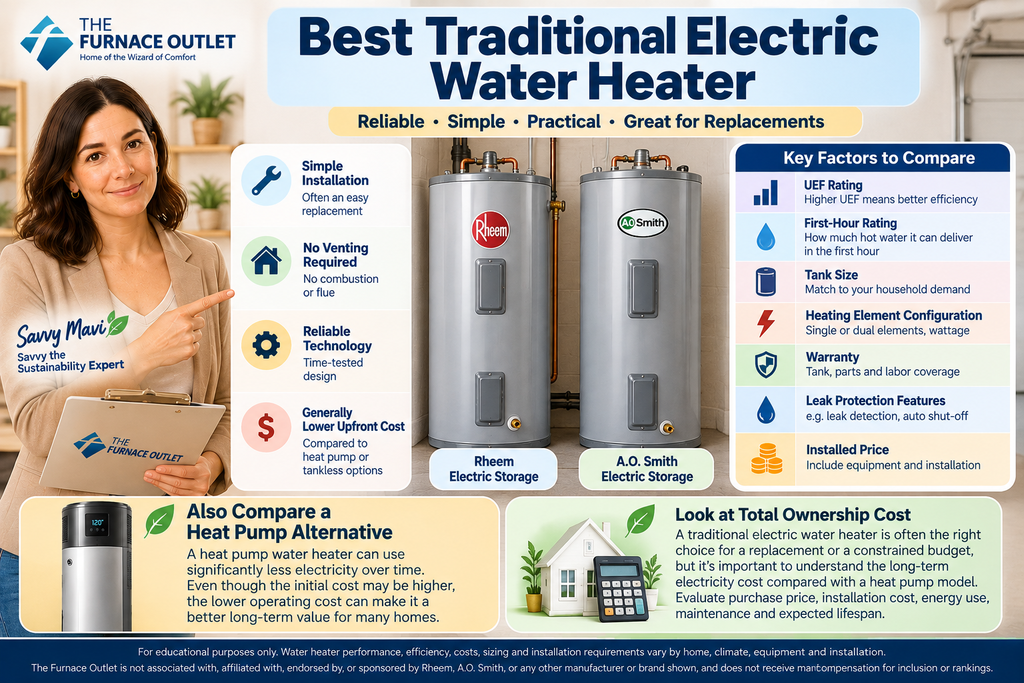
Conventional electric resistance water heaters rarely generate the excitement of heat pumps or high-end tankless systems, but simplicity is a legitimate product advantage. They have relatively straightforward operating principles, require no combustion venting, and can often replace an existing electric storage heater without the extensive infrastructure changes that another technology might require.
Rheem and A.O. Smith both offer broad conventional electric storage lineups, and I would compare them based on the exact model’s UEF, first-hour rating, tank size, heating-element configuration, warranty, leak-protection features, and installed price. I would also compare a heat-pump alternative before finalizing the purchase because the difference in long-term electricity consumption can be substantial.
This is where purchase price and ownership cost need to be separated. A standard resistance heater may be considerably less expensive to buy, yet a more efficient heat-pump model can consume much less electricity over years of operation. DOE’s Federal Energy Management Program similarly evaluates efficient residential water heaters on life-cycle economics rather than purchase price alone.
A conventional electric tank therefore remains useful, particularly for homeowners facing a constrained replacement budget or an installation where an HPWH is impractical. I simply would not choose one without first understanding what the efficiency trade-off is likely to cost over time.
For homeowners interested in a high-capacity condensing gas tankless system, the Rinnai SENSEI RX/RXP family deserves a place on the comparison list. Rinnai’s current RXP199iN provides a good illustration of what modern condensing tankless equipment can offer: the manufacturer lists a 0.98 UEF and maximum domestic hot-water flow of 11.1 GPM, with natural-gas and propane compatibility.
Those numbers need context, especially the 11.1 GPM figure. Maximum flow should never be interpreted as guaranteed hot-water delivery under every condition because a tankless heater’s capacity depends heavily on temperature rise. Heating relatively warm incoming water to 120°F requires much less energy per gallon than heating very cold groundwater to the same outlet temperature.
That means I would size a tankless system by calculating the fixtures likely to operate simultaneously and then comparing their combined flow with the heater’s output at the home’s expected incoming-water temperature. A household that needs two showers simultaneously has a different design problem from one that expects two showers, a faucet, and another hot-water appliance to operate together.
Tankless equipment can provide long-duration hot water because it is not limited by a stored tank volume, but “endless hot water” should never be confused with unlimited instantaneous capacity. Every tankless heater has a maximum heating rate.
The Noritz EZ Series Pro is another family I would examine, particularly when converting an existing storage-tank installation to tankless. Noritz currently lists the EZ Series Pro as including EZ111, EZ98, and EZ711 models, with the family reaching up to 11.1 GPM and 0.98 UEF. The company also emphasizes top-mounted water connections intended to make some tank-replacement installations more straightforward. Noritz
The installation-focused design is important because tankless conversions can become expensive when homeowners compare only the appliance price. Gas supply, venting, condensate disposal, plumbing changes, electrical power, isolation valves, and permitting can all influence the final project cost.
I would therefore request an itemized installed quote before concluding that a tankless conversion is either inexpensive or expensive. The actual building determines the answer.
For whole-house electric tankless applications, Stiebel Eltron’s Tempra Plus is one of the systems I would investigate. The feature that interests me most is its Advanced Flow Control technology. Stiebel Eltron explains that when hot-water demand exceeds what the heater can support, the system can reduce flow rather than simply allowing outlet temperature to fall.
That addresses one of the central challenges of tankless water heating: demand can sometimes exceed heating capacity. Managing flow can preserve outlet temperature, but homeowners still need to understand that reducing flow is itself a capacity-management response rather than creating additional heating power.
The bigger issue with whole-house electric tankless systems is often the electrical service. Producing large quantities of hot water instantaneously can require substantial electrical input, particularly where incoming groundwater is cold. Before buying one, I would have a qualified electrician or contractor verify the exact model’s voltage, amperage, breaker, conductor, and service requirements.
A compact appliance on the wall can therefore represent a surprisingly large electrical load. This is an excellent example of why equipment size should never be confused with infrastructure requirements.
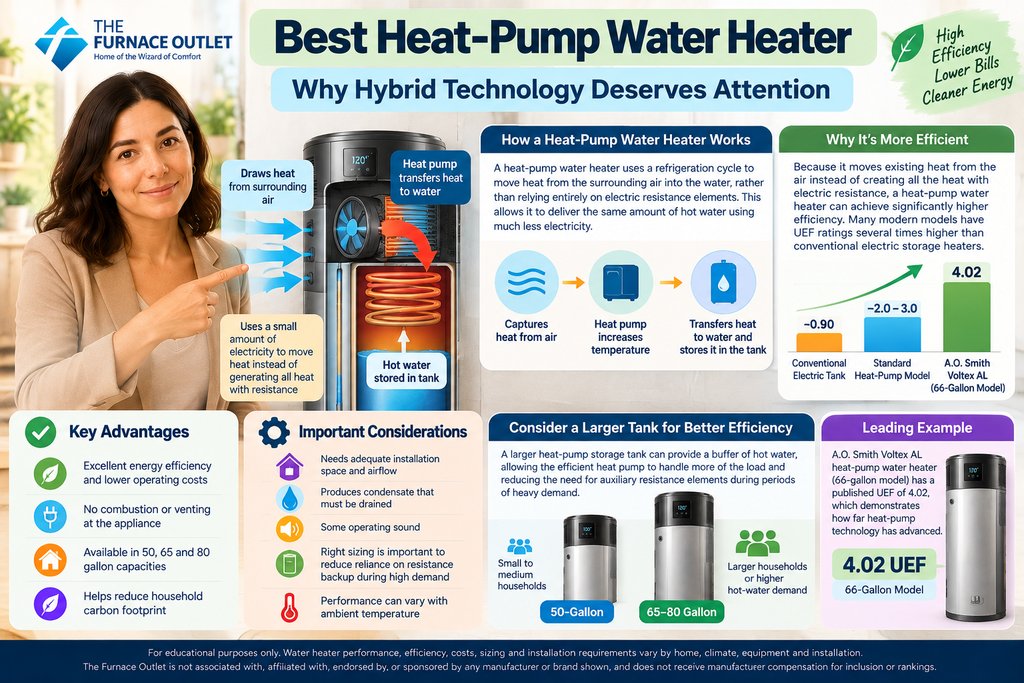
Heat-pump water heating is one of the most important developments in residential water heating because it changes how electricity is used. Instead of relying entirely on resistance elements to generate heat, the heat pump transfers heat already present in surrounding air into the water.
The result can be a dramatic efficiency improvement. Modern heat-pump water heaters can achieve UEF values several times those of conventional resistance storage heaters. The A.O. Smith example above, with a published UEF of 4.02 for one 66-gallon Voltex AL configuration, demonstrates the scale of the difference.
However, I would not buy a heat-pump model from UEF alone. A high-efficiency unit that is too small for the household may rely more frequently on its resistance elements during periods of heavy demand. ENERGY STAR’s design guidance specifically discusses sizing HPWH tanks to reduce auxiliary resistance operation and recommends following local code requirements and manufacturer sizing guidance.
For sustainability-focused homeowners, that creates an interesting lesson: sometimes a somewhat larger heat-pump storage tank can be the more efficient system choice because the stored hot water provides a buffer that allows the heat pump to operate more effectively.
If “budget” means the lowest immediate replacement expense, a conventional storage water heater that matches the home’s existing infrastructure will often deserve consideration. Replacing an electric tank with another compatible electric tank or an existing gas storage heater with a similar gas configuration may avoid the conversion expenses associated with a new technology.
However, I would separate lowest purchase cost from lowest ownership cost. Water heaters operate year after year, so the energy consumed over their lifetime can eventually exceed the importance of a few hundred dollars saved during purchase.
A useful ownership calculation is: Total ownership cost = equipment + installation + energy + maintenance + expected repair costs − applicable incentives.
This is one of the few short formulas worth isolating because it captures how I approach the entire buying decision. A lower-priced heater can be a sensible choice when budget constraints are real, but it should be selected with an understanding of the operating-cost trade-off rather than because its shelf price is lower.
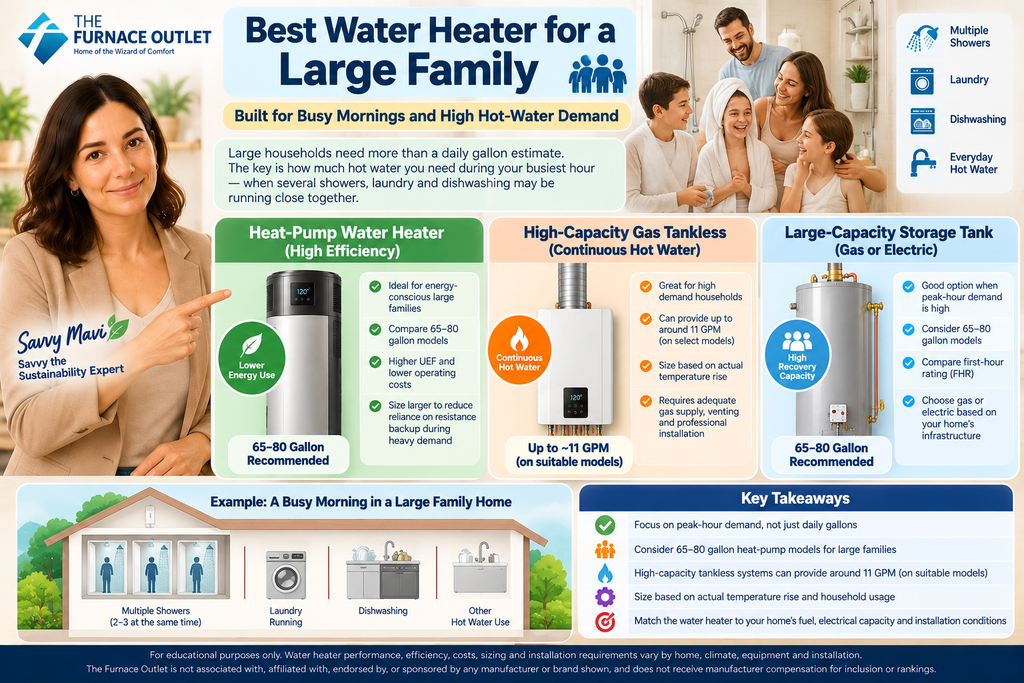
Large households need to think about more than total daily gallons. The critical question is often how much hot water the household needs during its busiest hour.
Imagine several morning showers taking place close together while laundry or dishwashing is also underway. A storage heater needs enough stored water and recovery capacity to satisfy that peak. A tankless system needs enough heating capacity to maintain the required flow at the actual temperature rise.
For a household interested in heat-pump technology, I would compare 65- and 80-gallon models rather than automatically buying the same tank size as the old resistance heater. ENERGY STAR’s guidance specifically notes that HPWH tank sizing can be increased to reduce reliance on auxiliary resistance heat during periods of heavy demand. ENERGY STAR
A high-capacity condensing gas tankless system can also be a compelling large-family solution where natural gas or propane infrastructure is appropriate. Products reaching around 11 GPM under favorable conditions demonstrate the potential, but the contractor should calculate expected output at the home’s actual temperature rise rather than sizing from the maximum published GPM.
A small household has the opposite problem: it is easy to buy more water heater than necessary. Oversizing can increase equipment cost and may add installation complexity without improving everyday comfort.
For a small household, I would compare a correctly sized storage tank, a modest tankless system, and possibly point-of-use equipment where the plumbing layout makes it useful. A remote bathroom or sink can sometimes benefit from a small local heater because it reduces the amount of water wasted while waiting for hot water to travel through a long plumbing run.
Point-of-use systems from manufacturers such as Stiebel Eltron demonstrate how specialized this category has become. Some current models use technologies designed to manage flow when demand exceeds capacity, which can make them useful for specific fixtures or limited groups of fixtures. Stiebel Eltron USA
The goal should not be to install the smallest appliance possible. It should be to match hot-water production and delivery to the actual demand.
Tank capacity is the specification most homeowners recognize, but it is only one part of storage-water-heater performance. Two 50-gallon water heaters can behave differently because their recovery capability, heating input, controls, and first-hour performance may differ.
This is why I would not select a tank simply because a household previously owned one of the same nominal size. Household occupancy may have changed, fixtures may have changed, and the new technology may recover differently from the old one.
Heat-pump systems make this particularly important because their most efficient heating mode typically recovers more slowly than high-powered resistance or combustion heating. A larger tank can therefore function as thermal storage, allowing the efficient heat pump to do more of the work before backup heating becomes necessary.
For storage water heaters, First-Hour Rating (FHR) is one of the most useful numbers to understand. It represents how much hot water a fully heated water heater can deliver during a standardized first hour, incorporating both the stored water and the system’s ability to replenish it.
This makes FHR much more meaningful than tank volume alone when comparing systems for busy households. If several people shower during the same morning period, what matters is not merely how many gallons the tank physically contains but how much usable hot water the system can deliver during that period.
When comparing two similarly sized tanks, I would therefore put their FHR figures beside each other and compare them with the household’s estimated peak-hour demand.
Tankless water heaters are usually discussed in gallons per minute, or GPM. The basic concept is straightforward: determine how many hot-water fixtures might operate simultaneously, estimate their combined flow, and then select a heater capable of meeting that requirement at the necessary temperature rise.
Temperature rise is the part homeowners sometimes miss. If incoming water is 70°F and the target is 120°F, the heater needs to produce a 50°F rise. If the incoming water is 40°F, the same 120°F target requires an 80°F rise. The second scenario requires substantially more heating energy per gallon.
That is why the published maximum flow rate should be treated as one performance point rather than a universal output guarantee. Rinnai, for example, publishes up to 11.1 GPM for the RXP199iN while also listing its 199,000 BTU maximum input and 0.98 UEF. Those specifications need to be interpreted together and within the manufacturer’s performance data.
Uniform Energy Factor (UEF) is the standardized efficiency metric homeowners will encounter when comparing modern residential water heaters. In general, a higher UEF means a greater proportion of the energy supplied to the water-heating system becomes useful hot water under the applicable test procedure.
The key phrase is “under the applicable test procedure.” UEF is extremely useful for comparison, but it should not be mistaken for a prediction of exactly what a household will spend on water heating.
Gas prices, electricity prices, hot-water consumption, climate, inlet-water temperature, operating mode, installation conditions, and household behavior all affect actual operating costs.
It is also important to compare technologies intelligently. A heat-pump water heater can achieve a UEF well above 3 because it transfers environmental heat into the water, while a condensing gas tankless system may have a UEF close to 1. Those numbers reflect fundamentally different energy sources and technologies rather than simply indicating that one appliance is “three times better” in every real-world respect.
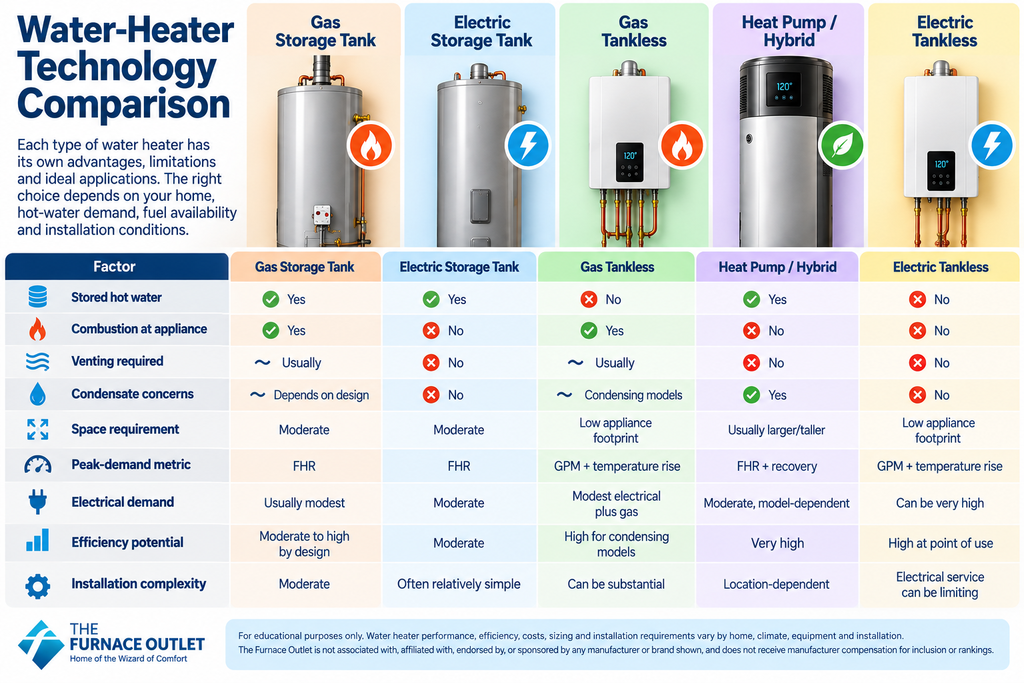
| Factor | Gas Tank | Electric Tank | Gas Tankless | Heat Pump/Hybrid | Electric Tankless |
|---|---|---|---|---|---|
| Stored hot water | Yes | Yes | No | Yes | No |
| Combustion at appliance | Yes | No | Yes | No | No |
| Venting required | Usually | No | Usually | No | No |
| Condensate concerns | Depends on design | No | Condensing models | Yes | No |
| Space requirement | Moderate | Moderate | Low appliance footprint | Usually larger/taller | Low appliance footprint |
| Peak-demand metric | FHR | FHR | GPM + temperature rise | FHR + recovery | GPM + temperature rise |
| Electrical demand | Usually modest | Moderate | Modest electrical plus gas | Moderate, model-dependent | Can be very high |
| Efficiency potential | Moderate to high by design | Moderate | High for condensing models | Very high | High at point of use |
| Installation complexity | Moderate | Often relatively simple | Can be substantial | Location-dependent | Electrical service can be limiting |
The table is intentionally qualitative because exact requirements vary by product. I would never assume that two heaters in the same category require identical electrical circuits, gas piping, venting, condensate arrangements, clearances, or installation procedures.
I start with household behavior rather than a generic chart based solely on the number of bedrooms. I want to know how many people live in the home, when they normally shower, whether multiple showers operate simultaneously, whether there is a large soaking tub, and whether laundry and dishwashing overlap with bathing.
For a storage water heater, I then estimate peak-hour demand and compare it with first-hour rating. For a tankless system, I estimate simultaneous fixture flow and calculate the required temperature rise. For a heat-pump water heater, I also consider how much storage will allow the heat pump to satisfy peak demand without relying excessively on resistance backup.
This approach is more useful than statements such as “a family of four needs a 50-gallon water heater.” Four-person households can have completely different usage patterns. One may take short showers spread throughout the day, while another may require four morning showers within an hour.
Correct sizing is therefore one of the most practical sustainability measures available. Undersizing can reduce comfort and push equipment harder, while unnecessary oversizing can increase purchase cost and, depending on technology, increase losses or infrastructure requirements.
Existing infrastructure can change the economics dramatically. A house with natural gas, appropriate venting, and sufficient gas capacity has different options from an all-electric house. Similarly, a home with limited electrical-service capacity may face additional costs if the selected water heater requires substantial electrical upgrades.
This is especially important when considering whole-house electric tankless equipment. The appliance itself may be physically compact, but instantaneous electrical heating can require significant power. The contractor or electrician should check the exact manufacturer’s requirements rather than assuming that an existing electric-tank circuit can support an electric tankless replacement.
For heat-pump systems, electrical requirements can also vary between models. This is another reason I recommend selecting the exact equipment before finalizing installation assumptions.
A water heater is not merely a box purchased online. It becomes part of the home’s plumbing, electrical, fuel, venting, drainage, and safety systems.
A gas tankless conversion may require new venting, modifications to the gas supply, condensate drainage, plumbing changes, isolation valves, and electrical power. A heat-pump installation may require a suitable electrical circuit, sufficient installation space, condensate drainage, and attention to surrounding-air conditions. A conventional electric tank may have fewer conversion requirements when replacing another compatible electric tank.
This is why I recommend obtaining complete installed quotes. Comparing a $1,500 appliance with a $2,500 appliance tells you surprisingly little if one project costs substantially more to install.
Permits and code requirements can also vary by jurisdiction, so the installation should be evaluated against current local requirements and the exact manufacturer’s instructions.
Water heaters work every day, which means small differences in daily energy consumption can accumulate over many years. This is where efficient equipment can justify a higher initial price.
The DOE’s Federal Energy Management Program evaluates residential water heaters using life-cycle cost considerations and notes significant potential lifetime savings for qualifying efficient heat-pump water heaters compared with less-efficient alternatives under its assumptions.
I would not take a national savings estimate and assume it applies exactly to one household. Instead, I would obtain the EnergyGuide information for the exact models, check local electricity and gas prices, and compare estimated annual operating costs.
If one water heater costs $800 more initially but is expected to save $200 per year in energy under realistic local assumptions, the price difference tells a very different story from a system that costs $2,500 more and saves only $75 annually.
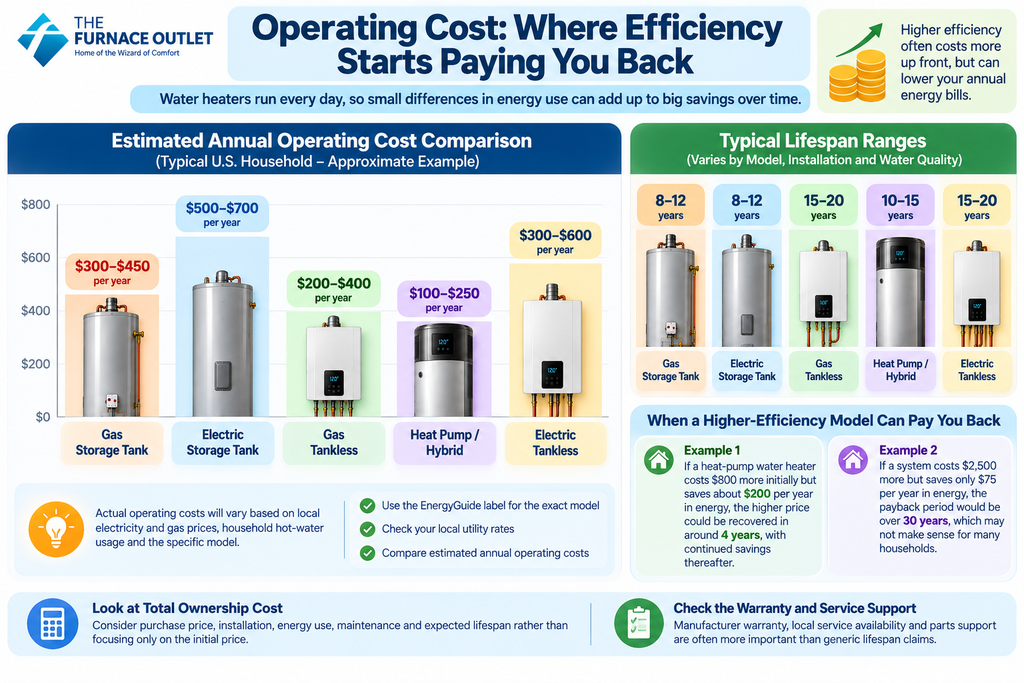
Water-heater lifespan is frequently presented online as though every tank fails after a particular number of years and every tankless heater lasts a fixed number of years. Real equipment does not behave that neatly.
Water chemistry, sediment, hardness, corrosion protection, installation quality, operating temperature, maintenance, usage, component design, and environmental conditions can all influence service life. A well-maintained system operating with favorable water quality can have a very different experience from an identical model operating under severe scale conditions.
For that reason, I place more weight on the manufacturer’s actual warranty, local service availability, maintenance requirements, and parts support than on generic lifespan promises.
Every water-heating technology has maintenance considerations. Storage tanks can accumulate sediment, while sacrificial anodes in applicable designs may require inspection or replacement. Tankless heat exchangers can accumulate mineral scale and may require periodic flushing or descaling, particularly where water hardness is high.
Heat-pump water heaters add refrigeration-system components, electronics, airflow requirements, and typically an air filter. Keeping the airflow path clean helps the heat pump operate as intended.
Maintenance requirements should therefore be included in the ownership comparison before purchase. A sophisticated high-efficiency appliance can be a great investment, but only if the homeowner understands how it needs to be maintained.
A long warranty printed on a product page can be reassuring, but warranty length is only the beginning of the comparison. Homeowners should determine which components are covered, whether labor is included, whether registration is required, whether installation conditions affect coverage, and whether warranty terms differ for residential and commercial use.
Noritz, for example, currently advertises a 25-year heat-exchanger warranty for its EZ Series Pro, while warranty terms for other components and applications should be checked in the applicable documentation.
I would also ask who actually handles the warranty claim. Local service infrastructure matters because a warranty is much more useful when qualified technicians and replacement parts are readily available.
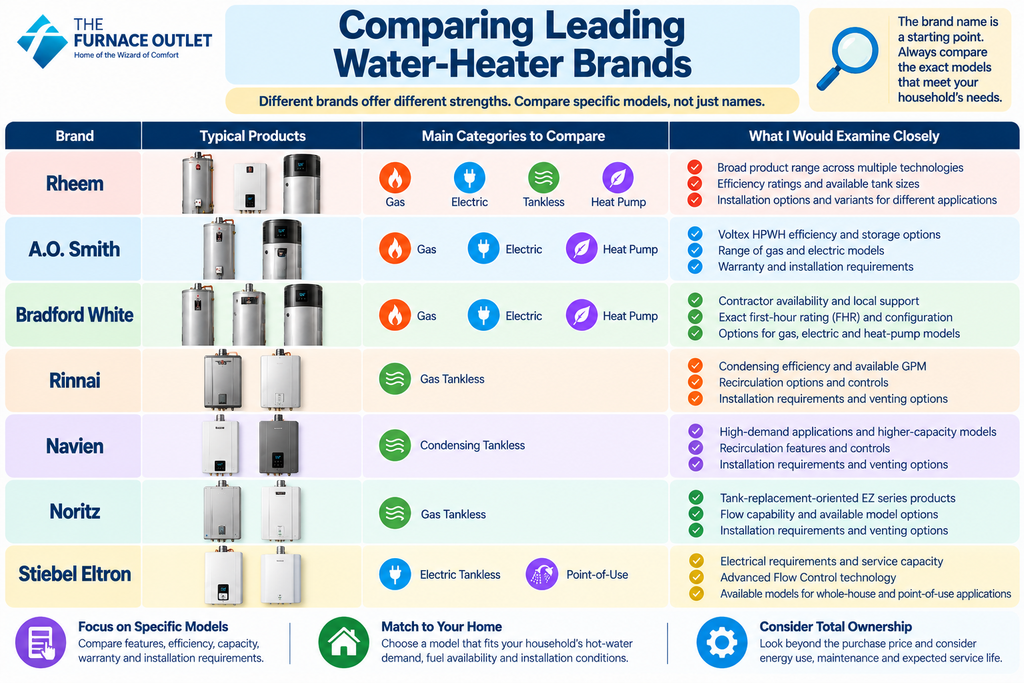
| Brand | Categories Worth Comparing | What I Would Examine Closely |
|---|---|---|
| Rheem | Gas, electric, tankless, heat pump | Broad product range, efficiency, installation options |
| A.O. Smith | Gas, electric, heat pump | Voltex HPWH efficiency and storage options |
| Bradford White | Gas and electric storage, heat pump | Contractor availability, exact FHR and configuration |
| Rinnai | Gas tankless | Condensing efficiency, GPM and recirculation options |
| Navien | Condensing tankless | High-demand applications, recirculation and installation requirements |
| Noritz | Gas tankless | Tank-replacement-oriented EZ products and flow capability |
| Stiebel Eltron | Electric tankless and point-of-use | Electrical requirements and Advanced Flow Control |
The brand name should be the beginning of the research rather than the end. Manufacturers can offer dozens of products with very different capacities, efficiency levels, installation requirements, and warranties.
A homeowner comparing Rheem with A.O. Smith, for example, should not ask simply which company is “better.” A much more useful comparison is between two specific models that satisfy the same household demand.
Rheem is worth comparing because its water-heating portfolio spans several technologies, allowing homeowners to investigate conventional storage, tankless, and heat-pump options without restricting the search to one technology.
For a sustainability-focused buyer, Rheem’s heat-pump offerings deserve particular attention, but I would compare their exact UEF, capacity, first-hour rating, electrical configuration, operating modes, sound specifications, and warranty against competing heat-pump models rather than making a decision from brand familiarity alone.
A.O. Smith has a similarly broad presence in residential water heating, but the Voltex heat-pump family is particularly important for this 2026 comparison. Its published efficiency levels illustrate why HPWH technology is increasingly difficult to ignore when replacing conventional electric resistance equipment. The Voltex AL 66-gallon model’s published 4.02 UEF is a particularly notable specification. Hot Water
The practical decision still comes down to sizing and installation. A 50-, 66-, or 80-gallon heat-pump model should be selected according to hot-water demand and recovery needs rather than simply choosing the highest-efficiency number.
Bradford White remains highly relevant to homeowners working through professional plumbing contractors, particularly for traditional storage-water-heater replacements. I would compare the exact model’s capacity, first-hour rating, venting method, UEF, burner or element configuration, warranty, and availability of local service.
For an existing gas-tank replacement where major conversion work is undesirable, a properly selected Bradford White model can be a practical option. For homeowners considering electrification, however, I would still compare the installed cost of a heat-pump alternative.
Rinnai is one of the brands I would put near the top of a gas tankless comparison. The current RXP199iN illustrates the performance available from the SENSEI family, with a published 0.98 UEF and maximum 11.1 GPM flow rate. Rinnai
Those figures make it interesting for high-demand households, but sizing still needs to be performed at the appropriate temperature rise. Gas supply, venting, condensate drainage, recirculation strategy, water quality, and maintenance should all be considered as part of the installation.
Navien deserves inclusion when comparing high-efficiency condensing gas tankless systems, particularly where homeowners are interested in recirculation features or substantial household demand. As with Rinnai and Noritz, I would not choose a Navien unit simply from maximum advertised flow.
The contractor should specify the exact model and show expected hot-water delivery at the design temperature rise. I would also compare installation requirements and local service support, because those factors can be just as important as the equipment specification.
Noritz’s EZ Series Pro is particularly interesting for storage-tank replacement projects. The manufacturer lists the family at up to 11.1 GPM and 0.98 UEF, while its top-mounted connections are intended to simplify certain conversions from traditional tank systems. Noritz
That does not mean every tank-to-tankless conversion becomes simple. Fuel supply, venting, condensate, clearances, and local code requirements still need evaluation. However, installation-oriented design can reduce unnecessary complexity in suitable applications.
Stiebel Eltron deserves particular attention for electric tankless and point-of-use applications. Its Tempra Plus systems use Advanced Flow Control, which the manufacturer says automatically reduces flow when hot-water demand exceeds heating capacity so that outlet temperature can be maintained. Stiebel Eltron USA
For me, the crucial buying question is electrical capacity. Before choosing a whole-house electric tankless model, I would have the electrical requirements reviewed professionally. Depending on the home and model, electrical upgrades can materially change the economics.
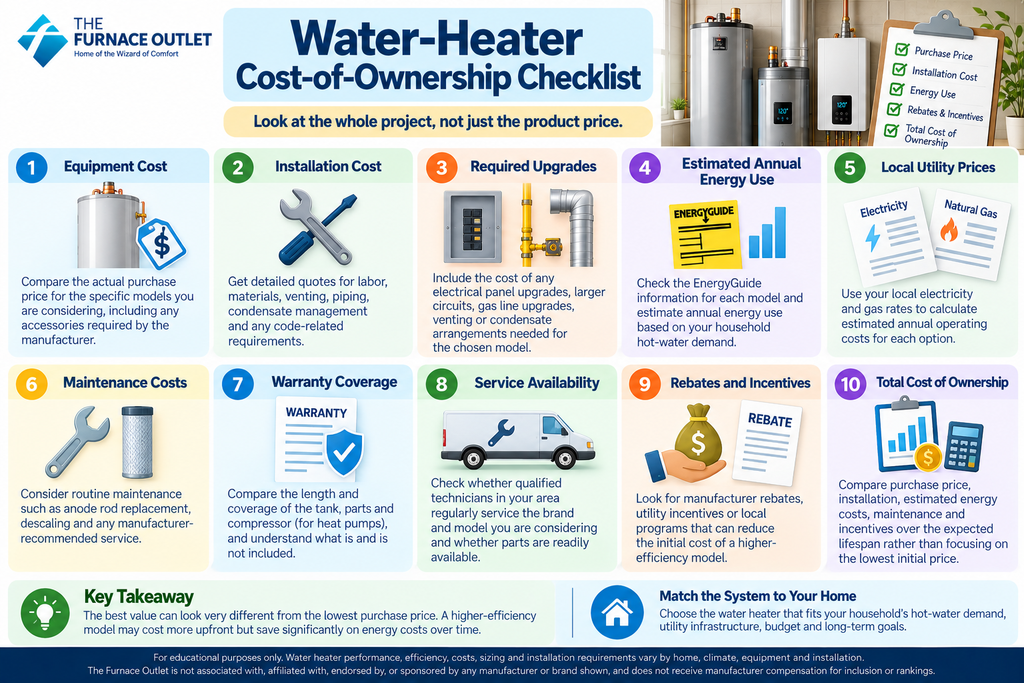
When I compare two water heaters, I look at the whole project rather than the product price. That means recording the equipment cost, installation cost, required electrical or gas upgrades, estimated annual energy use, local utility prices, expected maintenance, warranty coverage, likely service availability, and any legitimate rebates or incentives available to the homeowner.
The best value can then look quite different from the cheapest appliance. A heat-pump water heater may cost more to purchase but consume much less electricity than a resistance tank. A tankless heater may eliminate most storage losses but require expensive infrastructure modifications. A conventional tank may have a lower initial cost but greater long-term energy consumption.
This is why I prefer total cost of ownership to simplistic “best budget” labels. Sustainability becomes far easier to justify when energy efficiency and household economics are evaluated together.
If I were choosing a water heater for my own home in 2026, I would begin with the building and household rather than with a brand. I would calculate peak hot-water demand, determine available fuels, check electrical capacity, assess the installation space, consider local energy prices, and then compare equipment that can satisfy those requirements.
For an existing conventional electric-resistance installation, I would give an appropriately sized heat-pump water heater very serious consideration. Modern HPWH efficiency is compelling, and larger storage capacities can help the heat pump handle household demand while reducing reliance on resistance backup. DOE’s life-cycle approach to efficient water-heater purchasing reinforces why long-term energy cost deserves a place alongside initial price. The Department of Energy’s Energy.gov
For a home with suitable natural-gas infrastructure and a strong preference for long-duration hot-water delivery, I would compare high-efficiency condensing tankless products from Rinnai, Navien, and Noritz. I would insist, however, that the contractor size the system using simultaneous flow and actual temperature rise rather than selecting equipment from the largest GPM number on a brochure.
For a household where initial budget and installation simplicity are the primary concerns, a correctly sized conventional gas or electric storage heater remains a reasonable solution. Not every home needs the newest technology, and replacing functional infrastructure simply to chase an efficiency specification can sometimes undermine the economic logic of the project. The most sustainable choice is ultimately the system that provides the hot.
There is no single technology that is best for every home. For households currently using conventional electric resistance water heating, a properly sized heat-pump water heater deserves serious consideration because of its high efficiency. Homes with suitable natural-gas infrastructure and high continuous hot-water demand may benefit from condensing tankless equipment, while conventional storage heaters remain useful where straightforward installation and lower initial cost are priorities.
They can be, particularly when replacing a conventional electric resistance water heater and when the installation location is suitable. The correct comparison should include purchase and installation cost, expected electricity consumption, local utility rates, household demand, maintenance, and applicable incentives. DOE uses life-cycle cost analysis when evaluating efficient water-heating equipment, which is a more useful approach than comparing purchase prices alone. The Department of Energy’s Energy.gov
Tankless is different rather than universally better. A properly sized tankless system can provide long-duration hot water and reduce storage-related standby losses, but it has a finite heating capacity and may require substantial installation work. A storage heater provides a reservoir that can handle short periods of high demand very effectively when capacity and first-hour rating are properly matched to the household.
Household size by itself is not enough to choose a water heater. For a storage system, estimate peak-hour hot-water demand and compare it with the heater’s first-hour rating. For tankless equipment, calculate the combined flow of fixtures likely to operate simultaneously and determine the temperature rise from incoming water to the desired outlet temperature. For a heat-pump system, tank capacity and recovery strategy should also be considered because additional storage can reduce dependence on resistance backup during high-demand periods.
UEF stands for Uniform Energy Factor and provides a standardized measure of water-heater efficiency. A higher UEF generally represents greater efficiency within the applicable comparison, but homeowners should not treat it as a complete estimate of household operating cost. Fuel price, hot-water consumption, climate, inlet-water temperature, installation, and operating mode can all affect actual energy expenses.
Higher efficiency is desirable, but UEF should be considered together with technology, purchase price, installation requirements, household demand, and energy source. A high-UEF heat-pump system and a high-efficiency gas tankless heater use different energy sources and operating principles, so simply comparing their UEF numbers does not provide a complete environmental or financial comparison.
The required flow depends on the fixtures expected to operate simultaneously and the temperature rise the heater must produce. Add the expected simultaneous fixture flow and then check the manufacturer’s capacity data at the required temperature rise. A maximum advertised GPM figure should not be used as the only sizing criterion.
It may be, but tank capacity does not provide enough information by itself. Household peak demand and first-hour rating are more useful for storage-heater sizing. For heat-pump models, a larger tank may sometimes improve efficient operation by reducing reliance on resistance backup during periods of heavy demand. ENERGY STAR
They can cool the surrounding area because the heat pump extracts heat from ambient air and transfers it into the stored water. This characteristic should be considered when selecting the installation location, particularly in conditioned or confined spaces.
A correctly sized tankless heater can continue producing hot water for an extended period because it is not limited by a tank’s stored volume. However, it cannot supply unlimited flow. If simultaneous demand exceeds the heater’s capacity at the required temperature rise, performance will be constrained.
They can require periodic maintenance, especially where mineral scale accumulates in the heat exchanger. Water hardness, usage, and manufacturer recommendations influence maintenance frequency. I would check the exact installation and maintenance manual before purchase rather than assuming that tankless means maintenance-free.
There is no reliable universal lifespan that applies to every installation. Water chemistry, maintenance, operating temperature, usage, corrosion protection, scale, installation quality, and product design can all influence service life. Warranty terms and local service support are therefore more useful purchasing considerations than relying on a generic lifespan promise.
Planning ahead can be valuable when you are considering a change in technology. An emergency replacement leaves less time to evaluate heat-pump installation conditions, electrical capacity, tankless gas requirements, rebates, and alternative equipment. If an older heater is approaching replacement and you are considering electrification or tankless technology, researching those requirements in advance can make the eventual project much easier.
For additional research, I would use independent technical resources before relying entirely on retailer descriptions or marketing material. The U.S. Department of Energy’s residential water-heater guidance is useful for understanding efficiency and life-cycle economics, while ENERGY STAR’s heat-pump water-heater guidance provides valuable information about HPWH sizing and design considerations. The Department of Energy’s Energy.gov
For homeowners comparing certified equipment performance, the AHRI Directory of Certified Product Performance is another useful resource. For exact product claims discussed in this article, I would verify the current specifications through the manufacturers, including Rinnai’s SENSEI RXP specifications, A.O. Smith’s Voltex AL information, and Stiebel Eltron’s Tempra Plus technical information. Product specifications and availability can change, which is why exact model verification should be part of the buying process. Rinnai
The Furnace Outlet is an independent informational and educational resource. It is not associated with, affiliated with, endorsed by, or sponsored by Rheem, A.O. Smith, Bradford White, Rinnai, Navien, Noritz, Stiebel Eltron, or any other manufacturer or brand referenced in this article. Manufacturer inclusion does not imply endorsement, and The Furnace Outlet does not receive manufacturer compensation for inclusion or rankings in this guide.
Water-heater specifications, UEF ratings, GPM ratings, first-hour ratings, capacities, warranties, pricing, product availability, incentives, and installation requirements can change and may vary substantially by exact model, capacity, fuel type, location, and application. Always verify current specifications, EnergyGuide information, installation manuals, warranty terms, and applicable certifications for the exact model before purchasing.
Water-heater installation can involve electricity, natural gas or propane, combustion, venting, condensate disposal, plumbing, pressure and temperature controls, and local building or plumbing codes. Installation, servicing, electrical work, gas work, venting, and other regulated work should be performed by appropriately licensed or qualified professionals where required. This article is provided for general educational purposes and does not replace manufacturer instructions, local codes, permits, professional sizing, or advice from a qualified plumber, electrician, HVAC professional, or other licensed contractor