Newsletter Subscribe
Enter your email address below and subscribe to our newsletter

HVAC made simple
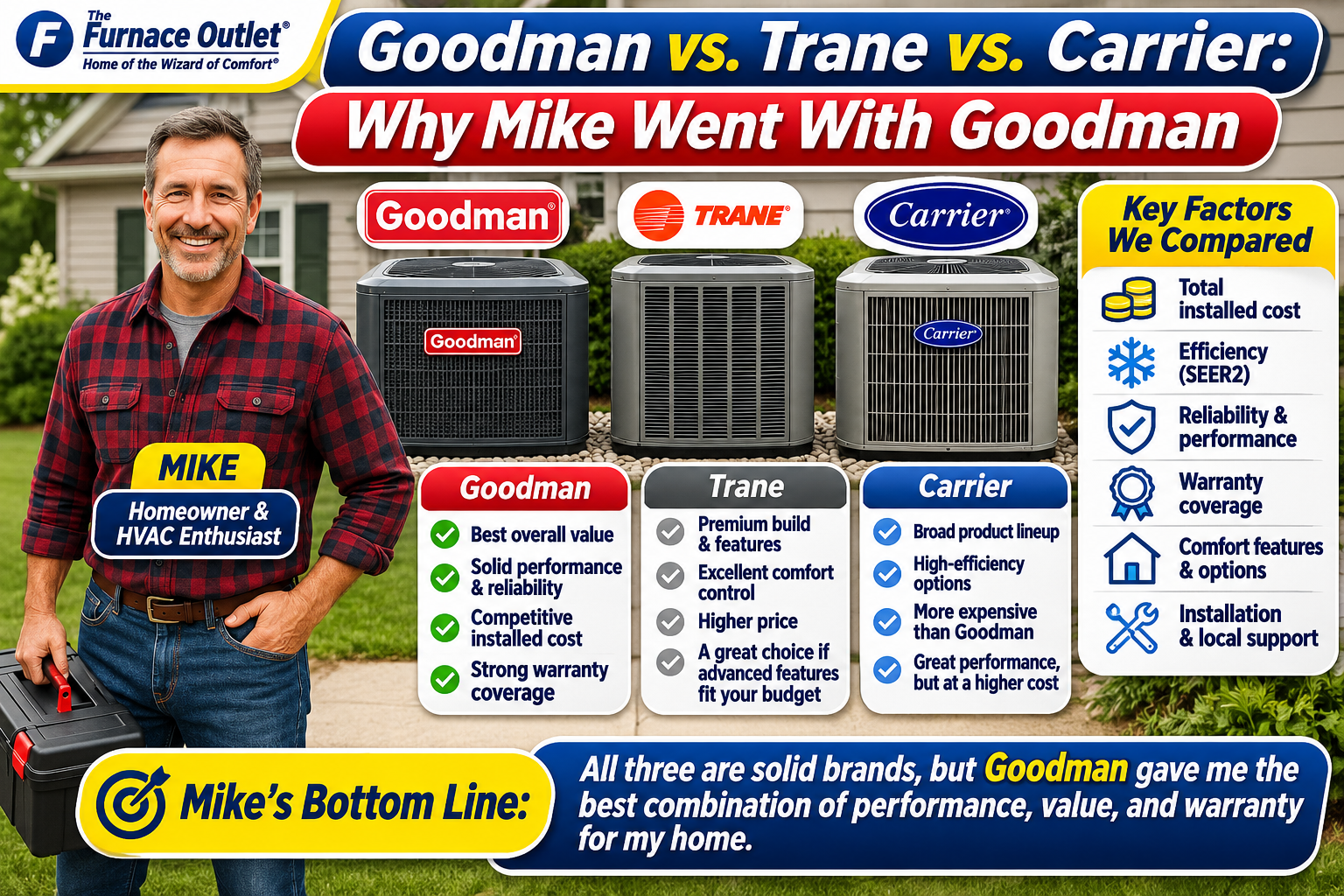
By Mike | The Furnace Outlet
When homeowners start comparing HVAC systems, three names frequently appear on their shortlist: Goodman, Trane, and Carrier. Each manufacturer offers residential heating and cooling equipment, but the differences in equipment pricing, efficiency, comfort features, warranties, and installation requirements can make choosing between them surprisingly complicated.
I’ve always believed that the best HVAC system isn’t necessarily the most expensive one. What matters is how well the equipment performs in your home, whether the installation is done correctly, and how much you’re spending for the comfort and reliability you’re actually getting. That’s exactly why, after weighing Goodman against Trane and Carrier, I found myself leaning toward Goodman.
For this 2026–2027 comparison, I’ll explain why Goodman would be my value-focused choice, where Trane and Carrier justify their higher prices, and what homeowners should examine before investing thousands of dollars in a new heating and cooling system.
Goodman has built its reputation around offering residential HVAC equipment at competitive prices. The brand manufactures central air conditioners, heat pumps, gas furnaces, and complete heating and cooling systems. Its lineup includes conventional single-stage equipment as well as more advanced configurations, giving homeowners several ways to balance affordability and performance.
Trane is often associated with premium residential HVAC equipment, sophisticated controls, and a broad selection of efficiency and comfort options. Its product range includes traditional single-stage systems, two-stage equipment, and variable-speed configurations designed to maintain more consistent indoor temperatures.
Carrier also offers a comprehensive residential HVAC lineup, ranging from more economical equipment to advanced variable-capacity systems. Its premium products emphasize precise temperature control, efficiency, and integrated comfort technology, while its more conventional systems compete in the broader residential replacement market.
All three manufacturers can provide effective heating and cooling. The important question isn’t which name sounds most impressive, but which specific system offers the right performance at a price that makes sense.
The biggest reason I favored Goodman was straightforward: overall value. When comparing equipment with similar cooling capacities and basic operating features, Goodman can often offer a lower initial purchase price than comparable premium-brand options.
That difference matters because a complete HVAC installation involves much more than the outdoor condenser. The final bill may include an indoor evaporator coil, furnace or air handler, refrigerant piping, electrical work, duct modifications, installation labor, and system commissioning.
If I can purchase a properly matched Goodman system and use part of the savings to improve ductwork, correct airflow problems, or hire a particularly experienced installer, that can be a better investment than spending the entire budget on a more expensive equipment brand.
However, I wouldn’t automatically choose Goodman simply because the initial quotation is lower. The comparison needs to include efficiency, noise, comfort features, warranty protection, and the contractor’s installation standards.
Trane offers several attractive features, particularly in its higher-end systems. Selected models use advanced compressor technology and variable-speed operation to adjust cooling output more closely to a home’s changing requirements.
This can provide more consistent temperatures and improved humidity management compared with conventional single-stage equipment. For homeowners living in hot, humid regions or those who are particularly sensitive to indoor temperature fluctuations, these features may justify a higher investment.
Goodman also offers high-efficiency and variable-speed equipment, so it’s important not to compare a basic Goodman unit with a premium Trane system and assume the difference is entirely about brand quality.
For a homeowner who primarily wants reliable central cooling without sophisticated controls, a properly sized Goodman system may deliver the necessary comfort at a lower price. Trane becomes more compelling when the homeowner specifically values advanced comfort features and the local contractor can demonstrate their practical benefits.
Carrier is another strong competitor, particularly because it offers equipment across several price and performance categories. Its Comfort, Performance, and Infinity product families address different homeowner requirements, although individual model availability and specifications change over time.
Carrier’s premium variable-capacity systems can deliver precise temperature control, quiet operation, and high seasonal efficiency. These benefits may be especially valuable in homes with demanding cooling requirements or long annual operating hours.
Goodman competes through attractive equipment pricing and a range of conventional and higher-efficiency systems. For homeowners who don’t require premium communicating controls or advanced compressor modulation, the savings can be meaningful.
My approach would be to compare two systems with similar SEER2 ratings, capacity, compressor staging, and warranty terms. If the Carrier quotation costs considerably more, I’d want to understand exactly what additional performance or comfort I’m receiving before paying the difference.
For 2026–2027 budgeting, a conventional residential central air conditioner replacement might cost approximately $4,000–$8,500 for Goodman, $5,500–$11,500 for Trane, and $5,000–$11,500 for Carrier. Premium variable-capacity systems and complicated installations can exceed these ranges substantially.
These figures are broad U.S. planning estimates rather than verified national averages or manufacturer quotations. They are not directly comparable unless each estimate includes similar indoor equipment, cooling capacity, efficiency, labor, and installation requirements.
For complete heating and cooling replacements involving both a furnace and central air conditioner, the total investment can be considerably higher. Electrical upgrades, ductwork repairs, zoning equipment, and other modifications may also increase costs.
I recommend collecting at least three detailed local quotations and comparing the actual equipment model numbers. A low price means very little if the contractor has omitted essential installation work.
A common assumption is that a less expensive air conditioner must cost more to operate. That’s not necessarily true because operating efficiency depends on the certified performance of the specific equipment combination, not simply the manufacturer’s reputation.
SEER2 measures seasonal cooling efficiency under standardized testing conditions. A system rated at 17 SEER2 will generally use less electricity for the same seasonal cooling output than a 14 SEER2 system under equivalent test conditions.
For example, moving from 14 SEER2 to 17 SEER2 represents a theoretical cooling electricity reduction of approximately 18% for equivalent seasonal cooling demand. Actual savings depend on local climate, thermostat settings, installation quality, airflow, and operating hours.
Goodman, Trane, and Carrier all offer equipment with different efficiency ratings. I would compare the certified AHRI ratings of the proposed systems and estimate annual energy costs using local electricity prices before deciding whether a more efficient model justifies its higher initial cost.
Reliability is one of the most debated topics in HVAC brand comparisons. Trane and Carrier have strong reputations, but brand reputation alone doesn’t establish that every system they manufacture will outperform a comparable Goodman unit.
Modern air conditioners contain compressors, motors, coils, electronic controls, and refrigerant components that can experience failures regardless of manufacturer. The likelihood of trouble also depends on equipment design, manufacturing quality, installation practices, operating conditions, and maintenance.
A poorly installed premium system can develop repeated problems, while a correctly installed midrange system may provide many years of dependable service. Incorrect refrigerant charging, inadequate airflow, poorly designed ductwork, and electrical problems are particularly important installation concerns.
I would rather have a carefully installed Goodman system from a reputable contractor than a more expensive system installed without proper testing and commissioning. That doesn’t prove Goodman is inherently more reliable, but it highlights how important workmanship is to long-term ownership.
Warranty protection can significantly affect the cost of owning an HVAC system, particularly when a major component fails after several years.
Goodman offers limited warranties that vary by model and registration requirements. Some eligible systems include extended parts coverage or additional component protection when the applicable conditions are satisfied.
Trane and Carrier also offer model-dependent limited warranties, with registration requirements and coverage provisions that vary by product and installation location.
Before purchasing, I recommend reviewing the actual warranty certificate rather than relying on a salesperson’s general statement about a ten-year warranty. Homeowners should verify compressor coverage, parts coverage, registration deadlines, labor exclusions, and whether the warranty changes when the property is sold.
A manufacturer’s parts warranty doesn’t necessarily pay for diagnostic visits, refrigerant, or installation labor. These expenses can become substantial even when the replacement component itself is covered.
One of the biggest mistakes homeowners make is assuming that purchasing a larger air conditioner will automatically improve comfort. In reality, an oversized system may cycle too frequently, provide uneven cooling, and struggle with humidity management.
An undersized system can have the opposite problem, operating for extended periods without adequately maintaining the desired indoor temperature during extreme weather.
A professional cooling load calculation should consider the home’s square footage, insulation, windows, air leakage, orientation, local climate, and other factors. Contractors commonly use ACCA Manual J methodology to estimate heating and cooling loads.
I would insist on proper sizing regardless of whether the final choice is Goodman, Trane, or Carrier. Correct equipment capacity and duct airflow are fundamental to comfort and efficiency.
When comparing HVAC quotations, homeowners often focus on the outdoor unit and overlook the installation process. However, installation quality can affect energy efficiency, equipment longevity, operating noise, and overall comfort.
A professional installation should include verification of the equipment match, appropriate refrigerant piping, proper evacuation procedures, electrical safety checks, airflow adjustments, condensate drainage, and performance testing.
The contractor should also evaluate whether the existing ductwork can handle the proposed equipment. Restrictive ducts, inadequate return airflow, and poorly sealed connections can reduce performance even when the air conditioner itself is highly efficient.
For me, this is another reason Goodman can make financial sense. If a lower equipment price allows room in the budget for necessary duct improvements and careful installation, the homeowner may achieve better overall results.
The HVAC industry has been transitioning toward refrigerants with lower global warming potential. This affects many residential air conditioners sold during the 2026–2027 buying period.
Selected newer Goodman systems use R-32 refrigerant, while many newer Trane and Carrier residential configurations use R-454B. Both are classified as A2L refrigerants, meaning they have lower flammability than conventional highly flammable refrigerants but require equipment and installation practices specifically designed for their safe use.
Neither refrigerant should be treated as automatically superior in every application. Equipment efficiency, safety controls, service requirements, and system design all matter.
I would make sure the contractor is qualified to install the proposed refrigerant system and that the indoor and outdoor components are approved for use together. Older equipment should not be assumed compatible simply because the connections appear similar.
Although Goodman would be my value-focused choice, there are situations where I would seriously consider paying more for Trane.
If the home experiences significant temperature fluctuations, requires sophisticated humidity control, or has demanding cooling requirements, a premium Trane configuration may offer worthwhile comfort improvements.
I would also consider Trane when a highly experienced local contractor offers excellent installation support, clear warranty terms, and dependable long-term service. The strength of the local service relationship can influence ownership satisfaction.
The additional cost becomes easier to justify when the homeowner can identify specific benefits rather than simply purchasing a more expensive brand name.
Carrier becomes particularly attractive when homeowners want advanced variable-capacity cooling, integrated controls, and access to a contractor who specializes in its equipment.
A properly designed Carrier system may provide excellent temperature stability and quiet operation, especially when paired with compatible indoor equipment and controls.
However, these benefits should be evaluated against the complete installed price. If a Goodman system meets the home’s actual cooling requirements and the premium Carrier features offer limited additional value, the lower-cost option may be more sensible.
I would compare certified efficiency ratings, operating sound levels, warranty terms, and the contractor’s proposed installation procedures before making the final decision.
Is Goodman really cheaper than Trane and Carrier?
Goodman is frequently positioned as a value-oriented brand and may offer lower equipment pricing than comparable Trane or Carrier systems. However, actual installed costs depend on the specific models, efficiency ratings, contractor, and installation requirements. Homeowners should compare complete quotations rather than brand averages.
Does Goodman last as long as Trane or Carrier?
A properly installed and maintained Goodman system can provide many years of dependable service, but there is no guarantee that it will last as long as a particular Trane or Carrier unit. Equipment quality, climate, installation, operating conditions, and maintenance all affect lifespan. A reasonable planning expectation for many central air conditioners is approximately 12–18 years, although individual results vary.
Is Goodman a good choice for hot climates?
Goodman offers air conditioners and heat pumps suitable for residential cooling in hot climates, provided the selected equipment has adequate capacity and is installed correctly. In areas with long cooling seasons, homeowners should compare efficiency ratings and humidity-control features because these can influence comfort and annual electricity costs.
Are Trane and Carrier worth the extra money?
They can be worth the additional investment when the selected equipment offers meaningful improvements in comfort, efficiency, noise, controls, or service support. However, a higher price does not automatically guarantee better performance or longer service life. The best choice depends on the homeowner’s priorities and the quality of the installation.
After comparing Goodman, Trane, and Carrier, my preference came down to value rather than brand prestige. Goodman offered the kind of straightforward heating and cooling equipment I would be comfortable recommending to a homeowner who wants dependable performance without paying extra for features they may never use.
That doesn’t mean Trane or Carrier are poor investments. Both offer excellent equipment options, particularly for homeowners seeking premium comfort technology and sophisticated system controls. But if the primary goal is efficient, dependable heating and cooling at a reasonable installed price, Goodman deserves serious consideration.
My recommendation is to compare properly sized systems with similar specifications, examine the full installation scope, and choose a contractor who will stand behind the work. The right Goodman system can be a smart purchase, but the best HVAC investment is always the one that delivers the comfort your home needs at a total cost you can justify.
This article provides general educational information about residential HVAC equipment selection. Pricing ranges are illustrative estimates, not verified national averages or guaranteed quotations. Product specifications, refrigerants, warranties, efficiency ratings, and installation requirements vary by model and location. Consult qualified HVAC contractors and current manufacturer documentation before purchasing or installing equipment.
For reliable product and technical information, homeowners can consult the official websites of Goodman Manufacturing, Trane Residential, and Carrier Residential. The U.S. Department of Energy explains central air-conditioning efficiency and proper system selection, while the AHRI Directory allows homeowners to verify certified equipment performance. These references are useful when comparing actual models rather than relying on general brand claims.