Newsletter Subscribe
Enter your email address below and subscribe to our newsletter

HVAC made simple
By Jake Lawson | Jake the HVAC Specialist | The Furnace Outlet
If you’re shopping for a new central air conditioner, Lennox is probably one of the brands you’ve come across. It’s known for offering everything from straightforward residential cooling systems to premium variable-capacity air conditioners designed for better efficiency, quieter operation, and more consistent indoor comfort. But one question comes up repeatedly among homeowners: How much does a Lennox air conditioner actually cost?
I’ve spent more than a decade working with residential and commercial HVAC systems, and one thing I’ve learned is that the equipment price rarely tells the whole story. A Lennox condenser advertised for a few thousand dollars can turn into a much larger investment once you include the indoor evaporator coil, installation labor, refrigerant piping, electrical work, and necessary modifications.
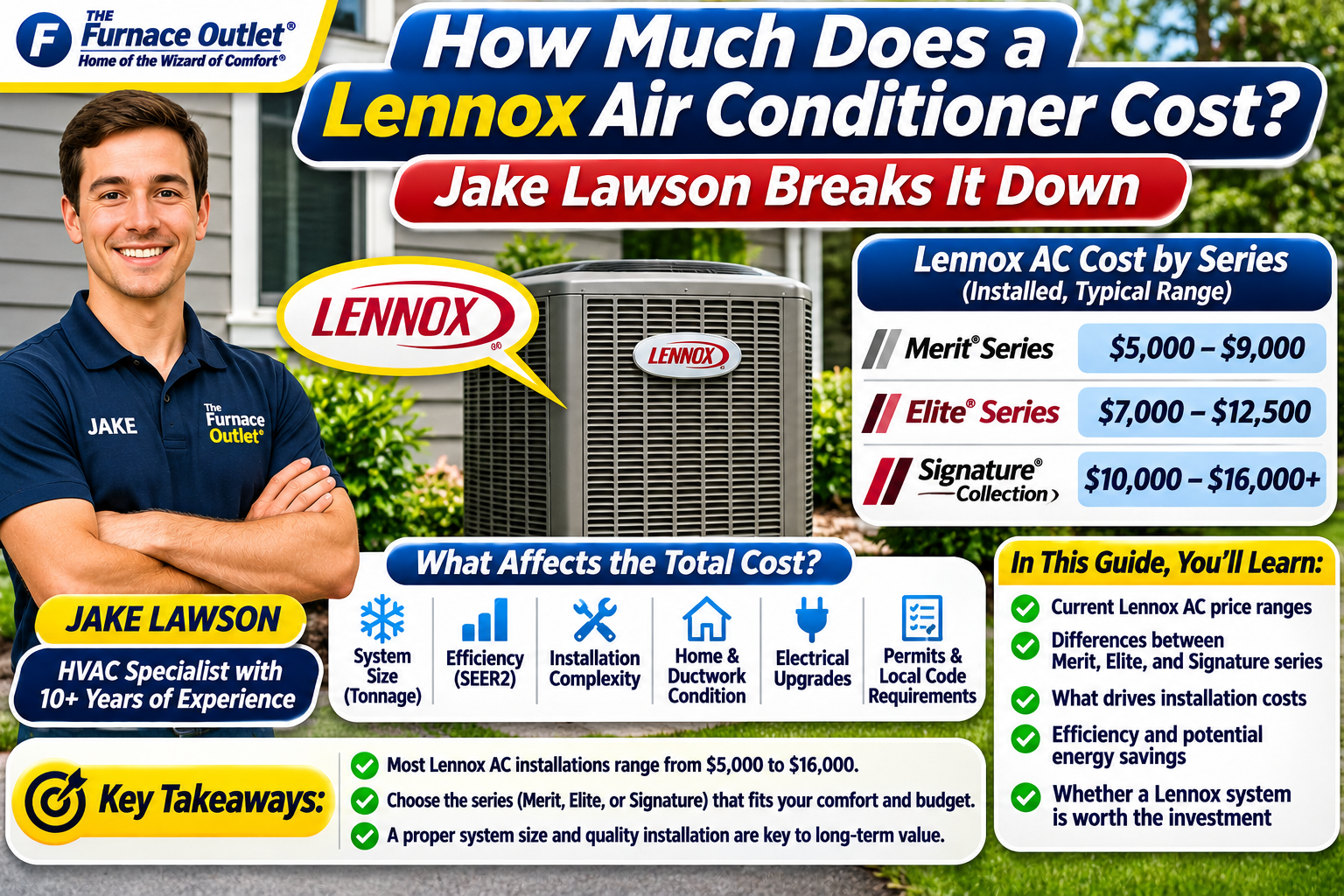
For 2026–2027, a Lennox central air conditioner installation may cost approximately $5,000 to $16,000, with premium or complicated projects potentially exceeding that range. The amount you actually pay depends on the system’s size, efficiency, equipment configuration, and installation requirements. Let’s break down where your money goes and whether Lennox is worth the investment.
Lennox offers several equipment tiers, which means homeowners can choose a system that fits their budget without necessarily paying for the manufacturer’s most advanced technology. Entry-level equipment generally costs less because it uses simpler compressor operation and fewer comfort features, while premium systems include sophisticated controls and variable-capacity technology.
For general budgeting, a Lennox Merit installation may fall around $5,000–$9,000, while an Elite system may cost approximately $7,000–$12,500. Premium Dave Lennox Signature Collection installations can reach $10,000–$16,000 or more. These figures are broad U.S. planning estimates rather than manufacturer-issued prices, and local quotations may vary substantially.
It’s important to understand that these ranges generally assume a replacement installation with usable existing ductwork. A project requiring substantial duct modifications, electrical upgrades, or difficult equipment access may cost considerably more. Homeowners should always request an itemized quotation rather than relying on a generic online price.
The Lennox Merit Series is designed for homeowners who want dependable central cooling without paying for every premium feature. Selected Merit air conditioners use single-stage compressors, while other configurations offer two-stage operation for improved temperature control.
Single-stage systems operate at a fixed cooling output whenever the compressor runs. They are generally less expensive to purchase and can be appropriate for homeowners who prioritize affordability and straightforward operation. However, they may produce more noticeable temperature fluctuations than advanced variable-capacity equipment.
Two-stage Merit models provide additional operating flexibility by allowing the compressor to run at different output levels. This can improve comfort during moderate weather while reducing the need for full-capacity operation.
I would consider a Merit system when the existing ductwork is in good condition, the home’s cooling requirements are relatively straightforward, and the homeowner wants to keep installation costs manageable.
The Lennox Elite Series offers a middle ground between basic equipment and the manufacturer’s most advanced systems. Depending on the model, homeowners can choose improved efficiency, quieter operation, and more sophisticated compressor technology.
Certain Elite models use variable-capacity operation, allowing the compressor to adjust its output more closely to the home’s cooling demand. Instead of repeatedly switching between full cooling and no cooling, these systems can operate at reduced capacity during milder conditions.
This can help maintain more consistent temperatures and support better humidity management when the complete system is properly matched and configured. The benefits are particularly noticeable in homes where cooling equipment operates for long periods throughout the summer.
For many homeowners, I would begin my comparison with the Elite Series. It can offer meaningful comfort improvements without automatically requiring the highest-priced Signature equipment.
The Dave Lennox Signature Collection represents Lennox’s premium residential cooling offerings. Selected systems feature advanced variable-capacity compressors, high seasonal efficiency ratings, and sophisticated comfort controls.
These systems can be attractive in hot climates where air conditioning operates extensively throughout the year. Variable-capacity technology may help reduce temperature swings, improve comfort during partial-load conditions, and provide quieter operation compared with some conventional single-stage systems.
However, premium efficiency comes with a higher initial investment. If the price difference between a midrange and premium system is several thousand dollars, homeowners should evaluate whether expected energy savings and comfort improvements justify that additional cost.
I recommend asking the contractor to estimate annual operating expenses for both systems using your local electricity rate and expected cooling demand. The most expensive Lennox system is not automatically the best financial choice for every household.
A 3-ton central air conditioner provides a nominal cooling capacity of 36,000 BTU per hour. This capacity is common in residential installations, but that does not mean it is suitable for every medium-sized home.
For 2026, a typical 3-ton Lennox replacement may cost approximately $6,000–$10,500 installed, assuming reasonably accessible equipment and existing ductwork that can be reused. Higher-efficiency configurations and complicated installations may cost more.
The final price depends on whether the project requires only an outdoor condenser replacement with compatible indoor equipment or a more complete system upgrade. Refrigerant compatibility, evaporator coil condition, electrical requirements, and duct airflow all affect the total.
I strongly recommend against choosing a 3-ton unit simply because the previous air conditioner was the same size. A proper cooling load calculation should account for insulation, windows, air leakage, climate, and the home’s actual heat gain.
One of the biggest pricing factors is cooling capacity. Larger systems generally require more expensive equipment, although efficiency and compressor technology can create an even greater difference in price than tonnage alone.
Installation complexity also matters. Replacing an accessible condenser and compatible indoor coil is generally less expensive than installing equipment in a cramped attic, modifying ductwork, or replacing an outdated electrical circuit.
The condition of the existing system can influence the project considerably. Refrigerant line sets may require replacement or approved preparation, condensate drainage may need correction, and the indoor coil must be compatible with the new outdoor unit.
Labor costs vary by region, contractor, and project scope. Homeowners in high-cost metropolitan areas may receive substantially higher estimates than those in smaller markets, even when the equipment is similar.
One of the most common mistakes homeowners make is comparing the advertised price of an outdoor air conditioner with a quotation for a complete installed cooling system. These are not equivalent purchases.
A complete installation may require a new evaporator coil, refrigerant line modifications, condensate drain improvements, electrical disconnects, circuit upgrades, thermostat replacement, and disposal of old equipment. Permit fees and required inspections may also apply.
Refrigerant changes deserve particular attention. Many newer Lennox air conditioners use R-454B refrigerant, and the indoor equipment must be approved for the selected outdoor system and refrigerant. Homeowners should not assume an older R-410A evaporator coil can simply be reused with a newer R-454B condenser.
Before approving an installation, I recommend requesting a written breakdown showing the outdoor unit, indoor components, electrical work, refrigerant work, labor, permits, and commissioning. This helps prevent unexpected charges and makes competing quotations easier to compare.
SEER2 stands for Seasonal Energy Efficiency Ratio 2 and measures cooling efficiency under standardized test conditions. A higher SEER2 rating generally indicates that a system can provide the same amount of cooling while consuming less electricity.
For example, when comparing a 14 SEER2 system with an 18 SEER2 system under equivalent seasonal cooling conditions, the higher-efficiency system could theoretically use approximately 22% less electricity for cooling. Actual savings depend on climate, installation quality, operating hours, thermostat settings, and the matched equipment.
If your household spends $1,000 annually on air-conditioning electricity, that theoretical efficiency difference would represent approximately $220 per year. However, the real-world savings may be different, and the calculation should not be treated as a guaranteed reduction in utility bills.
For homeowners in Florida, Texas, Arizona, or other regions with extended cooling seasons, higher efficiency may provide greater long-term value. In milder climates, a less expensive system may offer a more reasonable payback period.
Lennox is frequently positioned alongside Carrier and other established HVAC manufacturers, while Goodman often appeals to homeowners seeking competitive equipment pricing. However, comparing brands solely by average installation cost can be misleading.
A basic Lennox Merit system may cost less than a premium Carrier configuration, while a high-efficiency Lennox Signature system can be considerably more expensive than a standard Goodman air conditioner.
Goodman can offer attractive upfront value, especially when a homeowner wants a conventional central cooling system without advanced communicating controls. Carrier offers several equipment tiers, while Lennox provides both straightforward and sophisticated variable-capacity options.
My advice is to compare systems with similar cooling capacity, SEER2 ratings, compressor technology, warranty coverage, and installation scope. The contractor’s workmanship and local service support should be part of the decision, not just the brand name on the cabinet.
A properly installed and maintained central air conditioner may provide roughly 12–18 years of service, although actual lifespan varies considerably with climate, operating conditions, maintenance, and equipment quality.
Systems operating through long, demanding cooling seasons may experience more wear than equipment used only a few months annually. Coastal environments can also accelerate corrosion, while neglected filters and dirty coils may increase operating stress.
Regular professional maintenance helps identify electrical problems, airflow restrictions, refrigerant issues, and drainage concerns before they develop into expensive failures.
I recommend keeping outdoor coils clean, replacing indoor filters as required, and arranging professional inspections according to the manufacturer’s guidance. Good maintenance will not eliminate every breakdown, but it can help protect the investment.
Lennox warranty coverage varies by model, product family, installation date, registration status, and applicable program terms. Some products may qualify for extended limited parts coverage when registration and eligibility requirements are satisfied.
Homeowners should distinguish between a manufacturer’s parts warranty and an installation contractor’s labor warranty. A covered replacement component does not necessarily mean the labor required to diagnose and install it will be free.
Premium systems can also contain more specialized electronic controls and variable-capacity components, making local service expertise particularly important.
Before purchasing, I would request the exact warranty certificate for the proposed model and written confirmation of registration requirements, labor coverage, and exclusions.
Replacing an aging air conditioner is not always the most economical decision. If your current system is relatively young, operating efficiently, and requires only a minor repair, keeping it may make better financial sense.
However, replacement becomes more attractive when the equipment experiences repeated breakdowns, uses an obsolete or increasingly expensive refrigerant, or requires major repairs such as compressor replacement.
I recommend comparing the cost of the proposed repair with the age, condition, and expected remaining service life of the system. A major repair on a 15-year-old air conditioner may be difficult to justify, particularly when additional components are showing signs of deterioration.
A new Lennox system may improve comfort and efficiency, but homeowners should evaluate the complete installed cost against realistic future savings rather than expecting every replacement to pay for itself quickly.
Is Lennox considered an expensive air conditioner brand?
Lennox offers both moderately priced and premium central air conditioners. Its Merit Series is generally positioned for value-conscious buyers, while Elite and Signature configurations can cost significantly more because of advanced compressor technology, efficiency, and comfort features. The actual installed price depends on the equipment and contractor quotation.
How much does a Lennox air conditioner cost without installation?
Outdoor Lennox air conditioner equipment may cost approximately $2,000–$8,000 depending on the model and capacity, although dealer pricing varies. This does not represent the cost of a complete cooling system because indoor components, installation materials, labor, and commissioning may be additional.
Is a Lennox air conditioner worth the extra money?
A Lennox system can be worth the investment when its efficiency, comfort features, warranty, and installation quality align with the homeowner’s needs. However, a less expensive competing system may offer better value when the performance difference is small. Comparing complete installed quotations is the most dependable approach.
Does a Lennox air conditioner require a special thermostat?
Some Lennox systems can operate with conventional compatible thermostats, while certain advanced communicating configurations require specific controls to access their full functionality. Homeowners should verify thermostat compatibility before purchasing, especially when considering premium variable-capacity equipment.
When homeowners ask me how much they should budget for a Lennox air conditioner, I recommend beginning with the complete installed cost rather than the outdoor unit’s advertised price. For many conventional residential replacement projects, a planning budget around $5,000–$12,000 may be reasonable, while premium equipment and more complex installations can reach $16,000 or considerably more.
I would start with a professional load calculation, compare the Merit and Elite equipment that meets the home’s requirements, and then determine whether a Signature system offers enough additional comfort or efficiency to justify its higher price. I would also insist on clear quotations covering indoor equipment, refrigerant compatibility, electrical work, commissioning, and warranty terms.
A Lennox air conditioner can be a strong long-term investment, but the best purchase is the system that fits your home’s actual cooling needs, your budget, and the quality of service available in your area.
This article provides general educational information about Lennox central air conditioner pricing and selection. All costs are approximate U.S. planning estimates, not guaranteed dealer quotations. Equipment specifications, refrigerants, efficiency ratings, warranties, and availability vary by model and region. Consult qualified HVAC contractors and current manufacturer documentation before making installation decisions.