Newsletter Subscribe
Enter your email address below and subscribe to our newsletter

HVAC made simple
By Tony Marino | HVAC Technician & Home Comfort Specialist | The Furnace Outlet | Updated November 2026
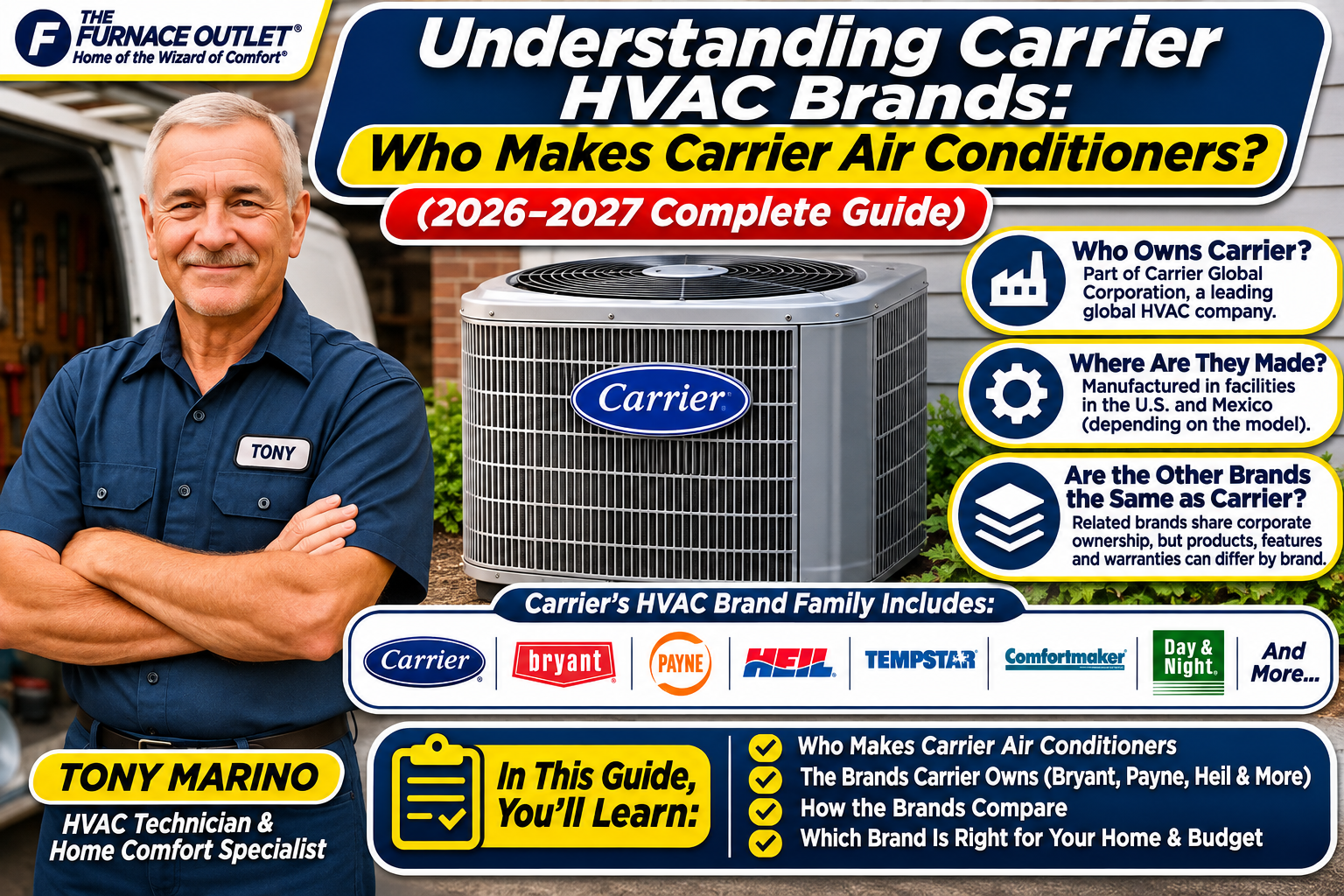
If you’ve been shopping for a new central air conditioner, you’ve probably come across Carrier, Bryant, Payne, Heil, Tempstar, and Comfortmaker. What many homeowners don’t realize is that these familiar HVAC names are connected through the same corporate family.
Carrier air conditioners are manufactured and marketed by businesses within Carrier Global Corporation, a major international heating, cooling, and climate-solutions company. Carrier Global also owns several other HVAC brands, including Bryant, Payne, Heil, Tempstar, Comfortmaker, Day & Night, Arcoaire, Airquest, and KeepRite. But here’s where things get interesting. Just because two air conditioners come from the same corporate family doesn’t necessarily mean they’re identical products with different logos.
After decades of working with residential HVAC systems, I’ve learned that understanding manufacturer relationships can help homeowners compare equipment more intelligently, especially when one brand costs considerably more than another. Let’s examine who makes Carrier air conditioners, how its related brands differ, and whether paying extra for the Carrier name makes financial sense.
Carrier is part of Carrier Global Corporation, a publicly traded American company headquartered in Palm Beach Gardens, Florida. The company’s history goes back to Willis Carrier, who developed the first modern electrical air-conditioning system in 1902. Carrier later became part of United Technologies Corporation before becoming an independent publicly traded company in 2020. Today, Carrier Global operates across residential HVAC, commercial heating and cooling, building controls, refrigeration, and other climate-related technologies.
Its portfolio includes several internationally recognized businesses and brands. According to the company’s official Carrier brand directory, Carrier’s heating and cooling family includes Bryant, Payne, Tempstar, Heil, Comfortmaker, Day & Night, and several other names. For homeowners, this corporate relationship is important because it helps explain why some equipment specifications, component designs, and technologies appear similar across different brands.
Carrier has manufacturing and operational facilities in multiple countries, including the United States and Mexico. However, the exact manufacturing location of an air conditioner depends on its model, product family, and production arrangements. It’s inaccurate to assume that every Carrier air conditioner is manufactured in the United States or that all Carrier-branded equipment comes from one factory. Carrier also operates through international manufacturing partnerships and regional businesses.
For example, International Comfort Products, a Carrier subsidiary, states that its equipment is manufactured in facilities located in the United States and Mexico. The International Comfort Products website provides additional information about its manufacturing operations and distribution network. If American manufacturing is a purchasing priority, I recommend checking the country-of-origin information for the exact equipment being quoted rather than relying on the manufacturer’s headquarters location.
Carrier’s residential HVAC family includes several familiar names serving different dealer networks and market segments. Bryant is closely associated with Carrier and offers a broad selection of residential air conditioners, heat pumps, furnaces, and indoor comfort products. Payne focuses on relatively straightforward residential heating and cooling equipment. International Comfort Products, commonly called ICP, manufactures and markets equipment under brands including Heil, Tempstar, Comfortmaker, Day & Night, Arcoaire, Airquest, and KeepRite.
These brands share corporate ownership, but they aren’t necessarily sold through the same contractors or supported by identical warranty programs. Carrier also owns other climate-related brands, including Toshiba HVAC and Viessmann Climate Solutions, which serve different product categories and geographic markets. Understanding these relationships helps explain why two seemingly competing HVAC brands may actually belong to the same parent company.
Carrier and Bryant are closely related residential HVAC brands, and certain models have historically shared similar engineering platforms, components, and performance characteristics. For example, both brands offer entry-level equipment, higher-efficiency systems, and advanced variable-speed air conditioners. Carrier’s Infinity product family and Bryant’s Evolution product family occupy comparable premium positions within their respective lineups. However, the two brands aren’t automatically identical.
Model specifications, control compatibility, available features, warranty conditions, and dealer support can differ. A Carrier system may also be quoted at a different installed price from a similarly equipped Bryant system. When homeowners ask me which is better, I recommend comparing the exact model numbers and certified efficiency ratings rather than making a decision based solely on the logo. If a Bryant system provides the performance and features you need at a substantially lower installed price, it may represent excellent value.
On the other hand, a Carrier dealer offering stronger installation support or a more suitable equipment configuration may justify the additional cost.
Payne is another HVAC brand within the Carrier family. Its product lineup generally emphasizes conventional residential heating and cooling solutions without necessarily offering the same range of premium features found in Carrier’s higher-end equipment. For homeowners replacing a basic single-stage air conditioner, Payne can be worth considering. A straightforward Payne system may provide the cooling capacity and efficiency required for a home without the added expense of sophisticated variable-speed controls.
However, it would be misleading to claim that every Payne air conditioner is simply a Carrier model with a different badge. Specifications, available capacities, sound ratings, compressor configurations, and warranty terms must be checked individually. I often recommend that budget-conscious homeowners compare Payne with Carrier Comfort and Bryant’s entry-level models. The best purchase is the system that meets the home’s cooling requirements and comes with a dependable installation.
International Comfort Products, or ICP, is a heating and cooling equipment manufacturer owned by Carrier Global Corporation. ICP has a long history in residential HVAC and operates several brands distributed through independent wholesalers and contractors. Its brand family includes Heil, Tempstar, Comfortmaker, Day & Night, Arcoaire, Airquest, and KeepRite.
Some of these products may share manufacturing platforms or components, but the exact similarities depend on the models being compared. ICP also maintains its own product support, dealer resources, and replacement-parts distribution arrangements. Homeowners can review the official ICP brand directory to understand the relationships among these names. One practical advantage of knowing about ICP is that it gives homeowners additional brands to investigate when comparing equipment quotations.
Heil, Tempstar, and Comfortmaker are ICP brands, and ICP is part of Carrier Global Corporation. That means these products belong to the broader Carrier corporate family. However, the distinction between corporate ownership and individual product manufacturing is important. Carrier-branded equipment and ICP-branded equipment may be produced through different manufacturing arrangements, even when they share certain engineering concepts or components.
Heil and Tempstar, for example, offer residential air conditioners and heat pumps with efficiency and comfort features that can compete with equipment sold under more widely advertised brands. Comfortmaker also offers residential heating and cooling systems through its own dealer network. I wouldn’t automatically assume that one of these brands is less reliable simply because its name is less familiar. Instead, compare the model specifications, installation quality, local parts availability, and warranty support.
No. Carrier and Goodman are not owned by the same company. Carrier belongs to Carrier Global Corporation, while Goodman is part of Daikin’s HVAC business. Daikin also owns the Amana residential HVAC brand. This distinction matters because homeowners sometimes confuse equipment manufacturers with the dealers or distributors selling their products.
Similarly, Trane and American Standard belong to the Trane Technologies family, while Rheem and Ruud are closely related brands within Rheem’s business. Understanding manufacturer ownership can help narrow a purchasing comparison, but it shouldn’t replace evaluating actual equipment performance.
Carrier’s residential air-conditioning lineup is commonly organized into Comfort, Performance, and Infinity product families. The Comfort series generally emphasizes straightforward cooling performance and value. The Performance series occupies the middle of the lineup, with selected models offering enhanced efficiency, comfort features, and more sophisticated controls. The Infinity series represents Carrier’s premium residential equipment, including advanced variable-speed technology on qualifying models.
Variable-speed systems can adjust cooling output to better match changing household demand, potentially improving temperature consistency and humidity management. However, model availability and specifications change over time. A homeowner comparing a Comfort system with an Infinity system should examine efficiency ratings, operating noise, control compatibility, maintenance requirements, and installed cost. The most expensive system isn’t automatically the best choice for every home.
Some related HVAC brands use similar or interchangeable components in certain equipment families. These may include selected compressors, motors, capacitors, electrical components, and other service parts. However, homeowners shouldn’t assume that every Carrier, Bryant, and Payne component is interchangeable. Even when two air conditioners appear similar, their control boards, wiring configurations, refrigerant requirements, and replacement-part specifications may differ.
Premium communicating systems can be particularly sensitive to component compatibility. Using an incorrect replacement part may create operating problems or affect warranty coverage. For repairs, technicians should identify the exact model and serial number and verify the manufacturer’s approved replacement component.
There isn’t sufficient independently verified, model-specific long-term failure data to establish that Carrier air conditioners consistently last longer than every Bryant, Heil, or Tempstar system. Reliability depends on several factors beyond the brand. Proper equipment sizing, refrigerant charging, airflow, electrical installation, and maintenance all influence how long an air conditioner performs dependably. A well-installed midrange air conditioner can provide better practical results than an expensive premium system installed incorrectly.
I also consider local service availability extremely important. A reliable contractor who understands the equipment and can obtain replacement parts quickly may provide more long-term value than a recognizable brand name alone. For budgeting purposes, homeowners often plan around approximately 12–18 years of central air-conditioner service life, although actual longevity varies.
Carrier and Bryant offer manufacturer limited warranties, but coverage varies by model, installation circumstances, registration requirements, and applicable terms. Some residential equipment may qualify for extended parts coverage when properly registered. Certain premium components may also have additional coverage, depending on the product. However, homeowners shouldn’t assume that a 10-year parts warranty includes labor, diagnostic charges, refrigerant, or every expense associated with a repair. Different brands and dealers may offer separate labor protection or extended service agreements.
Before purchasing, ask for the warranty certificate applicable to the exact equipment. The Carrier residential warranty information is a useful starting point for understanding coverage and checking eligible products.
Carrier has transitioned newer residential equipment toward lower-global-warming-potential refrigerants. One important example is R-454B, marketed by Carrier as Puron Advance. R-454B has a substantially lower global warming potential than R-410A, which was widely used in residential air conditioners for many years. Carrier reports a global warming potential of approximately 466 for R-454B compared with 2,088 for R-410A. R-454B is classified as an A2L refrigerant, meaning it has lower toxicity and mild flammability under the relevant safety classification.
New equipment designed for R-454B incorporates appropriate safety requirements. Older R-410A systems shouldn’t simply be converted by replacing their refrigerant with R-454B. The Carrier R-454B refrigerant guide explains the transition and its implications for newer air-conditioning equipment. When comparing Carrier-family brands, confirm the refrigerant and equipment generation associated with each quotation.
Carrier can be worth the additional investment when a particular model provides meaningful benefits in efficiency, comfort, noise reduction, or equipment controls. However, paying extra for the brand name alone doesn’t necessarily produce better results. Suppose one contractor quotes $5,500 for a properly matched Bryant system while another quotes $7,000 for a comparable Carrier system. The $1,500 difference should be evaluated against actual equipment specifications, warranty protection, installation quality, and contractor support.
If the Carrier system offers substantially better variable-speed comfort or efficiency, the additional investment may be reasonable. If the two systems provide nearly identical performance and installation quality, the lower-priced option could offer better value. These prices are illustrative examples, not current national averages. I recommend obtaining detailed quotations rather than comparing equipment names without knowing what is included.
The first step is determining your home’s actual heating and cooling requirements. A professional Manual J load calculation helps identify the appropriate equipment capacity rather than relying only on the size of the existing air conditioner. Next, compare the complete installed systems, including the outdoor unit, indoor coil, furnace or air handler, controls, and required accessories. Ask for certified efficiency information and verify whether the quoted equipment includes single-stage, two-stage, or variable-speed operation.
Installation quality deserves particular attention. A contractor should inspect ductwork, verify airflow, pressure-test refrigerant connections, and commission the system according to manufacturer requirements. Finally, evaluate warranty terms, local service support, and the contractor’s experience with the specific brand. Those factors often matter more than whether the equipment carries a Carrier, Bryant, Payne, or Heil logo.
Who manufactures Carrier air conditioners? Carrier air conditioners are produced and marketed by businesses within Carrier Global Corporation, which also owns several other HVAC brands.
Is Bryant made by Carrier? Bryant belongs to Carrier Global Corporation. Certain Carrier and Bryant products share related engineering and technology, but not every model is identical.
Does Carrier own Payne? Yes. Payne is part of the Carrier family and offers residential heating and cooling equipment.
Does Carrier own Heil and Tempstar? Yes. Heil and Tempstar are brands of International Comfort Products, which is owned by Carrier Global Corporation.
Are Carrier and Goodman the same manufacturer? No. Carrier belongs to Carrier Global Corporation, while Goodman is part of Daikin.
Is Carrier better than Bryant? Not automatically. The better choice depends on the specific models, installed prices, equipment features, warranty coverage, and contractor quality.
When homeowners discover that Carrier owns Bryant, Payne, Heil, Tempstar, and several other HVAC brands, they often ask why they should pay more for Carrier. My answer is that you shouldn’t pay extra unless you’re receiving something valuable in return. Carrier offers sophisticated premium equipment, but related brands can also provide excellent heating and cooling solutions. The right choice depends on your home’s needs, your budget, and the quality of the installation.
I recommend comparing exact model numbers, certified efficiency ratings, warranty coverage, and complete installation quotations before making a decision. Most importantly, choose a contractor who understands proper system sizing and commissioning. A well-installed air conditioner from a less expensive Carrier-family brand may provide better long-term value than a premium model installed poorly.