Newsletter Subscribe
Enter your email address below and subscribe to our newsletter

HVAC made simple
By Samantha Reyes | The AC Shopper | The Furnace Outlet | Updated November 2026
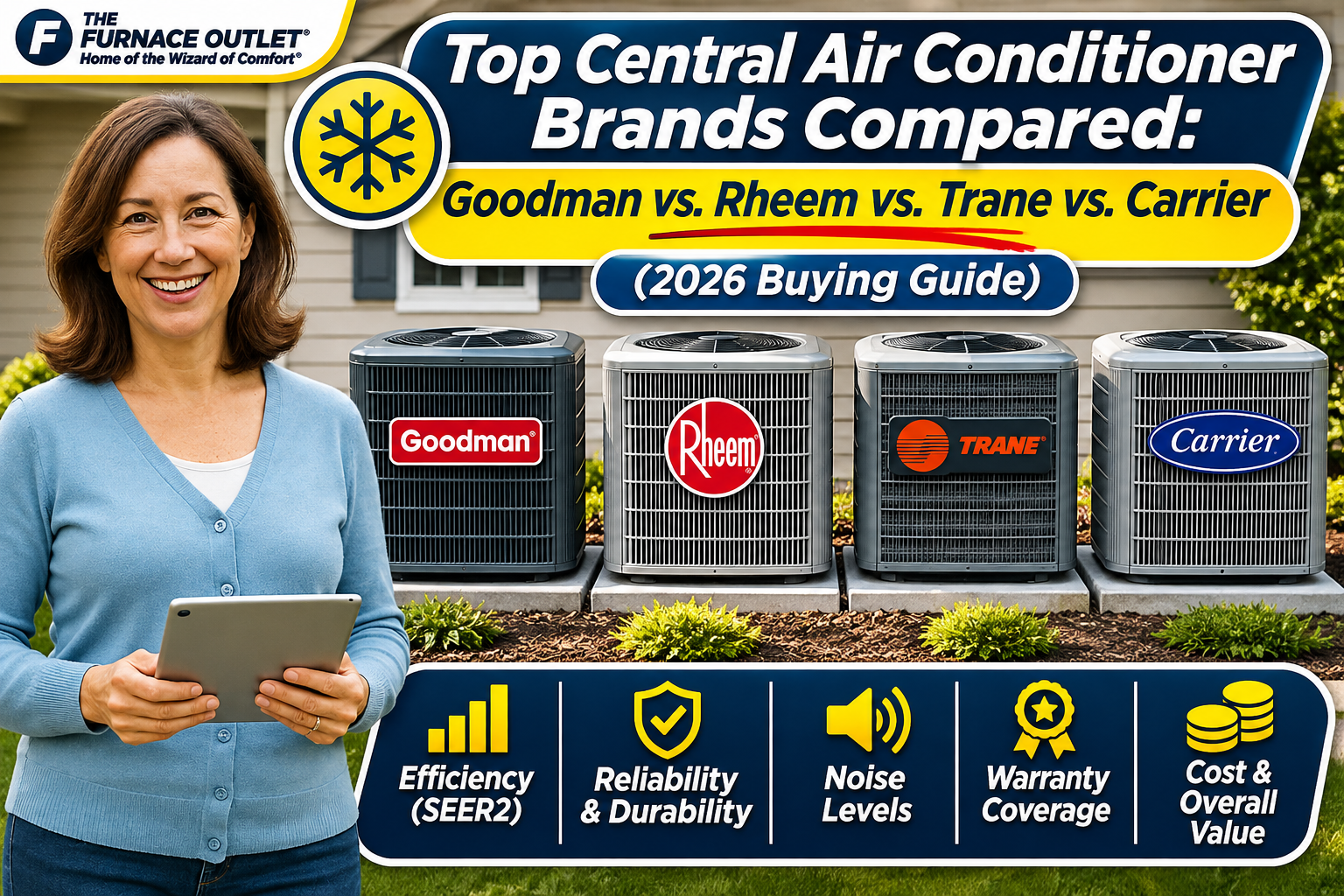
Choosing a new central air conditioner is a significant investment, and four names frequently appear on homeowners’ shortlists: Goodman, Rheem, Trane, and Carrier. All four manufacturers offer residential cooling systems, but they differ in pricing, compressor technology, efficiency, warranty coverage, and the way their equipment is sold and serviced.
Goodman is widely associated with value-oriented equipment, Rheem offers a balance of comfort and affordability, Trane emphasizes durability and premium system engineering, and Carrier provides a broad range of cooling technologies and advanced comfort controls. However, these are general market positions rather than guarantees that one brand will outperform another.
A well-installed Goodman system can be a better investment than an improperly sized premium Carrier or Trane system. Similarly, a higher-efficiency Rheem or Trane model may justify its additional cost when it delivers meaningful comfort improvements and long-term operating savings.
This guide compares the four brands from a homeowner’s perspective, covering efficiency, reliability, installation costs, noise, warranties, refrigerants, and long-term value. The goal is to help you choose the right complete cooling system rather than simply the most recognizable name.
Goodman is part of Daikin’s HVAC business and has established a strong position in the North American residential replacement market. Its appeal has traditionally been straightforward equipment, competitive pricing, and a broad range of models suited to different budgets.
Goodman offers single-stage systems for homeowners who want dependable basic cooling, along with higher-efficiency models using more advanced compressor technology. Its newer equipment includes systems designed around R-32 refrigerant, supporting the industry’s transition toward lower-global-warming-potential alternatives.
One advantage is that homeowners can choose a relatively simple system without paying for features they may not need. However, Goodman also offers inverter-driven options for buyers seeking improved temperature control and efficiency.
The brand’s main consideration is installation quality. As with any central air conditioner, incorrect refrigerant charging, poor ductwork, and improper airflow can significantly reduce performance. Goodman is worth considering when a qualified local installer offers a properly matched system at an attractive price.
Rheem has a long history in residential heating and cooling and offers central air conditioners across multiple efficiency and comfort categories. Its lineup includes conventional single-stage equipment and more advanced systems designed for quieter operation and improved temperature control. Rheem’s premium products may incorporate variable-speed or variable-capacity technology, depending on the model. These features allow equipment to respond more precisely to cooling demand instead of operating at full output whenever the thermostat calls for cooling.
The brand also emphasizes contractor diagnostics and equipment serviceability. Its EcoNet-compatible systems can provide integrated control features when paired with supported equipment.
Rheem is particularly attractive to homeowners seeking a balance between equipment sophistication and installation cost. However, pricing and product availability vary by region and dealer, so its value should be judged against the exact Goodman, Trane, or Carrier model being offered.
Trane is frequently positioned toward the premium end of the residential HVAC market. Its equipment lineup includes single-stage, multistage, and variable-speed systems designed for different comfort and efficiency requirements. Trane’s higher-end systems focus on precise capacity control, temperature consistency, and quiet operation. Certain models also support advanced communicating controls that coordinate the outdoor unit, indoor equipment, and thermostat.
For homeowners in regions with long, demanding cooling seasons, these features may offer meaningful benefits. A variable-speed system can operate at reduced capacity during milder conditions, potentially improving indoor comfort and reducing frequent starts and stops.
However, Trane’s premium positioning can mean higher installed costs. Advanced controls and proprietary components may also influence future repair expenses, making qualified local service support particularly important. Trane deserves consideration when comfort, sound performance, and advanced system features are priorities, but homeowners should compare its certified performance and complete installation price with competing equipment.
Carrier is one of the most established names in residential air conditioning and offers equipment spanning entry-level, midrange, and premium categories. Its product families include systems designed for basic cooling as well as advanced variable-speed equipment capable of adjusting output to changing indoor conditions. Premium Carrier configurations may provide sophisticated humidity management, communicating controls, and improved operating efficiency.
Carrier’s Infinity systems are particularly relevant for homeowners seeking integrated comfort control, while its other product families offer less complex alternatives at different price points. The primary consideration is cost. High-end Carrier installations can represent a substantial investment, especially when paired with compatible communicating indoor equipment and controls.
Carrier is worth evaluating when you want advanced comfort features and have access to an experienced installer who can configure and maintain the system correctly.
Energy efficiency is one of the most important considerations when comparing air conditioners, but it must be evaluated at the complete-system level. SEER2 measures seasonal cooling efficiency under standardized test conditions, while EER2 measures performance at specified operating conditions. Higher ratings generally indicate less electricity consumption for a given amount of cooling under the applicable test assumptions.
All four brands offer equipment at multiple efficiency levels. Goodman and Rheem provide relatively straightforward entry-level options, while Trane and Carrier have extensive premium offerings. Goodman and Rheem also offer higher-efficiency equipment, so the distinction isn’t simply budget versus premium.
A higher SEER2 rating doesn’t guarantee proportionally lower electricity bills. Actual savings depend on climate, cooling hours, thermostat settings, ductwork, equipment sizing, and installation quality.
For example, upgrading from a 14 SEER2 system to an 18 SEER2 system can reduce cooling electricity consumption under comparable operating conditions. However, the actual financial savings must be calculated using your home’s cooling demand and local electricity rates.
Reliability is often the first question homeowners ask, but it’s also one of the hardest to answer accurately. Goodman, Rheem, Trane, and Carrier all manufacture systems that can provide years of service when correctly installed and maintained. Yet there isn’t a universally applicable, independently verified failure-rate ranking that proves one of these four brands is always the most reliable.
Equipment reliability depends on the specific model, compressor design, control electronics, manufacturing quality, installation workmanship, operating conditions, and maintenance history. Premium equipment can include sophisticated electronics and variable-speed components that improve performance but may be more expensive to repair. Simpler single-stage equipment may offer easier servicing, although simplicity alone doesn’t guarantee a longer lifespan.
Instead of selecting a brand based on an unsupported reliability ranking, evaluate the contractor’s reputation, warranty support, equipment specifications, and local availability of replacement parts.
Outdoor noise can make a noticeable difference when a condenser is installed near a bedroom, patio, or neighboring home. All four manufacturers offer equipment designed to reduce operating noise. Premium variable-speed systems often operate more quietly at reduced cooling capacity than basic single-stage units running at full output.
However, sound ratings vary considerably within each brand. A premium Goodman or Rheem model may be quieter than an entry-level Trane or Carrier system, while a high-end Carrier or Trane model may outperform a basic competitor.
When comparing quotations, ask for the published sound rating of the exact condenser model and capacity. Also consider installation location, mounting methods, and nearby reflective surfaces. The quietest system on paper isn’t necessarily the best purchase if the additional cost provides little practical benefit for your home’s layout.
Installation prices vary widely by location, cooling capacity, efficiency rating, and the amount of work required. For budgeting purposes, a complete residential central AC replacement may cost approximately $5,000–$12,000 or more, with premium variable-speed systems and complicated installations sometimes exceeding that range.
Goodman frequently competes at the more affordable end of the market. Rheem may offer similar value with additional comfort features at certain price levels. Trane and Carrier premium systems often command higher prices, although entry-level models can be competitively priced.
These are broad market tendencies rather than verified nationwide price rankings. Local contractor pricing can reverse the expected order. The most useful comparison is the complete installed price for systems of the same capacity, similar efficiency, and equivalent installation scope. A quotation should identify the condenser, indoor coil, controls, electrical work, refrigerant line requirements, permits, and labor warranty.
Warranty coverage can significantly affect the long-term ownership experience, particularly when major components fail. Goodman offers a standard limited warranty with enhanced coverage available on qualifying models when registration and other conditions are satisfied. Selected systems may include additional compressor or unit-replacement protection.
Rheem also offers model-dependent limited parts and compressor warranties, with enhanced coverage often subject to registration requirements. Trane and Carrier provide their own limited warranty programs, which differ by equipment series and installation circumstances. A common mistake is assuming that a 10-year parts warranty includes 10 years of free repairs. Labor, refrigerant, service calls, and related expenses may not be covered unless separate protection has been purchased.
Always obtain the actual warranty certificate for the quoted model. Ask your contractor who handles claims, how quickly replacement parts can be obtained, and whether a separate labor warranty is included.
The transition away from higher-global-warming-potential refrigerants has become an important part of choosing new air-conditioning equipment. Goodman’s newer residential air-conditioning lineup prominently uses R-32, while Rheem’s current residential product specifications identify R-454B in multiple models. Trane and Carrier also offer equipment using lower-GWP refrigerants, with the exact refrigerant depending on the model and product generation.
Both R-32 and R-454B are classified as A2L refrigerants and require equipment designed for their properties. Neither should be substituted into an older R-410A system that wasn’t approved for the replacement refrigerant.
For homeowners, the best approach is to verify the refrigerant printed on the equipment identification label and confirm that the indoor and outdoor components are approved for use together.
Homes in regions such as Florida, Texas, Louisiana, and other hot or humid areas can benefit from equipment that maintains comfort during long cooling seasons. For these conditions, compressor modulation, appropriate airflow, and humidity control may matter as much as the highest advertised efficiency rating.
A properly sized variable-speed Carrier, Trane, Goodman, or Rheem system may provide more consistent indoor conditions than a basic single-stage model. However, a system that is oversized can still experience short cycling and inadequate humidity removal, regardless of brand.
The contractor should perform an appropriate cooling-load calculation and evaluate ductwork before selecting capacity. In many cases, improving duct leakage, insulation, or airflow can deliver meaningful comfort benefits without purchasing the most expensive condenser.
Premium equipment can be worth the additional cost when its advanced features solve specific comfort problems or deliver savings that justify the investment.
For example, a homeowner who values quiet operation, precise temperature control, and integrated humidity management may benefit from a variable-speed system. A household with simpler cooling requirements may find that a midrange Goodman or Rheem system provides comparable practical comfort at a lower installed price.
The premium-brand label alone isn’t sufficient justification for spending several thousand dollars more. Compare certified efficiency, compressor technology, warranty coverage, sound ratings, and the quality of the installation proposal. If two systems offer similar performance and warranty protection, the better contractor and more competitive total price may be the deciding factors.
Is Goodman as reliable as Trane or Carrier? Goodman can provide dependable cooling when correctly installed and maintained. However, there isn’t enough universally comparable public failure-rate data to conclude that Goodman, Trane, or Carrier is consistently the most reliable across all models and installations.
Is Rheem better than Goodman? Rheem and Goodman both offer entry-level and advanced residential air conditioners. Rheem may appeal to buyers interested in particular comfort controls or dealer services, while Goodman often competes strongly on equipment value. Compare equivalent models rather than brand names alone.
Which air conditioner brand has the best warranty? Warranty coverage depends on the specific model, registration status, ownership conditions, and jurisdiction. All four manufacturers offer limited warranty protection, but the details vary. Request written warranty certificates before purchasing.
Which brand offers the best value for money? Goodman and Rheem are worth considering for budget-conscious buyers, while Trane and Carrier offer premium comfort technologies. The best value is the system that provides suitable performance, dependable local service, and a reasonable total ownership cost.
If I were comparing Goodman, Rheem, Trane, and Carrier for my own home, I’d start by deciding which features genuinely matter. A homeowner who simply needs dependable cooling may not benefit from every premium feature, while someone dealing with uneven temperatures, humidity problems, or outdoor noise may appreciate a more sophisticated system.
I’d obtain at least three detailed installation quotations, confirm the cooling-load calculation, compare AHRI-certified equipment ratings, and review the written warranty terms. I’d also ask about replacement-part availability and the contractor’s experience with the exact system being proposed.
Goodman deserves attention for value, Rheem for its balanced product range, and Trane and Carrier for their premium comfort options. But none should win automatically. A correctly sized, professionally installed air conditioner with dependable service support is a better investment than an expensive brand name installed poorly.
This article provides independent educational information and is not sponsored or endorsed by Goodman, Rheem, Trane, Carrier, or their parent companies. Product specifications, efficiency ratings, warranties, pricing, and availability vary by model, region, and installation. Homeowners should verify current manufacturer documentation and consult qualified HVAC contractors before making purchasing decisions.
1. Goodman — Official Air Conditioner Product Lineup
https://www.goodmanmfg.com/products/air-conditioners
Use for Goodman models, compressor technology, R-32 refrigerants, and SEER2 ratings.
2. Rheem — Residential Air Conditioners
https://www.rheem.com/products/residential/heating-and-cooling/air-conditioners/
Use for Rheem model specifications, efficiency ratings, EcoNet features, and refrigerants.
3. Trane — Residential Central Air Conditioners
https://www.trane.com/residential/en/products/air-conditioners/
Use for Trane equipment categories, cooling capacities, and variable-speed technology.
4. Carrier — Residential Air Conditioning Systems
https://www.carrier.com/us/en/residential/air-conditioners/
Use for Carrier Infinity, Performance, and Comfort series comparisons, including compressor technology and comfort features.
5. U.S. Department of Energy — Energy-Efficient Central Air Conditioners
https://www.energy.gov/cmei/femp/purchasing-energy-efficient-residential-central-air-conditioners
Use for objective guidance on energy efficiency, certified equipment, and long-term operating costs.