Newsletter Subscribe
Enter your email address below and subscribe to our newsletter

HVAC made simple
By Tony Marino | The Furnace Outlet
When your Rheem furnace suddenly stops heating your home, finding the reset button may seem like the quickest way to restore comfort. However, furnace shutdowns are often the result of built-in safety mechanisms responding to overheating, ignition failures, restricted airflow, or electrical problems. Understanding why these protective mechanisms activate is more important than simply restarting the equipment.
Modern electric heating solutions, such as the Goodman MBVK variable-speed modular blower equipped with an approved electric heat kit, offer a different approach to residential heating. By eliminating the need for on-site fuel combustion, these systems remove several potential sources of gas furnace failure while introducing different electrical and installation considerations.
This comprehensive guide explains where Rheem furnace reset buttons are located, how to troubleshoot common shutdowns safely, and whether transitioning to a Goodman MBVK electric heating configuration makes sense for your home.
Unlike many household appliances, most Rheem gas furnaces do not have a universal, externally accessible reset button. Instead, they incorporate several temperature-sensitive switches, electronic controls, and safety mechanisms that interrupt operation when abnormal conditions occur.
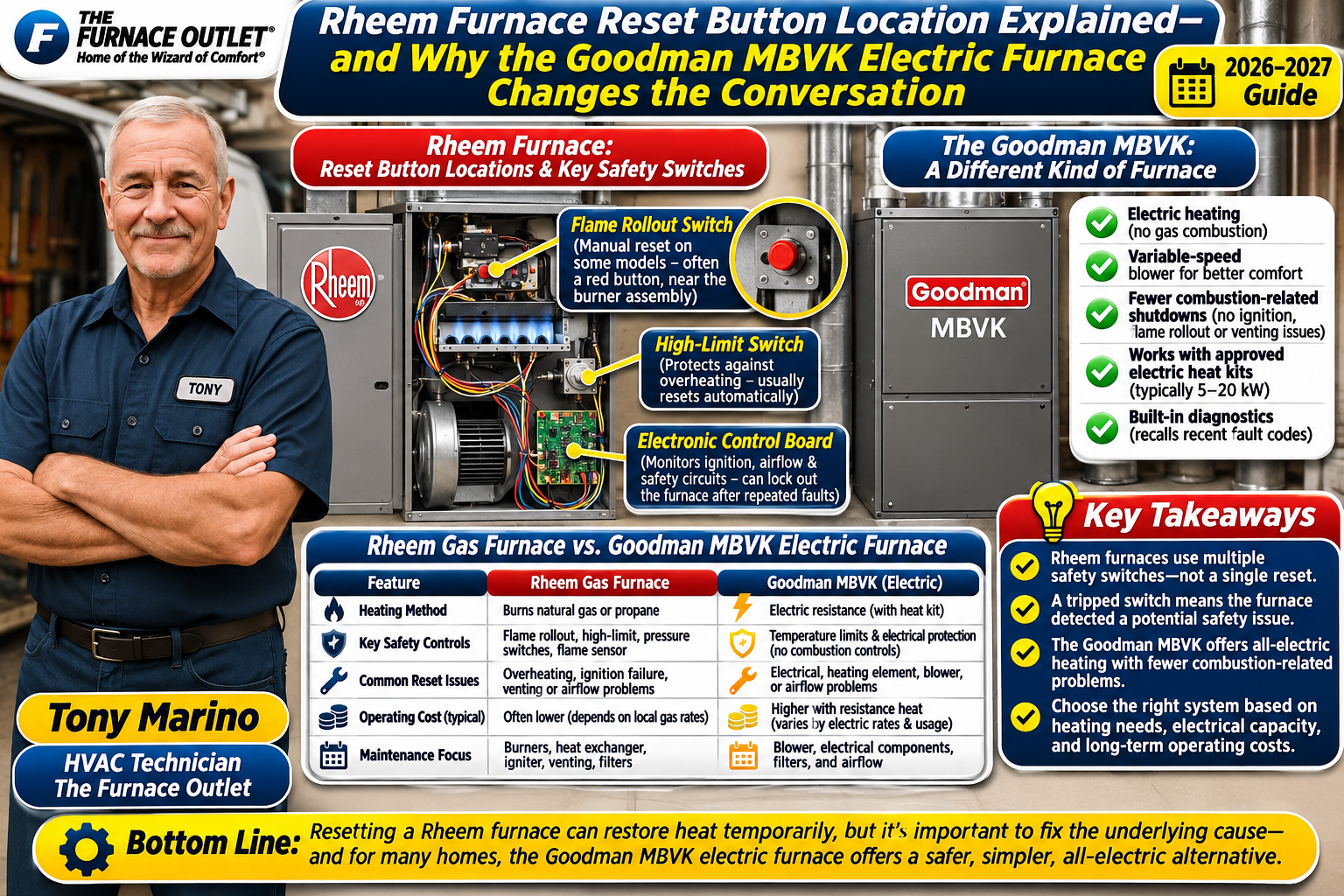
On certain Rheem furnace models, manual-reset flame rollout switches are located inside the burner compartment, near the burner assembly. These switches may feature a small red or differently colored reset button. Additional temperature limit switches may be located elsewhere within the furnace cabinet, depending on the equipment design and installation orientation.
The exact location varies between Rheem furnace models, including conventional 80% AFUE furnaces and high-efficiency condensing systems. Homeowners should identify their furnace model number and consult the appropriate manufacturer documentation before attempting any troubleshooting.
A manual-reset flame rollout switch is not an ordinary restart button. If this safety device has tripped, a qualified HVAC technician must investigate the underlying combustion or overheating problem before restoring operation.
For example, the Rheem GF801U Series installation manual identifies flame rollout switch locations near the burner cover plate on applicable models and specifically warns against resetting or bypassing these switches without qualified diagnosis.
Flame Rollout Switch: This safety device detects abnormal heat around the burner compartment when flames move outside their intended combustion area. A tripped rollout switch may indicate insufficient combustion air, a restricted exhaust system, burner problems, or heat exchanger issues. These conditions require immediate professional attention.
High-Limit Switch: The high-limit switch prevents the furnace from operating at excessively high temperatures. Many high-limit switches automatically reset once the furnace cools sufficiently, but repeated activation usually indicates restricted airflow, improper equipment sizing, or blower problems.
Auxiliary Limit Switch: Depending on the furnace configuration, additional temperature-sensitive switches provide protection against overheating in specific areas of the cabinet. Their location and reset requirements vary according to the equipment model.
Electronic Control Board Lockout: Modern Rheem furnaces incorporate electronic controls that monitor ignition, flame detection, and other operating conditions. Repeated unsuccessful ignition attempts may cause the control board to enter a temporary lockout period, preventing further heating attempts until the system can safely resume operation or receive professional attention.
A furnace that repeatedly shuts down is often responding to an unresolved operating problem rather than a defective reset button. Identifying the underlying cause can prevent unnecessary component replacement and reduce the likelihood of more serious equipment damage.
Dirty Air Filters: A heavily restricted air filter reduces the volume of air passing across the heat exchanger. As internal temperatures increase, the high-limit switch may interrupt heating to protect the equipment.
Restricted Return Air Ductwork: Undersized return ducts, blocked registers, and improperly designed duct transitions can increase airflow resistance. These restrictions may cause overheating even when the furnace itself is functioning correctly.
Ignition and Flame Sensor Problems: A deteriorating igniter or unreliable flame sensor can prevent the furnace from establishing or confirming safe combustion. Repeated unsuccessful ignition attempts may result in electronic lockout.
Blocked Exhaust or Combustion Air Venting: Obstructed vent pipes can interfere with safe furnace operation, particularly in high-efficiency condensing systems. Pressure switches and other protective devices may interrupt heating when abnormal venting conditions are detected.
Blower Motor Malfunctions: A defective blower motor, damaged control board, or incorrect airflow configuration can prevent sufficient air circulation. This can cause excessive temperatures and recurring protective shutdowns.
Condensate Drainage Problems: High-efficiency gas furnaces produce condensate during operation. Blocked drains or malfunctioning condensate management components can interfere with normal heating and activate protective controls.
The Rheem technical service reference identifies restricted ductwork, dirty filters, blower failures, and combustion-related problems among the potential reasons furnace safety controls may activate.
Before attempting to restart your furnace, confirm that the thermostat is set to heating mode and that its temperature setting is above the current indoor temperature. If the thermostat uses batteries, check whether they require replacement.
Inspect the accessible furnace air filter and confirm that return air grilles and supply registers are unobstructed. Check whether the furnace service switch is in its normal operating position and whether there has been an interruption to the electrical supply.
If your furnace has an externally visible diagnostic display, photograph or record the displayed error code before interrupting power. This information can help an HVAC technician identify the reason for the shutdown.
A normal restart through the thermostat or equipment power controls should only be performed when permitted by the model-specific owner’s manual and when no hazardous symptoms are present. Never repeatedly restart malfunctioning equipment, bypass protective switches, or manually reset internal combustion safety devices.
Many newer Rheem furnace models display numerical fault codes that provide useful information about equipment malfunctions. However, these codes vary between product generations, so homeowners should always refer to the diagnostic information supplied with their specific furnace.
On selected Rheem 801S series furnaces, error code 10 indicates a temporary ignition lockout, while code 11 indicates unsuccessful ignition. Codes 12 and 13 relate to flame detection problems, and code 22 indicates an interrupted temperature limit circuit.
Error code 33 identifies an open manual-reset safety circuit, commonly associated with flame rollout protection. Codes 55 and 57 indicate abnormal pressure switch conditions, while code 61 identifies a blower operating problem.
The Rheem 801S diagnostic flowchart provides model-specific diagnostic information. These codes should be used to communicate symptoms to a technician rather than as instructions to bypass or reset safety mechanisms.
If your furnace produces burning odors, unusual ignition noises, visible scorch marks, or repeated electrical breaker trips, discontinue operation and arrange professional service. These warning signs may indicate serious electrical, mechanical, or combustion-related problems.
If you detect natural gas or propane odors, immediately leave the building without operating electrical switches or appliances. Contact your gas utility or emergency services from a safe location outside the property. Similarly, a carbon monoxide alarm requires immediate evacuation and emergency assistance.
Restoring heat should never take priority over identifying potentially hazardous equipment conditions. A furnace that shuts down for safety reasons may be preventing a much more serious incident.
The Goodman MBVK is a variable-speed modular blower designed for residential HVAC applications. When equipped with a compatible, field-installed electric resistance heating kit, it can function as an electric furnace without requiring natural gas or propane combustion.
Unlike conventional gas furnaces, the MBVK does not require burners, flame sensors, gas valves, or combustion exhaust systems for its electric heating operation. Its primary responsibilities include air circulation, airflow management, and supporting compatible heating and cooling configurations.
According to the official Goodman MBVK product specifications, the equipment supports vertical and horizontal installation, variable-speed blower operation, dehumidification controls, compatible smart thermostat integration, and storage of its six most recent diagnostic faults.
Homeowners should understand that the MBVK is not necessarily supplied with electric heating elements as standard equipment. An approved heating kit must be selected according to the equipment model, residential heating load, and electrical infrastructure.
A conventional gas furnace relies on multiple mechanical and electronic components to initiate and maintain combustion safely. Failure of any critical component can interrupt heating and trigger a protective shutdown, even when the blower and ductwork remain fully functional.
An all-electric MBVK configuration removes several combustion-related failure points. Because it does not burn fuel, it cannot experience flame rollout, gas ignition failure, or combustion exhaust problems during electric heating operation.
However, electric heating equipment still requires temperature limits, electrical circuit protection, reliable blower operation, and appropriate airflow. Defective heating elements, excessive electrical resistance at connections, failed relays, or restrictive ductwork can still cause equipment shutdowns.
The fundamental difference is that an electric furnace eliminates combustion-related troubleshooting rather than eliminating the need for maintenance and safety protection altogether.
Heating Technology: Rheem gas furnaces generate heat through natural gas or propane combustion, transferring thermal energy through a heat exchanger. The Goodman MBVK, when equipped with an approved electric heating kit, generates heat through electrical resistance and distributes it using a variable-speed blower.
Safety Controls: Gas furnaces require ignition controls, flame monitoring, pressure switches, rollout protection, and temperature limit switches. Electric furnaces eliminate combustion-specific controls but continue to require overheating protection and appropriately rated electrical components.
Installation Requirements: A Rheem gas furnace requires a suitable fuel supply, combustion air provisions, and approved exhaust venting. The Goodman MBVK requires adequate electrical service capacity, compatible electric heating elements, properly designed ductwork, and appropriate electrical circuits.
Maintenance Requirements: Gas furnace maintenance includes inspections of the burners, heat exchanger, ignition system, and exhaust venting. Electric heating systems eliminate these combustion-related maintenance tasks but still require blower maintenance, electrical inspections, filter replacement, and airflow verification.
Energy Costs: Natural gas furnaces may offer lower heating costs in regions where gas is relatively inexpensive. Electric resistance heating can be more expensive, particularly during prolonged periods of cold weather, although pairing the MBVK with compatible heat pump equipment may improve overall energy efficiency.
The heating capacity of a Goodman MBVK electric furnace configuration depends on the approved electric heating kit installed with the modular blower. Electric heating elements are commonly rated in kilowatts rather than the BTU input ratings typically associated with gas furnaces.
A 5 kW electric heating kit provides approximately 17,060 BTU per hour of nominal heating output, while a 10 kW kit provides approximately 34,120 BTU per hour. A 15 kW configuration produces approximately 51,180 BTU per hour, and a 20 kW configuration theoretically delivers approximately 68,240 BTU per hour.
These conversions illustrate why replacing a gas furnace with electric resistance heating requires careful equipment selection. Not every heating kit capacity is compatible with every MBVK model, and a professional residential heating load calculation should determine the appropriate configuration.
Electric furnace operating expenses depend on heating capacity, electricity rates, insulation quality, outdoor temperatures, and actual equipment runtime. Although electric resistance heating converts nearly all consumed electricity into heat at the point of use, it does not necessarily provide the lowest operating costs.
Assuming an electricity rate of $0.16 per kWh and six equivalent full-load heating hours per day, a 5 kW heating configuration would cost approximately $144 monthly. Under identical conditions, a 10 kW configuration would cost approximately $288, a 15 kW configuration approximately $432, and a 20 kW configuration approximately $576.
These illustrative calculations assume a 30-day month and exclude additional blower consumption and utility charges. Actual expenses may differ considerably depending on climate, thermostat settings, and household heating requirements.
The U.S. Department of Energy’s furnace efficiency technical documentation explains the relationship between electric resistance heating technology and energy conversion efficiency.
One of the distinguishing features of the Goodman MBVK is its variable-speed blower motor. Instead of relying exclusively on a predetermined airflow speed, the blower can adjust its operation within approved performance limits to accommodate different heating and cooling requirements.
Properly configured variable-speed technology can provide more consistent indoor temperatures, quieter operation, improved humidity management when paired with compatible cooling equipment, and more efficient blower operation under suitable conditions.
However, even advanced blower technology cannot overcome severely restrictive ductwork. Homeowners should ensure that their return air system, filtration equipment, and supply ducts can accommodate the required airflow before investing in an equipment upgrade.
Replacing a Rheem gas furnace with a Goodman MBVK electric heating configuration may be practical, particularly for homeowners considering residential electrification. However, converting from gas to electricity involves considerably more than replacing one indoor HVAC cabinet with another.
The contractor must evaluate the home’s heating demand, electrical panel capacity, existing ductwork, thermostat compatibility, and any connected outdoor air conditioning or heat pump equipment. Electrical upgrades may represent a significant portion of the installation expense.
For example, a 10 kW electric heating system operating at 240 volts draws approximately 41.7 amps before accounting for additional equipment loads and applicable circuit sizing requirements. Larger heating configurations may require multiple dedicated circuits and electrical service modifications.
Homeowners should obtain a complete installation assessment before purchasing equipment to avoid unexpected expenses or inadequate winter heating performance.
The Goodman MBVK does not require the flame rollout protection switches associated with conventional gas furnaces because its electric heating configuration does not involve combustion. However, compatible electric heating assemblies incorporate temperature protection and other safety mechanisms that may interrupt operation when abnormal conditions occur.
If an MBVK system stops heating, potential causes include defective heating elements, restricted airflow, electrical supply interruptions, malfunctioning relays, blower problems, or control board faults. The equipment’s diagnostic fault recall feature can assist a qualified technician in identifying recurring operating problems.
As with gas furnaces, homeowners should never bypass protective controls or repeatedly reset electrical protection devices without determining why the equipment stopped operating.
Repairing an existing Rheem furnace often makes financial sense when the equipment is relatively young, properly installed, and experiencing an isolated component failure. Replacing a faulty igniter, correcting an airflow restriction, or addressing a thermostat problem may restore dependable heating without requiring a complete system conversion.
Replacing an aging furnace becomes more attractive when it experiences recurring major repairs, declining reliability, significant heat exchanger problems, or increasing maintenance expenses. Homeowners planning to install a heat pump or eliminate natural gas consumption may also benefit from evaluating the Goodman MBVK.
The decision should consider total ownership costs rather than focusing exclusively on equipment purchase prices or the inconvenience of occasional furnace shutdowns.
Regardless of the heating technology, adequate airflow remains essential for safe and efficient furnace operation. Dirty filters, undersized return ducts, obstructed supply registers, and incorrect blower settings can cause excessive operating temperatures in both gas and electric heating equipment.
Before selecting a replacement furnace, homeowners should understand how indoor air circulation affects equipment performance. Our comprehensive guide, What Is an Air Handler? Everything You Need to Know, explains blower motors, electric heating elements, filtration systems, and the relationship between airflow and HVAC reliability.
Where is the reset button on my Rheem gas furnace?
Certain Rheem furnaces have manual-reset safety switches near the burner assembly, although their precise location varies by model. These switches are protective devices rather than routine restart buttons and should only be reset following appropriate professional diagnosis.
Why does my Rheem furnace reset button keep tripping?
Recurring safety shutdowns may indicate airflow restrictions, overheating, combustion problems, or defective equipment components. Repeatedly resetting a safety device without correcting its underlying cause can create dangerous operating conditions.
Is the Goodman MBVK a complete electric furnace?
The Goodman MBVK is a variable-speed modular blower that can function as an electric furnace when equipped with a manufacturer-approved electric heating kit. The blower and heating elements must be correctly selected to meet the property’s heating and electrical requirements.
Is the Goodman MBVK more efficient than a gas furnace?
Electric resistance heating offers nearly complete point-of-use energy conversion, but this does not automatically translate into lower utility bills. Operating economics depend on electricity prices, natural gas rates, climate, heating demand, and whether the system incorporates a heat pump.
Can an electric furnace produce carbon monoxide?
An electric resistance furnace does not generate carbon monoxide through its normal heating process because it does not burn fuel. However, other fuel-burning appliances within the home may still present carbon monoxide risks, making appropriate household detection equipment important.
Can I install the Goodman MBVK myself?
Installing an MBVK electric heating configuration requires professional knowledge of HVAC equipment compatibility, electrical circuit requirements, airflow configuration, and applicable building codes. Improper installation may create electrical hazards, reduce equipment performance, and affect warranty coverage.
Finding the Rheem furnace reset button may seem like the simplest solution when your heating system suddenly stops working, but recurring safety shutdowns deserve careful investigation. A furnace’s protective controls are designed to prevent unsafe operating conditions, not to serve as routine maintenance switches.
The Goodman MBVK offers an alternative for homeowners interested in electric heating, variable-speed airflow, and compatibility with modern HVAC configurations. While eliminating on-site combustion removes several potential failure points, correct heating capacity, electrical protection, and professional installation remain essential.
Whether you decide to repair your existing Rheem furnace or transition to electric heating, prioritize household safety, dependable performance, realistic operating costs, and long-term equipment reliability.
This article is intended for general educational purposes and should not replace professional HVAC diagnosis, electrical work, or equipment installation. Reset switch locations, diagnostic codes, heating kit compatibility, and electrical requirements vary by equipment model. Always consult manufacturer-approved documentation and a qualified HVAC professional before servicing or modifying heating equipment.
Editorial Disclosure: The Furnace Outlet is not associated with, affiliated with, endorsed by, or sponsored by Carrier, Trane, Lennox, Bryant or any other manufacturer mentioned in this article. We do not receive manufacturer compensation for inclusion or rankings.
The Furnace Outlet
For educational purposes only. HVAC equipment removal, refrigerant handling, recycling and disposal requirements can vary by equipment and location. Consult a qualified HVAC professional and applicable federal, state and local requirements before removing or disposing of HVAC equipment.
© 2026 The Furnace Outlet | www.thefurnaceoutlet.com