Newsletter Subscribe
Enter your email address below and subscribe to our newsletter

HVAC made simple
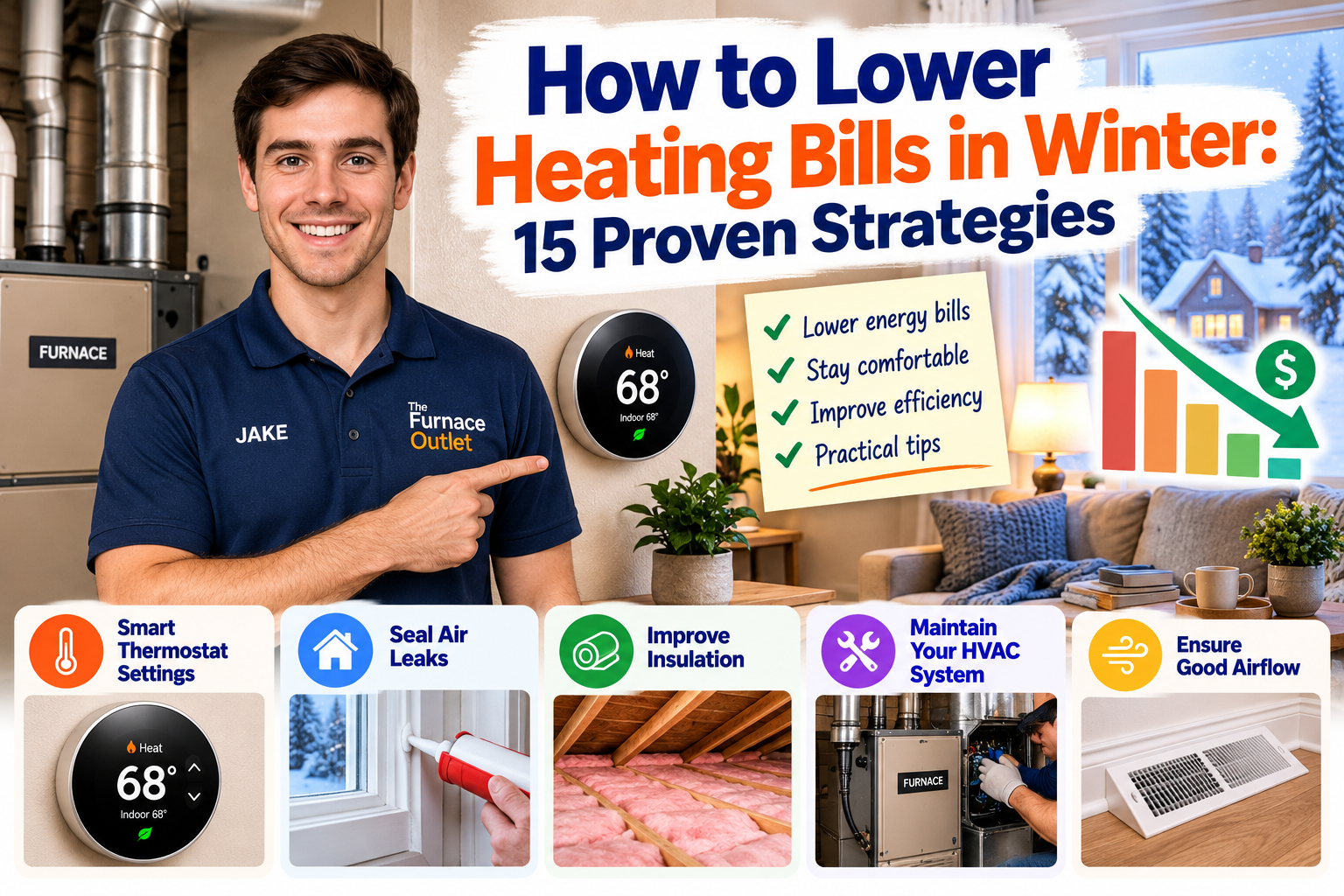
By Jake Lawson | HVAC Specialist | The Furnace Outlet
Updated October 2026 | Heating Efficiency, Energy Savings & Home Comfort
Winter heating bills can become a significant household expense, particularly in regions where furnaces and heat pumps operate for extended periods during cold weather. As outdoor temperatures fall, homes lose more heat through walls, ceilings, windows, doors, and uncontrolled air leakage. Heating equipment must replace that lost energy to maintain comfortable indoor temperatures, which can increase natural gas or electricity consumption.
Fortunately, reducing winter heating costs does not always require purchasing a new furnace, installing an expensive smart thermostat, or undertaking major renovations. Many worthwhile improvements begin with understanding how the heating system operates, correcting unnecessary heat loss, and maintaining equipment so it can perform as intended. The most effective approach combines practical household adjustments with targeted improvements to the building and its heating equipment.
As an HVAC specialist with more than 10 years of experience, I recommend investigating the reasons a home consumes heating energy before investing in upgrades. A poorly fitted furnace filter, uncontrolled air leakage, incorrect thermostat programming, or leaking ductwork may increase operating costs even when the heating equipment is relatively efficient. Conversely, replacing a functioning furnace without addressing serious insulation or distribution problems may produce disappointing results.
In this guide, I explain 15 practical, evidence-based strategies for lowering heating bills during winter, including thermostat optimization, air sealing, insulation, HVAC maintenance, heat pump operation, ductwork improvements, and energy-use monitoring. The objective is to help homeowners make informed decisions that support reliable comfort and potentially lower heating expenses throughout the 2026–2027 heating season.

Heating energy consumption is influenced by the difference between indoor and outdoor temperatures, the amount of heat escaping from the building, and the efficiency of the heating equipment. When outdoor temperatures fall substantially below the indoor thermostat setting, heat moves through the building envelope at a greater rate, requiring the heating system to operate more frequently or at higher output.
Insulation slows heat transfer through building surfaces, while air sealing limits uncontrolled movement of outdoor air into conditioned spaces. Windows, doors, attic penetrations, ductwork, and poorly insulated building components can contribute to heating demand. Even a high-efficiency furnace or heat pump must replace energy lost through these pathways.
Utility costs introduce another variable. Natural gas and electricity prices can change between billing periods, and fixed charges or seasonal pricing structures may affect the final amount owed. A higher bill does not necessarily mean that equipment efficiency has deteriorated; unusually cold weather or higher energy rates may explain part of the increase.
I recommend evaluating heating expenses alongside energy consumption and outdoor weather rather than comparing bill totals alone. Understanding these relationships helps identify which improvements are likely to produce meaningful savings.
Thermostat adjustments are among the most accessible ways to influence winter heating demand. For many households, approximately 68°F while occupants are awake and at home is a reasonable starting point, although individual comfort requirements and building conditions may justify different temperatures.
Maintaining a lower indoor temperature reduces the difference between indoor and outdoor conditions, generally reducing heat loss. However, the appropriate strategy depends on the heating equipment. Conventional furnaces may benefit from moderate setbacks during sleeping or unoccupied periods, while some heat pumps operate more economically with smaller temperature changes.
The U.S. Department of Energy explains that suitable thermostat setbacks of approximately 7–10°F for eight hours per day may reduce annual heating and cooling expenses by as much as 10% in certain circumstances. Actual results depend on climate, equipment, building characteristics, and operating schedules.
I recommend adjusting temperatures gradually and observing both comfort and energy consumption. A thermostat schedule that makes the home uncomfortable or frequently activates expensive auxiliary heating may require modification.
For additional guidance, read our related article, Best Thermostat Settings for Winter: Comfort vs. Energy Savings.

Uncontrolled air leakage can increase winter heating demand by allowing cold outdoor air to enter the home while conditioned indoor air escapes. Common leakage locations include exterior doors, window frames, attic access openings, plumbing penetrations, and gaps around electrical or mechanical installations.
Homeowners can begin by identifying noticeable drafts and inspecting accessible weatherstripping and caulking. Damaged door seals, deteriorated window caulk, and poorly fitted attic hatches may offer practical opportunities for improvement. Appropriate sealing materials should be selected for the specific surface and installation conditions.
However, air sealing must not interfere with required combustion air, mechanical ventilation, or appliance venting. Homes with fuel-burning equipment may require professional assessment before major airtightness improvements, particularly where pressure differences could affect combustion safety. The U.S. Department of Energy’s air-sealing guidance explains how reducing uncontrolled air movement can support household energy efficiency.
I recommend addressing obvious leaks before investing in expensive heating equipment upgrades. Reducing unnecessary heat loss can improve comfort while decreasing the heating load the equipment must satisfy.

Insulation helps slow heat transfer between indoor and outdoor environments. During winter, insufficient attic insulation can allow substantial heat to escape through the upper portions of a building, particularly when combined with uncontrolled air leakage. The appropriate insulation level depends on climate, existing construction, and applicable energy recommendations. Homeowners should not assume that adding a small amount of insulation automatically produces significant savings, especially when existing insulation is already adequate.
Before adding attic insulation, I recommend evaluating air leakage, moisture conditions, ventilation requirements, and the condition of existing materials. Air sealing relevant penetrations before insulation work is often important because insulation alone does not necessarily stop uncontrolled airflow. Wall insulation, crawlspace insulation, and basement conditions may also deserve attention, depending on the home’s construction. A professional energy assessment can help identify the most significant opportunities.
The Department of Energy’s insulation guidance provides information about insulation performance and recommended approaches. My preference is to prioritize improvements based on documented building conditions rather than purchasing insulation solely because heating bills appear high.
A neglected HVAC filter can restrict airflow as dust and debris accumulate on its surface. In forced-air heating systems, inadequate airflow may interfere with heat distribution and contribute to abnormal operating conditions. For gas furnaces, significant airflow restriction can contribute to overheating and activation of protective temperature-limit controls. Heat pumps also require appropriate airflow through indoor coils to maintain reliable performance.
Homeowners should inspect filters according to manufacturer recommendations and actual operating conditions. Standard one-inch filters may warrant monthly inspection during periods of frequent use, while deeper media filters may have different replacement requirements. Filter efficiency also matters. MERV 8 provides useful basic filtration, while MERV 11 and MERV 13 can capture additional airborne particles. However, higher filtration efficiency does not automatically improve energy performance. A filter with excessive resistance may reduce airflow in an incompatible system.
I recommend selecting a properly fitted filter that meets equipment requirements rather than assuming the highest available MERV rating is always best.

Professional maintenance can identify developing equipment problems that homeowners may not recognize during routine operation. Although maintenance cannot prevent every breakdown or guarantee a specific reduction in energy consumption, it can help verify that equipment operates within intended conditions. or gas furnaces, qualified servicing may include inspection of burners, ignition components, heat exchangers, venting systems, electrical connections, blower performance, and protective controls. Appropriate combustion testing and manufacturer-specific procedures may also be necessary.
Heat pump maintenance generally involves indoor and outdoor components, electrical controls, airflow, refrigerant-system performance, defrost operation, and auxiliary heating where installed. I recommend arranging servicing before sustained winter demand and requesting a written explanation of findings. Repairs should be supported by identifiable defects rather than vague promises of energy savings.
Our Furnace Maintenance Checklist: What Homeowners Should Know provides additional information about homeowner inspections and professional maintenance responsibilities.
Forced-air heating systems depend on properly designed airflow pathways. Supply registers distribute heated air into occupied rooms, while return-air openings allow air to circulate back toward the equipment. Furniture, rugs, storage boxes, and other household items can accidentally block these pathways. Some homeowners also close numerous supply registers to redirect heat into selected rooms, but excessive restrictions can increase duct-system resistance and interfere with equipment performance.
I recommend checking accessible registers and return grilles throughout the home. Move obstructions, confirm that openings intended to remain available are clear, and investigate rooms that consistently receive inadequate airflow. Uneven temperatures may indicate duct leakage, poor balancing, insulation differences, or equipment-design problems. Simply increasing the thermostat setting may raise energy consumption without correcting the underlying issue.
A qualified technician can evaluate airflow and static pressure when household-level checks do not resolve persistent distribution problems.

Leaking ductwork can waste heating energy by allowing conditioned air to escape before reaching occupied rooms. Duct leakage may be especially significant when ducts pass through unconditioned attics, crawlspaces, garages, or other spaces outside the home’s thermal envelope. Disconnected duct sections, deteriorated connections, damaged insulation, and poorly sealed joints can contribute to heat loss and uneven room temperatures. Return-air leakage may also draw air from unintended locations.
Homeowners can visually inspect accessible duct sections for obvious damage without dismantling equipment. However, concealed leakage and system-wide performance problems may require professional testing. Proper duct sealing generally involves materials and procedures suitable for HVAC applications. Ordinary household tapes and improvised repairs may not provide reliable long-term results.
The Duct Sealing explains why duct sealing and insulation can matter. I recommend evaluating duct condition before assuming that uneven heating requires a larger furnace or a more powerful blower.
Warm air tends to accumulate near ceilings because of buoyancy and room airflow patterns. In certain spaces, particularly rooms with high ceilings, gentle air circulation may help reduce temperature stratification and improve comfort. Many ceiling fans include a reversible operating direction intended for seasonal use. However, the appropriate direction and speed depend on fan design, mounting height, and room conditions. The objective is gentle circulation without creating uncomfortable drafts.
Ceiling fans do not generate additional heat or directly reduce the amount of energy required to replace heat escaping through the building envelope. Their potential benefit comes from improving comfort and temperature distribution, which may allow occupants to maintain an appropriate thermostat setting.
I recommend experimenting with low fan speeds and observing whether occupied areas feel more comfortable. If air movement creates a cooling sensation, the setting may be counterproductive. Fan electricity consumption should also be considered. Running fans continuously in empty rooms is unlikely to provide meaningful comfort benefits.

Windows influence winter heating demand through heat transfer, air leakage, and solar energy entering the home. Depending on window orientation and local conditions, sunlight can provide useful passive heating during daytime hours. Opening curtains or blinds on sun-facing windows may allow solar radiation to warm interior surfaces. Closing appropriate window coverings after sunset can help reduce certain forms of heat transfer and improve comfort near cold glass.
However, the benefit depends on window performance, climate, orientation, and the type of covering installed. Not every window receives useful winter sunlight, and some coverings provide limited insulating value.
I recommend using window coverings strategically rather than expecting them to replace proper insulation or efficient heating equipment. Drafty windows may require weatherstripping, sealing, or other improvements before coverings make a substantial difference. Homeowners should also manage condensation. Persistent moisture on windows may indicate humidity, insulation, or ventilation problems that require attention.
Portable electric space heaters can provide localized warmth, but their operating costs depend on wattage, runtime, electricity rates, and whether they allow central heating demand to decrease. Most conventional electric resistance heaters convert electrical input into heat at the point of use. A 1,500-watt heater operating for four hours consumes approximately 6 kilowatt-hours of electricity. The resulting cost depends on the local electricity tariff.
Using a space heater while maintaining the same whole-house thermostat setting generally adds electricity consumption rather than automatically reducing heating expenses. Targeted heating may be economical in certain circumstances, but the comparison should consider the efficiency and fuel cost of the central heating system.
Safety is equally important. Portable heaters should be used according to manufacturer instructions, kept away from combustible materials, and connected to appropriate electrical outlets. They should not be used with unsuitable extension cords or power strips. I recommend comparing actual energy costs before purchasing space heaters primarily to reduce utility bills.

Heat pumps can deliver efficient heating by transferring thermal energy from outdoor air into the home. Their performance varies with outdoor temperature, equipment design, installation quality, and operating conditions. Some systems use electric resistance auxiliary heating when additional capacity is required. Although backup heat can be necessary, unnecessary operation may increase electricity consumption.
Large thermostat setbacks followed by aggressive temperature recovery can activate auxiliary heating in certain installations. For this reason, I generally recommend relatively stable temperatures or modest setbacks unless the equipment and thermostat are designed to manage larger changes efficiently. Homeowners should also understand the difference between auxiliary heat and emergency heat. Emergency heat should not be selected simply because the house feels cold unless equipment instructions or a qualified professional indicate that its use is appropriate.
Outdoor units require unobstructed airflow and normal defrost operation. Persistent heavy icing or unusual heating performance warrants professional evaluation. The Department of Energy’s air-source heat pump guidance provides useful background on heat pump operation and efficiency.
Homeowners sometimes attempt to reduce heating expenses by closing vents or shutting off heating to rooms they rarely use. Whether this strategy is appropriate depends on the home’s HVAC design. In a conventional forced-air system, closing too many supply registers can increase static pressure, alter airflow, and create equipment performance problems. Unheated rooms may also affect neighboring spaces through heat transfer.
Homes with properly designed zoning systems may allow different temperature settings in separate areas. However, zoning equipment must be configured to maintain suitable airflow and heating-system operation. I recommend keeping distribution pathways consistent with the system design and addressing unused-room heating through appropriate controls rather than improvised register restrictions.
Where practical, closing doors to certain spaces may affect comfort and air circulation, but homeowners should ensure that required return-air pathways remain available. The goal is to reduce unnecessary heating demand without creating pressure imbalances, freezing risks, or equipment operating problems.
Indoor humidity affects comfort, condensation risk, and building conditions. During winter, cold outdoor air can contribute to low indoor humidity after it is heated, while excessive indoor moisture may condense on cold windows or poorly insulated surfaces. For many homes, approximately 30%–50% relative humidity is a useful general reference range, although appropriate winter levels depend on climate, construction, and outdoor temperatures.
I recommend monitoring humidity with a reliable hygrometer rather than assuming that adding moisture will automatically reduce heating costs. Humidifiers consume energy, require maintenance, and can create moisture problems when operated improperly. If condensation repeatedly appears on windows or other cold surfaces, homeowners should investigate humidity levels, ventilation, insulation, and moisture sources.
Humidity control may improve perceived comfort, but it cannot compensate for inadequate heating capacity or major building heat loss. The most effective strategy combines suitable temperature settings, moisture management, and a well-maintained building envelope.

Smart thermostats can help homeowners manage heating schedules through remote access, occupancy detection, adaptive programming, and energy-use reports. These features may reduce unnecessary heating when they are configured appropriately. However, purchasing a smart thermostat does not guarantee lower utility bills. Savings depend on previous thermostat habits, household schedules, heating equipment, and whether the new controls are used effectively.
Compatibility is particularly important for heat pumps with auxiliary heating and dual-fuel systems. Incorrect configuration can interfere with equipment operation or activate backup heating unnecessarily. I recommend choosing a thermostat that supports the installed equipment and provides features the household will actually use. Professional installation may be appropriate when wiring or control requirements are uncertain.
The ENERGY STAR smart thermostat program provides information about certified products and their energy-saving capabilities. For households that already maintain efficient thermostat schedules, the additional savings from upgrading may be modest. Convenience and monitoring features may still provide value.
The final strategy is to measure results rather than assume that every improvement will reduce bills by a predictable amount. Heating expenses are affected by weather, energy prices, occupancy, equipment performance, and building characteristics. I recommend reviewing electricity or natural gas consumption over several billing periods and comparing usage with outdoor conditions. Where available, utility portals, smart meters, and thermostat reports may provide additional information about consumption patterns.
A home energy assessment can help identify major sources of heat loss and prioritize improvements. Depending on the property, this may involve evaluating insulation, air leakage, ductwork, heating equipment, and ventilation. Homeowners should compare project costs with realistic expected benefits. A low-cost weatherstripping repair may be worthwhile immediately, while an expensive equipment replacement may require a more detailed evaluation. The most reliable savings strategy is to identify measurable problems, correct them appropriately, and monitor whether the changes improve comfort or reduce energy consumption.

Not every household needs all 15 improvements. A home with a recently installed high-efficiency heat pump may benefit more from thermostat optimization and insulation improvements than from equipment replacement. An older home with substantial air leakage may offer opportunities through building-envelope improvements before major mechanical investments.
The following comparison provides a general planning framework. Actual savings, installation costs, and payback periods depend on the property and should not be assumed from the categories alone.
| Strategy | Typical effort | Main benefit |
|---|---|---|
| Optimize thermostat settings | Low | Reduce unnecessary heating demand |
| Seal accessible air leaks | Low to moderate | Limit uncontrolled heat loss |
| Improve attic insulation | Moderate to high | Reduce heat transfer |
| Maintain HVAC filters | Low | Support proper airflow |
| Schedule professional servicing | Moderate | Identify equipment problems |
| Clear supply and return openings | Low | Improve airflow distribution |
| Inspect and seal ductwork | Moderate | Reduce distribution losses |
| Adjust ceiling fan operation | Low | Improve comfort where useful |
| Use window coverings strategically | Low | Manage solar gains and window comfort |
| Evaluate space heater use | Low | Avoid unnecessary electricity consumption |
| Optimize heat pump controls | Low to moderate | Limit avoidable backup heating |
| Review heating zones | Moderate | Match heating to occupied areas |
| Monitor indoor humidity | Low | Support comfort and moisture control |
| Evaluate smart thermostat options | Moderate | Improve scheduling convenience |
| Track energy consumption | Low | Measure results and guide investments |
I generally recommend starting with thermostat programming, filter condition, obvious air leaks, and airflow obstructions. These checks are relatively accessible and can reveal problems that do not require major purchases. More expensive improvements should be evaluated after identifying the home’s actual sources of energy loss.
Homeowners do not need to complete every energy-efficiency improvement immediately. A structured seven-day assessment can help identify priorities and organize the next steps.
| Day | Action | What to accomplish |
|---|---|---|
| Day 1 | Review heating bills | Compare energy consumption and recent costs |
| Day 2 | Optimize thermostat settings | Establish a practical winter schedule |
| Day 3 | Inspect HVAC filtration and airflow | Check filters, registers, and return openings |
| Day 4 | Identify accessible air leaks | Review doors, windows, and weatherstripping |
| Day 5 | Evaluate insulation and ductwork | Note visible deficiencies and comfort problems |
| Day 6 | Review equipment maintenance | Arrange qualified servicing where needed |
| Day 7 | Establish a monitoring routine | Track comfort, energy use, and future improvements |
This plan is intended to organize safe homeowner observations rather than encourage unqualified technical repairs. Suspected gas leaks, carbon monoxide alarms, damaged exhaust systems, electrical burning odors, or other immediate hazards require appropriate emergency action.
After completing the initial review, I recommend prioritizing improvements according to safety, documented heat loss, expected benefit, and available budget.
The most economical approach depends on local fuel prices, climate, heating equipment, and building efficiency. Reducing unnecessary heat loss and using properly maintained, efficient heating equipment are generally important starting points.
A lower indoor temperature generally reduces heat loss during cold weather, but the savings from a one-degree adjustment depend on outdoor conditions, duration, and equipment operation. There is no universal savings percentage for every household.
Not necessarily. Conventional furnace households may benefit from appropriate temperature setbacks. Some heat pump systems may operate more efficiently with relatively stable settings when large recoveries activate supplemental resistance heating.
They can help reduce unnecessary heating through improved scheduling and occupancy management. However, actual savings depend on previous habits, equipment compatibility, and correct configuration.
A heavily loaded filter can restrict airflow and interfere with equipment operation. However, the effect on energy consumption depends on the heating system and the severity of the restriction.
Closing numerous supply registers in a conventional forced-air system can increase duct resistance and cause airflow problems. Properly designed zoning is generally preferable to improvised register restrictions.
Sometimes targeted electric heating can be economical, but it depends on electricity prices, central heating efficiency, and whether whole-house heating demand is reduced. Adding a space heater without adjusting central heating generally increases total energy consumption.
Replacement may be appropriate when equipment is inefficient, unreliable, unsafe, or expensive to repair. However, age alone does not establish that replacement is the best financial decision. A documented assessment should consider equipment condition, installed cost, expected efficiency improvement, and building heat loss.

When homeowners ask me how to lower their winter heating bills, I recommend beginning with the building and heating system they already have. An efficient furnace or heat pump cannot fully compensate for major air leaks, inadequate insulation, blocked airflow, or poorly configured controls. Identifying these problems provides a more reliable starting point than purchasing new equipment without understanding the actual cause of high energy consumption.
My preferred strategy combines sensible thermostat settings, appropriate filtration, professional HVAC maintenance, ductwork evaluation, and targeted building-envelope improvements. For heat pump households, auxiliary heating behavior deserves particular attention, while gas furnace owners should prioritize combustion safety, venting integrity, and reliable airflow. Homeowners should also monitor actual energy consumption rather than relying on advertised savings percentages.
The most effective way to reduce winter heating bills is to minimize unnecessary heat loss, maintain reliable heating equipment, use controls appropriately, and prioritize improvements based on measurable household conditions. By combining these principles, homeowners can make better investment decisions, avoid unnecessary expenses, and support dependable indoor comfort throughout the 2026–2027 heating season.

U.S. Department of Energy — Thermostats: https://www.energy.gov/energysaver/thermostats. Guidance on thermostat operation, scheduling, and heating energy management.
U.S. Department of Energy — Air Sealing Your Home: https://www.energy.gov/sites/prod/files/guide_to_air_sealing.pdf. Information about reducing uncontrolled air leakage and improving household efficiency.
U.S. Department of Energy — Insulation: https://www.energystar.gov/saveathome/seal_insulate/methodology. Guidance on insulation and reducing heat transfer through building surfaces.
U.S. Department of Energy — Minimizing Energy Losses in Ducts: https://www.energystar.gov/sites/default/files/asset/document/ES_Duct_Sealing_flyer.pdf. Information about duct leakage, sealing, and insulation.
U.S. Department of Energy — Air-Source Heat Pumps: https://www.energy.gov/heat-pumps. Background on heat pump efficiency, operation, and heating performance.
ENERGY STAR — Smart Thermostats: https://www.energystar.gov/products/smart_thermostats. Information about certified smart thermostats and energy-saving features.
This article is provided by The Furnace Outlet for general educational purposes. Actual energy savings depend on climate, equipment condition, fuel prices, building characteristics, household behavior, and installation quality. No specific savings percentage or payback period is guaranteed.
Gas furnace repairs, combustion testing, exhaust vent modifications, electrical work, refrigerant-system servicing, and internal equipment adjustments should be performed by qualified professionals. Homeowners should maintain carbon monoxide and smoke alarms according to applicable codes and manufacturer instructions. Suspected gas leaks or carbon monoxide emergencies require immediate appropriate emergency action.
The Furnace Outlet publishes independent HVAC educational content. References to external organizations are included for informational purposes and do not imply sponsorship or endorsement.
© 2026 The Furnace Outlet | https://thefurnaceoutlet.com