Newsletter Subscribe
Enter your email address below and subscribe to our newsletter

HVAC made simple
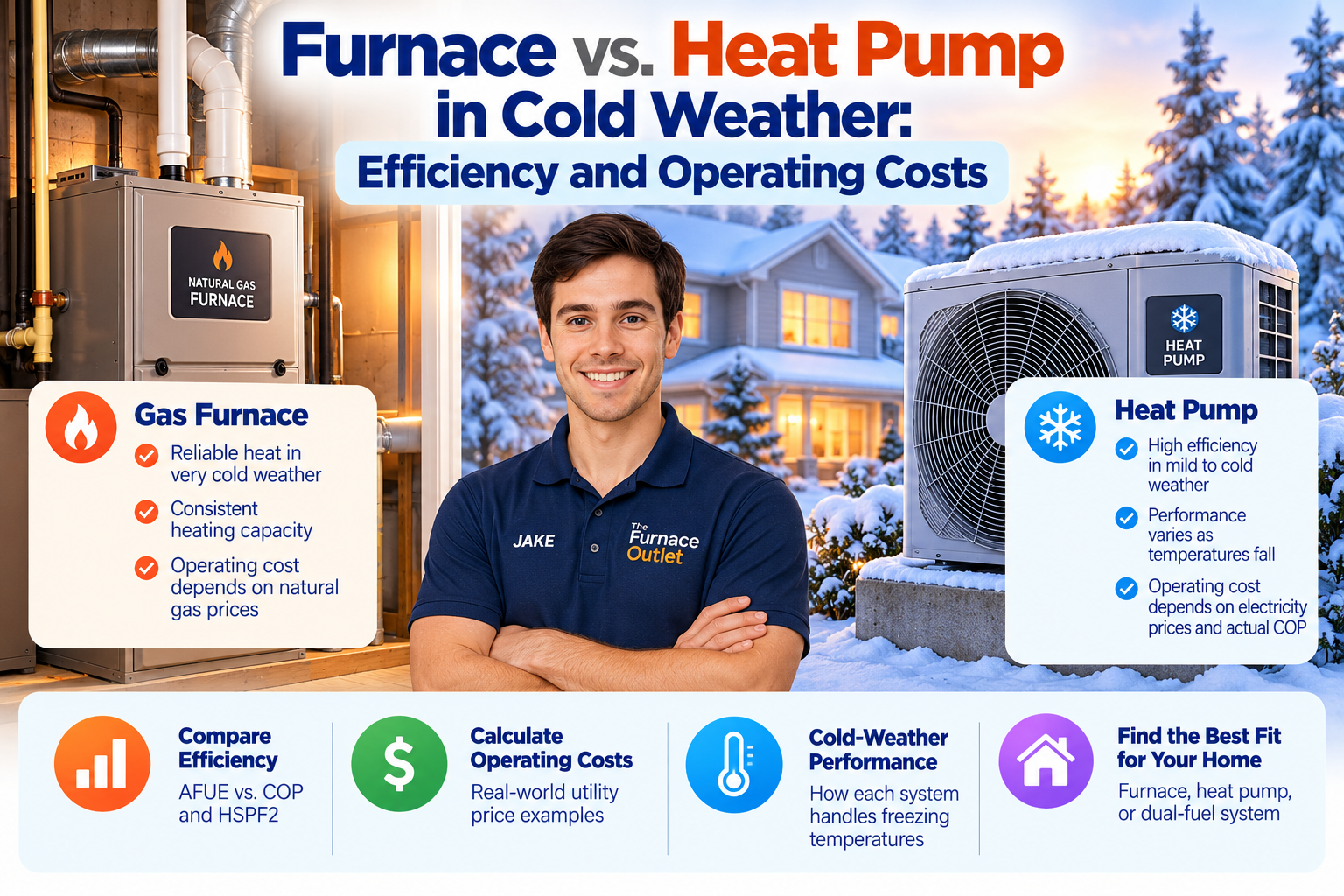
By Jake Lawson | HVAC Specialist | The Furnace Outlet
Updated October 2026 | Heating Efficiency, Cold-Climate Performance & Energy Costs
Choosing between a furnace and a heat pump becomes particularly important when winter temperatures drop below freezing. Homeowners want reliable indoor heating, manageable utility bills, and equipment that can maintain comfortable temperatures during prolonged cold weather. However, comparing these heating technologies is not as simple as identifying which system has the highest advertised efficiency rating.
Gas furnaces and heat pumps generate or deliver heat in fundamentally different ways. A gas furnace burns fuel to produce thermal energy, while an electric heat pump transfers existing heat from outdoor air into the home. This distinction influences efficiency, operating costs, heating capacity, installation requirements, and performance during extreme temperatures.
Modern cold-climate heat pumps have significantly expanded the range of conditions in which electric heating can operate effectively. Some models maintain substantial heating capacity at outdoor temperatures well below freezing. Nevertheless, their efficiency and available output vary with temperature, equipment design, installation quality, and operating conditions. Gas furnaces, meanwhile, provide comparatively predictable heating output across a wide range of outdoor temperatures, although their operating costs depend heavily on natural gas prices and equipment efficiency.
As an HVAC specialist with more than 10 years of experience, I recommend comparing heating systems using actual winter performance rather than relying exclusively on manufacturer efficiency claims. The most appropriate solution depends on local climate, electricity and gas tariffs, building heat loss, equipment sizing, and the availability of supplemental heating.
In this guide, I compare furnaces and heat pumps in cold weather, explain how their efficiency ratings differ, calculate illustrative operating costs, and discuss when conventional gas heating, electric heat pumps, or dual-fuel systems may offer the strongest combination of comfort and value.

A gas furnace generates heat through controlled combustion. Natural gas enters the burner assembly, where combustion produces thermal energy. A heat exchanger transfers that energy to circulating indoor air while keeping combustion products separated from household airflow during normal operation. A blower then distributes the heated air through ductwork. Furnace efficiency is commonly expressed using Annual Fuel Utilization Efficiency, or AFUE. A furnace rated at 95% AFUE is designed to convert approximately 95% of the fuel energy it consumes into useful heating over the standardized annual rating conditions, with the remainder representing losses. Actual installed performance and operating expenses can differ from the rating assumptions.
An air-source heat pump operates differently. Instead of creating heat through combustion, it uses a refrigeration cycle to absorb thermal energy from outdoor air and transfer it indoors. The system includes a compressor, heat exchangers, refrigerant, expansion components, and controls that coordinate the heating process.
Because a heat pump moves heat rather than relying solely on electrical resistance to produce it, the amount of useful heating delivered can exceed the electrical energy consumed. This advantage is commonly described using the coefficient of performance, or COP. Understanding this distinction is essential because furnace AFUE and heat pump COP are not directly interchangeable ratings.

Gas furnaces are typically evaluated using AFUE, while heat pumps are commonly evaluated using heating seasonal performance ratings and operating-point efficiency measurements.
A conventional gas furnace may have an AFUE rating around 80%, while high-efficiency condensing models commonly achieve ratings in the 90% range. These ratings describe standardized fuel-to-heat conversion performance rather than the amount of heat lost through a home’s ductwork or building envelope.
Heat pumps are often evaluated using HSPF2, a seasonal efficiency metric established under updated U.S. testing procedures. HSPF2 represents the relationship between useful heating delivered and electrical energy consumed under standardized seasonal conditions. COP provides a more immediate measure of heat pump performance at a particular operating condition. For example, a heat pump operating at a COP of 3 delivers approximately three units of heat for every unit of electrical energy consumed.
This does not mean that the same heat pump maintains a COP of 3 throughout winter. Outdoor temperature, compressor operation, defrost cycles, and supplemental heating can substantially affect performance. The U.S. Department of Energy’s air-source heat pump guidance provides useful background on heat pump operation and efficiency. I recommend comparing equipment using both seasonal ratings and cold-weather performance data, particularly in regions experiencing extended freezing conditions.

Air-source heat pumps extract energy from outdoor air, even when outdoor temperatures are below freezing. However, as outdoor air becomes colder, the available temperature difference and refrigeration-cycle operating conditions generally make heat transfer more demanding. Many heat pumps experience reduced efficiency as outdoor temperatures decline. Their heating capacity may also decrease, although the extent of the reduction depends heavily on compressor design, refrigerant circuit, control strategy, and equipment configuration.
Modern variable-speed cold-climate heat pumps can maintain useful heating output at substantially lower temperatures than many older conventional models. Some systems are designed and tested for operation at temperatures around 5°F or below, with certain products capable of operating at even colder conditions. However, the ability to operate at a particular outdoor temperature does not guarantee that the equipment can satisfy the home’s entire heating load at that temperature.
A heat pump may continue running successfully while delivering less heat than the building requires. When this happens, supplemental heating may be needed to maintain indoor comfort. I recommend reviewing manufacturer-published heating capacity and COP data at relevant outdoor temperatures rather than assuming that every heat pump performs identically in freezing weather.

A gas furnace does not depend on extracting heat from outdoor air. Its heating output is primarily determined by equipment design, fuel input, combustion conditions, and operating controls. For this reason, a properly functioning gas furnace can generally maintain its intended heating capacity across a wide range of outdoor temperatures, provided that the fuel supply, venting system, combustion air, and other installation requirements remain suitable.
However, the heating demand of the home increases as outdoor temperatures fall. A furnace that performs adequately during mild winter weather may operate for longer periods during severe cold, even when its rated heating capacity remains unchanged. An undersized furnace may struggle to maintain the thermostat setting during extreme conditions. Likewise, a poorly insulated or drafty home may require more heating energy than expected.
Gas furnaces also introduce combustion-related maintenance and safety considerations. Heat exchangers, exhaust venting, ignition systems, gas controls, and protective devices require appropriate inspection and servicing. I recommend evaluating furnace capacity against a proper building heating-load calculation rather than assuming that a larger furnace automatically provides better cold-weather comfort.
Heating capacity describes how much heat a system can deliver over time, commonly expressed in British thermal units per hour, or BTU/h. A home’s required heating capacity depends on outdoor design temperature, insulation, air leakage, windows, building geometry, ventilation, and other factors. The correct system size should reflect these characteristics rather than square footage alone.
For gas furnaces, the relationship between rated input and useful output depends partly on efficiency. A furnace with a nominal input of 80,000 BTU/h and a 95% AFUE rating should not automatically be treated as having exactly 76,000 BTU/h of rated output without consulting its certified specifications.
For heat pumps, available capacity changes with operating conditions. A model advertised as a three-ton system based on nominal cooling capacity may not deliver an equivalent amount of heating under every winter condition. Cold-climate heat pump selection therefore requires evaluating heating capacity at the local winter design temperature.
The Air Conditioning Contractors of America provides information about Manual J residential load calculations, which are widely used to estimate heating and cooling requirements. I recommend proper load calculations and equipment selection before comparing installation quotations.

The following comparison summarizes important differences between gas furnaces and air-source heat pumps. Actual performance depends on the selected equipment and installation.
| Feature | Gas furnace | Air-source heat pump |
|---|---|---|
| Heating method | Produces heat through combustion | Transfers heat from outdoor air |
| Common efficiency metric | AFUE | HSPF2 and COP |
| Outdoor temperature effect | Rated output generally remains relatively stable | Capacity and efficiency may change |
| Below-freezing operation | Generally effective when properly sized | Model-dependent; cold-climate units can perform well |
| Supplemental heating | Not normally required for a properly sized standalone furnace | May be needed under certain conditions |
| Energy source | Natural gas | Electricity |
| Cooling capability | Requires separate cooling equipment | Usually provides heating and cooling |
| Combustion exhaust | Required | Not required for an all-electric heat pump |
| Cold-weather maintenance | Combustion, venting, blower, and controls | Defrost, refrigerant system, airflow, and controls |
| Operating cost | Depends on gas price and AFUE | Depends on electricity price and actual COP |
The most important conclusion is that neither technology is automatically the least expensive choice in every climate. A heat pump may deliver substantially more useful heat per unit of purchased energy, yet electricity prices can make its operating cost higher than natural gas heating under certain conditions. Conversely, an efficient cold-climate heat pump may offer meaningful operating savings where electricity prices are favorable or natural gas is expensive.

To compare operating expenses fairly, homeowners should estimate the cost of delivering the same amount of useful heat. Natural gas is commonly billed in therms in the United States. One therm contains approximately 100,000 BTU of fuel energy. For a furnace with 95% AFUE, the standardized useful heating associated with one therm of fuel is approximately 95,000 BTU. Consider an illustrative natural gas price of $1.50 per therm. The approximate fuel cost of delivering 100,000 BTU of useful heat can be calculated as follows: Gas heating cost = Gas price per therm ÷ Furnace AFUE
For this example: $1.50 ÷ 0.95 = approximately $1.58 per 100,000 BTU of useful heat.
This calculation excludes certain additional costs, including blower electricity, fixed utility charges, and installation-specific performance differences. A furnace with 80% AFUE using the same gas price would have an estimated fuel cost of approximately $1.88 per 100,000 BTU of useful heat. The difference illustrates why furnace efficiency matters, but it also shows that fuel prices strongly influence the final comparison. I recommend using the actual variable gas rate from a recent utility bill rather than assuming that a national average applies to every household.

Heat pump operating costs depend on electricity consumption and the amount of useful heat delivered per kilowatt-hour. One kilowatt-hour of electricity represents approximately 3,412 BTU of energy. At a COP of 3, a heat pump delivers approximately 10,236 BTU of useful heat for each kilowatt-hour consumed.
The approximate electricity required to deliver 100,000 BTU of useful heat is: Electricity required = 100,000 ÷ (3,412 × COP)
At a COP of 3, the system requires approximately 9.77 kWh. If electricity costs $0.18 per kWh, the estimated heating expense becomes: 9.77 × $0.18 = approximately $1.76 per 100,000 BTU of useful heat.
At a COP of 2, the same heating output requires approximately 14.65 kWh, costing about $2.64. These examples demonstrate why outdoor temperature and actual heat pump efficiency are important. A system that is economical during relatively mild winter conditions may become more expensive to operate as its COP declines. Actual energy consumption may also include defrost operation, indoor and outdoor fans, controls, and supplemental resistance heating, depending on how the reported COP is defined.

The following table uses hypothetical energy prices of $1.50 per therm for natural gas and $0.18 per kWh for electricity.
These figures are provided solely to demonstrate the calculation method. They are not verified October 2026 utility rates or forecasts.
| Heating system | Assumed efficiency | Approximate cost per 100,000 BTU delivered |
|---|---|---|
| Gas furnace | 80% AFUE | $1.88 |
| Gas furnace | 95% AFUE | $1.58 |
| Heat pump | COP 4.0 | $1.32 |
| Heat pump | COP 3.0 | $1.76 |
| Heat pump | COP 2.5 | $2.11 |
| Heat pump | COP 2.0 | $2.64 |
| Heat pump | COP 1.5 | $3.52 |
| Electric resistance heating | COP 1.0 | $5.28 |
The comparison reveals an important point: a heat pump does not need to be less efficient than a furnace in energy terms to cost more to operate. At these hypothetical prices, the 95% AFUE gas furnace costs less to operate than a heat pump at COP 3, even though the heat pump delivers approximately three units of heat for each unit of electrical energy consumed.
However, when the heat pump reaches COP 4, it becomes less expensive than the furnace under the same assumed energy prices. The result changes when electricity or natural gas prices change. Homeowners should therefore avoid using a single comparison table as a universal purchasing recommendation.
A useful way to compare operating costs is to calculate the COP at which a heat pump and gas furnace deliver heat at approximately the same energy expense. The break-even COP depends on electricity price, gas price, and furnace efficiency. Using electricity priced at $0.18 per kWh, natural gas priced at $1.50 per therm, and a furnace rated at 95% AFUE, the approximate break-even COP is 3.34.
Under these assumptions, a heat pump operating above COP 3.34 would generally have a lower direct energy cost per unit of useful heat than the gas furnace. Below that level, the gas furnace would generally be less expensive. This threshold is not a fixed property of heat pumps. A different utility tariff can move the break-even point substantially.
For example, lower electricity prices favor heat pumps, while lower natural gas prices favor gas furnaces. I recommend calculating this threshold using local utility rates and comparing it with manufacturer performance data at the outdoor temperatures the home experiences most frequently.

During cold and humid conditions, frost may accumulate on an air-source heat pump’s outdoor coil. Excessive frost interferes with heat transfer, so many systems periodically initiate a defrost cycle. During defrost, the equipment temporarily changes operating conditions to warm the outdoor coil and remove accumulated frost. Homeowners may notice visible steam, melting water, or a temporary change in indoor heating behavior.
These events can be normal, but defrost operation consumes energy and may temporarily reduce useful heating delivery. The frequency and duration of defrost cycles depend on outdoor temperature, humidity, equipment design, and control strategy. Persistent heavy icing, repeated abnormal shutdowns, or substantial heating deterioration may indicate a problem requiring professional evaluation. I recommend considering defrost performance when comparing heat pumps in climates that frequently experience freezing temperatures combined with high humidity.

Some heat pump installations include electric resistance backup heating. This equipment can provide additional heating capacity when outdoor conditions exceed the heat pump’s available output or when controls determine supplemental heat is necessary. Electric resistance heating generally delivers approximately one unit of heat for each unit of electricity consumed, corresponding to a COP near 1 at the point of use. This is considerably less efficient than heat pump operation at COP 2 or 3.
However, supplemental heating may be necessary for comfort, equipment protection, or appropriate system operation. The objective is not to prevent auxiliary heat under all circumstances but to avoid unnecessary activation. Large thermostat setbacks followed by aggressive recovery can trigger auxiliary heating in certain systems. Some modern controls manage recovery more efficiently.
Emergency heat is a separate thermostat mode in many installations. It typically disables normal heat pump heating and relies on an alternative heating source. I recommend using emergency heat only when appropriate under manufacturer instructions or professional guidance rather than selecting it simply to warm the home faster.
Cold-climate heat pumps are specifically designed to provide useful heating performance at low outdoor temperatures. Many use variable-speed compressors, advanced refrigerant controls, and other technologies intended to maintain heating capacity under demanding conditions. However, the term cold-climate should not be treated as a guarantee that every qualifying model performs identically.
Homeowners should evaluate heating capacity, efficiency at relevant temperatures, defrost behavior, backup heating requirements, and installation conditions. The ENERGY STAR cold-climate heat pump information provides useful guidance on selecting appropriate equipment. A heat pump capable of operating at very low temperatures may still require supplemental heating if its available output falls below the building’s heating load. For this reason, I recommend comparing equipment capacity at local winter design conditions instead of focusing only on the lowest advertised operating temperature.
A dual-fuel heating system combines an electric heat pump with a gas furnace. The controls determine which heating source should operate under different conditions. During milder winter weather, the heat pump may provide efficient heating. When outdoor temperatures fall or operating economics change, the system can switch to the gas furnace. This arrangement can provide flexibility in climates experiencing both moderate and severe winter conditions.
However, dual-fuel systems introduce additional installation and control requirements. The thermostat, heat pump, furnace, and associated equipment must be properly matched and configured. The switching temperature should not be selected arbitrarily. It may depend on available heating capacity, utility prices, comfort requirements, and manufacturer specifications.
In some installations, the most economical switching temperature differs from the temperature at which the heat pump can no longer satisfy the home’s heating load. I recommend professional evaluation of both economic and capacity-related operating limits when designing a dual-fuel system.

Operating cost is only one component of the financial comparison. Installation expenses, equipment lifespan, maintenance requirements, repairs, and available incentives can significantly affect total ownership cost. A home that already has a functioning gas furnace and central air-conditioning system may face different replacement economics from a property without existing gas service. Similarly, a homeowner replacing both an aging furnace and air conditioner may find that a heat pump provides an attractive alternative because it offers both heating and cooling.
Installation complexity matters. Electrical service upgrades, duct modifications, refrigerant piping, equipment placement, condensate management, and control compatibility can influence project cost. Cold-climate heat pumps may also require careful attention to outdoor-unit mounting, snow clearance, drainage, and defrost-water management.
Gas furnaces require appropriate combustion air, exhaust venting, and fuel connections. I recommend comparing complete installed quotations rather than equipment prices alone. The financial analysis should include expected annual energy expenses, maintenance, potential repairs, and available rebates or tax incentives for which the project actually qualifies.
Climate influences the heating technology decision, but it does not determine the answer by itself. In relatively mild winter regions, air-source heat pumps can be particularly attractive because they often operate at favorable COP values for much of the heating season. Their ability to provide cooling during summer adds further practical value. In colder regions, modern cold-climate heat pumps may still provide effective and economical heating, but capacity and efficiency at low temperatures deserve greater attention.
Where natural gas is inexpensive relative to electricity, a high-efficiency furnace may offer lower operating costs during severe winter conditions. In regions with variable winter temperatures and favorable dual-fuel economics, combining a heat pump with a gas furnace may offer useful flexibility. For homes without natural gas service, installing new gas infrastructure can substantially change the financial comparison. I recommend using local heating-degree-day patterns, winter design temperatures, utility rates, and building-load calculations rather than choosing equipment based only on broad regional labels.
One common mistake is comparing a furnace’s AFUE rating directly with a heat pump’s COP without accounting for the different measurement methods. A 95% AFUE furnace and a heat pump operating at COP 3 cannot be evaluated fairly without converting their useful heating output into comparable energy costs. Another mistake is assuming that every heat pump stops working below freezing. Modern cold-climate equipment can provide substantial heating at low temperatures, although capacity and efficiency vary.
Homeowners may also assume that gas furnaces are always cheaper because natural gas has historically been competitively priced in certain regions. Electricity and gas tariffs differ substantially across utilities and can change over time. Incorrect sizing is another concern. Oversized or undersized equipment can create comfort and operating problems, regardless of heating technology. Finally, I discourage selecting equipment based solely on projected energy savings without reviewing installation costs, maintenance requirements, and the condition of the building envelope.

The most practical decision process begins with the home’s heating requirements and progresses toward equipment selection.
| Evaluation factor | What homeowners should confirm |
|---|---|
| Winter climate | Local design temperature and typical winter conditions |
| Building heat loss | Proper heating-load calculation |
| Existing equipment | Furnace, air conditioner, ductwork, and controls |
| Electricity price | Actual variable cost per kWh |
| Natural gas price | Actual variable cost per therm |
| Furnace efficiency | Verified AFUE rating |
| Heat pump performance | Heating capacity and COP at relevant temperatures |
| Supplemental heating | Availability, cost, and control strategy |
| Installation requirements | Electrical, ductwork, venting, and equipment placement |
| Ownership economics | Installed cost, maintenance, repairs, and incentives |
I recommend requesting itemized contractor proposals that identify the selected equipment, design assumptions, expected heating capacity, and any supplemental heating arrangements. Homeowners should also ask how the proposed system will maintain indoor comfort during the coldest expected conditions.
Heat pumps can deliver multiple units of useful heat for each unit of electricity consumed, making them highly efficient in energy terms. However, their efficiency varies with operating conditions, and higher energy efficiency does not always translate into lower utility costs.
Many modern heat pumps operate below 20°F, and cold-climate models can provide heating at substantially lower temperatures. Available capacity and efficiency depend on the specific equipment.
It can be, particularly when natural gas prices are favorable and heat pump COP decreases. However, the answer depends on local utility rates, equipment performance, and supplemental heating use.
There is no universally best system. Properly selected cold-climate heat pumps can offer strong efficiency, while high-efficiency gas furnaces and dual-fuel systems may provide advantages under particular economic or operating conditions.
Replacement may be worthwhile when the existing equipment is aging, cooling equipment also requires replacement, electricity prices are favorable, or other project benefits justify the investment. A complete installed-cost and operating-cost comparison is advisable.
Many air-source heat pumps provide both heating and cooling. Whether a particular model can replace a furnace entirely depends on the home’s heating load, climate, and the heat pump’s available capacity.
Many heat pump systems benefit from relatively stable thermostat settings or modest setbacks, particularly when large temperature recoveries trigger electric resistance backup heating. Equipment-specific controls and manufacturer guidance should determine the final approach.

When homeowners ask me whether a furnace or heat pump is better in cold weather, I explain that the answer depends on the relationship between heating demand, equipment performance, and local energy prices. A modern cold-climate heat pump can provide efficient heating below freezing, while a properly sized gas furnace offers relatively consistent heating capacity across demanding winter conditions. Neither characteristic automatically establishes which system will be less expensive to operate.
My preferred approach begins with a proper heating-load calculation, followed by an evaluation of actual utility rates and manufacturer-published cold-weather performance data. For heat pumps, I pay particular attention to available capacity, COP, defrost operation, and supplemental heating requirements. For gas furnaces, I evaluate AFUE, equipment condition, combustion safety, and the cost of delivered heat. Dual-fuel systems deserve consideration where the combination offers practical or economic advantages.
The best cold-weather heating system is the one that meets the home’s design heating load safely and reliably while providing the strongest overall balance of installation cost, operating efficiency, energy prices, maintenance requirements, and long-term comfort. By comparing these factors rather than relying on simplified efficiency claims, homeowners can make better decisions for the 2026–2027 heating season and beyond.

U.S. Department of Energy — Air-Source Heat Pumps: https://www.energy.gov/heat-pumps. Explains heat pump technology, efficiency, and operation.
U.S. Department of Energy — Furnaces and Boilers: https://www.energy.gov/cmei/buildings/consumer-furnaces. Provides information about furnace efficiency and equipment selection.
ENERGY STAR — Air-Source Heat Pumps: https://www.energystar.gov/products/air_source_heat_pumps. Offers guidance on certified equipment and cold-climate performance.
Air Conditioning Contractors of America — Manual J: https://www.acca.org/standards/technical-manuals/manual-j. Provides information about residential heating and cooling load calculations.
U.S. Department of Energy — Thermostats: https://www.energystar.gov/products/smart_thermostats. Discusses heating controls and thermostat operating strategies.
U.S. Energy Information Administration: https://www.eia.gov/. Provides U.S. energy pricing and consumption information useful for evaluating heating costs.
This article is intended for general educational purposes. Operating-cost calculations are illustrative and do not represent current local utility rates, guaranteed savings, or equipment-specific performance predictions. Actual costs depend on electricity and fuel tariffs, equipment condition, heating load, weather, installation quality, and operating practices.
Gas furnace installation, combustion testing, exhaust venting, electrical work, refrigerant-system servicing, and dual-fuel control configuration should be performed by appropriately qualified professionals. Homeowners should follow manufacturer instructions and applicable building and safety codes.
The Furnace Outlet provides independent HVAC educational content. References to external organizations do not imply sponsorship, endorsement, or affiliation.
© 2026 The Furnace Outlet | https://thefurnaceoutlet.com