Newsletter Subscribe
Enter your email address below and subscribe to our newsletter

HVAC made simple
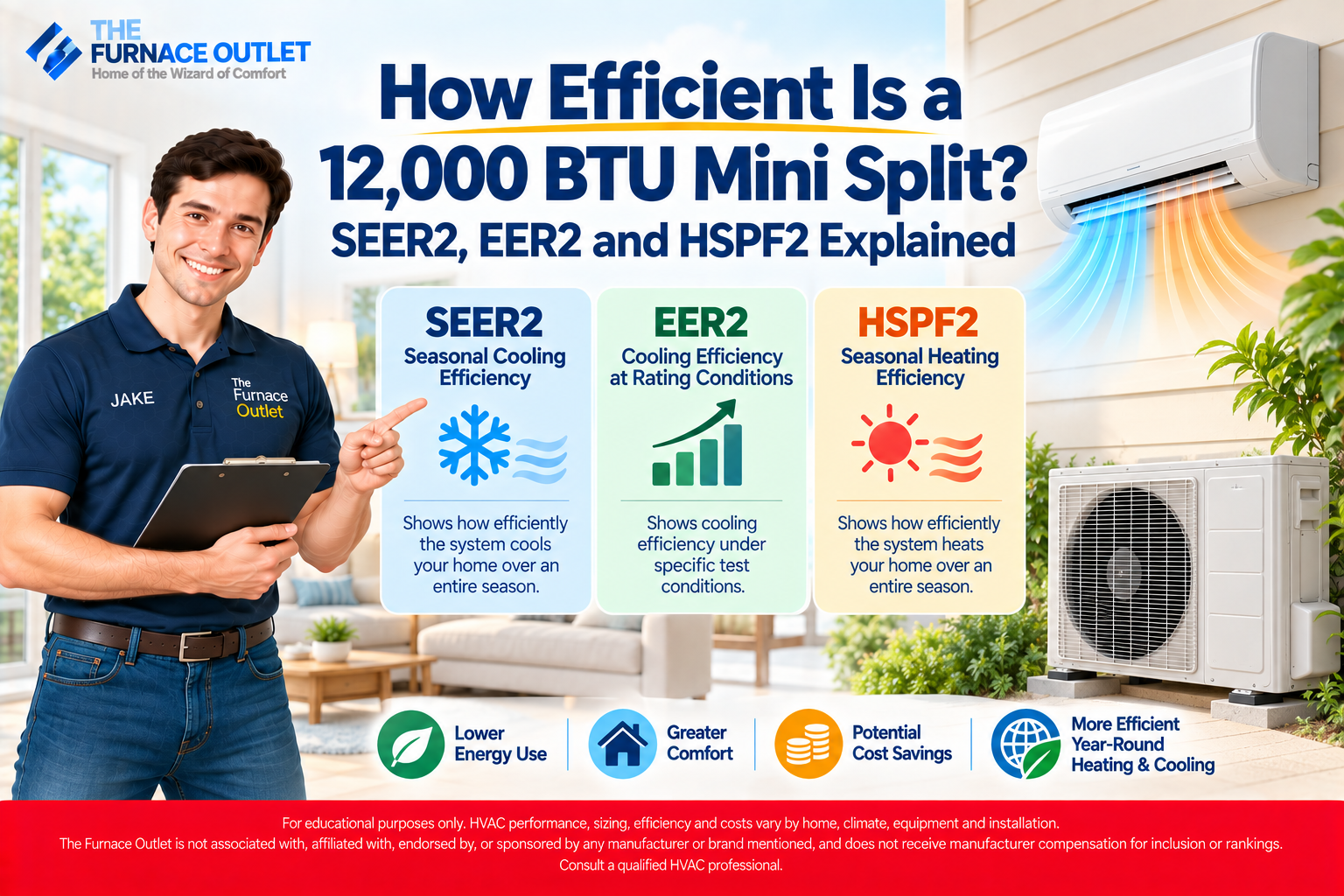
A 12,000 BTU mini split can be remarkably efficient, but the 12,000 BTU rating itself tells you almost nothing about efficiency. That number primarily identifies a nominal capacity class—12,000 BTU per hour is commonly called one ton of cooling capacity. To understand how efficiently a particular one-ton mini split uses electricity, I look much more closely at its SEER2, EER2 and HSPF2 ratings, along with its actual operating characteristics.
Those three ratings answer related but different questions. SEER2 describes seasonal cooling efficiency, EER2 provides another perspective on cooling efficiency at specified rating conditions, and HSPF2 describes seasonal heating efficiency for heat pumps. Higher values generally indicate better rated efficiency within the same metric, but homeowners should resist turning any single number into a complete measure of HVAC quality. The Department of Energy adopted the updated SEER2 and HSPF2 terminology with revised test procedures beginning in 2023.
A high-efficiency mini split still needs to be correctly sized, properly installed and appropriate for the climate. Those factors can ultimately matter more to your comfort and electricity consumption than choosing whichever product happens to advertise the largest efficiency number.
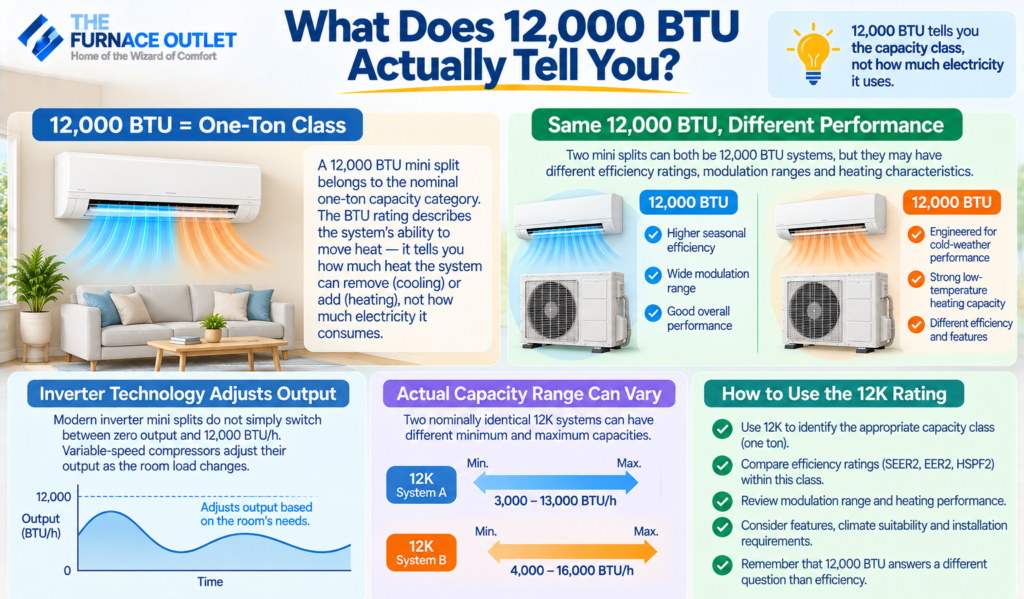
A 12,000 BTU mini split belongs to the nominal one-ton capacity category. In simple terms, the BTU rating describes the system’s ability to move heat rather than how much electricity it consumes to accomplish that work.
This distinction is fundamental. Two mini splits can both be marketed as 12,000 BTU systems while having substantially different efficiency ratings, modulation ranges and heating characteristics. One might provide excellent seasonal efficiency but relatively ordinary cold-weather performance, while another may be engineered specifically to retain substantial heating capacity at very low outdoor temperatures.
Modern inverter mini splits complicate the comparison further because they do not simply switch between zero output and 12,000 BTU/h. Variable-speed compressors can adjust their output as the room load changes. The actual minimum and maximum capacities of two nominally identical 12K systems can therefore differ.
I would consequently use 12K to identify the appropriate capacity class and efficiency ratings to help compare products within that class. They answer different questions.
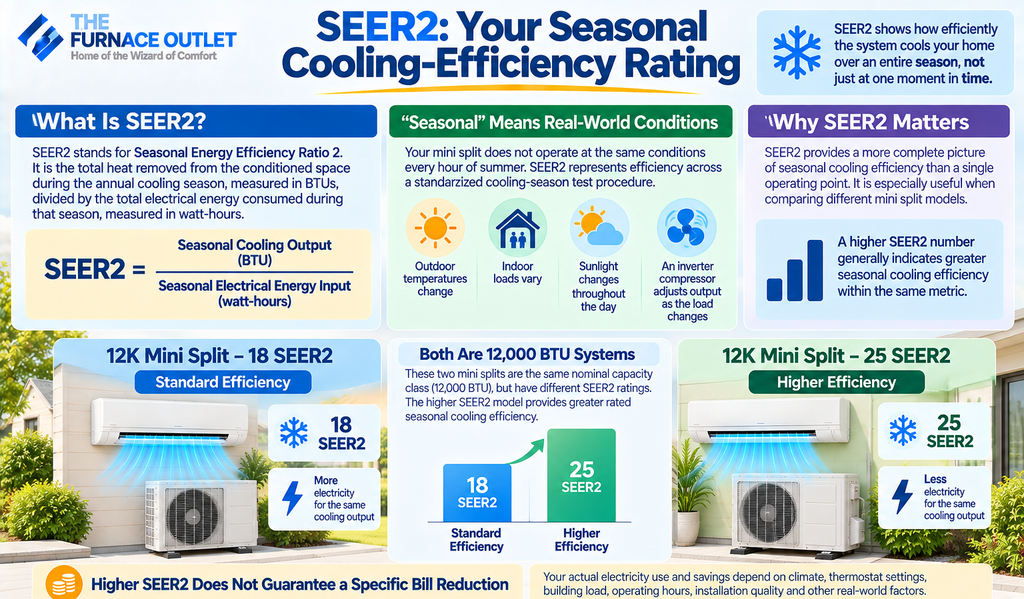
SEER2 stands for Seasonal Energy Efficiency Ratio 2. ENERGY STAR defines it as the total heat removed from the conditioned space during the annual cooling season, measured in BTUs, divided by the total electrical energy consumed during that season, measured in watt-hours.
The basic concept can be represented as: SEER2 = Seasonal Cooling Output ÷ Seasonal Electrical Energy Input
The important word is seasonal. Your mini split does not encounter identical conditions every hour of summer. Outdoor temperatures change, indoor loads vary, sunlight changes throughout the day and an inverter compressor adjusts its output in response.
SEER2 attempts to represent efficiency across a standardized cooling-season test procedure rather than describing performance at only one operating point. This makes it particularly useful when comparing the seasonal cooling efficiency of different systems.
If two appropriately sized 12K mini splits have SEER2 ratings of 18 and 25, for example, the 25-SEER2 system has the higher rated seasonal cooling efficiency. That does not mean your electricity bill will automatically be reduced by a specific percentage, because real-world consumption also depends on climate, thermostat settings, building load, operating hours and installation quality.
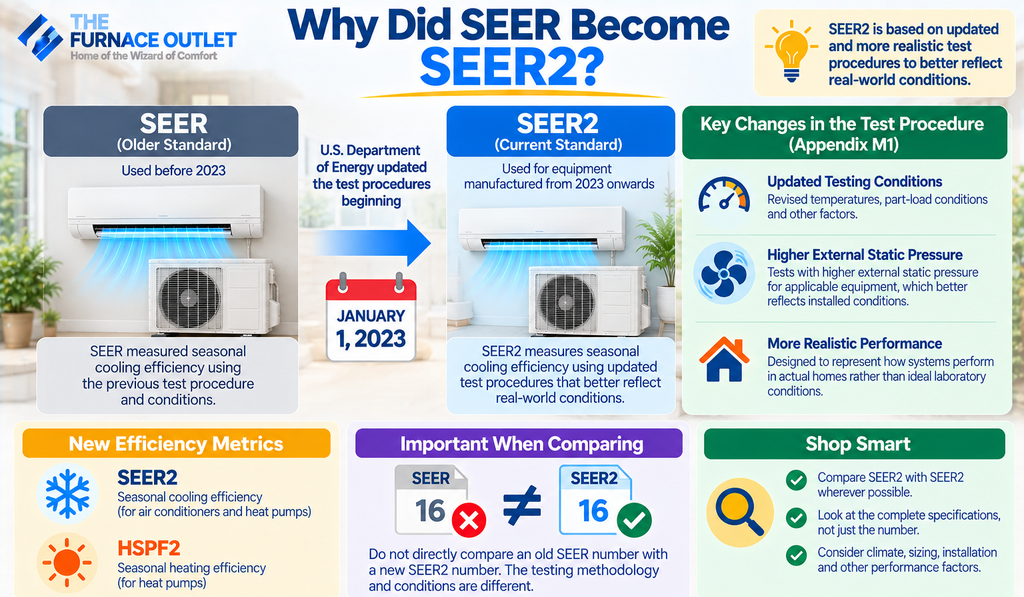
If you have researched HVAC equipment before, you may remember seeing SEER rather than SEER2. The change is not simply manufacturers adding a “2” to the old rating.
The Department of Energy changed the residential HVAC test procedures and efficiency terminology beginning January 1, 2023. The newer metrics include SEER2 for seasonal cooling efficiency and HSPF2 for seasonal heating efficiency. AHRI explains that the Appendix M1 test procedure changed testing conditions, including higher external static pressure for applicable equipment, with the goal of better reflecting installed conditions.
This matters when comparing older and newer equipment specifications. Do not directly compare an old SEER number with a new SEER2 number as though the testing methodology were identical.
When shopping for current equipment, I would compare SEER2 with SEER2 wherever possible.
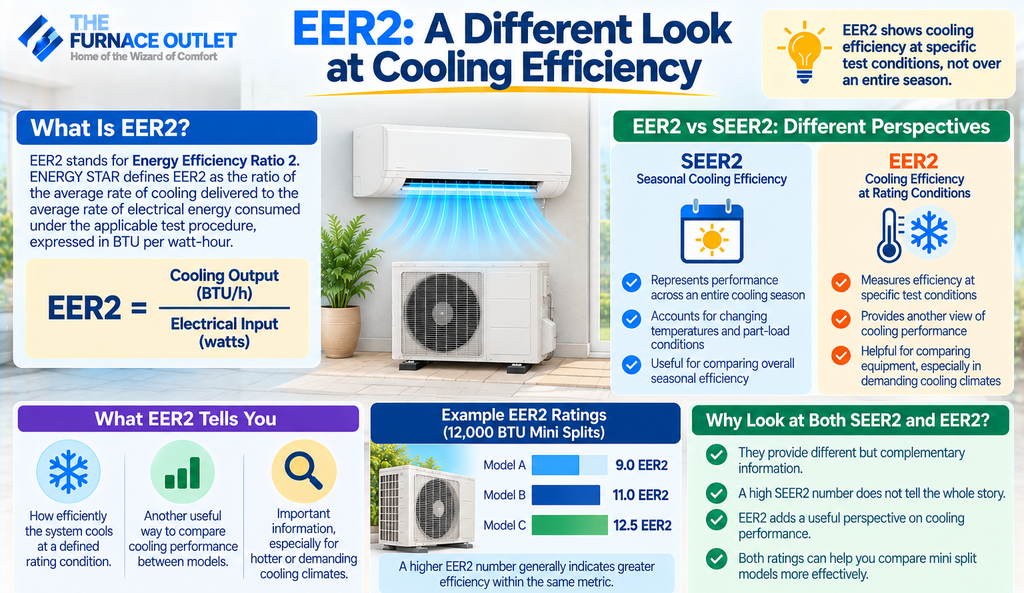
EER2 stands for Energy Efficiency Ratio 2. ENERGY STAR defines EER2 as the ratio of the average rate of cooling delivered to the average rate of electrical energy consumed under the applicable test procedure, expressed in BTU per watt-hour.
Conceptually, it can be expressed as: EER2 = Cooling Output ÷ Electrical Input at the Rating Condition
The distinction between SEER2 and EER2 is important. SEER2 represents seasonal cooling performance, whereas EER2 gives us information about efficiency under defined rating conditions rather than attempting to summarize an entire cooling season.
That is why I like looking at both numbers. A very high SEER2 number can certainly attract attention, but EER2 adds another useful perspective when comparing equipment. For homeowners in demanding cooling climates, I would not ignore EER2 simply because SEER2 receives more attention in advertising.
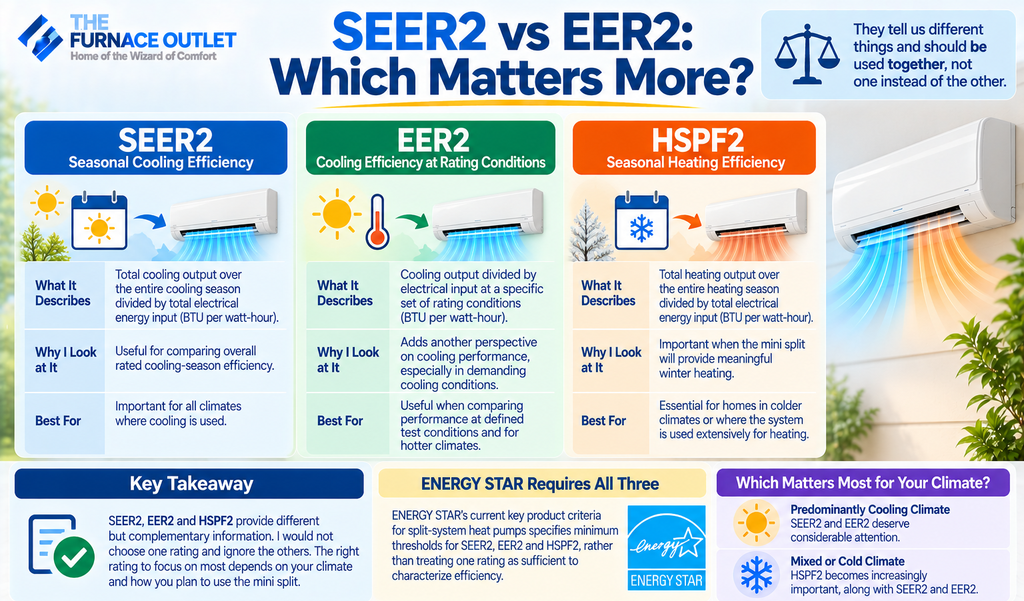
I would not frame this as choosing one rating and ignoring the other. They tell us different things.
| Rating | What It Describes | Why I Look at It |
|---|---|---|
| SEER2 | Seasonal cooling efficiency | Useful for comparing overall rated cooling-season efficiency |
| EER2 | Cooling efficiency under specified rating conditions | Adds another perspective on cooling performance |
| HSPF2 | Seasonal heating efficiency | Important when the mini split will provide meaningful winter heating |
For a home in a predominantly cooling climate, SEER2 and EER2 deserve considerable attention. For a home where the mini split will operate heavily in both summer and winter, HSPF2 becomes increasingly important as well.
The ENERGY STAR criteria illustrate why these ratings are considered together. Its current key product criteria for split-system heat pumps specify minimum thresholds across SEER2, EER2 and HSPF2 rather than treating one rating as sufficient to characterize efficiency.
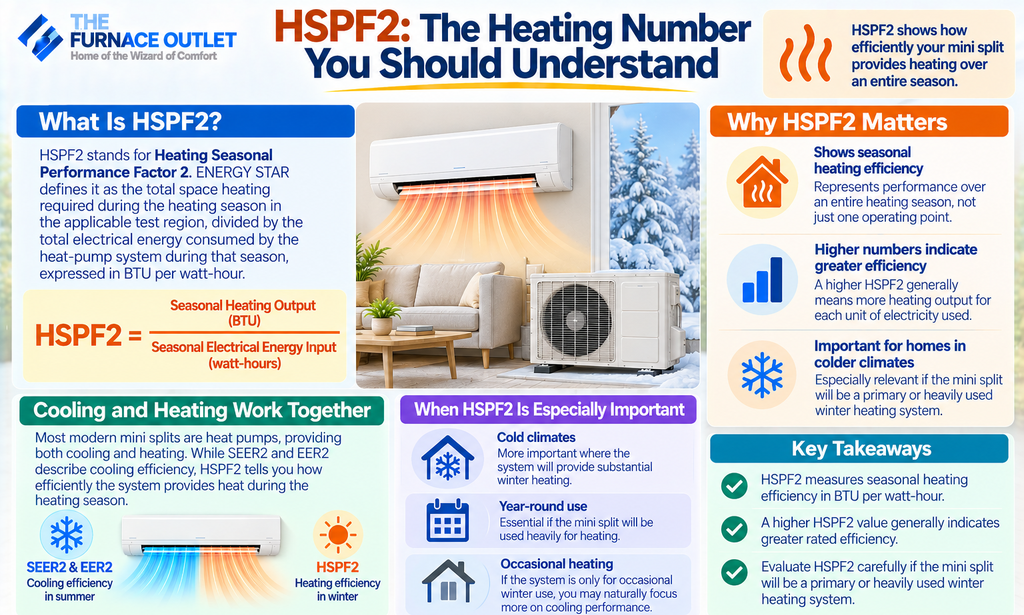
If your 12K mini split is a heat pump—and most modern mini splits sold for year-round comfort are—cooling efficiency tells only half the story.
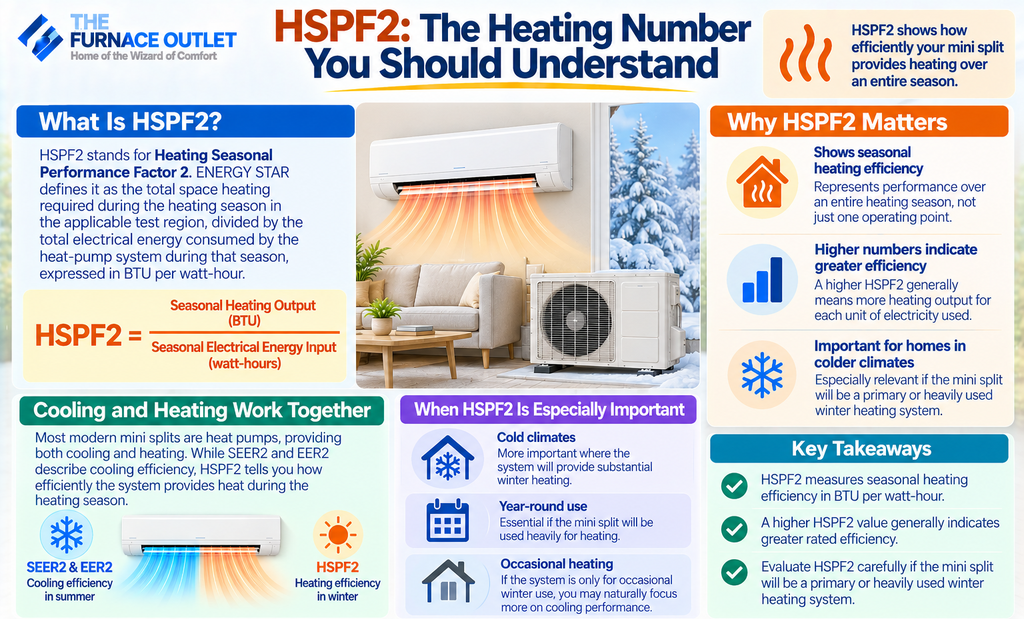
HSPF2 stands for Heating Seasonal Performance Factor 2. ENERGY STAR defines it as the total space heating required during the heating season in the applicable test region divided by the total electrical energy consumed by the heat-pump system during that season, expressed in BTU per watt-hour.
Conceptually: HSPF2 = Seasonal Heating Output ÷ Seasonal Electrical Energy Input
As with SEER2, a higher HSPF2 value generally indicates greater rated seasonal efficiency within the metric.
This rating becomes particularly relevant when the mini split will serve as a primary or heavily used winter heating system. A homeowner purchasing a mini split primarily for an occasional summer room may naturally focus on cooling performance. Someone relying on that same system through a long heating season needs to evaluate the heating side much more carefully.
This distinction is extremely important. High seasonal heating efficiency and strong low-temperature heating capacity are not exactly the same thing.
A mini split may have an attractive HSPF2 rating while another system may distinguish itself by maintaining more usable heating capacity as outdoor temperatures become extremely low. If I were selecting equipment for primary heating in a cold climate, I would therefore look beyond HSPF2.
I would review the manufacturer’s published heating-capacity data at outdoor temperatures relevant to the location, along with coefficient of performance where appropriate. I would also investigate whether the system meets recognized cold-climate performance requirements.
ENERGY STAR’s current cold-climate criteria illustrate this distinction clearly. In addition to efficiency requirements, qualifying heat pumps must demonstrate specified low-ambient performance, including a COP of at least 1.75 at 5°F and at least 70% heating-capacity retention at 5°F compared with the specified 47°F capacity measurement.
In other words, HSPF2 tells me about seasonal heating efficiency; low-temperature performance data tells me much more about what happens when winter becomes severe.
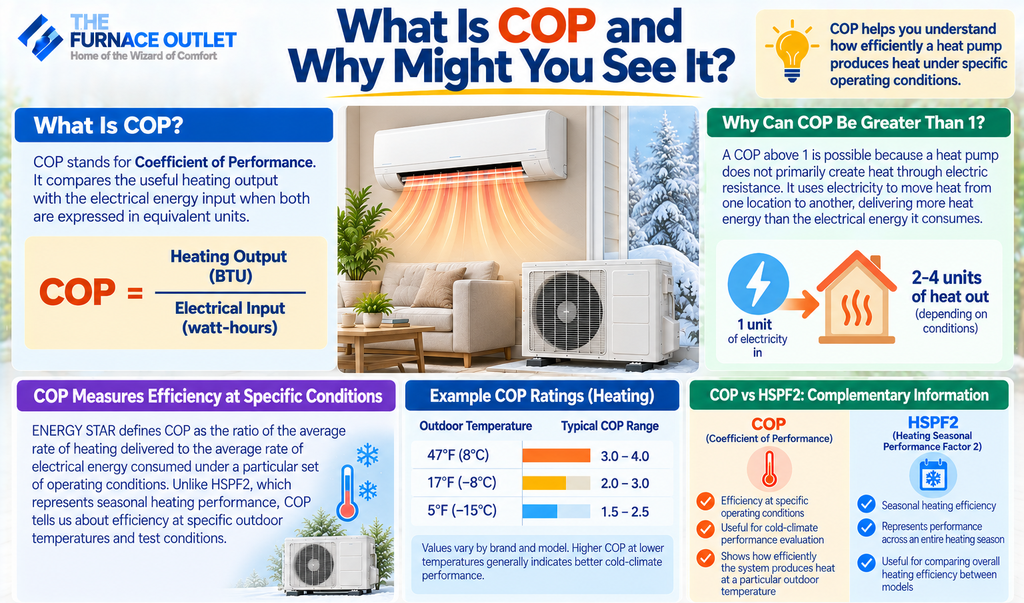
While comparing heating specifications, you may also encounter COP, or Coefficient of Performance. COP compares useful heating output with the electrical energy input when both are expressed in equivalent units. A COP above 1 is possible because a heat pump does not primarily create heat through electric resistance; it uses electricity to move heat from one location to another.
ENERGY STAR defines COP as the ratio of the average rate of heating delivered to the average rate of electrical energy consumed under a particular set of operating conditions. Unlike HSPF2, which represents seasonal heating performance, COP can tell us about efficiency at particular operating conditions. That makes it useful when evaluating cold-climate performance data. I would therefore think of HSPF2 and COP as complementary information rather than competing ratings.
There is no single SEER2, EER2 or HSPF2 rating that defines every good 12K mini split. The market includes basic equipment, value-oriented systems, high-efficiency premium products and specialized cold-climate heat pumps.
As a useful reference point rather than a universal buying threshold, current ENERGY STAR criteria for qualifying split-system heat pumps include 15.2 SEER2, 11.0 EER2 and 7.8 HSPF2. ENERGY STAR’s cold-climate criteria add further requirements; for non-ducted split systems, the listed seasonal requirements include at least 15.2 SEER2 and 8.5 HSPF2, along with the specified low-ambient tests.
Those values are useful benchmarks, but I would not turn them into a simplistic rule that says anything above a particular number is automatically excellent. Current 12K mini splits can span a broad range of efficiency levels, and a premium system may substantially exceed minimum qualification criteria.
The important question is what you are paying for and whether the additional efficiency provides meaningful value for your climate and usage.
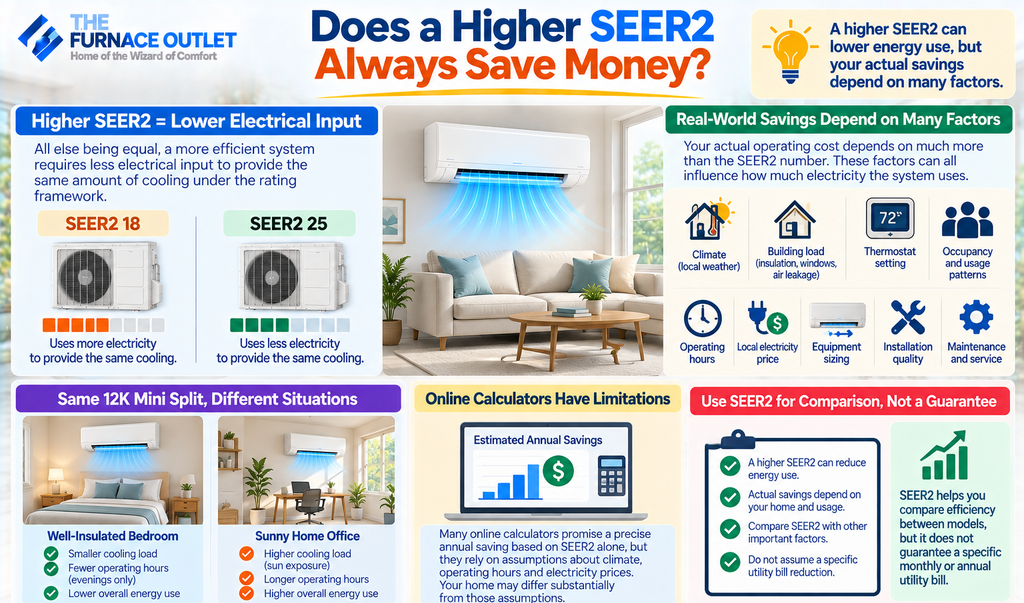
All else being equal, a more efficient system requires less electrical input to provide a given amount of cooling under the rating framework. In the real world, however, “all else” is rarely equal.
Your actual operating cost depends on the building load, climate, thermostat setting, occupancy, operating hours, local electricity price, equipment sizing, installation and maintenance. A 12K mini split cooling a well-insulated bedroom for several evening hours faces a completely different workload from an identical system conditioning a sunny home office throughout a hot day.
This is why I would be cautious with online calculators that promise a precise annual saving from SEER2 alone. DOE’s federal purchasing guidance demonstrates that higher-efficiency equipment can reduce modeled energy consumption, but its cost calculations rely on explicit assumptions about operating hours, climate and electricity prices. Your home may differ substantially from those assumptions.
Use efficiency ratings for comparison, not as a guaranteed utility-bill forecast.
One reason modern mini splits can achieve impressive seasonal efficiency is their use of inverter-driven variable-speed compressors. A traditional fixed-capacity system largely operates by turning its compressor on and off. An inverter mini split can adjust compressor speed and capacity in response to changing load. Once the room approaches the desired temperature, the system may be able to reduce output rather than repeatedly delivering full capacity.
That capability can contribute to excellent part-load performance, quieter operation and more stable indoor temperatures. It also explains why the system’s minimum and maximum capacity range deserves attention alongside SEER2.
Two 12K systems with similar seasonal ratings may have different modulation characteristics. For a small or highly efficient room where the load is frequently low, minimum capacity can be particularly relevant.
Buying a very high-SEER2 mini split does not eliminate the need to size it correctly. ENERGY STAR specifically states that properly sized HVAC equipment is essential for performance and comfort and warns that systems that are either too large or too small can struggle to meet the home’s needs. It recommends that contractors verify sizing using a Manual J load calculation.
That principle is especially important with 12K equipment because homeowners often select mini splits using simple square-foot charts. Those charts can be useful during preliminary research, but they cannot account properly for windows, insulation, air leakage, ceiling height, solar exposure, occupancy, internal heat gain and climate.
I would rather install a correctly sized moderately high-efficiency system than choose an unnecessarily large system simply because its efficiency rating looks spectacular on paper.
Published efficiency ratings are measured under standardized test procedures. Your house is not a laboratory. Installation quality matters. Refrigerant piping, electrical installation, condensate management, indoor-unit location and outdoor-unit placement all need to meet the manufacturer’s requirements. The indoor head also needs to distribute conditioned air effectively throughout the intended zone.
DOE specifically notes that installation problems can reduce efficiency, comfort and equipment life, reinforcing the importance of quality installation rather than relying solely on rated performance. This is why I consider the installer part of the equipment decision for professionally installed systems. An impressive efficiency number cannot compensate for poor design or installation.
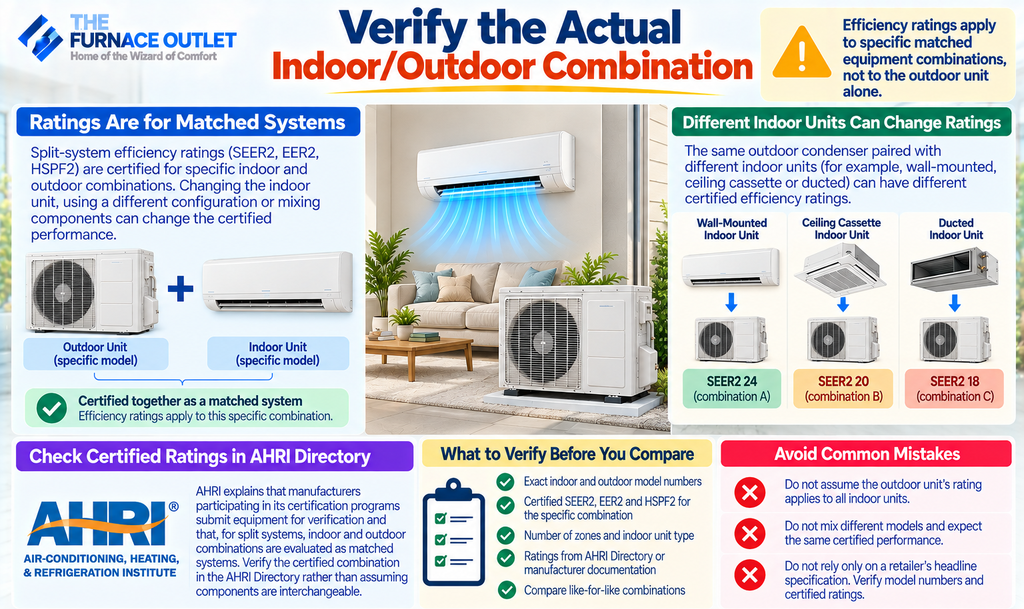
Another mistake I see during mini-split research is treating an efficiency number as though it belongs independently to the outdoor condenser. Split-system ratings apply to specific matched equipment combinations. Changing the indoor unit or configuration can change certified performance.
AHRI explains that manufacturers participating in its certification programs submit equipment for verification and that, for split systems, indoor and outdoor combinations are evaluated as matched systems. AHRI recommends confirming the certified combination through its rating information rather than assuming components are interchangeable.
Before comparing two 12K systems, make sure you are comparing the actual combinations you intend to purchase. Verify model numbers and certified ratings rather than relying exclusively on a retailer’s headline specification.
When I compare 12,000 BTU mini splits, I begin with the calculated heating and cooling load because efficiency does not matter if the equipment is the wrong size. Once I know that one ton is appropriate, I compare SEER2 and EER2 for cooling, HSPF2 for seasonal heating and the manufacturer’s low-temperature capacity data if winter performance matters.
I also check minimum and maximum capacity, operating-temperature range, indoor and outdoor sound ratings, electrical requirements, refrigerant type, warranty conditions, controls, service support and the exact AHRI-rated indoor/outdoor combination. A system that performs well across those categories is more interesting to me than one that wins a comparison based solely on the largest SEER2 number.
For cold climates, I place considerably more weight on low-temperature capacity and COP data. For predominantly cooling climates, SEER2 and EER2 naturally become more prominent. For mild climates where the mini split runs extensively at part load, modulation characteristics can be particularly valuable. The correct priority depends on how and where the equipment will actually operate.
A 12,000 BTU mini split can be exceptionally efficient, but 12,000 BTU describes capacity, not efficiency. SEER2 tells you about rated seasonal cooling efficiency, EER2 provides another standardized view of cooling efficiency, and HSPF2 describes rated seasonal heating efficiency. If the mini split will serve as an important winter heat source, those numbers should be supplemented with low-temperature heating-capacity and COP data.
Higher ratings generally indicate greater rated efficiency within the same metric, but I would never select a mini split from SEER2 alone. Proper sizing, modulation range, climate suitability, installation quality, matched-system certification, warranty and service support all contribute to whether the equipment will actually be a good choice.
For technical reference, useful sources include ENERGY STAR Ductless Heating & Cooling guidance, ENERGY STAR Heat Pump Key Product Criteria, U.S. Department of Energy heat-pump efficiency guidance, AHRI’s 2023 efficiency standards explanation and AHRI’s air-conditioning and heat-pump efficiency guide.
Editorial & HVAC Disclaimer: This content is for educational purposes only. HVAC performance, sizing, efficiency and costs vary by home, climate, equipment and installation. Efficiency ratings are standardized comparison metrics and do not guarantee a specific household energy use or utility cost. The Furnace Outlet is not associated with, affiliated with, endorsed by, or sponsored by any manufacturer or brand mentioned and does not receive manufacturer compensation for inclusion or rankings. Verify current certified ratings and equipment specifications and consult a qualified HVAC professional before selecting or installing equipment.
https://thefurnaceoutlet.com/best-12000-btu-mini-splits-of-2026-1-ton-systems-compared/