Newsletter Subscribe
Enter your email address below and subscribe to our newsletter

HVAC made simple
By Tony Marino (Tony the Trusted Tech)
The Furnace Outlet | Updated October 2026
Winter can be demanding on an air-source heat pump. As outdoor temperatures fall, the equipment must continue transferring heat into the home while dealing with frost accumulation, changing heating loads, snow, ice, and prolonged operating periods. A properly selected and maintained heat pump can deliver dependable heating in cold weather, but neglected airflow restrictions, drainage problems, electrical faults, and incorrect control settings can reduce performance or contribute to unexpected breakdowns.
Over the years, I have seen homeowners spend money replacing expensive components when the underlying problem involved something much simpler, such as a severely restricted air filter, snow packed around an outdoor coil, or a thermostat that was incorrectly configured. I have also seen the opposite situation: a homeowner repeatedly clearing ice from an outdoor unit when the actual problem was a failed defrost sensor or an abnormal refrigeration condition. The lesson is that effective winter maintenance involves both routine homeowner care and professional inspection of the complete heating system.
This guide provides a practical winter maintenance checklist for the 2026–2027 heating season. I will explain which tasks homeowners can safely perform, which inspections belong to qualified HVAC technicians, how to recognize developing problems, and why preventive maintenance should focus on actual equipment condition rather than unnecessary adjustments or component replacement.
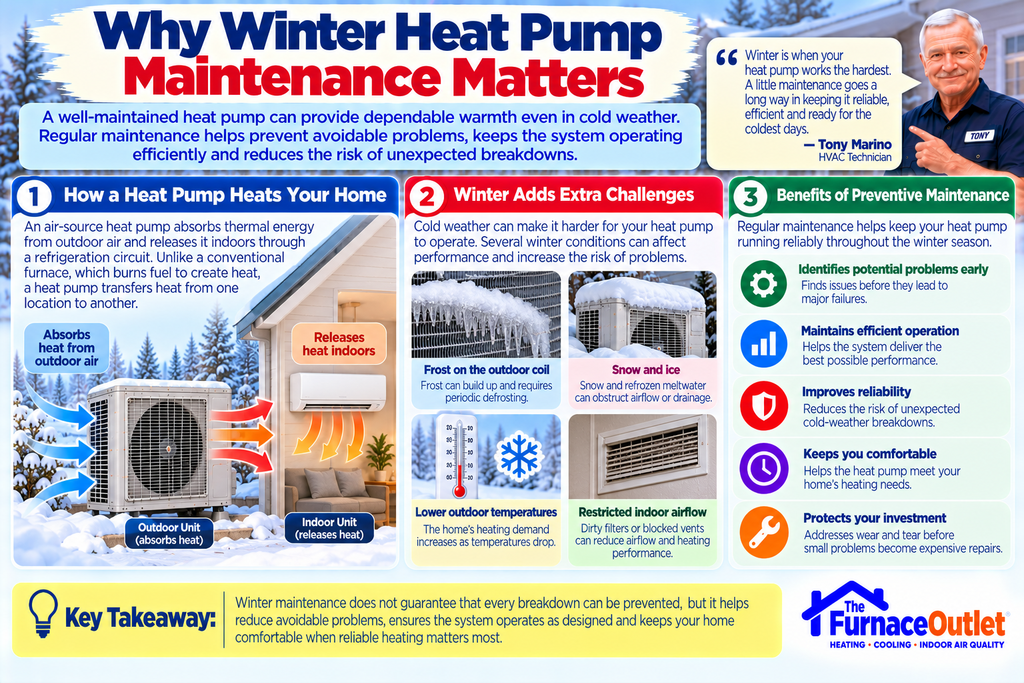
An air-source heat pump heats a home by absorbing thermal energy from outdoor air and releasing it indoors through a refrigeration circuit. Unlike a conventional combustion furnace, which generates heat by burning fuel, a heat pump transfers heat from one location to another. Its performance depends on proper refrigerant flow, compressor operation, heat exchanger condition, airflow, and electronic controls.
Winter introduces several operating challenges. Outdoor coils may develop frost that requires periodic defrosting, while snow and refrozen meltwater can obstruct airflow or drainage. At the same time, the home’s heating demand increases as outdoor temperatures decline. If indoor airflow becomes restricted or the equipment develops a control problem, the heat pump may struggle to maintain comfort precisely when reliable heating is most important.
Preventive maintenance helps identify these problems before they develop into significant failures. However, maintenance does not guarantee that every breakdown can be prevented. Compressors, electronic modules, sensors, motors, and other components can still fail unexpectedly. The objective is to reduce avoidable operating problems, verify that the system functions as designed, and address warning signs before they cause additional damage.
Indoor air filters are among the most important routine maintenance items in a ducted heat pump system. As air circulates through the return ductwork, the filter captures dust and other airborne particles. Over time, accumulated debris can restrict airflow, making it more difficult for the indoor heat exchanger to transfer heat into the home’s air distribution system.
A severely restricted filter may contribute to inadequate heating, uneven room temperatures, abnormal refrigeration conditions, or protective shutdowns on certain equipment. Homeowners may also notice weak airflow from supply registers or unusually long heating cycles. However, a dirty filter does not explain every winter heating problem, and its condition should be evaluated alongside other operating symptoms.
Check accessible filters according to manufacturer instructions and replace or clean them when required. The appropriate interval depends on filter design, household conditions, system runtime, and airborne dust levels. Use the filter size and specifications recommended for the installed equipment, because installing an excessively restrictive filter can create airflow problems even when the filter is new.
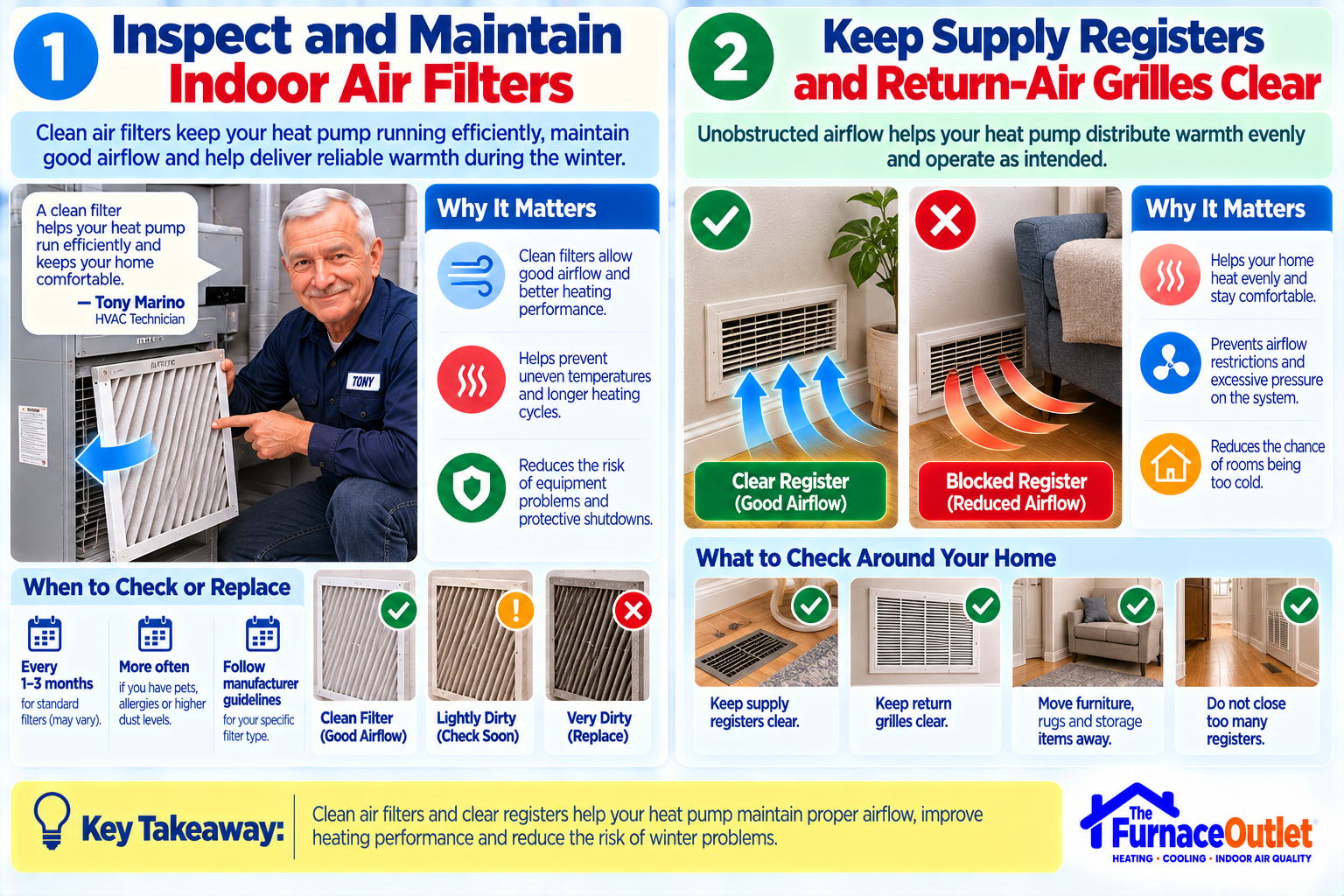
A heat pump requires unobstructed indoor airflow to distribute warmth effectively. Furniture, rugs, storage boxes, and other household objects can block supply registers or return-air grilles, reducing circulation and creating uneven temperatures between rooms. Closing too many supply registers may also increase duct pressure and interfere with the system’s intended airflow.
Before winter, walk through the home and inspect accessible supply and return openings. Make sure that furniture does not cover grilles and that household items are not restricting airflow. If certain rooms remain consistently colder than others, record the locations rather than immediately adjusting duct dampers or equipment controls.
Uneven heating can involve duct leakage, inadequate duct sizing, airflow balancing, insulation deficiencies, or thermostat placement. A qualified contractor may need to measure airflow and evaluate the distribution system before recommending changes. Maintaining open registers is useful, but it cannot correct every ductwork or equipment-design problem.
During heating operation, the outdoor coil absorbs thermal energy from surrounding air. The outdoor fan moves air across the coil, allowing the refrigeration system to collect that energy. Leaves, snowdrifts, vegetation, and stored objects can restrict airflow and reduce the equipment’s ability to operate efficiently.
Homeowners should maintain the manufacturer-required clearances around the outdoor cabinet throughout winter. Remove accessible loose leaves and snow from surrounding areas when weather and footing conditions are safe. Avoid pushing snow against the coil or piling shoveled snow near fan discharge openings.
The required clearance depends on equipment design. Top-discharge units and side-discharge mini-splits have different airflow requirements, so a universal distance should not replace the installation manual. Never reach through fan grilles, use sharp tools against coil fins, or attempt to remove ice attached to moving components. If the unit becomes heavily obstructed, stop operation safely according to manufacturer guidance and arrange professional inspection.
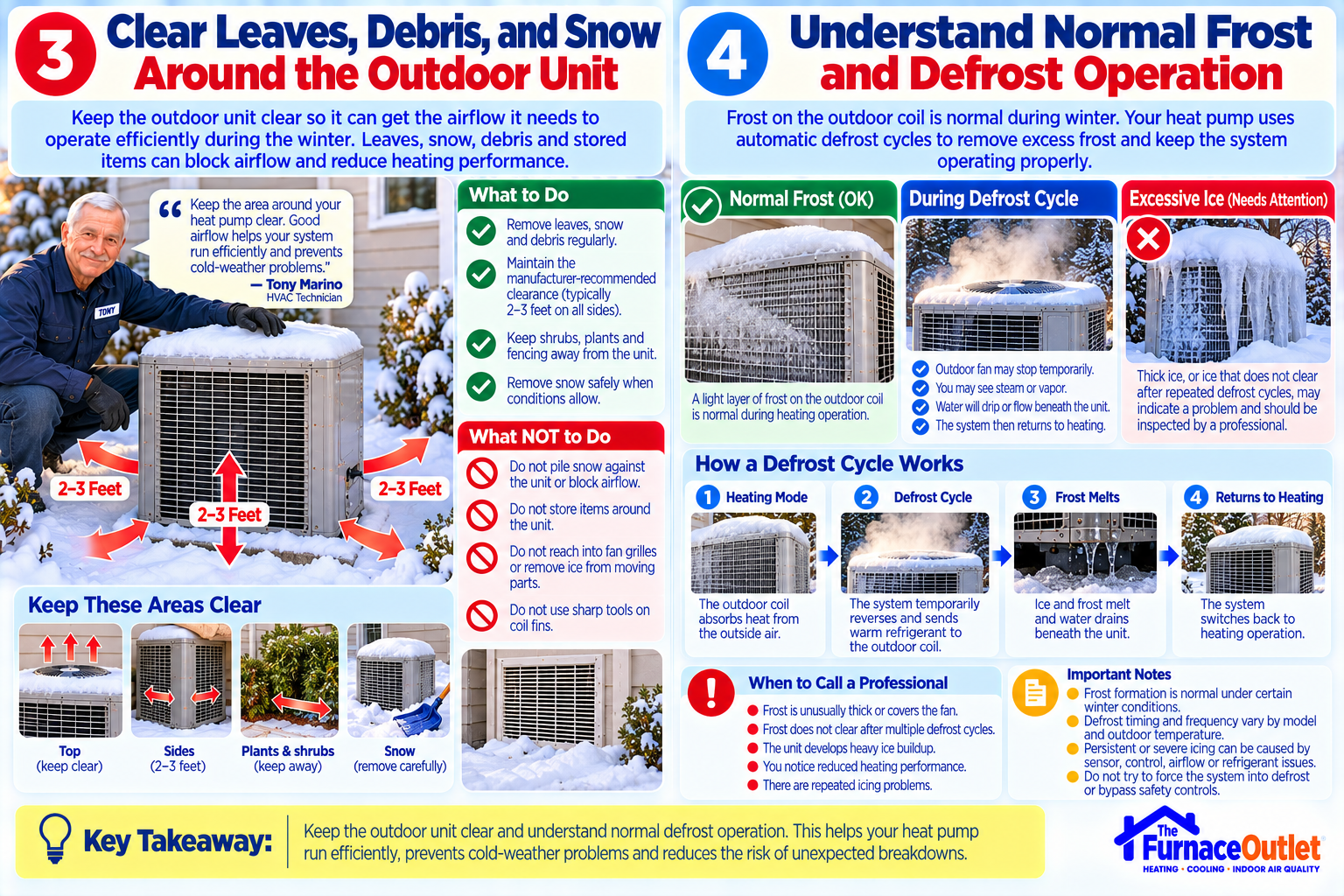
Frost formation is a normal part of heat pump operation under certain winter conditions. During heating, the outdoor coil may become colder than freezing even when the surrounding air temperature is slightly above 32°F. Moisture contacting the cold coil can freeze, producing a light white coating across the fins.
Most air-source heat pumps use automatic defrost controls to remove excessive frost. During a conventional reverse-cycle defrost event, the refrigeration system temporarily directs heat toward the outdoor coil. Homeowners may notice the outdoor fan stopping, a change in operating sound, visible vapor, or water dripping beneath the cabinet. These observations can be normal when the equipment completes defrost and returns to heating.
The concern arises when frost becomes unusually thick, remains after repeated defrost attempts, or reaches the fan assembly. Defective sensors, control problems, refrigerant abnormalities, and restricted airflow can interfere with effective frost removal. Homeowners should observe and document recurring icing rather than attempting to bypass defrost controls or force the equipment into a particular operating mode.
Ice beneath a heat pump does not always indicate a malfunctioning defrost system. When frost melts during defrost, water drains through the outdoor cabinet. If the ground, support pad, or surrounding surface remains below freezing, that water may refreeze and gradually accumulate beneath the unit.
Repeated defrost cycles can cause the ice mass to grow upward, particularly when the equipment sits close to the ground or drainage is poor. Eventually, the accumulation may obstruct base-pan openings or interfere with cabinet components. Roof runoff, nearby snowbanks, and poor grading can make the problem worse.
Observe whether water drains away from the equipment and whether ice repeatedly builds toward the cabinet. Do not chip ice from the base pan, strike refrigerant tubing, or pour boiling water over frozen components. In severe winter climates, a qualified contractor may recommend improved drainage, appropriate equipment elevation, or manufacturer-approved base-pan heating accessories. The correct solution depends on installation conditions rather than automatically replacing defrost components.
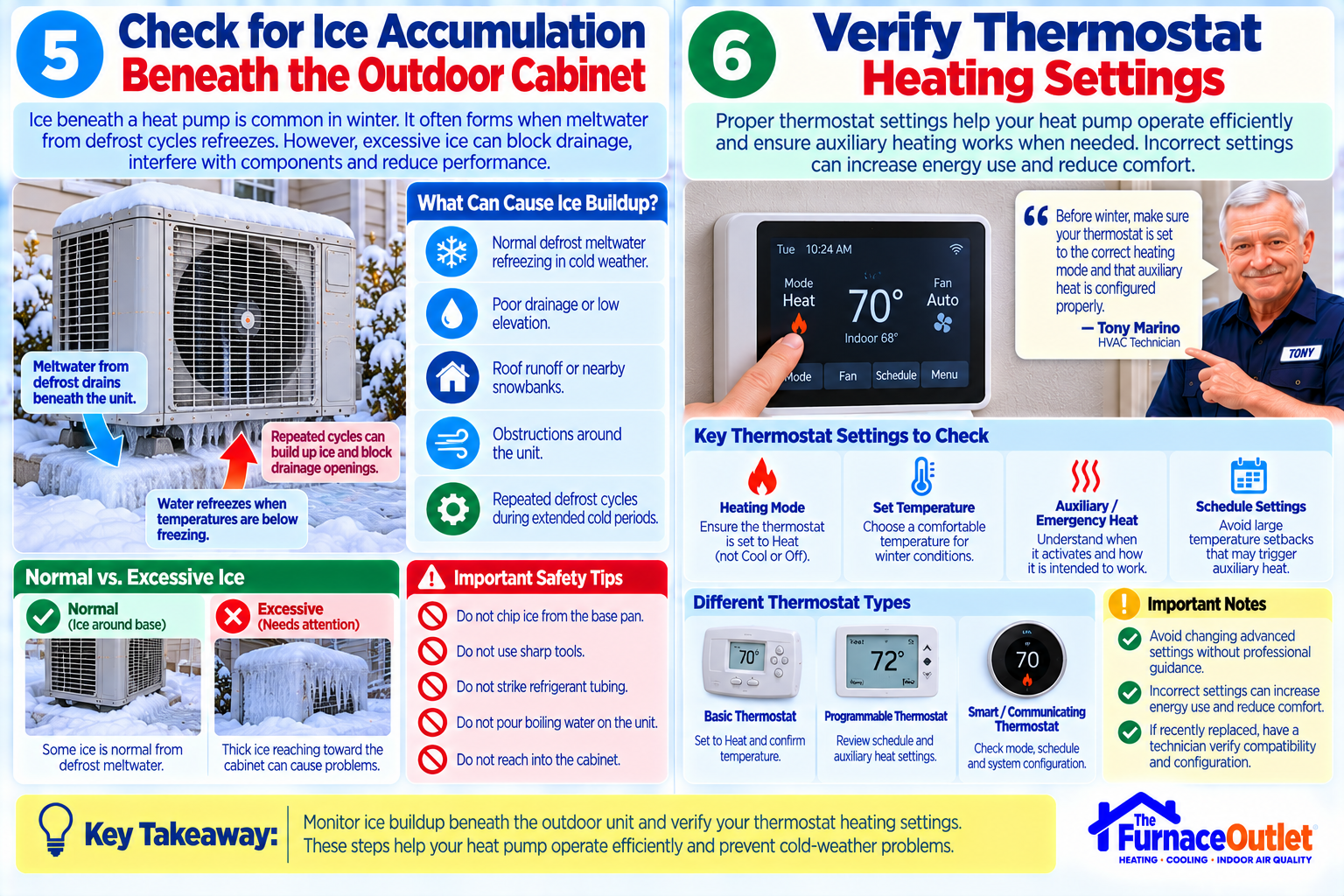
Thermostat configuration plays an important role in heat pump performance. Before winter, confirm that the thermostat is set to the intended heating mode and that the selected temperature is appropriate for the household. If the system includes auxiliary or emergency heating, understand how those functions are intended to operate.
Some thermostats activate electric auxiliary heating when the indoor temperature falls substantially below the selected setpoint or when additional heating capacity is required. Large temperature setbacks followed by sudden increases may therefore increase backup heating use on certain systems. Modern communicating and variable-speed equipment may manage recovery differently, making manufacturer-specific guidance important.
Homeowners should avoid changing advanced staging settings, compressor lockouts, reversing-valve configuration, or dual-fuel changeover temperatures without qualified guidance. Incorrect programming can reduce heating performance or increase operating costs. If the thermostat was recently replaced, professional verification of compatibility and configuration may be particularly valuable.
Many conventional ducted heat pumps include electric resistance heating elements that supplement compressor heating during demanding conditions. Other systems use gas or oil furnaces in dual-fuel arrangements. Some cold-climate or ductless installations have no integrated electric resistance backup.
When supplemental heating is required, the system should activate the appropriate source according to its intended control sequence. If backup heating fails, the compressor may continue operating while indoor temperature gradually falls. Potential causes include incorrect thermostat staging, defective heat strips, failed relays, interrupted electrical circuits, or furnace-related problems.
A thermostat displaying “AUX” does not necessarily prove that backup equipment is producing heat. It may simply indicate that supplemental heating has been requested. A qualified technician should identify the installed backup system and verify its actual response. Electrical heat strips and combustion equipment contain hazards that make homeowner testing inappropriate.
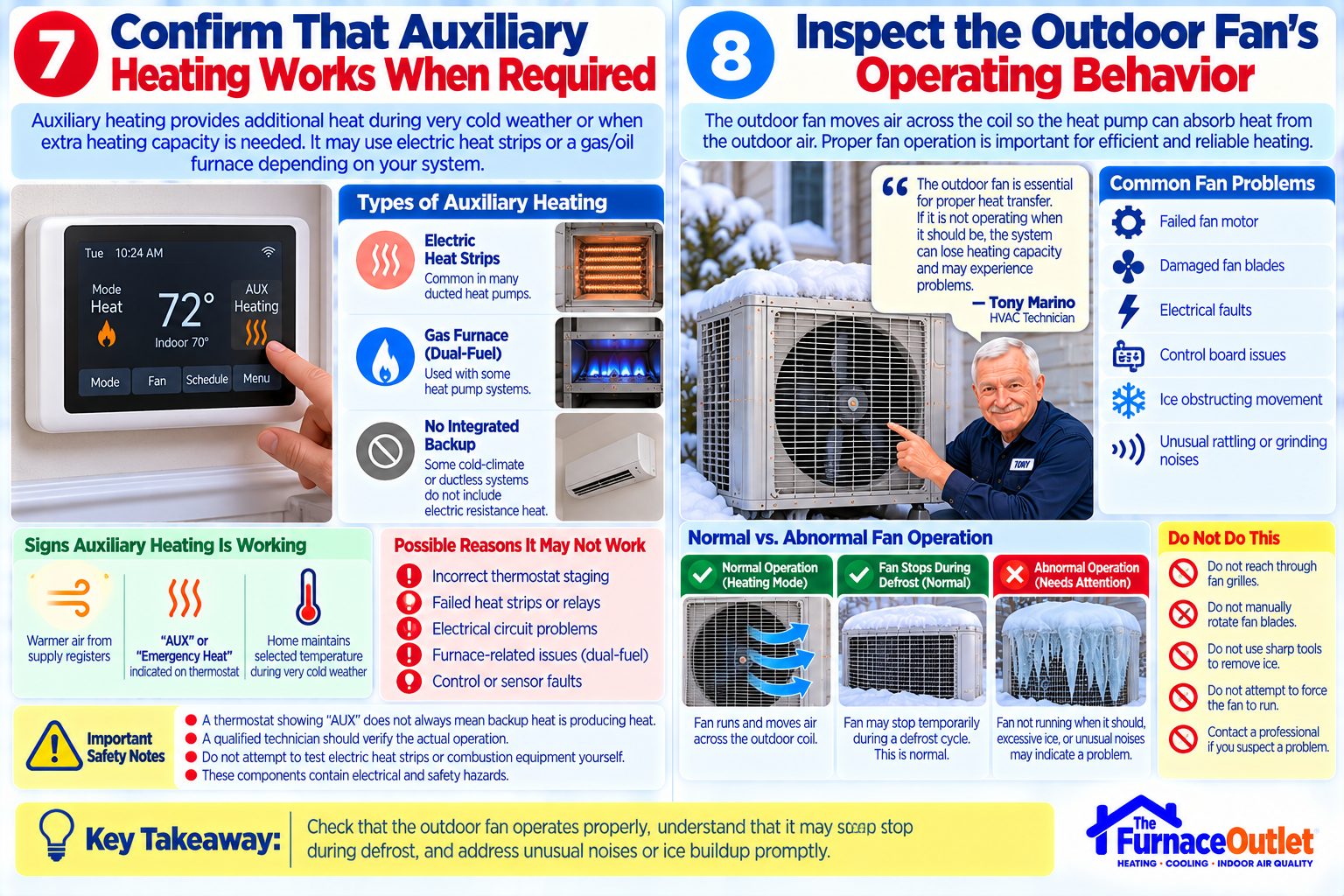
The outdoor fan supports heat transfer by moving air across the outdoor coil during normal heating. If the fan fails when airflow is required, the system may experience reduced heating capacity, abnormal operating conditions, or protective shutdowns.
Potential problems include a defective fan motor, damaged blades, electrical faults, control abnormalities, or ice obstructing movement. Homeowners may notice unusual rattling, scraping, or grinding sounds, particularly when ice reaches the fan assembly.
However, the outdoor fan commonly stops during certain defrost sequences. A stationary fan observed briefly during winter is not automatically evidence of failure. The technician must determine whether the equipment is heating, defrosting, or responding to a protective control. Homeowners should never reach through the grille, manually rotate fan blades, or attempt to break ice away from moving components.
A heat pump compressor may produce different operating sounds as outdoor conditions and heating demand change. Variable-speed compressors can adjust their output, while conventional systems may produce recognizable startup and shutdown sounds. A brief change in sound during defrost can also be normal.
More concerning symptoms include repeated hard-start noises, unusually loud mechanical knocking, persistent grinding, or frequent attempts to start followed by immediate shutdown. These conditions may involve compressor problems, electrical faults, protective controls, or abnormal refrigeration operation.
Noise alone does not establish that a compressor has failed. A technician should review operating commands, electrical supply, diagnostic history, and refrigeration performance before recommending major repairs. Compressor replacement is expensive, making accurate diagnosis essential.
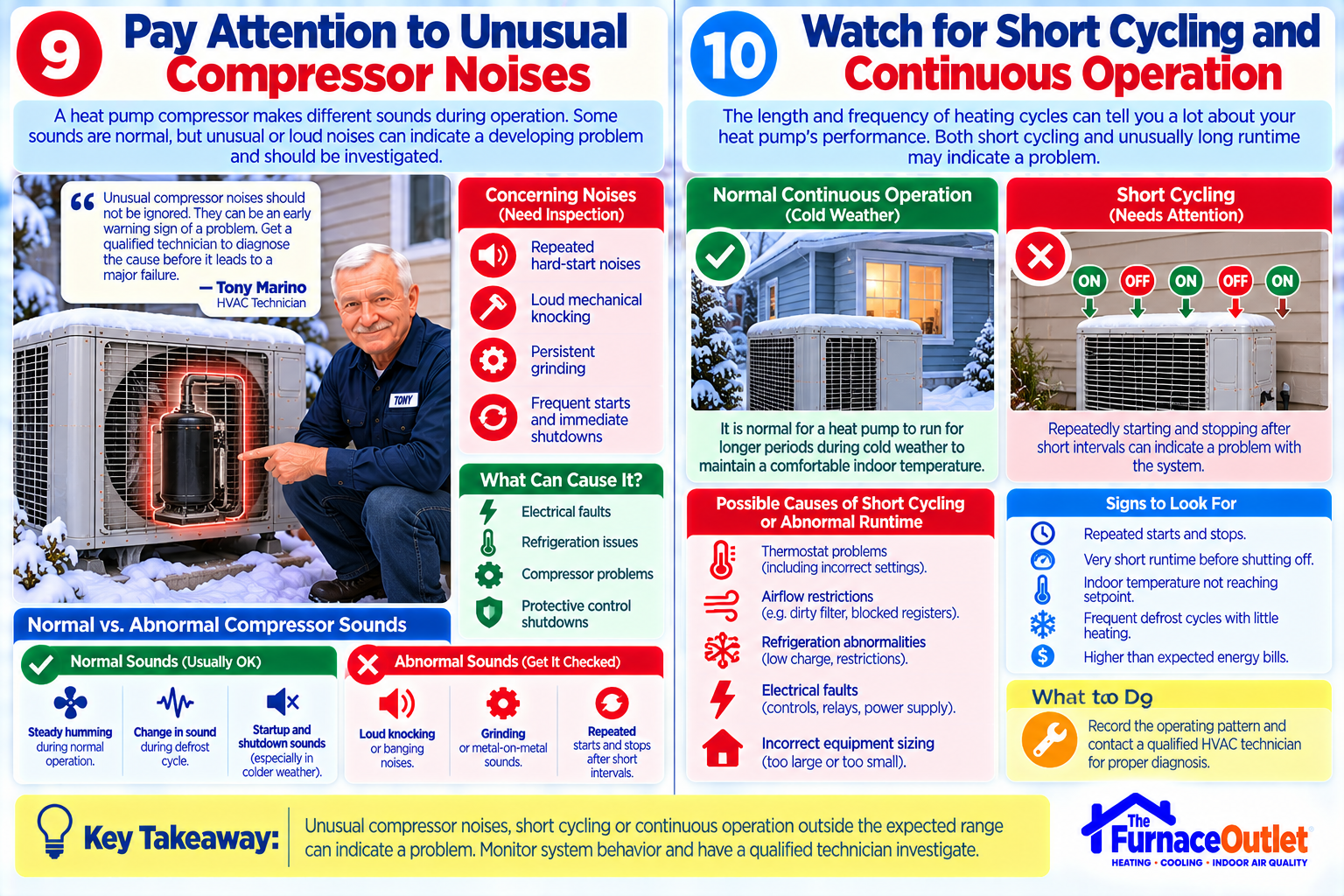
Winter heating cycles vary according to outdoor conditions, equipment design, and the home’s heating demand. A properly sized heat pump may run for extended periods during cold weather because steady operation is necessary to replace the heat escaping from the building.
Continuous operation is not automatically a malfunction if indoor temperature remains comfortable and the equipment is functioning within its intended operating range. Similarly, shorter cycles during mild weather may be expected on certain systems.
Concern increases when the compressor repeatedly starts and stops after unusually brief intervals, protective shutdowns occur, or indoor temperature continues falling despite prolonged operation. Thermostat problems, airflow restrictions, refrigeration abnormalities, electrical faults, and equipment sizing can all influence cycling behavior. Record the operating pattern and request professional evaluation if performance becomes abnormal.
A heat pump requires an appropriate refrigerant charge and unrestricted refrigerant flow to transfer heat efficiently. Significant leaks, restrictions, or malfunctioning expansion devices can reduce heating capacity and contribute to abnormal operating conditions.
Possible symptoms include inadequate heating, unusual outdoor coil frosting, prolonged compressor operation, or repeated protective shutdowns. However, these observations do not prove that refrigerant is low. Airflow deficiencies, defrost problems, compressor abnormalities, and incorrect control signals can produce overlapping symptoms.
Refrigerant is not normally consumed during operation. A properly sealed system should not require routine topping up. If a leak is confirmed, the technician should investigate its source and recommend appropriate repairs before restoring the correct charge. Homeowners should never manipulate refrigerant service valves or attempt to add refrigerant themselves.
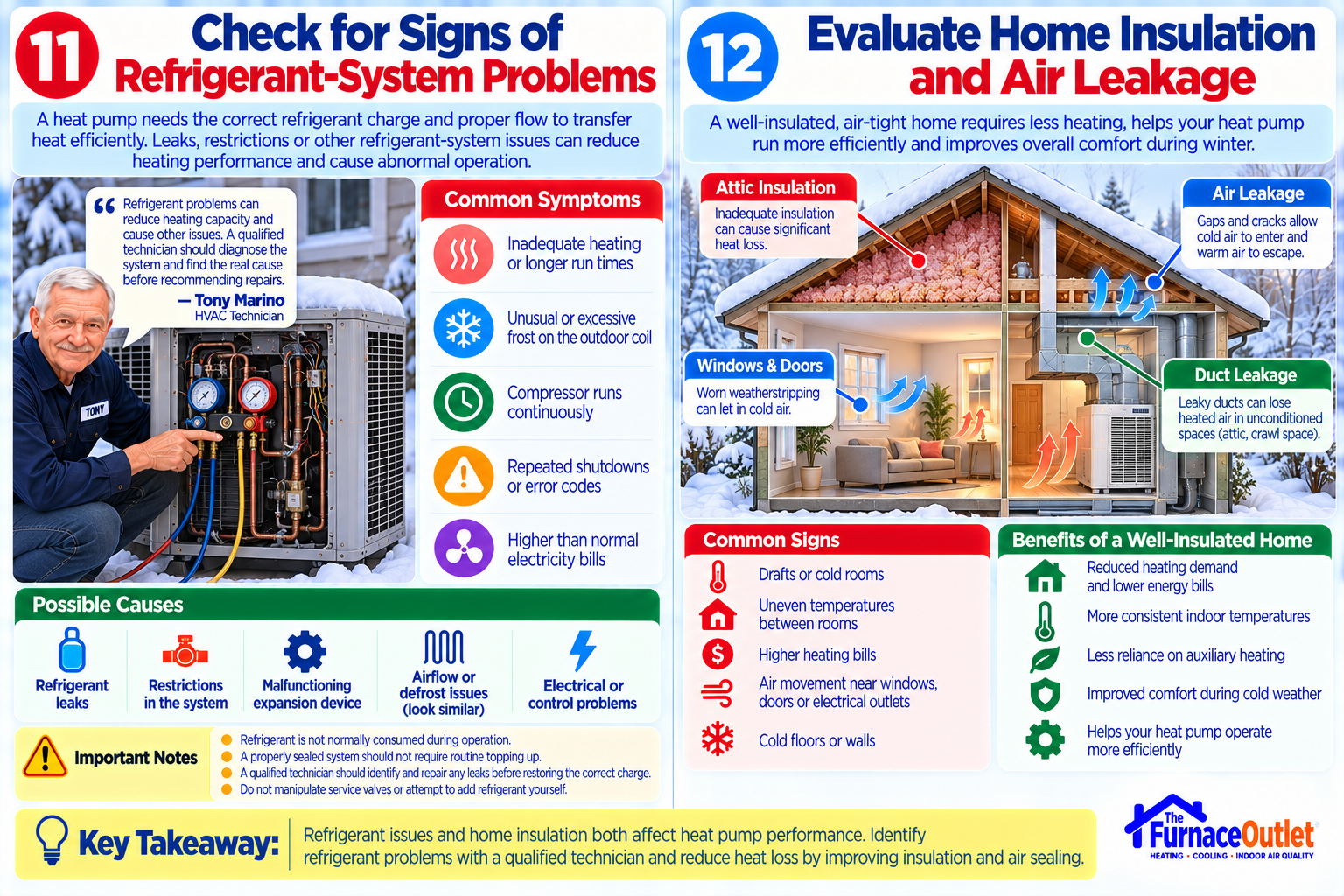
Heat pump maintenance should not focus exclusively on mechanical equipment. A home with inadequate insulation or significant air leakage may require substantially more heating than a similar well-insulated building. This increases compressor runtime and may increase dependence on supplemental heating.
Common problem areas include poorly insulated attics, deteriorated weatherstripping, leaky windows, unsealed penetrations, and duct leakage through unconditioned spaces. Homeowners may notice drafts, cold rooms, uneven temperatures, or increased heating bills during windy weather.
Appropriate insulation, air sealing, and duct leakage correction can reduce heating demand and improve comfort. A qualified energy auditor or contractor can help identify worthwhile improvements. However, building-envelope work should complement rather than replace diagnosis of genuine equipment faults.
A professional inspection should verify that the heat pump operates according to its manufacturer specifications. The technician should identify the exact equipment model, thermostat configuration, heating stages, backup heating arrangement, and relevant operating limits.
Depending on the system and observed conditions, inspection may include indoor airflow, blower performance, outdoor fan operation, electrical connections, control signals, temperature sensors, defrost operation, drainage, and diagnostic fault history. Refrigeration measurements may be appropriate when symptoms or manufacturer procedures indicate a need.
The technician should also evaluate auxiliary heating and applicable safety controls. Maintenance should not automatically involve adding refrigerant or replacing electronic components without evidence of a problem. A useful service report explains what was inspected, identifies any abnormal findings, and distinguishes recommended repairs from optional improvements.
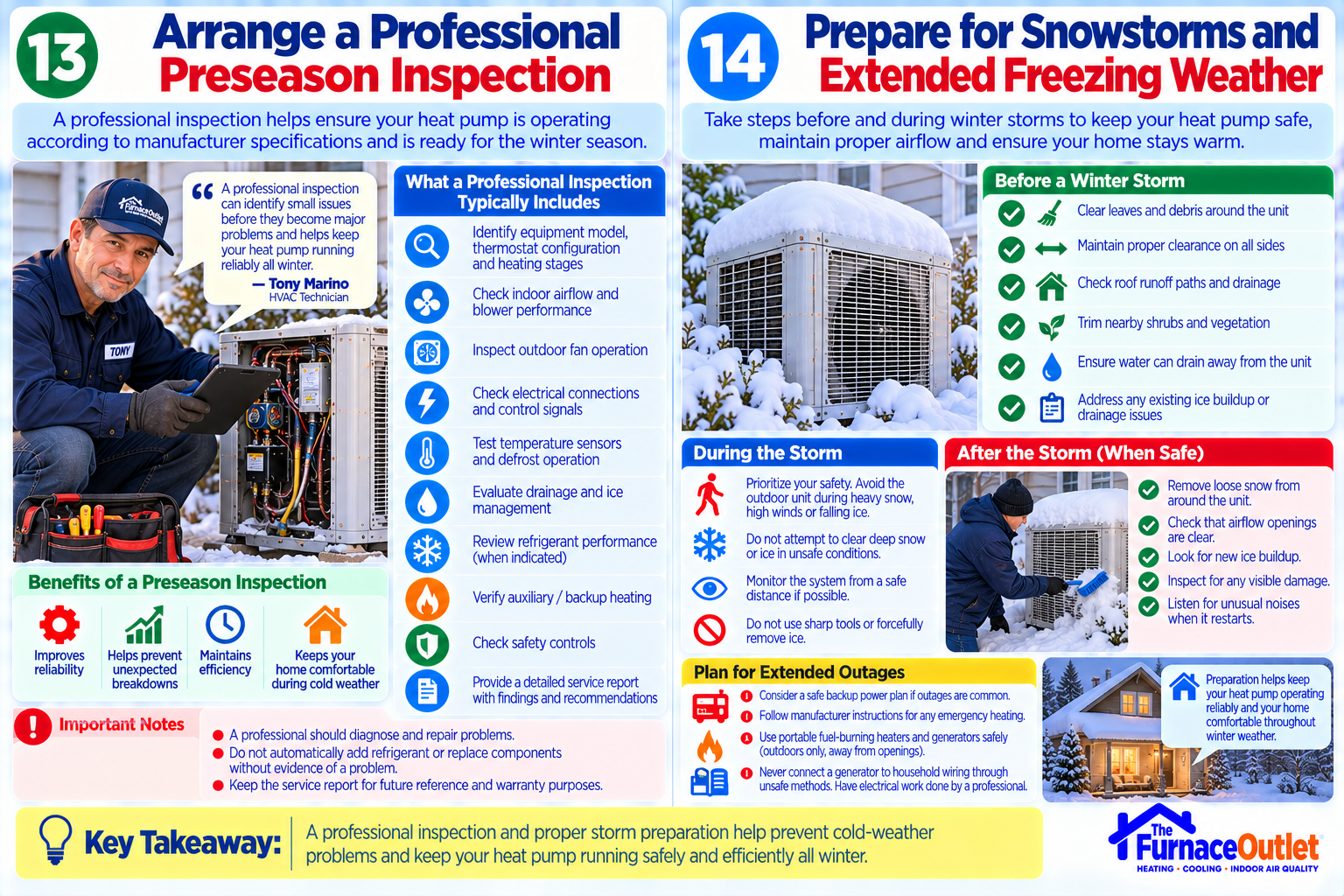
Before a major winter storm, confirm that the outdoor unit has appropriate airflow clearance and that surrounding areas are not likely to collect excessive drifting snow. Inspect nearby roof runoff paths and drainage conditions, particularly where refrozen water has previously accumulated beneath the cabinet.
During severe weather, prioritize personal safety. Do not approach the outdoor equipment during dangerous winds, falling ice, heavy roof snow, or unsafe footing. Once conditions permit, inspect the unit from a safe distance and remove accessible loose snow from surrounding areas without contacting sensitive components.
For homes where winter outages are common, consider an emergency heating plan that follows manufacturer instructions and electrical safety requirements. Portable fuel-burning heaters and generators introduce carbon monoxide and fire hazards if used incorrectly. Any backup power arrangement must be properly designed and installed, with generators operated outdoors well away from openings and never connected to household wiring through unsafe methods.
Developing problems often produce symptoms before the heating system stops completely. Declining indoor comfort, persistent outdoor icing, repeated fault codes, abnormal noises, weak airflow, or unexpectedly frequent auxiliary heating may indicate that the equipment requires attention.
Homeowners should pay particular attention to changes from the system’s normal operating behavior. A heat pump that previously maintained comfort during similar weather but now struggles to reach the thermostat setting deserves investigation.
Electrical warning signs require greater caution. Burning odors, smoke, sparking, or repeated breaker trips may indicate hazardous conditions. If the system repeatedly locks out, develops severe mechanical noises, or shows signs of electrical danger, stop operating the affected equipment safely according to manufacturer guidance and arrange qualified service. Do not repeatedly reset protective controls without correcting the cause.
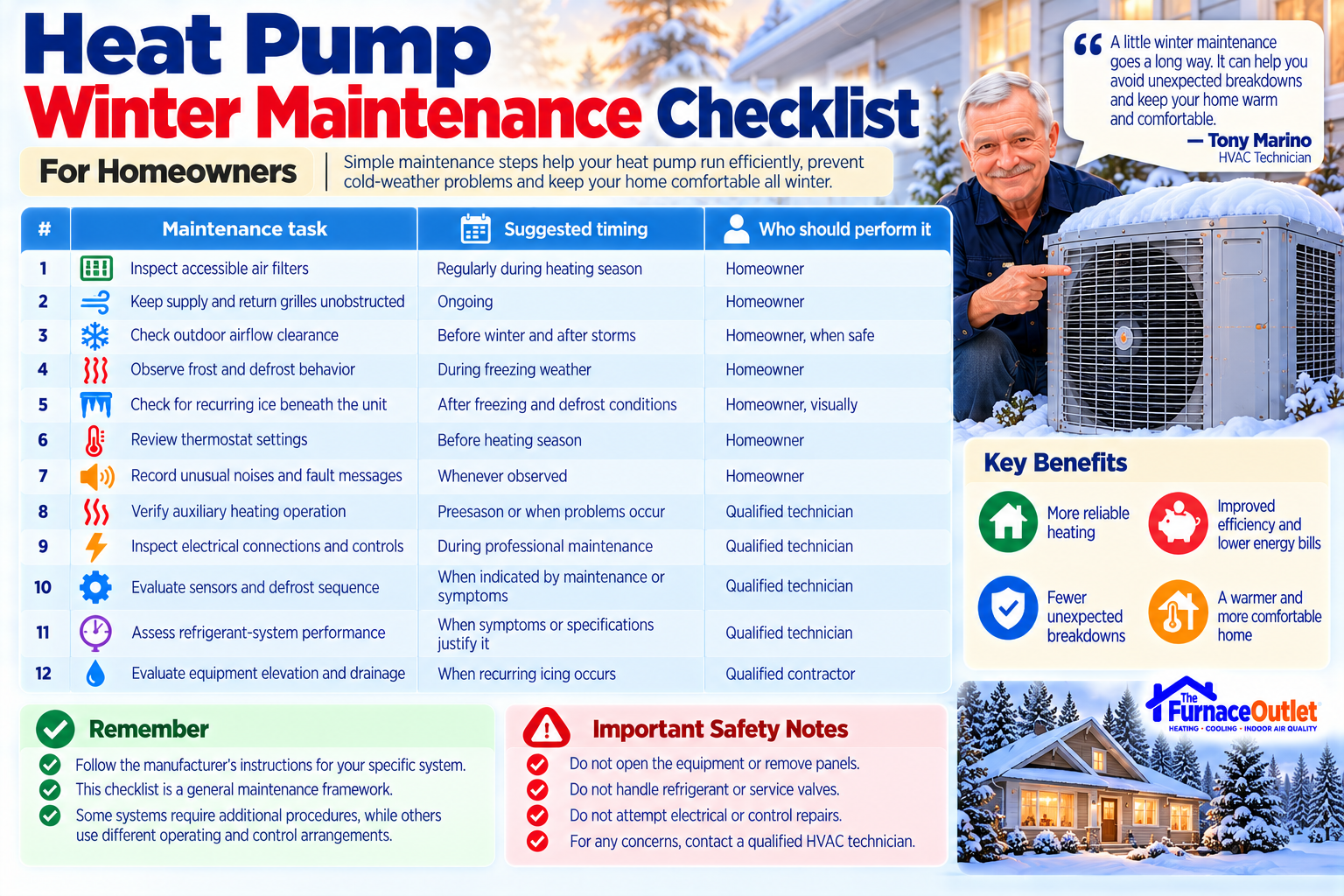
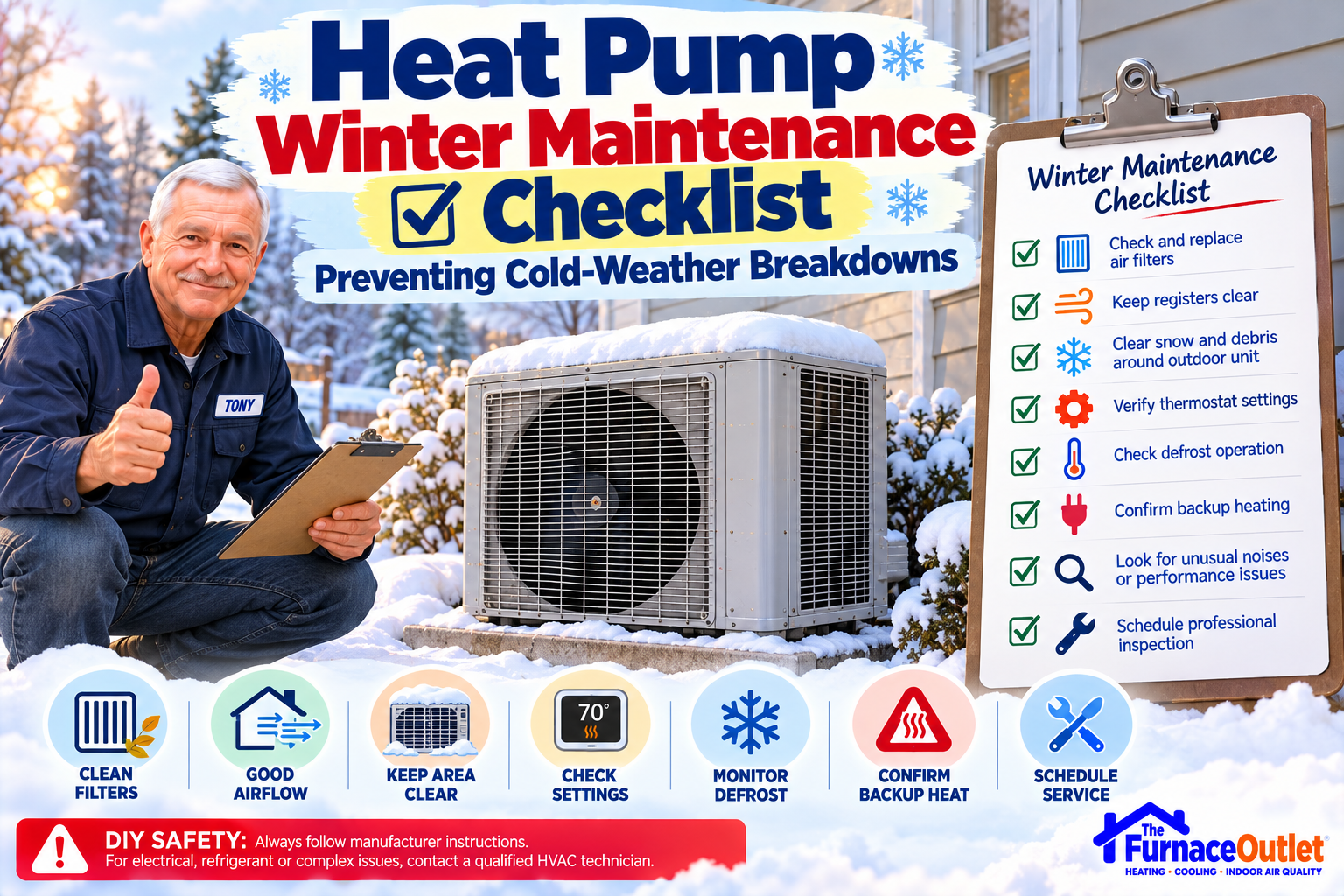
| Maintenance task | Suggested timing | Who should perform it |
|---|---|---|
| Inspect accessible air filters | Regularly during heating season | Homeowner |
| Keep supply and return grilles unobstructed | Ongoing | Homeowner |
| Check outdoor airflow clearance | Before winter and after storms | Homeowner, when safe |
| Observe frost and defrost behavior | During freezing weather | Homeowner |
| Check for recurring ice beneath the unit | After freezing and defrost conditions | Homeowner, visually |
| Review thermostat settings | Before heating season | Homeowner |
| Record unusual noises and fault messages | Whenever observed | Homeowner |
| Verify auxiliary heating operation | Preseason or when problems occur | Qualified technician |
| Inspect electrical connections and controls | During professional maintenance | Qualified technician |
| Evaluate sensors and defrost sequence | When indicated by maintenance or symptoms | Qualified technician |
| Assess refrigerant-system performance | When symptoms or specifications justify it | Qualified technician |
| Evaluate equipment elevation and drainage | When recurring icing occurs | Qualified contractor |
This checklist is a general maintenance framework rather than a substitute for the manufacturer’s instructions. Certain systems require additional procedures, while others use different operating and control arrangements.
Many homeowners arrange professional heat pump maintenance at least annually, while systems operating year-round for both heating and cooling may benefit from seasonal inspections. The appropriate schedule depends on manufacturer recommendations, equipment condition, operating hours, climate, and warranty requirements.
Routine homeowner tasks such as filter inspection and outdoor clearance checks should occur more frequently because conditions change throughout the year. Snow accumulation, fallen leaves, household dust, and airflow obstructions can develop between professional visits.
Maintenance frequency should be based on actual equipment needs rather than a rigid universal schedule. A technician should explain which procedures are necessary for the installed model and whether additional visits are justified by operating conditions.
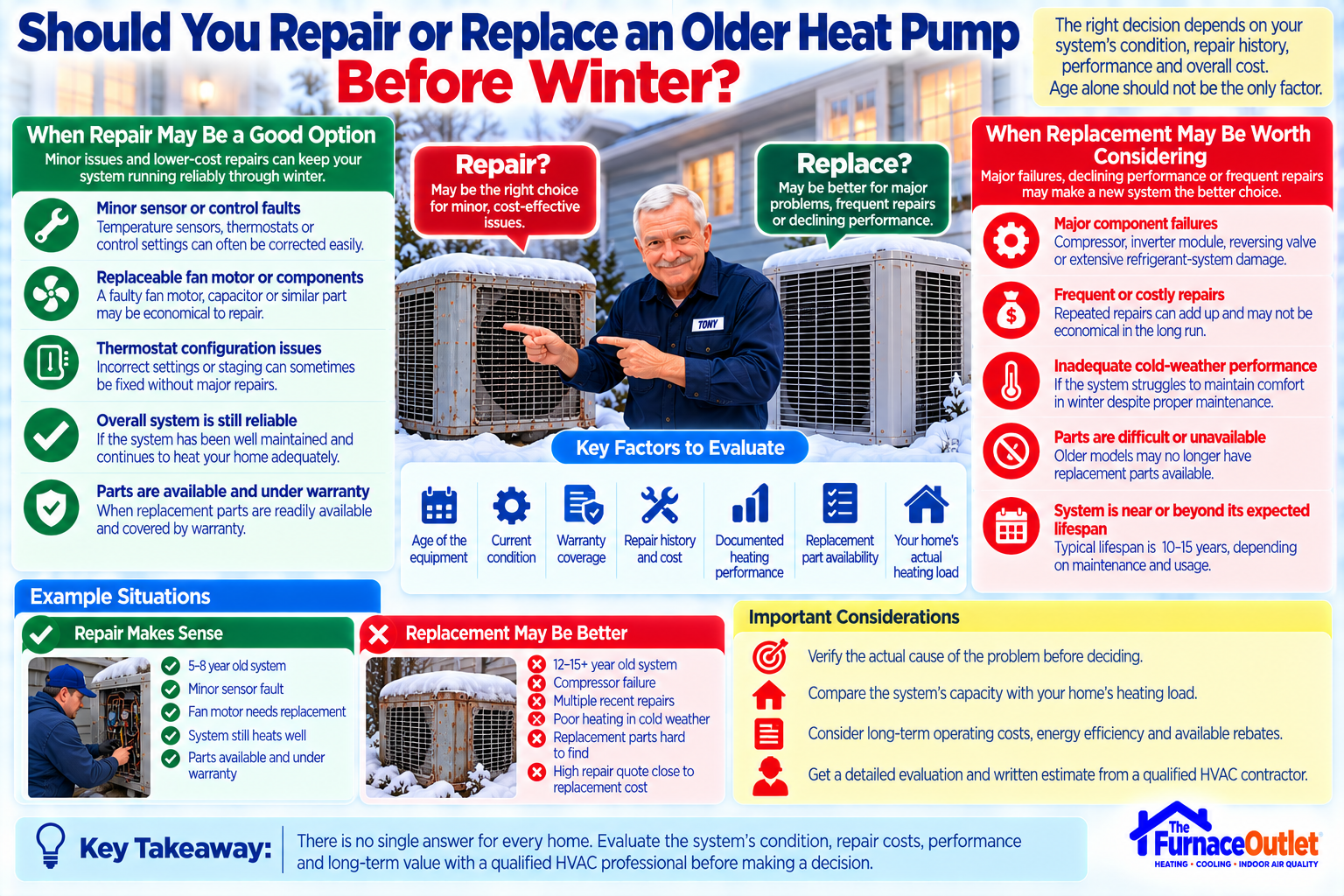
The decision depends on equipment age, condition, warranty coverage, repair history, replacement-part availability, and documented heating performance. A heat pump with a minor sensor fault, replaceable fan component, or thermostat configuration problem may be economical to repair.
Major failures involving compressors, inverter modules, reversing valves, or extensive refrigerant-system damage require broader evaluation. Repeated costly repairs, inadequate cold-weather capacity, or unavailable replacement parts may make equipment replacement worth considering.
However, age alone should not determine the decision. A properly maintained older system that remains reliable may continue providing useful service, while a relatively new system with an unresolved installation problem may perform poorly. Before replacement, the contractor should verify the actual cause and compare the home’s heating load with the equipment’s documented capacity.
Not automatically. A properly installed heat pump can operate during snowfall when airflow, drainage, and operating conditions remain within manufacturer requirements. Shut it down safely if serious obstructions, mechanical damage, or hazardous conditions develop.
Yes. Light frost may form during winter heating and should generally be managed by automatic defrost operation. Thick ice that persists or interferes with the fan requires investigation.
Do not cover an operating heat pump with a tarp or tightly fitted enclosure. Outdoor equipment requires manufacturer-specified airflow and clearances. Any protective structure should be professionally evaluated for compatibility.
Avoid pouring boiling water or using sharp tools, open flames, or improvised heating devices on frozen equipment. If ice is attached to sensitive components or obstructs the fan, arrange qualified service.
A thermostat’s auxiliary heating indicator may show that backup heating has been requested, but it does not always confirm that the equipment is energized. A technician can verify actual backup heating operation.
No. Preventive maintenance reduces avoidable problems and helps identify developing faults, but electrical and mechanical components can still fail unexpectedly.
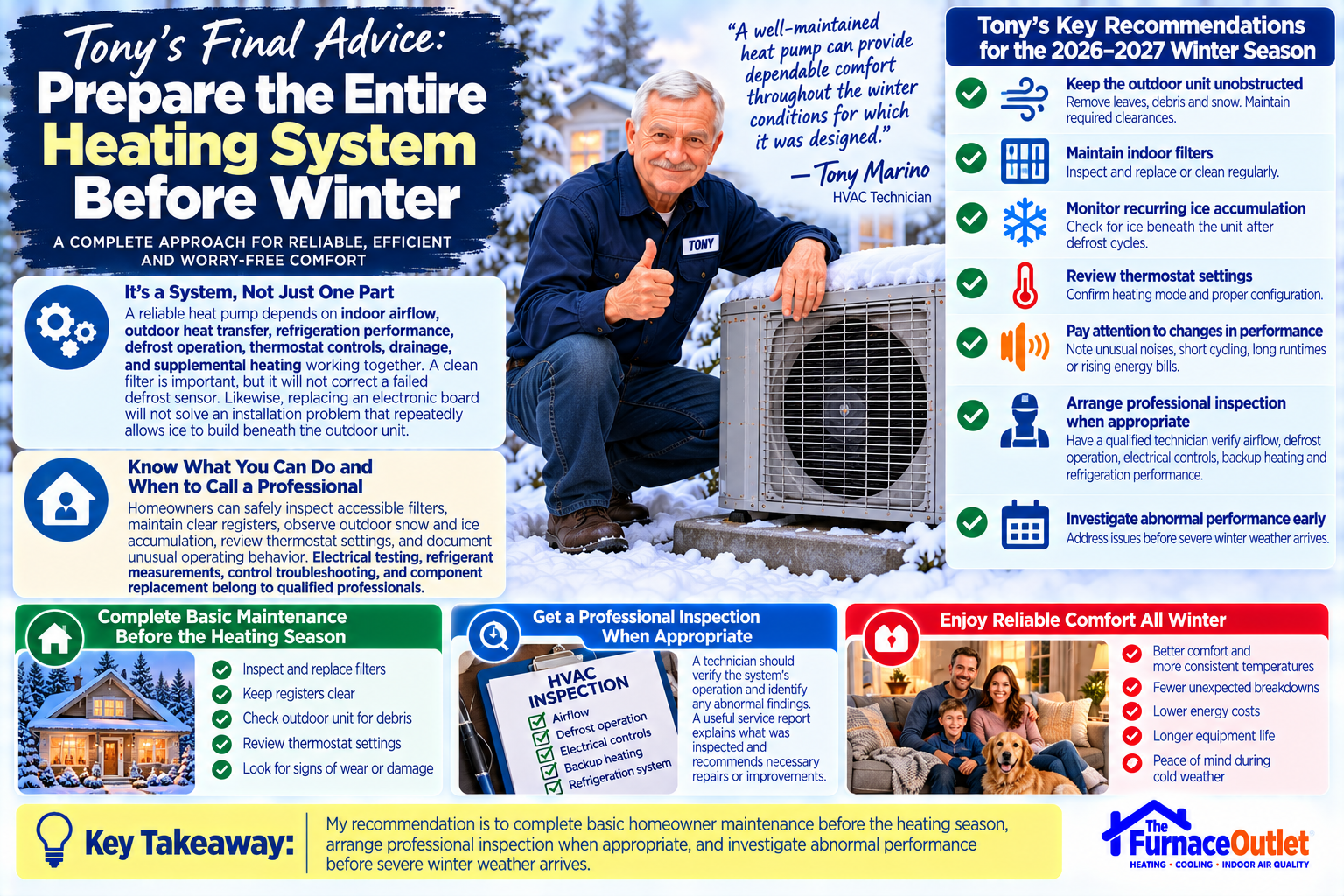
When a homeowner asks me what matters most in winter heat pump maintenance, I do not recommend focusing on one component. A reliable heating system depends on indoor airflow, outdoor heat transfer, refrigeration performance, defrost operation, thermostat controls, drainage, and supplemental heating working together. A clean filter is important, but it will not correct a failed defrost sensor. Likewise, replacing an electronic board will not solve an installation problem that repeatedly allows ice to build beneath the outdoor unit.
I also want homeowners to understand the difference between routine maintenance and professional diagnosis. Homeowners can safely inspect accessible filters, maintain clear registers, observe outdoor snow and ice accumulation, review thermostat settings, and document unusual operating behavior. Electrical testing, refrigerant measurements, control troubleshooting, and component replacement belong to qualified professionals.
My recommendation is to complete basic homeowner maintenance before the heating season, arrange professional inspection when appropriate, and investigate abnormal performance before severe winter weather arrives. A technician should verify airflow, defrost operation, electrical controls, backup heating, and refrigeration performance when indicated by the equipment and symptoms.
For the 2026–2027 winter season, keep the outdoor unit unobstructed, monitor recurring ice accumulation, maintain indoor filters, and pay attention to changes in heating performance. A properly selected, installed, and maintained heat pump should provide dependable comfort throughout the winter conditions for which it was designed.
This article provides general homeowner education and does not replace manufacturer instructions, professional HVAC diagnosis, or applicable building and electrical codes. Heat pumps contain hazardous electrical components, moving fan assemblies, pressurized refrigerant, and protective safety controls. Homeowners should not remove electrical panels, manipulate refrigerant connections, bypass controls, manually rotate fan blades, or attempt unauthorized repairs. Burning odors, smoke, sparking, repeated electrical trips, and severe mechanical problems require qualified professional attention. The Furnace Outlet – HVAC Knowledge Hub
U.S. Department of Energy — Air-Source Heat Pumps: https://www.energystar.gov/products/air_source_heat_pumps
U.S. Department of Energy — Operating and Maintaining Your Heat Pump: https://www.energy.gov/heat-pumps
ENERGY STAR — Air-Source Heat Pumps: https://www.energystar.gov/products/air_source_heat_pumps
U.S. Department of Energy — Weatherize Your Home: https://www.energy.gov/cmei/scep/wap/weatherization-assistance-program
ACCA — Residential HVAC Design and Technical Manuals: https://www.acca.org/standards/technical-manuals
Northeast Energy Efficiency Partnerships — Cold Climate Air-Source Heat Pump List: https://ashp.neep.org/
These resources provide additional guidance on heat pump performance, maintenance, equipment selection, weatherization, and cold-climate heating. Always follow the exact equipment manufacturer’s documentation for maintenance procedures, operating limits, and safety requirements.