Newsletter Subscribe
Enter your email address below and subscribe to our newsletter

HVAC made simple
By Tony Marino (Tony the Trusted Tech)
The Furnace Outlet | Updated October 2026
When winter storms arrive, homeowners often become concerned about snow accumulating around their outdoor heat pump. A light layer of snow on top of the cabinet may look harmless, but heavy snowfall, drifting snow, and repeated freezing conditions can interfere with equipment operation if the unit becomes buried or its airflow openings are obstructed. I have seen homeowners assume that a heat pump cannot operate in snow, while others ignore significant snow accumulation until their heating performance deteriorates. Neither approach is particularly helpful.
Modern air-source heat pumps are designed to operate outdoors through a range of winter conditions, including freezing temperatures and snowfall. Cold-climate models can continue extracting useful thermal energy from outdoor air even when temperatures fall well below 32°F. However, these systems still require adequate airflow, functioning defrost controls, proper drainage, and installation clearances. Snow accumulation becomes a problem when it interferes with these essential operating requirements rather than simply because snow is present nearby.
The safest winter maintenance strategy is to understand which snow conditions are normal, which situations require attention, and what homeowners can do without damaging expensive equipment. In this guide, I will explain how snow affects heat pump performance, why airflow and drainage matter, how to recognize dangerous ice accumulation, and when a qualified HVAC technician should investigate the installation.
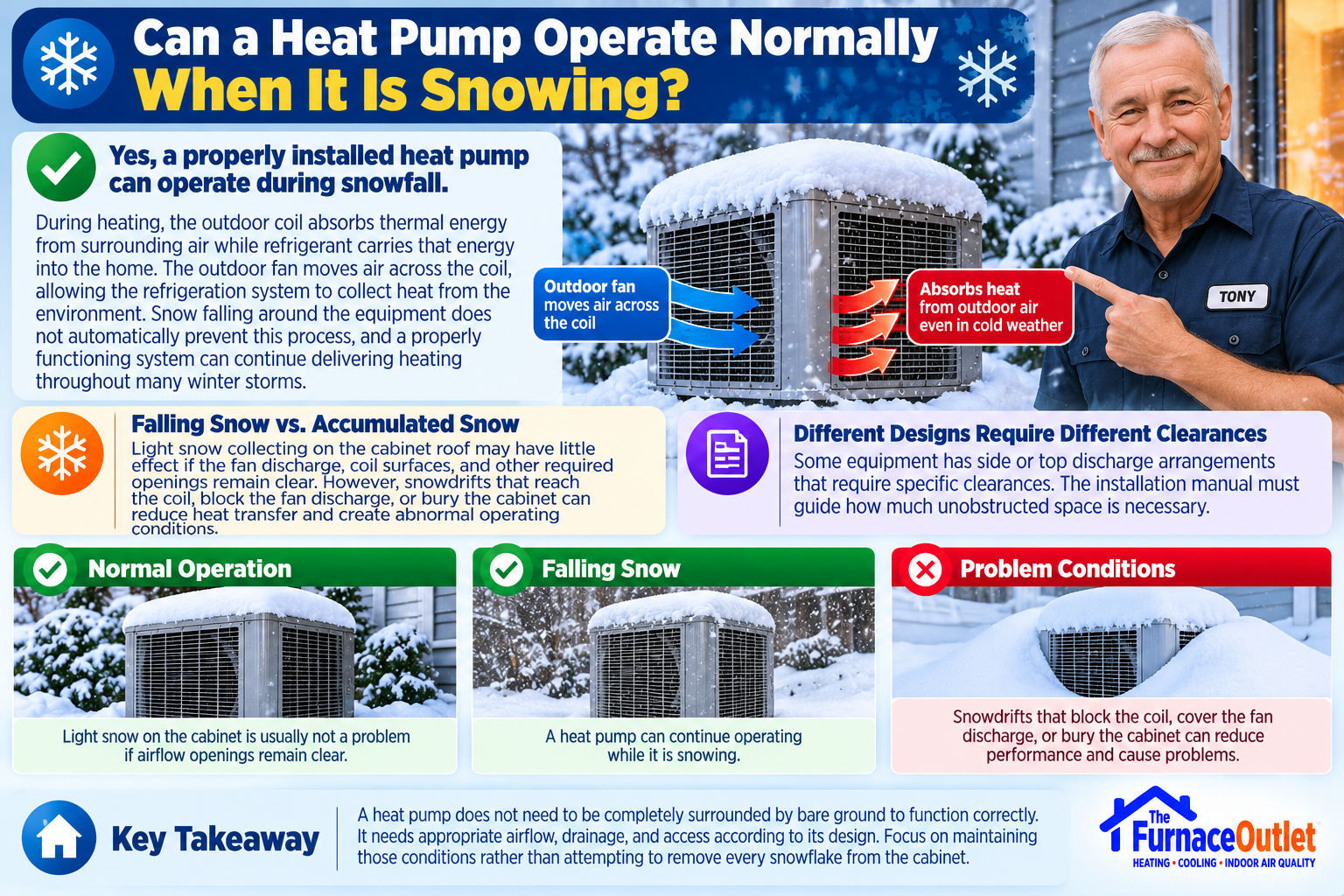
Yes, a properly installed heat pump can operate during snowfall, provided outdoor conditions remain within its approved operating range and required airflow paths are not obstructed. During heating, the outdoor coil absorbs thermal energy from surrounding air while refrigerant carries that energy into the home. The outdoor fan moves air across the coil, allowing the refrigeration system to collect heat from the environment. Snow falling around the equipment does not automatically prevent this process, and a properly functioning system can continue delivering heating throughout many winter storms.
The important distinction is between falling snow and accumulated snow that restricts the equipment. Light snow collecting on the cabinet roof may have little effect if the fan discharge, coil surfaces, and other required openings remain clear. However, snowdrifts that reach the coil, block the fan discharge, or bury the cabinet can reduce heat transfer and create abnormal operating conditions. Some equipment also has side or top discharge arrangements that require different clearances, so the installation manual must guide how much unobstructed space is necessary.
A heat pump does not need to be completely surrounded by bare ground to function correctly. It needs appropriate airflow, drainage, and access according to its design. Homeowners should focus on maintaining those conditions rather than attempting to remove every snowflake from the cabinet.
During winter heating, the outdoor coil functions as the evaporator and absorbs heat from outside air. If snow accumulates against the coil or blocks airflow openings, the volume of air moving across the heat exchanger may decline. This can reduce the amount of heat the refrigeration system absorbs and may force the equipment to operate longer to satisfy indoor heating demand. Depending on the system and severity of the restriction, abnormal coil temperatures, protective shutdowns, or inadequate indoor heating can develop.
Snow restrictions are particularly troublesome when the outdoor fan cannot move air through the cabinet as intended. A large snowdrift beside the unit may restrict incoming air, while snow or ice above a top-discharge unit can interfere with the discharge pathway. These restrictions can affect equipment differently depending on cabinet configuration, fan design, compressor controls, and outdoor conditions. Consequently, there is no universal snow depth at which every heat pump becomes unsafe to operate.
Homeowners may notice extended heating cycles, declining indoor temperature, unusual fan sounds, or visible snow packed against the coil. However, these observations do not automatically establish that the snow is the only problem. A qualified technician may need to evaluate airflow, defrost operation, and refrigeration performance if heating remains inadequate after safe access and clearance issues have been addressed.
There is no single snow-clearance distance that applies to every residential heat pump. The appropriate clearance depends on the manufacturer’s installation requirements, outdoor unit configuration, fan discharge direction, local snowfall patterns, and whether the system is installed on an elevated stand or concrete pad. Some manufacturers specify minimum distances around the cabinet for airflow and servicing, while cold-climate installation guidance may recommend additional space to accommodate snow accumulation.
As a practical principle, snow should not be allowed to pack against the outdoor coil, cover required ventilation openings, obstruct the fan discharge, or prevent defrost water from draining away. A top-discharge unit must maintain its required overhead clearance, while a side-discharge system needs unobstructed airflow in the directions specified by its manufacturer. These differences make generic internet clearance recommendations unreliable.
I recommend checking the installation manual for the exact model rather than assuming that a fixed distance such as 12, 18, or 24 inches is universally sufficient. If the outdoor unit becomes repeatedly buried during ordinary winter storms, the installation location or support height may require professional evaluation.
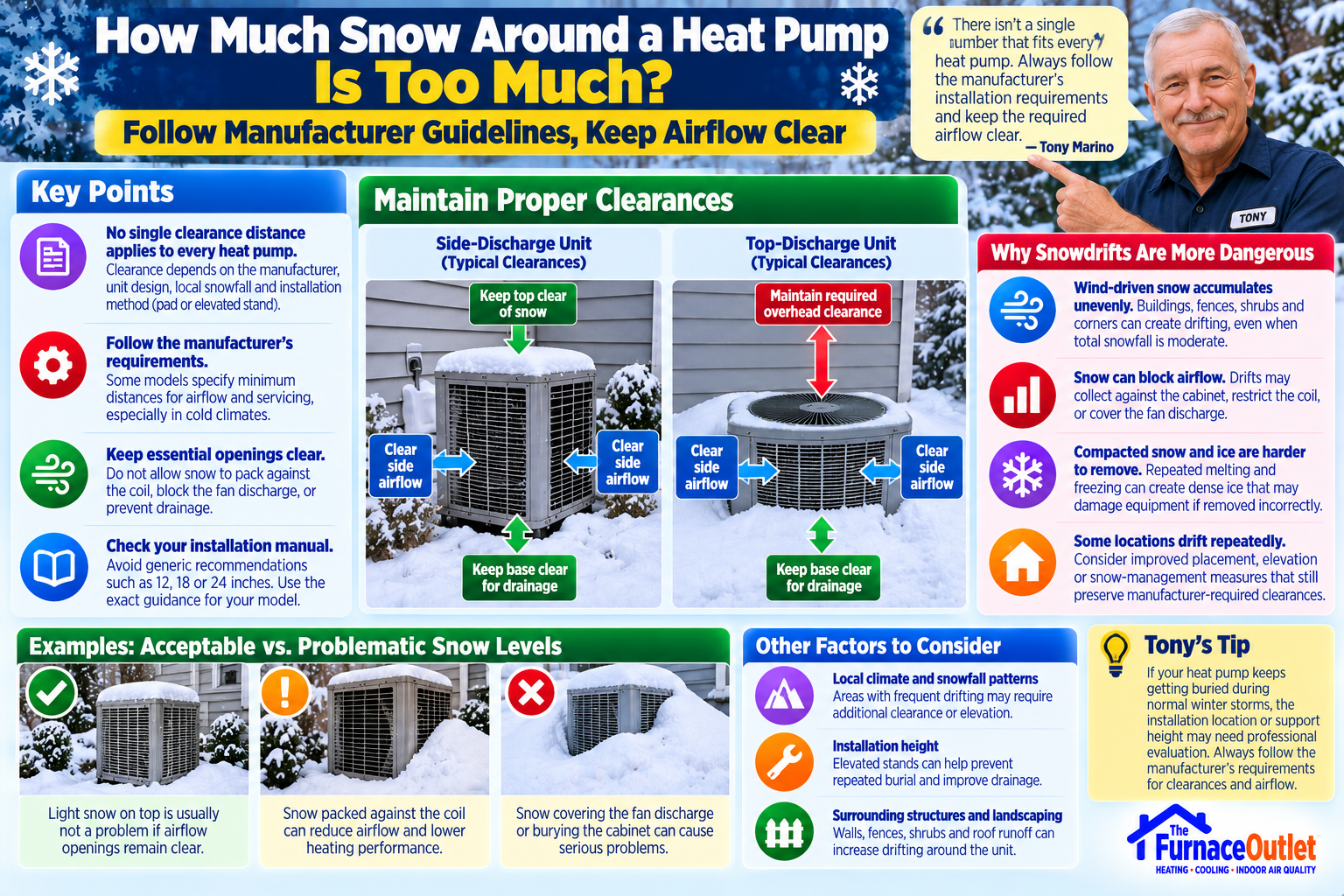
Wind-driven snow can accumulate unevenly around buildings, fences, shrubs, and outdoor equipment. A heat pump installed beside a wall or in a sheltered corner may experience significant drifting even when total snowfall is moderate. Snow can gradually collect against the cabinet, restrict the coil’s airflow, or form a dense barrier around the fan discharge. Because drifting depends on wind direction and nearby structures, the same installation may remain clear during one storm and become obstructed during another.
Snowdrifts can also become compacted and difficult to remove safely. Repeated melting and freezing may transform soft snow into hard ice that attaches to the cabinet or surrounding ground. If homeowners attempt to break this material away with metal tools, they risk damaging coil fins, refrigerant tubing, electrical components, or fan assemblies.
For homes in areas with frequent drifting, preventive measures may involve improved equipment placement, appropriate elevation, or carefully designed snow-management arrangements. However, any proposed barrier must preserve manufacturer-required airflow clearances. A poorly positioned snow fence or decorative enclosure can create additional restrictions even if it reduces visible snowfall around the unit.
Snow collecting on the top of an outdoor heat pump is not always an immediate concern. The effect depends on the cabinet design, whether the top contains a fan discharge, and whether the snow is loose or compacted. Some outdoor units discharge air upward through a top-mounted fan, making obstruction of that opening particularly important. Other systems discharge air horizontally and may tolerate limited snow accumulation on an otherwise unobstructed cabinet roof.
If loose snow can be removed safely from an accessible exterior surface without approaching moving components, electrical connections, or delicate coil fins, gentle removal may be appropriate. However, homeowners should never push tools through fan grilles, scrape protective coatings, or attempt to remove tightly frozen ice from internal components. Equipment should not be approached during unsafe weather or when surrounding surfaces create a slipping hazard.
The safest approach is to follow the manufacturer’s snow-removal instructions and maintain required airflow openings. If snow has become packed into the fan assembly or frozen against sensitive components, stop operating the equipment safely according to manufacturer guidance and arrange professional assistance.
Outdoor airflow is essential because the heat pump depends on surrounding air as its heat source. During heating operation, refrigerant circulating through the outdoor coil absorbs thermal energy from air moved across the heat exchanger. If the outdoor fan cannot maintain sufficient airflow, heat absorption may deteriorate and the refrigeration system may operate outside its intended conditions.
Snow accumulation is only one possible source of restriction. Leaves, outdoor storage, decorative screening, dense vegetation, and nearby structures can also interfere with airflow. In winter, these existing obstructions may become more significant when snow and ice reduce the remaining available space.
The outdoor fan does not necessarily operate continuously, even during a heating request. Many conventional heat pumps intentionally stop the fan during defrost to help warm the coil and melt accumulated frost. Therefore, a stationary fan observed briefly during winter does not automatically indicate failure.
A technician should distinguish normal defrost behavior from a genuine fan or airflow problem before recommending repairs. Homeowners should never reach through the grille or attempt to rotate fan blades manually.
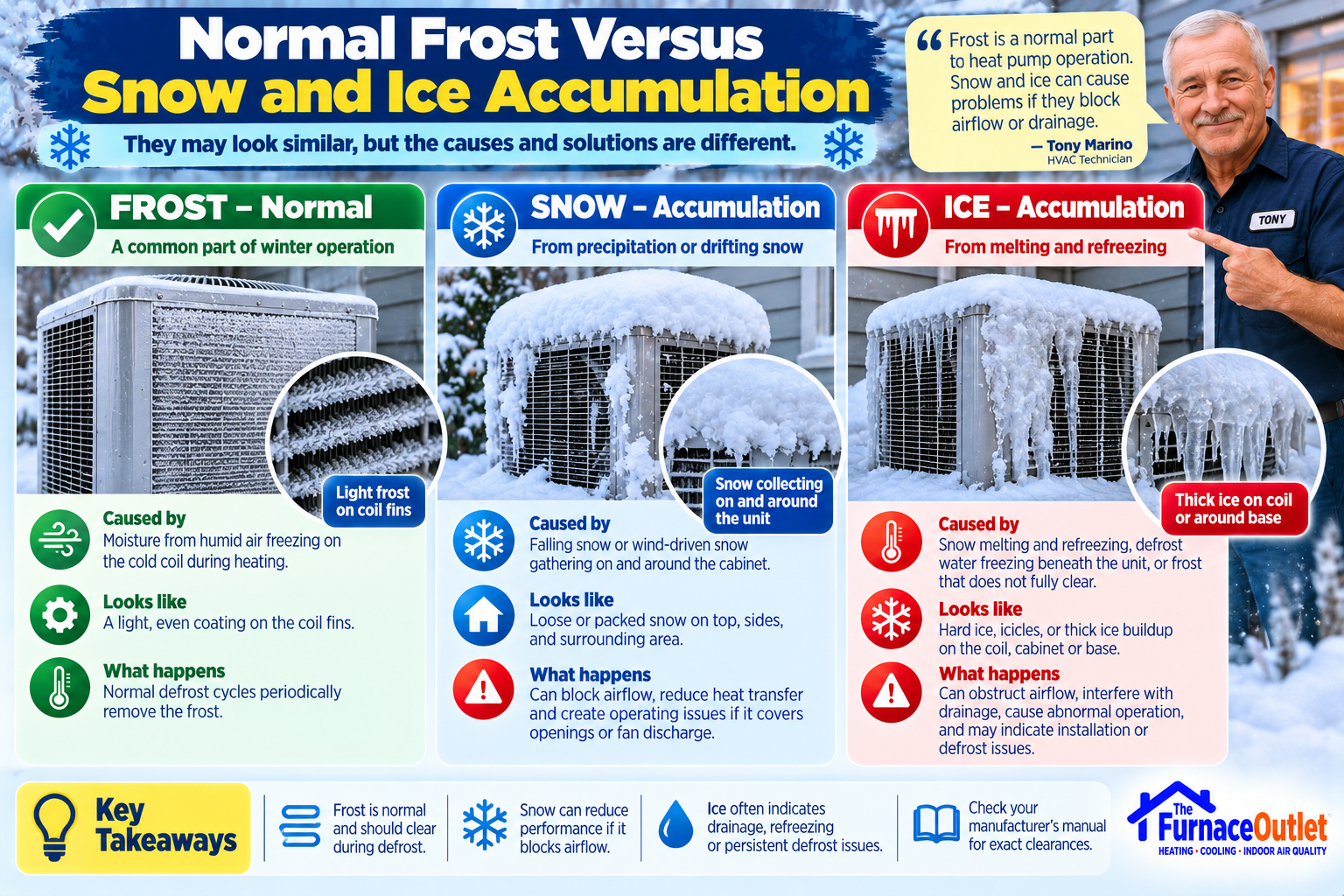
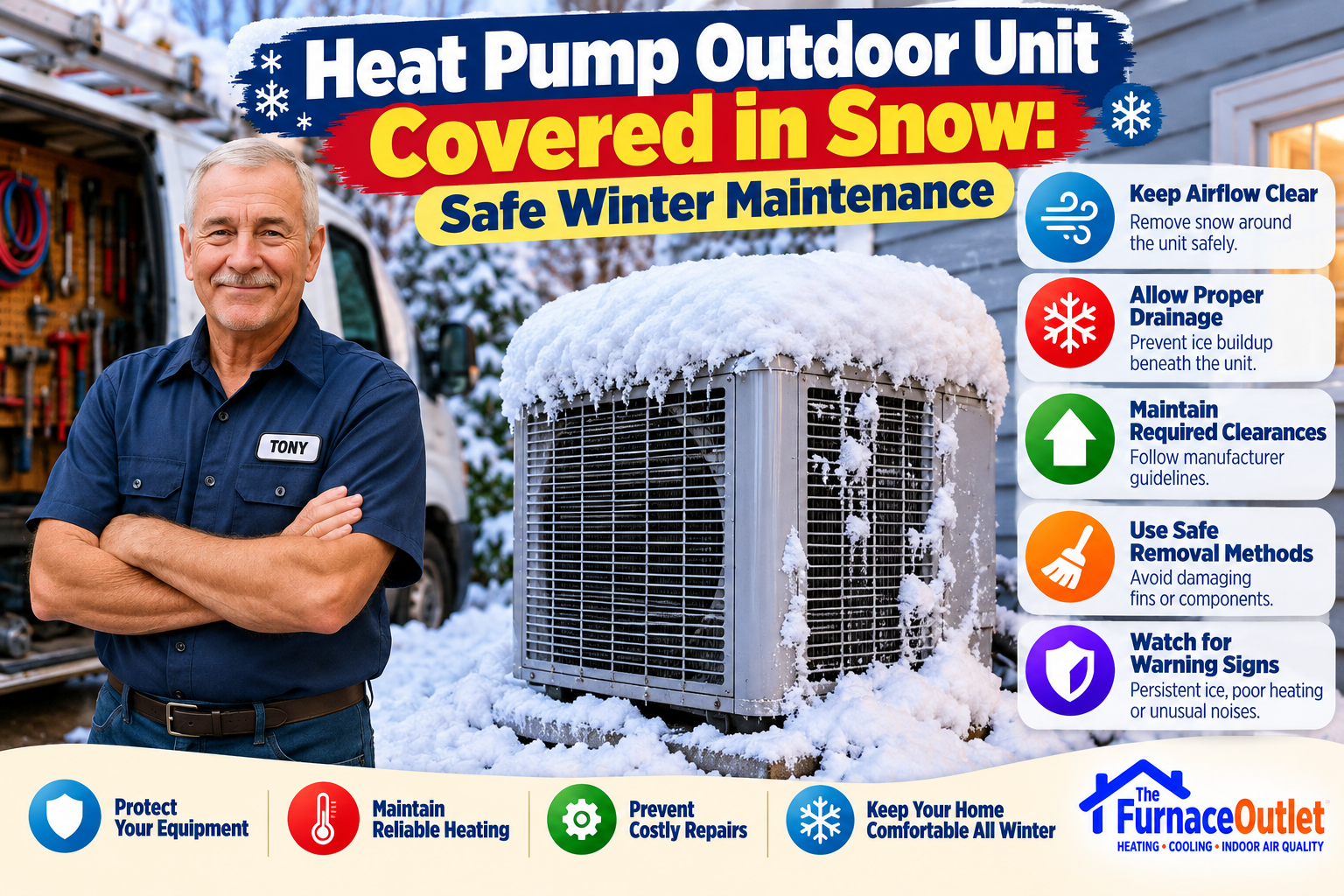
Frost on an outdoor heat pump is not necessarily caused by snowfall. During heating, the outdoor coil may become colder than the freezing point of water. When humid air contacts the cold coil, moisture can condense and freeze, creating a light frost coating across the coil fins. This is a normal physical process under suitable weather conditions, particularly during damp conditions near freezing.
Snow accumulation is different because it originates from precipitation or drifting snow collecting on and around the cabinet. Ice may develop when snow partially melts and refreezes, when defrost water freezes beneath the unit, or when frost remains because defrost is ineffective. These conditions can look similar from a distance but may require different corrective actions.
A normal defrost cycle should periodically remove excessive frost from the coil. However, defrost operation is not intended to eliminate every snowdrift surrounding the equipment or solve poor site drainage. If a large amount of ice forms beneath the cabinet while the coil itself clears successfully, the problem may involve drainage rather than defective defrost controls.
Identifying where snow and ice are accumulating is an important first step before assuming that a mechanical component has failed.
Many conventional air-source heat pumps use reverse-cycle defrost to remove frost from the outdoor coil. When the equipment’s controls determine that defrost is necessary, the refrigeration system temporarily changes operating conditions so warm refrigerant flows through the outdoor heat exchanger. This warms the coil and melts accumulated frost, allowing airflow and heat transfer to recover.
During defrost, the outdoor fan commonly stops to reduce heat loss from the coil. Homeowners may hear a change in operating sound, notice visible water vapor, or observe water dripping beneath the cabinet. These behaviors can be normal when the equipment completes the sequence and returns to heating.
Some ducted systems activate electric auxiliary heating during defrost to offset the temporary reduction in indoor heating. Other systems manage the interruption differently, depending on their design.
Importantly, a successful defrost cycle does not guarantee that snow surrounding the cabinet will disappear. The process is primarily intended to manage frost on the outdoor heat exchanger. Heavy external snow accumulation, blocked discharge openings, or refrozen drainage water may require separate attention.
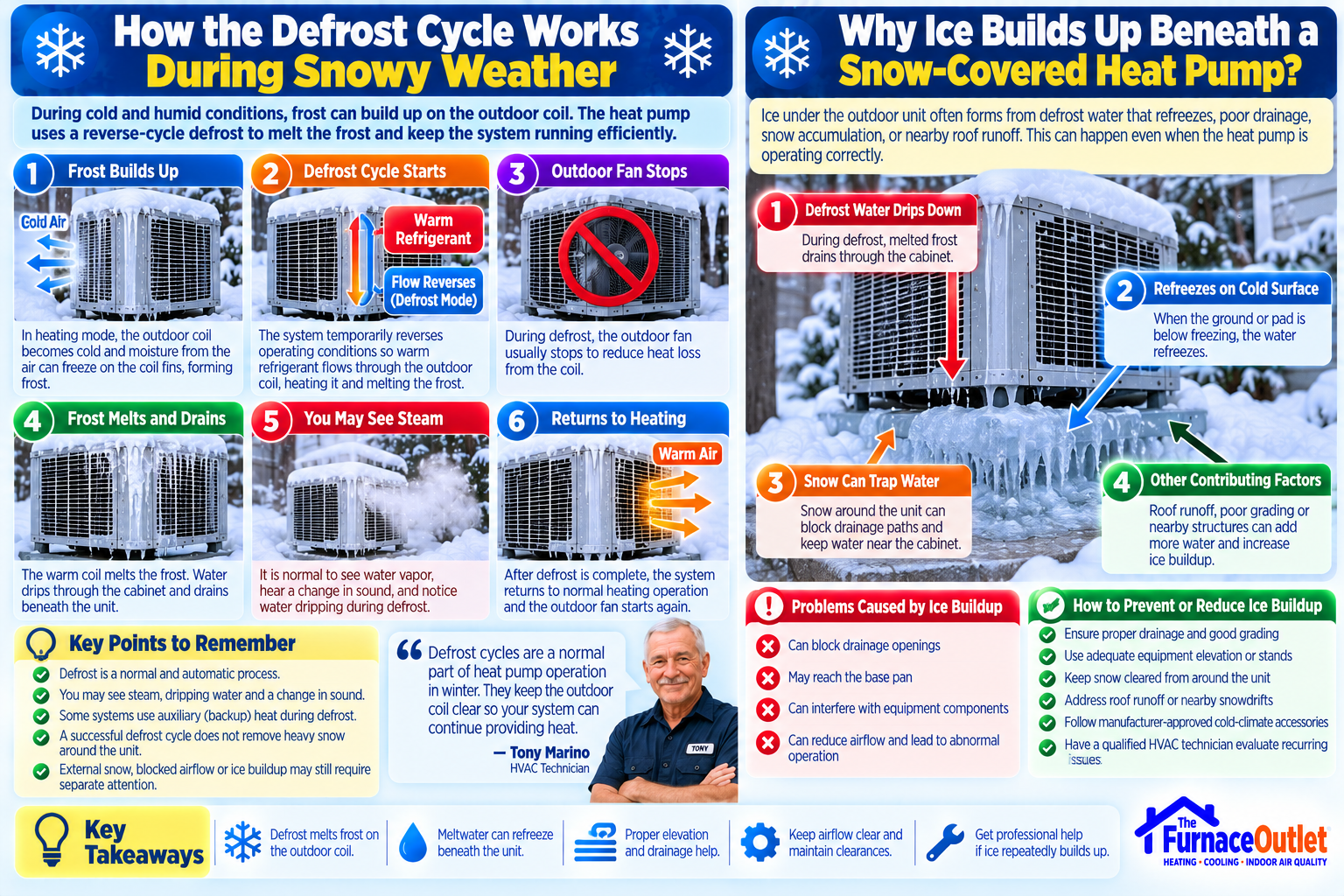
During defrost, accumulated frost melts and drains through the outdoor cabinet. When the surrounding ground, concrete pad, or support surface remains below freezing, this water may refreeze beneath the unit. Over repeated cycles, ice can gradually accumulate into a larger mass, particularly when drainage is poor or the outdoor unit has limited clearance above the ground.
Snow accumulation can make this problem worse by obstructing drainage paths or trapping water around the cabinet. Roof runoff, melting snow from nearby structures, and poorly graded surfaces may also contribute to ice formation independently of the heat pump’s refrigeration system.
If ice grows upward toward the base pan, it may obstruct drainage openings or eventually interfere with equipment components. This can occur even when the heat pump’s defrost controls are operating correctly.
The appropriate correction depends on installation conditions. Improved drainage, adequate equipment elevation, or manufacturer-approved cold-climate accessories may be necessary. Simply removing accumulated ice once may not prevent recurrence if meltwater continues collecting in the same location.
Outdoor heat pump elevation is especially important in regions with frequent snowfall, prolonged freezing temperatures, and repeated defrost cycles. A unit installed directly on a low concrete pad may become surrounded by snow or refrozen meltwater during severe winter conditions. Even when the refrigeration system operates correctly, inadequate clearance can interfere with drainage and airflow.
Cold-climate installations may use elevated stands, wall brackets, or other manufacturer-approved support arrangements to maintain sufficient clearance above expected snow and ice accumulation. However, the appropriate height depends on local conditions, equipment requirements, structural considerations, and applicable installation standards.
Raising an outdoor unit is not a simple homeowner maintenance task. Refrigerant piping, electrical connections, condensate drainage, support stability, vibration, and wind exposure must all be considered. Improperly lifting or repositioning equipment can damage connections and create safety hazards.
If a heat pump repeatedly becomes buried or develops ice reaching the base pan, I recommend asking a qualified contractor to evaluate the installation rather than improvising a support structure.

Homeowners sometimes consider installing a roof, canopy, or decorative enclosure to protect their outdoor heat pump from snow. Although a properly designed structure may reduce direct snow accumulation or roof runoff, an incorrectly installed cover can restrict airflow, trap discharged air, complicate servicing, or create additional icing problems.
The risk depends on equipment design. Top-discharge systems require appropriate overhead airflow clearance, while side-discharge systems have different requirements. A low canopy positioned above a top-discharge fan can interfere with operation even if it keeps snow off the cabinet. Similarly, closely spaced walls or decorative screens can restrict incoming or outgoing air.
A shelter should never be installed solely based on appearance or generic clearance advice. The contractor should review the exact manufacturer’s installation requirements and account for snow shedding, structural loads, drainage, and service access.
A purpose-designed arrangement that preserves airflow may be appropriate in some installations, but covering the unit with a tarp or enclosing it tightly during operation is not a safe substitute.
Unlike equipment that remains unused during winter, an air-source heat pump may need to operate throughout the heating season. Covering the outdoor cabinet with a tarp, plastic sheet, blanket, or fitted storage cover while the equipment is operating can obstruct airflow and interfere with heat transfer.
A cover may also contact moving fan components, become drawn toward ventilation openings, trap moisture, or create abnormal operating conditions. Even if the cover appears loose, wind and equipment airflow can change its position unexpectedly.
Some manufacturers provide covers for specific equipment during extended shutdown or storage, but those products must be used only according to the manufacturer’s instructions. A cover intended for inactive equipment should not be assumed safe during heating operation.
For an active winter heat pump, the priority is maintaining required airflow and drainage rather than sealing the cabinet against the weather. If homeowners are uncertain about an accessory or enclosure, they should consult the manufacturer or a qualified installer before using it.
The safest snow-removal method begins with evaluating the surrounding conditions. Homeowners should avoid approaching the outdoor unit during active blizzards, icy footing, falling roof snow, or other unsafe weather. Once conditions permit, accessible loose snow around the equipment may be removed carefully while preserving the manufacturer’s required airflow and service clearances.
Use gentle methods appropriate for the surrounding ground and landscaping, keeping shovels and other tools away from coil fins, fan grilles, electrical connections, refrigerant piping, and the cabinet itself. Do not push packed snow into the outdoor unit or create a new snowbank directly beside its airflow openings.
Never use metal scrapers, sharp tools, open flames, or improvised heating devices to remove ice from the equipment. Pouring boiling water onto frozen components can cause thermal stress, create additional refreezing hazards, and potentially damage sensitive parts.
If ice is attached to the coil or obstructing the fan, stop operation safely according to manufacturer guidance and arrange qualified service. Homeowner snow removal should remain limited to accessible surrounding areas and safe exterior maintenance.
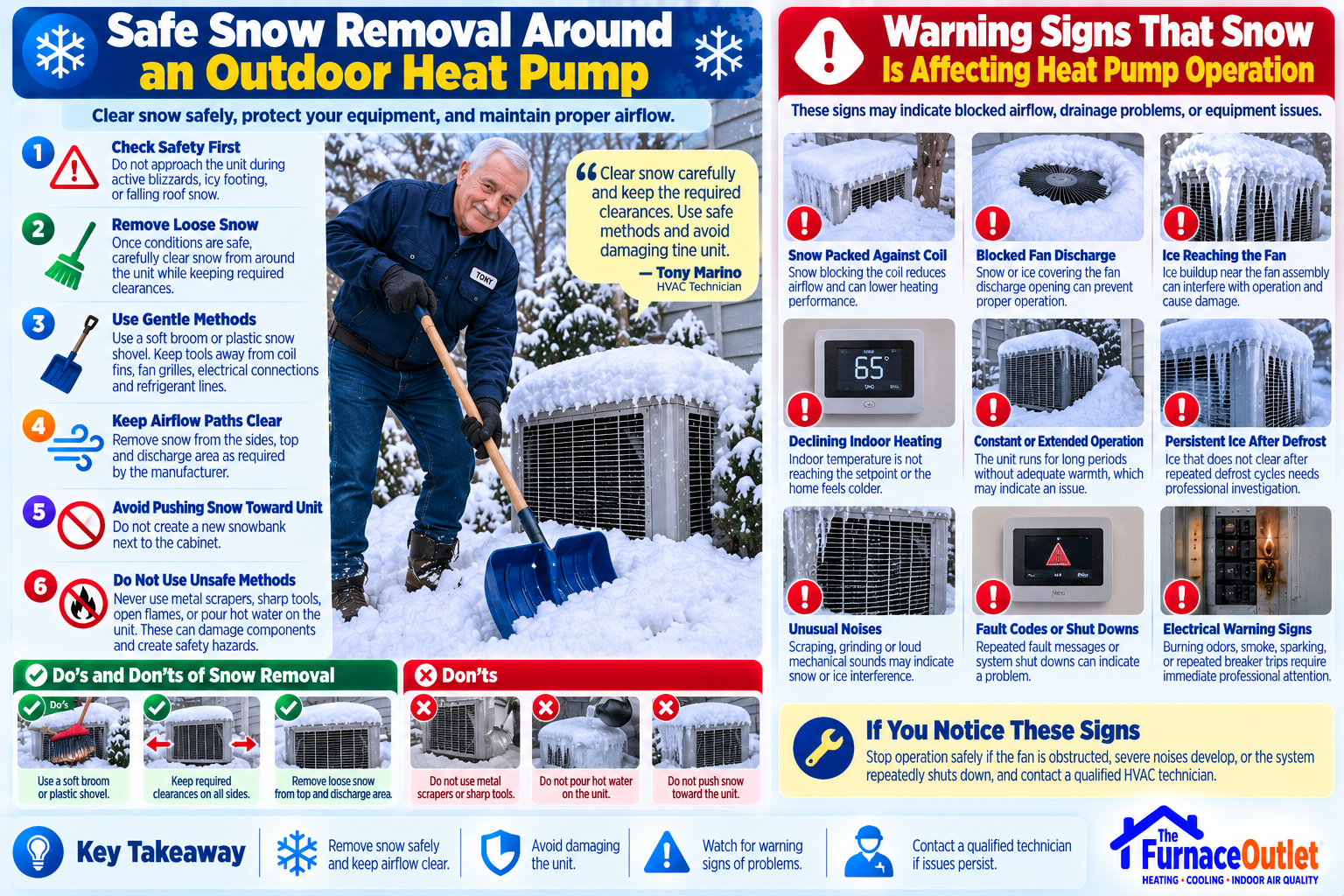
A heat pump surrounded by snow does not automatically have a mechanical problem. However, certain symptoms suggest that airflow, drainage, or equipment operation may be compromised. These include snow packed against coil surfaces, blocked fan discharge openings, ice reaching the fan assembly, repeated protective shutdowns, and declining indoor heating performance.
Homeowners may also notice unusual scraping or grinding noises, prolonged compressor operation without adequate warmth, or fault messages on the thermostat. Persistent ice that does not clear after repeated defrost attempts deserves professional investigation, particularly when indoor comfort deteriorates.
Electrical warning signs require additional caution. Burning odors, smoke, sparking, or repeated breaker trips may indicate hazards beyond ordinary snow accumulation.
If the fan is obstructed, severe mechanical noises develop, or the system repeatedly shuts down, stop operating the affected equipment safely and contact a qualified technician. Repeatedly resetting protective faults without correcting the underlying problem can increase equipment damage.
After the storm has passed and outdoor conditions are safe, inspect the heat pump from a distance before approaching it. Determine whether snow has accumulated against the coil, blocked the fan discharge, or surrounded the cabinet. Check whether large snowbanks, roof runoff, or nearby structures are directing additional snow and water toward the equipment.
Observe whether the thermostat is maintaining indoor temperature and whether the heat pump appears to operate normally. Remember that the outdoor fan may temporarily stop during defrost, so a brief stationary fan is not automatically a failure. Water dripping beneath the unit or visible vapor during defrost may also be normal.
Inspect the accessible indoor air filter and maintain it according to manufacturer instructions. Keep supply registers and return-air grilles unobstructed because indoor airflow remains important during winter heating.
Record unusual noises, persistent ice, fault codes, or changes in indoor comfort. Photographs taken from a safe location may help a technician understand the problem. Do not open equipment panels, touch electrical components, manipulate refrigerant connections, or attempt to free frozen fan blades.
Professional diagnosis begins with identifying the exact heat pump model, installation arrangement, outdoor clearances, and manufacturer operating requirements. The technician should determine whether snow is restricting airflow, interfering with the fan, blocking drainage, or contributing to abnormal ice accumulation.
The technician may then evaluate the equipment’s operating mode, outdoor fan behavior, defrost sequence, sensor readings, and diagnostic fault history. If heating performance remains inadequate, refrigeration measurements and compressor operating information may also be required according to manufacturer procedures.
Installation conditions deserve equal attention. Equipment elevation, surrounding grading, roof runoff, snowdrift patterns, and base-pan drainage may explain recurring problems even when the refrigeration system functions correctly.
A complete diagnosis should distinguish a genuine mechanical failure from an environmental or installation problem. Replacing a defrost board will not correct a snowdrift that repeatedly blocks airflow, while raising the unit will not repair a malfunctioning reversing valve.
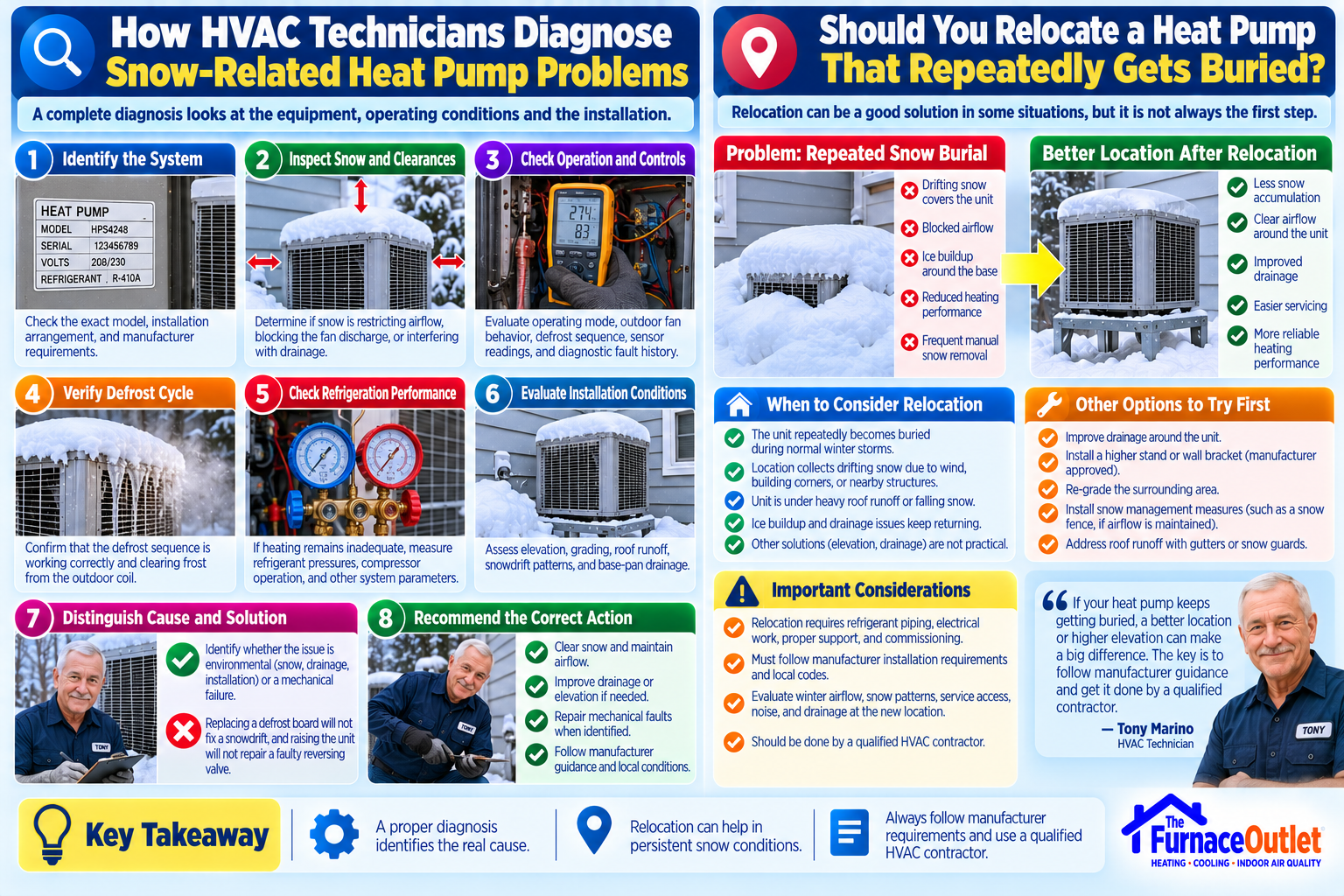
Relocation may deserve consideration when an outdoor heat pump repeatedly becomes obstructed despite reasonable maintenance and appropriate snow removal. Some locations naturally collect drifting snow because of prevailing winds, building corners, roof geometry, or surrounding structures. If the equipment sits directly beneath heavy roof runoff or falling snow, the installation may also experience recurring icing and physical damage risks.
However, relocation should not be the first response to every winter obstruction. Improved drainage, a suitable elevated stand, or other manufacturer-approved installation modifications may address the problem without moving the entire system.
Relocating a heat pump involves refrigerant piping, electrical connections, structural support, airflow requirements, and equipment commissioning. These considerations make it a professional installation project rather than a homeowner adjustment.
The contractor should compare potential locations based on winter airflow, snow accumulation, service access, noise, drainage, and manufacturer requirements before recommending changes.
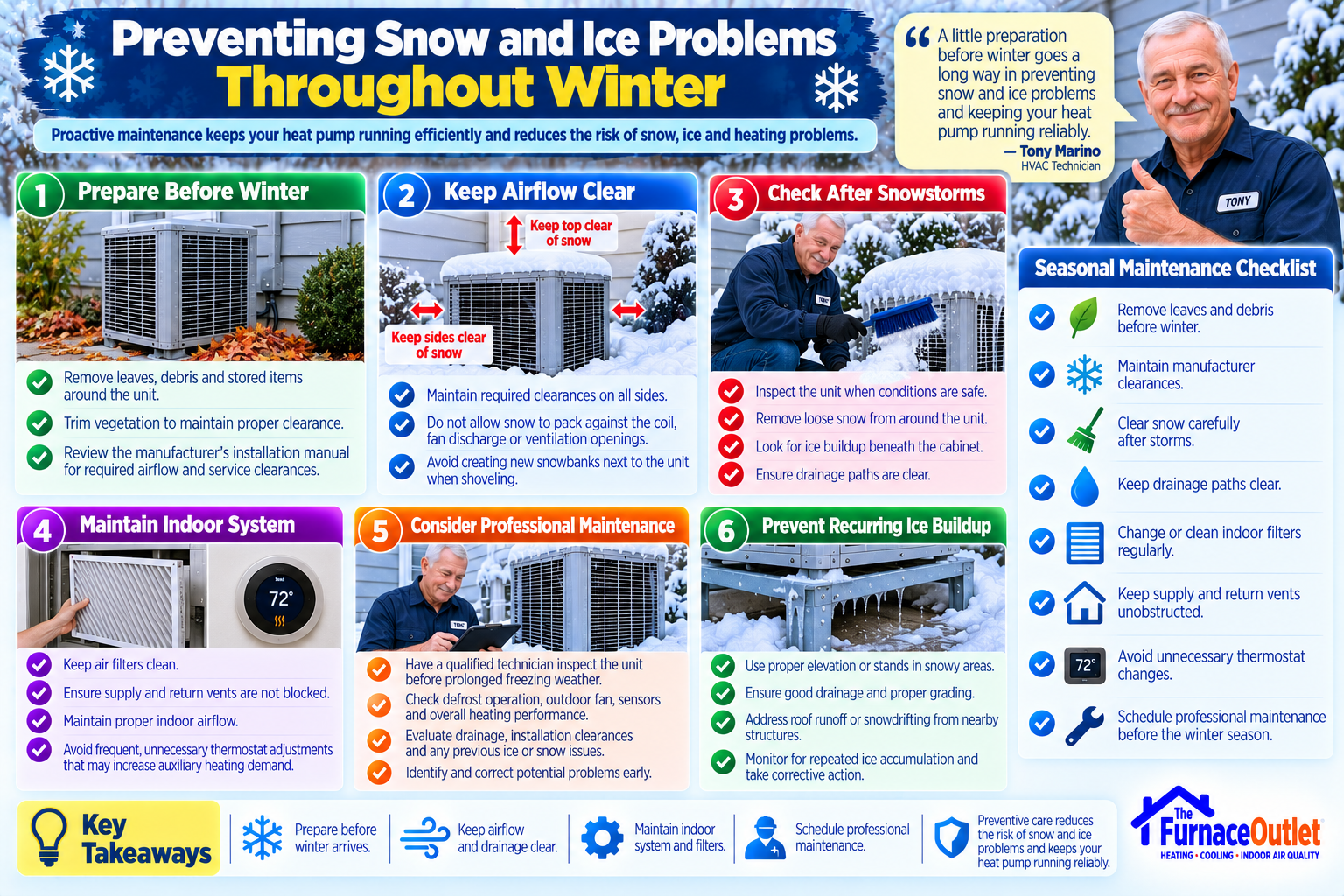
Effective winter maintenance begins before the first major snowfall. Inspect the surrounding area for leaves, loose debris, stored objects, or vegetation that could restrict airflow once snow accumulates. Review the equipment’s installation instructions so you understand which openings and clearances must remain unobstructed.
After significant storms, inspect the outdoor unit when conditions are safe and remove accessible loose snow from surrounding areas without contacting sensitive components. Pay attention to repeated ice accumulation beneath the cabinet, particularly where meltwater may refreeze and gradually rise toward the equipment.
Indoor maintenance also matters. Keep filters clean, preserve supply and return airflow, and avoid unnecessary thermostat adjustments that may increase supplemental heating demand on certain systems.
For the 2026–2027 winter season, I recommend arranging professional maintenance before prolonged freezing weather arrives. A qualified technician can evaluate heating performance, defrost operation, outdoor fan condition, drainage, relevant sensors, and installation clearances. Preventive attention to recurring snow and ice problems may reduce the likelihood of an inconvenient heating failure during severe weather.
Yes. Some snow accumulation around or on an outdoor cabinet can be normal during winter. The concern is whether snow blocks required airflow openings, interferes with the fan, obstructs drainage, or affects heating performance. Follow the exact manufacturer’s clearance requirements.
Many properly installed heat pumps can operate during heavy snowfall, provided conditions remain within their approved operating range and airflow is maintained. If drifting snow buries the unit or blocks the fan discharge, operation may become impaired.
It depends on the equipment design and whether snow obstructs required openings. Loose snow on an accessible exterior surface may sometimes be removed gently, but homeowners should never scrape frozen components, reach through fan grilles, or interfere with moving parts.
Ice beneath the unit may form when defrost meltwater or surrounding snowmelt refreezes on a cold surface. Repeated accumulation can indicate inadequate drainage, insufficient elevation, or surrounding water runoff. It does not automatically mean the defrost controls have failed.
Do not cover an operating outdoor heat pump with a tarp or storage cover. Restricting airflow can interfere with heating performance and create equipment hazards. Use accessories only when approved by the manufacturer for the intended operating conditions.
Do not reach through the grille or attempt to free the fan manually. Stop operating the affected equipment safely according to manufacturer guidance and contact a qualified HVAC technician if ice or packed snow cannot be cleared without touching equipment components.
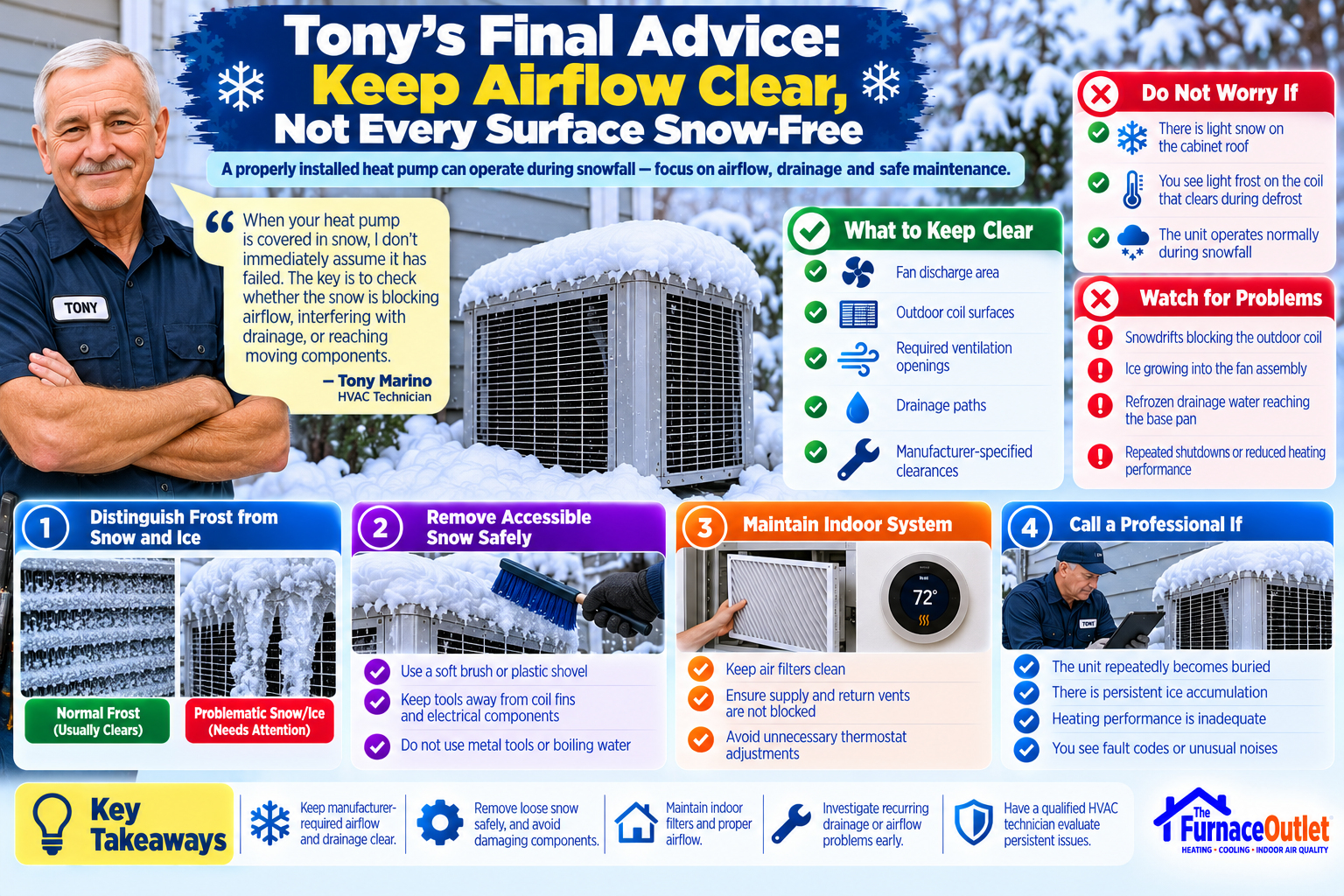
When a homeowner tells me their outdoor heat pump is covered in snow, I do not immediately assume the equipment has failed. I first want to know whether the snow is simply resting on an exterior surface or whether it is blocking airflow, interfering with drainage, or reaching moving components. A properly installed heat pump can operate during snowfall, but it cannot perform as intended when its required ventilation paths are buried or its fan becomes obstructed.
I also want homeowners to distinguish normal frost and defrost water from serious snow and ice accumulation. Light frost that clears during defrost is expected under suitable winter conditions. Snowdrifts blocking the outdoor coil, ice growing into the fan assembly, or refrozen drainage water reaching the base pan require a different response. These problems may involve maintenance, installation clearance, drainage, or mechanical faults, and the correct solution depends on identifying the actual cause.
My recommendation is to maintain manufacturer-required airflow and drainage clearances, remove accessible loose snow safely, and avoid touching frozen equipment components. If the heat pump repeatedly becomes buried, develops persistent ice, or struggles to maintain indoor comfort, have a qualified HVAC technician evaluate the installation and operating sequence before authorizing major repairs.
For the 2026–2027 winter season, inspect the outdoor unit after significant storms when conditions are safe, maintain indoor filters, and investigate recurring drainage or airflow restrictions early. A properly selected, installed, and maintained heat pump should continue providing dependable heating throughout the winter conditions for which it was designed.
This article provides general homeowner education and does not replace professional HVAC diagnosis or manufacturer instructions. Outdoor heat pumps contain hazardous electrical components, moving fan assemblies, pressurized refrigerant, and protective controls. Snow and ice removal can also involve slipping hazards, falling snow, and contact with energized equipment. Homeowners should not remove electrical panels, reach through fan grilles, chip ice from coils, bypass safety devices, or attempt unauthorized repairs. Persistent heating failures, mechanical obstructions, and electrical warning signs should be evaluated by qualified professionals.
U.S. Department of Energy — Air-Source Heat Pumps: https://www.energystar.gov/products/air_source_heat_pumps
U.S. Department of Energy — Operating and Maintaining Your Heat Pump: https://www.energy.gov/heat-pumps
ENERGY STAR — Air-Source Heat Pumps: https://www.energystar.gov/products/air_source_heat_pumps
Northeast Energy Efficiency Partnerships — Cold Climate Air-Source Heat Pump List: https://ashp.neep.org/
U.S. Department of Energy — Weatherize Your Home: https://www.energy.gov/cmei/scep/wap/weatherization-assistance-program
These resources provide general guidance on heat pump operation, cold-climate performance, maintenance, and energy efficiency. Always consult the exact equipment manufacturer’s installation and operating documentation for snow clearances, approved accessories, and safe maintenance procedures.