Newsletter Subscribe
Enter your email address below and subscribe to our newsletter

HVAC made simple
By Tony Marino | The Trusted HVAC Tech | The Furnace Outlet | Updated November 2026
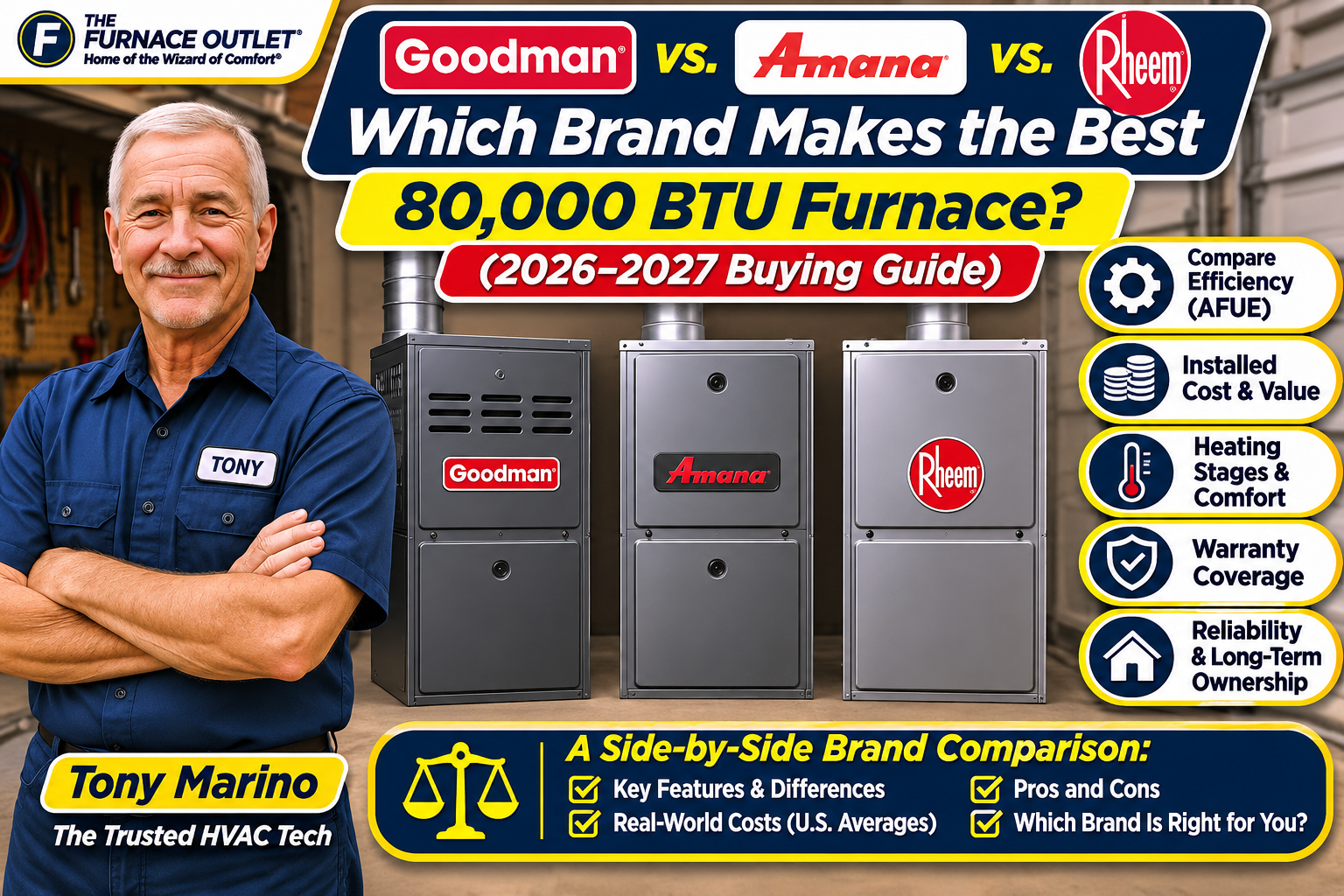
If you’re replacing an aging gas furnace, there’s a good chance you’ve come across Goodman, Amana, and Rheem. All three manufacture residential heating equipment, and each offers furnace models in or around the 80,000 BTU input-capacity category. But when you’re spending several thousand dollars on a new heating system, choosing between them isn’t always straightforward.
I’ve worked around enough residential furnaces to know that the most expensive brand isn’t necessarily the best choice. A properly sized Goodman can deliver dependable heating, an Amana may offer attractive warranty protection, and a Rheem can provide excellent comfort features when matched to the right home.
The real differences come down to efficiency, heating stages, blower technology, warranty coverage, installation quality, and total ownership cost. Let’s compare these brands from a practical homeowner’s perspective rather than relying on advertising claims.
An 80,000 BTU gas furnace typically has a nominal fuel input capacity of 80,000 British thermal units per hour. However, the amount of useful heat delivered depends on the furnace’s efficiency rating, known as AFUE.
For example, an 80% AFUE furnace with an 80,000 BTU input provides approximately 64,000 BTU per hour of rated heating output under the simplified input-output calculation. A 96% AFUE furnace with the same input delivers approximately 76,800 BTU per hour.
That difference is significant, especially when replacing an older furnace. However, actual rated output should always be verified using the manufacturer’s specifications.
An 80,000 BTU furnace isn’t automatically suitable for every medium-sized or large house. Climate, insulation, air leakage, window performance, and ceiling height all influence heating requirements.
Before choosing any brand, ask your contractor to perform a Manual J heating-load calculation. Buying more heating capacity than your home needs can cause short cycling, uneven temperatures, and unnecessary equipment wear.
Goodman has earned a reputation for offering straightforward residential HVAC equipment at competitive prices. Its furnace lineup includes single-stage and two-stage models, with different blower configurations and efficiency ratings.
For homeowners considering an 80,000 BTU furnace, Goodman’s high-efficiency product families include models with AFUE ratings reaching approximately 96% or higher, depending on the configuration.
The official Goodman gas furnace lineup provides information about available furnace families, efficiency ratings, and operating features. Goodman’s biggest advantage is affordability. A conventional single-stage furnace with an ECM blower may provide everything a homeowner needs without the higher cost of advanced communicating controls.
However, entry-level Goodman models may offer fewer comfort adjustments than premium two-stage or modulating furnaces. That doesn’t make them inferior for every application; it simply means homeowners should compare the actual equipment features. If budget is your primary concern, Goodman deserves a place on your shortlist.
Amana and Goodman belong to the same broader manufacturing organization under Daikin. Because of that relationship, certain equipment platforms and technologies may be similar, although individual models, controls, and warranty packages can differ. Amana offers residential gas furnaces with single-stage, two-stage, and variable-speed operating configurations. Selected models feature high AFUE ratings, insulated cabinets, ECM blower motors, and advanced diagnostic controls.
According to Amana’s official furnace product information, the brand offers multiple efficiency and comfort options for different residential applications. One of Amana’s strongest selling points is warranty protection. Certain qualifying models offer enhanced heat-exchanger or unit-replacement coverage, subject to registration and other warranty conditions.
However, I wouldn’t automatically pay more for an Amana simply because its warranty sounds better. Homeowners should compare the exact written warranty terms, labor exclusions, and local service support. When similarly equipped Goodman and Amana furnaces are priced close together, warranty differences may help determine which offers better value.
Rheem is another established HVAC manufacturer with a broad residential heating lineup. Its gas furnaces include conventional single-stage equipment as well as two-stage and more advanced heating configurations. Depending on the model, Rheem furnaces may offer high-efficiency operation, ECM blower motors, diagnostic features, and comfort-oriented controls.
Rheem’s official gas furnace product collection provides an overview of available heating equipment and technology.
Rheem’s appeal often lies in the combination of conventional reliability-focused design and higher-tier comfort options. Two-stage models can operate at reduced heating output during milder weather, potentially providing longer heating cycles and more consistent indoor temperatures. However, Rheem isn’t automatically quieter, more efficient, or more reliable than Goodman or Amana. Those comparisons depend on the exact models and installation conditions. A well-installed Rheem furnace can be a strong choice, particularly when a local contractor has extensive experience servicing the brand.
All three manufacturers offer high-efficiency gas furnaces, so it’s important to compare specific AFUE ratings rather than brand reputations. A Goodman furnace rated at 96% AFUE and an Amana furnace with the same rating have essentially equivalent standardized annual fuel-conversion efficiency. A Rheem model rated at 97% AFUE would use slightly less fuel to deliver the same amount of useful heat, assuming comparable conditions.
However, the difference between 96% and 97% AFUE is relatively small. It generally won’t justify a major price premium based on fuel savings alone. The U.S. Department of Energy’s furnace efficiency guidance explains how AFUE affects heating efficiency and why installation and maintenance matter. For homeowners replacing an older 80% AFUE furnace with a 96% AFUE model, the potential reduction in fuel consumption is much more substantial than the difference between two modern high-efficiency furnaces.
One of the most important differences between furnace models is how they control heating output. A single-stage furnace generally operates at one main heating level whenever the thermostat calls for heat. These systems are relatively straightforward and typically less expensive. A two-stage furnace can operate at a lower heating output during moderate weather and increase to full capacity when needed. This can improve temperature consistency and reduce noticeable hot-and-cold swings.
Some premium furnaces offer modulating heating, allowing more precise adjustments to output. Goodman, Amana, and Rheem all offer different operating configurations across their product ranges, although availability varies by capacity and model. For a well-insulated home with relatively predictable heating demand, a properly sized single-stage furnace may be sufficient. For homeowners prioritizing comfort and quieter operation, a two-stage system may be worth the additional investment.
Furnace noise depends on more than the manufacturer’s name. Blower speed, cabinet insulation, ductwork design, gas-valve operation, and installation quality all influence sound levels. Premium models with variable-speed blowers may operate more quietly during lower-demand conditions because they can move air at reduced speeds.
However, even a high-end furnace can become noisy when connected to undersized ductwork or restrictive air filters. Rheem, Goodman, and Amana all offer models with features intended to improve airflow control and reduce operating noise. If quiet operation is particularly important, ask your contractor to compare the exact furnace configurations and evaluate whether your ductwork can support the required airflow.
For preliminary U.S. budgeting, a conventional 80,000 BTU Goodman gas furnace installation may cost approximately $3,500–$6,500. A comparable Amana system might fall around $4,000–$7,000, while Rheem installations may range from approximately $4,000–$7,500.
These are broad planning estimates, not verified national averages or manufacturer-specific quotations. Premium two-stage or modulating systems and complex installations can exceed these ranges. The final price depends on AFUE efficiency, venting requirements, local labor rates, ductwork modifications, and whether existing gas or electrical connections need upgrading.
An 80% AFUE furnace may require different venting arrangements from a 96% condensing furnace. Replacing an older conventional furnace with a high-efficiency model can therefore involve additional vent piping and condensate drainage work. Always request a complete installed quotation rather than comparing equipment-only prices.
Homeowners naturally want to know which furnace will provide the fewest repairs over its lifetime. Unfortunately, there isn’t enough consistent, independently verified, model-specific failure-rate data to declare Goodman, Amana, or Rheem the universal reliability winner. All three manufacturers produce established residential heating equipment, but individual models differ in components, complexity, and service requirements.
Installation quality is especially important. Incorrect gas pressure, inadequate airflow, improper venting, or poor combustion setup can create problems regardless of the furnace brand. Regular maintenance also matters. Filters, burners, flame sensors, condensate drainage, and safety controls should be inspected according to manufacturer recommendations.
I would rather see a homeowner purchase a properly sized midrange furnace from a skilled installer than spend extra money on premium equipment installed without adequate testing.
Warranty protection can influence the long-term cost of furnace ownership, particularly when expensive components fail. Goodman and Amana offer limited parts and heat-exchanger warranties on eligible models, with enhanced coverage available for certain equipment under specified conditions. Rheem also provides limited warranty protection, with coverage varying by furnace family and registration requirements.
The official Rheem warranty information explains how homeowners can review applicable coverage and registration requirements. Manufacturer warranties commonly exclude labor and diagnostic charges, meaning a covered replacement part may still involve out-of-pocket repair expenses. Before purchasing, compare the actual warranty certificates and ask whether your contractor provides a separate labor warranty.
For homeowners in colder regions, high-efficiency heating can provide meaningful fuel savings over the furnace’s operating life.
A 95–97% AFUE furnace may be particularly attractive where winter heating demand is substantial and natural gas costs are significant.
Two-stage heating can also improve comfort during long heating seasons by allowing the furnace to operate at reduced output when full capacity isn’t necessary.
However, brand choice should come after proper heating-load calculations and evaluation of venting, ductwork, and installation requirements.
A correctly sized Goodman, Amana, or Rheem high-efficiency furnace can be suitable for cold climates when installed according to manufacturer specifications and local codes.
Goodman is an appealing starting point when affordability and straightforward heating performance are the priorities. Its conventional furnace models can provide good value without requiring premium controls. Amana deserves consideration when its warranty package and available comfort features justify the additional cost compared with a similarly equipped Goodman.
Rheem may be particularly attractive when a qualified local contractor offers a competitive installation package and dependable ongoing service. Rather than selecting a brand first, compare equivalent models with similar heating capacity, AFUE ratings, operating stages, and blower technology. The contractor’s installation quality and local service support should carry substantial weight in your final decision.
Is Goodman cheaper than Amana and Rheem? Goodman is generally positioned as a value-oriented brand, although actual installed prices depend on the equipment model, contractor, and location.
Are Goodman and Amana furnaces manufactured by the same company? Both brands are part of Daikin’s HVAC manufacturing organization. Some equipment platforms may be related, but individual models and warranty terms can differ.
Is an 80,000 BTU furnace enough for a 2,000-square-foot house? Possibly, but square footage alone cannot determine heating requirements. A Manual J calculation is necessary to select the appropriate capacity.
Is a 96% AFUE furnace worth the extra money? It may be, especially when replacing an older 80% AFUE furnace in a cold climate. The financial benefit depends on fuel costs, annual heating demand, and the installed price difference.
Which furnace brand has the best warranty? Warranty benefits vary by model, registration, and applicable conditions. Compare the exact written coverage rather than assuming one brand offers the best protection across its entire lineup.
If I were choosing between Goodman, Amana, and Rheem for an 80,000 BTU heating application, I would start with the home’s calculated heating load, not the brand logo. Goodman would be on my shortlist for straightforward value, Amana for its potential warranty advantages, and Rheem for its range of comfort-oriented heating options. But none of these manufacturers automatically wins every comparison.
The best investment is a properly sized furnace with suitable efficiency, dependable local service, a clear warranty, and professional installation. Get at least three detailed quotations, compare equivalent equipment, and make sure the contractor verifies airflow, combustion performance, venting, and safety controls before completing the job.
This article provides general educational information for U.S. homeowners. Equipment specifications, available capacities, efficiency ratings, warranty terms, and installation costs vary by model and region. Pricing figures are illustrative estimates rather than guaranteed quotations. Always obtain a professional heating-load calculation and have gas furnace installation, combustion testing, venting, and electrical work completed by appropriately qualified professionals.