Newsletter Subscribe
Enter your email address below and subscribe to our newsletter

HVAC made simple
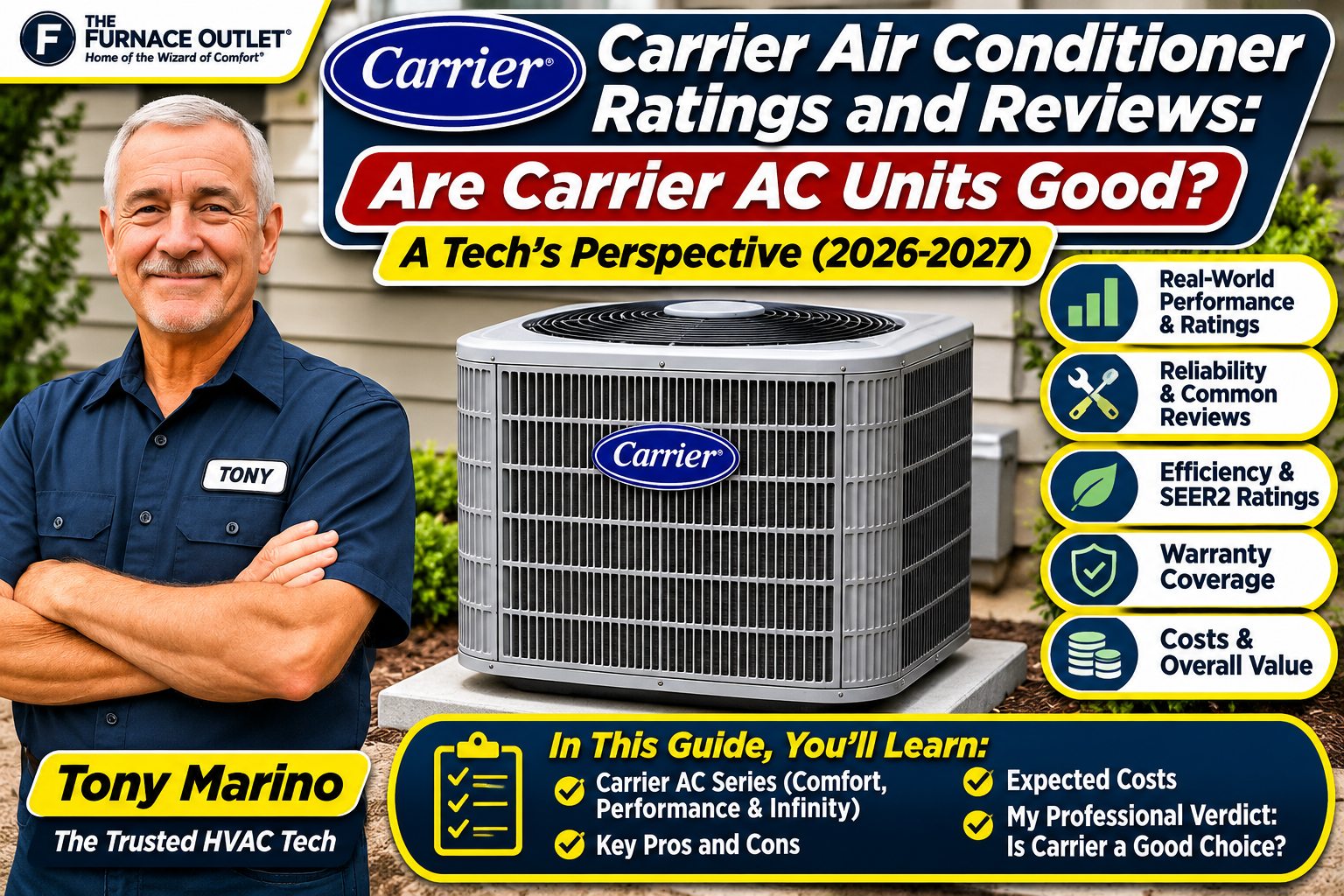
By Tony Marino | The Trusted HVAC Tech | The Furnace Outlet | Updated November 2026
Carrier is one of the most recognizable names in residential air conditioning, but brand recognition doesn’t automatically mean you’re getting the best value. When homeowners ask me whether Carrier air conditioners are good, my answer is generally yes, but with a few important qualifications.
I’ve spent years working around residential HVAC equipment, and I’ve seen premium air conditioners struggle because of poor installation while simpler systems perform reliably for years. Carrier manufactures everything from straightforward single-stage cooling systems to sophisticated variable-speed equipment, so judging the entire brand based on one model doesn’t make much sense.
Carrier’s biggest strengths include its broad product lineup, advanced comfort technology, high-efficiency options, and established dealer network. Its biggest drawbacks are potentially higher installation costs, more expensive repairs on sophisticated equipment, and the importance of choosing compatible controls. If you’re considering Carrier for your next central air conditioner, here’s how I would evaluate its performance, efficiency, reliability, warranties, and overall value.
Carrier is an established American HVAC manufacturer with a long history in air conditioning technology. The company offers residential cooling systems across three main product families: Comfort, Performance, and Infinity. These categories serve different homeowners. Comfort models focus on essential cooling at more accessible prices, Performance models balance efficiency with additional features, and Infinity systems emphasize advanced temperature control, quieter operation, and premium efficiency.
Carrier’s official air conditioner buying guide explains these product tiers and their differences. One important consideration is that not every Carrier system uses the same compressor, electronics, or control technology. Before buying, compare the actual model specifications rather than assuming every unit bearing the Carrier name delivers identical performance.
Carrier’s Comfort Series is designed for homeowners who want conventional central cooling without paying for every premium feature. These systems generally use single-stage compressors, meaning they operate at their primary cooling capacity when running. The main advantage is simplicity. A conventional single-stage air conditioner can provide effective cooling when properly sized and connected to suitable ductwork. Current Comfort configurations can reach approximately 16.5 SEER2 in qualifying matched systems, although ratings vary by model and indoor equipment.
The disadvantage is that single-stage systems cannot adjust compressor capacity as precisely as variable-speed models. That may result in more noticeable temperature changes and less flexible humidity management. For a reasonably insulated home with straightforward cooling requirements, I wouldn’t hesitate to consider a properly installed Carrier Comfort system if the price is competitive.
The Performance Series occupies Carrier’s middle tier and includes equipment offering additional efficiency and comfort features. Depending on the model, Performance air conditioners may use single-stage or two-stage compressors. Two-stage operation allows the system to run at reduced capacity during milder conditions and increase output when additional cooling is needed. Certain Performance configurations offer efficiency ratings reaching approximately 18 SEER2, with specific ratings depending on the matched system.
Some models also support connected diagnostic technology that can help participating contractors evaluate operating conditions. For homeowners who want improved comfort without moving into the most expensive equipment category, Performance models deserve serious consideration. In many installations, I would compare a well-priced Performance system against both entry-level Carrier equipment and premium alternatives before deciding.
Carrier’s Infinity Series represents its higher-end residential cooling technology. Selected systems feature variable-speed compressors, advanced communicating controls, and sophisticated humidity management. The Infinity 21 air conditioner, model 26VNA1, offers up to 21 SEER2 in qualifying configurations and can adjust compressor operation across a broad capacity range.
According to Carrier’s official Infinity 21 specifications, the system also offers sound ratings as low as 55 decibels under specified conditions. Variable-speed technology can help maintain more consistent temperatures by adjusting cooling output instead of repeatedly operating at full capacity. However, premium performance comes with additional cost and complexity. Repairs involving specialized controls or inverter components may be more expensive than repairs on conventional equipment. For homeowners in hot, humid climates who value quiet operation and precise comfort, Infinity can be attractive. For households with modest cooling needs, the additional investment may not always pay for itself.
Carrier’s cooling efficiency ratings vary significantly across its product lineup. Current qualifying systems reach approximately 16.5 SEER2 in the Comfort tier, 18 SEER2 in Performance, and 21 SEER2 in Infinity. SEER2 measures seasonal cooling efficiency under standardized testing conditions. Higher ratings generally indicate less electricity consumption for comparable cooling output. However, the advertised maximum rating doesn’t necessarily represent the efficiency of every available capacity or indoor equipment combination.
The U.S. Department of Energy’s central air conditioner efficiency guidance explains why certified efficiency ratings matter when comparing equipment. Always ask your contractor for the complete matched-system rating rather than relying solely on the outdoor condenser’s advertised efficiency.
Carrier has an established manufacturing history and produces equipment across several performance categories. However, that doesn’t mean every model will experience the same repair frequency or service life. There isn’t enough consistent, independently verified, model-specific failure-rate information to assign Carrier a universal reliability score against every competitor. Reliability depends on compressor design, electrical components, installation quality, maintenance, climate, and operating conditions.
In my experience, incorrect refrigerant charging, inadequate airflow, poor ductwork, and installation mistakes can cause problems regardless of equipment price. A properly installed Carrier Comfort system may provide better long-term value than an expensive Infinity system installed without adequate testing. I recommend evaluating the installing contractor just as carefully as the air conditioner itself.
Online customer ratings can be useful, but they need context. A homeowner reviewing a Carrier Comfort model may have a very different experience from someone operating an Infinity variable-speed system. Some customers praise Carrier equipment for cooling performance, quiet operation, and comfort features. Others report concerns about installation costs, repair expenses, or service experiences.
These opinions are worth reading, but individual reviews don’t establish a brand-wide failure rate. A meaningful review should identify the exact model, equipment age, installation conditions, and nature of the complaint. I would be cautious about websites that assign Carrier a precise reliability score without explaining their methodology or identifying the products being evaluated. For a serious purchase, compare model-specific reviews alongside warranty terms, contractor reputation, and actual equipment specifications.
Noise performance is one area where Carrier’s premium equipment can offer a noticeable advantage. Selected Infinity systems have published sound ratings as low as 55 decibels, while certain Performance and Comfort models have minimum published ratings around 67 and 71 decibels, respectively. These are manufacturer-reported values for specific configurations, not guaranteed sound levels at every installation.
Actual noise depends on compressor operation, fan speed, installation location, nearby surfaces, and equipment condition. If your outdoor unit sits near a bedroom, patio, or neighboring house, quieter equipment may justify additional spending. However, proper placement and installation can also make a substantial difference, even with conventional systems.
Carrier air conditioner installation costs vary considerably by equipment capacity, efficiency, contractor, and geographic market. Carrier’s published 2026 pricing guidance places central air conditioning installations broadly around $3,000–$15,000 or more, depending on equipment and project requirements. For practical budgeting, a conventional Carrier Comfort replacement may fall toward the lower portion of that range, while advanced Infinity installations may approach or exceed the upper end.
These figures aren’t model-specific quotations. Indoor coil replacement, electrical upgrades, refrigerant piping, ductwork modifications, and labor can significantly affect the final price. The Carrier air conditioner pricing guide provides additional context on how equipment tiers and installation complexity influence cost. I recommend obtaining at least three detailed quotations before committing to a replacement.
Carrier competes with several established residential HVAC manufacturers, each offering different equipment tiers and pricing strategies. Trane and Lennox both offer premium cooling technologies, including high-efficiency variable-capacity systems. Goodman generally emphasizes value-oriented equipment, while Rheem provides conventional and higher-efficiency options across its lineup.
Carrier’s advantage is its broad selection, allowing homeowners to choose between relatively straightforward systems and advanced communicating equipment. However, brand reputation alone doesn’t establish superior reliability or operating efficiency. A Goodman system with a strong installation package may offer better value than a more expensive Carrier configuration. Conversely, a premium Carrier system may be worth the additional cost when precise humidity control and quiet operation are priorities.
Compare equivalent capacities, SEER2 ratings, compressor technologies, warranties, and complete installation prices before making a decision.
Carrier offers limited warranty protection on eligible residential cooling equipment, but coverage depends on the model, registration, installation date, and applicable terms. Carrier’s current Consumer Choice Warranty program allows eligible replacement-system owners, through participating dealers and timely registration, to choose between a 10-year parts-only limited warranty and a five-year parts plus three-year labor limited warranty.
Certain eligibility conditions and exclusions apply, and homeowners should confirm the specific coverage available for their installation. The official Carrier warranty information explains registration requirements and coverage options. A manufacturer warranty doesn’t automatically cover every repair expense. Diagnostic fees, refrigerant, and other charges may remain the homeowner’s responsibility depending on the warranty.
Before purchasing, ask your contractor to explain both manufacturer protection and any separate installation labor warranty.
Many newer Carrier residential air conditioners use Puron Advance, Carrier’s branding for R-454B refrigerant. R-454B has a lower global warming potential than R-410A and is classified as an A2L refrigerant, requiring appropriately designed equipment and installation procedures. Older Carrier systems may use R-410A, so homeowners should verify the refrigerant specified on the exact equipment nameplate. Refrigerants aren’t interchangeable. An existing R-410A system cannot simply be converted to R-454B by changing the refrigerant charge. Qualified HVAC professionals must follow manufacturer instructions and applicable safety requirements when installing or servicing these systems.
A central air conditioner may provide approximately 10–15 years or more of service, but no manufacturer can guarantee a specific lifespan for every installation. Carrier equipment is subject to the same environmental and operating stresses that affect other central cooling systems. Hot climates, heavy operating hours, coastal corrosion, poor maintenance, and electrical problems can shorten service life.
Regular filter replacement, outdoor coil cleaning, condensate drainage maintenance, and professional inspections can help preserve equipment performance. If your existing Carrier system is approaching 15 years old and requires a major compressor or refrigerant-system repair, compare the repair cost against the benefits of replacement.
For homeowners prioritizing affordable conventional cooling, Carrier Comfort may provide everything necessary without unnecessary complexity. For those seeking a balance of efficiency, comfort, and price, I would give the Performance Series serious consideration. For homeowners who want premium humidity management, quiet operation, and variable-speed technology, Infinity offers compelling features when the budget supports them.
The correct choice also depends on your home’s cooling load, ductwork, climate, and expected length of ownership. An expensive system won’t compensate for inadequate insulation, major air leaks, or poorly designed ductwork.
Are Carrier air conditioners good quality? Carrier offers established residential cooling equipment across multiple price and performance tiers. Its systems can provide effective cooling when correctly sized, installed, and maintained, but reliability varies by model and operating conditions.
Is Carrier better than Goodman? Carrier offers more premium comfort technologies across its lineup, while Goodman generally emphasizes affordability. The better value depends on the exact equipment and complete installation package.
Which Carrier air conditioner is the most efficient? Among the currently highlighted residential central AC configurations, the Infinity 21 offers up to 21 SEER2. Available models and certified ratings can change, so verify current specifications.
Are Carrier AC repairs expensive? Repairs involving premium communicating controls, inverter electronics, or specialized components can be costly. Conventional models may be simpler to service, although actual expenses depend on the failure and warranty coverage.
Is Carrier worth the higher price? It can be, particularly when quieter operation, better humidity management, or advanced controls provide meaningful benefits. Homeowners with straightforward cooling needs may find better value in a less expensive model.
Carrier makes good air conditioners, but I wouldn’t recommend buying one simply because the brand has a strong reputation. The Comfort Series can be a sensible option for conventional cooling, the Performance Series often deserves consideration for balanced value, and Infinity provides advanced technology for homeowners who prioritize premium comfort.
My biggest recommendation is to compare the complete installed system rather than the outdoor unit alone. Ask for a professional Manual J calculation, verify the matched-system SEER2 rating, review warranty coverage, and choose a contractor who performs thorough installation testing. A properly installed Carrier air conditioner can be a worthwhile long-term investment. Just make sure you’re paying for features your home actually needs rather than a nameplate or an impressive advertised rating.