Newsletter Subscribe
Enter your email address below and subscribe to our newsletter

HVAC made simple
By Jake Lawson | HVAC Specialist | The Furnace Outlet | Updated November 2026
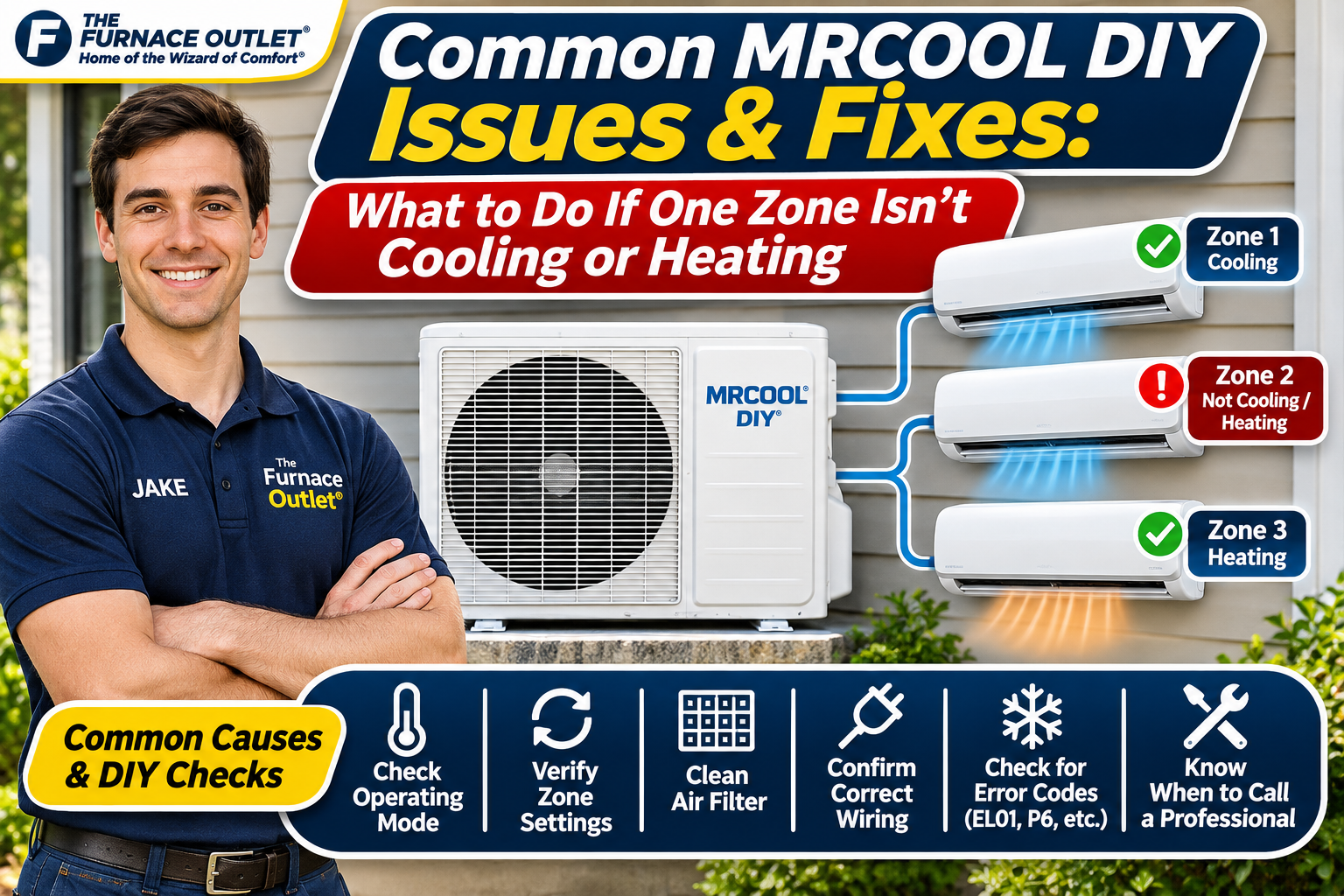
One of the biggest advantages of a MRCOOL DIY multi-zone mini-split system is the ability to control temperatures in different rooms independently. You can cool a bedroom, maintain a comfortable living room, and adjust another space according to its occupants’ preferences, all while using one outdoor condenser. But what happens when one indoor unit suddenly stops cooling or heating while the others continue operating normally?
It’s a frustrating problem, particularly when the system is relatively new or has worked without trouble for months. The good news is that a single-zone failure doesn’t automatically mean the compressor has failed or that the entire system needs replacement. In my experience working with ductless HVAC equipment, the most useful starting point is identifying whether the problem involves airflow, thermostat settings, communication wiring, refrigerant distribution, or an equipment fault.
MRCOOL’s own troubleshooting guidance identifies several causes of uneven zone performance, including mismatched communication wiring and refrigerant connections. Other common possibilities include dirty filters, conflicting operating modes, sensor faults, and installation-related problems. This guide explains how to identify the likely cause, which checks homeowners can safely perform, and when professional service is necessary.
A MRCOOL DIY multi-zone system connects several indoor air handlers to a single outdoor heat-pump condenser. Each indoor unit has its own temperature controls, fan, sensors, and refrigerant connections. The outdoor condenser distributes refrigerant to the connected indoor units according to system demand and operating conditions. Each zone communicates with the outdoor unit through dedicated electrical connections. These communication connections must correspond to the correct refrigerant piping connections.
For example, an indoor unit connected to refrigerant port A must have its communication wiring connected to the matching A terminals, according to the applicable model’s wiring diagram. If the refrigerant piping and electrical connections are mismatched, the system may respond incorrectly when individual zones request heating or cooling. MRCOOL specifically discusses this problem in its official multi-zone incorrect cooling behavior guide.
Understanding this relationship is particularly important when troubleshooting a system that has never operated correctly since installation.
Before assuming there’s a mechanical problem, check the operating mode selected on every indoor unit. Many conventional multi-zone heat-pump systems cannot provide heating to one room while simultaneously providing cooling to another. Although the indoor units have independent temperature controls, they share the outdoor refrigeration system’s overall heating or cooling mode. If one indoor unit is set to COOL while another is set to HEAT, the system may prioritize one operating mode and prevent the conflicting zone from operating.
MRCOOL identifies a double-dash display, shown as --, as a possible indication of this condition on supported multi-zone models. The simplest correction is to set all active indoor units to the same operating mode. For example, select COOL on every zone during summer and HEAT on every zone during winter. Avoid AUTO mode while troubleshooting because different indoor units may independently request opposing operating modes.
After synchronizing the settings, allow the system time to respond. If the conflict persists, follow the restart procedure specified for your model. MRCOOL provides additional details in its double-dash mode conflict troubleshooting guide.
If the indoor fan operates normally but the room isn’t getting colder, begin with the basic airflow and temperature checks. Confirm that the indoor unit is set to COOL and that the selected temperature is below the actual room temperature. Set the fan to a normal or higher speed temporarily and make sure the air louvers aren’t directing conditioned air away from the occupied space. Next, inspect the indoor air filter. A heavily clogged filter can restrict airflow through the evaporator coil, reducing cooling performance and potentially contributing to coil icing.
Remove and clean the filter according to the manufacturer’s instructions. Allow it to dry completely before reinstalling it. Also check whether furniture, curtains, or other objects are obstructing the air inlet or outlet. If the indoor unit continues blowing room-temperature air while the other zones cool normally, the problem may involve refrigerant flow, a temperature sensor, communication controls, or another internal component. At that point, further diagnosis should be based on the exact model and any displayed fault codes rather than repeatedly changing thermostat settings.
Heating complaints require a slightly different approach because mini-split heat pumps operate differently from conventional electric resistance heaters. When a heat pump first enters heating mode, the indoor fan may delay operation while the indoor coil warms. This helps prevent uncomfortable cold air from blowing into the room. During cold weather, the outdoor unit may also enter a defrost cycle. Depending on the model, indoor airflow may temporarily stop or decrease while the system removes frost from the outdoor coil.
These behaviors can be normal and don’t necessarily indicate a malfunction. However, if one zone consistently fails to produce heat while the others work normally, check that all active zones are set to HEAT and that the requested temperature is above the room temperature. If the affected unit displays an error code, record it before attempting a restart.
Persistent heating failure can involve communication faults, sensors, refrigerant distribution controls, or other internal problems requiring professional diagnosis.
Communication wiring mismatches are particularly important when a newly installed MRCOOL multi-zone system behaves unpredictably. Imagine that the refrigerant piping for the bedroom is connected to outdoor port A, but the communication wiring for that bedroom is connected to the terminals associated with port B. When the bedroom requests cooling, the outdoor unit may respond as though a different indoor unit needs refrigerant. The result can be confusing. One room may cool unexpectedly, another may fail to cool, or the system may behave differently depending on which zones are operating.
MRCOOL’s technical support documentation identifies this type of mismatch as a cause of incorrect zone operation. The proper correction involves tracing each indoor unit’s refrigerant piping and communication wiring to the outdoor condenser, then confirming that the connections correspond to the manufacturer’s diagram. Because this requires access to electrical connections and potentially other hazardous components, homeowners should not attempt to rearrange wiring themselves. A qualified technician should disconnect and verify power is off, inspect the connections, correct any mismatch, and test each zone individually before checking combined operation.
MRCOOL mini-split systems use diagnostic codes to identify recognized faults, but their meanings can differ between product generations and equipment families. On applicable DIY models, EL01 or E1 may indicate a communication problem between indoor and outdoor equipment. A communication failure can prevent an indoor unit from receiving the signals required for normal operation.
Potential causes include damaged communication wiring, loose electrical connections, control-board faults, or problems associated with the outdoor unit. The location of the fault can provide useful clues. If only one indoor unit reports the error, the technician may focus on that zone’s communication circuit and indoor controls. If every indoor unit reports communication errors, the outdoor equipment or a shared electrical issue may require closer investigation.
MRCOOL’s EL01/E1 troubleshooting guide discusses how technicians can distinguish between individual-zone and system-wide communication problems. Homeowners should record the displayed code and contact technical support rather than opening energized electrical compartments or attempting control-board repairs.
Yes. Refrigerant-related problems can affect the performance of an individual zone, although the symptoms depend on the system design and the nature of the fault. MRCOOL DIY systems use precharged refrigerant line sets on applicable models, simplifying certain installation steps. However, precharged connections do not eliminate the possibility of refrigerant leaks or installation-related problems. A poorly seated connection, damaged line set, or refrigerant circuit fault can interfere with normal operation.
Symptoms may include inadequate cooling, repeated protective shutdowns, unusual frost formation, or fault codes associated with refrigerant pressure. A refrigerant shortage can also affect multiple zones, so a single underperforming indoor unit doesn’t prove that a leak exists in that particular branch. Do not loosen refrigerant connections, attempt to recharge the system, or repeatedly operate equipment displaying pressure-related faults. A qualified technician should evaluate the system using the manufacturer’s diagnostic procedures. Refrigerant type also varies by MRCOOL model and generation. Always confirm the exact refrigerant from the equipment nameplate before any service.
Some MRCOOL DIY systems display PC03 or P6 when the equipment detects an abnormal refrigerant pressure condition. However, P6 does not have one universal meaning across every MRCOOL product family. Different models and generations may use the same code for different faults. For applicable DIY equipment, MRCOOL associates PC03/P6 with pressure-related protection and recommends investigating the refrigerant circuit and installation conditions.
On newly installed systems, the technician may need to verify that the applicable service valves were opened correctly and that the refrigerant connections were completed according to the installation manual. These checks are particularly important when the system has never cooled or heated properly.
A pressure-related error shouldn’t automatically be interpreted as proof that refrigerant needs to be added. Restrictions, installation problems, and other equipment faults can produce related symptoms. Use the model-specific fault chart before drawing conclusions or authorizing repairs.
Absolutely. Each indoor air handler has its own filter and airflow path, so one zone can develop a significant restriction while the others remain unaffected. A bedroom unit operating continuously in a dusty environment may accumulate debris faster than a unit in a less frequently used room. As the filter becomes restricted, airflow decreases and heat transfer suffers. During cooling, this can contribute to unusually low coil temperatures and potentially ice formation. During heating, restricted airflow may interfere with heat delivery and contribute to protective operating conditions.
Check the affected zone’s filter, clean it according to the owner’s manual, and inspect the air inlet for visible obstructions. If the indoor coil is already covered in ice, stop cooling operation and allow it to thaw according to manufacturer guidance. Don’t chip away the ice or apply direct heat to the coil. If icing returns after the filter is clean, arrange professional service. Refrigerant, sensor, or other airflow-related faults may be involved.
Not every uneven-cooling complaint involves a broken component. Sometimes the affected room has a greater cooling load than the indoor unit can comfortably handle. A west-facing bedroom with large windows may experience significantly more afternoon solar heat gain than a shaded room of similar size. Insulation, air leakage, ceiling height, occupancy, and electronic equipment can also influence the room’s cooling demand.
If the indoor unit produces cold air but the room remains uncomfortable, the problem may involve insufficient capacity, poor air circulation, or excessive heat gain. A technician can evaluate the room’s cooling load and compare it with the indoor unit’s actual capacity under the operating conditions. Multi-zone systems also have total outdoor capacity limitations. The connected indoor units may have combined nominal capacities exceeding the outdoor unit’s available capacity, depending on the approved configuration.
When several zones demand maximum cooling simultaneously, the outdoor system may distribute its available capacity rather than delivering every indoor unit’s full nominal output. This is an important distinction between a true malfunction and a system operating within its designed capacity limits.
A restart can sometimes clear a temporary control problem, but it should not be used repeatedly to conceal an ongoing fault. Before restarting, record any error codes and confirm that the thermostat settings and operating modes are correct. If the owner’s manual recommends a power reset, follow its procedure and allow the equipment to complete any required startup delay.
Some systems intentionally delay compressor operation for several minutes after power is restored to protect the equipment. If the same fault returns, stop troubleshooting through repeated resets and contact MRCOOL support or a qualified technician. A persistent communication error, refrigerant protection fault, or electrical problem generally requires diagnosis rather than another restart.
Homeowners can reasonably inspect filters, confirm thermostat settings, check accessible airflow obstructions, and record diagnostic information. However, electrical wiring, control-board testing, refrigerant connections, pressure measurements, and internal component replacement require appropriate technical expertise.
Stop operating the system immediately if you notice burning odors, damaged or unusually hot wiring, repeated breaker trips, or abnormal mechanical noises. For a newly installed system, contact the installer or MRCOOL technical support before making changes that could affect warranty coverage. The most useful information to provide includes the indoor and outdoor model numbers, approximate installation date, affected zone, error code, operating mode, and a description of which other zones are functioning normally.
Regular maintenance can help reduce the likelihood of avoidable performance problems. Keep indoor filters clean, maintain adequate clearance around the indoor air handlers, and ensure that the outdoor condenser remains free of leaves and other obstructions. Check the operating modes when transitioning between heating and cooling seasons, particularly in homes where different occupants control separate rooms.
If one zone begins performing differently from the others, investigate early rather than allowing the problem to continue for weeks. Annual professional inspection can also help identify developing electrical, airflow, drainage, or refrigerant-system issues before they lead to major equipment failures. MRCOOL’s official DIY multi-zone installation and owner’s manual includes maintenance recommendations, operating information, and basic troubleshooting checks. Always use the documentation matching your particular system generation.
Why is one MRCOOL mini-split zone not cooling while the others work? Possible causes include incorrect thermostat settings, a dirty filter, mismatched communication wiring, a sensor fault, or a refrigerant distribution problem. Start with basic homeowner checks before requesting technical diagnosis.
Can one MRCOOL zone heat while another cools? Conventional MRCOOL DIY multi-zone heat-pump systems generally cannot provide simultaneous heating and cooling. Conflicting operating modes can prevent a zone from operating and may produce a double-dash error.
Why does one MRCOOL indoor unit blow air but not heat or cool? The indoor fan may be operating without an active heating or cooling demand, or the system may be experiencing a mode conflict, protective delay, communication fault, or refrigeration problem. Confirm the settings and check for error codes.
Can incorrect wiring cause only one MRCOOL zone to malfunction? Yes. MRCOOL identifies mismatched communication wiring and refrigerant ports as a possible cause of incorrect zone behavior, especially after installation.
Does a MRCOOL DIY system need professional maintenance? Routine filter cleaning and basic visual checks can be performed by homeowners following the owner’s manual. Electrical testing, refrigerant diagnosis, internal repairs, and other specialized service should be handled by qualified professionals.
When one MRCOOL DIY zone stops cooling or heating, I wouldn’t immediately assume the outdoor condenser has failed. The fact that other zones are still operating can provide valuable clues about where to begin troubleshooting. I’d first check the affected indoor unit’s mode, temperature setting, filter, and displayed fault codes. Then I’d determine whether the problem appeared immediately after installation or developed after months of normal operation.
For a new installation, communication wiring and refrigerant-port matching deserve particular attention. For an established system, airflow restrictions, sensor problems, communication faults, and refrigerant-related issues may be more relevant.
Most importantly, I would avoid replacing expensive components without confirming the cause. A methodical diagnosis is usually the best way to restore comfort while avoiding unnecessary repairs.
MRCOOL — Troubleshooting Multi-Zone Incorrect Cooling Behavior: Official MRCOOL Zone Wiring Guide. Explains mismatched refrigerant ports and communication wiring.
MRCOOL — Double-Dash Error Troubleshooting: How to Fix Multi-Zone Mode Conflicts. Covers heating and cooling conflicts between zones.
MRCOOL — EL01/E1 Communication Errors: Official Mini-Split Communication Troubleshooting. Provides diagnostic information for communication failures.
MRCOOL — Mini-Split Error Code Reference: MRCOOL Error Code Library. Lists fault codes across different product generations.
MRCOOL — DIY Multi-Zone Installation and Owner’s Manual: Official Installation and Operation Manual (PDF). Includes maintenance, troubleshooting, installation, and safety guidance.
This article provides independent educational information and is not affiliated with or endorsed by MRCOOL. Diagnostic codes, installation requirements, refrigerants, and operating characteristics vary by model and generation. Electrical components and refrigerant circuits can present serious hazards. Homeowners should limit troubleshooting to safe, manufacturer-approved checks and contact qualified HVAC professionals for wiring, refrigerant, electrical, or internal equipment repairs. Always follow the exact installation and service manual for the equipment.