PTAC systems don’t just heat or cool—they shape the entire thermal personality of a room. When placed correctly, a PTAC creates:
-
Even temperatures
-
Smooth airflow
-
Minimal noise
-
Low energy usage
-
Faster heating and cooling
-
No drafts, cold corners, or hot spots
When placed incorrectly, even the best PTAC:
-
Short-cycles
-
Overheats
-
Creates stratification
-
Pushes cold air into the wrong corners
-
Pulls warm air into the return prematurely
-
Runs longer and louder
That’s why Mike developed the Thermal-Balance Placement Method—a system that looks at room geometry, furniture layout, convection flow, occupant behavior, and thermal load paths to position a PTAC so it performs like a much larger (and more expensive) unit.
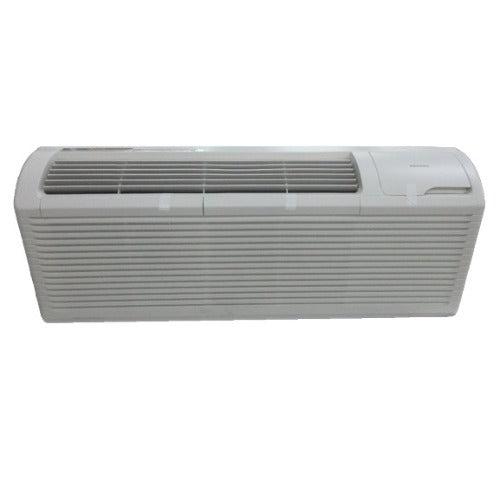
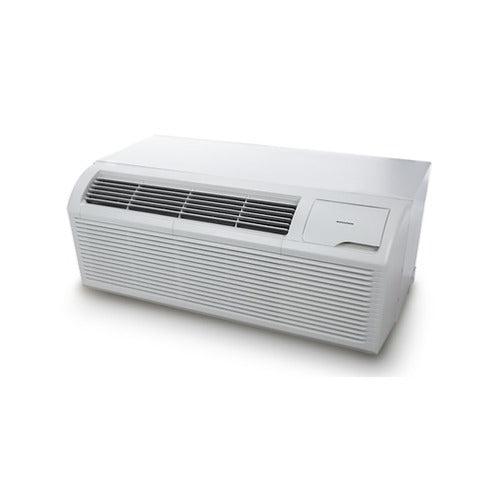
Amana J-Series PTAC Model 15,000 BTU PTAC Unit with 3.5 kW Electric Heat
This guide walks you through everything Mike checks before placing a PTAC in any room.
🧭 1. The Science Behind Thermal Balance
Thermal balance is achieved when:
-
Supply air (discharge) travels far enough to mix
-
Return air pulls from the right zone
-
Heat or cold distributes evenly without resistance
-
Walls, windows, and ceilings don’t steal too much heat
The U.S. Department of Energy confirms that AC performance depends heavily on placement relative to room geometry and heat loads:
🔗 https://www.energy.gov/energysaver/room-air-conditioners
Mike translates that into simple rules:
“A PTAC must see the room—not the wall, the bed, or the curtains.”
If a PTAC can’t “see” the space, it can’t condition it.
🖼️ 2. Mike’s 3-Zone Room Model (Used Before Every Install)
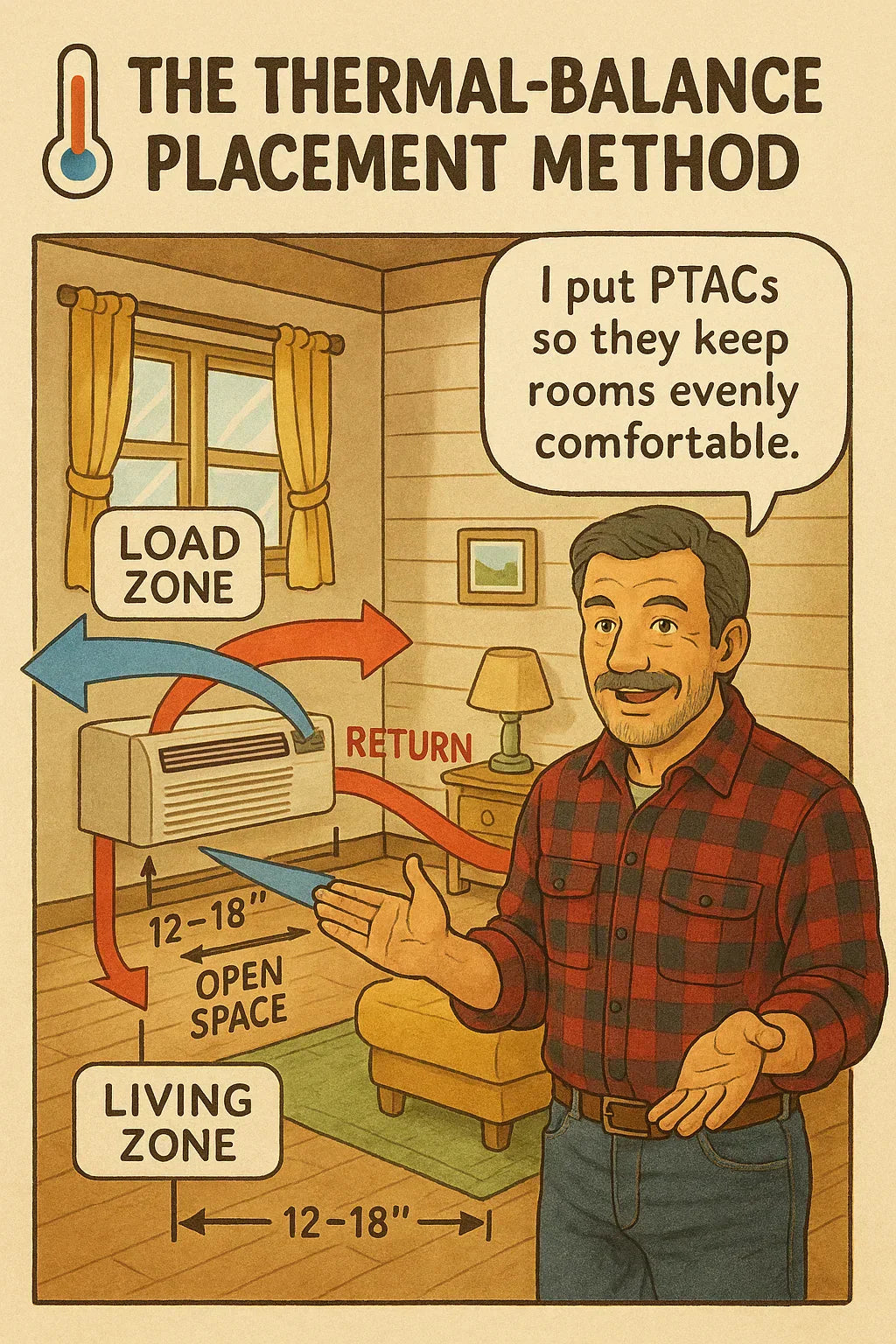
Before choosing placement, Mike maps each room into three thermal zones:
Zone A — The Load Zone
Where the room gains or loses the most heat:
-
Windows
-
Sliding doors
-
Exterior walls
-
Corners exposed to outdoor temperature
Zone B — The Living Zone
Where people spend time:
-
Bed
-
Sofa
-
Desk
-
TV area
Zone C — The Throw Zone
The open pathway where discharge air can travel.
The goal is simple:
Place the PTAC so the Throw Zone cuts through the Load Zone and reaches the Living Zone.
This guarantees even comfort.
🪟 3. Why PTACs Almost Always Go Under a Window (Mike’s Real Reason)
Most manufacturers recommend placing PTACs under windows—but not for the reason most people think.
Mike’s Reason: Windows Are the Room’s Thermal Weak Spot
Windows create the largest temperature loss or gain.
Placing the PTAC here:
-
Counteracts radiant cold
-
Neutralizes heat intrusion in summer
-
Fills the biggest thermal void
-
Maximizes natural convection mixing
ASHRAE building comfort standards validate that conditioning equipment should neutralize dominant thermal loads first
And there’s a second reason:
Windows tend to leave the best open Throw Zone for discharge air.
📏 4. The Thermal-Balance Placement Rules (Mike’s 6 Core Rules)
1️⃣ The PTAC must face the largest open section of the room.
If airflow meets a wall too soon, mixing fails.
2️⃣ The PTAC must not blow directly onto a bed.
Cold/warm drafts cause discomfort and reduce efficiency.
3️⃣ The return must have at least 24" of clearance.
(From furniture, curtains, or bedding.)
4️⃣ The discharge must have at least 48" of open throw space.
This allows air to project fully and mix.
5️⃣ The PTAC should sit within 5–15 ft of the room’s centerline path.
Closer to the center means better temperature evenness.
6️⃣ The PTAC must not face a doorway.
Air escapes instead of mixing.
Combined, these rules guarantee full-room thermal coverage.
🧊 5. The Cold-Drop Principle: How Mike Uses Convection to His Advantage
Cold air falls.
Warm air rises.
Mike uses this natural convection to determine placement:
In Cooling Mode:
-
Air should project straight across the room
-
Bounce off the opposite wall
-
Drop gently to mix from floor to ceiling
In Heating Mode:
-
Warm air should rise
-
Sweep the ceiling
-
Fall evenly around the room
If placement disrupts this pattern, stratification occurs.
DOE airflow studies show poor circulation drastically reduces cooling efficiency:
🔗 https://www.energy.gov/energysaver/air-sealing-your-home
Mike’s placement eliminates “cold puddles” and “hot ceilings.”
🛋️ 6. Furniture Mapping: Why Mike Treats Furniture Like Airflow Obstacles
Rooms aren’t empty.
Beds, sofas, and dressers block airflow.
Mike checks:
✔ Bed height & placement
No discharge air should hit the bed directly.
✔ Sofa back height
If above grille height, it blocks throw distance.
✔ Dresser tops
They deflect airflow upward too quickly.
✔ Curtains & drapes
These can cause return starvation.
✔ TV stands, trunks, and benches
Often the biggest offenders in hotel rooms.
EPA indoor air quality research confirms airflow obstruction dramatically degrades ventilation and temperature consistency:
🔗 https://www.epa.gov/indoor-air-quality-iaq
Mike reorganizes furniture if necessary to maintain thermal balance.
🔄 7. Mike’s Thermal Loop Test (Before Final Placement)
Mike simulates airflow using his “Thermal Loop Test”:
Step 1 — Stand behind the PTAC
And visualize discharge air traveling straight.
Step 2 — Identify the first major surface it hits
This becomes the bounce wall.
Step 3 — Visualize the return path
Air must loop back naturally, not forcefully.
Step 4 — Confirm no furniture interrupts the loop
If furniture blocks either path, the PTAC moves.
This test takes 10 seconds but prevents years of bad airflow.
🧱 8. The Placement Mistakes Mike Fixes the Most
These are the top placement errors Mike sees in real homes and hotels:
❌ PTAC behind a curtain
Discharge air is trapped; return air is starved.
❌ PTAC blowing directly at a bed
Person gets too cold/hot while rest of room suffers.
❌ PTAC too far off center
Air throws improperly and spirals into a corner.
❌ PTAC facing a hallway
Air escapes instead of conditioning the room.
❌ PTAC too close to furniture
Creates dead zones and thermal pockets.
❌ PTAC too close to exterior corners
Doesn’t reach room center.
Avoid these errors and comfort skyrockets.
🏨 9. Thermal-Balance Method in Hotel Rooms
Mike specializes in hotel retrofits, where poor PTAC placement is rampant.
Hotels often have:
-
Long curtains
-
Tall furniture
-
Narrow wall cuts
-
High occupancy loads
-
Rapid room turnover
Mike uses three hotel-specific rules:
Hotel Rule 1: Curtain Lift or Curtain Lock
He adds curtain clips or standoffs so airflow isn’t trapped.
Hotel Rule 2: Bed Clearance Line
Beds stay at least 36 inches away from the PTAC’s throw path.
Hotel Rule 3: Desk Realignment
Desks are rotated to avoid blocking return flow.
These changes boost cooling performance by 20–40% with no equipment change.
🧩 10. The Thermal-Balance Zones by Room Shape
🟦 Rectangular Rooms
PTAC centered on shorter wall → best airflow.
🟩 Square Rooms
PTAC under window → symmetrical mixing.
🟥 L-Shaped Rooms
PTAC must face the longest open section, never the enclosed leg.
🟨 Studio Apartments
Place PTAC where the “living zone” receives direct airflow.
🟪 Narrow Rooms (Dorms)
Angle the discharge slightly using directional louvers.
These placements maximize the thermal loop.
🔥 11. Thermal-Balance for HEAT Mode: Mike Prevents Stratification
Heat mode is often ignored—but placement heavily affects heating comfort.
Heat rises and forms a hot ceiling layer unless:
-
Discharge is angled slightly upward (5–15 degrees)
-
There is enough room for warm-air cycling
-
The PTAC sits where convection can expand
Mike checks for:
-
High ceilings
-
Loft spaces
-
Ceiling fans (and direction)
-
Staircase drafts
DOE heating-efficiency guidance stresses proper airflow to avoid heat layering:
🔗 https://www.energy.gov/energysaver/home-heating-systems
Mike’s placement ensures heat fills the room—not the ceiling.
🧪 12. Mike’s 3-Phase Validation After Placing the PTAC
After choosing the location, Mike tests it with:
1️⃣ The Candle Draft Test
Shows how air actually moves across the room.
2️⃣ The Thermal Camera Test
Exposes cold corners and poor mixing.
3️⃣ The Temperature Spread Test
Mike measures room temperature in:
-
Corners
-
Center
-
Near the ceiling
-
Near the floor
A spread of < 3°F means perfect thermal balance.
🏆 13. Why the Thermal-Balance Placement Method Works
Because it follows physics—not guesswork.
Mike’s method respects:
-
Natural convection
-
Air throw distance
-
Return-air positioning
-
Furniture geometry
-
Room shape
-
Occupant comfort
-
Thermal load points
-
Safety clearance zones
It transforms a PTAC from “just an appliance” into a finely tuned comfort system.
Mike puts it best:
“Even temperature isn’t luck—it's placement.”
📘 14. Mike’s Placement Checklist
Before he signs off, Mike verifies:
✔ PTAC centered or properly offset
✔ Minimum 48" discharge space
✔ Minimum 24" return-air space
✔ No furniture blocking airflow
✔ Curtains lifted or locked
✔ Airflow reaches the Living Zone
✔ Thermal loop fully established
✔ Heat mode does not stratify
✔ Cooling mode reaches far wall
Only then does Mike consider the placement “balanced.”
Buy this on Amazon at: https://amzn.to/47cH9ut
In the next topic we will know more about: The Guest-Ready Reliability Package: Mike’s Hotel-Grade Steps to Ensure PTACs Never Fail Under Pressure