The Airflow Bottleneck No One Talks About — And the Reason Two-Stage Furnaces Fail on Day One
There are two types of HVAC installers:
1. The ones who slide in a new furnace and reuse the old return drop because “it was fine before.”
2. Tony.
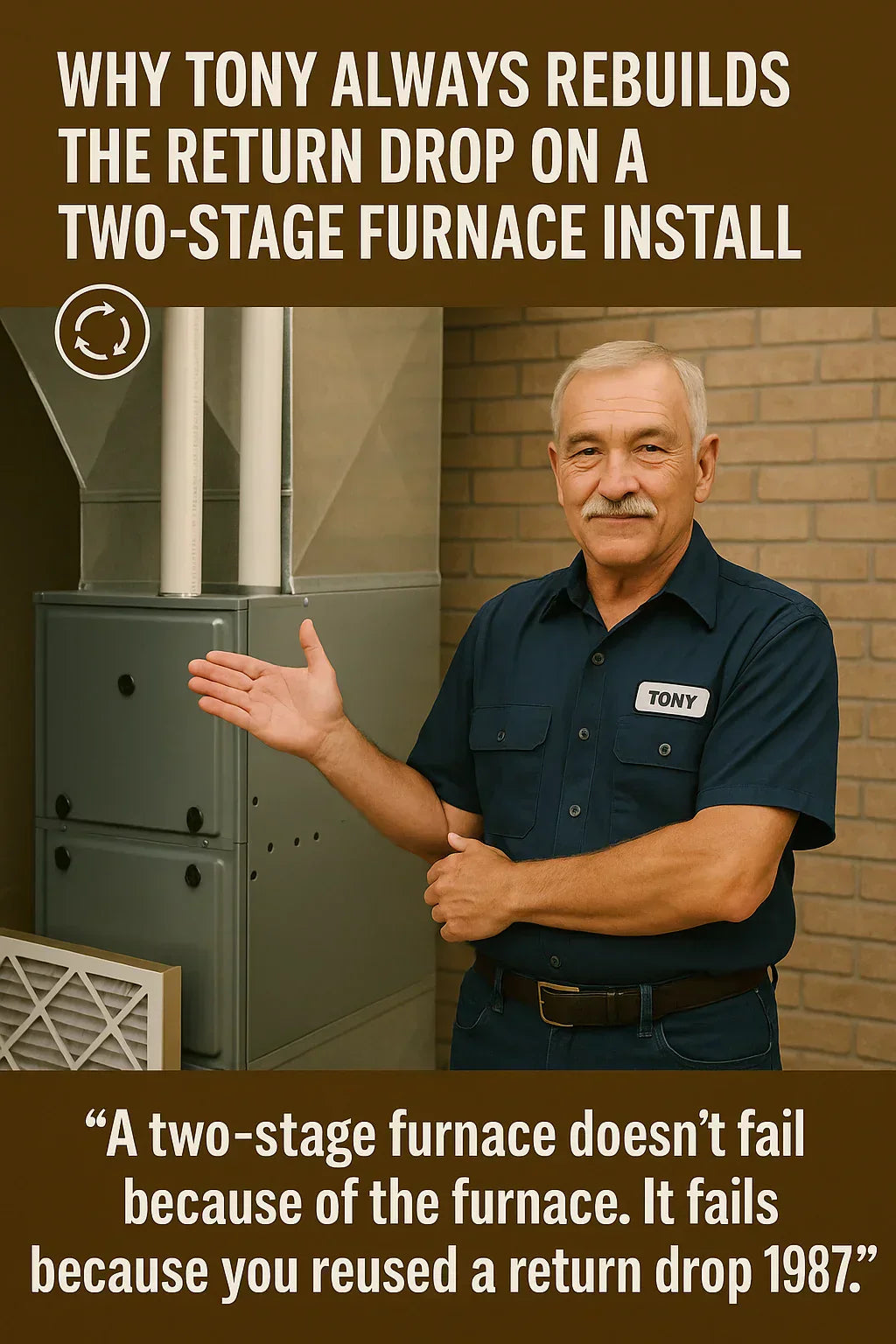
Tony refuses to reuse a return drop on any two-stage furnace installation — especially a high-efficiency, ECM-driven system like the Goodman GR9T961004CN.
Why?
Because the return drop is the #1 hidden restriction in almost every home’s duct system.
It is the silent killer of:
-
airflow
-
staging logic
-
temperature rise
-
blower motor life
-
noise level
-
efficiency
-
comfort
Tony will tell you:
“A two-stage furnace doesn’t fail because of the furnace.
It fails because you reused a return drop from 1987.”
And he’s right.
Let’s break down exactly why he rebuilds the return drop every single time.
🌀 1. Two-Stage Furnaces Need Two Completely Different Airflows
This is the part most installers don’t understand.
A two-stage furnace doesn’t run at one airflow — it runs at two:
✔ Low Stage (~65% airflow)
Quiet, slow, long cycles, low static pressure.
✔ High Stage (100% airflow)
Full output, maximum CFM, maximum static pressure load on return duct.
A single-speed furnace from the 80s didn’t care about airflow variation.
But a two-stage + ECM blower?
It absolutely cares.
DOE guidelines confirm that ECM-driven two-stage furnaces require precise duct sizing to maintain efficiency:
👉 https://www.energy.gov/energysaver/furnaces-and-boilers
Tony explains it better:
“Your return drop needs to support low stage and high stage.
Most return drops barely support low stage.”
📉 **2. The Biggest Airflow Restriction in 90% of Homes?
The Return Drop.**
Homeowners think their filter is causing airflow problems.
Installers think their supply duct is to blame.
Tony knows better.
The return drop is:
-
too narrow
-
too tall
-
too short
-
too restrictive
-
badly transitioned
-
full of turbulence
-
undersized for ECM blowers
-
never updated when equipment is upgraded
ASHRAE ventilation guidelines specifically identify return ductwork as the most common point of excessive pressure loss:
👉 https://www.ashrae.org/technical-resources
Tony has a simpler description:
“Your whole system is choking at the drop.”
📏 3. Why Return Drops Are Always Undersized (The Ugly History)
Reason 1: Old PSC furnaces didn’t need as much air
They ran lower CFM, lower static, and tolerated bad ductwork.
Reason 2: Installers matched new equipment to old ductwork
Because “it worked before.”
Reason 3: Homebuilders did the bare minimum
Return drops were sized for cost, not performance.
Reason 4: No one calculates return-side friction loss
Installers skip Manual D.
They eyeball it.
Reason 5: High-MERV filters require more area
But return drops never get widened to match.
Tony puts it bluntly:
“You can’t feed a modern furnace with dinosaur ductwork.”
🔥 4. What a Too-Small Return Drop Does to a Two-Stage Furnace
This is where Tony gets fired up, because the consequences are severe.
Let’s break them down.
🚫 Consequence 1 — High Static Pressure
Return static skyrockets.
This forces the ECM blower to max out torque, increasing noise and energy use.
If total external static exceeds 0.50" WC?
Your system is no longer within design spec.
🌡️ Consequence 2 — High Temperature Rise
Insufficient airflow means hotter air through the heat exchanger.
The heat exchanger runs above its design temp → metal fatigue → cracks.
EPA documentation ties airflow restriction to heat exchanger damage:
👉 https://www.epa.gov/indoor-air-quality-iaq
🔁 Consequence 3 — Staging Failure
Low stage trips into high stage too soon.
High stage overheats and trips the limit.
End result?
A two-stage furnace behaves like a broken single-stage unit.
🔇 Consequence 4 — Noise (Whistling, Roaring, Boominess)
High velocity = turbulence
Turbulence = noise
Tony says:
“If your return sounds like a jet intake, your drop is garbage.”
🌬️ Consequence 5 — Reduced Airflow to the Coil
Cooling performance tanks.
Humidity rises.
Upstairs gets hot.
Coil freezes.
💵 Consequence 6 — Efficiency Dies
Two-stage furnaces save money because they run in low stage 80–90% of the time.
But with a restricted return?
-
Low stage never satisfies
-
High stage becomes the default
-
Gas bills skyrocket
-
Electricity bills climb
Two-stage efficiency only works with proper airflow.
🧮 5. The Math Proves the Return Drop Must Be Rebuilt
Let’s do what Tony does — actual numbers.
A modern 100,000 BTU two-stage furnace typically moves:
✔ 1,050–1,200 CFM in low stage
✔ 1,400–1,600 CFM in high stage
But typical return drops are:
-
14x8 (112 sq in)
-
16x8 (128 sq in)
-
14x10 (140 sq in)
Face velocity should never exceed 700–800 FPM in a return drop.
Let’s calculate:
1,600 CFM ÷ 140 sq in = 820 FPM → TOO HIGH
1,600 CFM ÷ 112 sq in = 1,142 FPM → DISASTER
Tony uses this math to prove the point:
“Most return drops can’t handle high stage on a two-stage furnace — not even close.”
🧰 6. Why Tony ALWAYS Rebuilds the Return Drop (His Rules)
Here are Tony’s non-negotiables when he installs a two-stage furnace.
📐 Rule #1 — The Drop Must Match the Furnace Width
If the furnace cabinet is 21 inches wide, the return drop must be 21 inches wide (minimum).
No exceptions.
📦 Rule #2 — The Drop Must Be Larger Than the Filter
Filters are often 16x25 or 20x25.
A narrow drop starves the filter.
Tony says:
“If the filter is bigger than the drop, you did the drop wrong.”
🔄 Rule #3 — Smooth Transitions Only
Return air entering the blower must be:
-
smooth
-
gradual
-
low-turbulence
Tony uses 4–5 sided transitions, never a “hard 90.”
ASHRAE recommends tapered transitions for low static:
👉 https://www.ashrae.org
📊 Rule #4 — Return Drop Must Support 1,400–1,600 CFM
This often means going to:
-
10x24
-
12x24
-
14x24
-
or dual return drops
🧱 Rule #5 — Tony Adds a Bottom Return Whenever Possible
Bottom returns reduce turbulence dramatically.
Side-only returns are a restriction nightmare.
If the system allows bottom return?
Tony ALWAYS builds one.
🧼 Rule #6 — No Flex Duct Returns
Flex duct collapses.
Flex duct increases friction loss.
Flex duct kills airflow.
Tony says:
“Flex is for bath fans, not furnaces.”
🔧 Rule #7 — Drop Must Be Fully Sealed
Gaps destroy return performance by:
-
pulling in unconditioned air
-
adding turbulence
-
increasing blower noise
Tony seals everything with mastic + UL foil tape.
🧭 Rule #8 — Tony Uses Turning Vanes in Tight Bends
Turning vanes reduce static in:
-
tight return elbows
-
narrow mechanical rooms
-
retrofit installations
They also reduce return whistle.
🧪 7. Tony’s Diagnostic Checklist — How He Knows a Return Drop Is Wrong
Here’s how Tony diagnoses return-side airflow in under 5 minutes:
✔ 1. Static Pressure Test
If total ESP > 0.50?
Return is undersized.
✔ 2. Temperature Rise Test
If rise is above manufacturer spec?
Return is choking.
✔ 3. Blower Torque Test
If ECM torque is maxed out?
Return restriction confirmed.
✔ 4. Sound Test
If return sounds like a shop vac?
Drop is too small.
✔ 5. Finger Test at Filter Rack
If suction is strong at the filter?
Velocity too high.
✔ 6. Coil Inspection
Hot streaks = poor airflow distribution.
Tony’s summary:
“Noise, heat, and pressure never lie.”
🏆 8. What Tony’s Perfect Return Drop Looks Like
Here’s Tony’s gold standard for a modern two-stage furnace:
✔ 1. Full-width drop (21 inches wide)
Matches the furnace cabinet exactly.
✔ 2. Oversized return opening
To lower velocity and noise.
✔ 3. Tall enough for stable airflow
Typically 36–48 inches high.
✔ 4. Smooth, tapered transition into blower
No hard bends.
No abrupt angles.
✔ 5. Bottom return when possible
Massively lowers static.
✔ 6. Turning vanes inside elbows
Eliminates turbulence.
✔ 7. Mastic-sealed seams
No air leaks, no whistle.
✔ 8. Proper filter rack sizing
Expanded area, low face velocity.
✔ 9. Rigid duct ONLY
No flex duct in return path.
✔ 10. Pressure tested before completion
Static under 0.50” WC is mandatory.
🛑 9. Homeowner Symptoms of a Bad Return Drop
Homeowners report these problems when their return drop is too small:
-
Furnace is loud
-
Furnace runs constantly
-
Cold rooms
-
AC coil freezes
-
Furnace overheats
-
High gas bills
-
High electric bills
-
Furnace trips into high stage too quickly
-
Furnace shuts off unexpectedly
-
Weak airflow at registers
Tony can diagnose every single one of these by looking at the return drop.
🧨 Final Word from Tony
“Modern two-stage furnaces are airflow machines.
They don’t care about your old ductwork.
They don’t care about what worked in 1993.
They care about CFM, static pressure, turbulence, and return-side physics.”
“If you don’t rebuild the return drop, the furnace will run loud, hot, and inefficient for its entire life.”
“If you DO rebuild it?
The furnace runs like it came from the factory:
quiet, efficient, smooth, and reliable.”
“And that’s why I rebuild every return drop — no exceptions.”
Buy this on Amazon at: https://amzn.to/48LE6e5
In the next topic you will know more about: The First 10 Minutes After Install: Tony’s Full Startup & Commissioning Checklist