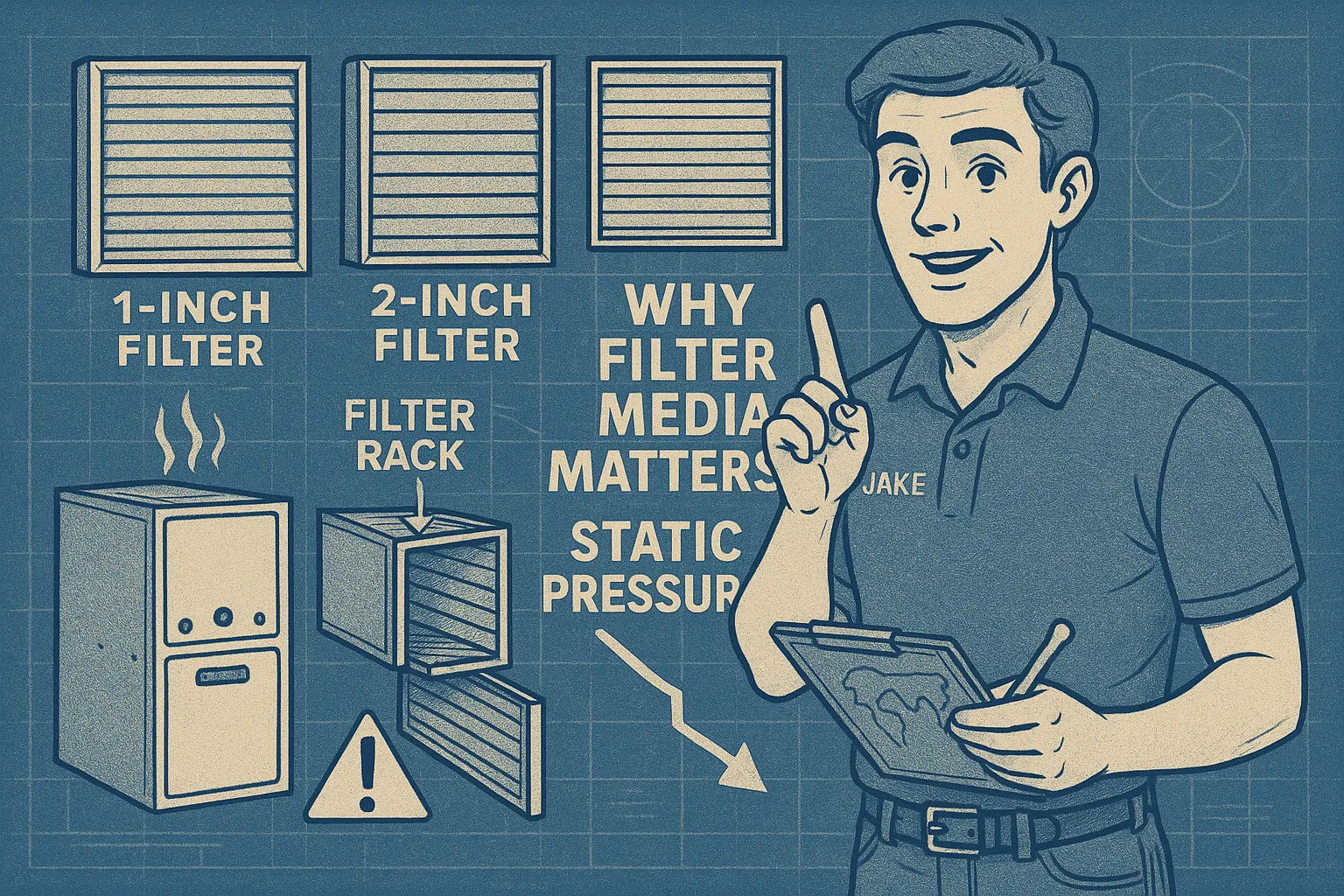
Introduction: The Filter Is the First Restriction—And Usually the Worst
Jake says this on every job:
“If your filter is wrong, your entire HVAC system is wrong.”
Homeowners think filters are simple:
-
Swap them once in a while
-
Pick a MERV rating
-
Buy whatever is on sale
But Jake has seen the damage the wrong filter can cause:
-
screaming ECM blowers
-
hot/cold room imbalance
-
furnace overheating
-
high static pressure
-
whistling returns
-
1st vs 2nd floor temperature fights
-
short cycling
-
failed heat exchangers
And in nearly every case?
100,000 BTU 96% AFUE Upflow/Horizontal Two Stage Goodman Gas Furnace - GR9T961004CN
The problem starts right at the filter rack.
In this article, Jake breaks down the real airflow science behind 1-inch, 2-inch, and 4-inch filters — and explains which one wins for:
-
static pressure
-
blower health
-
temperature rise
-
noise
-
two-stage comfort
-
ECM motor efficiency
-
long-term system performance
Let’s go to battle.
🧱 1. The Filter Isn’t an Accessory — It’s the First Airflow Gatekeeper
Jake explains it like this:
“Air doesn’t start at the blower. It starts at the filter.”
The furnace cannot breathe until:
-
return air passes through the grille
-
return duct funnels it
-
filter media cleans it
-
furnace accepts it through the blower
Most systems fail at step 3: the filter media.
Why? Because filter thickness controls:
-
air velocity (how fast air hits the media)
-
pressure drop (how hard air is to pull through)
-
surface area (how much filter there is to breathe through)
-
ECM motor workload
-
temperature rise stability
-
coil performance
-
noise
Jake sees it every day:
A poorly designed filter setup will choke even the best furnace.
A properly designed one will transform a system.
And the winner — by a landslide — is always the filter with the largest media surface area.
🔥 2. The 1-Inch Filter Problem: Jake’s “Never Use These on a 96% Furnace” Rule
Jake does NOT use 1-inch filters on:
-
96% AFUE furnaces
-
two-stage furnaces
-
ECM blower systems
-
multi-story homes
-
high-static duct systems
-
tight mechanical rooms
-
long branch runs
Why?
Reason 1 — Surface area is tiny
Even with pleats, a 1-inch filter simply cannot provide enough area to keep velocity low.
Reason 2 — Static pressure skyrockets
Most 1-inch MERV 8 filters add:
-
0.20–0.35 inches of static WHEN CLEAN
-
0.40–0.60 inches when partially dirty
-
0.70–1.0+ inches when clogged
Jake’s rule:
“The moment a 1-inch filter gets dusty, your furnace gets loud.”
Reason 3 — Velocity noise increases
High velocity = loud airflow.
This causes:
-
hissing
-
whistling
-
grille rumble
-
return pull noise
Reason 4 — Heat exchanger stress
Low airflow = high temperature rise.
High temperature rise = furnace stress.
Jake has seen furnaces go from a stable 35°F rise to a dangerous 65–75°F rise simply because of a 1-inch filter.
Reason 5 — Bad for two-stage furnaces
Stage 1 airflow becomes:
-
weak
-
uneven
-
loud
Stage 2 becomes:
-
too hot
-
too fast
-
overfiring
Two-stage comfort disappears.
⚠️ 3. The 2-Inch Filter Myth: Better Than 1-Inch, But Still a Compromise
Jake uses 2-inch filters only when:
-
the furnace room is tight
-
the return drop has no depth
-
the customer won’t rebuild the return platform
-
the blower is ECM and static is already decent
2-inch filters provide:
-
more surface area
-
lower velocity
-
better dust loading
-
quieter operation
But Jake is blunt:
“A 2-inch filter is a Band-Aid, not a fix.”
Their problems:
1. They still load fast
Every inch of media matters.
A 2-inch filter fills up far quicker than a 4-inch.
2. Pressure drop is still too high for many duct systems
Typical static added:
-
0.12–0.20 inches
Better than 1-inch, but still too high for homes with: -
long duct runs
-
small returns
-
high-MERV preferences
-
older duct systems
3. Still causes noise in high-MERV versions
A 2" MERV 13 is almost as restrictive as a 1" MERV 11.
Jake sees this a lot.
Verdict: 2-inch filters are “better,” but not ideal.
They will not solve the deeper airflow restrictions in most homes.
🥇 4. The 4-Inch Filter Advantage: Jake’s Gold Standard for 96% Furnaces
This is Jake’s standard for every two-stage furnace he installs.
Why 4-inch filters win:
A. MASSIVE surface area
More surface area = lower velocity = lower resistance.
This keeps:
-
ECM blower quiet
-
airflow stable
-
temperature rise predictable
-
Stage 1 operation dominant
B. Extremely low pressure drop
Most 4-inch filters add:
-
0.05–0.10 inches of static pressure
That is a huge improvement over:
-
1-inch: 0.20–0.35”
-
2-inch: 0.12–0.20”
Jake calls this:
“The difference between breathing through a straw and breathing through a snorkel.”
C. Ideal for two-stage furnaces like the Goodman GR9T96
Two-stage furnaces run longer Stage 1 cycles.
Stage 1 airflow must be:
-
gentle
-
quiet
-
smooth
-
unrestricted
A 4-inch filter protects low-stage comfort.
D. Keeps ECM blower RPM low
ECM motors compensate for restrictions by increasing RPM.
This increases:
-
noise
-
wear
-
watt usage
Lower static = lower RPM = long motor life.
E. Perfect for homes with pets, allergies, or dust
4-inch filters hold 4–6x more dust than 1-inch filters.
Most homeowners forget to replace 1-inch filters.
A 4-inch MERV 11 or MERV 13 holds enough dust to last 6–12 months without drastically increasing static pressure.
📊 5. The Science: Surface Area vs. MERV Rating (Jake’s Core Rule)
Homeowners obsess over MERV rating.
Jake obsesses over surface area.
Jake’s rule:
“A big MERV number means nothing if the filter has no area to breathe through.”
A 4-inch MERV 13 often has lower static pressure than a 1-inch MERV 8 because the surface area is so much larger.
This is why he picks:
-
4-inch > MERV 13
-
2-inch > MERV 11
-
1-inch > MERV 8 or lower only in emergencies
📉 6. Static Pressure Battle: 1-inch vs. 2-inch vs. 4-inch
Jake’s real-world numbers (averages):
1-inch filter
-
Clean: 0.20–0.35"
-
Lightly dirty: 0.40–0.60"
-
Dirty: 0.60–1.00+"
2-inch filter
-
Clean: 0.12–0.20"
-
Dirty: 0.30–0.45"
4-inch filter
-
Clean: 0.05–0.10"
-
Dirty: 0.10–0.20"
Jake explains:
“Your system’s static pressure should be 0.40–0.50” total.
One 1-inch filter can ruin that by itself.”
🔧 7. Filter Racks vs. Filter Cabinets — Jake’s Mandatory Upgrade
Jake replaces:
-
cheap 1-inch slide-in racks
-
flimsy spring clips
-
leaky frames
-
bent filter rails
Because they cause:
-
bypass airflow
-
turbulence
-
filter warping
-
noise
-
dust accumulation inside blower
-
higher static
Jake installs:
Sealed 4-inch media cabinets
These create:
-
a flush, airtight seal
-
smooth airflow transition
-
evenly distributed intake pressure
-
quiet blower intake
A proper cabinet reduces static by 0.05–0.15” alone.
🔇 8. Filter Choice and System Noise: Jake’s Quiet System Method
Jake finds noise problems tied to filters in 90% of homes.
1-inch filters = loudest systems
High velocity → hissing and whooshing.
2-inch = moderate
Lower noise but still insufficient in high-static systems.
4-inch = whisper quiet
Why?
-
more surface area
-
smoother airflow
-
blower RPM lower
-
return turbulence reduced
This is how Jake designs silent systems.
❄️ 9. How Filter Choice Affects Temperature Balance Across Rooms
High static = low airflow = cold/different rooms.
Jake improves room balance by:
-
reducing static
-
improving CFM to long runs
-
stabilizing coil airflow
-
maximizing Stage 1 runtime
Upstairs Bedrooms
These benefit the most because:
-
they require more airflow
-
ducts are longer
-
risers have pressure loss
Jake sees 20–30% more airflow to second floors after switching to 4-inch media.
🛠️ 10. Maintenance Reality: Why Homeowners Murder 1-Inch Filters
Jake sees filters unchanged for 6–12 months.
A 1-inch filter must be changed every 30 days.
That never happens.
So Jake designs systems that forgive the homeowner:
-
4-inch = replace every 6–12 months
-
2-inch = replace every 60–90 days
Lower maintenance + better airflow = homeowner win.
📦 11. When Jake Recommends Each Filter Thickness
1-inch Filter
Jake’s answer: NEVER
Except:
-
temporary fix
-
legacy systems
-
old 80% furnaces on PSC blowers
2-inch Filter
Use only when:
-
cabinet depth limited
-
customer refuses return rebuild
-
moderate static systems
4-inch Filter
Use ALWAYS when:
-
96% furnaces
-
two-stage heating
-
ECM blower
-
multi-floor homes
-
filters replaced infrequently
-
homeowners want quiet airflow
Perfect match for:
-
Goodman GR9T96
-
any two-stage Goodman
🧪 12. Jake’s Step-by-Step Filter Upgrade Method
When Jake arrives at a home with airflow complaints:
Step 1 — Measure static pressure
Aim for 0.40–0.50" total.
Step 2 — Inspect filter rack
Bad? Replace it.
Step 3 — Install 4-inch media filter
Always a cabinet, never a slide-in.
Step 4 — Fix return geometry
Add or widen returns.
Step 5 — Reduce turbulence near blower
Correct transitions, elbows, or drop box.
Step 6 — Adjust blower speed
Lower RPM in Stage 1 if static improves.
Step 7 — Balance system
Adjust takeoffs and dampers.
Jake consistently sees static drop by:
0.20–0.40 inches after an upgrade.
🧪 13. Real-Home Case Study: The 1-Inch Filter That Destroyed Comfort
Home:
2,300 sq ft, two-story
Furnace: Goodman GR9T96
Symptoms:
-
loud airflow
-
cold upstairs
-
1-inch MERV 11 filter
-
static = 0.92"
-
ΔT = 67°F
-
Stage 2 running constantly
Installer recommended upsizing the furnace.
Jake disagreed.
Jake’s Fix:
-
replaced rack
-
installed 4-inch media cabinet
-
added 20x25 return
-
smoothed return transition
Results:
-
static = 0.92" → 0.44"
-
ΔT stabilized at 38°F
-
Stage 1 operation = 85%
-
noise dropped 50%
-
second floor warmed evenly
Jake saved the system — no new furnace needed.
🔗 14. Verified External Sources
-
DOE Furnace Efficiency Guidelines
https://www.energy.gov/energysaver/furnaces-and-boilers -
ASHRAE Airflow Standards
https://www.ashrae.org -
SMACNA Duct Construction Rules
https://www.smacna.org - Goodman Technical Literature
🎯 Conclusion: The Filter Determines Everything
Jake ends every filter conversation with this:
“Your filter decides how loudly the system runs, how evenly rooms heat, how long the furnace lives, and how well your two-stage system performs.”
In Jake’s world:
-
4-inch wins
-
2-inch is acceptable
-
1-inch is the enemy
This is the definitive guide to filtration for modern 96% AFUE furnaces — especially the Goodman GR9T96.
Buy this on Amazon at: https://amzn.to/48LE6e5
In the next topic we will know more about: Jake’s Checklist for a Perfect Two-Stage Install: Thermostat, Dip Switches, Timing, Blower Speed & More