Newsletter Subscribe
Enter your email address below and subscribe to our newsletter

HVAC made simple
By Mark Callahan | The Furnace Outlet
Choosing the best 3.5-ton air conditioner and furnace combination involves much more than comparing equipment prices or selecting a familiar HVAC brand. Homeowners must consider cooling efficiency, heating capacity, compressor technology, warranty protection, replacement part availability, installation quality, and long-term operating expenses. A well-matched system can provide dependable year-round comfort while keeping energy consumption and maintenance costs manageable.
For homeowners replacing an aging central HVAC system, brands such as Carrier, Trane, Goodman, Amana, Rheem, Lennox, and Daikin offer several compelling options. However, the most expensive system is not necessarily the best investment, particularly when a more affordable alternative can meet the same household heating and cooling requirements.
This guide ranks leading HVAC brands based on their overall value proposition, available efficiency options, serviceability, comfort features, and suitability for residential applications across the United States.
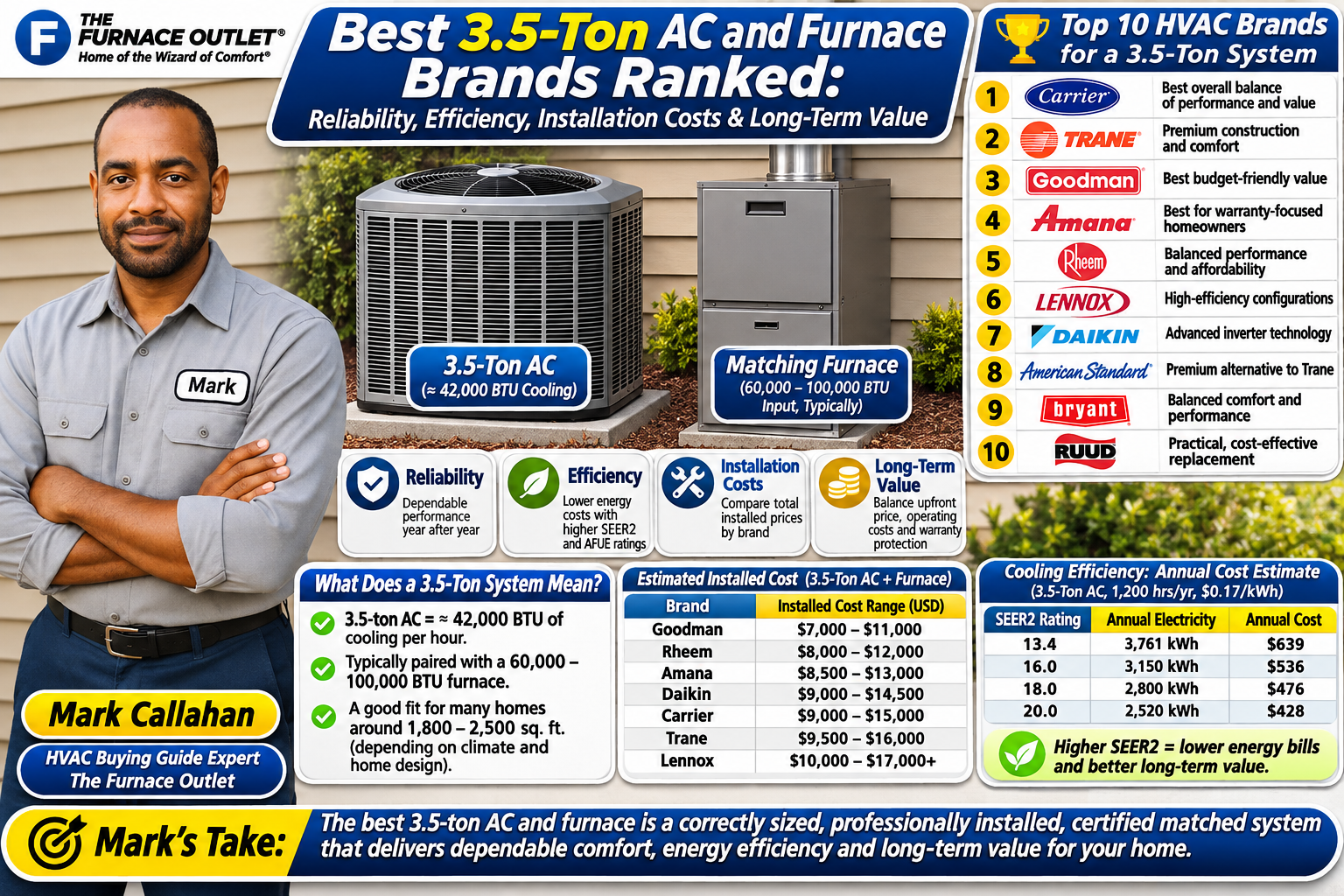
A 3.5-ton air conditioner provides approximately 42,000 BTU of nominal cooling capacity per hour. It is commonly considered for medium-to-large residential properties, although the actual cooling requirements depend on climate, insulation, ceiling height, window exposure, air leakage, and ductwork performance.
The furnace paired with a 3.5-ton air conditioner does not necessarily require a specific heating capacity. Depending on the home’s heating load and furnace efficiency, an appropriately matched system might include a 60,000, 80,000, or 100,000 BTU input furnace.
For example, an 80,000 BTU furnace operating at 96% annual fuel utilization efficiency (AFUE) has an approximate rated heating output of 76,800 BTU per hour. The air conditioner’s cooling capacity and the furnace’s heating output must therefore be evaluated independently rather than selected solely according to house size.
The following rankings prioritize overall residential value, equipment selection, comfort technology, serviceability, and potential ownership costs. They represent editorial buying recommendations rather than statistically verified rankings of equipment failure rates.
| Rank | HVAC Brand | Best For | Price Segment |
|---|---|---|---|
| 1 | Carrier | Best overall balance | Mid-range to premium |
| 2 | Trane | Premium construction and comfort | Premium |
| 3 | Goodman | Best budget-friendly value | Budget to mid-range |
| 4 | Amana | Warranty-focused buyers | Mid-range to premium |
| 5 | Rheem | Balanced performance and affordability | Mid-range |
| 6 | Lennox | High-efficiency configurations | Premium |
| 7 | Daikin | Inverter technology | Mid-range to premium |
| 8 | American Standard | Premium alternative to Trane | Mid-range to premium |
| 9 | Bryant | Balanced comfort and performance | Mid-range to premium |
| 10 | Ruud | Practical residential replacement | Budget to mid-range |
The best brand for an individual homeowner may differ from its overall ranking. A competitively priced Goodman system installed by an experienced contractor can deliver better long-term value than a premium system installed with incorrect airflow, improper refrigerant charging, or inadequate ductwork.
Carrier earns the top position because of its broad equipment portfolio, advanced comfort technologies, and availability of both economical and premium heating and cooling configurations. Homeowners can choose between conventional single-stage equipment, two-stage systems, and sophisticated variable-capacity configurations.
Carrier’s Comfort, Performance, and Infinity product families accommodate different budgets and comfort requirements. According to the official Carrier furnace buying guide, selected premium furnaces achieve up to 98.5% AFUE, making them attractive for households with substantial winter heating requirements.
Carrier is particularly suitable for homeowners who expect to remain in their properties for many years and prioritize humidity management, consistent indoor temperatures, quieter operation, and integrated system controls. Its primary disadvantage is the potentially higher installation and replacement component costs associated with premium equipment.
Trane is a strong contender for homeowners seeking premium residential heating and cooling equipment. Its product portfolio includes conventional and variable-capacity air conditioning systems alongside single-stage, two-stage, and modulating gas furnaces.
Higher-end Trane configurations can deliver more consistent indoor temperatures and extended cooling cycles at reduced capacity. These characteristics can be especially beneficial in humid climates where moisture removal is an important part of maintaining indoor comfort.
The main consideration is whether the additional investment provides measurable benefits for your particular home. Homeowners with moderate HVAC usage may find that a less expensive system delivers comparable practical comfort at a lower lifetime cost.
Goodman remains one of the most compelling choices for homeowners who prioritize affordability, straightforward equipment configurations, and long-term value. Its conventional central air conditioning systems and gas furnaces can provide effective residential comfort without the purchase price associated with premium brands.
The official Goodman air conditioner lineup includes R-32 equipment, conventional split systems, and advanced inverter-driven configurations. Its product selection allows buyers to choose between simpler replacement equipment and more sophisticated energy-saving technology.
A properly matched Goodman 3.5-ton air conditioner combined with an appropriately sized high-efficiency furnace can be an attractive option for homeowners seeking a reasonable balance between initial investment and operating expenses.
Amana deserves consideration because of its combination of premium comfort features, available inverter technology, and potentially attractive warranty programs. Goodman, Amana, and Daikin belong to the same broader corporate family, although their equipment offerings, controls, pricing, and warranty conditions can differ.
Certain Amana products offer enhanced component or unit replacement warranties subject to model-specific eligibility requirements. Homeowners should carefully examine registration deadlines, ownership restrictions, labor exclusions, and other conditions before assigning financial value to extended warranty protection.
Amana becomes particularly attractive when its installed price is close to a comparable Goodman system and the additional warranty or comfort features justify the difference.
Rheem offers a practical combination of conventional and advanced HVAC technologies for homeowners who want dependable heating and cooling without automatically purchasing the most expensive equipment available.
Its broad residential portfolio makes it a reasonable candidate for complete system replacements involving both air conditioning and gas heating. Rheem can be especially competitive when experienced local contractors provide favorable installation pricing and accessible maintenance support.
As with other brands, the long-term performance of a Rheem system depends heavily on equipment selection, airflow configuration, ductwork condition, and preventive maintenance.
Lennox is particularly attractive to homeowners interested in advanced humidity management, variable-capacity operation, and high-efficiency heating and cooling configurations. Premium systems may provide meaningful energy savings in properties with extended annual cooling seasons.
However, purchasing the highest available efficiency rating does not automatically guarantee the lowest lifetime ownership cost. Higher equipment prices, specialized components, and potential repair expenses should be evaluated against realistic energy savings.
Lennox makes the most financial sense when homeowners have substantial annual HVAC usage, relatively high electricity rates, and access to experienced local service providers.
Daikin offers extensive experience in inverter-driven heating and cooling technology. Variable-capacity systems can adjust compressor output according to household cooling demand, potentially improving temperature stability and reducing unnecessary cycling.
Homeowners comparing Daikin with Goodman or Amana should examine the exact equipment configuration rather than assuming that related brands deliver identical performance. Compressor technology, communication protocols, thermostat requirements, warranties, and certified system efficiency may differ.
Daikin is especially worth considering for households prioritizing quiet operation, humidity control, and advanced energy management.
American Standard provides a compelling alternative for homeowners comparing premium residential HVAC systems with Trane. Bryant offers a broad range of residential heating and cooling equipment and shares corporate ownership with Carrier, making it another worthwhile comparison when evaluating features and installation quotations.
Ruud provides an alternative to Rheem within the same broader manufacturing organization. These three brands should not be overlooked simply because they rank below the most widely recognized names, particularly when local installation support, warranty protection, and pricing are favorable.
Complete HVAC replacement costs vary considerably depending on equipment efficiency, furnace capacity, labor requirements, geographic location, ductwork modifications, electrical upgrades, venting requirements, and refrigerant compatibility.
The following ranges represent illustrative US budgeting estimates for a complete central air conditioner and gas furnace replacement under reasonably standard installation conditions.
| Brand | Estimated Installed Cost |
|---|---|
| Goodman | $7,000–$11,000 |
| Ruud | $7,500–$11,500 |
| Rheem | $8,000–$12,000 |
| Amana | $8,500–$13,000 |
| Bryant | $8,500–$13,500 |
| Daikin | $9,000–$14,500 |
| American Standard | $9,000–$14,500 |
| Carrier | $9,000–$15,000 |
| Trane | $9,500–$16,000 |
| Lennox | $10,000–$17,000+ |
These estimates are not live contractor quotations or verified national pricing averages. Premium communicating systems, substantial ductwork replacement, complex installations, and high-cost metropolitan areas may exceed these ranges.
Compressor technology is often more important to everyday comfort than the brand name itself. Single-stage air conditioners operate at their available full capacity whenever cooling is requested, while two-stage and variable-capacity equipment can adjust output to better match changing household requirements.
| Feature | Single-Stage | Two-Stage | Variable-Capacity |
|---|---|---|---|
| Initial cost | Lower | Moderate | Higher |
| Temperature consistency | Standard | Improved | Excellent |
| Humidity management | Standard | Improved | Excellent |
| Operating noise | Generally higher | Moderate | Often lower |
| Repair complexity | Lower | Moderate | Higher |
| Part-load efficiency | Standard | Improved | Potentially highest |
| Best application | Budget replacement | Balanced comfort | Premium comfort |
For many homeowners, a two-stage system represents a practical compromise between sophisticated comfort technology and reasonable installation costs. Variable-capacity systems become more attractive when extended cooling seasons and humidity management justify the additional investment.
Electricity consumption depends on the system’s certified SEER2 rating, cooling demand, outdoor conditions, and operating characteristics. Higher efficiency generally reduces the electricity required to deliver an equivalent amount of cooling.
Using 1,200 equivalent full-load cooling hours annually and an electricity rate of $0.17 per kWh, the following simplified comparison illustrates potential operating expenses.
| SEER2 Rating | Estimated Annual Electricity | Annual Cooling Cost |
|---|---|---|
| 13.4 | 3,761 kWh | $639 |
| 14.3 | 3,524 kWh | $599 |
| 15.2 | 3,316 kWh | $564 |
| 16 | 3,150 kWh | $536 |
| 18 | 2,800 kWh | $476 |
| 20 | 2,520 kWh | $428 |
Upgrading from 13.4 to 18 SEER2 could theoretically reduce annual cooling expenses by approximately $163 under these assumptions. Actual savings depend on weather, equipment performance, thermostat settings, and household usage. The ENERGY STAR central air conditioner efficiency specifications provide additional information about standardized cooling efficiency measurements.
A 3.5-ton air conditioner should never automatically be paired with an 80,000 BTU furnace simply because the combination is commonly available. Furnace capacity must reflect the property’s calculated winter heating load and the efficiency of the selected equipment.
| Furnace Input | Output at 80% AFUE | Output at 96% AFUE |
|---|---|---|
| 60,000 BTU | 48,000 BTU | 57,600 BTU |
| 80,000 BTU | 64,000 BTU | 76,800 BTU |
| 100,000 BTU | 80,000 BTU | 96,000 BTU |
| 120,000 BTU | 96,000 BTU | 115,200 BTU |
Oversized furnaces may contribute to frequent cycling, uneven temperatures, increased noise, and unnecessary component wear. The furnace blower must also be capable of providing the airflow required by the selected air conditioner.
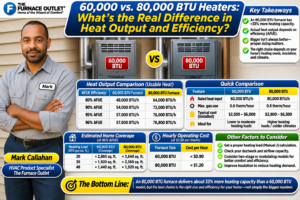
Homeowners comparing different furnace capacities should read our detailed guide on 60,000 vs. 80,000 BTU Heaters: What’s the Real Difference in Heat Output and Efficiency? to better understand how heating capacity affects equipment selection and household comfort.
Homeowners purchasing replacement HVAC equipment should pay particular attention to the industry’s transition toward lower-global-warming-potential refrigerants, including R-32 and R-454B. Both refrigerants belong to the A2L safety classification and require compatible equipment and manufacturer-approved installation procedures.
Regional energy efficiency requirements must also be considered. The AHRI residential central air conditioner standards guide explains the different requirements applicable to northern, southeastern, and southwestern US regions.
Never assume that an existing evaporator coil, refrigerant line set, or furnace is automatically compatible with a replacement outdoor unit. The AHRI Directory of Certified Product Performance allows homeowners and contractors to verify certified equipment combinations and performance ratings.
| Homeowner Priority | Recommended Brands |
|---|---|
| Lowest upfront investment | Goodman, Ruud |
| Best overall balance | Carrier, Rheem, Bryant |
| Premium comfort | Trane, Carrier, American Standard |
| Advanced inverter technology | Daikin, Amana |
| Maximum available efficiency | Lennox, Carrier, Trane |
| Warranty-focused purchase | Amana |
| Conventional serviceability | Goodman, Rheem, Ruud |
Homeowners should obtain at least three comparable installation quotations that include exact model numbers, certified efficiency ratings, furnace capacity, warranty terms, and installation scope. Comparing equipment of equivalent specifications provides a much more reliable purchasing framework than comparing brand names alone.
What is the best affordable 3.5-ton AC and furnace combination? Goodman is a strong starting point for budget-conscious homeowners because of its equipment selection and value-oriented positioning. Rheem and Ruud are also worth comparing when competitive local installation quotations are available.
How many square feet can a 3.5-ton AC cool? A 3.5-ton system may serve homes approximately 1,800–2,500 square feet under certain conditions. However, professional cooling load calculations are essential because insulation, climate, solar exposure, and building construction can substantially change capacity requirements.
Is Carrier better than Goodman? Carrier offers attractive premium comfort technologies, while Goodman frequently provides a lower-cost purchasing alternative. The better investment depends on the specific equipment combination, installation quality, and ownership costs.
How long should a 3.5-ton HVAC system last? A well-maintained central air conditioner may operate for approximately 12–20 years, while a gas furnace may last 15–25 years. Actual service life depends on climate, usage, installation quality, maintenance, and component condition.
Carrier earns the overall recommendation for its broad equipment selection and advanced comfort capabilities, while Goodman stands out as the value-focused choice for homeowners seeking affordable complete HVAC replacement. Trane remains a compelling premium alternative, and Amana, Rheem, and Daikin deserve consideration for their respective warranty, affordability, and inverter technology advantages.
Ultimately, the best 3.5-ton AC and furnace combination is a correctly sized, professionally installed, certified matched system that delivers dependable comfort at a reasonable lifetime ownership cost. Prioritize installation quality and appropriate equipment selection before paying a substantial premium solely for a brand name.
Editorial Disclosure: The Furnace Outlet is not associated with, affiliated with, endorsed by, or sponsored by Carrier, Trane, Lennox, Bryant or any other manufacturer mentioned in this article. We do not receive manufacturer compensation for inclusion or rankings.
The Furnace Outlet
For educational purposes only. HVAC equipment removal, refrigerant handling, recycling and disposal requirements can vary by equipment and location. Consult a qualified HVAC professional and applicable federal, state and local requirements before removing or disposing of HVAC equipment.
© 2026 The Furnace Outlet | www.thefurnaceoutlet.com