Newsletter Subscribe
Enter your email address below and subscribe to our newsletter

HVAC made simple
By Mark Callahan | The Furnace Outlet
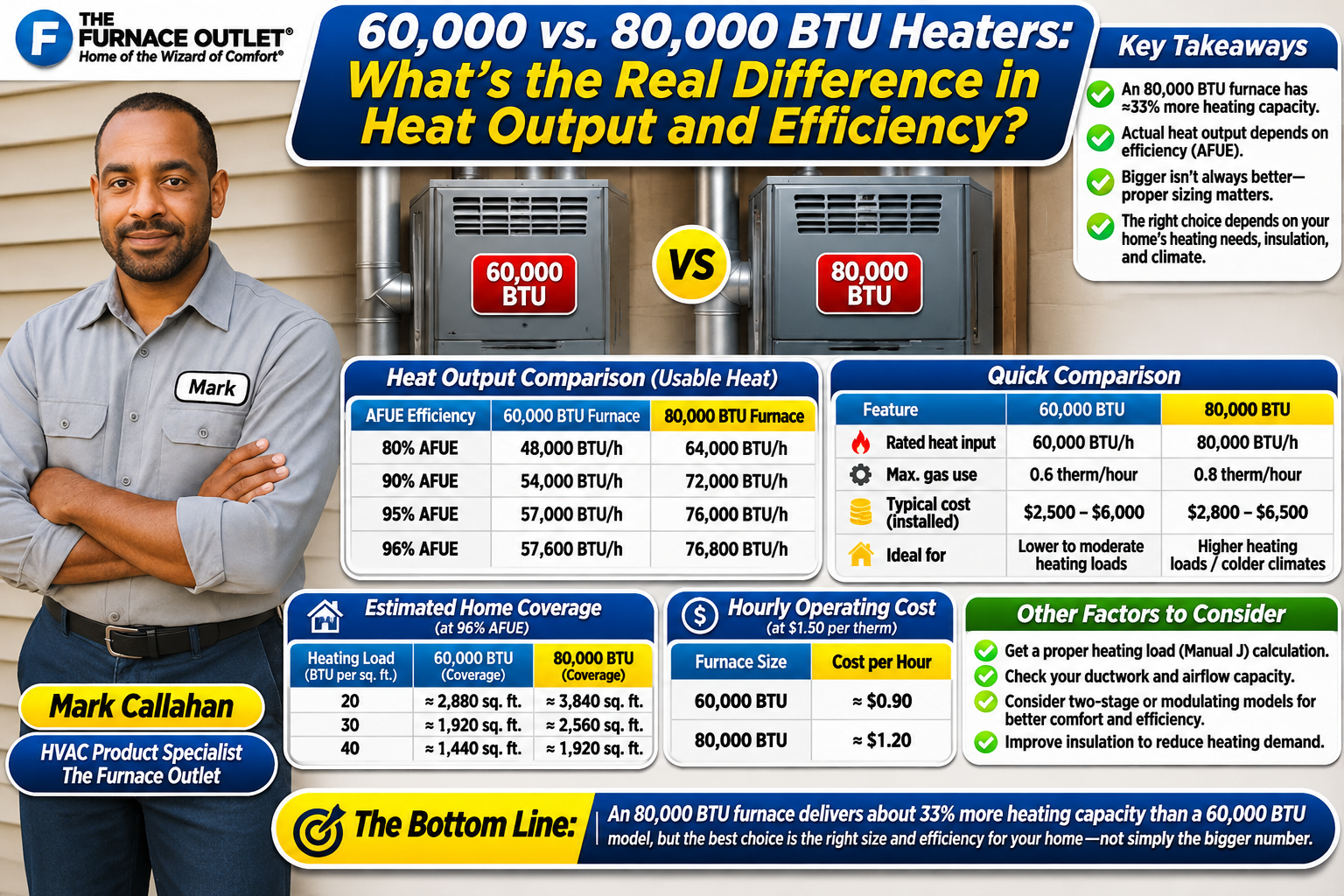
Choosing between a 60,000 BTU and an 80,000 BTU heating system involves more than comparing equipment capacity. Although an 80,000 BTU furnace has approximately 33% more rated heating input than a 60,000 BTU model, purchasing a larger furnace does not automatically translate into better comfort, lower heating bills, or improved energy efficiency.
The right furnace size depends on your home’s square footage, insulation, ceiling height, climate, air leakage, ductwork, and overall heating requirements. An oversized furnace can create uneven temperatures and frequent cycling, while an undersized system may struggle to maintain comfortable indoor conditions during extremely cold weather.
This guide explains the actual differences between 60,000 and 80,000 BTU furnaces, including usable heat output, energy efficiency, fuel consumption, installation costs, and long-term ownership expenses. The primary focus is residential natural gas furnaces, although the principles of heating capacity also apply to other heating technologies.
The primary difference between these two furnace sizes is their maximum heating capacity. However, the amount of usable heat delivered to the home also depends on the furnace’s efficiency rating, operating characteristics, and installation quality.
| Feature | 60,000 BTU Furnace | 80,000 BTU Furnace |
|---|---|---|
| Rated heat input | 60,000 BTU/h | 80,000 BTU/h |
| Approximate output at 80% AFUE | 48,000 BTU/h | 64,000 BTU/h |
| Approximate output at 96% AFUE | 57,600 BTU/h | 76,800 BTU/h |
| Maximum gas consumption | 0.6 therm/hour | 0.8 therm/hour |
| Equipment cost | Generally lower | Generally higher |
| Airflow requirements | Generally lower | Generally higher |
| Ideal application | Lower heating loads | Higher heating loads |
| Oversizing risk | Smaller, efficient homes | Homes with moderate heating loads |
An 80,000 BTU furnace is particularly useful when a building has substantial heat loss or operates in a colder climate. However, a properly sized 60,000 BTU furnace can provide better overall comfort than an oversized 80,000 BTU system.
BTU stands for British Thermal Unit, a measurement of thermal energy. One BTU represents approximately the energy required to increase the temperature of one pound of water by one degree Fahrenheit. Furnace capacity is expressed in BTU per hour, indicating the rate at which the equipment consumes fuel energy or delivers heat.
For most residential gas furnaces, the advertised BTU rating represents the maximum fuel input rather than the actual usable heating output. This distinction becomes particularly important when comparing furnaces with different efficiency ratings.
A furnace cannot convert every unit of fuel energy into usable indoor heat. Some energy is lost through combustion exhaust and other operating processes, with the amount depending on equipment design and efficiency.
The Annual Fuel Utilization Efficiency rating, commonly known as AFUE, measures how effectively a furnace converts fuel energy into usable heat over a heating season. The U.S. Department of Energy’s home heating efficiency guide explains how AFUE distinguishes conventional heating equipment from high-efficiency systems. The Department of Energy’s Energy.gov
For preliminary comparisons, homeowners can estimate equivalent useful heating capacity using the following formula. Actual rated output should always be confirmed using manufacturer specifications.
Approximate Heat Output = Furnace BTU Input × AFUE
| AFUE Rating | 60,000 BTU Furnace | 80,000 BTU Furnace | Output Difference |
|---|---|---|---|
| 80% | 48,000 BTU/h | 64,000 BTU/h | 16,000 BTU/h |
| 90% | 54,000 BTU/h | 72,000 BTU/h | 18,000 BTU/h |
| 92% | 55,200 BTU/h | 73,600 BTU/h | 18,400 BTU/h |
| 95% | 57,000 BTU/h | 76,000 BTU/h | 19,000 BTU/h |
| 96% | 57,600 BTU/h | 76,800 BTU/h | 19,200 BTU/h |
| 98% | 58,800 BTU/h | 78,400 BTU/h | 19,600 BTU/h |
These simplified calculations illustrate why furnace capacity and efficiency must be evaluated together. A smaller high-efficiency furnace can deliver heating performance surprisingly close to that of a larger conventional system.
A 60,000 BTU furnace operating at 96% AFUE provides approximately 57,600 BTU/h of equivalent useful heat, while an 80,000 BTU furnace operating at 80% AFUE provides approximately 64,000 BTU/h. Despite having a substantially higher input capacity, the larger conventional furnace provides only about 11.1% more estimated useful heat.
| Specification | 60K High-Efficiency Furnace | 80K Conventional Furnace |
|---|---|---|
| Fuel input | 60,000 BTU/h | 80,000 BTU/h |
| AFUE | 96% | 80% |
| Approximate useful output | 57,600 BTU/h | 64,000 BTU/h |
| Maximum gas consumption | 0.6 therm/hour | 0.8 therm/hour |
| Equivalent fuel energy loss | 2,400 BTU/h | 16,000 BTU/h |
For homes with heating requirements comfortably below 57,600 BTU/h, the smaller high-efficiency furnace may represent a better investment. However, properties requiring more heat during design winter conditions may still need the larger system.
Square footage provides a starting point for estimating heating requirements, but it should never be the only factor used to select furnace capacity. A well-insulated home in Georgia may require substantially less heating capacity than a similarly sized property in Minnesota.
The following table illustrates theoretical coverage using different assumed heating loads per square foot and furnaces rated at 96% AFUE.
| Assumed Heating Load | 60,000 BTU Furnace | 80,000 BTU Furnace |
|---|---|---|
| 20 BTU/h per sq. ft. | 2,880 sq. ft. | 3,840 sq. ft. |
| 30 BTU/h per sq. ft. | 1,920 sq. ft. | 2,560 sq. ft. |
| 40 BTU/h per sq. ft. | 1,440 sq. ft. | 1,920 sq. ft. |
| 50 BTU/h per sq. ft. | 1,152 sq. ft. | 1,536 sq. ft. |
| 60 BTU/h per sq. ft. | 960 sq. ft. | 1,280 sq. ft. |
These figures demonstrate how insulation and climate can dramatically influence heating capacity requirements. They are mathematical illustrations rather than recommended furnace sizes for specific properties.
The ACCA Manual J Residential Load Calculation standard provides a recognized methodology for calculating residential heating and cooling requirements using actual building characteristics. ACCA
An 80,000 BTU furnace is not inherently more or less energy efficient than a 60,000 BTU furnace. If both systems have identical AFUE ratings, they have the same standardized seasonal fuel conversion efficiency, although their actual installed performance may differ.
The larger furnace consumes more fuel when operating at maximum capacity but may require less operating time to satisfy the same heating demand. Consequently, purchasing a smaller furnace does not automatically reduce annual fuel consumption.
Correct equipment sizing, burner staging, blower technology, ductwork performance, and installation quality ultimately influence real-world heating efficiency. An appropriately sized furnace generally provides better operating conditions than equipment selected exclusively for its maximum heating capacity.
A therm represents 100,000 BTU of natural gas energy. At maximum rated input, a 60,000 BTU furnace consumes approximately 0.6 therm per hour, while an 80,000 BTU furnace consumes approximately 0.8 therm per hour.
Using an illustrative natural gas rate of $1.50 per therm, the following table compares fuel expenses at equivalent full-power operating durations.
| Operating Duration | 60,000 BTU Furnace | 80,000 BTU Furnace |
|---|---|---|
| 1 hour | $0.90 | $1.20 |
| 4 hours | $3.60 | $4.80 |
| 6 hours | $5.40 | $7.20 |
| 8 hours | $7.20 | $9.60 |
| 10 hours | $9.00 | $12.00 |
| Monthly at 6 hours/day | $162 | $216 |
| Monthly at 8 hours/day | $216 | $288 |
These calculations exclude blower electricity, fixed utility charges, and taxes. They compare identical operating durations rather than identical heating demand, so they should not be interpreted as guaranteed savings from purchasing a smaller furnace.
For a more meaningful efficiency comparison, consider a home requiring 50 million BTU of useful heat annually. Assuming natural gas costs $1.50 per therm, the estimated annual heating expenses would vary according to furnace efficiency.
| Furnace Efficiency | Annual Gas Consumption | Annual Fuel Cost |
|---|---|---|
| 80% AFUE | 625 therms | $937.50 |
| 90% AFUE | 555.6 therms | $833.33 |
| 95% AFUE | 526.3 therms | $789.47 |
| 96% AFUE | 520.8 therms | $781.25 |
| 98% AFUE | 510.2 therms | $765.31 |
Upgrading from an 80% AFUE furnace to a 96% AFUE furnace could reduce fuel consumption by approximately 16.7% under equivalent heating conditions. In this example, the annual fuel savings would be approximately $156, regardless of whether the appropriately sized replacement furnace has a 60,000 or 80,000 BTU input rating.
An oversized furnace may heat the area surrounding the thermostat quickly before shutting down, leaving distant rooms inadequately heated. Frequent startup and shutdown cycles can also contribute to temperature fluctuations, increased equipment wear, and noticeable operating noise.
The ENERGY STAR HVAC Quality Installation guidance emphasizes appropriate equipment sizing and airflow optimization to improve comfort and reduce unnecessary equipment deterioration. ENERGY STAR
Homeowners should avoid upgrading from 60,000 BTU to 80,000 BTU simply because they believe additional capacity will guarantee better performance. Addressing inadequate insulation, duct leakage, and airflow restrictions may resolve existing comfort problems without increasing furnace capacity.
An undersized furnace may operate continuously during extremely cold weather without maintaining the desired indoor temperature. Rooms with large windows, exterior walls, or significant air leakage may become particularly uncomfortable.
However, extended furnace operation during cold weather does not automatically indicate an equipment sizing problem. Longer heating cycles can be entirely normal when outdoor temperatures approach the home’s winter design conditions.
A professional heating load assessment can distinguish inadequate furnace capacity from ductwork deficiencies, insulation problems, or mechanical faults.
Burner technology can significantly influence comfort and temperature consistency. A larger two-stage furnace may operate at a lower heating capacity during ordinary winter conditions while retaining additional output for colder weather.
| Feature | Single-Stage | Two-Stage | Modulating |
|---|---|---|---|
| Heating output | Fixed | Low and high | Variable |
| Temperature consistency | Basic | Improved | Generally excellent |
| Operating noise | More noticeable | Lower at partial load | Often quieter at partial load |
| Initial cost | Lower | Moderate | Higher |
| Ability to match changing demand | Limited | Good | Excellent |
For example, an 80,000 BTU two-stage furnace with a hypothetical 65% low-fire setting would operate at 52,000 BTU/h of fuel input during low-stage operation. Actual staging percentages vary by manufacturer, and even a variable-capacity furnace must be appropriately sized.
Increasing furnace capacity without evaluating existing ductwork can create airflow restrictions, excessive static pressure, overheating, and uncomfortable operating noise. An 80,000 BTU furnace generally requires more heating airflow than a comparable 60,000 BTU model operating at the same temperature rise.
| Furnace at 96% AFUE | Estimated Airflow at 50°F Temperature Rise |
|---|---|
| 60,000 BTU | 1,067 CFM |
| 80,000 BTU | 1,422 CFM |
These estimates use standard-air conditions and the sensible heat relationship between airflow, heat output, and temperature rise. Actual airflow settings must comply with manufacturer specifications and accommodate any connected air conditioning equipment.
The ACCA technical manuals identify Manual D as the residential duct design methodology used alongside load calculations and equipment selection procedures. ACCA
Homeowners experiencing uneven temperatures, restricted airflow, or excessive furnace noise should also explore our guide on Do You Need Multiple Return Air Ducts? Expert Tips for Larger Homes. Adequate return airflow can be particularly important when upgrading to higher-capacity heating equipment because the existing duct system may not support the additional airflow requirements.
The purchase price difference between these furnace sizes is often less significant than the cost of modifying ductwork, venting, gas connections, and other installation components. High-efficiency equipment may also require condensate drainage and compatible combustion venting.
| Furnace Configuration | Estimated Installed US Cost |
|---|---|
| 60,000 BTU, 80% AFUE | $2,500–$4,500 |
| 80,000 BTU, 80% AFUE | $2,800–$5,000 |
| 60,000 BTU, 96% AFUE | $3,500–$6,000 |
| 80,000 BTU, 96% AFUE | $3,800–$6,500 |
| Premium two-stage or modulating system | $4,500–$8,500+ |
These are illustrative budgeting ranges rather than verified contractor quotations. Local labor charges, equipment availability, installation complexity, and regional requirements can significantly affect final costs.
For a more detailed understanding of equipment prices, professional labor expenses, and potential long-term heating savings, read our comprehensive guide on Installation Costs for a 60,000–80,000 BTU Goodman Furnace. Understanding the complete installation expense can help homeowners determine whether increasing furnace capacity or investing in higher efficiency provides better financial value.
The most reliable approach is to calculate your home’s heating load and compare it with manufacturer-rated furnace output. The ACCA Manual S Residential Equipment Selection standard provides procedures for matching equipment capacity to calculated building requirements and manufacturer performance data. ACCA
Homeowners should also consider planned insulation improvements, existing ductwork capacity, local winter temperatures, ceiling height, and future home additions. These factors may influence whether a 60,000 BTU or 80,000 BTU furnace provides better long-term performance.
Is an 80,000 BTU furnace 33% more powerful than a 60,000 BTU furnace? Yes, when comparing rated fuel input. If both furnaces have identical efficiency ratings, their approximate useful heating output also differs by 33.3%.
Will an 80,000 BTU furnace increase my gas bill? Not necessarily, because the larger furnace may operate for shorter periods to satisfy the same heating demand. Actual fuel expenses depend on efficiency, building heat loss, cycling behavior, and thermostat settings.
Is a 60,000 BTU furnace enough for a 2,000-square-foot house? It may be sufficient for a well-insulated property with moderate heating requirements. A professional load calculation is necessary to confirm whether its rated output meets the home’s winter heating demand.
Can I replace a 60,000 BTU furnace with an 80,000 BTU furnace? Such an upgrade may be appropriate when calculated heating requirements justify additional capacity. Existing ductwork, gas piping, venting, electrical connections, and equipment compatibility must also be professionally evaluated.
Which furnace lasts longer? Furnace lifespan depends more on installation quality, equipment construction, maintenance, operating conditions, and appropriate sizing than on BTU capacity. Oversized equipment that cycles excessively may experience premature component wear.
Choosing between a 60,000 and an 80,000 BTU furnace should begin with understanding how much heat your home actually loses during winter. A smaller high-efficiency furnace can deliver excellent comfort and lower fuel consumption when correctly matched to the building, while an 80,000 BTU furnace provides additional capacity for properties with greater heating requirements.
Invest in accurate equipment sizing, appropriate efficiency, compatible ductwork, and professional installation rather than purchasing additional BTUs unnecessarily. The best furnace is the system that consistently meets your heating requirements without excessive cycling, unnecessary energy consumption, or avoidable installation expenses.
Editorial Disclosure: The Furnace Outlet is not associated with, affiliated with, endorsed by, or sponsored by Carrier, Trane, Lennox, Bryant or any other manufacturer mentioned in this article. We do not receive manufacturer compensation for inclusion or rankings.
The Furnace Outlet
For educational purposes only. HVAC equipment removal, refrigerant handling, recycling and disposal requirements can vary by equipment and location. Consult a qualified HVAC professional and applicable federal, state and local requirements before removing or disposing of HVAC equipment.
© 2026 The Furnace Outlet | www.thefurnaceoutlet.com