Newsletter Subscribe
Enter your email address below and subscribe to our newsletter

HVAC made simple
By Tony Marino | The Furnace Outlet
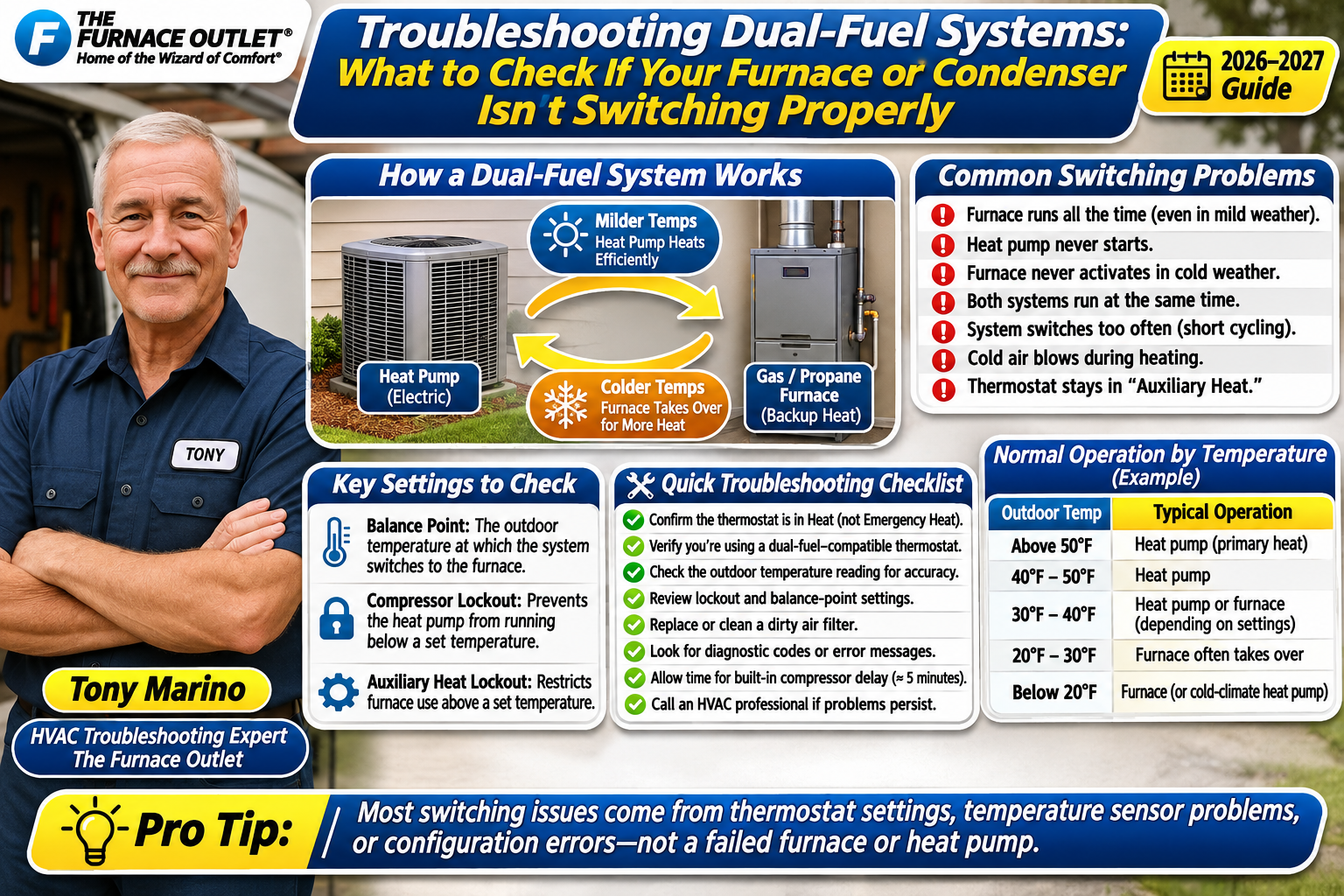
A dual-fuel HVAC system combines the energy efficiency of an electric heat pump with the dependable heating capacity of a gas or propane furnace. When properly configured, the system automatically switches between these two heating sources based on outdoor temperatures, indoor heating demand, thermostat settings, and equipment operating limitations.
However, when the switching process fails, homeowners may experience unexpectedly high utility bills, insufficient heating, cold air coming from supply vents, or a furnace that operates even when outdoor temperatures are relatively mild. In other cases, the outdoor heat pump may continue running when the furnace should have taken over.
Understanding how dual-fuel systems manage heating transitions is essential for identifying these problems. This guide explains common switching issues, thermostat configuration errors, outdoor temperature sensor problems, electrical faults, and safe troubleshooting procedures that can help restore reliable heating performance.
A dual-fuel system typically consists of an outdoor heat pump, an indoor gas or propane furnace, an evaporator coil, and a compatible thermostat or integrated equipment controller. During moderate winter conditions, the heat pump transfers thermal energy from outdoor air into the home, often providing efficient heating with relatively low electricity consumption.
As outdoor temperatures decrease, heat pump efficiency and available heating capacity may decline. Depending on the equipment configuration and local energy prices, the system switches to the furnace when outdoor conditions or indoor heating requirements make combustion heating more appropriate.
| Operating Condition | Primary Heating Source |
|---|---|
| Mild outdoor temperatures | Heat pump |
| Moderate winter temperatures | Heat pump, depending on settings |
| Below configured changeover temperature | Gas or propane furnace |
| Emergency heat mode | Typically the furnace |
| Summer cooling | Outdoor heat pump |
| Heat pump defrost cycle | Model-specific operation |
Unlike conventional all-electric heat pump systems with resistance backup heating, most dual-fuel systems are designed to prevent simultaneous normal heating operation of the heat pump and gas furnace. Certain manufacturer-approved configurations may permit specific exceptions during defrost or other controlled operating conditions.
The balance point is one of the most important concepts in dual-fuel troubleshooting. It helps determine when the system should transition from electric heat pump operation to fossil-fuel heating.
The thermal balance point occurs when the heat pump’s available heating capacity equals the building’s heating requirements. The economic balance point occurs when operating the furnace becomes less expensive than operating the heat pump.
According to Carrier’s dual-fuel heating system guide, changeover temperatures commonly fall around 35°F to 40°F, although the appropriate setting varies considerably depending on equipment capabilities, climate, and utility prices. Modern cold-climate heat pumps may operate efficiently at substantially lower temperatures.
| Outdoor Temperature | Possible System Operation |
|---|---|
| Above 50°F | Heat pump generally preferred |
| 40°F–50°F | Heat pump operation |
| 30°F–40°F | Heat pump or furnace, depending on configuration |
| 20°F–30°F | Equipment-dependent changeover |
| Below 20°F | Furnace or cold-climate heat pump |
| Below 0°F | Furnace or suitably rated cold-climate equipment |
These temperature ranges are illustrative rather than universal recommendations. Homeowners should not change their compressor lockout temperature without understanding equipment specifications and local heating requirements.
Switching problems are not always caused by defective equipment. Incorrect thermostat programming, inaccurate temperature readings, communication errors, and restricted airflow can produce symptoms that resemble mechanical failure.
| Symptom | Possible Cause |
|---|---|
| Furnace runs continuously | Incorrect lockout settings or heat pump failure |
| Heat pump never starts | Thermostat configuration or electrical fault |
| Furnace never activates | Ignition failure or missing heating signal |
| Both heating sources operate together | Control configuration or interlock problem |
| System frequently switches between fuels | Sensor error or unsuitable staging settings |
| Cold air blows during heating | Defrost cycle or reversing valve fault |
| Thermostat remains in auxiliary heat | Incorrect settings or insufficient heat pump output |
| Outdoor unit continues running below lockout | Sensor or control malfunction |
| Heating bills suddenly increase | Excessive reliance on backup heating |
| System shuts down during transition | Safety lockout or communication failure |
Identifying when the problem occurs, particularly in relation to outdoor temperatures and thermostat indications, can significantly narrow the troubleshooting process.
The thermostat is the central decision-making component in many dual-fuel installations. If the thermostat is configured incorrectly, both heating systems may remain mechanically functional while failing to switch as intended.
Begin by confirming that the thermostat is set to Heat rather than Emergency Heat, Cool, or Off. Emergency Heat generally disables normal heat pump heating and relies on the backup furnace, potentially explaining why the outdoor unit never operates.
Allow sufficient time for equipment protection delays before concluding that a heating source has failed. Many systems incorporate compressor restart delays of approximately five minutes to prevent equipment damage from rapid cycling.
Not every smart thermostat supports dual-fuel heating. Some thermostats are designed for conventional furnace and air conditioning systems, while others support heat pumps with electric resistance backup but lack the appropriate controls for fossil-fuel backup.
The U.S. Department of Energy’s dual-fuel thermostat training resources explain the importance of equipment-specific thermostat programming and control coordination.
| Thermostat Configuration | Dual-Fuel Suitability |
|---|---|
| Conventional furnace and AC thermostat | Generally unsuitable |
| Basic heat pump thermostat | Model-dependent |
| Heat pump thermostat with electric auxiliary heat | Not necessarily compatible |
| Dual-fuel-compatible smart thermostat | Suitable when properly configured |
| Manufacturer-specific communicating thermostat | Suitable for compatible equipment |
If switching problems began after replacing your thermostat, configuration and compatibility should be among the first areas investigated. Our detailed guide on Smart Thermostat Compatibility: What Works With Your HVAC and What Doesn’t explains how different thermostat technologies interact with furnaces, heat pumps, and multistage heating equipment.
Dual-fuel thermostats may incorporate temperature-based control settings that determine when each heating source is permitted to operate. Incorrect settings can cause the furnace to activate prematurely or prevent it from operating when additional heat is required.
| Control Setting | Function |
|---|---|
| Compressor lockout | Prevents heat pump heating below a selected temperature |
| Auxiliary heat lockout | Restricts backup heating above a selected temperature |
| Temperature differential | Helps determine when additional heating is needed |
| Staging delay | Controls when another heating stage becomes necessary |
| Compressor protection delay | Prevents excessively rapid compressor restarts |
| Emergency Heat | Allows backup heating without normal heat pump operation |
The Resideo TH7000 thermostat documentation illustrates how fossil-fuel and electric auxiliary heating configurations can use different lockout logic. Consequently, thermostat settings intended for electric resistance backup should not automatically be applied to gas furnace backup.
Homeowners can review displayed settings and record their observations, but a qualified technician should adjust installer-level parameters when equipment compatibility or operating requirements are uncertain.
Some dual-fuel systems rely on a physical outdoor temperature sensor, while others obtain outdoor temperature information through connected thermostat services. Incorrect readings can cause the system to select the wrong heating source.
Compare the thermostat’s displayed outdoor temperature with a reliable local temperature reading. A persistent discrepancy may indicate sensor positioning problems, damaged wiring, connectivity issues, or an incorrect location configuration within the thermostat application.
Physical sensors exposed to direct sunlight or nearby heat sources can report temperatures that are higher than actual outdoor conditions. Internet-connected thermostats may also experience outdated temperature readings when network connectivity is interrupted.
If the outdoor heat pump operates normally but the furnace fails to activate when additional heating is required, the problem may involve either the furnace itself or the controls responsible for requesting backup heat. Possible causes include incorrect auxiliary heating settings, ignition failure, furnace safety lockouts, condensate drainage problems, restricted airflow, or communication faults between system components.
Homeowners should check accessible air filters, thermostat indications, and visible diagnostic codes without removing electrical or combustion access panels. Record any flashing diagnostic lights before interrupting equipment power, as restarting the system may erase useful fault information. Repeated ignition failures or safety lockouts require professional diagnosis rather than repeated furnace resets.
A furnace that operates throughout mild winter weather may indicate that the heat pump has been disabled by thermostat settings or an equipment protection mechanism. Emergency Heat mode, incorrect outdoor temperature readings, excessive compressor lockout settings, and outdoor unit electrical faults are common possibilities.
| Possible Cause | Recommended Action |
|---|---|
| Emergency Heat selected | Return thermostat to normal Heat mode if safe |
| Compressor restart delay | Allow the specified waiting period |
| Incorrect outdoor temperature | Compare displayed and actual temperatures |
| Circuit breaker tripped | Seek professional assessment if unexplained or recurring |
| Outdoor coil obstructed | Remove loose surrounding debris safely |
| Compressor protection fault | Arrange professional diagnosis |
| Thermostat configuration error | Request installer configuration review |
Persistent outdoor unit failure may involve refrigerant problems, control boards, contactors, capacitors, inverter electronics, or compressor faults. These components require professional testing.
Simultaneous normal heating operation is generally inappropriate for conventional dual-fuel systems that share an indoor air distribution system. The gas furnace can raise the air temperature entering the indoor refrigerant coil beyond the heat pump’s intended operating conditions. Improper coordination may contribute to excessive refrigerant pressures, protective shutdowns, increased energy consumption, and equipment damage. However, certain systems have manufacturer-approved operating sequences that permit limited overlap during specific conditions.
If both heating sources appear to operate together repeatedly, switch the system off using normal thermostat controls and arrange a professional inspection. Do not attempt to bypass interlocks, bridge thermostat terminals, or modify control wiring.
Heat pumps operating during cold, humid weather can develop frost on their outdoor coils. The equipment periodically enters a defrost cycle to remove accumulated frost and restore efficient heat transfer.
During defrost, homeowners may observe steam rising from the outdoor unit, temporary changes in operating sound, a stationary outdoor fan, or a brief change in indoor supply-air temperature. Backup furnace operation during defrost depends on the manufacturer’s approved control sequence.
| Normal Defrost Behavior | Potential Equipment Problem |
|---|---|
| Temporary steam | Ice remains after repeated cycles |
| Brief outdoor fan stoppage | Fan remains inoperative afterward |
| Temporary change in sound | Persistent grinding or banging |
| Short-lived temperature changes | Prolonged cold indoor airflow |
| Frost clears from outdoor coil | Thick ice continually accumulates |
Never remove ice using sharp tools, boiling water, or external heating equipment. Persistent icing should be investigated by an HVAC technician.
The reversing valve allows the heat pump to alternate between heating and cooling by changing refrigerant flow direction. A malfunctioning valve or an incorrect thermostat reversing-valve configuration can prevent the heat pump from delivering the expected heating performance.
A reversing valve problem does not directly control the transition between electric and gas heating. However, inadequate heat pump output can create additional heating demand that causes the thermostat to rely excessively on the furnace. The Carrier reversing valve troubleshooting guide provides additional information about faults affecting heat pump heating and cooling transitions. Heat Pumps
Improper heating source selection can significantly increase operating expenses. Whether electricity or natural gas provides cheaper heating depends on local utility rates, furnace efficiency, and the heat pump’s actual operating efficiency.
Consider a household requiring 10 million BTU of useful heat, with electricity costing $0.17 per kWh and natural gas costing $1.50 per therm.
| Heating Source | Estimated Heating Cost |
|---|---|
| Heat pump at COP 4.0 | $124.56 |
| Heat pump at COP 3.0 | $166.08 |
| Heat pump at COP 2.5 | $199.30 |
| Heat pump at COP 2.0 | $249.12 |
| 80% AFUE gas furnace | $187.50 |
| 96% AFUE gas furnace | $156.25 |
Under these illustrative conditions, the heat pump becomes less expensive than the 96% AFUE furnace when its COP exceeds approximately 3.19. Different electricity and natural gas prices can substantially change this economic threshold.
The calculations exclude fixed utility charges, blower consumption, and maintenance expenses. Homeowners can explore The Furnace Outlet HVAC Calculators for additional assistance with heating costs and equipment requirements.
A systematic troubleshooting approach begins with confirming normal thermostat operation, reviewing outdoor temperature readings, checking accessible filters, observing equipment behavior, and recording visible fault codes. These preliminary observations can help a technician distinguish control problems from mechanical failures without unnecessary component replacement.
The ENERGY STAR HVAC maintenance checklist recommends professional inspection of electrical connections, operating controls, airflow, refrigerant performance, and combustion components. Scheduling preventive maintenance before winter can help identify problems before they interrupt heating operation.
Repair expenses depend on whether the problem involves thermostat programming, electrical components, furnace ignition, refrigerant circuitry, or major equipment failure.
| Service or Repair | Estimated US Cost |
|---|---|
| Diagnostic service visit | $100–$250 |
| Thermostat reconfiguration | $100–$250 |
| Outdoor temperature sensor replacement | $100–$300 |
| Thermostat replacement | $150–$500 |
| Contactor replacement | $150–$400 |
| Furnace ignitor replacement | $150–$350 |
| Control board replacement | $350–$1,200 |
| Reversing valve replacement | $600–$1,600 |
| Compressor replacement | $1,500–$3,500+ |
These figures are preliminary budgeting estimates rather than verified contractor quotations. Warranty coverage, equipment accessibility, replacement part availability, and regional labor charges can substantially affect final expenses.
Professional assistance is necessary when basic thermostat and airflow checks fail to restore proper operation, particularly if the equipment repeatedly shuts down, develops persistent ice, trips electrical breakers, or operates both heating sources unexpectedly.
If you smell natural gas, leave the building immediately without operating electrical switches and contact your gas utility or emergency services from outside. A carbon monoxide alarm, smoke, sparking, or burning electrical odors also requires immediate safety action rather than continued troubleshooting.
At what temperature should a dual-fuel system switch to gas? There is no universal changeover temperature. The appropriate setting depends on heat pump performance, building heating requirements, furnace efficiency, and local utility rates.
Why does my thermostat show auxiliary heat when it is warm outside? Possible explanations include thermostat recovery settings, inaccurate outdoor temperature readings, incorrect auxiliary heating configuration, or insufficient heat pump performance. Persistent auxiliary heating during mild weather warrants investigation.
Can I manually switch between my heat pump and furnace? Some compatible thermostats provide an Emergency Heat setting that operates the backup furnace. However, this setting should generally remain reserved for heat pump failure or manufacturer-approved operating circumstances.
Does a dual-fuel system require a special thermostat? Most dual-fuel installations require a thermostat or integrated controller specifically capable of coordinating heat pump and fossil-fuel heating. Using an incompatible thermostat can result in unreliable or potentially damaging equipment operation.
When a dual-fuel HVAC system fails to switch properly, investigate thermostat configuration and temperature sensing before assuming that the furnace or heat pump needs replacement. Many apparent equipment failures originate from improper control settings, inaccurate sensor readings, or inadequate coordination between heating sources.
A correctly configured dual-fuel system should deliver dependable comfort while selecting an appropriate heating source for prevailing conditions. Professional commissioning, accurate changeover settings, and regular preventive maintenance remain essential for maximizing efficiency, protecting equipment, and reducing long-term heating expenses.
Editorial Disclosure: The Furnace Outlet is not associated with, affiliated with, endorsed by, or sponsored by Carrier, Trane, Lennox, Bryant or any other manufacturer mentioned in this article. We do not receive manufacturer compensation for inclusion or rankings.
The Furnace Outlet
For educational purposes only. HVAC equipment removal, refrigerant handling, recycling and disposal requirements can vary by equipment and location. Consult a qualified HVAC professional and applicable federal, state and local requirements before removing or disposing of HVAC equipment.
© 2026 The Furnace Outlet | www.thefurnaceoutlet.com