Newsletter Subscribe
Enter your email address below and subscribe to our newsletter

HVAC made simple
By Samantha Reyes | The Furnace Outlet
Traditional window air conditioners have been a popular cooling solution for decades, but they often come with frustrating compromises. They block natural light, obstruct outdoor views, produce noticeable indoor noise, and can make opening or closing a window nearly impossible during the summer months. For renters, apartment residents, and homeowners looking for a more comfortable alternative, saddle window air conditioners offer an innovative approach to room cooling.
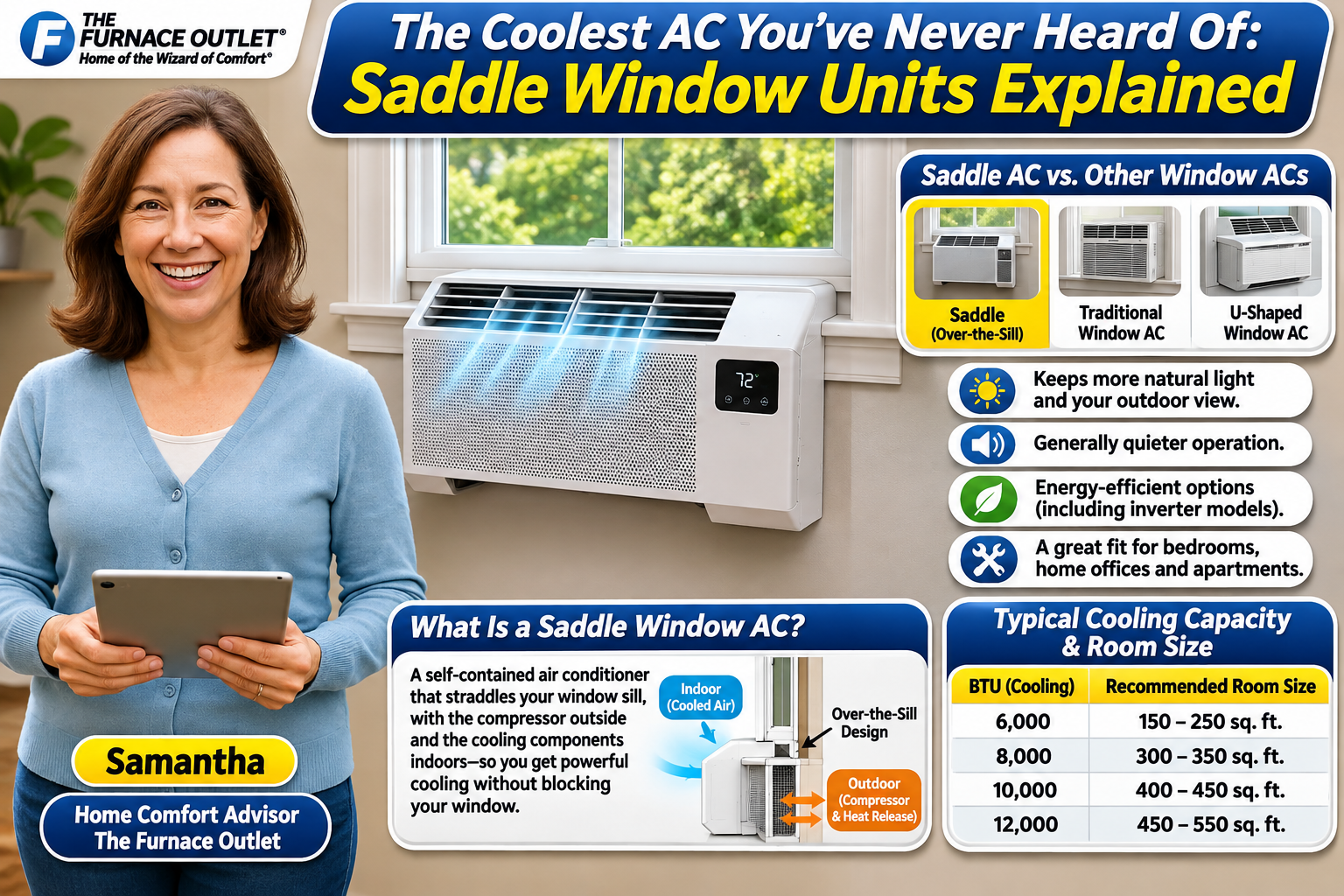
Unlike conventional window AC units, saddle air conditioners feature a distinctive over-the-sill design that allows much of the equipment to sit below the window opening. This configuration can improve visibility, reduce indoor noise, and preserve more of the window’s functionality without requiring a permanent central air conditioning or ductless mini-split installation.
But are saddle window air conditioners really worth the additional investment? This guide explores how they work, their advantages and disadvantages, cooling efficiency, installation requirements, operating costs, and whether they represent a smarter cooling solution for your home.
A saddle window air conditioner, also known as an over-the-sill air conditioner, is a self-contained cooling system designed to straddle the bottom portion of a window. Instead of occupying the entire window opening, the equipment extends downward on both sides of the wall, resembling a saddle resting over a horse’s back.
The indoor section contains the evaporator coil, air circulation fan, filters, and operating controls, while the outdoor section generally houses the compressor and condenser coil. A connecting section passes over the window sill, allowing refrigerant and electrical connections to operate within a factory-assembled system.
This design preserves significantly more window space while maintaining the convenience of a traditional room air conditioner. Unlike a ductless mini-split, it generally does not require separate refrigerant line installation or drilling a permanent opening through an exterior wall.
A saddle air conditioner uses the same vapor-compression refrigeration cycle found in conventional window air conditioners. Warm indoor air passes across a cold evaporator coil, where refrigerant absorbs heat and moisture before cooled air returns to the room.
The refrigeration system transfers absorbed heat to the outdoor condenser, where it is released into the surrounding atmosphere. Positioning the compressor outside and below the window opening can help reduce the amount of mechanical noise entering the room.
Some premium saddle air conditioners incorporate inverter-driven compressors that continuously adjust cooling output according to demand. This technology can improve temperature consistency, reduce energy consumption, and minimize the noticeable startup and shutdown noise associated with conventional fixed-speed compressors.
Although these three air conditioning designs perform the same basic cooling function, their differences in construction significantly influence installation, noise, aesthetics, and overall comfort.
| Feature | Saddle Window AC | Traditional Window AC | U-Shaped Window AC |
|---|---|---|---|
| Window obstruction | Minimal | Significant | Moderate |
| Natural light preservation | Excellent | Limited | Good |
| Indoor noise | Generally low | Moderate to high | Generally low |
| Window operation | Possible on compatible models | Usually restricted | Possible on compatible models |
| Inverter availability | Select models | Select models | Widely available |
| Installation complexity | Moderate | Low to moderate | Moderate |
| Wall thickness limitations | Important | Less restrictive | Model-dependent |
| Purchase cost | Moderate to high | Low to moderate | Moderate to high |
| Appearance | Low-profile | Conventional | Modern |
Saddle units are especially attractive to homeowners who prioritize unobstructed outdoor views and natural lighting. U-shaped air conditioners may provide similar acoustic benefits, but their central opening accommodates the window sash rather than positioning most of the equipment below the sill.
Traditional window air conditioners can make bedrooms, home offices, and apartments feel darker by occupying a substantial portion of the available window area. Saddle units minimize this problem by positioning their larger components below the window opening, creating a less intrusive installation.
The design can also be beneficial in bedrooms where compressor noise interrupts sleep or home offices where background noise interferes with online meetings. Although the actual acoustic performance varies by model, separating the compressor from the indoor environment can noticeably improve comfort.
Many saddle units also incorporate modern features such as Wi-Fi connectivity, programmable timers, sleep modes, remote controls, adjustable fan speeds, and energy-saving operating modes. These features provide greater control over cooling schedules and household electricity consumption.
Selecting the correct cooling capacity is essential for maintaining comfortable temperatures without excessive electricity consumption. Saddle air conditioners are available in several capacities, commonly ranging from approximately 6,000 to 12,000 BTU/h.
| Cooling Capacity | Recommended Room Size |
|---|---|
| 6,000 BTU | 150–250 sq. ft. |
| 8,000 BTU | 300–350 sq. ft. |
| 10,000 BTU | 400–450 sq. ft. |
| 12,000 BTU | 450–550 sq. ft. |
These are preliminary room-sizing guidelines based on ordinary residential conditions. Rooms with high ceilings, large sun-facing windows, inadequate insulation, or multiple occupants may require additional cooling capacity.
The ENERGY STAR room air conditioner guide provides useful guidance on selecting appropriately sized and energy-efficient cooling equipment.
Homeowners should avoid purchasing an oversized air conditioner simply to achieve faster cooling. Excessive cooling capacity can contribute to frequent cycling and inadequate humidity removal, particularly in fixed-speed systems.
A saddle design does not automatically make an air conditioner more energy efficient than a conventional window unit. Actual efficiency depends on compressor technology, heat exchanger performance, fan operation, air leakage, and the equipment’s Combined Energy Efficiency Ratio, commonly known as CEER.
Inverter-equipped saddle units can offer improved partial-load performance because they adjust compressor speed instead of repeatedly operating at maximum capacity. This capability can be particularly valuable in bedrooms and living areas where cooling requirements change throughout the day.
Homeowners should compare the published CEER ratings and annual energy consumption figures of individual models before purchasing. The ENERGY STAR certified room air conditioner database can help identify equipment meeting recognized efficiency requirements.
Operating expenses depend on equipment power consumption, compressor runtime, outdoor temperatures, thermostat settings, and local electricity rates. Inverter systems may consume substantially less electricity during periods when the room requires only limited cooling.
The following examples assume six equivalent full-power operating hours per day and an electricity rate of $0.16 per kWh.
| Cooling Capacity | Assumed Power Draw | Daily Cost | Monthly Cost |
|---|---|---|---|
| 6,000 BTU | 500 watts | $0.48 | $14.40 |
| 8,000 BTU | 650 watts | $0.62 | $18.72 |
| 10,000 BTU | 850 watts | $0.82 | $24.48 |
| 12,000 BTU | 1,000 watts | $0.96 | $28.80 |
These calculations are illustrative rather than manufacturer-specific operating estimates. Actual electricity consumption may be lower or higher depending on equipment efficiency and the amount of cooling required.
At the same assumed electricity rate, an 8,000 BTU unit drawing an average of 650 watts for six equivalent full-power hours daily would cost approximately $112 to operate over a six-month cooling season.
Soleus Air saddle air conditioners feature an over-the-sill configuration designed to preserve window visibility while positioning major mechanical components below the window opening. The brand offers multiple cooling capacities, with features varying between equipment generations. Its official saddle air conditioner installation manual illustrates the distinctive mounting arrangement and support requirements.
GE Profile ClearView air conditioners use a similar over-the-sill approach, with selected models offering inverter technology, smart connectivity, and adjustable installation configurations. These systems are particularly appealing to homeowners seeking a modern appearance, reduced indoor noise, and greater flexibility when accommodating different wall thicknesses.
When comparing brands, homeowners should prioritize window compatibility, published sound ratings, CEER efficiency, warranty coverage, drainage design, and replacement parts availability rather than relying exclusively on brand recognition.
Indoor noise reduction is one of the most attractive features of saddle air conditioners. The over-the-sill configuration places the compressor outside and allows the window and surrounding wall structure to provide some separation between outdoor mechanical noise and the indoor living environment.
| Sound Level | General Perception |
|---|---|
| 35–40 dBA | Very quiet indoor environment |
| 40–45 dBA | Quiet bedroom or library |
| 45–50 dBA | Noticeable but relatively quiet |
| 50–60 dBA | Clearly audible background noise |
| Above 60 dBA | Increasingly intrusive indoors |
Premium saddle air conditioners may advertise sound levels in the low-40 dBA range under specific operating conditions. However, noise levels increase with fan speed and cooling demand, and manufacturer measurements may not use identical testing conditions.
For bedrooms, nurseries, home offices, and study rooms, a quieter saddle air conditioner may provide meaningful comfort improvements even when its cooling capacity is identical to that of a conventional window unit.
Window compatibility is one of the most important considerations when purchasing a saddle air conditioner. A unit that fits the width of your window may still be unsuitable if the wall or sill is too thick for its connecting section.
Homeowners need to measure the usable window opening width, maximum opening height, total sill and wall depth, available indoor clearance beneath the window, and exterior clearance for the condenser section. Storm windows, decorative trim, security bars, radiators, and projecting exterior architectural features can also interfere with installation.
The installation requirements for representative older saddle models include window openings between 24 and 48 inches wide and a minimum opening height of 16 inches. These dimensions are model-specific and should never be assumed to apply to every saddle air conditioner. ManualsFile+1
If your property has unusually narrow windows, explore our guide on Smart Cooling for Slim Windows: 14-Inch AC Units That Deliver. Understanding alternative compact cooling designs can help you identify suitable equipment when a conventional saddle unit cannot accommodate your window dimensions.
Most residential saddle air conditioners are designed for installation in compatible single-hung or double-hung windows. Their mounting arrangements vary by manufacturer and may incorporate adjustable supports, mounting blocks, window security brackets, and customized insulation materials.
Because saddle units can be heavy and awkward to position, installation should generally involve two adults or a qualified installer. The window sill must be structurally sound, and all manufacturer-required supports must be installed before operating the equipment.
Proper sealing is equally important because gaps around the window allow warm outdoor air and humidity to enter the room. The ENERGY STAR room air conditioner installation guidance explains the importance of weather stripping and sealing gaps surrounding window-mounted cooling equipment.
Many smaller saddle units operate on standard North American 115V electrical supplies. Nevertheless, homeowners must verify the equipment’s voltage, amperage, and circuit requirements, use an appropriately grounded outlet, and avoid extension cords or power strips.
All air conditioners remove some moisture from indoor air during cooling. In traditional window systems, collected condensate often drains toward the outdoor section or is used to improve condenser heat transfer.
The unusual geometry of saddle air conditioners means that condensation management can be more complex. Some designs incorporate internal reservoirs, drainage channels, or condensate pumps to move collected moisture from the indoor section to the outdoor portion.
Homeowners should follow the manufacturer’s leveling and drainage instructions rather than applying conventional window AC installation practices. Incorrect positioning or obstructed drainage components can result in indoor water leakage, unpleasant odors, or automatic equipment shutdown.
Saddle air conditioners generally carry a purchase-price premium compared with basic conventional window units. Their specialized cabinet construction, quieter operating configuration, and additional comfort features can contribute to higher equipment costs.
| Equipment Type | Illustrative US Price Range |
|---|---|
| Basic 6,000 BTU saddle AC | $300–$450 |
| 8,000 BTU saddle AC | $350–$550 |
| 10,000 BTU saddle AC | $450–$650 |
| 12,000 BTU saddle AC | $500–$800 |
| Premium inverter saddle AC | $500–$900 |
Professional installation, where necessary, may add approximately $100–$300 or more depending on window accessibility, structural conditions, and local labor rates. These figures are budgeting estimates rather than verified current retailer quotations.
| Advantages | Disadvantages |
|---|---|
| Preserves natural light | Higher initial purchase price |
| Maintains more outdoor visibility | Limited compatibility with some windows |
| Potentially quieter indoor operation | Can be heavy and difficult to handle |
| No permanent refrigerant line installation | Wall thickness restrictions |
| Modern appearance | Potentially more complex drainage |
| Smart controls on selected models | Fewer equipment choices |
| Suitable for many rental properties | Building restrictions may apply |
The financial value of a saddle air conditioner depends on how much the homeowner prioritizes noise reduction, natural lighting, and window functionality. A conventional window air conditioner may provide similar cooling capacity at a lower purchase price, while a saddle unit can deliver a more pleasant everyday living experience.
Portable air conditioners are frequently purchased by renters who cannot install conventional window units. However, single-hose portable systems can draw conditioned indoor air outside, potentially causing additional warm outdoor air to enter the building.
A saddle air conditioner transfers heat outdoors without occupying valuable floor space or requiring a large exhaust hose inside the room. When window installation is permitted and structurally suitable, it may offer better cooling efficiency and a less cluttered indoor environment than many portable systems.
The U.S. Department of Energy’s room air conditioner guide provides additional information about room cooling efficiency, equipment selection, and proper installation.
Regular maintenance helps preserve cooling performance, reduce electricity consumption, and prevent premature equipment failure. Air filters should be inspected regularly during the cooling season and cleaned or replaced according to the manufacturer’s instructions.
Homeowners should also keep indoor air outlets unobstructed, maintain sufficient outdoor condenser clearance, inspect window seals for deterioration, and monitor the equipment for drainage problems. Unusual mechanical noises, persistent water leakage, electrical odors, or declining cooling performance should be evaluated by a qualified service professional.
Can you open a window with a saddle air conditioner installed? Many saddle designs allow the window to be opened after installation, subject to manufacturer instructions and security requirements. The available opening and functionality depend on the equipment design and mounting arrangement.
Are saddle air conditioners suitable for apartments? They can be excellent cooling solutions for apartments with compatible windows. Tenants should obtain any necessary landlord approval and confirm that building regulations permit window-mounted air conditioning equipment.
Do saddle window AC units require professional installation? Many models are designed for homeowner installation, provided the window meets all structural and dimensional requirements. Professional assistance is advisable for heavy equipment, elevated windows, complicated mounting conditions, or uncertain electrical compatibility.
Can a saddle air conditioner provide heating in winter? Selected models include heating functionality, but the heating technology and outdoor operating temperature limits vary. Homeowners should verify whether the equipment provides resistance heating or heat pump operation before relying on it for winter comfort.
Can a saddle window AC be left installed throughout winter? This depends on manufacturer recommendations, outdoor weather exposure, window sealing, and drainage requirements. Seasonal removal may be advisable for cooling-only equipment in regions experiencing freezing temperatures.
Saddle window air conditioners represent a thoughtful improvement over conventional window cooling equipment, particularly for homeowners who value natural light, quieter operation, and an unobstructed living environment. Their distinctive design addresses several common frustrations associated with traditional window AC units without requiring the expense of a permanently installed ductless cooling system.
Before purchasing, carefully evaluate window dimensions, wall thickness, cooling capacity, energy efficiency, electrical compatibility, and installation requirements. A properly selected saddle air conditioner can provide efficient summer cooling while preserving the comfort, appearance, and functionality of your home.
Editorial Disclosure: The Furnace Outlet is not associated with, affiliated with, endorsed by, or sponsored by Carrier, Trane, Lennox, Bryant or any other manufacturer mentioned in this article. We do not receive manufacturer compensation for inclusion or rankings.
The Furnace Outlet
For educational purposes only. HVAC equipment removal, refrigerant handling, recycling and disposal requirements can vary by equipment and location. Consult a qualified HVAC professional and applicable federal, state and local requirements before removing or disposing of HVAC equipment.
© 2026 The Furnace Outlet | www.thefurnaceoutlet.com