Newsletter Subscribe
Enter your email address below and subscribe to our newsletter

HVAC made simple
By Jake Lawson | The Furnace Outlet
Ductless mini split systems have become increasingly popular among homeowners looking for energy-efficient heating and cooling without the expense of installing traditional ductwork. DIY-friendly equipment, precharged refrigerant lines, and readily available installation accessories have made these systems particularly attractive to homeowners who want to reduce installation costs.
However, installing a mini split involves more than mounting an indoor unit, connecting refrigerant lines, and switching on the power. Building permits, electrical codes, refrigerant handling regulations, equipment placement requirements, and manufacturer installation instructions all play important roles in determining whether an installation is legal and safe.
Even systems specifically marketed as DIY-friendly are not automatically exempt from local permitting requirements. An improperly installed mini split can create electrical hazards, reduce energy efficiency, affect warranty coverage, and lead to complications during insurance claims or future property sales.
This comprehensive guide explains the permits, codes, electrical requirements, refrigerant regulations, and installation responsibilities that homeowners across the United States should understand before purchasing or installing a ductless mini split system.
In many parts of the United States, homeowners may legally perform certain HVAC installation tasks on their own primary residences. However, the extent of permitted DIY work depends on state licensing laws, municipal building regulations, property ownership, equipment specifications, and the type of work involved.
Some jurisdictions allow homeowners to obtain mechanical and electrical permits for their own residential projects. Others require licensed contractors to perform specific portions of the installation, particularly electrical connections and refrigerant-related work.
A DIY mini split kit does not override these legal requirements. The manufacturer’s designation of a product as suitable for homeowner installation describes its installation design, not its legal status in every jurisdiction.
Before purchasing equipment, homeowners should contact their local building department to determine whether homeowner installation is permitted, which permits are required, and whether licensed professionals must complete particular tasks.
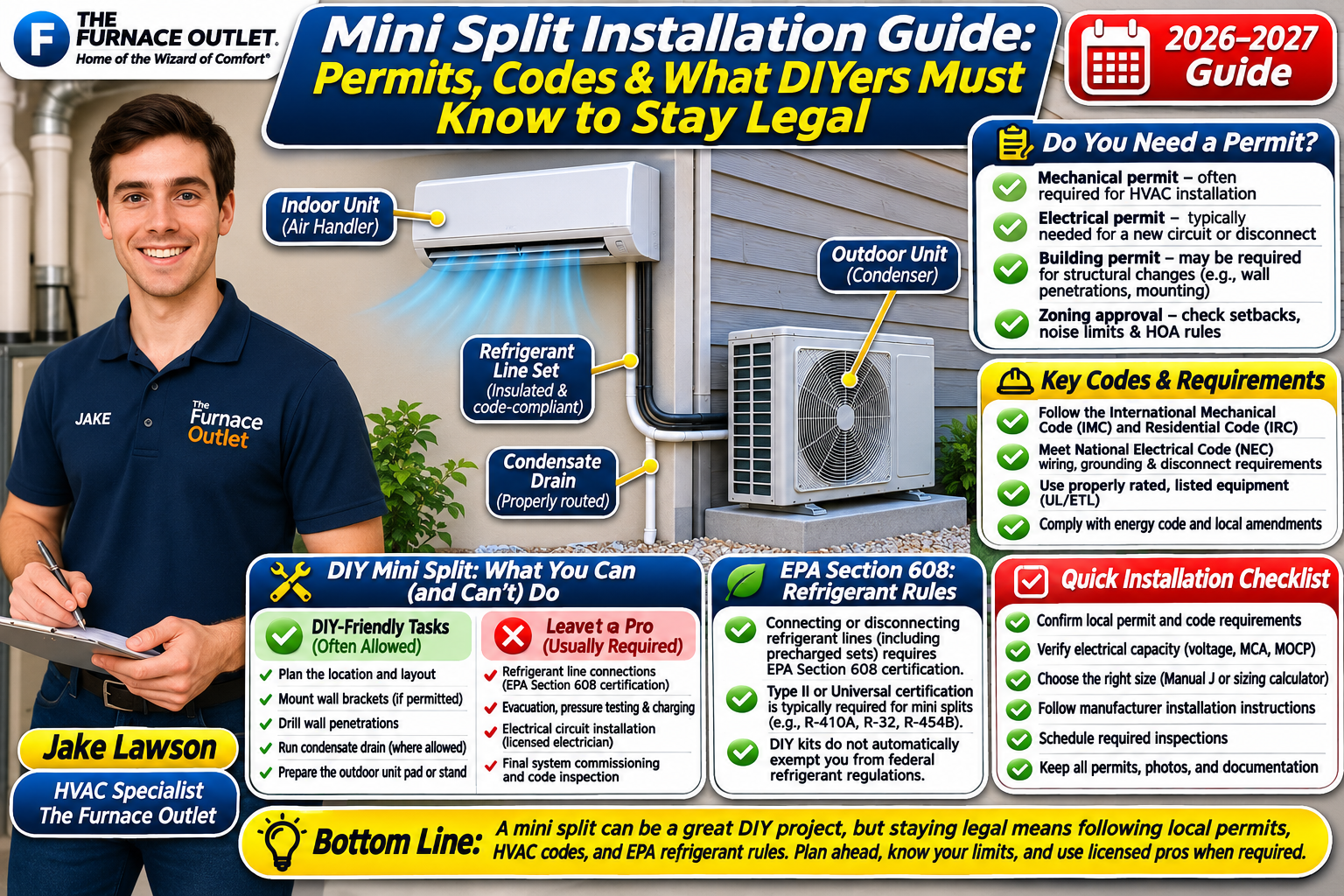
Mini split installation may require several different permits, depending on the complexity of the project and local building regulations. Obtaining the appropriate permits helps ensure that the equipment installation meets applicable safety, structural, electrical, and energy efficiency requirements.
Mechanical Permit: A mechanical permit generally covers the installation of indoor air handlers, outdoor condensers, refrigerant piping, condensate drainage, and associated mechanical components. Many jurisdictions require this permit even when replacing existing HVAC equipment.
Electrical Permit: Installing a dedicated electrical circuit, circuit breaker, outdoor disconnect, or modifying an existing electrical panel typically requires an electrical permit. Homeowners may need to hire a licensed electrician depending on local regulations.
Building Permit: A separate building permit may be necessary when installation involves structural modifications, roof penetrations, wall reinforcement, or significant changes to the building envelope. Requirements depend on the nature of the work and local building codes.
Zoning Approval: Outdoor equipment placement may be subject to property-line setbacks, neighborhood noise restrictions, historic district requirements, and homeowners association regulations. These restrictions can influence where an outdoor condenser may legally be installed.
For example, the City of San José’s HVAC permitting guidelines explain how mechanical, electrical, and building permits may apply to residential ductless mini split installations. Homeowners should confirm the specific requirements applicable to their own municipality.
Mini split installations are generally governed by a combination of mechanical, residential, electrical, building, and energy conservation codes. The applicable code editions and amendments vary between states and local jurisdictions.
The International Mechanical Code (IMC) and International Residential Code (IRC) address mechanical equipment installation, refrigerant piping, drainage, ventilation, and equipment safety. The National Electrical Code (NEC), also known as NFPA 70, establishes requirements for electrical wiring, grounding, circuit protection, and equipment disconnects.
Energy conservation codes may establish additional requirements concerning equipment efficiency, insulation, system sizing, and installation verification. Manufacturer installation instructions and equipment listing requirements must also be considered.
A system that satisfies federal energy efficiency standards is not automatically compliant with every local installation requirement. Homeowners must consider the complete installation rather than relying exclusively on the equipment’s certification labels.
One of the most frequently misunderstood aspects of DIY mini split installation is refrigerant handling. Federal regulations under Section 608 of the Clean Air Act require appropriate technician certification for activities that could compromise the refrigerant circuit and release regulated refrigerants.
Conventional mini split installation may involve refrigerant piping connections, evacuation, pressure testing, refrigerant charging, and commissioning. These activities require appropriate technical qualifications when they fall within regulated refrigerant work.
The EPA’s Section 608 technician guidance specifically explains that connecting or disconnecting precharged refrigerant lines on an R-410A mini split requires certification. Homeowners should not assume that purchasing a precharged installation kit automatically provides an exemption.
Type II or Universal EPA certification is generally appropriate for regulated refrigerant work involving conventional high-pressure residential split systems. State and local contractor licensing requirements may apply independently of federal refrigerant certification.
Precharged mini splits simplify installation by reducing some of the specialized procedures associated with conventional refrigerant piping. Certain systems incorporate factory-charged line sets and proprietary connections designed to minimize refrigerant exposure during assembly.
However, easier installation does not necessarily eliminate federal certification requirements. The EPA’s homeowner refrigerant regulations FAQ expressly addresses certification requirements for installing R-410A mini splits, including connecting precharged lines.
Homeowners should confirm whether the specific equipment and proposed installation activities comply with applicable federal regulations. Marketing claims such as “DIY installation,” “no vacuum pump required,” and “precharged line set” should not be interpreted as blanket legal exemptions.
Mini split systems are available in both 115V and 208/230V configurations, depending on equipment capacity and design. Selecting the correct voltage is important, but voltage compatibility alone does not establish whether an existing household circuit is suitable.
Equipment nameplates typically identify the minimum circuit ampacity (MCA) and maximum overcurrent protection (MOCP). These specifications guide the selection of electrical conductors and protective devices alongside applicable electrical codes.
Depending on the equipment and locally adopted code, installation may require a dedicated circuit, appropriately rated disconnect, equipment grounding, weather-resistant electrical components, and ground-fault protection.
Homeowners should never select breaker sizes solely according to mini split BTU capacity. A licensed electrician should evaluate the equipment specifications and existing electrical infrastructure before installation.
Correct equipment sizing is essential for efficient operation and indoor comfort. Installing a mini split based solely on room square footage can result in excessive capacity, inadequate heating or cooling, poor humidity control, and unnecessary energy consumption.
A residential heating and cooling load calculation considers insulation, window orientation, ceiling height, air leakage, climate conditions, occupancy, and solar heat gain. Some jurisdictions require documented load calculations when approving new HVAC installations.
Homeowners can use the The Furnace Outlet HVAC Calculators for preliminary equipment planning. However, these estimates should not replace a professional Manual J calculation where one is necessary for equipment selection or permitting.
Outdoor mini split condensers must be installed on suitable support structures that provide stability, adequate airflow, drainage, and convenient maintenance access. Depending on local environmental conditions, installations may also require wind-resistant anchoring, snow clearance, or flood protection.
Ground pads, structural wall brackets, and elevated equipment stands are common mounting solutions. The appropriate option depends on equipment weight, building construction, climate, and manufacturer specifications.
Our related guide, How to Mount the Outdoor Unit: Ground Pad vs. Wall Bracket vs. Stand, explains how these mounting approaches affect equipment reliability, noise, drainage, and installation costs.
Every mini split system has specific limitations concerning refrigerant line length, vertical separation, insulation, connection methods, and refrigerant charge. Exceeding these limitations can reduce performance, damage the compressor, and potentially affect warranty coverage.
Refrigerant piping must be appropriately supported and protected against physical damage. Building penetrations may require weatherproofing, air sealing, and approved firestopping where applicable.
Homeowners should avoid modifying factory-precharged line sets or substituting incompatible refrigerant components. Refrigerant connections and commissioning should be completed by appropriately certified professionals following the equipment manufacturer’s installation documentation.
During cooling operation, indoor mini split units remove moisture from the air as water condenses on the evaporator coil. This moisture must be directed toward an approved drainage location to prevent water damage, microbial growth, and deterioration of surrounding building materials.
Gravity drainage is generally preferable when the installation layout permits it. Where gravity drainage is impractical, a manufacturer-compatible condensate pump may be necessary.
Local regulations may restrict connections to sanitary drainage systems or prohibit condensate discharge onto walkways and neighboring properties. Drainage arrangements should therefore satisfy both equipment instructions and applicable local requirements.
The HVAC industry’s transition toward lower-global-warming-potential refrigerants has introduced additional installation considerations. Refrigerants such as R-32 and R-454B belong to the A2L safety classification, indicating lower toxicity and mild flammability.
Equipment using these refrigerants must be installed according to its specific safety listing, refrigerant charge limitations, room-size requirements, and manufacturer instructions. Certain equipment configurations may incorporate refrigerant detection and mitigation systems.
Homeowners should never substitute A2L refrigerants into equipment designed for R-410A or assume that conventional installation procedures are suitable for every newer system. Refrigerant compatibility and safety requirements must be evaluated for the complete equipment configuration.
Depending on local regulations and their practical abilities, homeowners may be able to complete preliminary tasks such as evaluating equipment locations, clearing vegetation, preparing an accessible installation area, and coordinating equipment delivery.
Preparing an equipment foundation or mounting location may also be possible where permitted. However, structural modifications, elevated mounting, wall penetrations, concealed utility locations, and equipment lifting introduce additional safety considerations.
Electrical circuit installation, refrigerant connections, system commissioning, and safety inspections should be handled by appropriately qualified professionals. A hybrid installation approach can reduce labor expenses while maintaining regulatory compliance and equipment reliability.
A building inspector may examine equipment positioning, structural support, electrical protection, refrigerant piping, condensate drainage, and compliance with approved installation documentation. Additional inspections may be required before concealed wiring or piping is covered.
The Heat Pump Space Heating Permitting and Inspection Checklist, available through the U.S. Department of Energy’s Building Science Education resource, illustrates documentation and inspection considerations for residential heat pump installations.
Homeowners should retain approved permits, inspection records, equipment specifications, contractor invoices, and commissioning documentation. These records can prove valuable when making warranty claims, selling the property, or arranging future maintenance.
As a preliminary US budgeting estimate, a mechanical permit may cost approximately $50–$300, while an electrical permit may range from $50–$250. Additional building permits, plan reviews, and inspection charges can increase the total expense.
Homeowners may provisionally budget $100–$600 for routine permitting expenses, although complicated installations and higher-cost municipalities can exceed this range. These figures are illustrative planning allowances rather than verified national averages.
The local building department remains the most reliable source for actual permit fees and documentation requirements.
Unpermitted installations can result in municipal fines, mandatory corrective work, retroactive permit applications, and additional inspection expenses. In some circumstances, homeowners may need to expose concealed wiring or piping so inspectors can evaluate the completed work.
An unpermitted installation may also complicate property sales, insurance claims, and manufacturer warranty requests. However, it does not automatically invalidate every insurance policy or equipment warranty, as these consequences depend on the applicable terms and circumstances.
Obtaining the necessary permits before installation is generally less expensive and less complicated than correcting an unauthorized installation afterward.
Before ordering equipment, confirm homeowner installation eligibility with your local building department and identify the applicable mechanical, electrical, and building permits. Review the manufacturer’s installation instructions, equipment voltage, refrigerant type, line set limitations, and outdoor clearance requirements.
Arrange professional electrical and regulated refrigerant work before beginning installation. Finally, schedule the required inspections, retain all installation documentation, and confirm that the equipment has been properly commissioned before operating it regularly.
Do I need a permit to install a mini split in my garage?
Many jurisdictions require permits for permanently installed garage HVAC equipment, particularly when a new electrical circuit is necessary. Garage-specific equipment placement and building safety requirements may also apply.
Does a 115V mini split require an electrical permit?
A 115V rating does not automatically exempt equipment from electrical permitting requirements. Permit obligations depend on whether new wiring, circuit modifications, or permanently connected equipment are involved.
Can I install a mini split and hire someone to connect the refrigerant lines?
This hybrid approach may be permitted and can reduce installation expenses. However, confirm the arrangement with the contractor and local building department before performing any preliminary work.
Can I sell my house with an unpermitted mini split?
Selling a property with unpermitted HVAC improvements may be possible, but disclosure obligations and corrective requirements vary by jurisdiction. Missing permits can complicate transaction negotiations and property inspections.
Do these requirements also apply in Canada?
Canada has separate provincial and territorial requirements for refrigeration work, trade licensing, electrical safety, and permits. The US EPA Section 608 requirements discussed in this article should not be treated as Canadian certification requirements.
Installing a mini split can be an excellent investment in household comfort, energy efficiency, and flexible temperature control. However, saving money through DIY installation should never come at the expense of electrical safety, refrigerant compliance, structural integrity, or local building regulations.
The smartest approach is to complete permitted preliminary work yourself while assigning regulated and technically demanding installation tasks to qualified professionals. A properly permitted, inspected, and commissioned mini split provides a stronger foundation for dependable performance and long-term ownership.
This article provides general educational information rather than legal, engineering, or professional installation advice. Permit requirements, adopted building codes, licensing regulations, and equipment specifications vary by location. Always consult your local authority having jurisdiction, qualified HVAC professionals, and manufacturer documentation before beginning installation.
Editorial Disclosure: The Furnace Outlet is not associated with, affiliated with, endorsed by, or sponsored by Carrier, Trane, Lennox, Bryant or any other manufacturer mentioned in this article. We do not receive manufacturer compensation for inclusion or rankings.
The Furnace Outlet
For educational purposes only. HVAC equipment removal, refrigerant handling, recycling and disposal requirements can vary by equipment and location. Consult a qualified HVAC professional and applicable federal, state and local requirements before removing or disposing of HVAC equipment.
© 2026 The Furnace Outlet | www.thefurnaceoutlet.com