Newsletter Subscribe
Enter your email address below and subscribe to our newsletter

HVAC made simple
By Jake Lawson | Jake the HVAC Specialist, The Furnace Outlet
Updated: November 2026
Heating and cooling an apartment or condominium isn’t quite like managing comfort in a traditional single-family home. You’ve usually got less space, closer neighbors, limited installation options, and building rules that can make choosing an HVAC system surprisingly complicated.
I’ve worked with enough compact residential HVAC installations to know that the most expensive system isn’t necessarily the best one. What matters is finding equipment that delivers comfortable temperatures, keeps noise under control, doesn’t waste electricity, and fits the building’s installation requirements.
Whether you’re replacing an aging wall unit, upgrading a noisy window air conditioner, or considering a ductless mini-split, this guide explains which HVAC options make sense for different apartments and condos in 2026–2027.
Apartments and condominiums often have different heating and cooling challenges from detached houses. Shared walls may reduce heating and cooling loads, but upper-floor units, large windows, poor insulation, and direct sunlight can create uncomfortable temperature differences. Noise also becomes more important when your bedroom, living room, and workspace are close together. A compressor that sounds acceptable in a large house may become frustrating in a studio apartment, particularly at night.
Building restrictions introduce another complication. Some condo associations prohibit outdoor condensers on balconies, while rental agreements may limit window-mounted equipment or modifications to exterior walls. Before purchasing anything, confirm which systems your building permits, whether exterior penetrations require approval, and who is responsible for installation and maintenance.
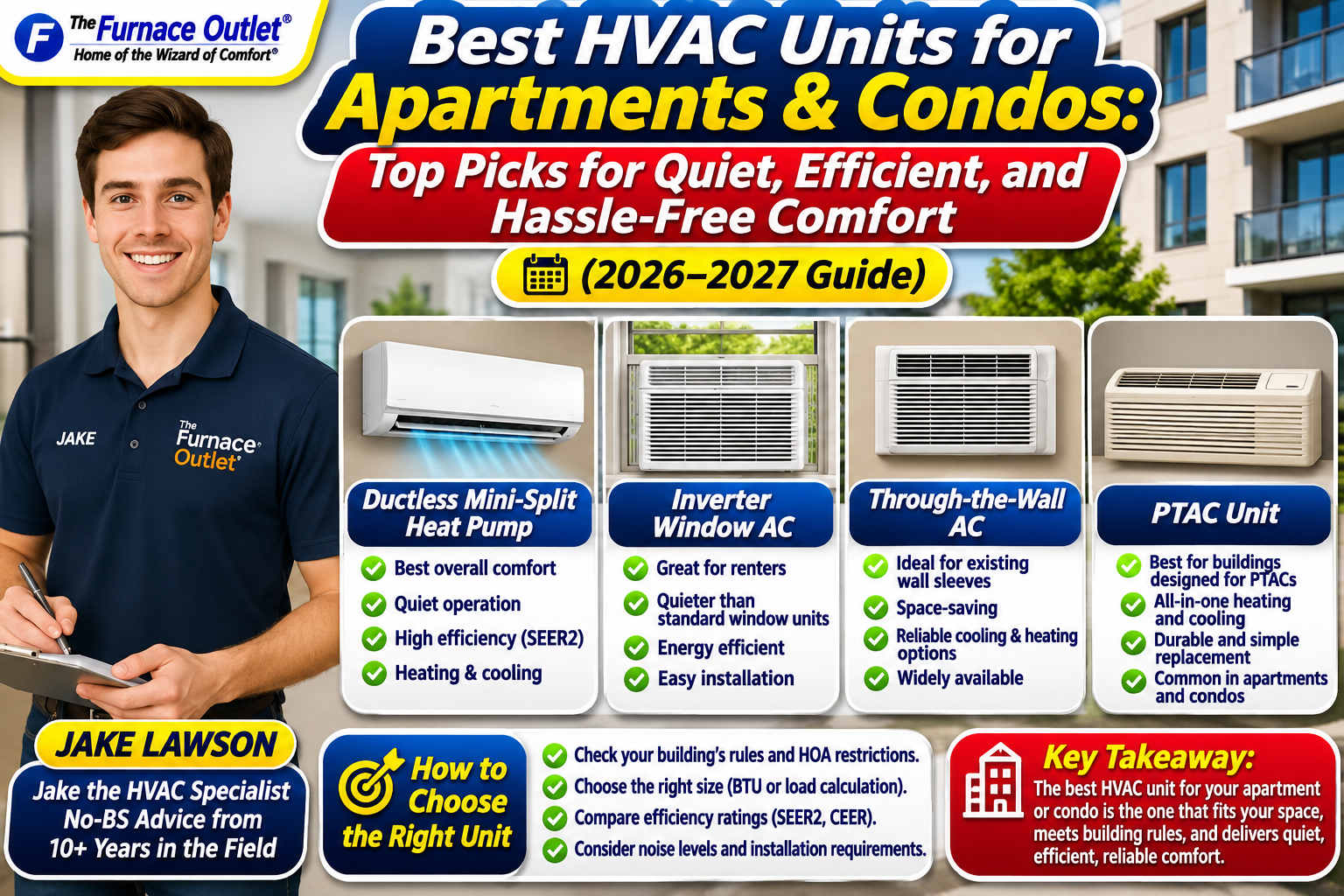
If your building allows installation, a ductless mini-split heat pump is one of my favorite solutions for apartments and condos. These systems connect an indoor air-handling unit to an outdoor compressor through refrigerant piping and electrical connections. Unlike conventional ducted central systems, mini-splits deliver heating and cooling directly into individual rooms or zones. This makes them especially useful in apartments without existing ductwork. Brands worth comparing include Mitsubishi Electric, Daikin, Fujitsu, LG, and GREE. Their product lines offer different combinations of efficiency, heating capability, sound performance, and control features.
For a typical single-room installation, homeowners might budget approximately $3,000–$6,500, while multi-zone installations can cost considerably more. These are illustrative U.S. planning ranges, not confirmed national averages. The biggest limitation is installation permission. A mini-split may be an excellent technical choice but completely impractical if your building doesn’t allow an outdoor condenser, condensate drainage modifications, or refrigerant piping through exterior walls. The U.S. Department of Energy’s ductless mini-split heat pump guidance explains their operating principles, advantages, and installation considerations.
For renters who can’t install permanent equipment, a modern inverter window air conditioner can be an excellent alternative. Traditional window air conditioners generally switch their compressors on and off as cooling demand changes. Inverter models can adjust compressor speed, helping maintain steadier indoor temperatures and reducing noise during lower-load operation. Midea U-shaped inverter units, LG Dual Inverter models, and selected GE Profile ClearView and Friedrich units are worth comparing. Availability, certification, window compatibility, and sound ratings vary by exact model.
U-shaped and saddle-style designs can be especially attractive because much of the compressor noise remains outside the room. Some designs also preserve more of the window view than traditional box-shaped units. Depending on size and features, a reasonable equipment-only planning budget may range from approximately $350–$900 or more. For most renters, I’d prioritize an ENERGY STAR-certified inverter model that fits the approved window opening, offers a suitable cooling capacity, and includes reliable installation hardware.
ENERGY STAR’s room air conditioner buying guidance explains the benefits of variable-speed compressors, correct sizing, and modern window configurations.
Many older apartment buildings and condominiums already have permanent wall sleeves designed to accommodate room air conditioners. If your property has one, a compatible through-the-wall unit may be the simplest replacement option. Friedrich, GE Appliances, and other manufacturers offer equipment in this category. Some models provide cooling only, while others include heating functions. The important word here is compatible. Wall sleeves differ in dimensions, ventilation arrangements, and drainage requirements. A unit that physically fits may still be unsuitable if its condenser airflow requirements don’t match the sleeve.
Expect equipment-only costs to vary widely, with many installations falling somewhere around $600–$1,500 or more before additional labor or sleeve modifications. I recommend confirming the existing sleeve’s dimensions, the old unit’s specifications, electrical requirements, and building approval before ordering a replacement.
Packaged terminal air conditioners, commonly called PTAC units, are familiar sights in hotels, older apartments, and certain condominium developments. These systems typically sit in a wall opening and combine heating and cooling functions in one packaged cabinet. Amana, Friedrich, GE Zoneline, and other manufacturers offer PTAC equipment with different capacities, electrical configurations, and heating options. A PTAC can be a sensible replacement when the building was originally designed around that equipment type. Installation may be relatively straightforward when the replacement is compatible with the existing sleeve, grille, electrical supply, and condensate arrangements.
However, PTAC units aren’t automatically the quietest or most efficient option. Some use electric resistance heating, which can be costly to operate in cold climates. For planning purposes, equipment may cost roughly $800–$2,000 or more, depending on features and capacity. Installation, electrical modifications, and replacement sleeves can increase the total. I would choose a PTAC primarily when it matches the building’s established HVAC configuration rather than attempting to retrofit one into an apartment that was never designed for it.
Portable air conditioners are often marketed as the easiest solution for apartment residents. They require no permanent outdoor condenser and can generally be moved between rooms. But there’s an important catch: most portable air conditioners still need to exhaust hot air outdoors through a window or another approved opening. Dual-hose designs are generally preferable to single-hose models because they reduce the amount of conditioned indoor air exhausted from the living space.
When comparing portable units, look at the DOE SACC cooling-capacity rating rather than relying solely on the larger advertised ASHRAE BTU figure. Portable ACs can be useful for temporary cooling, restricted buildings, or rooms where window units aren’t allowed. However, they typically take up valuable floor space and may produce more indoor noise than a comparable window inverter unit. I’d treat portable AC as a practical fallback rather than my first choice for permanent apartment cooling.
Some modern condominiums already have compact central air-conditioning systems or ducted heat pumps installed in utility closets, ceiling spaces, or dedicated mechanical rooms. If your condo has existing ductwork, replacing the original equipment with a properly matched compact system may be more practical than installing individual room units. Carrier, Trane, Goodman, Rheem, and other manufacturers offer equipment configurations that can suit smaller ducted residences. However, space limitations are significant. The replacement must fit the mechanical closet, provide adequate service access, and work with the existing ducts, condensate drainage, and electrical infrastructure.
A replacement project may cost several thousand dollars, with total pricing depending heavily on capacity, equipment type, accessibility, and required modifications. I wouldn’t recommend converting an apartment to a completely different HVAC configuration without evaluating the building’s mechanical design and association requirements.
When neighbors are close and rooms are small, sound performance deserves serious attention. Well-designed ductless mini-splits often provide very quiet indoor operation at low fan speeds. Modern inverter window units can also be impressively quiet, particularly when their compressor sits mostly outside the room. PTAC systems and traditional through-the-wall units may produce more noticeable compressor and fan noise, although actual performance varies considerably by model.
Portable air conditioners place most mechanical components inside the living space, making sound control more challenging. Always compare manufacturer-published indoor sound ratings at comparable operating conditions. A low-speed sound rating may look impressive, but the unit could be substantially louder at maximum cooling output. Installation matters, too. Poor mounting, loose brackets, and vibration transmitted through walls or window frames can make an otherwise quiet system unpleasant.
One of the biggest mistakes apartment residents make is buying an oversized air conditioner. As a rough starting point, a small room around 150 square feet may require approximately 5,000 BTU per hour, while a 300–350-square-foot room may need around 8,000 BTU per hour. A larger room near 450 square feet may require approximately 10,000 BTU per hour. These figures are general screening estimates for room air conditioners, not substitutes for a proper cooling-load calculation.
A sunny top-floor condo with large west-facing windows can need considerably more cooling than a shaded apartment of identical size. For permanent ductless or central systems, I recommend a professional load calculation rather than choosing capacity solely from square footage. Oversizing can cause unnecessary cycling and inadequate moisture removal, while undersizing may leave the apartment uncomfortable during extreme weather.
Different HVAC equipment categories use different efficiency measurements, so don’t compare their ratings as though they’re interchangeable. Window and through-the-wall room air conditioners commonly use CEER, or Combined Energy Efficiency Ratio. Higher CEER ratings generally indicate better efficiency within comparable equipment categories. Central air conditioners and many mini-split systems use SEER2 for seasonal cooling efficiency, while heat pumps also have heating-performance ratings such as HSPF2.
Portable air conditioners use different testing and reporting conventions, including DOE SACC cooling capacity and associated efficiency metrics. For apartment residents, I’d look beyond the headline efficiency rating and consider how many hours the system will operate, local electricity prices, and whether the unit can reduce compressor output during milder weather. The U.S. Department of Energy’s room air conditioner purchasing guidance provides useful information about energy-efficient equipment selection.
Operating costs depend on electrical demand, daily runtime, local electricity rates, and the system’s ability to modulate output. Suppose a window air conditioner averages 700 watts while operating. Running it for eight hours would consume approximately 5.6 kilowatt-hours. At $0.16 per kilowatt-hour, that equals about $0.90 per day, or approximately $27 over 30 days. Now consider a system averaging 1,200 watts over the same eight-hour period. It would consume approximately 9.6 kilowatt-hours per day, costing about $46 over 30 days at the same rate.
These examples are simplified illustrations rather than real-world predictions. Inverter systems frequently change their power consumption, and cooling loads fluctuate throughout the day. For a more accurate estimate, use the manufacturer’s energy-consumption data, expected operating hours, and your utility’s actual electricity rate.
Before buying a permanent HVAC system, investigate the rules governing your property. Condo associations may restrict exterior equipment, wall penetrations, condensate discharge, balcony installations, and visible refrigerant lines. Even window air conditioners may be prohibited in certain buildings for appearance or safety reasons.
Some buildings have centralized HVAC arrangements or shared mechanical infrastructure that individual owners cannot modify independently. A professional installer should verify the applicable building requirements, permits, electrical capacity, and equipment location before starting work. I strongly recommend getting written approval whenever an installation changes the building exterior or shared mechanical systems.
Window air conditioners generally require routine filter cleaning, unobstructed airflow, and occasional inspection of seals and drainage. Mini-splits need clean filters, clear condensate drainage, and periodic inspection of indoor and outdoor components. Their compact design doesn’t eliminate maintenance, particularly in dusty or humid environments. PTAC and through-the-wall systems require filter maintenance, accessible service panels, and proper airflow through the wall sleeve or exterior grille.
Portable air conditioners need filter cleaning, exhaust-hose inspection, and condensate management according to the manufacturer’s instructions. The easiest system to maintain is often the one that is correctly installed, accessible for service, and supported by local technicians.
I’ve seen homeowners spend extra money on premium equipment only to discover that it doesn’t fit their windows, violates association rules, or requires electrical upgrades they never budgeted for. Another common mistake is selecting a system based on BTU capacity alone. Cooling capacity matters, but so do humidity control, efficiency, noise, airflow, and installation quality.
Don’t assume every mini-split can be installed without professional help. Refrigerant work, electrical connections, condensate drainage, and building penetrations require proper planning and may be subject to licensing requirements. Likewise, don’t buy a replacement PTAC or through-the-wall unit without checking compatibility with the existing sleeve and electrical system.
The EPA’s refrigerant phasedown guidance is also useful when comparing newer systems that use lower-global-warming-potential refrigerants.
What is the best HVAC system for a small apartment?
For a small apartment where permanent installation is allowed, a properly sized ductless mini-split can provide excellent comfort and efficiency. If you’re renting or cannot install an outdoor condenser, an inverter window air conditioner is often a more practical choice. The best option depends on building rules, room layout, and budget.
Are mini-splits allowed in condominiums?
Some condominiums permit mini-splits, while others restrict exterior condensers, refrigerant lines, or structural penetrations. You should obtain written approval from the association or property manager before planning installation. Local building codes and electrical requirements must also be satisfied.
Can one mini-split cool an entire apartment?
It depends on the layout and cooling load. A single indoor unit may work well in an open studio or compact apartment, but closed bedrooms and separated living spaces can experience uneven temperatures. Multi-zone systems or additional indoor units may be necessary for reliable room-by-room comfort.
Are window AC units cheaper to run than portable air conditioners?
Comparable window units are often more efficient than portable air conditioners, particularly single-hose portable models. However, actual electricity costs depend on the specific equipment, cooling capacity, operating conditions, and usage. Compare certified efficiency data rather than assuming every window unit will be cheaper.
What HVAC system is best for an older condo?
If the condo already has a through-the-wall unit or PTAC, a compatible replacement may be the simplest solution. If the building permits modifications, a ductless mini-split could offer better comfort and efficiency. The final choice should account for the existing electrical supply, wall sleeve, ventilation, and association rules.
For most apartment and condo residents, I would narrow the decision to three practical choices: a ductless mini-split for permitted permanent installations, an inverter window air conditioner for renters and smaller spaces, or a compatible PTAC or through-the-wall replacement when the building already uses that configuration.
Don’t overlook noise ratings, electrical requirements, installation restrictions, and maintenance access. Those details can matter more to daily comfort than a small difference in advertised efficiency. My advice is to buy the system that fits your actual living space and building requirements, not simply the one with the biggest cooling capacity or most impressive marketing claims.
A properly sized, professionally installed, and well-maintained HVAC system can make even a compact apartment comfortable without unnecessary energy waste or expensive installation surprises.
This article is intended for general educational purposes and does not replace professional HVAC design, installation, or electrical advice. Product availability, efficiency ratings, installation requirements, refrigerant regulations, and costs vary by location and model. All price and energy-cost figures are illustrative estimates. Apartment residents and condo owners should confirm building rules, obtain required approvals, and consult appropriately qualified professionals before installing or modifying HVAC equipment.
The article draws on five relevant sources covering room AC efficiency, equipment selection, installation considerations, and refrigerant changes.