Newsletter Subscribe
Enter your email address below and subscribe to our newsletter

HVAC made simple
By Jake Lawson | HVAC Specialist, The Furnace Outlet
Updated: November 2026
If you’re shopping for a ductless mini-split, you’ve probably come across three names that keep appearing in homeowner discussions: GREE, MRCOOL, and Pioneer. All three offer heating and cooling solutions, but they approach installation, equipment selection, and long-term ownership differently.
One of the biggest mistakes homeowners make is assuming that every mini-split advertised online is designed for DIY installation. That isn’t the case. Some systems are engineered specifically for homeowners, while others require professional refrigerant connections, specialized equipment, and licensed installation to maintain warranty coverage.
I’ve spent more than a decade working with residential HVAC equipment, and I can tell you that installation quality often matters as much as the name printed on the outdoor unit. In this guide, I’ll compare these three brands from a practical perspective so you can decide whether you’re a hands-on DIY homeowner, a budget-conscious buyer willing to hire a technician, or someone who prefers a fully professional installation.
Before comparing brands, it’s important to understand what makes a mini-split genuinely DIY-friendly. A conventional ductless system typically requires refrigerant tubing to be connected, leak-tested, evacuated, and commissioned using specialized HVAC tools.
A true DIY-oriented system may use factory-precharged refrigerant lines and engineered quick-connect fittings that eliminate some of those traditional refrigerant installation procedures. However, electrical work, mounting, drainage, wall penetrations, and code compliance still require proper attention.
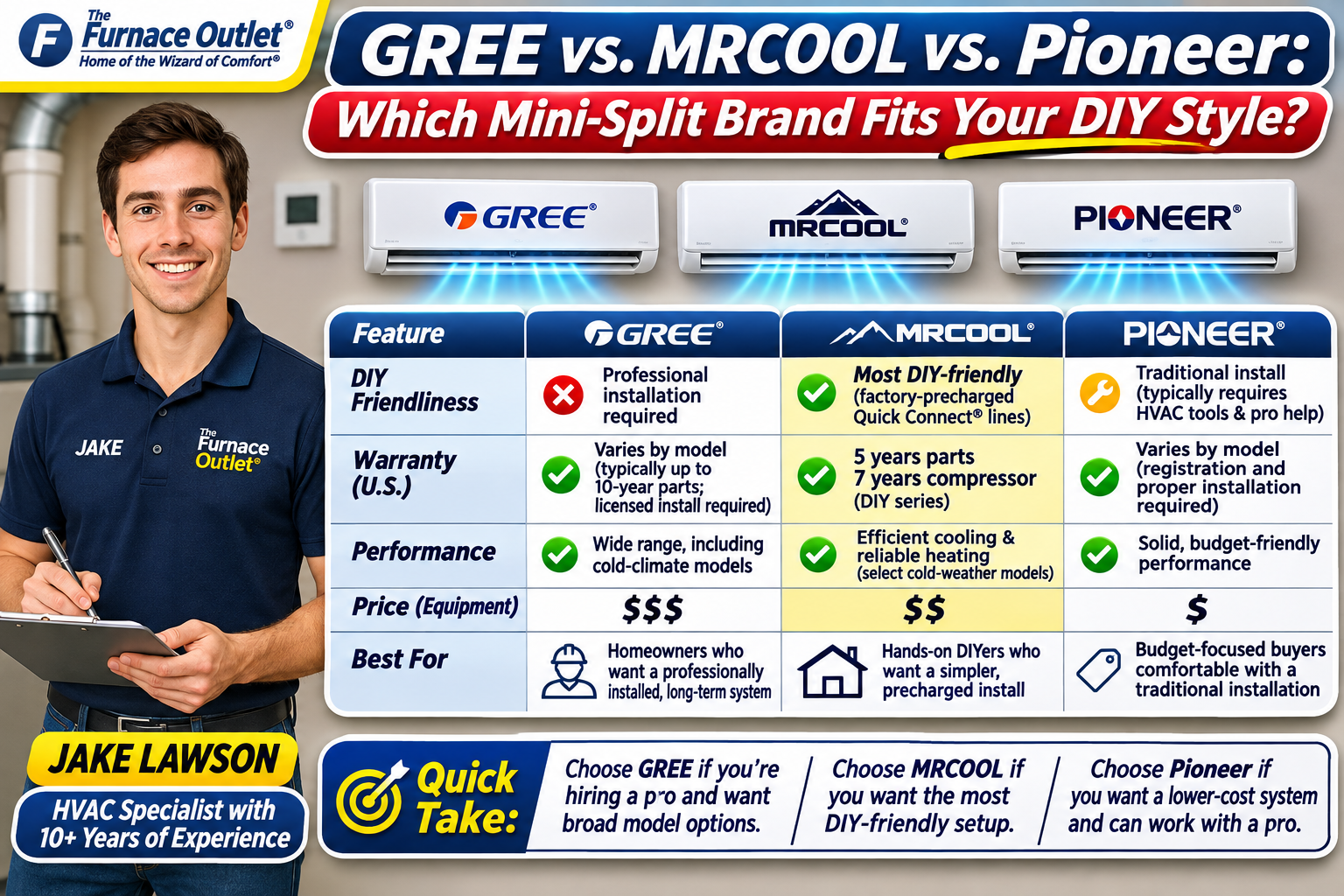
This distinction is central to the comparison. MRCOOL’s dedicated DIY product lines are specifically designed around simplified installation. GREE generally emphasizes professional installation, while Pioneer offers competitively priced equipment that commonly uses conventional installation procedures.
The right choice depends on how much work you intend to perform yourself and whether you’re comfortable hiring a qualified HVAC contractor.
GREE is a major air-conditioning manufacturer offering ductless heating and cooling systems across multiple performance categories. Its residential mini-split products include options designed for efficient cooling, heating, and operation in varying climates.
One reason I consider GREE worth evaluating is its range of equipment. Depending on the model, homeowners can find systems suited to bedrooms, living areas, additions, and larger applications requiring more substantial heating or cooling capacity.
However, GREE is not the brand I would automatically recommend to someone determined to complete an entire installation independently. GREE’s U.S. warranty guidance requires installation by a licensed HVAC contractor, and DIY installation can void warranty coverage.
For homeowners who want reliable equipment and are comfortable paying for professional installation, GREE deserves consideration. The most important factors are selecting the correct model, verifying the efficiency and cold-weather ratings, and finding a contractor familiar with the equipment.
MRCOOL has developed a strong identity around homeowner-friendly ductless systems. Its dedicated DIY series uses factory-precharged Quick Connect refrigerant line sets designed to simplify installation without the traditional field evacuation process required by many conventional mini-splits.
For the 2026–2027 buying period, MRCOOL’s fifth-generation DIY systems include models using R-454B refrigerant. The company also offers different product families, so buyers should not assume every MRCOOL mini-split has the same installation procedure.
I particularly like the concept for homeowners who are comfortable mounting equipment, planning a line-set route, and coordinating the electrical requirements but don’t want to perform conventional refrigerant-line preparation.
The trade-off is that simplified installation doesn’t eliminate every challenge. The homeowner must still select the correct capacity, follow mounting and clearance requirements, protect the wall opening, provide suitable condensate drainage, and arrange qualified electrical work where necessary.
MRCOOL is especially attractive when the main objective is reducing the complexity of refrigerant installation. However, the total project cost should include electrical upgrades, mounting hardware, line-set accessories, and any professional services required.
Pioneer is another recognizable name in the U.S. ductless mini-split market, particularly among homeowners researching affordable heating and cooling equipment online.
Its product range includes wall-mounted systems and other ductless configurations suitable for residential applications. Pioneer often appeals to buyers who want to purchase equipment directly and have flexibility in selecting an installer.
The important distinction is that many Pioneer systems use conventional refrigerant connections and commissioning procedures. A homeowner shouldn’t assume that a Pioneer mini-split can be installed using the same simplified process as a dedicated MRCOOL DIY system.
For someone comfortable handling non-refrigerant preparation and hiring a qualified technician to complete the specialized work, Pioneer can be worth considering. However, the installer must be willing to work with customer-supplied equipment, and the warranty requirements should be confirmed before purchase.
I would evaluate Pioneer based on the complete installed price rather than the equipment price alone. An inexpensive system can become less attractive if installation, electrical work, and additional materials cost more than expected.
If installation simplicity is your primary consideration, MRCOOL’s dedicated DIY series has the clearest advantage among these three choices. Its precharged connections are specifically intended to reduce the specialized refrigerant work associated with conventional installations.
GREE generally belongs in the professional-installation category. Its warranty requirements make contractor involvement an important part of the purchasing decision.
Pioneer falls closer to the conventional-installation side, although specific product configurations and installation requirements vary. It may appeal to mechanically confident homeowners who plan to coordinate professional assistance.
My recommendation is to read the installation manual for the exact model before ordering. Marketing descriptions such as easy installation and DIY-friendly do not necessarily mean the system can be installed entirely without specialized HVAC work.
All three brands offer inverter-driven mini-split systems, but their actual efficiency and heating performance depend on the specific model and matched indoor-outdoor configuration.
When comparing cooling performance, I look at SEER2 ratings, cooling capacity, operating noise, and how effectively the equipment modulates output during partial-load conditions.
For heating, HSPF2 ratings and published low-temperature heating capacity are especially important. A mini-split that performs well in mild weather may deliver substantially less heating output during severe winter conditions.
GREE offers systems intended for a range of climates, including models with enhanced low-temperature heating capabilities. MRCOOL also offers heat-pump configurations designed for colder conditions, while Pioneer has models suited to different heating applications.
Rather than declaring one brand universally superior, I recommend comparing the published specifications of similarly sized models. A high-efficiency unit from one brand should not be compared directly with an entry-level model from another.
A 12,000 BTU mini-split isn’t automatically appropriate for every room of a certain square footage. Insulation, windows, climate, ceiling height, solar exposure, and air leakage all influence the required heating and cooling capacity.
An oversized system may struggle with humidity control or operate less comfortably than expected, depending on its minimum modulation capability. An undersized system may run continuously during extreme weather without maintaining the desired temperature.
For example, a well-insulated bedroom in a moderate climate may require considerably less capacity than a sun-exposed room of the same size in a hot southern state.
I recommend using an appropriate residential load calculation rather than relying entirely on a manufacturer’s square-footage coverage estimate. This becomes particularly important for multi-zone systems and homes that depend on mini-splits for winter heating.
Price comparisons between GREE, MRCOOL, and Pioneer can be misleading because homeowners often compare equipment-only prices with complete installation packages.
For broad 2026–2027 U.S. budgeting, a single-zone mini-split project might cost approximately $1,500–$3,500 when using a suitable homeowner-installable system and paying separately for necessary electrical work and accessories. Professionally installed single-zone projects may commonly fall around $3,000–$6,500 or more.
These figures are illustrative planning ranges rather than verified brand-specific quotations. Actual costs vary substantially with capacity, efficiency, electrical requirements, installation complexity, location, and contractor pricing.
MRCOOL may reduce certain labor expenses through its dedicated DIY connection system. Pioneer may offer an attractive equipment purchase price, but professional refrigerant commissioning can increase the total. GREE installations should be evaluated as contractor-installed projects, including labor and warranty considerations.
I always recommend comparing complete project quotations rather than selecting equipment solely because the online purchase price looks inexpensive.
Warranty terms can change the value of a mini-split purchase significantly. Homeowners should confirm whether coverage applies to parts, compressors, labor, or complete equipment replacement.
GREE’s U.S. warranty guidance emphasizes licensed professional installation, with coverage varying according to the application and installer status. This means homeowners planning an entirely DIY installation should consider warranty eligibility before purchasing.
MRCOOL’s fifth-generation DIY limited warranty identifies five years of parts coverage and seven years of compressor coverage, subject to the applicable warranty terms. Importantly, MRCOOL’s support guidance distinguishes its DIY products from other series that require installation documentation for warranty claims.
Pioneer buyers should examine the warranty document for the exact model and seller, including installation qualifications, registration requirements, and claim procedures. Don’t assume that a general warranty statement covers labor or every installation situation.
From my perspective, a lower equipment price isn’t a bargain if an installation mistake leaves the homeowner responsible for expensive repairs.
A mini-split’s long-term performance depends on equipment design, correct installation, maintenance, operating conditions, and access to replacement components.
GREE’s contractor-oriented approach may be attractive when a qualified local installer can provide ongoing service. MRCOOL’s DIY model may appeal to homeowners who value direct product support, but they should still confirm local technician availability for future repairs.
Pioneer buyers should similarly investigate replacement-part availability and whether local HVAC companies are willing to service customer-purchased equipment.
One issue I frequently see is homeowners researching the purchase price extensively but never checking who will repair the system five years later.
Before choosing any brand, contact local HVAC contractors and ask whether they service the exact model you’re considering. This simple step can prevent significant inconvenience after the warranty period begins.
Refrigerant selection has become an increasingly important consideration for mini-split buyers as manufacturers transition toward lower-global-warming-potential refrigerants.
For example, MRCOOL’s fifth-generation DIY series uses R-454B in specified configurations. Other product lines across the market may use R-32 or different refrigerants, depending on the model and production generation.
Both R-32 and R-454B are classified as A2L refrigerants, meaning they have lower flammability characteristics than highly flammable refrigerants but still require appropriate safety precautions and compatible equipment.
Homeowners should never assume refrigerants or components are interchangeable. The correct refrigerant, approved piping arrangement, electrical requirements, and safety provisions are determined by the specific system design.
For a new installation, I recommend verifying the model’s refrigerant type and ensuring the installer follows the current manufacturer’s instructions and applicable safety requirements.
If you’re a hands-on homeowner who wants to perform as much of the installation as permitted and practical, MRCOOL’s dedicated DIY series is the most natural starting point. Its simplified refrigerant connections are a meaningful advantage for this type of project.
If you’re primarily focused on obtaining competitively priced equipment and are willing to hire a qualified installer, Pioneer may be worth evaluating. The total installed cost and availability of future service should guide the decision.
If you prefer a contractor-led installation with professional sizing, commissioning, and ongoing service support, GREE is a strong candidate. Its equipment range and installer-oriented warranty structure suit that approach.
None of these brands is automatically the best for every homeowner. Your installation experience, available contractors, climate, budget, and long-term maintenance expectations should determine the final choice.
Is MRCOOL easier to install than GREE or Pioneer?
MRCOOL’s dedicated DIY series is designed to simplify homeowner installation through factory-precharged Quick Connect refrigerant lines. Conventional GREE and many Pioneer systems require professional refrigerant procedures, while GREE’s U.S. warranty specifically requires licensed contractor installation. Electrical and building-code requirements still apply to DIY systems.
Can I install a GREE mini-split myself?
Although homeowners may be able to perform certain preparatory tasks, GREE’s U.S. warranty guidance states that DIY installations void warranty coverage. Professional installation is therefore the appropriate route for homeowners who want to preserve the manufacturer’s warranty and ensure proper system commissioning.
Is Pioneer cheaper than MRCOOL?
Some Pioneer equipment may have a lower initial purchase price than comparable MRCOOL DIY systems, but pricing varies by model, capacity, efficiency, and retailer. Professional installation and refrigerant commissioning can change the total cost significantly, so compare complete installed estimates rather than equipment prices alone.
Which brand is best for cold climates?
The best choice depends on the specific model’s low-temperature heating capacity, efficiency, defrost performance, and the home’s calculated heating load. All three brands should be evaluated using published performance data rather than broad brand claims. In particularly cold regions, supplemental heating may still be necessary.
When homeowners ask me whether GREE, MRCOOL, or Pioneer is the better mini-split brand, I usually begin by asking how they intend to install and maintain the equipment.
For genuine homeowner-oriented installation, I would start with MRCOOL’s dedicated DIY systems. For a professionally installed system, I would seriously consider GREE, particularly when an experienced local contractor is available. For value-conscious buyers willing to coordinate professional installation, Pioneer deserves a closer look.
But I wouldn’t purchase any of them without checking the heating and cooling load, efficiency ratings, warranty conditions, refrigerant requirements, and availability of local service.
A properly sized and professionally commissioned budget system can provide better long-term value than an expensive mini-split installed incorrectly. Choose the equipment that fits your home, your installation capabilities, and your long-term ownership expectations.
This article provides general educational information about ductless mini-split selection and installation. Brand specifications, product availability, refrigerants, warranty terms, and pricing may change. Refrigerant work, electrical connections, wall penetrations, and equipment commissioning may require qualified or licensed professionals and applicable permits. Always consult the exact manufacturer’s installation instructions, warranty documentation, and local building regulations before purchasing or installing HVAC equipment.
These five manufacturer resources support the article’s comparison of installation requirements, warranty coverage, and equipment features.
1. GREE Comfort — Find a Contractor explains GREE’s licensed-installation requirements and warranty implications.
2. MRCOOL — DIY 5th Generation describes factory-precharged Quick Connect lines and homeowner-oriented installation.
3. MRCOOL — Warranty Coverage outlines coverage differences between MRCOOL’s DIY and conventional product families.
4. Pioneer — Can I Install the System Myself? explains which installation tasks homeowners can perform and which require qualified installers.
5. Pioneer — Warranty Coverage explains the manufacturer’s installation and registration requirements.