Newsletter Subscribe
Enter your email address below and subscribe to our newsletter

HVAC made simple
By Jake Lawson | Jake the HVAC Specialist | The Furnace Outlet
Choosing a ductless mini-split system can be surprisingly difficult, especially when three well-known manufacturers keep appearing in your research: Mitsubishi Electric, Daikin, and GREE. All three offer inverter-driven heating and cooling systems, multiple capacity options, and equipment designed for homes without traditional ductwork. However, the differences become more noticeable when you examine cold-weather performance, installation costs, warranty coverage, efficiency, and long-term service availability.
I’ve worked with enough HVAC equipment to know that the most expensive system is not automatically the best choice, and the least expensive system is not necessarily a bargain. A properly installed GREE mini-split can outperform a poorly installed premium system, while Mitsubishi or Daikin may offer features that justify spending more for certain homes.
For the 2026–2027 buying season, the smartest approach is to compare specific models rather than relying entirely on brand reputation. Let’s look at where each manufacturer stands out and which system makes the most sense for your home.
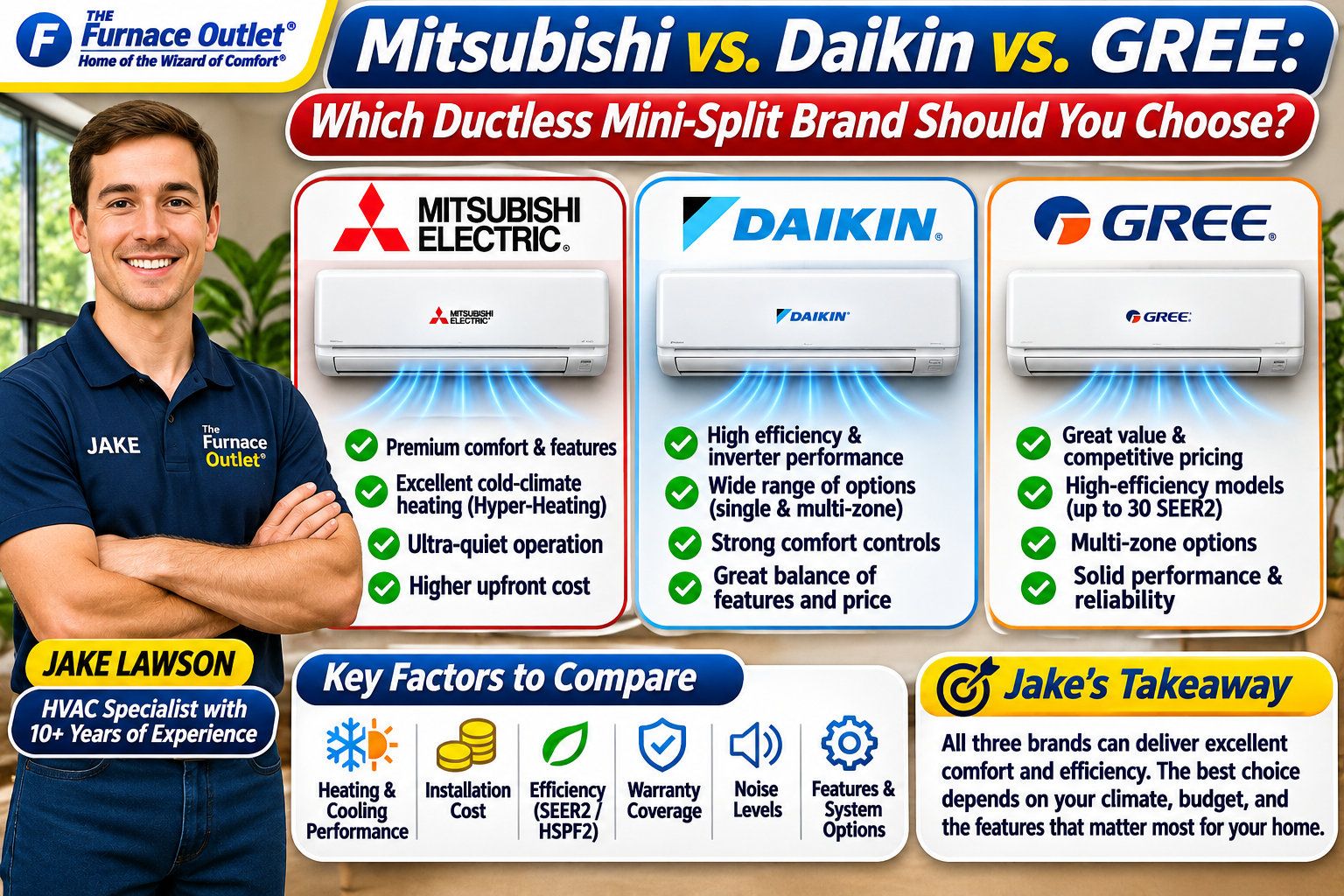
Mitsubishi Electric has established a strong position in the premium ductless heating and cooling market. Its residential product lineup includes wall-mounted indoor units, concealed ducted systems, multi-zone configurations, and advanced cold-climate heat pumps. The brand is particularly attractive to homeowners who prioritize comfort control, quiet operation, and dependable heating in colder regions.
Daikin is another major HVAC manufacturer with a broad range of residential and commercial products. Its ductless systems include compact single-zone solutions, multi-zone equipment, and premium inverter-driven configurations. Daikin appeals to homeowners seeking an established manufacturer with sophisticated comfort technology and a range of equipment options.
GREE competes strongly on equipment value while also offering advanced inverter technology and high-efficiency systems. Its lineup includes economical single-zone models, multi-zone systems, and cold-climate products designed to maintain heating performance at low outdoor temperatures. GREE should not be dismissed as merely a budget alternative because some of its premium models offer impressive published efficiency specifications.
The important distinction is that each brand sells multiple equipment tiers. Comparing a premium Mitsubishi system against an entry-level GREE unit tells you very little about how similarly equipped products would perform.
Mitsubishi Electric is particularly appealing when heating performance matters as much as cooling. Its Hyper-Heating INVERTER technology, commonly identified as H2i, is designed to maintain useful heating capacity at low outdoor temperatures.
Certain Mitsubishi cold-climate configurations are engineered to deliver full rated heating capacity at specified temperatures below freezing, with operating capabilities extending into extremely cold conditions. However, the exact heating output depends on the selected outdoor unit, indoor equipment, and outdoor temperature.
Mitsubishi also offers several indoor unit styles, including wall-mounted, floor-mounted, and concealed ducted configurations. This flexibility can be valuable when homeowners want efficient heating and cooling without placing a visible wall-mounted unit in every room.
The main drawback is cost. Mitsubishi equipment and installation can carry a premium, particularly when advanced cold-climate features, multiple zones, or specialized controls are involved. For homeowners in mild climates who mainly need supplemental cooling, that additional expense may not always be justified.
Daikin offers an appealing middle ground for homeowners who want advanced inverter technology without automatically choosing the most expensive available configuration. Its product lineup includes single-zone mini-splits, multi-zone systems, and specialized heat pump models for different climates.
One advantage of Daikin is its emphasis on variable-capacity operation. Instead of repeatedly turning the compressor on and off at full capacity, an inverter system can adjust its output as cooling or heating demand changes. This can improve temperature consistency and reduce unnecessary energy consumption under suitable conditions.
Daikin also offers premium comfort features on selected models, including advanced airflow control, quiet operating modes, and connected controls. Availability varies by equipment family, so homeowners should verify which features are included in the specific system being quoted.
Daikin can be a particularly good choice when a reputable local contractor specializes in the brand. As with Mitsubishi, the quality of installation and commissioning plays a major role in determining whether the equipment delivers its advertised performance.
GREE is often associated with lower equipment prices, but its current mini-split lineup includes considerably more than basic cooling systems. Models such as the Livo R32, Vireo R32, and Sapphire R32 serve different efficiency and performance requirements.
GREE’s published product information identifies Sapphire R32 configurations with efficiency ratings reaching up to 30 SEER2, although the exact rating depends on the matched system. The manufacturer also offers multi-zone equipment and specialized products designed for demanding heating conditions.
This makes GREE an attractive option for homeowners who want inverter-driven comfort while controlling the initial equipment budget. For a single bedroom, home office, garage conversion, or supplemental cooling project, a properly sized GREE system may provide excellent value.
The main consideration is local service support. Before buying, I would confirm that qualified technicians in your area regularly install and repair the particular GREE model and can obtain replacement parts when needed. A low purchase price loses some of its appeal if future repairs become difficult.
All three manufacturers offer high-efficiency ductless systems, and no brand should be declared the universal efficiency winner without comparing exact equipment combinations.
SEER2 measures seasonal cooling efficiency under standardized conditions, while HSPF2 measures seasonal heating efficiency. Higher ratings generally indicate better performance under the applicable test procedure, but they do not guarantee identical savings in every climate.
GREE’s premium Sapphire R32 lineup demonstrates that high efficiency is not exclusive to premium-priced brands. Mitsubishi and Daikin also offer highly efficient inverter systems, with performance varying across model families, capacities, and indoor-unit combinations.
When comparing quotations, I recommend asking for the AHRI-certified ratings of each proposed system. This provides a more meaningful comparison than advertising claims based on the highest-rated model in an entire product lineup.
Cold-weather performance is one of the most important considerations for homeowners planning to use a mini-split as their primary heating system.
Mitsubishi’s Hyper-Heating systems are especially worth considering in regions with prolonged freezing temperatures. Their low-temperature heating capabilities make them attractive for northern U.S. homes, although homeowners still need to verify the capacity available at their local winter design temperature.
Daikin also offers cold-climate heat pump configurations, but the minimum operating temperature and available heating capacity vary by model. Homeowners should examine the manufacturer’s extended-performance tables rather than assuming every Daikin mini-split provides the same winter heating capability.
GREE offers cold-climate products as well, including certain systems designed to operate at outdoor temperatures far below freezing. However, the ability to operate at a particular temperature does not mean the unit will deliver its full nominal heating capacity at that temperature.
For any of these brands, I would request a heating load calculation and a comparison of delivered BTUs at the home’s winter design temperature. That is the only dependable way to determine whether the proposed system can provide sufficient heating without excessive supplemental energy use.
One of the biggest advantages of ductless mini-splits is their ability to operate quietly, especially at reduced compressor and fan speeds. Mitsubishi, Daikin, and GREE all offer models designed for low indoor sound levels.
However, published noise ratings depend on the model, fan speed, and testing conditions. A manufacturer’s lowest advertised decibel figure may represent operation at minimum fan speed rather than maximum cooling output.
For bedrooms, nurseries, and home offices, I recommend comparing indoor sound-pressure ratings at multiple fan settings. Outdoor-unit noise should also be considered, particularly when equipment will be installed near a bedroom window, patio, or neighboring property.
A correctly installed unit with adequate mounting support, proper refrigerant piping, and appropriate vibration isolation can also help minimize unwanted noise.
For a typical U.S. single-zone installation, homeowners might encounter broad planning costs of approximately $3,500–$7,500 for Mitsubishi, $3,000–$7,000 for Daikin, and $2,500–$6,000 for GREE. These are illustrative installed-price ranges, not verified national averages or current dealer quotations.
Actual pricing can fall outside these ranges depending on capacity, efficiency, installation complexity, electrical upgrades, refrigerant line length, local labor rates, and equipment availability.
Multi-zone installations can cost substantially more because they involve multiple indoor units, longer refrigerant piping, additional condensate management, and more complex commissioning.
I would never compare an equipment-only online price with a professionally installed quotation. A complete estimate should include mounting hardware, line sets, electrical connections, condensate drainage, pressure testing, evacuation, startup procedures, and applicable permits.
Mitsubishi, Daikin, and GREE all manufacture systems that can deliver dependable service when properly selected, installed, and maintained. However, there is no reliable basis for claiming that every model from one manufacturer will outlast every model from another.
Mini-split reliability depends heavily on installation quality. Improper refrigerant charging, poor flare connections, inadequate condensate drainage, and incorrect electrical installation can cause problems regardless of equipment brand.
Maintenance is equally important. Dirty indoor filters, restricted outdoor coils, blocked condensate drains, and neglected electrical connections can reduce performance and increase the likelihood of breakdowns.
For long-term ownership, I recommend choosing a contractor who understands the equipment and can provide routine maintenance and future repairs. A strong local service relationship can be more valuable than a small difference in advertised efficiency.
Warranty terms vary by manufacturer, product family, registration status, installation requirements, and location. Some Mitsubishi residential systems qualify for extended coverage when installed through eligible contractor programs, while Daikin offers different warranty arrangements across its product lines.
GREE also provides limited warranties, but coverage varies by model and product generation. Certain published GREE R32 equipment specifications identify five-year parts and seven-year compressor coverage, illustrating why homeowners should not assume that every GREE system automatically includes a ten-year parts warranty.
Before purchasing, obtain the actual warranty certificate for the proposed equipment. Confirm parts coverage, compressor coverage, registration deadlines, labor exclusions, and whether installation by a particular contractor is required for extended protection.
A long parts warranty can be valuable, but it does not necessarily cover labor, refrigerant, diagnostic visits, or other service expenses.
For a bedroom, home office, or other single-room application, all three brands offer suitable equipment. The best choice depends on the room’s cooling and heating load, noise requirements, and available budget.
GREE may be particularly attractive when the homeowner wants efficient cooling at a competitive installed price. Daikin can be a strong choice when a local installer offers a well-matched system with good service support. Mitsubishi becomes especially appealing when premium comfort, quiet operation, or cold-weather heating performance is a priority.
Rather than automatically purchasing a 12,000 BTU unit for every bedroom, I recommend calculating the actual load. An oversized mini-split may operate inefficiently at low loads or provide less effective humidity control than a correctly sized system.
Whole-home applications require more careful planning because equipment configuration becomes just as important as brand selection.
Mitsubishi offers ducted and ductless solutions that can serve multiple rooms, making it attractive for comprehensive heating and cooling upgrades. Daikin also provides multi-zone configurations and a variety of indoor equipment options.
GREE offers multi-zone systems capable of serving several indoor units, which can make it a cost-effective option for homeowners seeking independent temperature control across different rooms.
However, a multi-zone system is not automatically the most efficient solution. Multiple smaller single-zone systems can sometimes offer better part-load performance and operational flexibility. The correct design depends on building layout, simultaneous heating and cooling needs, and the minimum capacity of the proposed equipment.
Is Mitsubishi better than Daikin for mini-splits?
Mitsubishi may be preferable for homeowners prioritizing certain premium comfort features or specific cold-climate configurations. Daikin can offer comparable practical value when its equipment matches the home’s requirements and a qualified local installer provides strong support. The better choice depends on the exact models, installation quality, and total project cost.
Are GREE mini-splits reliable enough for everyday use?
GREE manufactures residential mini-splits designed for regular heating and cooling operation, including high-efficiency and cold-climate models. Reliability depends on the selected equipment, correct installation, maintenance, and local service availability. Homeowners should verify warranty terms and replacement-parts support before purchasing.
Which mini-split brand is best for very cold climates?
Mitsubishi Hyper-Heating is a strong candidate, but selected Daikin and GREE cold-climate models also deserve consideration. Compare published heating capacity at your area’s winter design temperature rather than relying only on minimum operating temperature claims.
Is it worth paying more for Mitsubishi or Daikin?
Paying more may make sense when the higher-priced system provides measurable benefits in cold-weather output, comfort, noise control, efficiency, or service support. If a properly installed GREE system meets the same requirements at a significantly lower total cost, it may offer better financial value.
If I were selecting a mini-split for a home with demanding winter heating requirements, Mitsubishi would be one of my first brands to evaluate. Its specialized cold-climate equipment and range of indoor configurations make it particularly appealing for homeowners planning to rely heavily on a heat pump.
Daikin would be a strong contender for homeowners seeking balanced efficiency, inverter comfort, and access to a reputable local installation network. I would compare its specific equipment specifications and contractor quotation directly against Mitsubishi rather than assuming one brand automatically performs better.
For homeowners focused on controlling upfront costs, I would give GREE serious consideration. Its modern inverter systems and high-efficiency models can deliver compelling value, provided that local installation and service support are dependable.
Ultimately, the best mini-split is not determined by the manufacturer’s name alone. Correct sizing, certified performance, proper installation, warranty protection, and reliable service are what turn a good piece of equipment into a comfortable, long-lasting investment.
This article provides general educational guidance about ductless mini-split selection and comparison. Prices, efficiency ratings, heating capacity, warranties, and product availability vary by model, configuration, region, and installation requirements. Consult qualified HVAC professionals and current manufacturer documentation before purchasing or installing equipment.